
I INTRODUCTION TO ACCOUNTING MEANING AND OBJECTIVES OF
I. INTRODUCTION TO ACCOUNTING MEANING AND OBJECTIVES OF ACCOUNTING INFORMATION
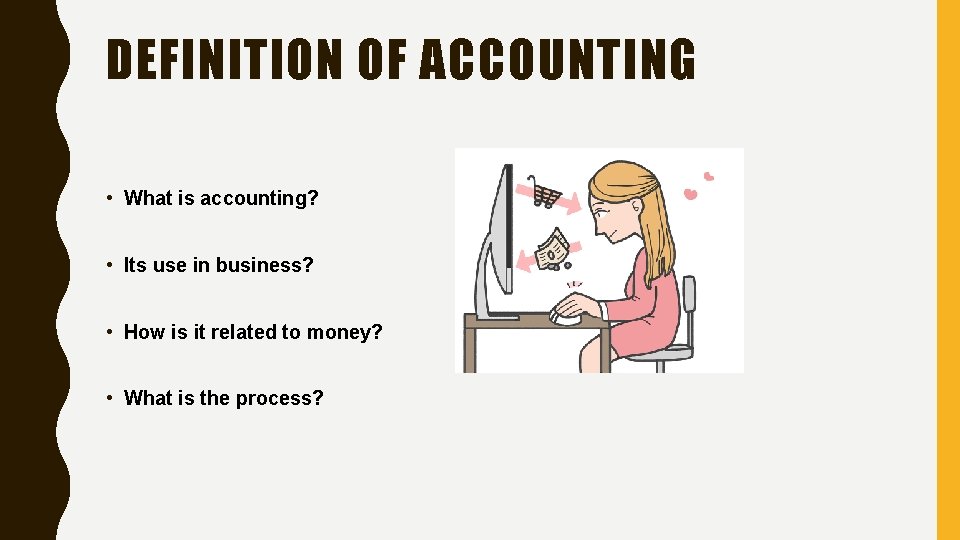
DEFINITION OF ACCOUNTING • What is accounting? • Its use in business? • How is it related to money? • What is the process?
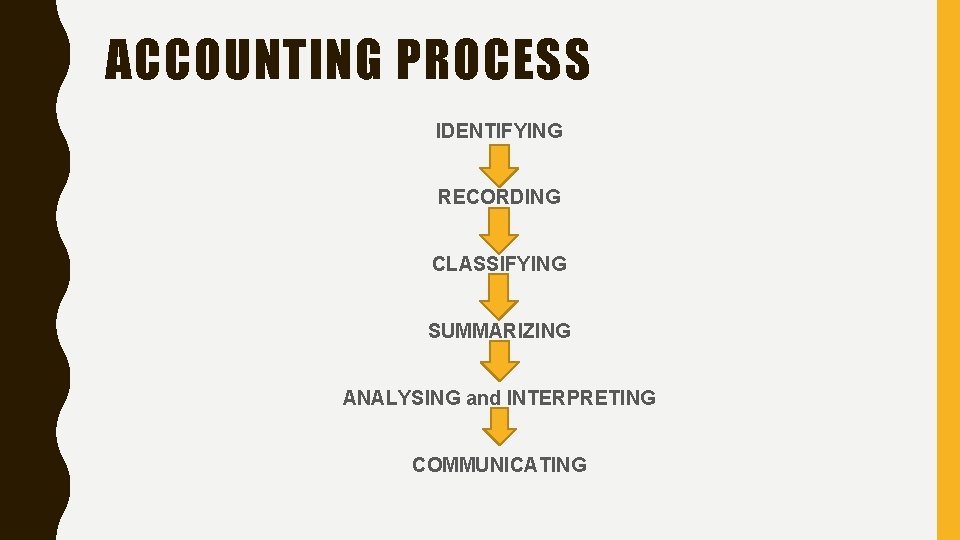
Accounting is the ART of • IDENTIFYING, • MEASURING, • RECORDING, • CLASSIFYING, • SUMMARISING , • INTERPRETING and • COMMUNICATING financial information.

LET’S THINK THROUGH AN EXAMPLE KEEP A RECORD OF EACH AND EVERY ACTIVITY IN YOUR BUSINESS WHICH INVOLVES MONEY
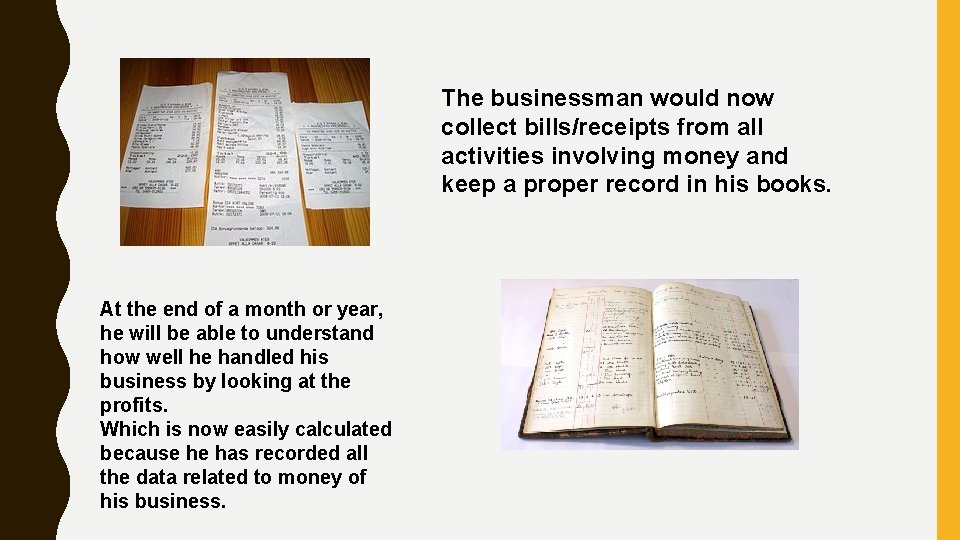
The businessman would now collect bills/receipts from all activities involving money and keep a proper record in his books. At the end of a month or year, he will be able to understand how well he handled his business by looking at the profits. Which is now easily calculated because he has recorded all the data related to money of his business.
ACCOUNTING THEREFORE GIVES INFORMATION ON: a. THE RESOURCES AVAILABLE b. HOW THE AVAILABLE RESOURCES HAVE BEEN EMPLOYED; AND c. THE RESULTS ACHIEVED BY THEIR USE.
CHARACTERISTICS OF ACCOUNTING • Identification of Financial transactions and events which can be measured in terms of money (economic activity), like purchasing raw materials, sale of goods etc. • Measuring the identified transactions in terms of money. (an event which cannot be measured in terms of money cannot be recorded in the books of accounts) • Recording - the transactions identified are recorded in the books of accounts i. e. Journal. • Classifying - process of grouping transactions or entries of one nature at one place. E. G. all events related to SALES will be recorded in Sales A/C. • Summarising – presenting the data in a simplified form for reference by outsiders. In Trial balance, Profit and Loss Account and Balance sheet (FINAL A/Cs) • Analysis and Interpretation – carried out so that users of financial data can make meaningful judgement of the position of the business. • Communicating- communicating the financial data toits users so that appropriate decisions can be made.
IS ACCOUNTING AN ART OR SCIENCE? ART SCIENCE • Art is a technique which helps us to achieve desired objectives. • Any organised knowledge based on certain basic principles is a science. • Accounting is an art of recording, classifying and summarising financial transactions. • Accounting is also a science because it is an organised knowledge based on certain basic principles. THUS, ACCOUNTING IS BOTH AN ART AND SCIENCE.
OBJECTIVES OF ACCOUNTING 1. Maintaining accounting records – in a systematic manner 2. Determining Profit or Loss – to know whether the firm has earned a profit or incurred a loss. This is known by preparing Income statement or Trading and Profit and Loss account. 3. Determining Financial Position – known from Balance Sheet. 4. Facilitating Management –management needs this information for decision-making, effective control, budgeting and forecasting. 5. Providing accounting information to users – users, both internal and external need financial information for analysing the firm’s performance. 6. Protecting Business assets – by recording the assets (cash, bank balance, building, land) of the business, so that the management can
FUNCTIONS OF ACCOUNTING • Maintaining Systematic Accounting Records- the primary function of accounting is to maintain systematic record of all financial transactions and events, following the accounting rules and principles. • Preparation of Financial Statements- They are the final accounts prepared at the end of an accounting year. It includes Trading and Profit and Loss account and Balance Sheet. Both statements are important for decision-making. • Meeting Legal Requirements- Accounting records can be used as an evidence in the court of Law. Submitting accounting records is important for Income tax Act, Companies Act etc. • Communicating Financial Information- the financial users maybe internal users like management and employees, or external users like Government, public etc. • Assistance to Management – Management requires financial information for help in decision making and protecting its assets and exercising control.
ADVANTAGES OF ACCOUNTING 1. Financial Performance of the business 2. Assistance to Management 3. Replaces Memory 4. Facilitates Comparative study- by comparing profits of this year and past years. 5. Facilitates loans- loans are provided by banks based on the company’s performance. 6. Evidence in court 7. Helps in Decision-making 8. Helps in sale of Business
LIMITATIONS OF ACCOUNTING • Accounting is not fully exact- Inspite of recording all transactions based on evidences(bills, receipts), some estimates may have to be made like the useful life of the assets etc. • Unrealistic Information- Accounting information may be unrealistic, because statements are prepared following accounting principles which maynot be followed properly. • Accounting ignores Qualitative Elements- it is confined to monetary matters only, and ignores qualities like honesty, sincerity and hard work. • Accounting may lead to Window dressing- window dressing means manipulation of accounts to conceal vital facts and present financial statements to show a better position than what actually is. It may deceive the govt. as well as public.
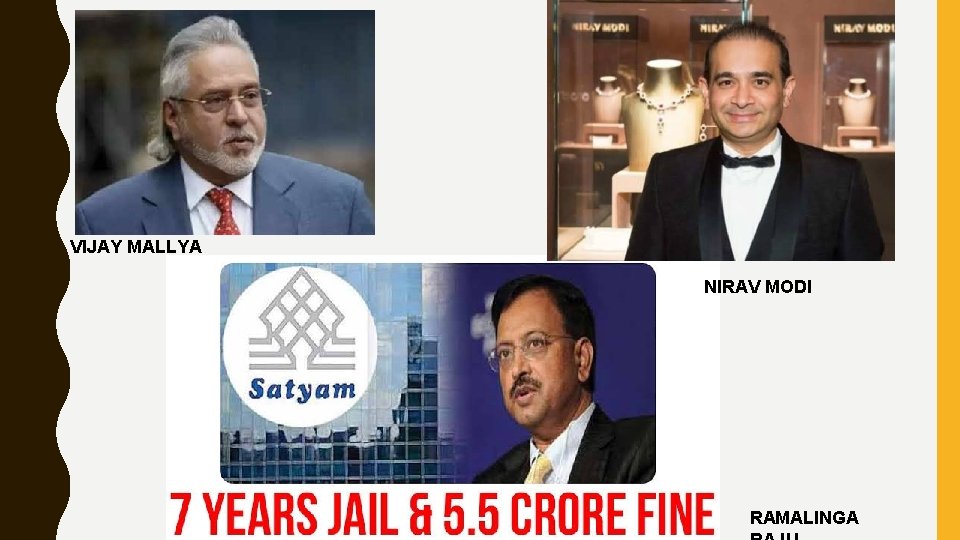
VIJAY MALLYA NIRAV MODI RAMALINGA
USERS OF ACCOUNTING INFORMATION • Users of Accounting information can be categorised into 1. INTERNAL USERS and 2. EXTERNAL USERS
INTERNAL USERS 1. OWNERS- owners contribute capital (money) in the business and thus are exposed to maximum risk. Therefore they are interested to know if the firm has earned a profit or incurred a loss. 2. MANAGEMENT- the management makes use of accounting information to make decisions like determining selling price of goods, whether to invest in new projects etc. 3. EMPLOYEES AND WORKERS- employees get salary and also bonus during occasions, which is linked to company’s earnings. Therefore they are interested in the financial information of the business.
EXTERNAL USERS 1. BANKS AND FINANCIAL INSTITUTIONS- banks are important for any business as they provide loans to businesses. So banks need accounting information of the company to ensure safety of their money and recovery of the loan. 2. INVESTORS- those who invest money in the business may/maynot have direct control over the business. But they are interested in accounting information to know if their investment is safe and will they get higher returns. 3. CREDITORS- creditors are parties who supply goods/ services on credit. Before granting credit, creditors must satisfy themselves about the credit-worthiness of the business and accounting information helps the to decide. 4. GOVERNMENT- the government requires accounting information to study the position or success of an industry, to take policy decisions, and to check if income tax, GST etc are being paid properly. 5. RESEARCHERS- for research work 6. CONSUMERS- consumers need accounting information to keep a check on rising prices of goods and services. 7. PUBLIC- they want to know the financial information because a lot of aspects might affect
ACCOUNTING PROCESS IDENTIFYING RECORDING CLASSIFYING SUMMARIZING ANALYSING and INTERPRETING COMMUNICATING
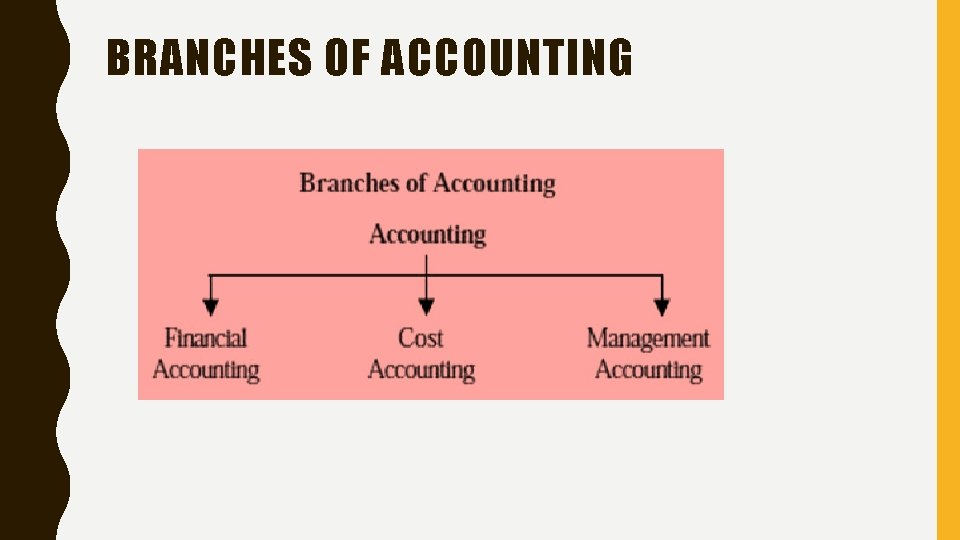
BRANCHES OF ACCOUNTING
FINANCIAL ACCOUNTING • It is that branch of accounting which records financial transactions and events, summarises and interprets them before communicating the results to the users. • It is confined to preparation of financial statements i. e. Profit and Loss Account and The Balance Sheet.
COST ACCOUNTING • This branch is concerned with ascertaining cost of products, operations or activities. • This branch deals with recording costs with the objective of ascertaining, reducing and controlling costs.
MANAGEMENT ACCOUNTING • The most recently developed branch • It is concerned with generating accounting information relating to funds, cost, profits etc. as it helps management in decisionmaking.
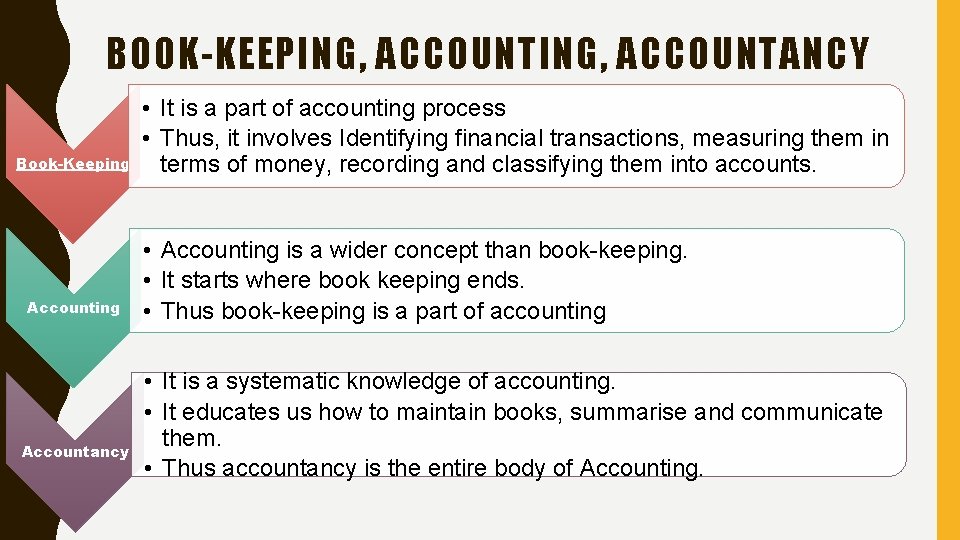
BOOK-KEEPING, ACCOUNTANCY Book-Keeping Accountancy • It is a part of accounting process • Thus, it involves Identifying financial transactions, measuring them in terms of money, recording and classifying them into accounts. • Accounting is a wider concept than book-keeping. • It starts where book keeping ends. • Thus book-keeping is a part of accounting • It is a systematic knowledge of accounting. • It educates us how to maintain books, summarise and communicate them. • Thus accountancy is the entire body of Accounting.
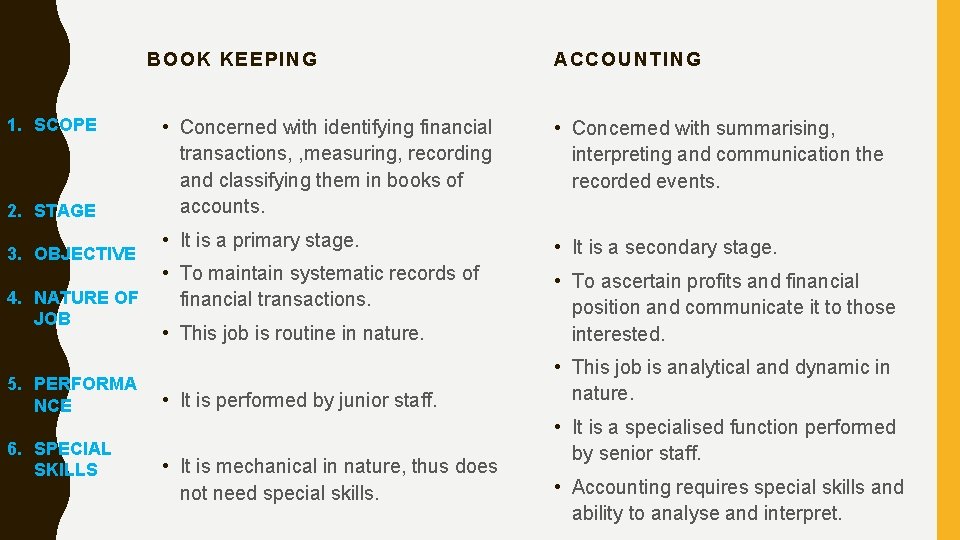
BOOK KEEPING 1. SCOPE 2. STAGE 3. OBJECTIVE 4. NATURE OF JOB 5. PERFORMA NCE 6. SPECIAL SKILLS ACCOUNTING • Concerned with identifying financial transactions, , measuring, recording and classifying them in books of accounts. • Concerned with summarising, interpreting and communication the recorded events. • It is a primary stage. • It is a secondary stage. • To maintain systematic records of financial transactions. • This job is routine in nature. • To ascertain profits and financial position and communicate it to those interested. • It is performed by junior staff. • This job is analytical and dynamic in nature. • It is mechanical in nature, thus does not need special skills. • It is a specialised function performed by senior staff. • Accounting requires special skills and ability to analyse and interpret.
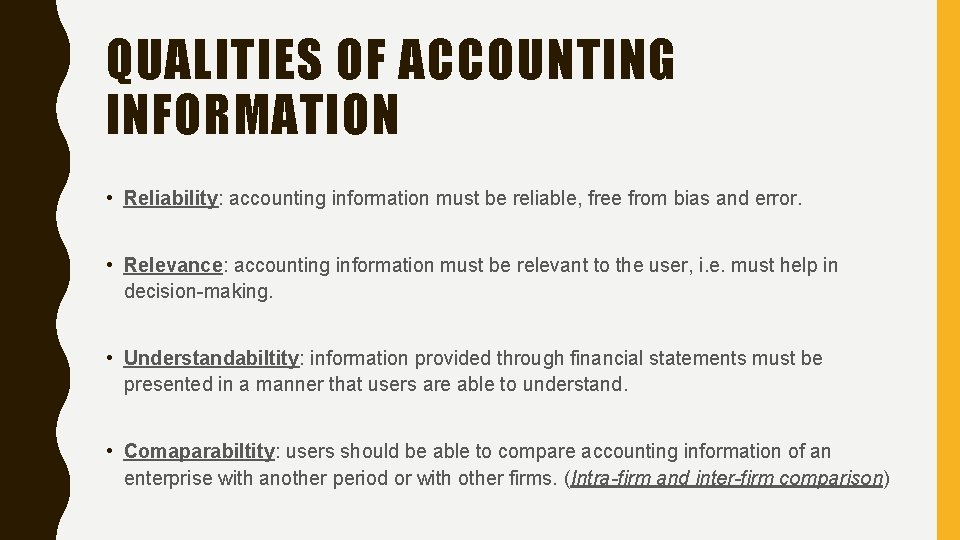
QUALITIES OF ACCOUNTING INFORMATION • Reliability: accounting information must be reliable, free from bias and error. • Relevance: accounting information must be relevant to the user, i. e. must help in decision-making. • Understandabiltity: information provided through financial statements must be presented in a manner that users are able to understand. • Comaparabiltity: users should be able to compare accounting information of an enterprise with another period or with other firms. (Intra-firm and inter-firm comparison)
- Slides: 24