
I Intro to Kinematics Motion in One Dimension
- Slides: 23
I: Intro to Kinematics: Motion in One Dimension AP Physics C Mrs. Coyle
n n n n Particle Model Position Vector Displacement, distance Average Velocity, Average Speed Instantaneous Velocity, Instantaneous Speed Intro to the Derivative. Graphical Analysis (position vs time) Uniform Linear Motion
Video Clip of Oil Spill in Gulf n http: //www. youtube. com/watch? v=_2 EXDmn NPw 0
Motion n n Motion is relative Origin Position is compared to an origin Coordinate system or a reference frame
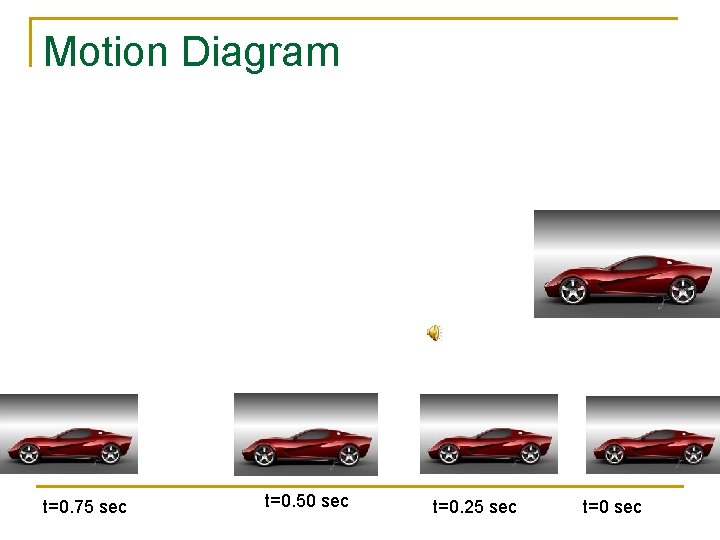
Motion Diagram t=0. 75 sec t=0. 50 sec t=0. 25 sec t=0 sec
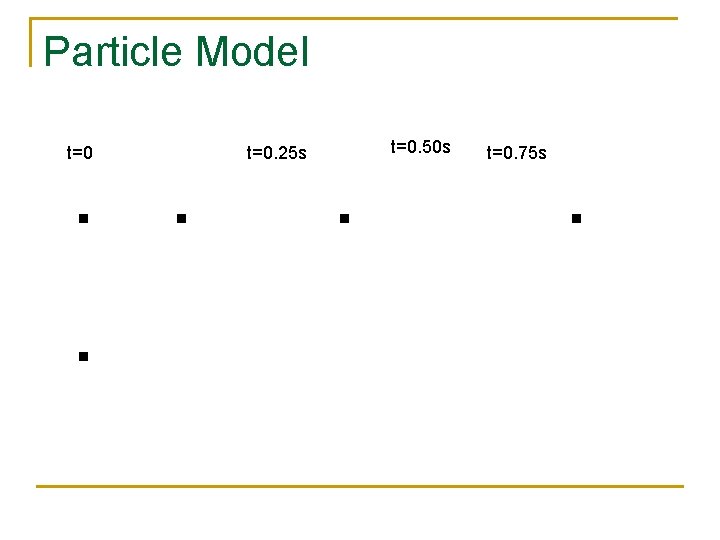
Particle Model . . . t=0. 25 s . t=0. 50 s t=0. 75 s .
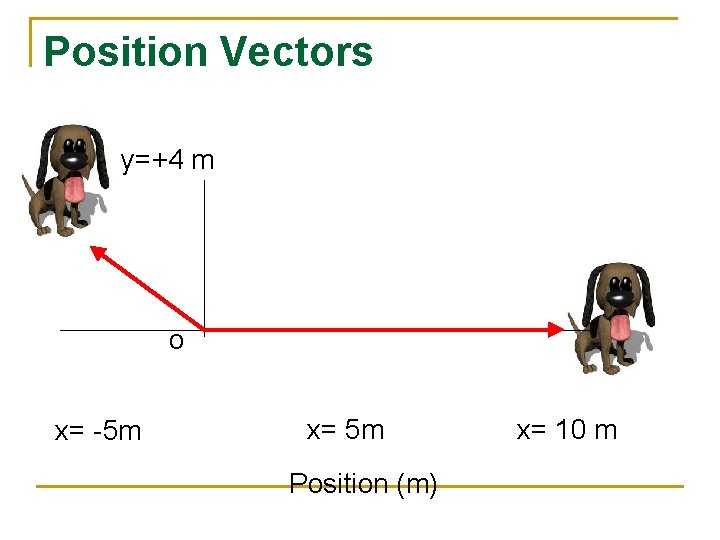
Position Vectors y=+4 m o x= -5 m x= 5 m Position (m) x= 10 m
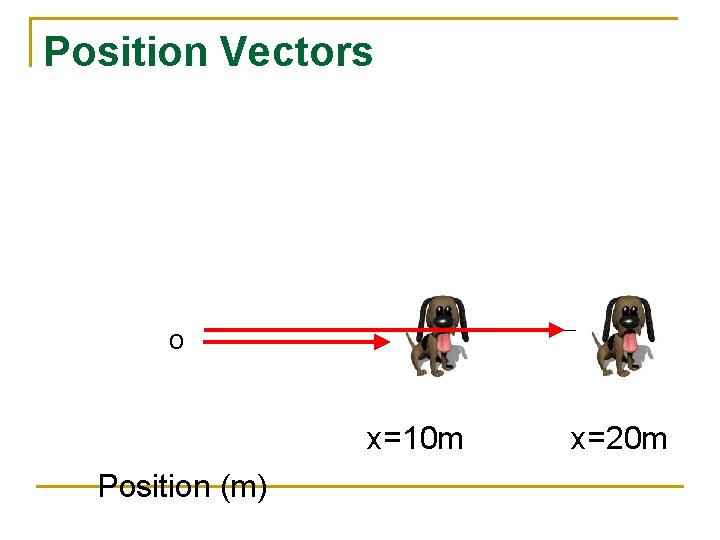
Position Vectors o x=10 m Position (m) x=20 m
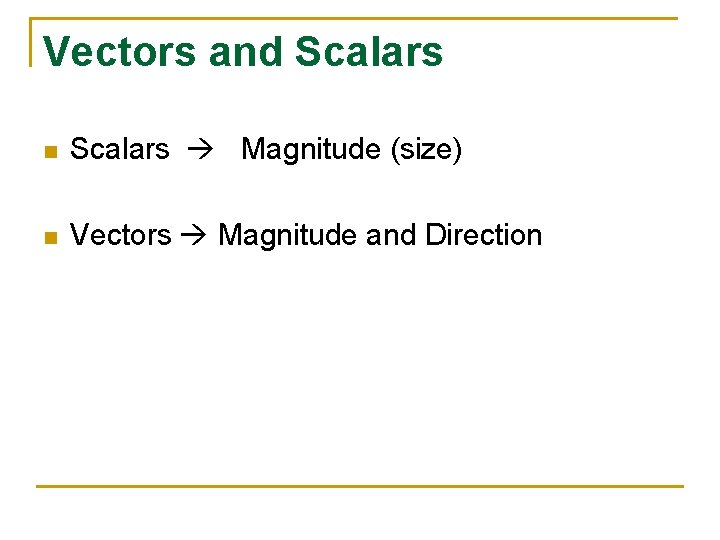
Vectors and Scalars n Scalars Magnitude (size) n Vectors Magnitude and Direction
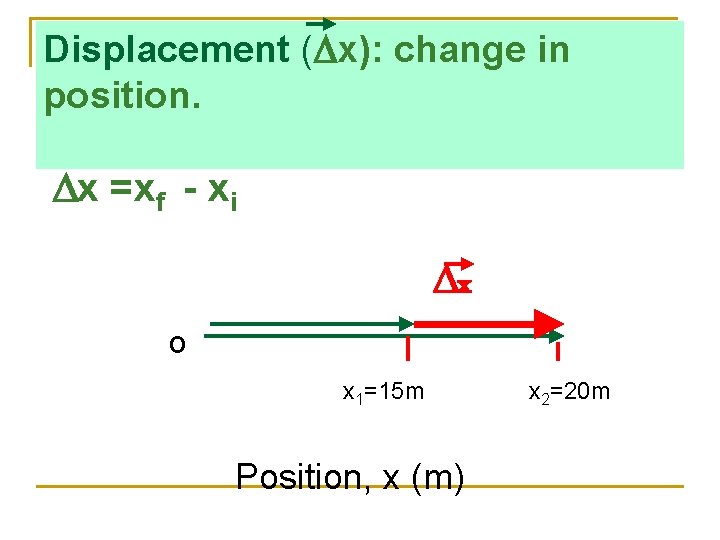
Displacement (Dx): change in position. Dx =xf - xi Dx o x 1=15 m Position, x (m) x 2=20 m
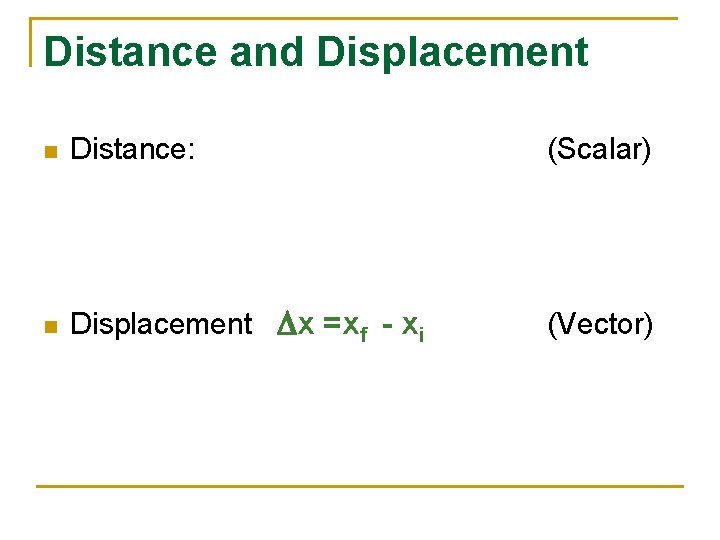
Distance and Displacement n Distance: (Scalar) n Displacement Dx =xf - xi (Vector)
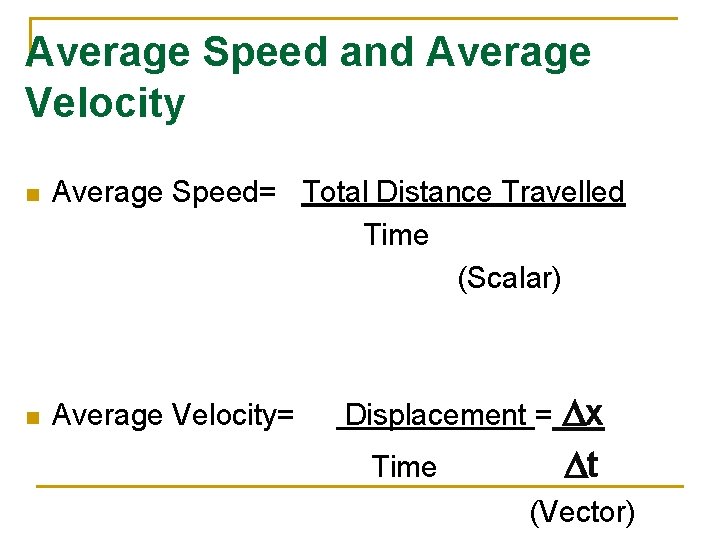
Average Speed and Average Velocity n Average Speed= Total Distance Travelled Time (Scalar) n Average Velocity= Displacement = Time Dx Dt (Vector)
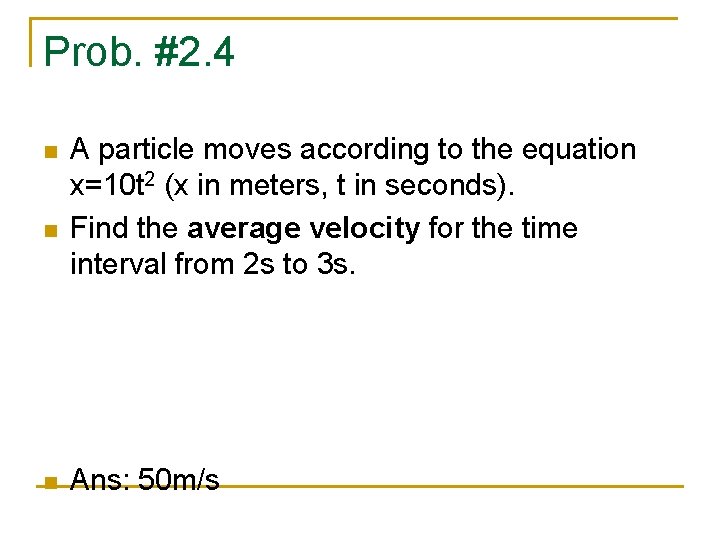
Prob. #2. 4 n n n A particle moves according to the equation x=10 t 2 (x in meters, t in seconds). Find the average velocity for the time interval from 2 s to 3 s. Ans: 50 m/s
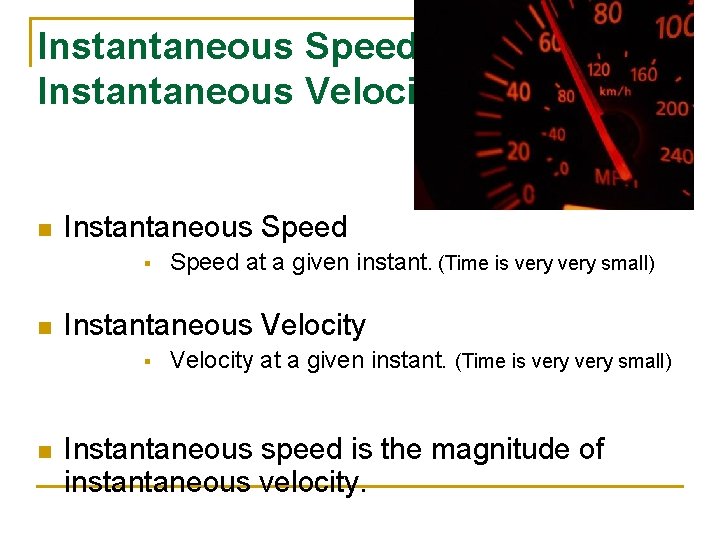
Instantaneous Speed Instantaneous Velocity n Instantaneous Speed § n Instantaneous Velocity § n Speed at a given instant. (Time is very small) Velocity at a given instant. (Time is very small) Instantaneous speed is the magnitude of instantaneous velocity.
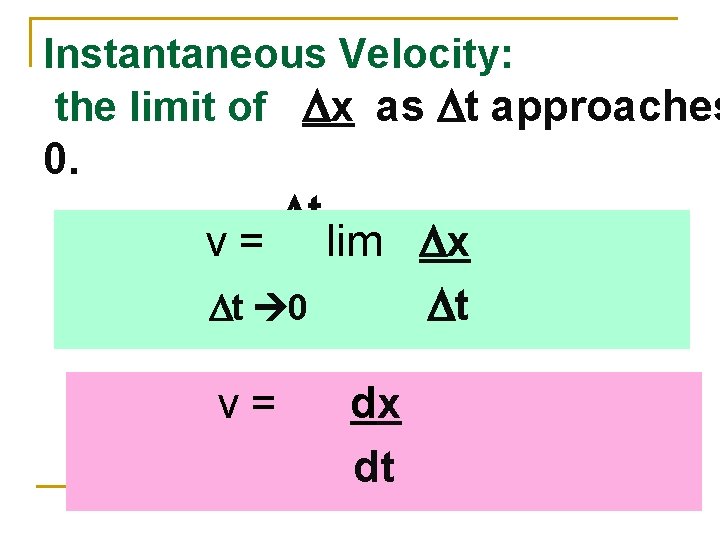
Instantaneous Velocity: the limit of Dx as Dt approaches 0. Dt v = lim Dx Dt Dt 0 v= dx dt
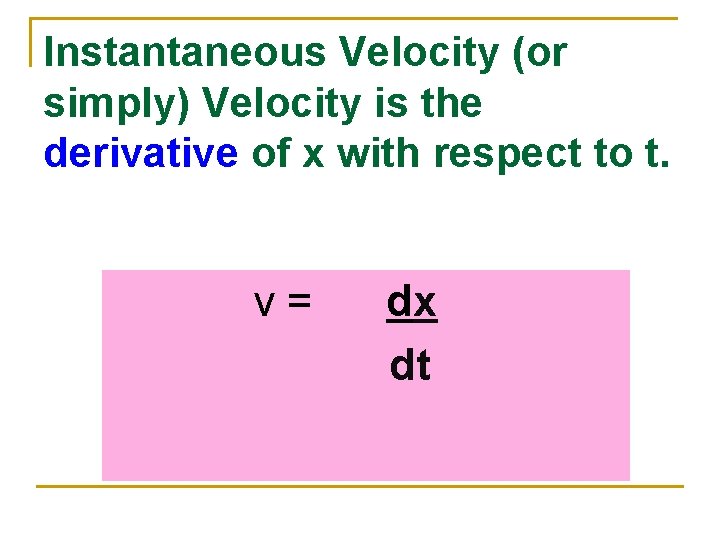
Instantaneous Velocity (or simply) Velocity is the derivative of x with respect to t. v= dx dt
Instantaneous Velocity n Instantaneous speed is the magnitude of instantaneous velocity.
Graphical Analysis of Motion n Position vs Time Velocity vs Time Acceleration vs Time
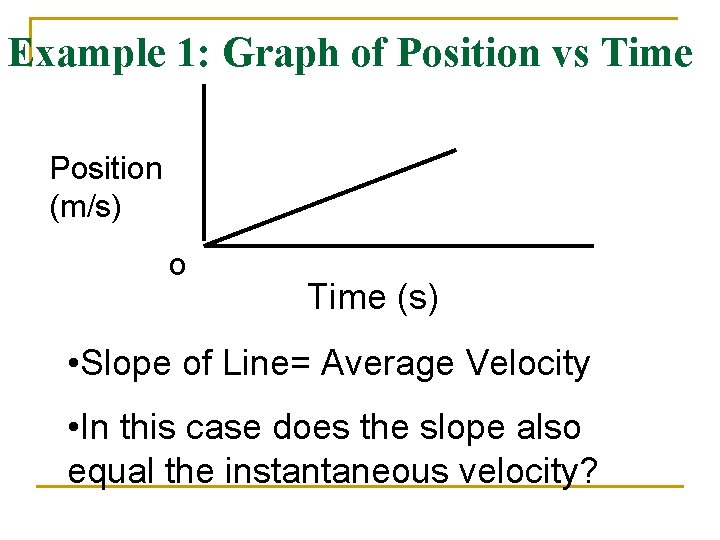
Example 1: Graph of Position vs Time Position (m/s) o Time (s) • Slope of Line= Average Velocity • In this case does the slope also equal the instantaneous velocity?
Uniform Linear Motion n Motion with constant velocity q Straight line q Same direction
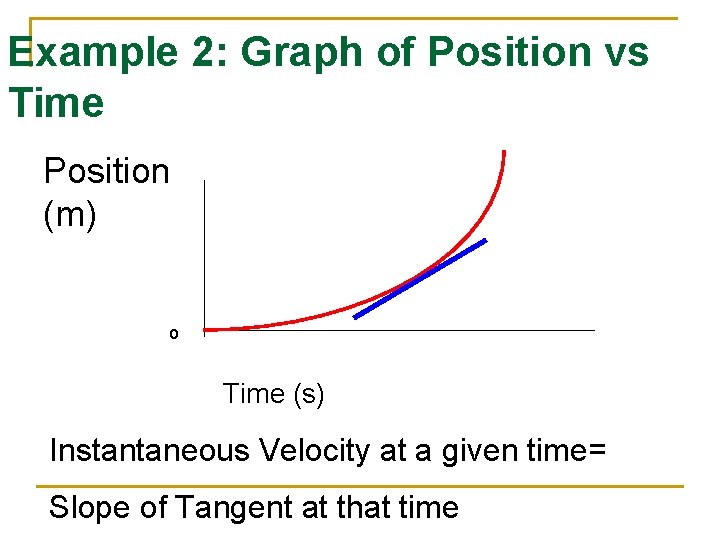
Example 2: Graph of Position vs Time Position (m) o Time (s) Instantaneous Velocity at a given time= Slope of Tangent at that time
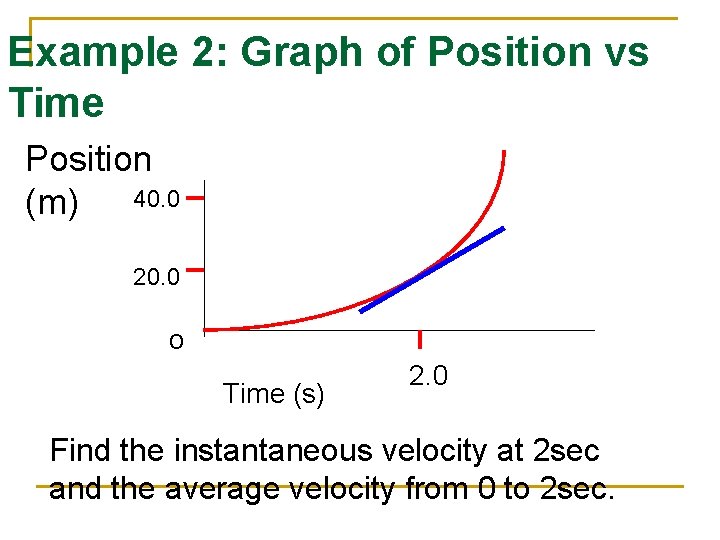
Example 2: Graph of Position vs Time Position 40. 0 (m) 20. 0 o Time (s) 2. 0 Find the instantaneous velocity at 2 sec and the average velocity from 0 to 2 sec.
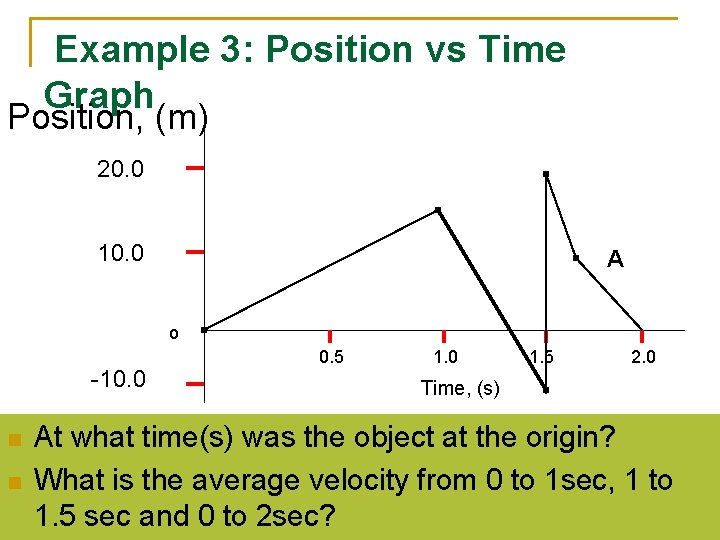
Example 3: Position vs Time Graph Position, (m) 20. 0 10. 0 A o -10. 0 n n 0. 5 1. 0 1. 5 2. 0 Time, (s) At what time(s) was the object at the origin? What is the average velocity from 0 to 1 sec, 1 to 1. 5 sec and 0 to 2 sec?