
I Heredity Genetics o The passing of traits
- Slides: 21
I. Heredity & Genetics o The passing of traits from parent to offspring o Traits are controlled by genes, genes so therefore, GENETICS is the study of how traits are inherited through the action of alleles
II. ALLELES o Are ONE FORM of a gene (there can be more than one form) o Sex cells have one form of a gene on their chromosomes o Body cells have two forms or ALLELES for a single gene (you got one from Mom and one from Dad) o One may be dominant over another. If this happens, the dominant gene is the one expressed. If not, the recessive trait is expressed.
III. DOMINANT AND RECESSIVE o A Dominant trait will always be expressed and will “mask” mask a recessive trait o A recessive trait can only be expressed if there are no dominant alleles present.
o Example: Example Eye color—Brown color is dominant and blue is recessive. A person can have a brown allele and a blue allele but still have brown eyes because the brown allele is dominant and “hides” hides the blue allele.
Generally, dominant alleles are represented with a capital letter, and recessive alleles are represented with a lowercase letter. Example: R= dominant r = recessive
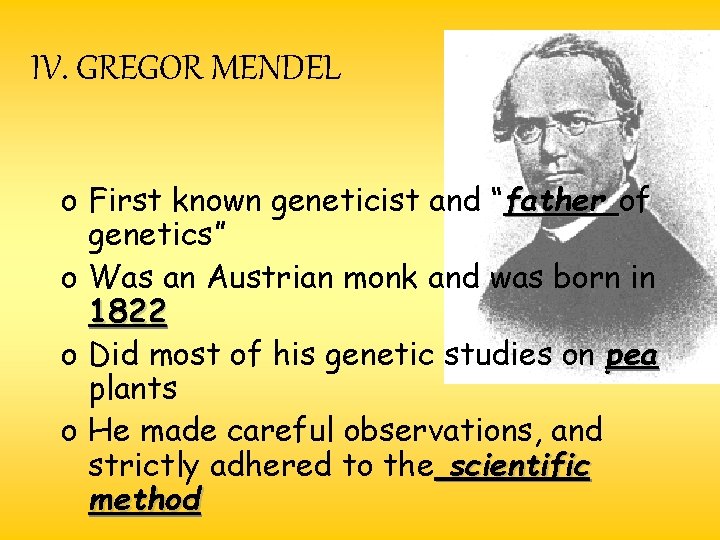
IV. GREGOR MENDEL o First known geneticist and “father of genetics” o Was an Austrian monk and was born in 1822 o Did most of his genetic studies on pea plants o He made careful observations, and strictly adhered to the scientific method
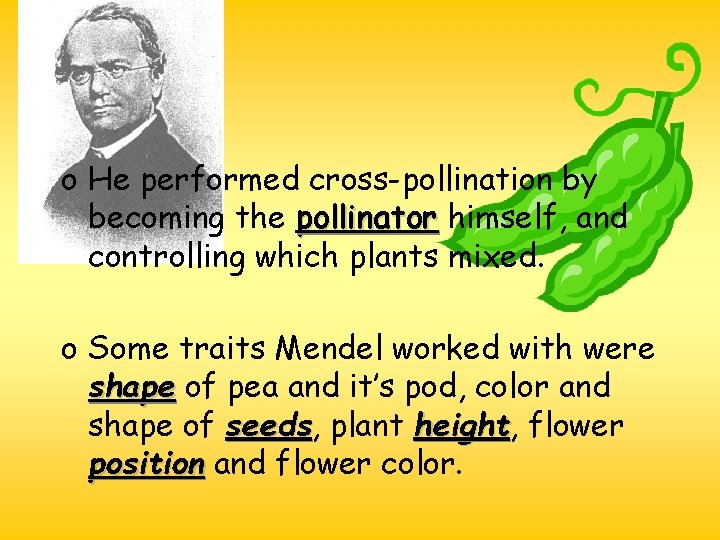
o He performed cross-pollination by becoming the pollinator himself, and controlling which plants mixed. o Some traits Mendel worked with were shape of pea and it’s pod, color and shape of seeds, seeds plant height, height flower position and flower color.
V. PROBABILITY o Helps predict the chance that something will happen o Example: the probability of throwing heads or tails on a coin is 50% (1/2 chances) o Your predictions become more accurate with the more trials you run!
Why is it that if a couple has 2 children, they don’t always have one boy and one girl? 2 is a really small sample #…so won’t always “see” the ratio!
VI. Using a Punnett Square o Used to help predict Mendelian genetics o In Punnett squares, dominant traits are represented with a CAPITAL letter, and recessive traits represented by a LOWER CASE letter. Take for instance, eye color. Choose to represent eye color with the letter b. Big B or “B” for dominant and little b or “b” for recessive. o Each organism is represented by TWO letters, one for each allele.
o “Purebred” species have two alleles of the same trait, and therefore would be represented by two of the same letters. This is called homozygous For instance: BB or bb. o Species with two different alleles or two different forms of the gene would have two different “letters” letters and by called “heterozygous”. For instance: Bb o The alleles present in the organism are referred to as its genotype For instance, BB, Bb, or bb.
o The PHYSICAL trait that shows, regardless of genotype is called a PHENOTYPE o For instance, Blue or Brown Eyes.
Steps for using the Punnett square: 1) One parent’s alleles (genotype) go along the top 2) The other parent’s alleles go down the side. 3) You fill in the squares like doing the communicative property of multiplication. 4) See Below:
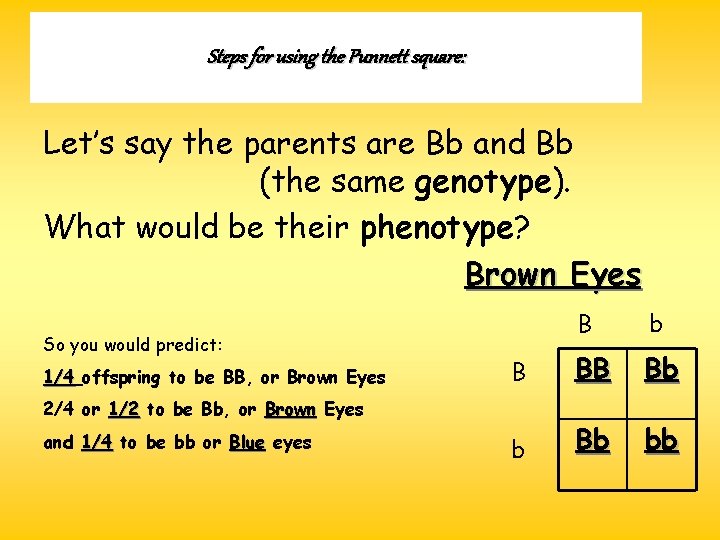
Steps for using the Punnett square: Let’s say the parents are Bb and Bb (the same genotype). What would be their phenotype? Brown Eyes So you would predict: 1/4 offspring to be BB, or Brown Eyes B b B BB Bb bb 2/4 or 1/2 to be Bb, or Brown Eyes and 1/4 to be bb or Blue eyes
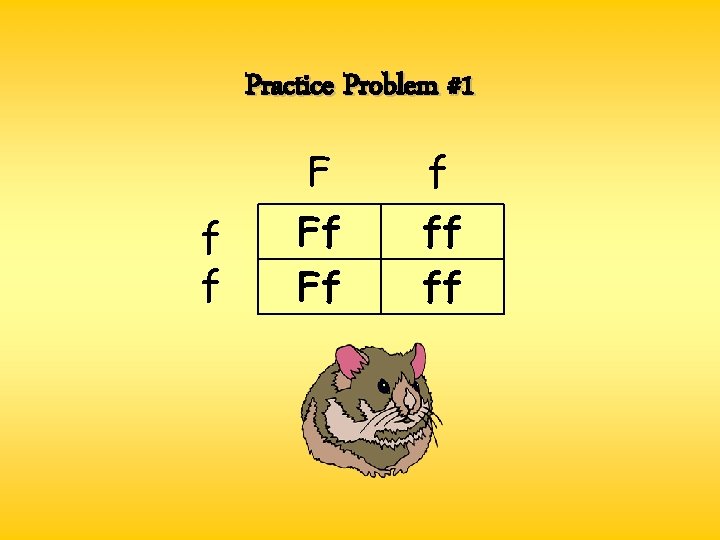
Practice Problem #1 • Predict the fur color of the offspring of a white heterozygous hamsters and a brown homozygous hamster. White is dominant. Brown is recessive. • Use any letter you like.
Practice Problem #1 f f F Ff Ff f ff ff
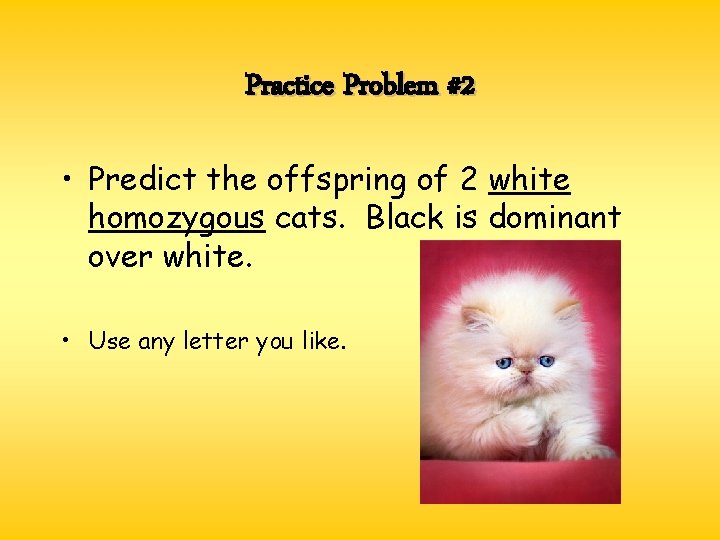
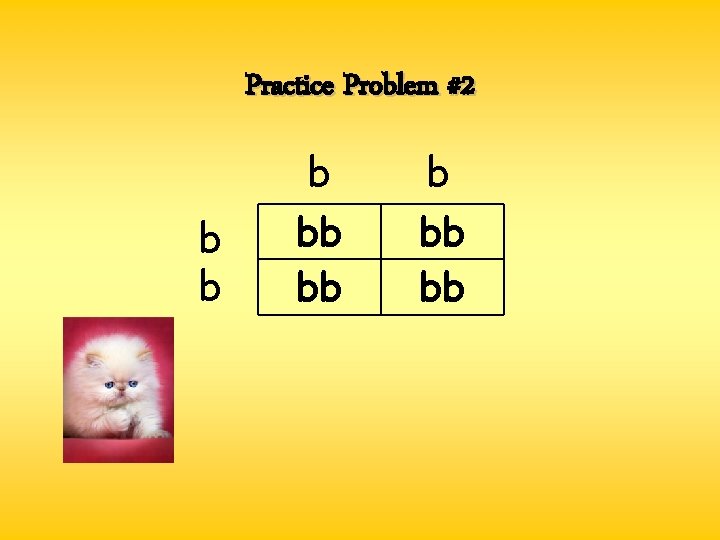
Practice Problem #2 • Predict the offspring of 2 white homozygous cats. Black is dominant over white. • Use any letter you like.
Practice Problem #2 b bb bb bb
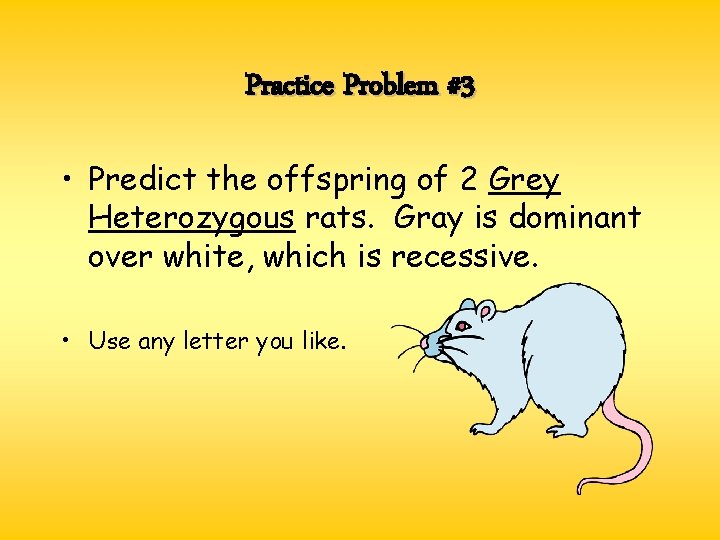
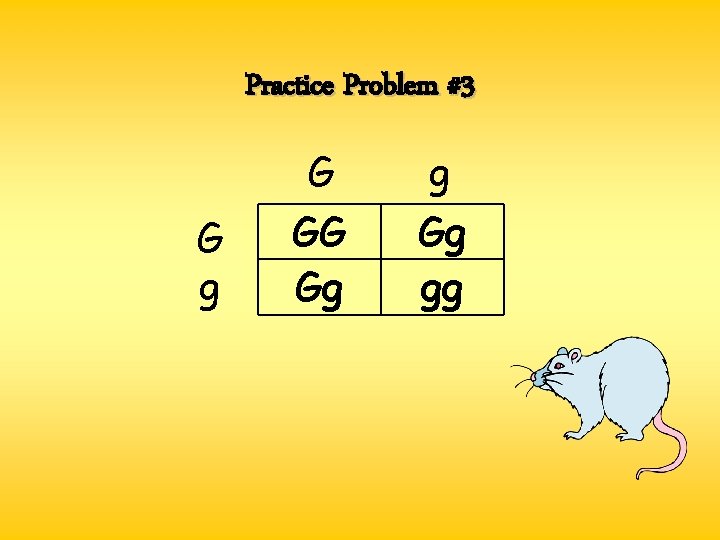
Practice Problem #3 • Predict the offspring of 2 Grey Heterozygous rats. Gray is dominant over white, which is recessive. • Use any letter you like.
Practice Problem #3 G g G GG Gg gg