
i Comp Research overview Murat Demirbas University at
i. Comp Research overview Murat Demirbas University at Buffalo, SUNY CSE Dept.
Personal computing ? • PC processors are only 2% of all processors • Where do the rest of the processors go? � Automotive industry, e. g. , new car has dozens of microprocessors � Communications, e. g. , cell-phones � Consumer electronics, e. g. , microwaves, washing machines � Industrial equipment, e. g. , factory floor robots 2
Ubiquitous computing i. Comp • Instead of us interacting with the computers in the virtual world, the computers should interact with us in our physical world • Technology is now available via MEMS and CMOS radios • Real-world deployments have already started: � Environmental monitoring � Asset management � Military surveillance 3
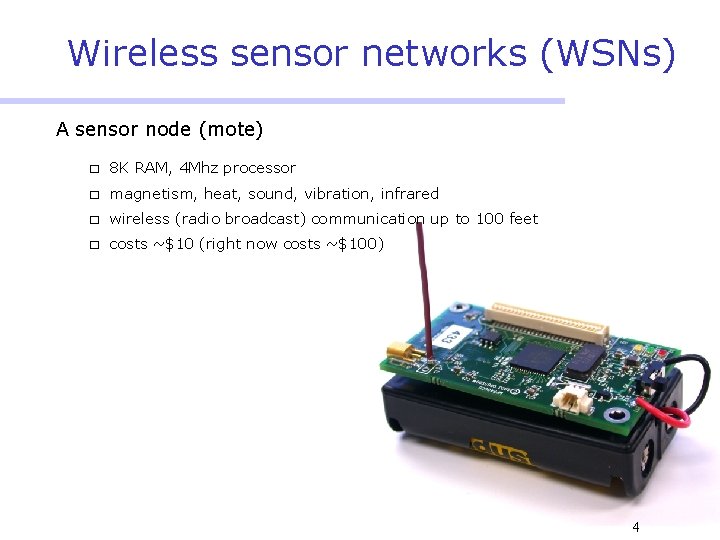
Wireless sensor networks (WSNs) A sensor node (mote) � 8 K RAM, 4 Mhz processor � magnetism, heat, sound, vibration, infrared � wireless (radio broadcast) communication up to 100 feet � costs ~$10 (right now costs ~$100) 4
Challenges in WSN • Scalability � � Thousands of nodes collaborate; for achieving scalability distributed & local algorithms are needed Distributed algorithms are notoriously difficult to design • Reliability � Wireless communication is unreliable due to collisions � Consensus is hard to achieve � Nodes fail due to adverse environmental conditions and software bugs � Maintenance of infrastructures are costly and difficult 5
Research overview 1. WSNs in-network querying and tracking services 2. Wireless Sensor Actor Networks (WSANs) 3. Internet-integrated large-scale WSN deployments 4. Self-stabilizing systems theory 6
1. In-network querying & tracking The objective is to answer contextual & spatial queries in WSNs • What is the location of the nearest enemy tank? � a soldier may query the WSN (via a palm device) in a battlefield scenario • What is a safe path to the nearest available exit? � a firefighter may ask in a rescue-evacuation scenario 7
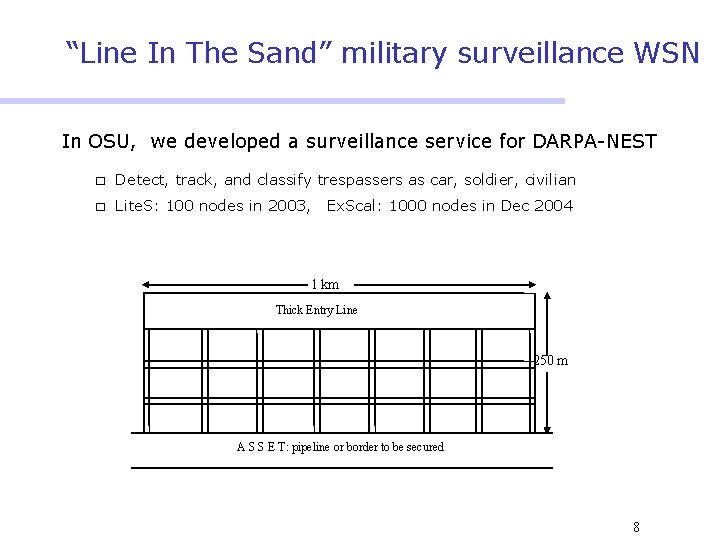
“Line In The Sand” military surveillance WSN In OSU, we developed a surveillance service for DARPA-NEST � Detect, track, and classify trespassers as car, soldier, civilian � Lite. S: 100 nodes in 2003, Ex. Scal: 1000 nodes in Dec 2004 1 km Thick Entry Line 250 m A S S E T: pipeline or border to be secured 8
Our results. . . For scalability, local operations are needed over global structures By exploiting the geometry of WSNs, we design efficient, minimal, and resilient infrastructures • Querying structures: Glance, Glance DQT, DQT Pee. R-tree � O(d) time for querying, where d is the distance to the nearest answer � Graceful resilience to the face node failures via simplicity of design • Tracking structures: Stalk, Stalk Trail, DQT-mobile � O(d) time for querying � O(m*logm) for update, where m is the distance the evader moved � Local self-healing via containment wave idea & stretch-factor idea 9
2. Wireless Sensor Actor Networks The objective is to achieve collaboration and coordination in swarm robotic/vehicular/sensor networks • Distributed control applications for in-network actuation � � � Active vibration and noise cancellation in factory floors Task and resource allocation in multimedia (video) WSNs Leader election, consensus, in-network information fusion • Deployment and relocation of mobile WSANs for environmental pollution surveillance and removal − Sensors relocate to provide dynamic coverage by following the gradient – Although neighbors can change for nodes, the network should stay connected – What are local rules and suitable primitives to maintain such mobile WSANs? 10
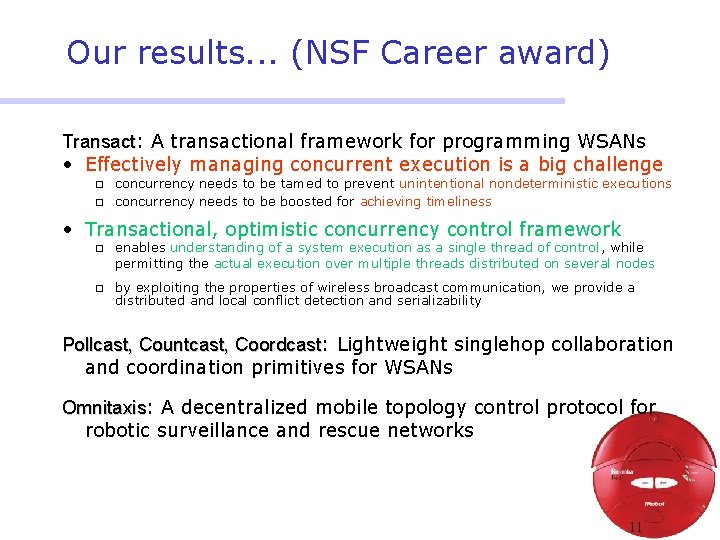
Our results. . . (NSF Career award) Transact: Transact A transactional framework for programming WSANs • Effectively managing concurrent execution is a big challenge � � concurrency needs to be tamed to prevent unintentional nondeterministic executions concurrency needs to be boosted for achieving timeliness • Transactional, optimistic concurrency control framework � � enables understanding of a system execution as a single thread of control, while permitting the actual execution over multiple threads distributed on several nodes by exploiting the properties of wireless broadcast communication, we provide a distributed and local conflict detection and serializability Pollcast, Countcast, Coordcast: Coordcast Lightweight singlehop collaboration and coordination primitives for WSANs Omnitaxis: Omnitaxis A decentralized mobile topology control protocol for robotic surveillance and rescue networks 11
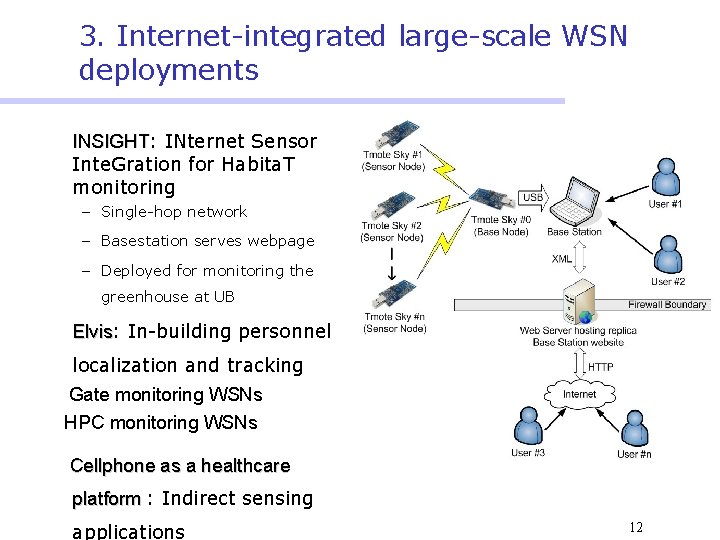
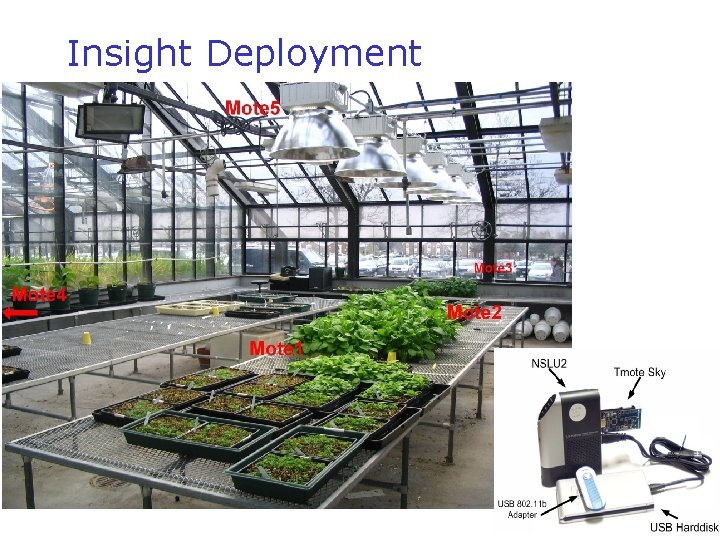
3. Internet-integrated large-scale WSN deployments INSIGHT: INSIGHT INternet Sensor Inte. Gration for Habita. T monitoring – Single-hop network – Basestation serves webpage – Deployed for monitoring the greenhouse at UB Elvis: Elvis In-building personnel localization and tracking Gate monitoring WSNs HPC monitoring WSNs Cellphone as a healthcare platform : Indirect sensing applications 12
Insight Deployment
Plant & play parking lot monitoring 14
Plant & play parking lot monitoring 15
Plant & play parking lot monitoring 16
Anybody interested in iphone/ipod programming class? 17
4. Self-stabilizing systems theory • Self-stabilization is the ability of a system to recover within bounded steps from arbitrary states to states from where the system exhibits desired behavior • Arbitrary state corruption provides a clean abstraction of how many systems are perturbed by their diverse environments � � Self-stabilization provides a viable method to deal with state corruption Case-by-case analysis of faults and recovery is shunned in favor of a uniform mechanism • Self-stabilizing systems do not need any initialization � Self-configuring! 18
- Slides: 18