
I Characteristics of a Gas A Gases assume
- Slides: 27
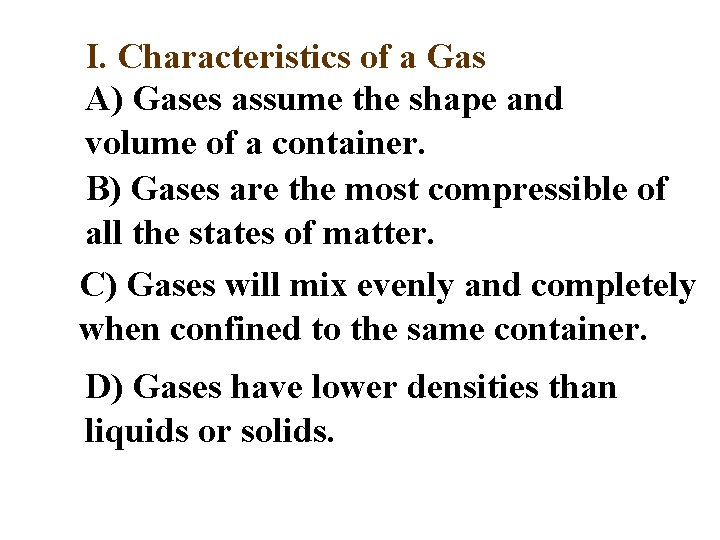
I. Characteristics of a Gas A) Gases assume the shape and volume of a container. B) Gases are the most compressible of all the states of matter. C) Gases will mix evenly and completely when confined to the same container. D) Gases have lower densities than liquids or solids.
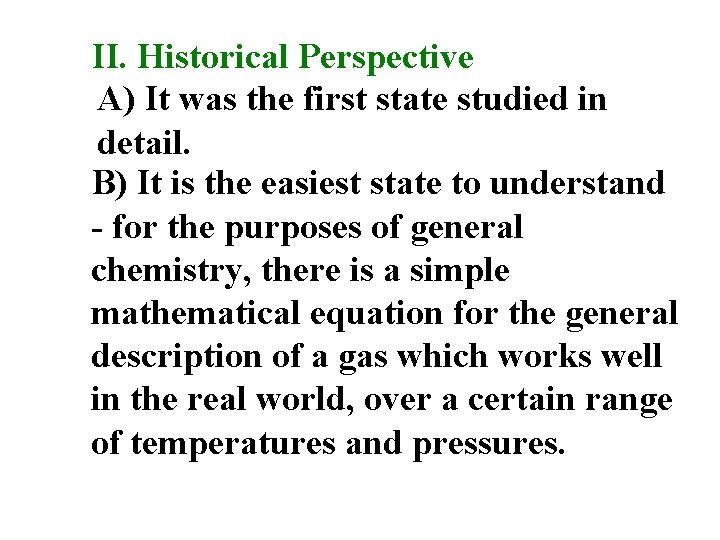
II. Historical Perspective A) It was the first state studied in detail. B) It is the easiest state to understand - for the purposes of general chemistry, there is a simple mathematical equation for the general description of a gas which works well in the real world, over a certain range of temperatures and pressures.
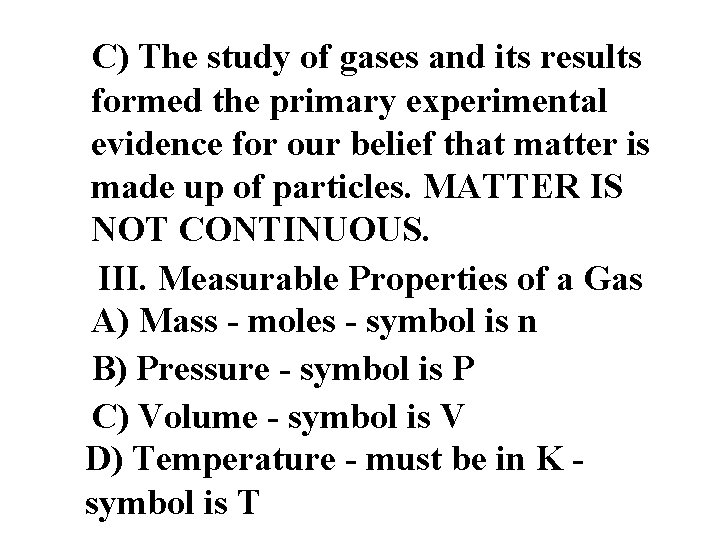
C) The study of gases and its results formed the primary experimental evidence for our belief that matter is made up of particles. MATTER IS NOT CONTINUOUS. III. Measurable Properties of a Gas A) Mass - moles - symbol is n B) Pressure - symbol is P C) Volume - symbol is V D) Temperature - must be in K symbol is T
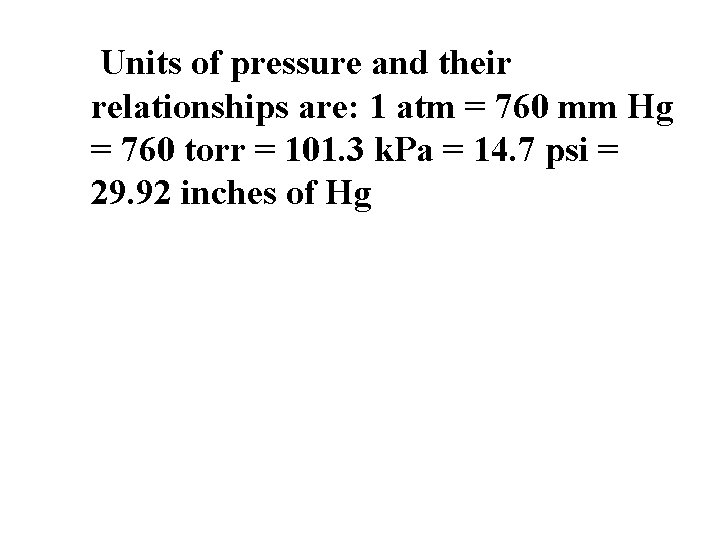
Units of pressure and their relationships are: 1 atm = 760 mm Hg = 760 torr = 101. 3 k. Pa = 14. 7 psi = 29. 92 inches of Hg
1) The volume of a gas is directly proportional to the number of molecules (moles) of gas at the same T and P. 2) One mole of any gas occupies the same volume for a given T and P and contains the same number of particles - atoms - molecules.
Boyle's Law: For a fixed amount of gas and constant temperature, PV = constant.
Charles's Law: at constant pressure the volume is linearly proportional to temperature. V/T = constant
Gay-Lussac’s Law v Old man Lussac studied the direct relationship between temperature and pressure of a gas. • As the temperature increases the press- ure a gas exerts on its container increases. v During his experiments volume of the system and amount of gas were held constant.
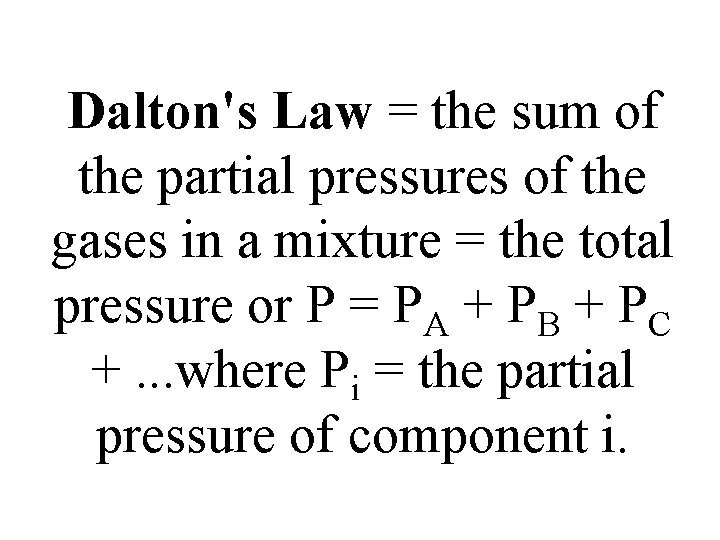
Dalton's Law = the sum of the partial pressures of the gases in a mixture = the total pressure or P = PA + PB + PC +. . . where Pi = the partial pressure of component i.
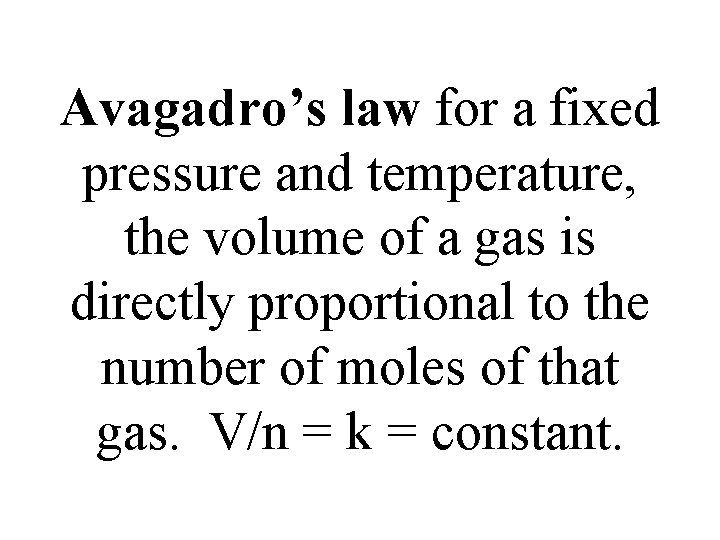
Avagadro’s law for a fixed pressure and temperature, the volume of a gas is directly proportional to the number of moles of that gas. V/n = k = constant.
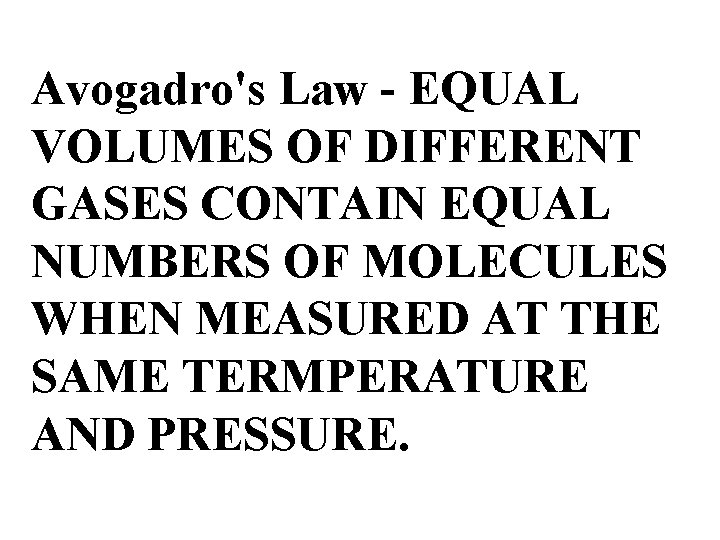
Avogadro's Law - EQUAL VOLUMES OF DIFFERENT GASES CONTAIN EQUAL NUMBERS OF MOLECULES WHEN MEASURED AT THE SAME TERMPERATURE AND PRESSURE.
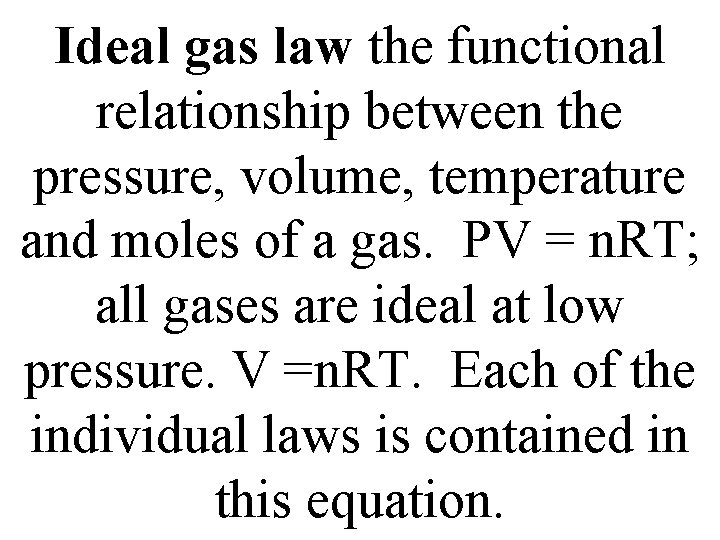
Ideal gas law the functional relationship between the pressure, volume, temperature and moles of a gas. PV = n. RT; all gases are ideal at low pressure. V =n. RT. Each of the individual laws is contained in this equation.
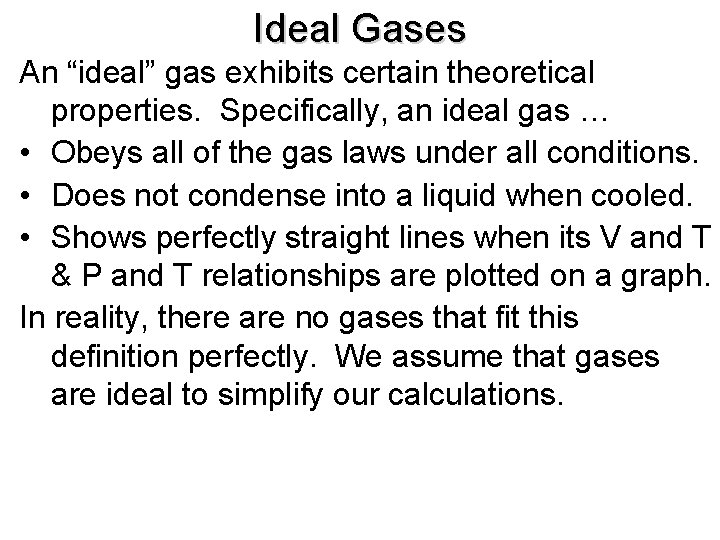
Ideal Gases An “ideal” gas exhibits certain theoretical properties. Specifically, an ideal gas … • Obeys all of the gas laws under all conditions. • Does not condense into a liquid when cooled. • Shows perfectly straight lines when its V and T & P and T relationships are plotted on a graph. In reality, there are no gases that fit this definition perfectly. We assume that gases are ideal to simplify our calculations.
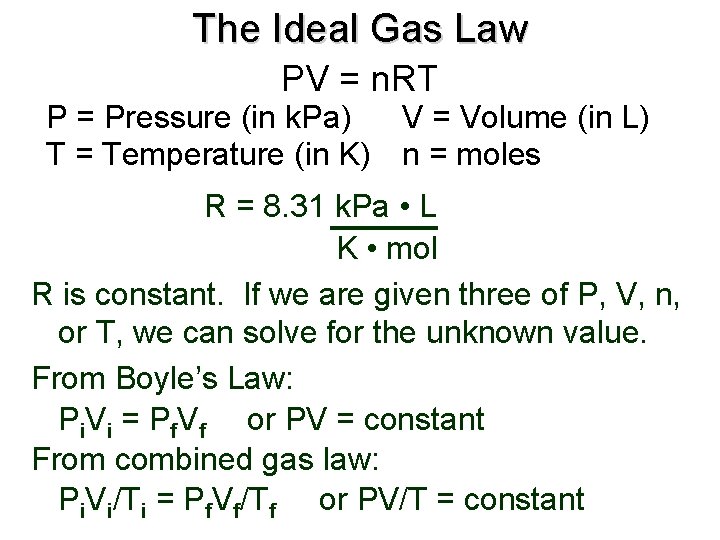
The Ideal Gas Law PV = n. RT P = Pressure (in k. Pa) V = Volume (in L) T = Temperature (in K) n = moles R = 8. 31 k. Pa • L K • mol R is constant. If we are given three of P, V, n, or T, we can solve for the unknown value. From Boyle’s Law: Pi. Vi = Pf. Vf or PV = constant From combined gas law: Pi. Vi/Ti = Pf. Vf/Tf or PV/T = constant
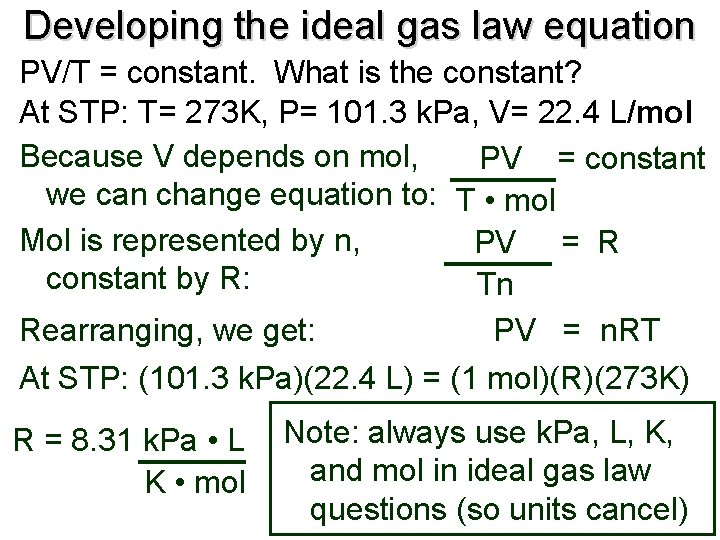
Developing the ideal gas law equation PV/T = constant. What is the constant? At STP: T= 273 K, P= 101. 3 k. Pa, V= 22. 4 L/mol Because V depends on mol, PV = constant we can change equation to: T • mol Mol is represented by n, PV = R constant by R: Tn Rearranging, we get: PV = n. RT At STP: (101. 3 k. Pa)(22. 4 L) = (1 mol)(R)(273 K) R = 8. 31 k. Pa • L K • mol Note: always use k. Pa, L, K, and mol in ideal gas law questions (so units cancel)
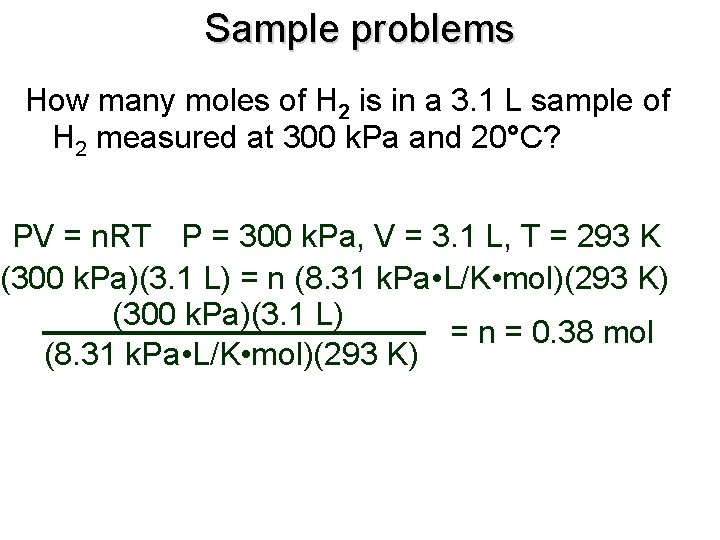
Sample problems How many moles of H 2 is in a 3. 1 L sample of H 2 measured at 300 k. Pa and 20°C? PV = n. RT P = 300 k. Pa, V = 3. 1 L, T = 293 K (300 k. Pa)(3. 1 L) = n (8. 31 k. Pa • L/K • mol)(293 K) (300 k. Pa)(3. 1 L) = n = 0. 38 mol (8. 31 k. Pa • L/K • mol)(293 K)
Ideal Gas Law Questions 1. How many moles of CO 2(g) is in a 5. 6 L sample of CO 2 measured at STP?
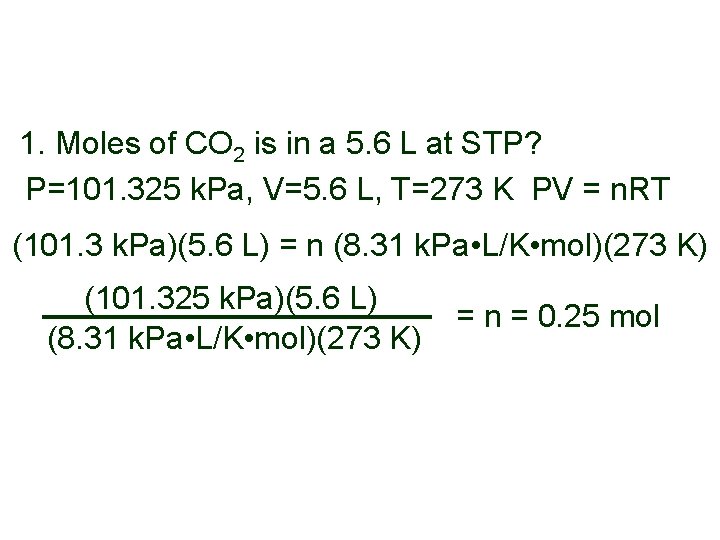
1. Moles of CO 2 is in a 5. 6 L at STP? P=101. 325 k. Pa, V=5. 6 L, T=273 K PV = n. RT (101. 3 k. Pa)(5. 6 L) = n (8. 31 k. Pa • L/K • mol)(273 K) (101. 325 k. Pa)(5. 6 L) (8. 31 k. Pa • L/K • mol)(273 K) = n = 0. 25 mol
2. a) Calculate the volume of 4. 50 mol of SO 2(g) measured at STP. b) What volume would this occupy at 25°C and 150 k. Pa?
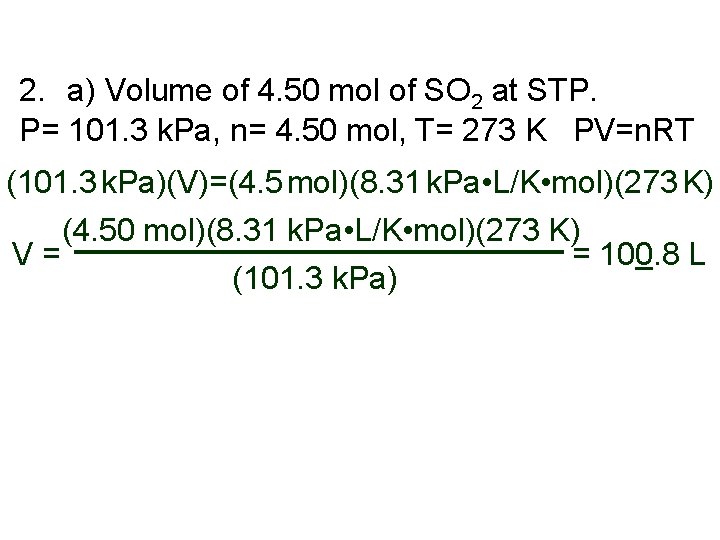
2. a) Volume of 4. 50 mol of SO 2 at STP. P= 101. 3 k. Pa, n= 4. 50 mol, T= 273 K PV=n. RT (101. 3 k. Pa)(V)=(4. 5 mol)(8. 31 k. Pa • L/K • mol)(273 K) (4. 50 mol)(8. 31 k. Pa • L/K • mol)(273 K) V= = 100. 8 L (101. 3 k. Pa)
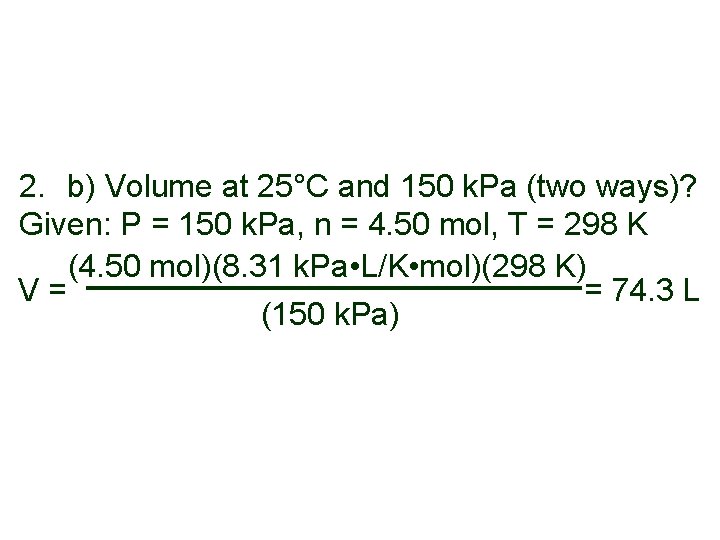
2. b) Volume at 25°C and 150 k. Pa (two ways)? Given: P = 150 k. Pa, n = 4. 50 mol, T = 298 K (4. 50 mol)(8. 31 k. Pa • L/K • mol)(298 K) V= = 74. 3 L (150 k. Pa)
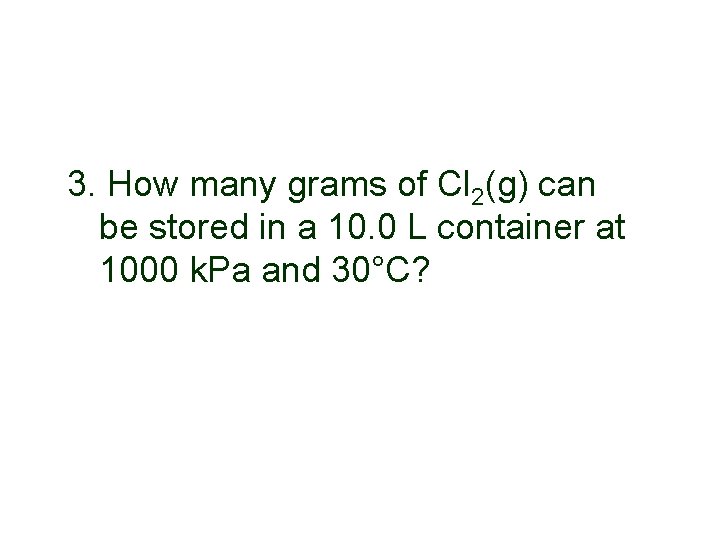
3. How many grams of Cl 2(g) can be stored in a 10. 0 L container at 1000 k. Pa and 30°C?
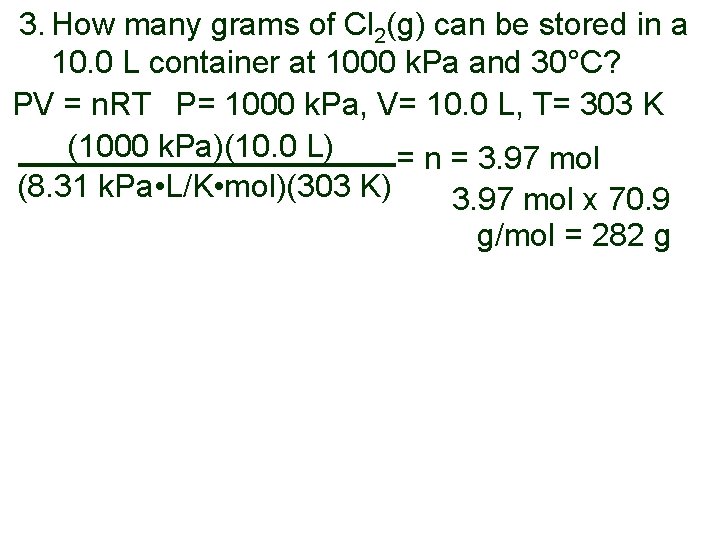
3. How many grams of Cl 2(g) can be stored in a 10. 0 L container at 1000 k. Pa and 30°C? PV = n. RT P= 1000 k. Pa, V= 10. 0 L, T= 303 K (1000 k. Pa)(10. 0 L) = n = 3. 97 mol (8. 31 k. Pa • L/K • mol)(303 K) 3. 97 mol x 70. 9 g/mol = 282 g
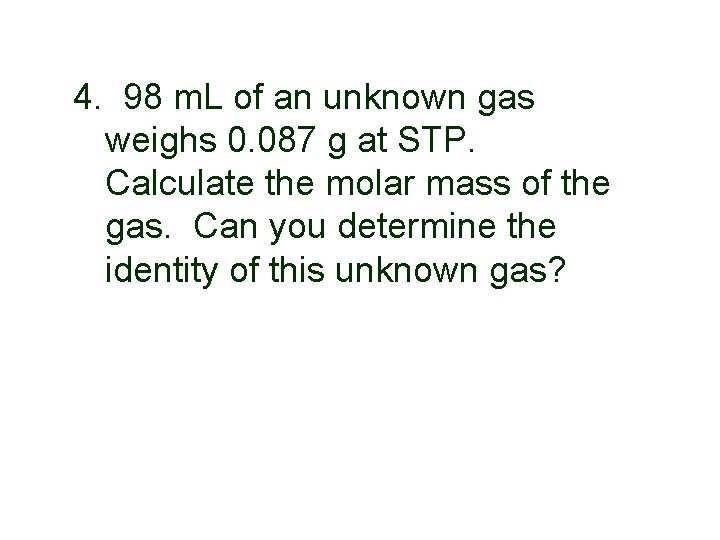
4. 98 m. L of an unknown gas weighs 0. 087 g at STP. Calculate the molar mass of the gas. Can you determine the identity of this unknown gas?
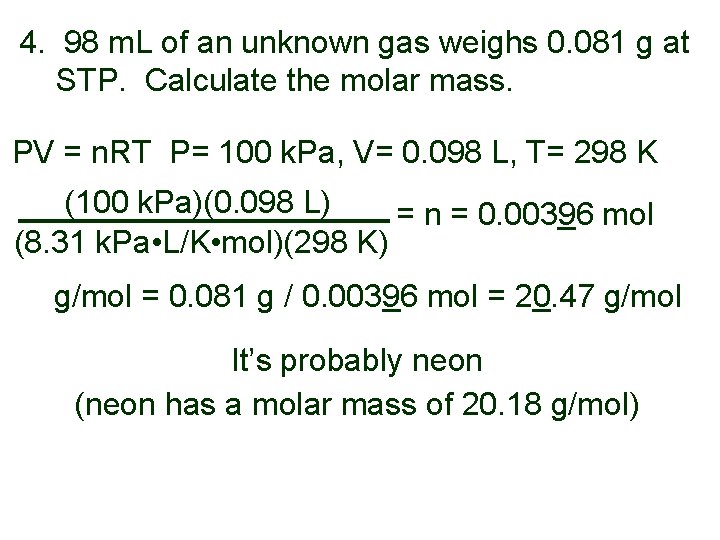
4. 98 m. L of an unknown gas weighs 0. 081 g at STP. Calculate the molar mass. PV = n. RT P= 100 k. Pa, V= 0. 098 L, T= 298 K (100 k. Pa)(0. 098 L) = n = 0. 00396 mol (8. 31 k. Pa • L/K • mol)(298 K) g/mol = 0. 081 g / 0. 00396 mol = 20. 47 g/mol It’s probably neon (neon has a molar mass of 20. 18 g/mol)
Diffusion the process whereby a gas spreads out through another gas to occupy the space with uniform partial pressure.
Effusion the process in which a gas flows through a small hole in a container.