
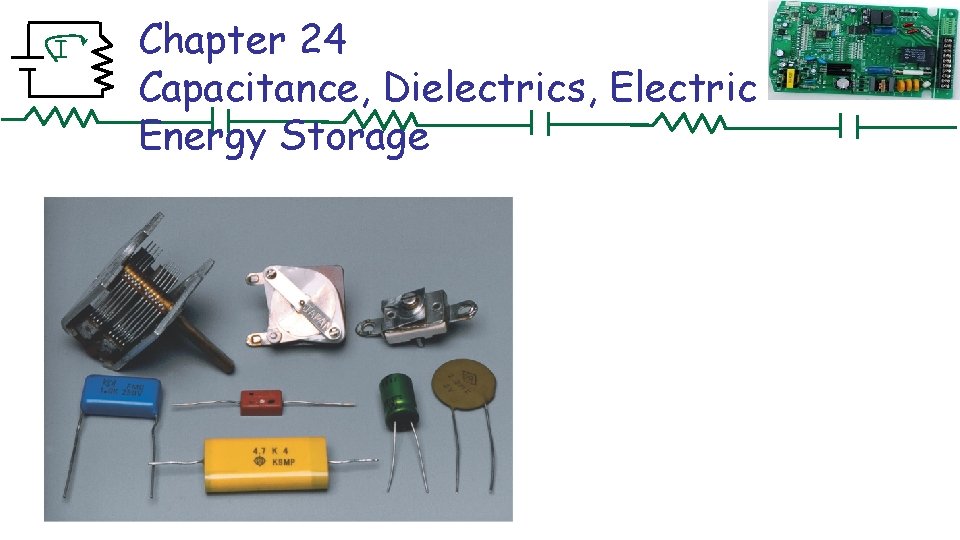
I Chapter 24 Capacitance Dielectrics Electric Energy Storage
- Slides: 7
I Chapter 24 Capacitance, Dielectrics, Electric Energy Storage
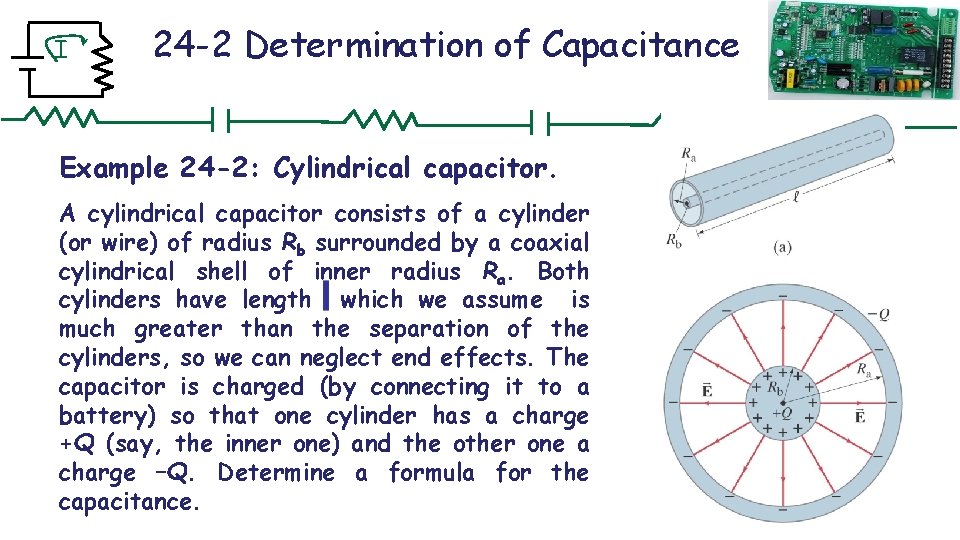
I 24 -2 Determination of Capacitance Example 24 -2: Cylindrical capacitor. A cylindrical capacitor consists of a cylinder (or wire) of radius Rb surrounded by a coaxial cylindrical shell of inner radius Ra. Both cylinders have length which we assume is much greater than the separation of the cylinders, so we can neglect end effects. The capacitor is charged (by connecting it to a battery) so that one cylinder has a charge +Q (say, the inner one) and the other one a charge –Q. Determine a formula for the capacitance.
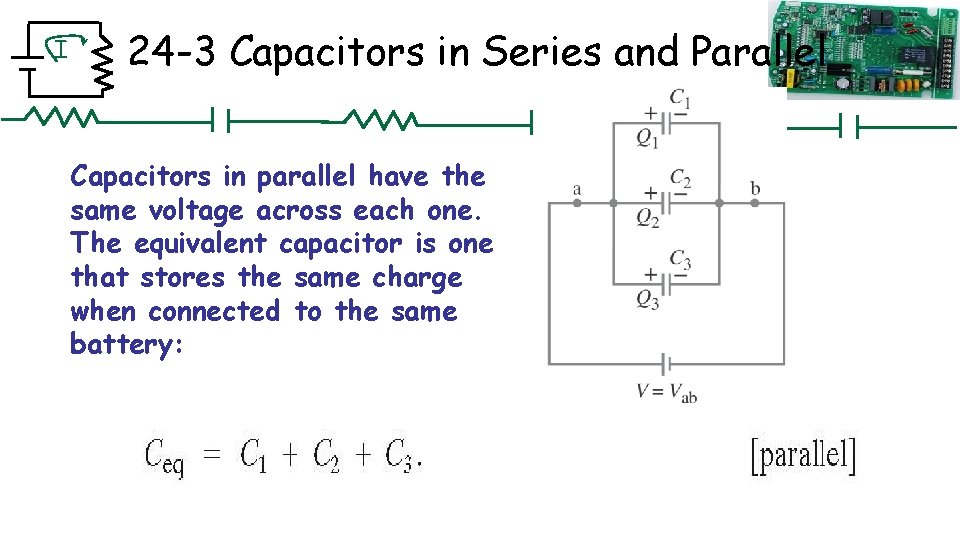
I 24 -3 Capacitors in Series and Parallel Capacitors in parallel have the same voltage across each one. The equivalent capacitor is one that stores the same charge when connected to the same battery:
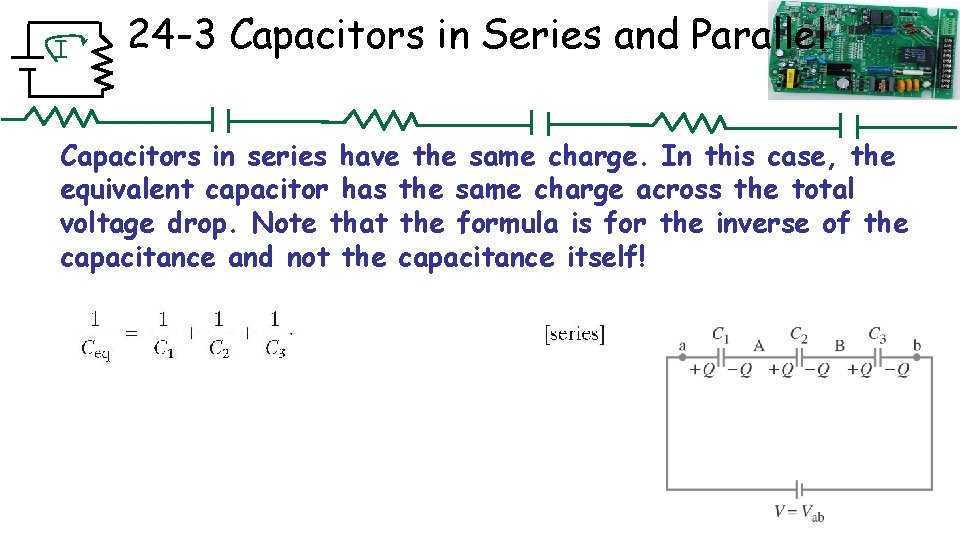
I 24 -3 Capacitors in Series and Parallel Capacitors in series have the same charge. In this case, the equivalent capacitor has the same charge across the total voltage drop. Note that the formula is for the inverse of the capacitance and not the capacitance itself!
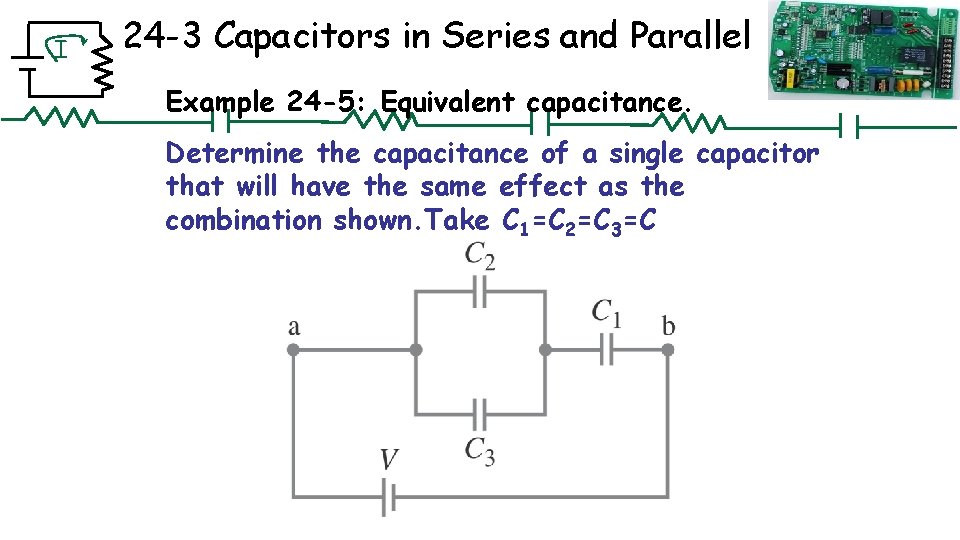
I 24 -3 Capacitors in Series and Parallel Example 24 -5: Equivalent capacitance. Determine the capacitance of a single capacitor that will have the same effect as the combination shown. Take C 1=C 2=C 3=C
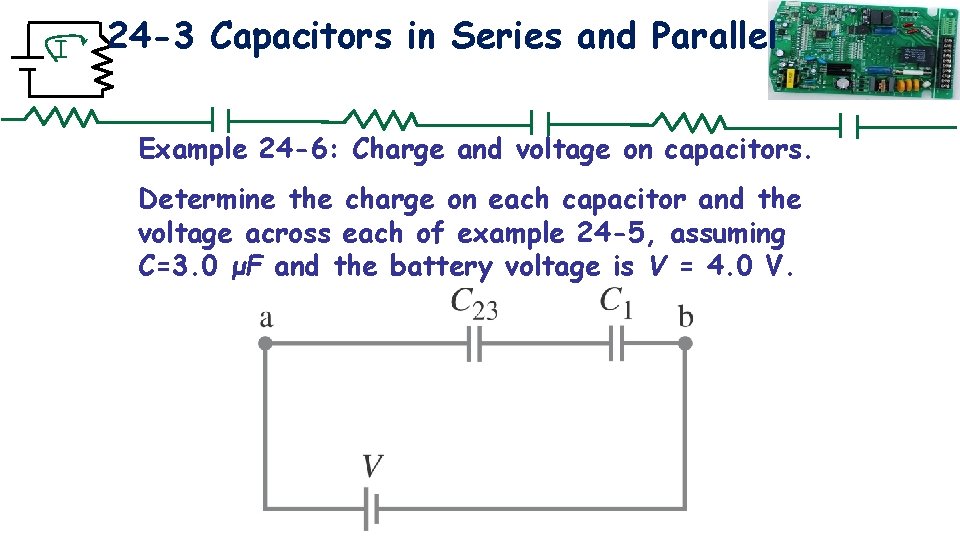
I 24 -3 Capacitors in Series and Parallel Example 24 -6: Charge and voltage on capacitors. Determine the charge on each capacitor and the voltage across each of example 24 -5, assuming C=3. 0 μF and the battery voltage is V = 4. 0 V.
I Problem 28 28. (II) A 0. 50μF and a 0. 80 μF capacitor are connected in series to a 9. 0 -V battery. Calculate (a) the charge on each capacitor and (b) the potential difference across each capacitor. (c) Repeat parts (a) and (b) assuming the two capacitors are in parallel.