
i Cargo Intelligent Cargo in Efficient and Sustainable
i. Cargo Intelligent Cargo in Efficient and Sustainable Global Logistics Operations David Quesada Atos Thessaloniki, 14 th October 2011
Agenda • • Background Vision Objectives Approach Technical concept Pilot cases Implementation Consortium description i. Cargo
Background Freight transport and logistics will have a central role in EU’s transformation into a smart, sustainable and inclusive economy. The Europe 2020 Strategy sets specific objectives in terms of: » Energy efficiency and decarbonisation » Economic growth It is commonly acknowledged that Information and Communication Technologies will play a fundamental role in overcoming the above issues i. Cargo
Vision • Cargo will be intelligent and part of a network of interoperable vehicles, infrastructures and logistics management systems • An open platform of freight management services providing access to information systems • The flow of goods will be managed cooperatively • Real-time data collection and event management to become part of logistics practices i. Cargo

i. Cargo: Objectives The i. Cargo project aims at advancing and extending the use of ICT to support new logistics services that: • synchronize vehicle movements and logistics operations to lower CO 2 emissions, • provide dynamic planning methods involving intelligent cargo, vehicle and infrastructure systems • combine services, resources and information from different stakeholders, taking part in an open freight management ecosystem. i. Cargo

Approach (1) Logistics users Logistics Companies New low-CO 2 services offer, Better utilization of resources Optimized solutions for environmental efficiency Common Framework Less GHG emissions, Less traffic Community Higher penetration of ICTbased services in the logistics market ICT for Transport Research & Industry i. Cargo
Approach (2) i. Cargo involves representatives of the main stakeholders in three main areas of activity: • leading ICT companies and institutes to integrate in i. Cargo the necessary technology components to develop innovative approaches and business models for co-modal transport environmental optimization and dynamic planning; • implementation, demonstration and validation of three extensive pilots in end-to-end multi-actor intermodal chains • extensive dissemination of research results, demonstration and pilot cases validation activities, aimed at transferring i. Cargo results to the international transport logistics community and supporting take-up and extensive exploitation immediately after the project i. Cargo
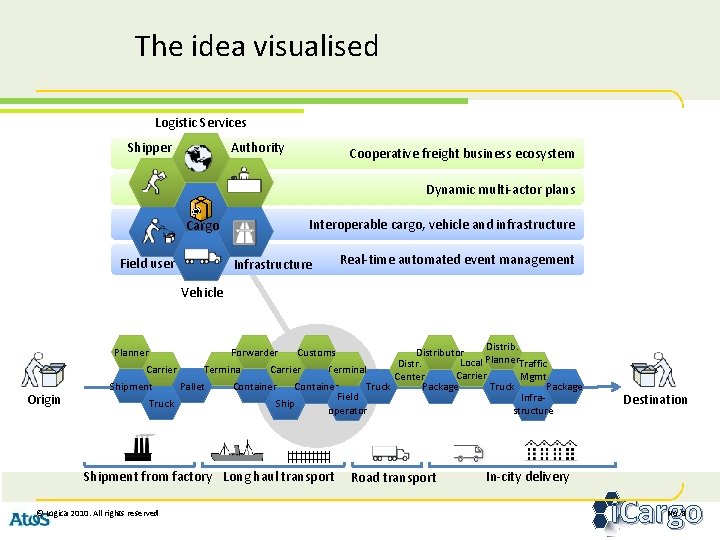
The idea visualised Logistic Services Shipper Authority Cooperative freight business ecosystem Dynamic multi-actor plans Interoperable cargo, vehicle and infrastructure Cargo Field user Infrastructure Real-time automated event management Vehicle Distributor Planner Local Distr. Traffic Terminal Carrier Center Mgmt Pallet Shipment Container Truck Package Field Infra. Truck Ship operator structure Planner Origin Forwarder Customs Shipment from factory Long haul transport © Logica 2010. All rights reserved Road transport Destination In-city delivery i. Cargo No. 8
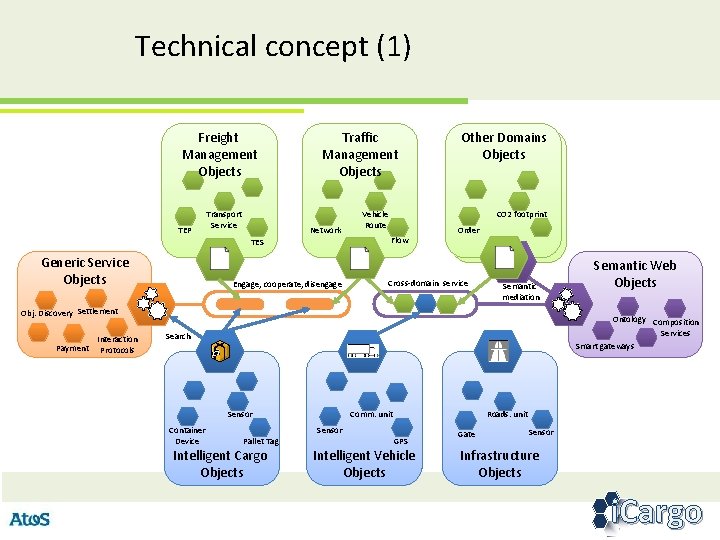
Technical concept (1) Freight Management Objects TEP Transport Service Traffic Management Objects Network TES Generic Service Objects Engage, cooperate, disengage Vehicle Route Other Domains Objects CO 2 footprint Flow Order Cross-domain service Semantic mediation Obj. Discovery Settlement Payment Interaction Protocols Ontology Composition Services Smart gateways Search Sensor Container Device Semantic Web Objects Pallet Tag Intelligent Cargo Objects Comm. unit Sensor Roads. unit GPS Intelligent Vehicle Objects Gate Sensor Infrastructure Objects i. Cargo
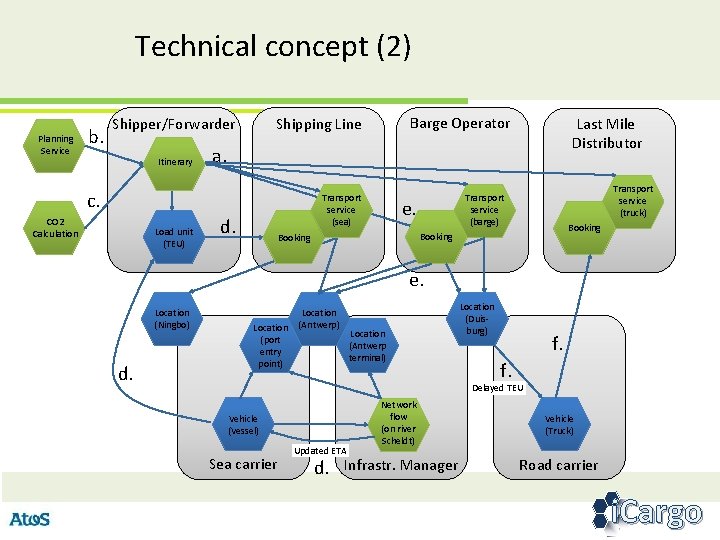
Technical concept (2) Planning Service b. Shipper/Forwarder Itinerary Load unit (TEU) Last Mile Distributor a. c. CO 2 Calculation Barge Operator Shipping Line Transport service (sea) d. Transport service (truck) Transport service (barge) e. Booking e. Location (Ningbo) d. Location (port entry point) Location (Antwerp terminal) Location (Duisburg) f. f. Delayed TEU Network flow (on river Scheldt) Vehicle (Truck) Infrastr. Manager Road carrier Vehicle (Vessel) Sea carrier Updated ETA d. i. Cargo
Pilot cases The i. Cargo approach and technologies will be applied in three open, largescale pilots to demonstrate and validate viable industrial implementations of low-carbon logistics services, going beyond technological proofs of concept. Each pilot will: • Take a systemic approach, encompassing the entire transport chain and involving different transport modes as well as the main actors (shippers, transport operators, authorities and infrastructures) necessary to implement the service. • Build a logistics information value chain, where services, resources and information from different stakeholders are exposed and combined in an open freight management ecosystem. • Carry out supply-chain wide tests, covering the entire route of goods from source to destination, including logistic operations across modes. This will allow estimating impact on a systemic level as well as assessing feasibility from the viewpoint of multiple involved stakeholders. 11 i. Cargo
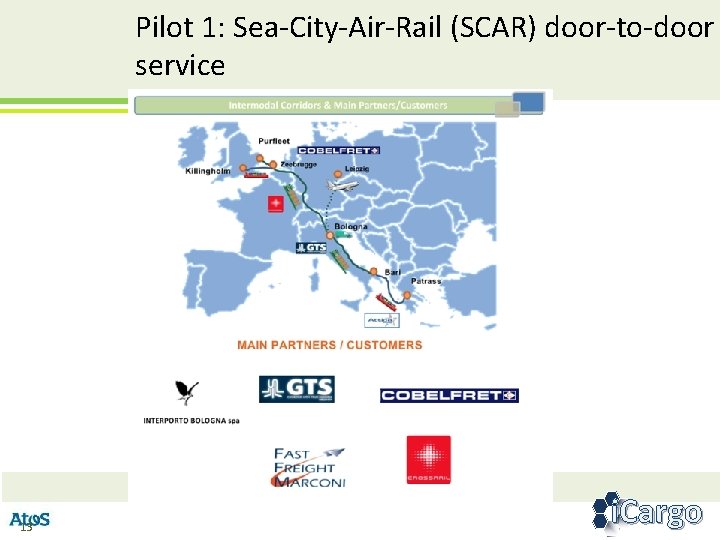
Pilot 1: Sea-City-Air-Rail (SCAR) door-to-door service The SCAR pilot will show simplified and more energy-efficient management of freight flows in transnational Rail/Multimodal corridors, by: • replacing complex business process interactions of the partners with bottom-up adaptive interoperability of the first/last mile urban/interurban smart distribution with Rail, Air, Sea and Road freight traffic; • introducing on-going dynamic control for energy/emissions reduction based on independent intelligent units (“i. Unit”) on both the cargo and vehicle. • supplying a corridor oriented ICT infrastructure for logistics/transport service providers allowing the dynamic cargo/means management 12 i. Cargo
Pilot 1: Sea-City-Air-Rail (SCAR) door-to-door service 13 i. Cargo
Pilot 2: Green Corridor between Sweden and the European Continent The “Green Corridor” pilot will demonstrate e-services to integrate motorways of the sea with competitive hinterland comodal offerings, making these an attractive alternative to rail in terms of resources utilization and hence “greenness”, by: • integrating information about, e. g. , available services, booking, status reporting, and electronic mandatory reporting to authorities, to cover the combination of rail, sea, road; • using on-cargo devices for communication between train and infrastructure, for real-time monitoring of key performance indicators, e. g. the CO 2 -footprint. i. Cargo
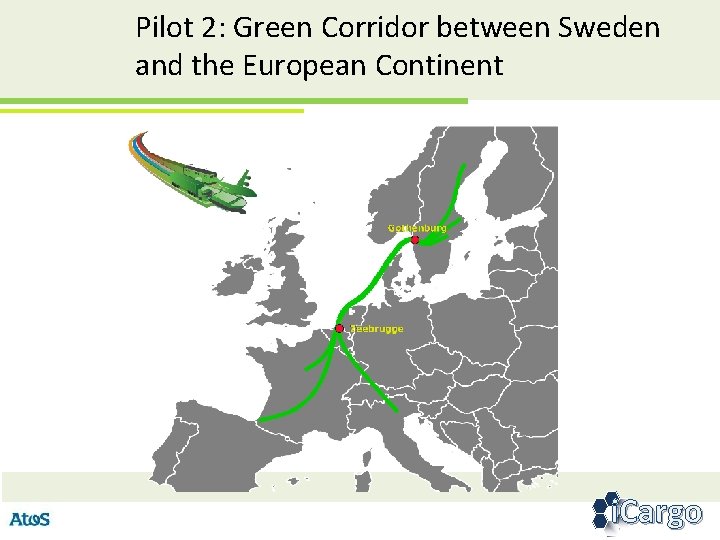
Pilot 2: Green Corridor between Sweden and the European Continent i. Cargo
Pilot 3: Logistics Services Providers – Shippers cooperation The Logistics Services Providers – Shippers cooperation pilot will show to improve the sustainability profile of an entire, complex supply chain through cooperative planning and execution solutions, by: • providing new capabilities and standards for information exchange between all actors in transport as well as logistics operations, like warehousing, including the use of environmental attributes in supply chain optimization; • monitoring cargo environment and quality even in presence of extremely large volumes, by replacing back-office systems connections with decentralized computing based on smart tags and distributed intelligence. i. Cargo
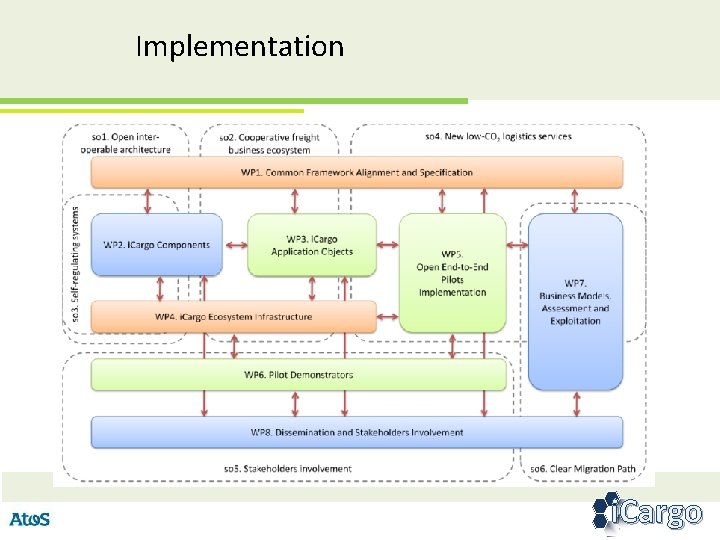
Implementation i. Cargo
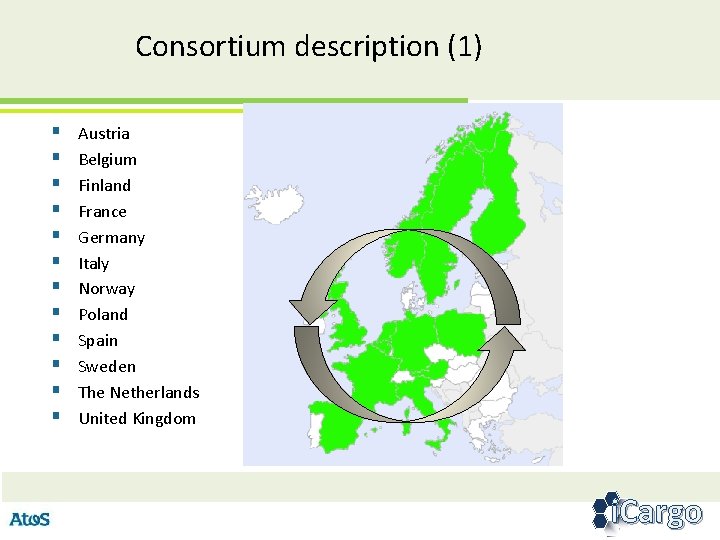
Consortium description (1) § § § Austria Belgium Finland France Germany Italy Norway Poland Spain Sweden The Netherlands United Kingdom i. Cargo
Consortium description (2) i. Cargo

THANK YOU! David Quesada Atos Research & Innovation Transport Line Responsible T +34 93 486 1818 david. quesada@atosresearch. eu david. quesada@atos. net Diagonal 200 08018 Barcelona Spain www. atosresearch. eu 20 i. Cargo
- Slides: 20