
I CAN Statements Scientific Method Define the term
![“I CAN” Statements Scientific Method • Define the term SCIENTIFIC METHOD [L 1] •](https://slidetodoc.com/presentation_image_h/e9904316d703a755b672f19385f8a318/image-2.jpg "“I CAN” Statements Scientific Method • Define the term SCIENTIFIC METHOD [L 1] •")
![5) Record and Analyze Data: [collection/interpretation] NO scientist accepts others’ work if they do](https://slidetodoc.com/presentation_image_h/e9904316d703a755b672f19385f8a318/image-6.jpg "5) Record and Analyze Data: [collection/interpretation] NO scientist accepts others’ work if they do")
![INDEPENDENT CONTROLLED [constants] SUNSCREEN 34](https://slidetodoc.com/presentation_image_h/e9904316d703a755b672f19385f8a318/image-34.jpg "INDEPENDENT CONTROLLED [constants] SUNSCREEN 34")
![INDEPENDENT CONTROLLED [constants] SUNSCREEN AMOUNT of “BURN” 35](https://slidetodoc.com/presentation_image_h/e9904316d703a755b672f19385f8a318/image-35.jpg "INDEPENDENT CONTROLLED [constants] SUNSCREEN AMOUNT of “BURN” 35")
![INDEPENDENT CONTROLLED [constants] SUNSCREEN AMOUNT of “BURN” SPF 30 BRAND « X » QUANTITY](https://slidetodoc.com/presentation_image_h/e9904316d703a755b672f19385f8a318/image-36.jpg "INDEPENDENT CONTROLLED [constants] SUNSCREEN AMOUNT of “BURN” SPF 30 BRAND « X » QUANTITY")
- Slides: 49
“I CAN” Statements Scientific Method • Define the term SCIENTIFIC METHOD [L 1] • Describe what a scientific method approach may entail [L 1] • Define the term FACT [L 1] • Differentiate between Scientific Law and Scientific Theory [L 3] • Recognize the parts of Experimental Design (variables, groups) [L 1] • Design an Experiment [L 3] • Develop an argument [L 3] re. the challenges and problems technology may bring 2
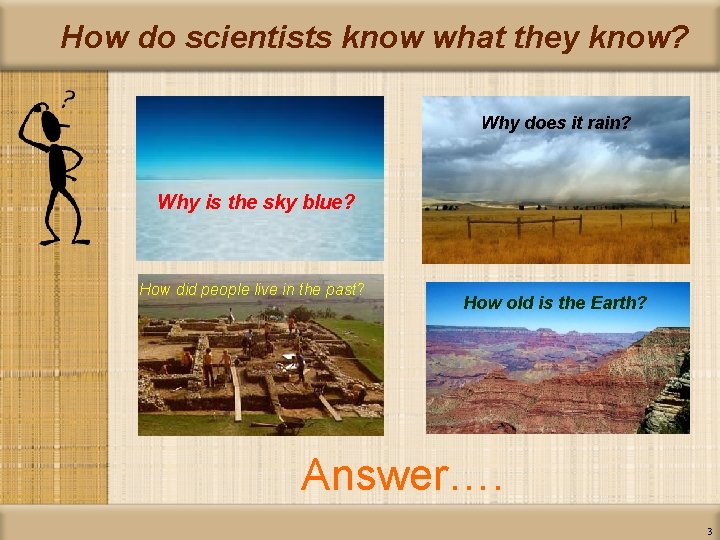
How do scientists know what they know? Why does it rain? Why is the sky blue? How did people live in the past? How old is the Earth? Answer…. 3
• It is NOT a recipe / It is not a rigid path It is a TOOL • It requires INTELLIGENCE, IMAGINATION, and CREATIVITY • It is a process of discovery, beginning with observations leading to key questions and possible answers CRITICAL THINKING • Experiments will test whether our answers are valid or not • It is very similar to everyday DECISION MAKING [e. g. what to wear this morning? ] 4
1) State / Identify the Problem / Ask a key question: After observations are made, a problem or issue that you want to learn more about is identified. 2) Gather Information: Consult a wide variety of resources, take notes and study the existing data. 3) Form an Hypothesis: A statement formulated from prior knowledge, and/or observations that can be tested; an educated guess/prediction about what might happen or might have happened. 4) Design an Experiment / Procedure: List the steps to test your hypothesis. 5
5) Record and Analyze Data: [collection/interpretation] NO scientist accepts others’ work if they do not keep complete data. Organize the data into table, analyze. 6) State a Conclusion Write a statement that proves or disproves your original hypothesis. If the original hypothesis is rejected, you need to formulate a new hypothesis 7) Report / communicate your conclusion Scientists write reports using mainly data tables and graphs to inform others about their findings 6
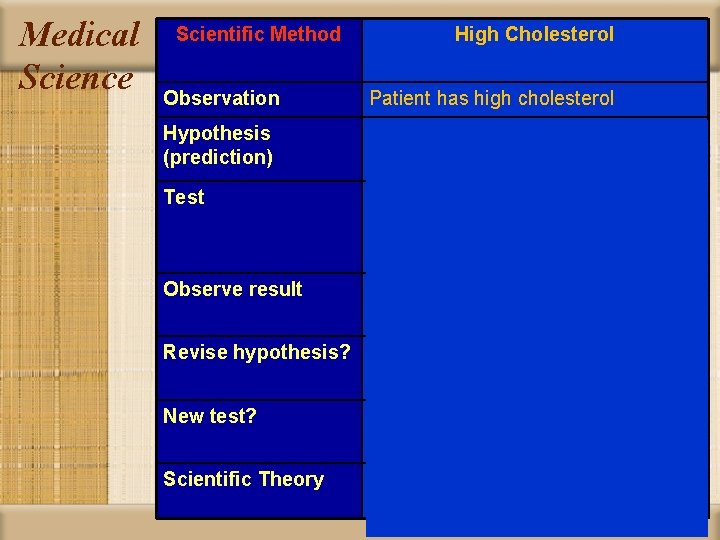
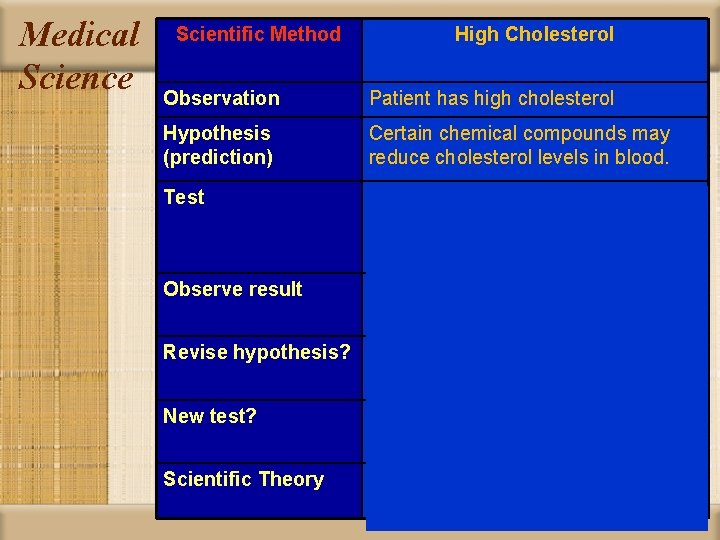
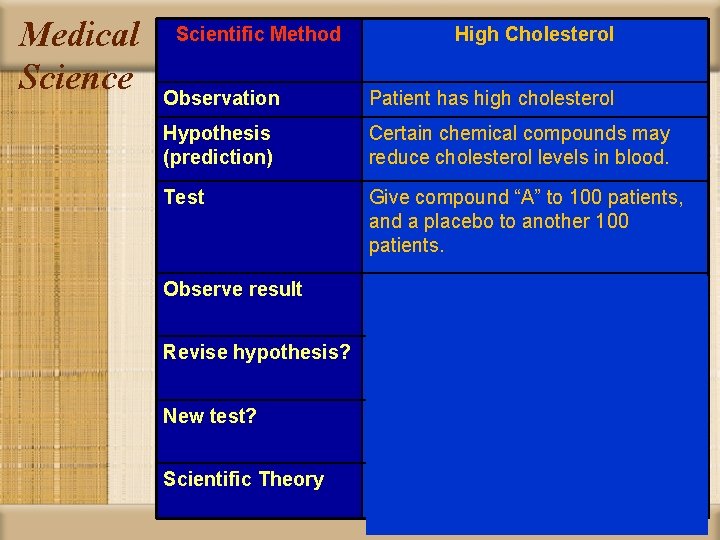
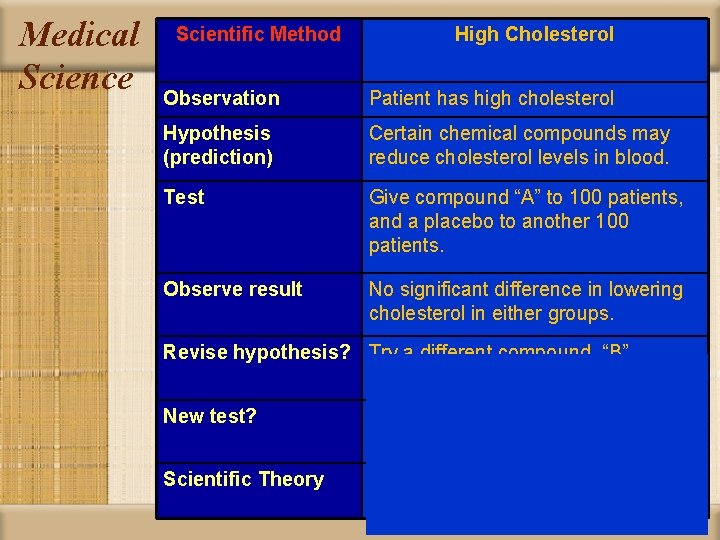
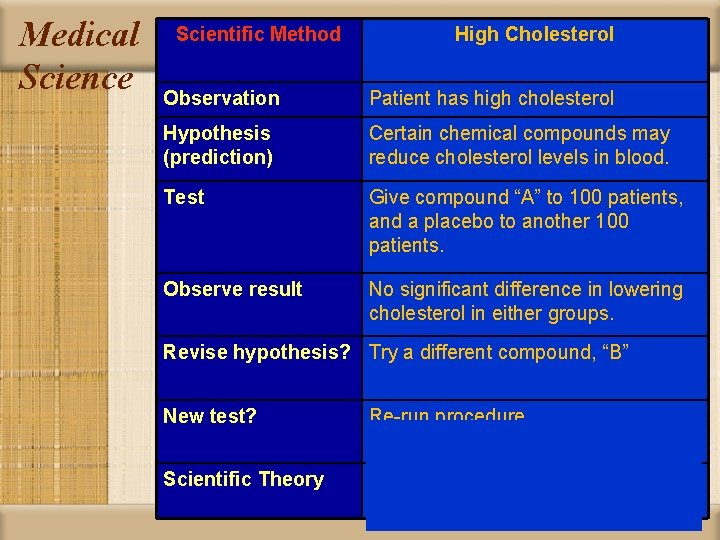
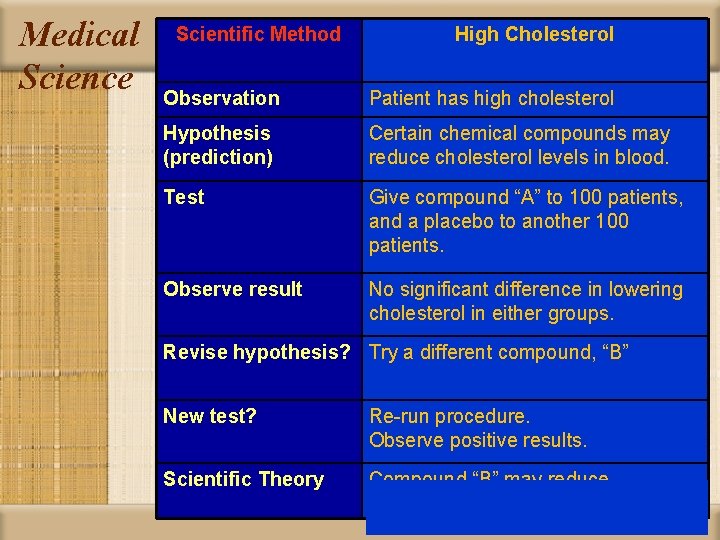
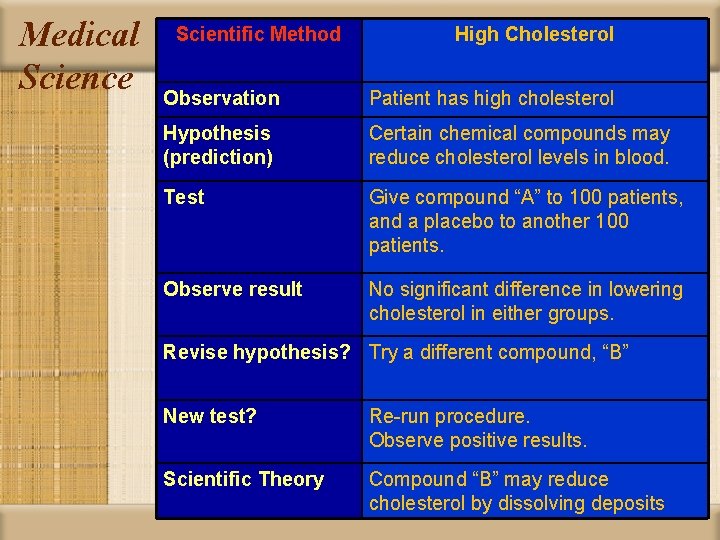
Medical Science Scientific Method High Cholesterol Observation Patient has high cholesterol Hypothesis (prediction) Certain chemical compounds may reduce cholesterol levels in blood. Test Give compound “A” to 100 patients, and a placebo to another 100 patients. Observe result No significant difference in lowering cholesterol in either groups. Revise hypothesis? Try a different compound, “B” New test? Re-run procedure. Observe positive results. Scientific Theory Compound “B” may reduce cholesterol by dissolving deposits
Medical Science Scientific Method High Cholesterol Observation Patient has high cholesterol Hypothesis (prediction) Certain chemical compounds may reduce cholesterol levels in blood. Test Give compound “A” to 100 patients, and a placebo to another 100 patients. Observe result No significant difference in lowering cholesterol in either groups. Revise hypothesis? Try a different compound, “B” New test? Re-run procedure. Observe positive results. Scientific Theory Compound “B” may reduce cholesterol by dissolving deposits
Medical Science Scientific Method High Cholesterol Observation Patient has high cholesterol Hypothesis (prediction) Certain chemical compounds may reduce cholesterol levels in blood. Test Give compound “A” to 100 patients, and a placebo to another 100 patients. Observe result No significant difference in lowering cholesterol in either groups. Revise hypothesis? Try a different compound, “B” New test? Re-run procedure. Observe positive results. Scientific Theory Compound “B” may reduce cholesterol by dissolving deposits
Medical Science Scientific Method High Cholesterol Observation Patient has high cholesterol Hypothesis (prediction) Certain chemical compounds may reduce cholesterol levels in blood. Test Give compound “A” to 100 patients, and a placebo to another 100 patients. Observe result No significant difference in lowering cholesterol in either groups. Revise hypothesis? Try a different compound, “B” New test? Re-run procedure. Observe positive results. Scientific Theory Compound “B” may reduce cholesterol by dissolving deposits
Medical Science Scientific Method High Cholesterol Observation Patient has high cholesterol Hypothesis (prediction) Certain chemical compounds may reduce cholesterol levels in blood. Test Give compound “A” to 100 patients, and a placebo to another 100 patients. Observe result No significant difference in lowering cholesterol in either groups. Revise hypothesis? Try a different compound, “B” New test? Re-run procedure. Observe positive results. Scientific Theory Compound “B” may reduce cholesterol by dissolving deposits
Medical Science Scientific Method High Cholesterol Observation Patient has high cholesterol Hypothesis (prediction) Certain chemical compounds may reduce cholesterol levels in blood. Test Give compound “A” to 100 patients, and a placebo to another 100 patients. Observe result No significant difference in lowering cholesterol in either groups. Revise hypothesis? Try a different compound, “B” New test? Re-run procedure. Observe positive results. Scientific Theory Compound “B” may reduce cholesterol by dissolving deposits
Medical Science Scientific Method High Cholesterol Observation Patient has high cholesterol Hypothesis (prediction) Certain chemical compounds may reduce cholesterol levels in blood. Test Give compound “A” to 100 patients, and a placebo to another 100 patients. Observe result No significant difference in lowering cholesterol in either groups. Revise hypothesis? Try a different compound, “B” New test? Re-run procedure. Observe positive results. Scientific Theory Compound “B” may reduce cholesterol by dissolving deposits
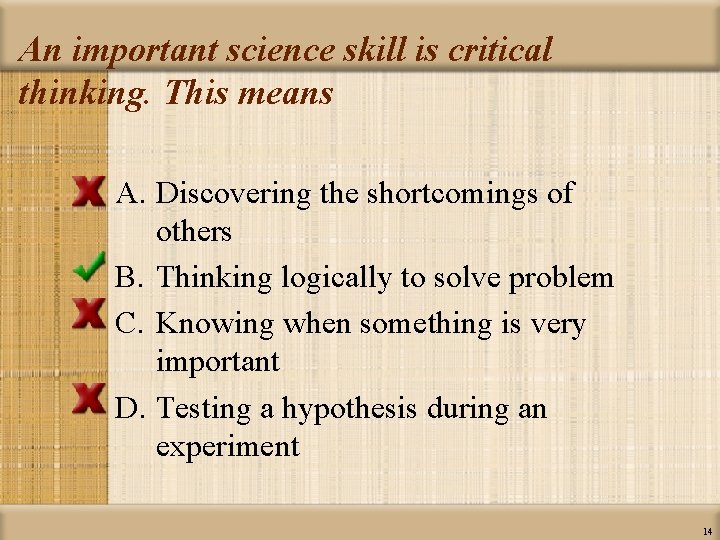
An important science skill is critical thinking. This means A. Discovering the shortcomings of others B. Thinking logically to solve problem C. Knowing when something is very important D. Testing a hypothesis during an experiment 14
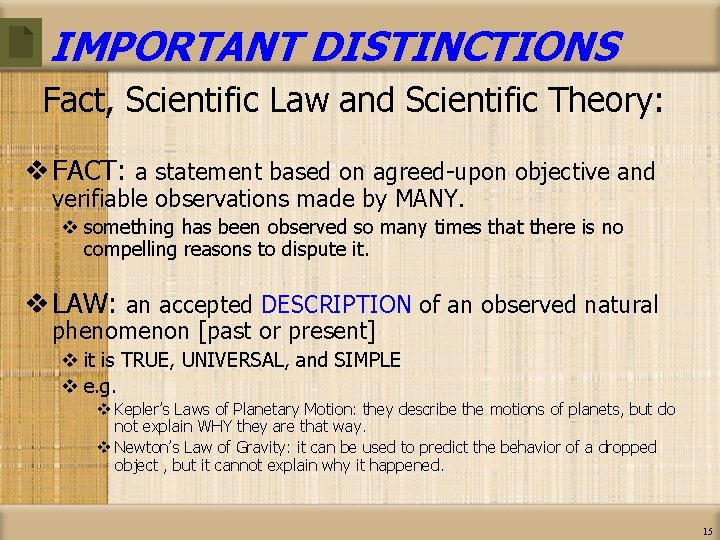
IMPORTANT DISTINCTIONS Fact, Scientific Law and Scientific Theory: v FACT: a statement based on agreed-upon objective and verifiable observations made by MANY. v something has been observed so many times that there is no compelling reasons to dispute it. v LAW: an accepted DESCRIPTION of an observed natural phenomenon [past or present] v it is TRUE, UNIVERSAL, and SIMPLE v e. g. v Kepler’s Laws of Planetary Motion: they describe the motions of planets, but do not explain WHY they are that way. v Newton’s Law of Gravity: it can be used to predict the behavior of a dropped object , but it cannot explain why it happened. 15
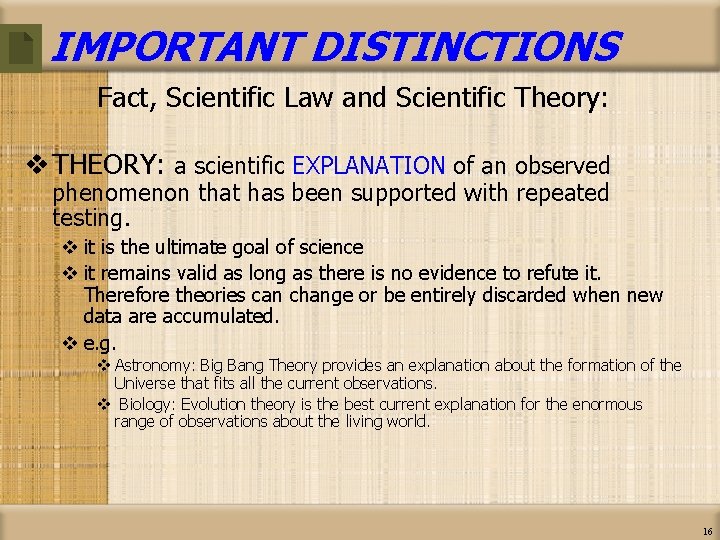
IMPORTANT DISTINCTIONS Fact, Scientific Law and Scientific Theory: v THEORY: a scientific EXPLANATION of an observed phenomenon that has been supported with repeated testing. v it is the ultimate goal of science v it remains valid as long as there is no evidence to refute it. Therefore theories can change or be entirely discarded when new data are accumulated. v e. g. v Astronomy: Big Bang Theory provides an explanation about the formation of the Universe that fits all the current observations. v Biology: Evolution theory is the best current explanation for the enormous range of observations about the living world. 16
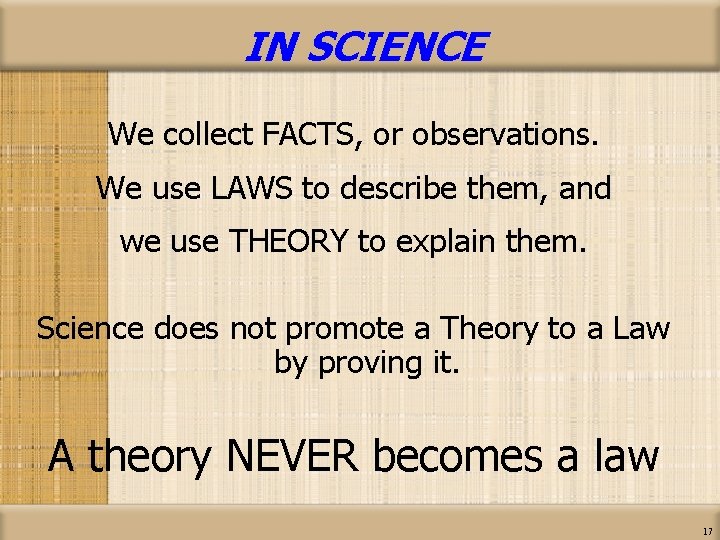
IN SCIENCE We collect FACTS, or observations. We use LAWS to describe them, and we use THEORY to explain them. Science does not promote a Theory to a Law by proving it. A theory NEVER becomes a law 17
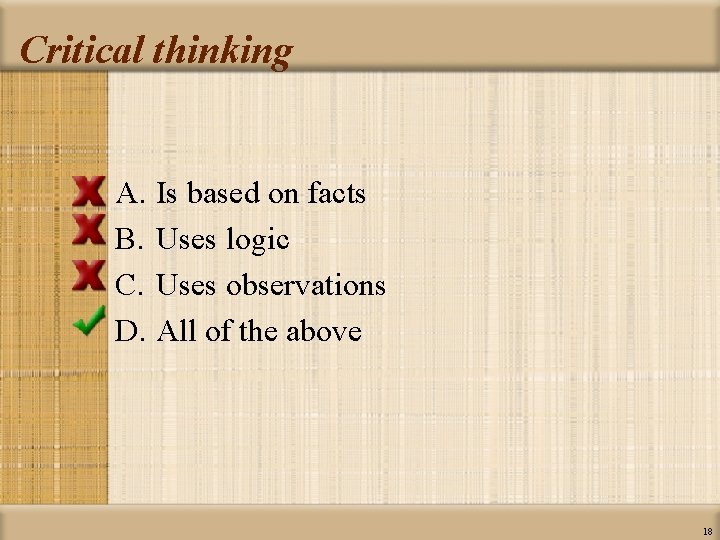
Critical thinking A. Is based on facts B. Uses logic C. Uses observations D. All of the above 18
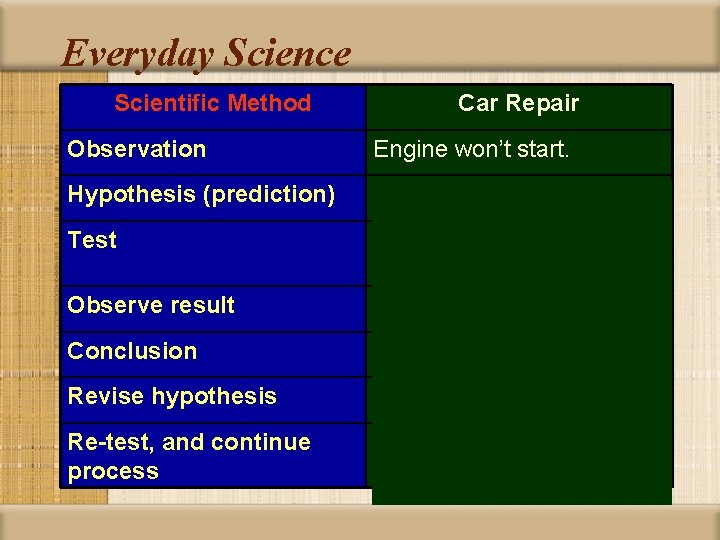
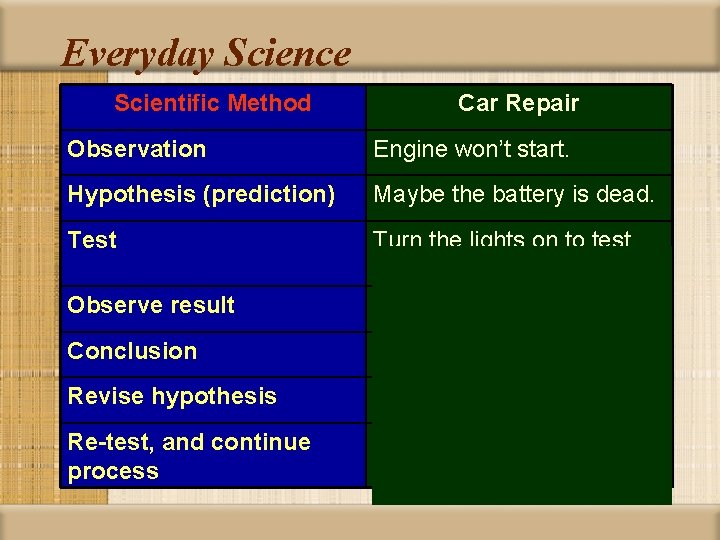
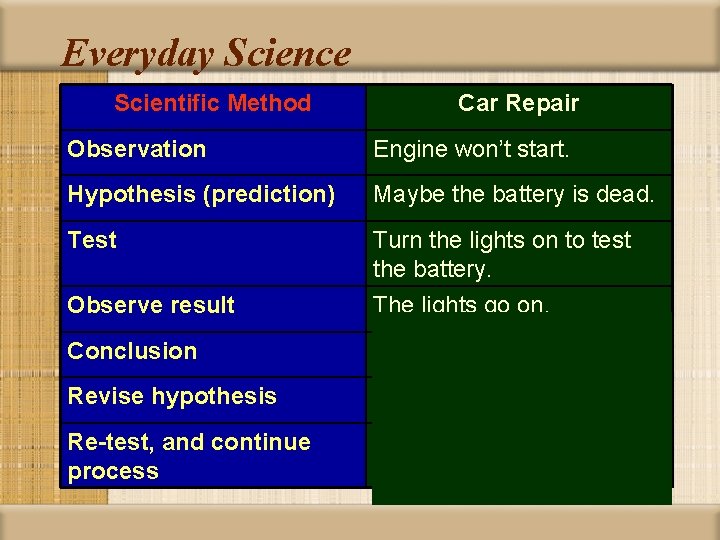
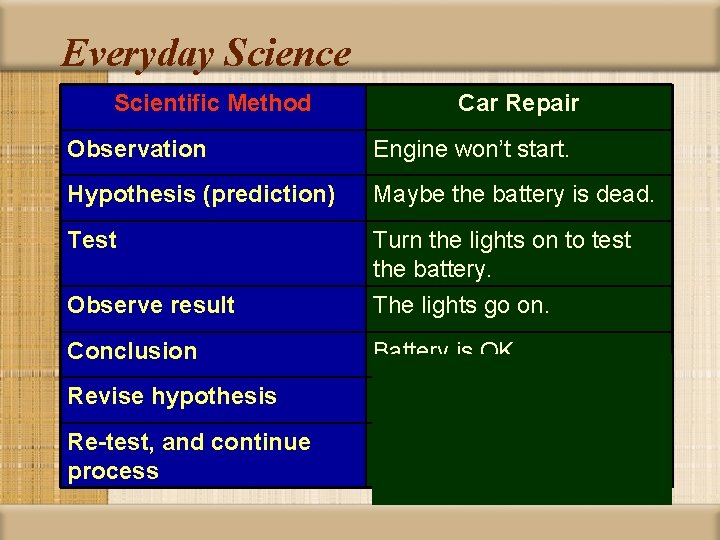
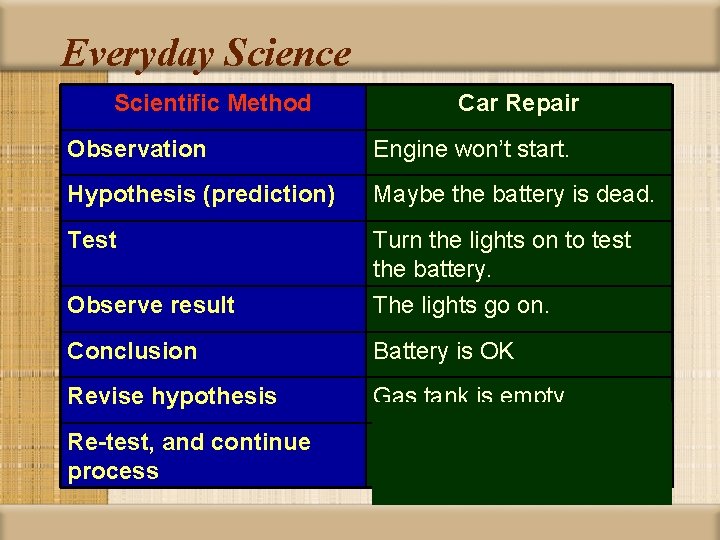
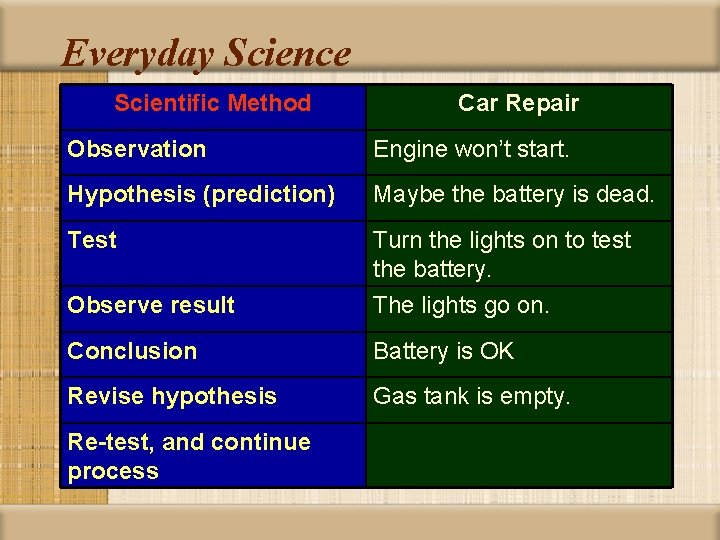
Everyday Science Scientific Method Car Repair Observation Engine won’t start. Hypothesis (prediction) Maybe the battery is dead. Test Turn the lights on to test the battery. Observe result The lights go on. Conclusion Battery is OK Revise hypothesis Gas tank is empty. Re-test, and continue process
Everyday Science Scientific Method Car Repair Observation Engine won’t start. Hypothesis (prediction) Maybe the battery is dead. Test Turn the lights on to test the battery. Observe result The lights go on. Conclusion Battery is OK Revise hypothesis Gas tank is empty. Re-test, and continue process
Everyday Science Scientific Method Car Repair Observation Engine won’t start. Hypothesis (prediction) Maybe the battery is dead. Test Turn the lights on to test the battery. Observe result The lights go on. Conclusion Battery is OK Revise hypothesis Gas tank is empty. Re-test, and continue process
Everyday Science Scientific Method Car Repair Observation Engine won’t start. Hypothesis (prediction) Maybe the battery is dead. Test Turn the lights on to test the battery. Observe result The lights go on. Conclusion Battery is OK Revise hypothesis Gas tank is empty. Re-test, and continue process
Everyday Science Scientific Method Car Repair Observation Engine won’t start. Hypothesis (prediction) Maybe the battery is dead. Test Turn the lights on to test the battery. Observe result The lights go on. Conclusion Battery is OK Revise hypothesis Gas tank is empty. Re-test, and continue process
Everyday Science Scientific Method Car Repair Observation Engine won’t start. Hypothesis (prediction) Maybe the battery is dead. Test Turn the lights on to test the battery. Observe result The lights go on. Conclusion Battery is OK Revise hypothesis Gas tank is empty. Re-test, and continue process
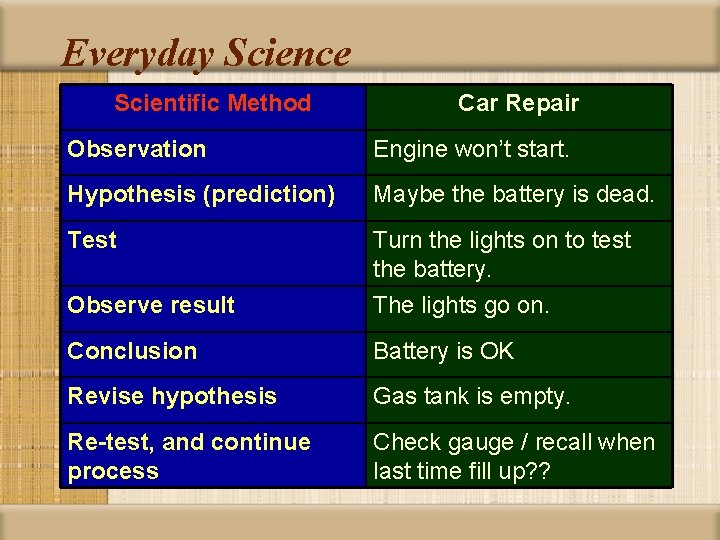
Everyday Science Scientific Method Car Repair Observation Engine won’t start. Hypothesis (prediction) Maybe the battery is dead. Test Turn the lights on to test the battery. Observe result The lights go on. Conclusion Battery is OK Revise hypothesis Gas tank is empty. Re-test, and continue process Check gauge / recall when last time fill up? ?
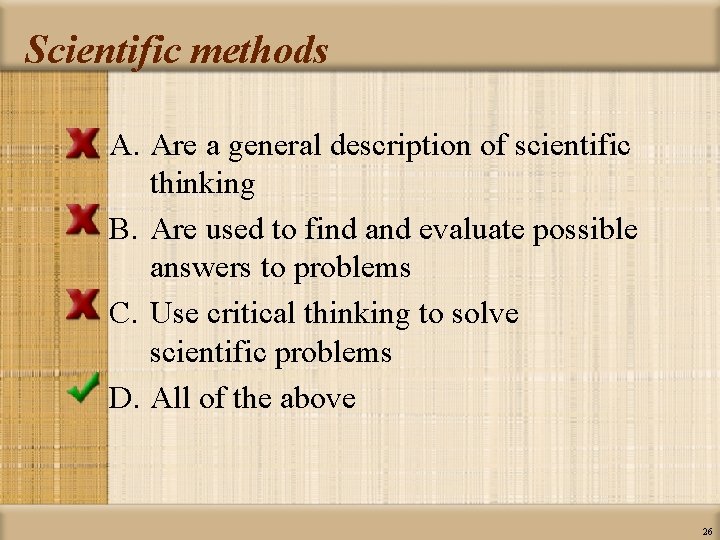
Scientific methods A. Are a general description of scientific thinking B. Are used to find and evaluate possible answers to problems C. Use critical thinking to solve scientific problems D. All of the above 26
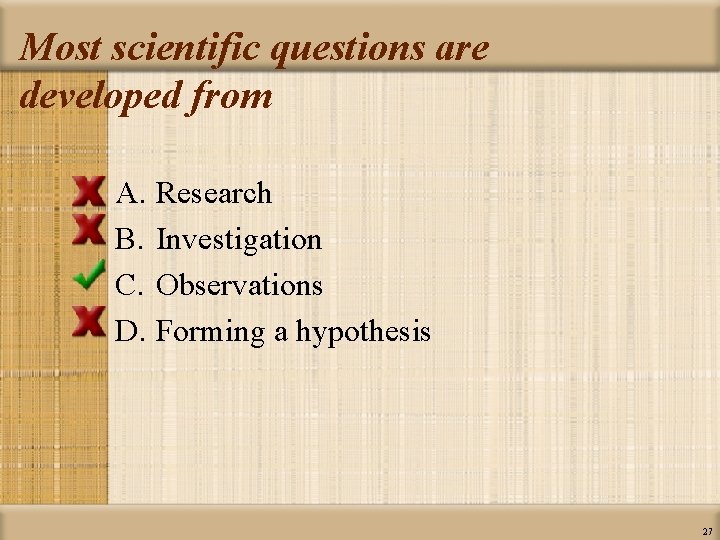
Most scientific questions are developed from A. Research B. Investigation C. Observations D. Forming a hypothesis 27
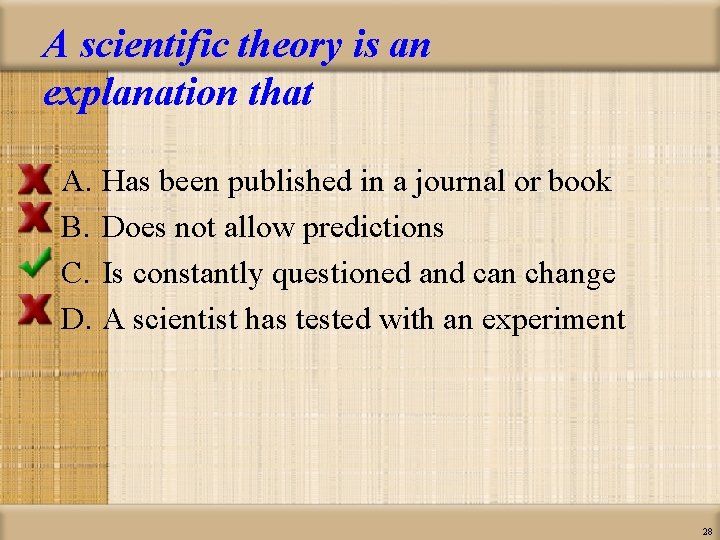
A scientific theory is an explanation that A. Has been published in a journal or book B. Does not allow predictions C. Is constantly questioned and can change D. A scientist has tested with an experiment 28
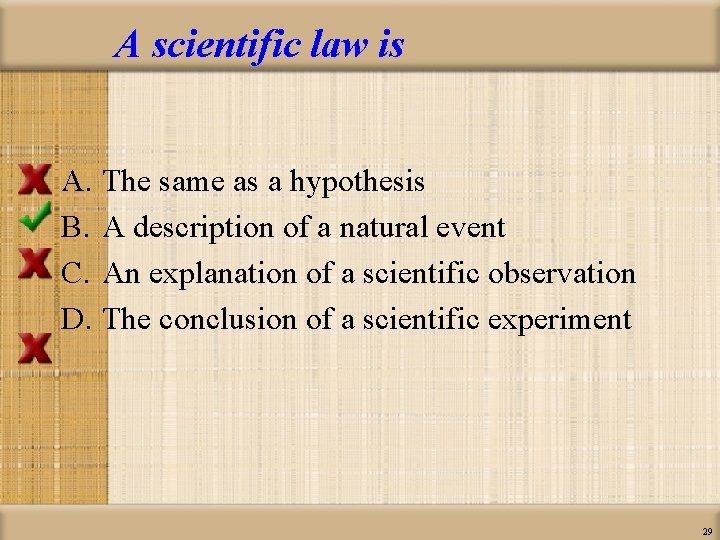
A scientific law is A. The same as a hypothesis B. A description of a natural event C. An explanation of a scientific observation D. The conclusion of a scientific experiment 29
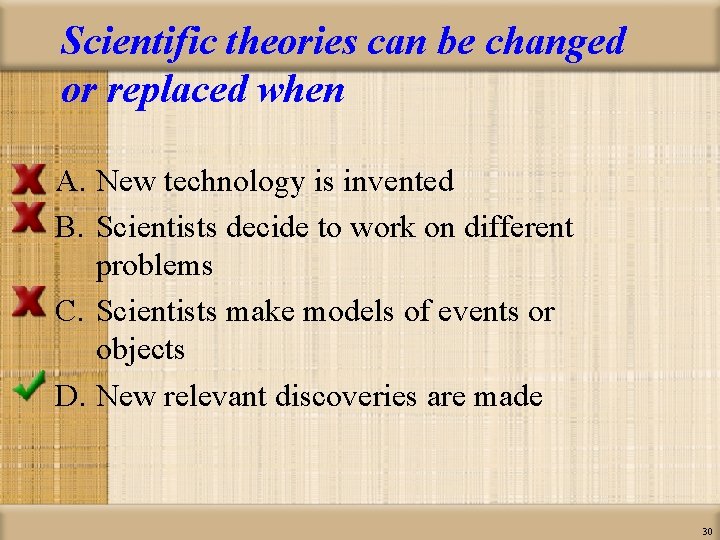
Scientific theories can be changed or replaced when A. New technology is invented B. Scientists decide to work on different problems C. Scientists make models of events or objects D. New relevant discoveries are made 30
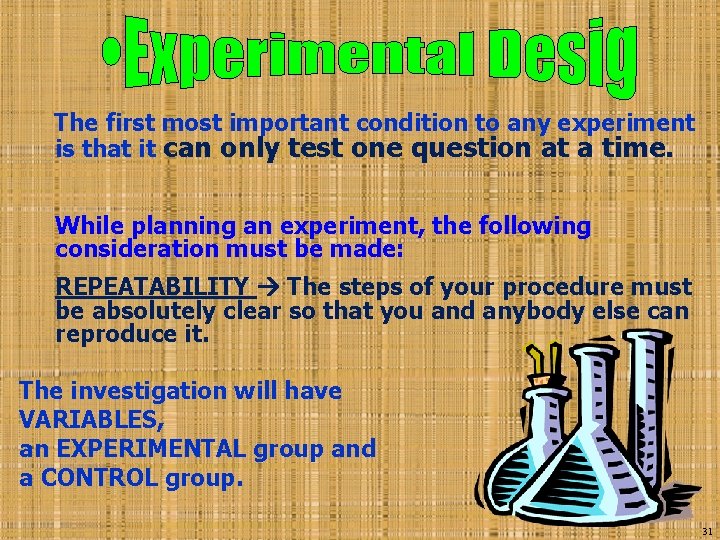
The first most important condition to any experiment is that it can only test one question at a time. While planning an experiment, the following consideration must be made: REPEATABILITY The steps of your procedure must be absolutely clear so that you and anybody else can reproduce it. The investigation will have VARIABLES, an EXPERIMENTAL group and a CONTROL group. 31
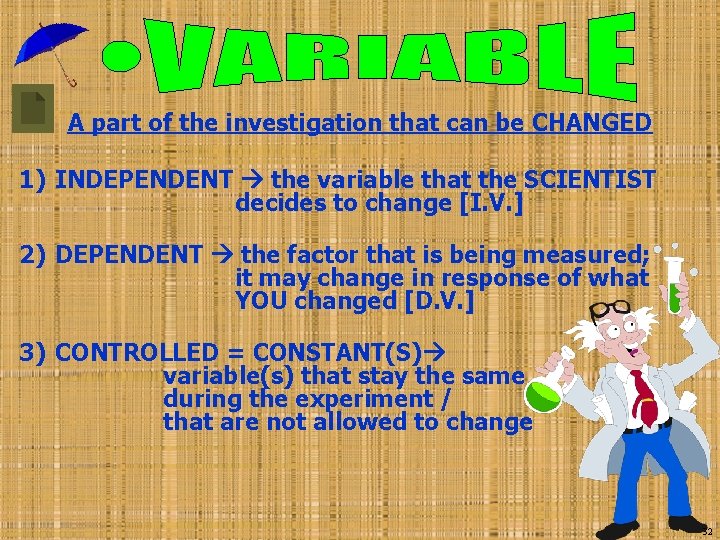
A part of the investigation that can be CHANGED 1) INDEPENDENT the variable that the SCIENTIST decides to change [I. V. ] 2) DEPENDENT the factor that is being measured; it may change in response of what YOU changed [D. V. ] 3) CONTROLLED = CONSTANT(S) variable(s) that stay the same during the experiment / that are not allowed to change 32
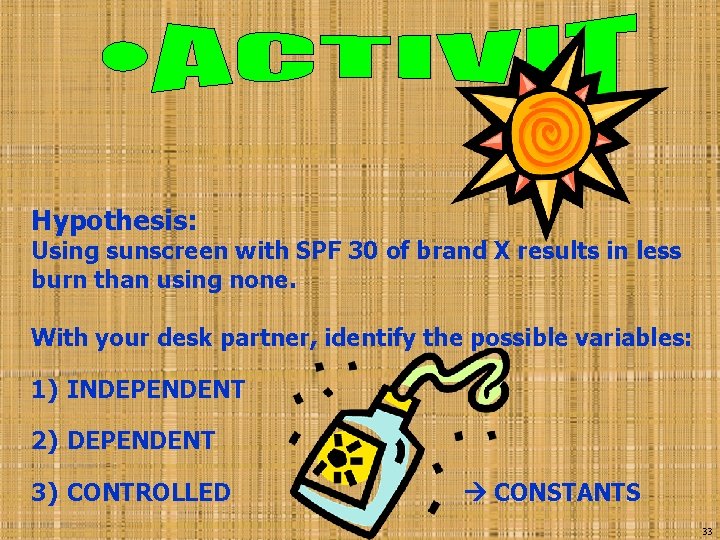
Hypothesis: Using sunscreen with SPF 30 of brand X results in less burn than using none. With your desk partner, identify the possible variables: 1) INDEPENDENT 2) DEPENDENT 3) CONTROLLED CONSTANTS 33
INDEPENDENT CONTROLLED [constants] SUNSCREEN 34
INDEPENDENT CONTROLLED [constants] SUNSCREEN AMOUNT of “BURN” 35
INDEPENDENT CONTROLLED [constants] SUNSCREEN AMOUNT of “BURN” SPF 30 BRAND « X » QUANTITY applied BODY PART(s) LENGTH OF EXPOSURE TIME OF EXPOSURE LOCATION SKIN TYPE 36
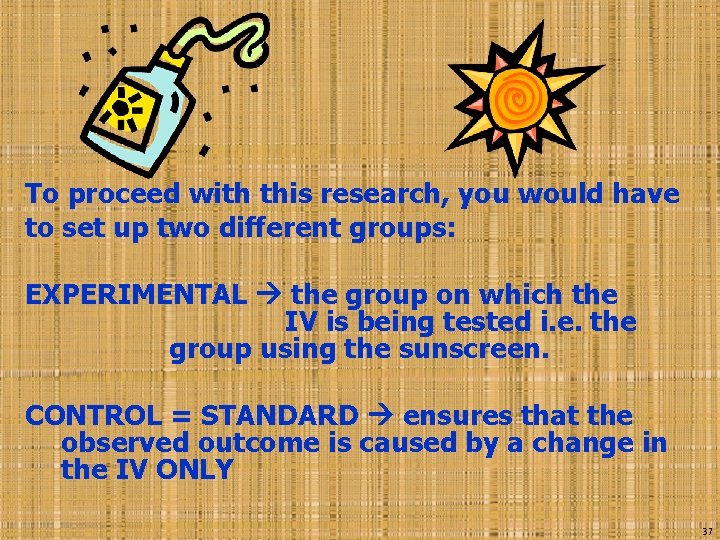
To proceed with this research, you would have to set up two different groups: EXPERIMENTAL the group on which the IV is being tested i. e. the group using the sunscreen. CONTROL = STANDARD ensures that the observed outcome is caused by a change in the IV ONLY 37
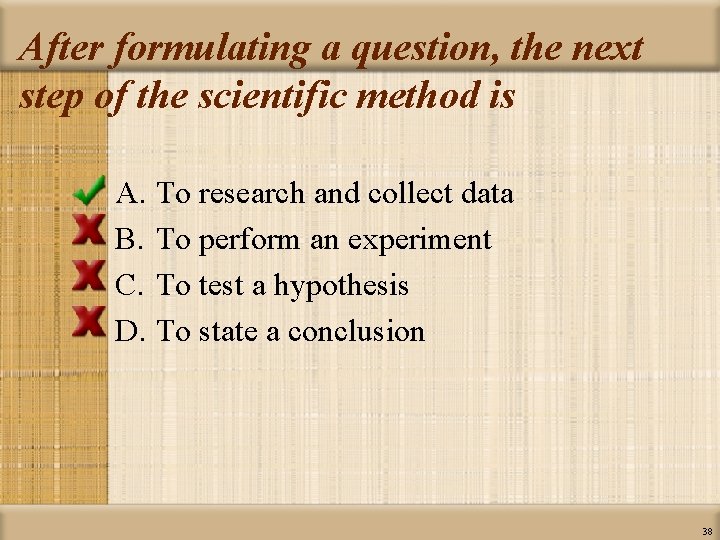
After formulating a question, the next step of the scientific method is A. To research and collect data B. To perform an experiment C. To test a hypothesis D. To state a conclusion 38
Why are REPEATED TRIALS Necessary in an experiment? • To make sure results are valid • The more trials conducted, the more likely the results are reliable • To make sure a “fluke” is not considered the true result 39
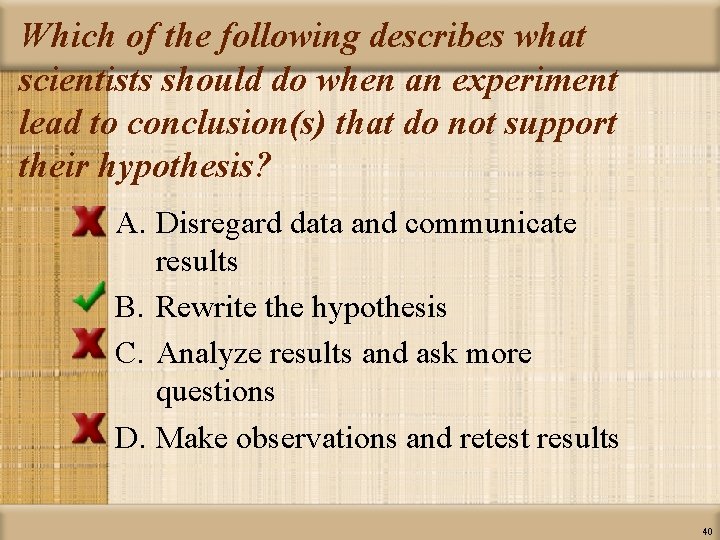
Which of the following describes what scientists should do when an experiment lead to conclusion(s) that do not support their hypothesis? A. Disregard data and communicate results B. Rewrite the hypothesis C. Analyze results and ask more questions D. Make observations and retest results 40
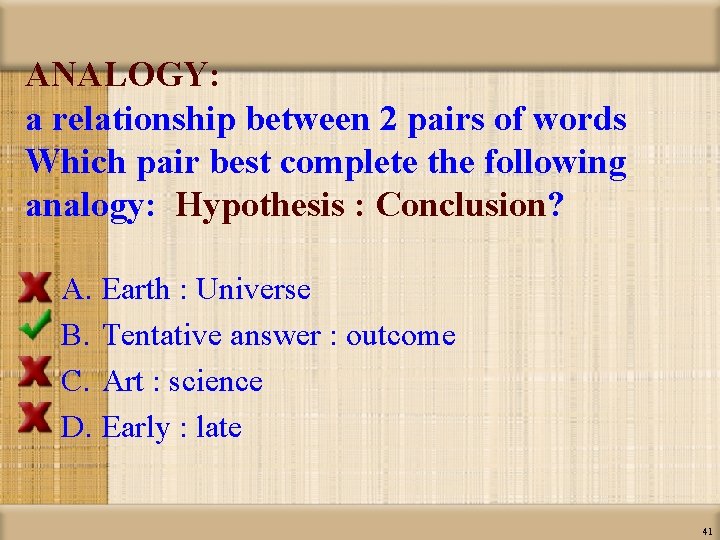
ANALOGY: a relationship between 2 pairs of words Which pair best complete the following analogy: Hypothesis : Conclusion? A. Earth : Universe B. Tentative answer : outcome C. Art : science D. Early : late 41
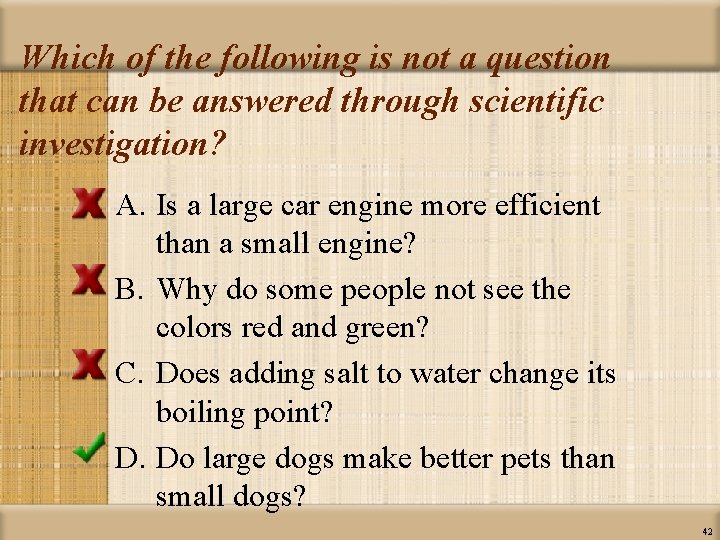
Which of the following is not a question that can be answered through scientific investigation? A. Is a large car engine more efficient than a small engine? B. Why do some people not see the colors red and green? C. Does adding salt to water change its boiling point? D. Do large dogs make better pets than small dogs? 42
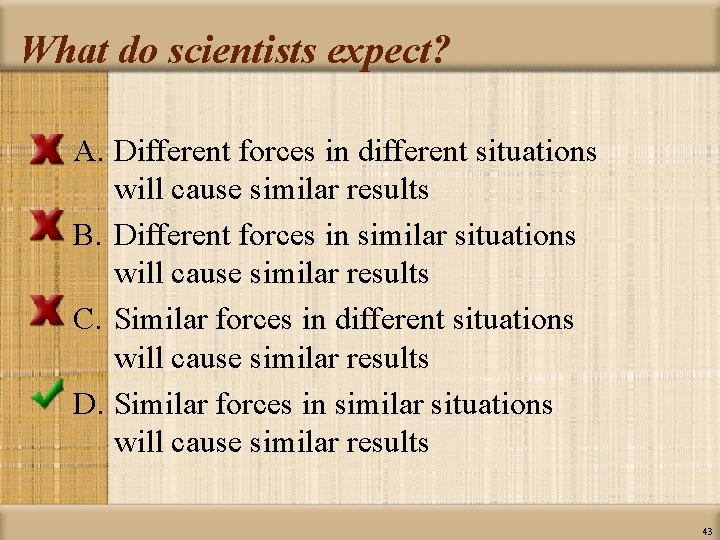
What do scientists expect? A. Different forces in different situations will cause similar results B. Different forces in similar situations will cause similar results C. Similar forces in different situations will cause similar results D. Similar forces in similar situations will cause similar results 43
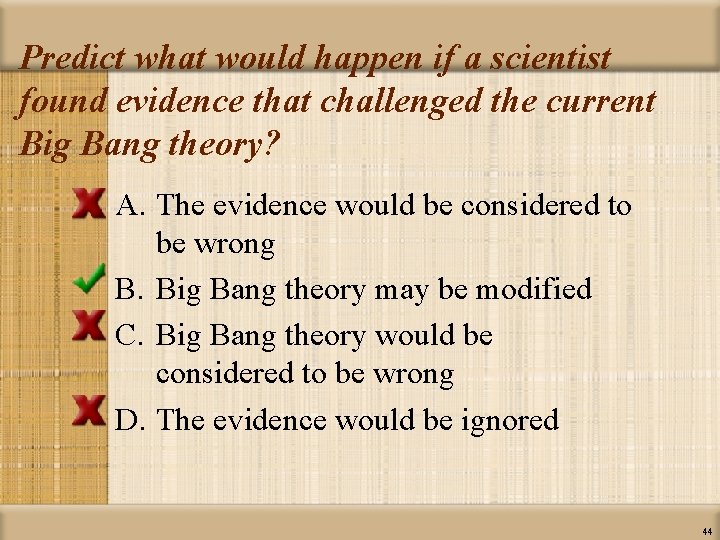
Predict what would happen if a scientist found evidence that challenged the current Big Bang theory? A. The evidence would be considered to be wrong B. Big Bang theory may be modified C. Big Bang theory would be considered to be wrong D. The evidence would be ignored 44
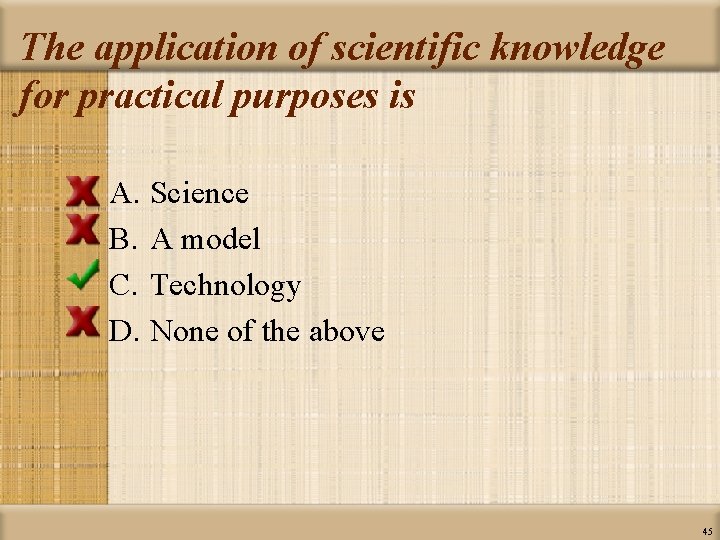
The application of scientific knowledge for practical purposes is A. Science B. A model C. Technology D. None of the above 45
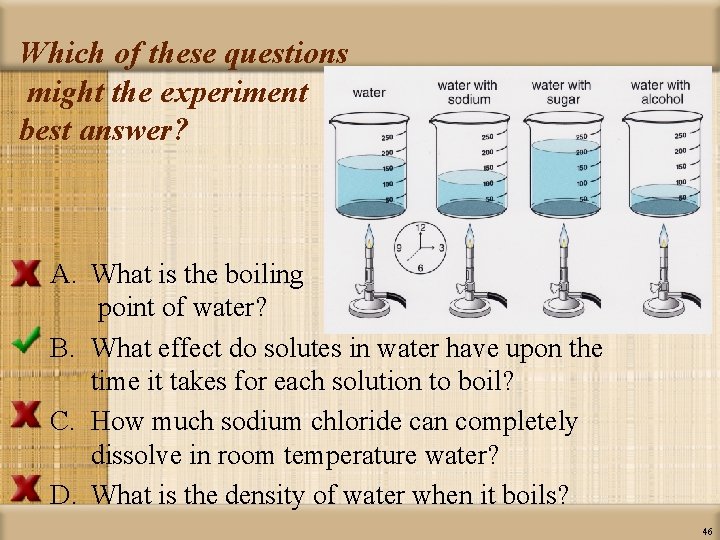
Which of these questions might the experiment best answer? A. What is the boiling point of water? B. What effect do solutes in water have upon the time it takes for each solution to boil? C. How much sodium chloride can completely dissolve in room temperature water? D. What is the density of water when it boils? 46
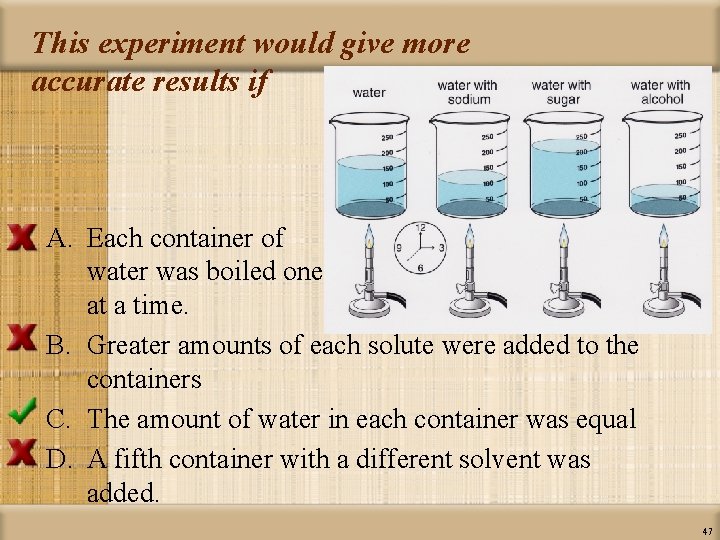
This experiment would give more accurate results if A. Each container of water was boiled one at a time. B. Greater amounts of each solute were added to the containers C. The amount of water in each container was equal D. A fifth container with a different solvent was added. 47
What is the difference between science and technology?
Science is gaining and organizing new knowledge Technology Is the application of that knowledge to achieve practical results [Also know as applied sc. ]