
I can partition whole numbers and decimal fractions

I can partition whole numbers and decimal fractions (to three decimal places) in different ways. I can compare different ways of partitioning the same number. I can partition any whole number flexibly to help me calculate.
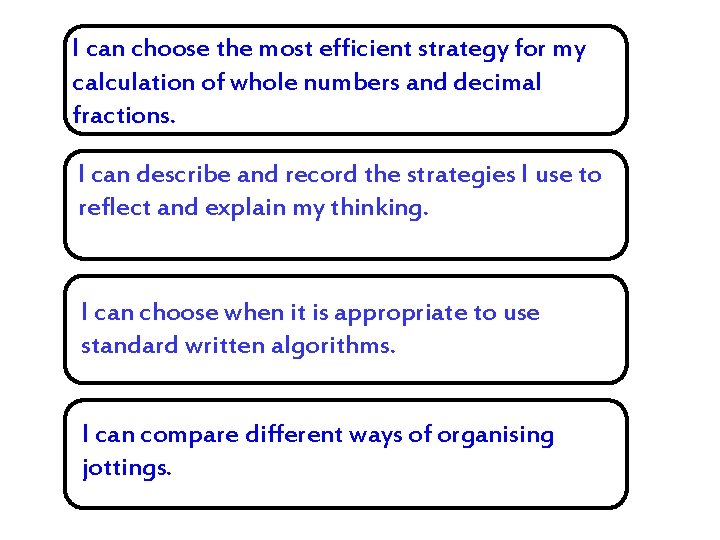
I can choose the most efficient strategy for my calculation of whole numbers and decimal fractions. I can describe and record the strategies I use to reflect and explain my thinking. I can choose when it is appropriate to use standard written algorithms. I can compare different ways of organising jottings.
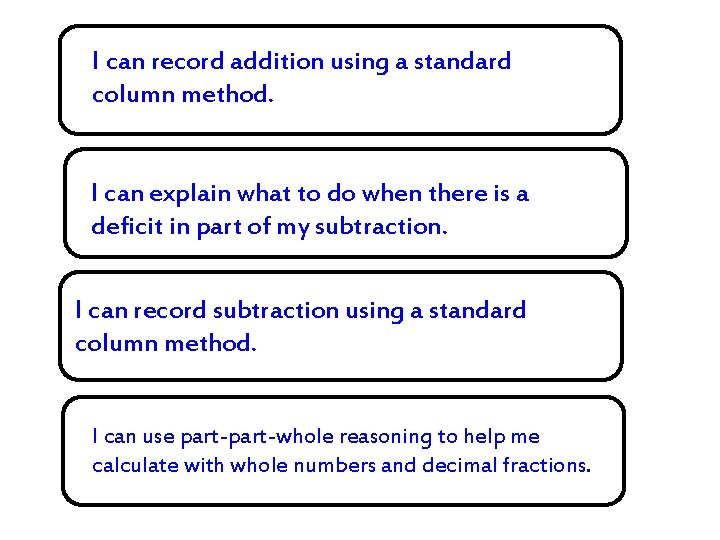
I can record addition using a standard column method. I can explain what to do when there is a deficit in part of my subtraction. I can record subtraction using a standard column method. I can use part-whole reasoning to help me calculate with whole numbers and decimal fractions.

I can use what I know about operations to make a prediction about the solution to problems involving whole numbers and decimal fractions. I can write a number sentence to help me solve add and subtract problems containing larger numbers or decimal fractions. I can use links between add and subtract to make my calculations with larger numbers or decimal fractions easier. I can use links between add and subtract to change a problem so that it can be solved on a calculator.
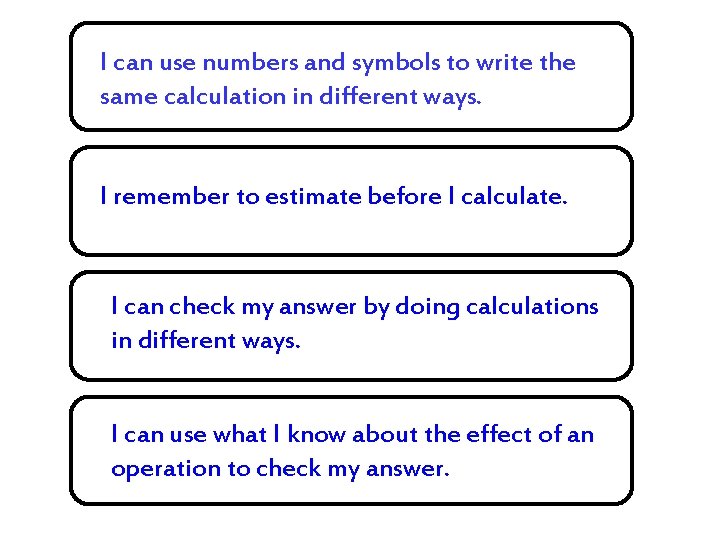
I can use numbers and symbols to write the same calculation in different ways. I remember to estimate before I calculate. I can check my answer by doing calculations in different ways. I can use what I know about the effect of an operation to check my answer.
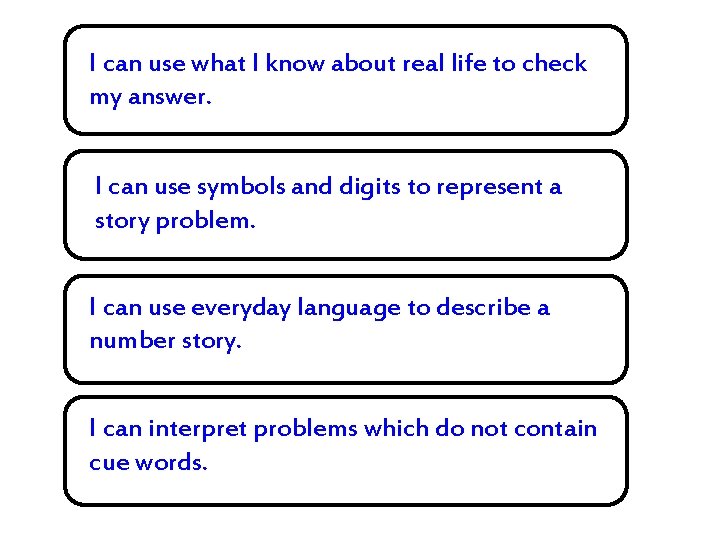
I can use what I know about real life to check my answer. I can use symbols and digits to represent a story problem. I can use everyday language to describe a number story. I can interpret problems which do not contain cue words.
I can choose the most efficient strategy for my calculations. I can use a compensation strategy to add and subtract e. g. 68+37 is 70+35 or 62 -37 is 65 -40. I can describe and record the above to reflect my own strategies and thinking. I can interpret the results of division when the answer is a decimal fraction.
I can accurately enter and read out numbers to 1 000. I can use the memory function. I can explain the effects of entering operations in a different order. I can decide on the correct order to enter operations.
I can add and subtract multiples of 10, 100 and 1000 to and from whole numbers and decimal fractions to two decimal places. I can add and subtract whole numbers and decimal fractions to two decimal places, within the number range of 0 – 1 000.
- Slides: 9