
I can investigate materials which will dissolve I
- Slides: 13
• I can investigate materials which will dissolve. • I can describe dissolving. • I can explain the difference between melting and dissolving. • I can identify materials which will dissolve in water. • I can investigate factors which affect the speed of dissolving.
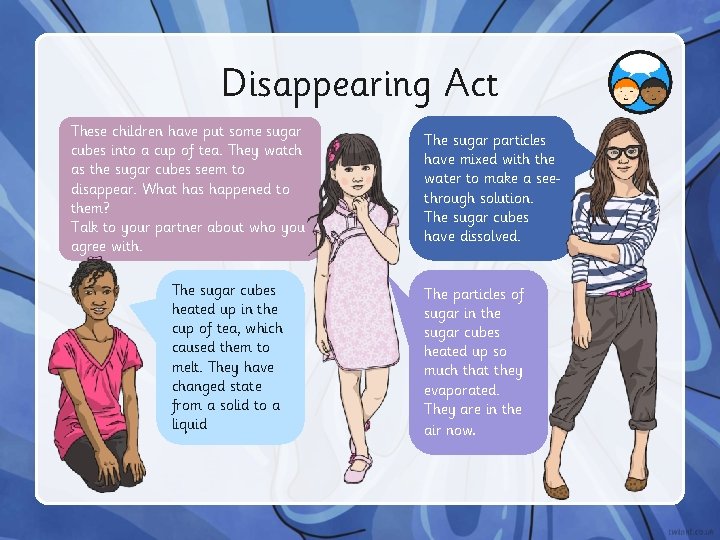
Disappearing Act These children have put some sugar cubes into a cup of tea. They watch as the sugar cubes seem to disappear. What has happened to them? Talk to your partner about who you agree with. The sugar cubes heated up in the cup of tea, which caused them to melt. They have changed state from a solid to a liquid The sugar particles have mixed with the water to make a see through solution. The sugar cubes have dissolved. The particles of sugar in the sugar cubes heated up so much that they evaporated. They are in the air now.
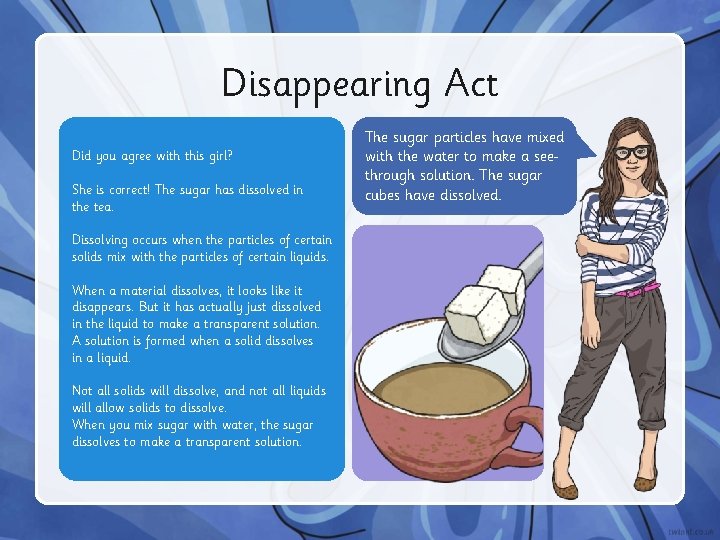
Disappearing Act Did you agree with this girl? She is correct! The sugar has dissolved in the tea. Dissolving occurs when the particles of certain solids mix with the particles of certain liquids. When a material dissolves, it looks like it disappears. But it has actually just dissolved in the liquid to make a transparent solution. A solution is formed when a solid dissolves in a liquid. Not all solids will dissolve, and not all liquids will allow solids to dissolve. When you mix sugar with water, the sugar dissolves to make a transparent solution. The sugar particles have mixed with the water to make a see through solution. The sugar cubes have dissolved.
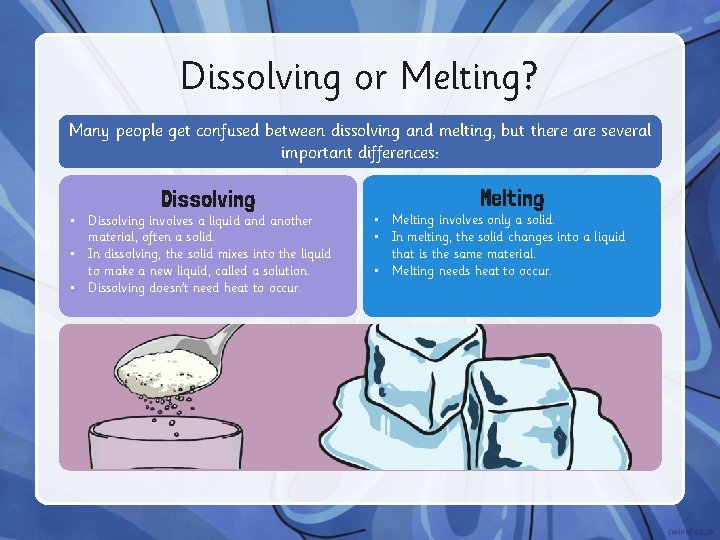
Dissolving or Melting? Many people get confused between dissolving and melting, but there are several important differences: Dissolving • Dissolving involves a liquid another material, often a solid. • In dissolving, the solid mixes into the liquid to make a new liquid, called a solution. • Dissolving doesn't need heat to occur. Melting • Melting involves only a solid. • In melting, the solid changes into a liquid that is the same material. • Melting needs heat to occur.
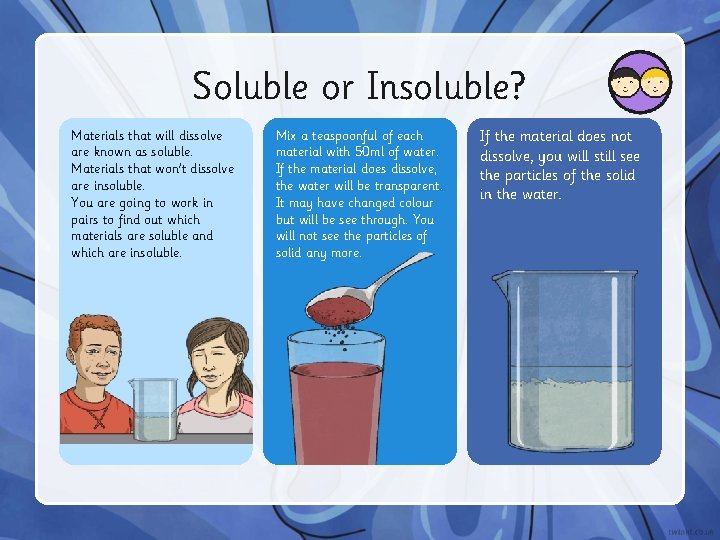
Soluble or Insoluble? Materials that will dissolve are known as soluble. Materials that won't dissolve are insoluble. You are going to work in pairs to find out which materials are soluble and which are insoluble. Mix a teaspoonful of each material with 50 ml of water. If the material does dissolve, the water will be transparent. It may have changed colour but will be see through. You will not see the particles of solid any more. If the material does not dissolve, you will still see the particles of the solid in the water.
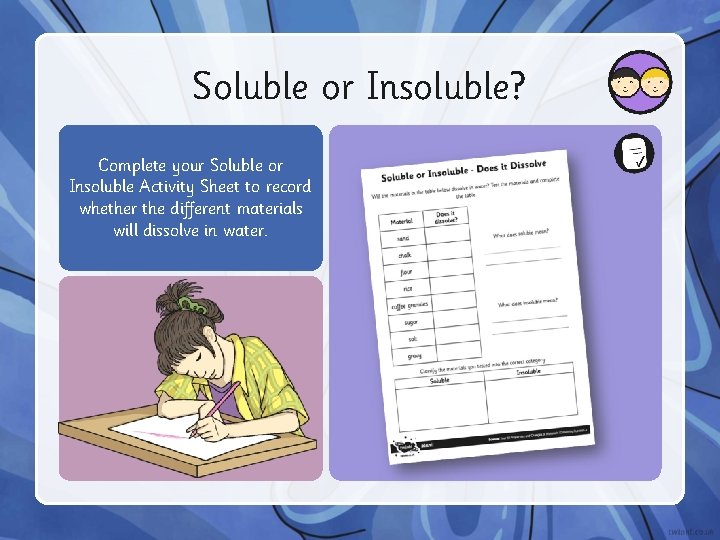
Soluble or Insoluble? Complete your Soluble or Insoluble Activity Sheet to record whether the different materials will dissolve in water.
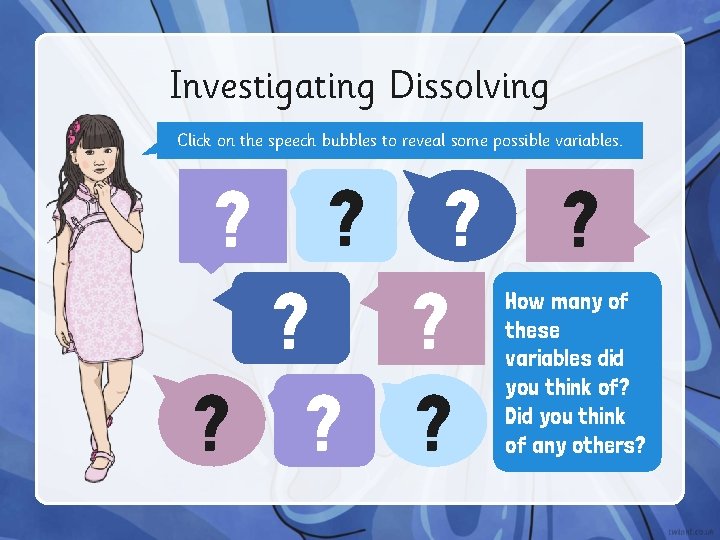
Investigating Dissolving You are going to work in pairs to investigate dissolving. You will need to consider the possible variables that might affect dissolving, then think of a question to ask about one of these variables. Talk to your partner about the possible variables.
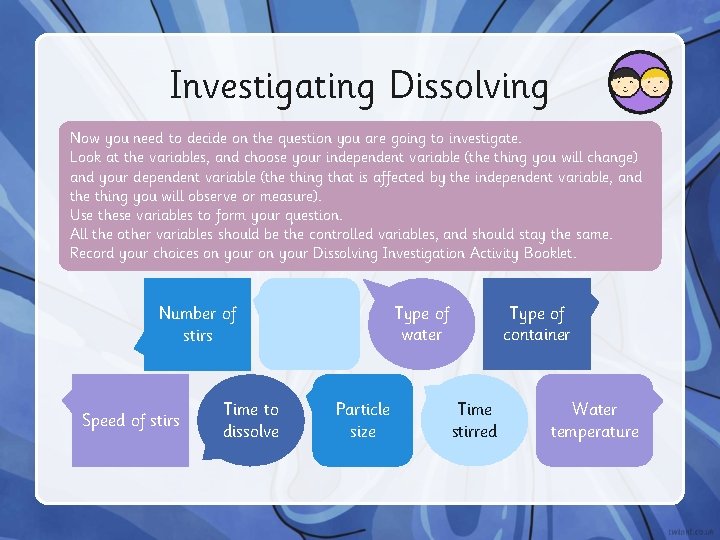
Investigating Dissolving Click on the speech bubbles to reveal some possible variables. ? ? ? ? Number of stirs Type of water Water temperature Time to dissolve Particle size Speed of stirs Time stirred ? Type of container How many of these variables did you think of? Did you think of any others?
Investigating Dissolving Now you need to decide on the question you are going to investigate. Look at the variables, and choose your independent variable (the thing you will change) and your dependent variable (the thing that is affected by the independent variable, and the thing you will observe or measure). Use these variables to form your question. All the other variables should be the controlled variables, and should stay the same. Record your choices on your Dissolving Investigation Activity Booklet. Speed of stirs Time to dissolve Type of container Type of water Number of stirs Particle size Time stirred Water temperature
Share Your Findings Speak to someone in your class who investigated a different question to you. What did they find out? Tell them what you found out. Now speak to someone who investigated the same question as you. Did they find the same answer as you? Can you think why or why not?
• I can investigate materials which will dissolve. • I can describe dissolving. • I can explain the difference between melting and dissolving. • I can identify materials which will dissolve in water. • I can investigate factors which affect the speed of dissolving.