
I CAN Describe capacity and length of LTM
I CAN • Describe capacity and length of LTM • Describe the 4 types of LTM Copyright © Allyn & Bacon 2007
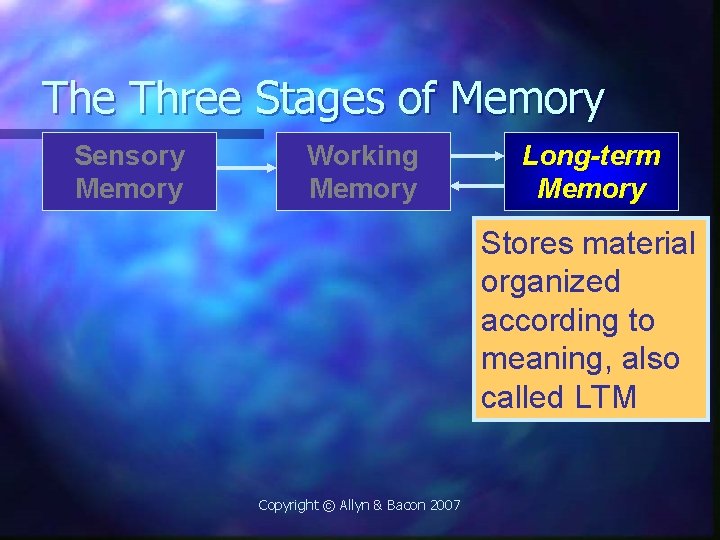
The Three Stages of Memory Sensory Memory Working Memory Long-term Memory Stores material organized according to meaning, also called LTM Copyright © Allyn & Bacon 2007
The Third Stage: Long-Term Memory Capacity and Duration: • Largest capacity and duration • Capacity is unlimited • Lasts a lifetime unless damaged/dementia • Unknown why it has unlimited capacity • Stores information according to meaning Copyright © Allyn & Bacon 2007
Parts of the Brain Associated with Long Term Memory Amygdala and Hypothalamus Strengthens memories that have strong emotional associations…. Posttraumatic Stress Disorder Visual Cortex Generating visual images Hippocampus • Deterioration of the hippocampus the cause of Alzheimer’s Disease • Long term memories make a stop here before going into long term storage Copyright © Allyn & Bacon 2007

The Third Stage: Long-Term Memory Procedural Memory Division of LTM that stores memories for how things are done Example: How to tie a shoe Declarative Memory Division of LTM that stores explicit information (also known as fact memory) Requires some conscious mental effort Example: The capital of Copyright © Allyn & Bacon 2007 Boston Yes…this was intentional
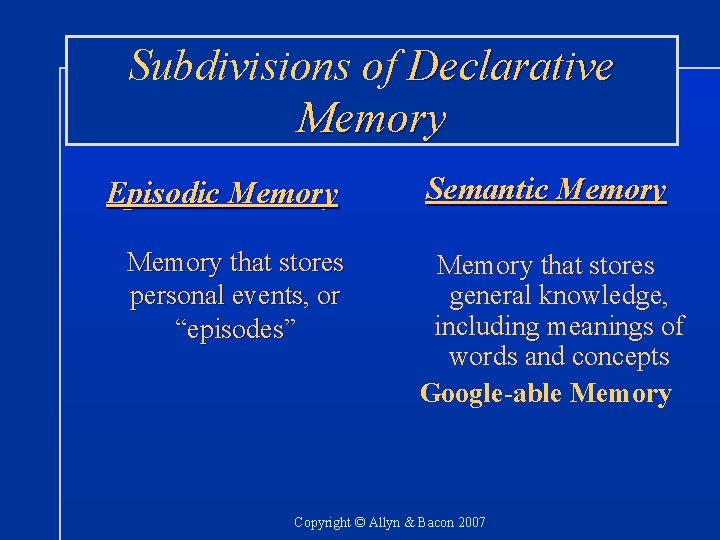
Subdivisions of Declarative Memory Episodic Memory that stores personal events, or “episodes” Semantic Memory that stores general knowledge, including meanings of words and concepts Google-able Memory Copyright © Allyn & Bacon 2007
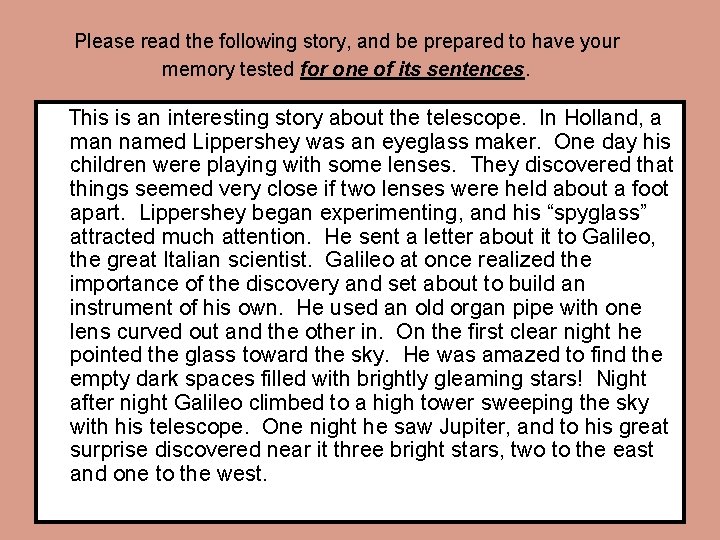
Please read the following story, and be prepared to have your memory tested for one of its sentences. This is an interesting story about the telescope. In Holland, a man named Lippershey was an eyeglass maker. One day his children were playing with some lenses. They discovered that things seemed very close if two lenses were held about a foot apart. Lippershey began experimenting, and his “spyglass” attracted much attention. He sent a letter about it to Galileo, the great Italian scientist. Galileo at once realized the importance of the discovery and set about to build an instrument of his own. He used an old organ pipe with one lens curved out and the other in. On the first clear night he pointed the glass toward the sky. He was amazed to find the empty dark spaces filled with brightly gleaming stars! Night after night Galileo climbed to a high tower sweeping the sky with his telescope. One night he saw Jupiter, and to his great surprise discovered near it three bright stars, two to the east and one to the west. Copyright © Allyn & Bacon 2007
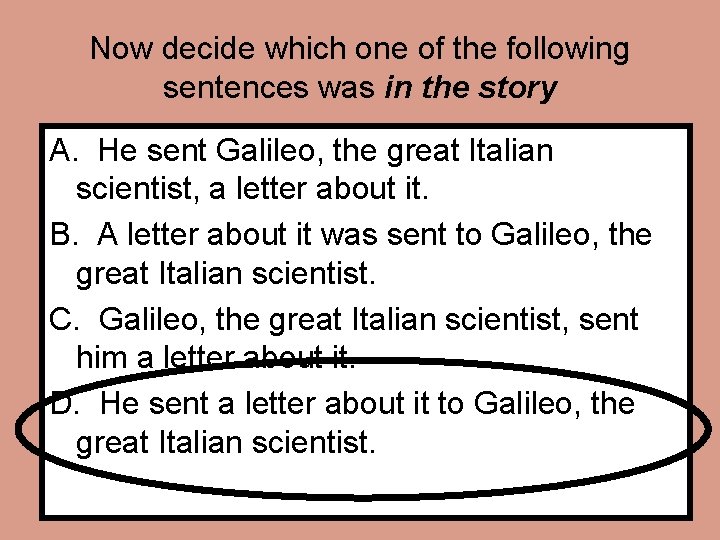
Now decide which one of the following sentences was in the story A. He sent Galileo, the great Italian scientist, a letter about it. B. A letter about it was sent to Galileo, the great Italian scientist. C. Galileo, the great Italian scientist, sent him a letter about it. D. He sent a letter about it to Galileo, the great Italian scientist. Copyright © Allyn & Bacon 2007

Long-term memory Declarative memory Procedural memory Semantic memory Episodic memory Includes memory for: language, facts general knowledge Includes memory for: events, personal experiences Copyright © Allyn & Bacon 2007 Includes memory for: motor skills, operant and classical conditioning

Eidetic Memory • The so-called “photographic” memory • An "unfounded myth? ? ? " • Evidence of it is found more often in children than adults Eidetic memory as observed in children is typified by the ability of an individual to study an image for approximately 30 seconds, and maintain a nearly perfect photographic memory of that image for a short time once it has been removed Copyright © Allyn & Bacon 2007
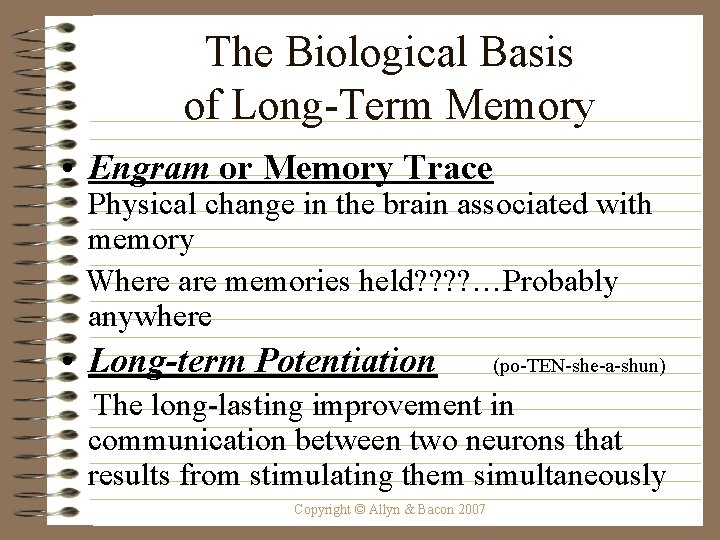
The Biological Basis of Long-Term Memory • Engram or Memory Trace Physical change in the brain associated with memory Where are memories held? ? …Probably anywhere • Long-term Potentiation (po-TEN-she-a-shun) The long-lasting improvement in communication between two neurons that results from stimulating them simultaneously Copyright © Allyn & Bacon 2007
The Biological Basis of Long-Term Memory Consolidation The process by which short-term memories are changed to long-term memories Copyright © Allyn & Bacon 2007
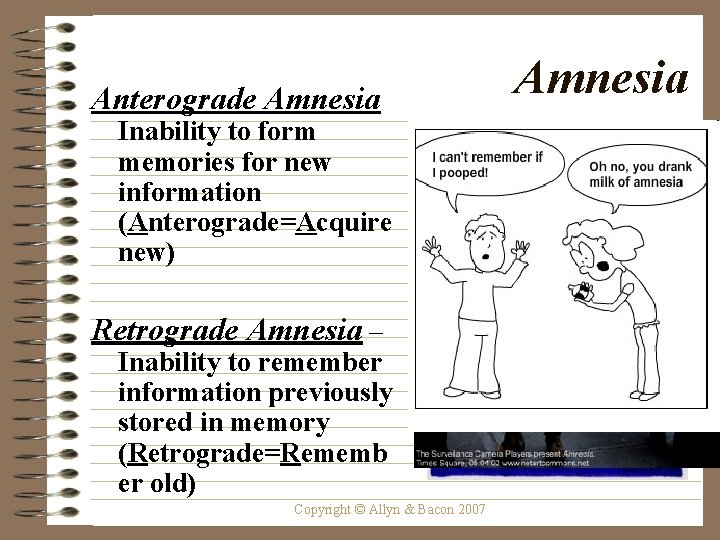
Anterograde Amnesia Inability to form memories for new information (Anterograde=Acquire new) Retrograde Amnesia – Inability to remember information previously stored in memory (Retrograde=Rememb er old) Copyright © Allyn & Bacon 2007 Amnesia
50 First Dates Trailer Watch 50 First Dates. Copyright trailer © Allyn & Bacon 2007 • http: //www. youtube. com/watch? v=Erj. P 5 x. MTc 8 I

Flashbulb Memories Clear, vivid long term memory of an especially meaningful and emotional event Usually accurate for at least the first year after the event Information can be lost, but not destroyed or deleted Copyright © Allyn & Bacon 2007
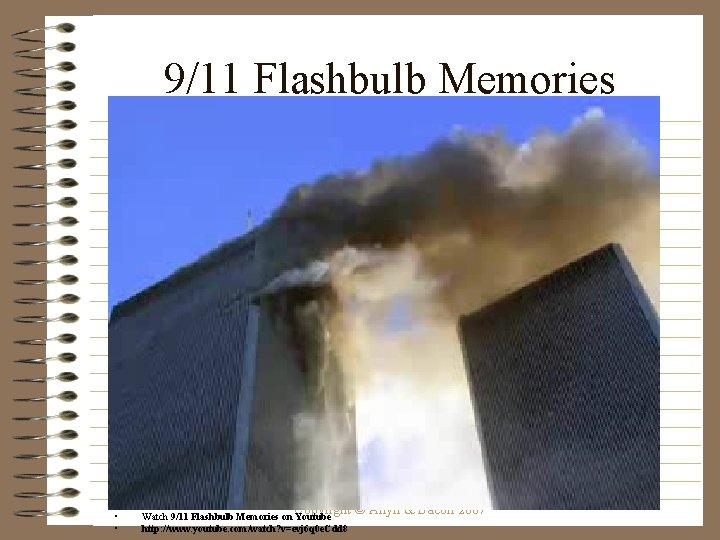
9/11 Flashbulb Memories • • Copyright © Allyn & Bacon 2007 Watch 9/11 Flashbulb Memories on Youtube http: //www. youtube. com/watch? v=evj 6 q 0 e. Cdd 8
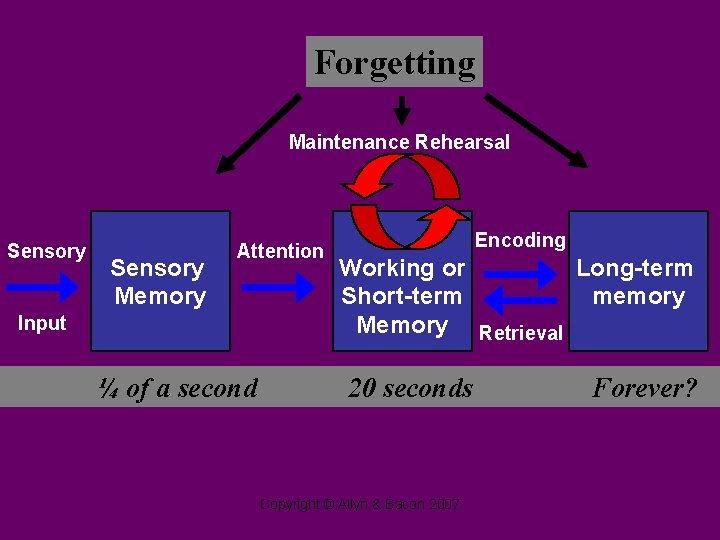
Forgetting Maintenance Rehearsal Sensory Memory Attention Input ¼ of a second Encoding Working or Long-term Short-term memory Memory Retrieval 20 seconds Copyright © Allyn & Bacon 2007 Forever?
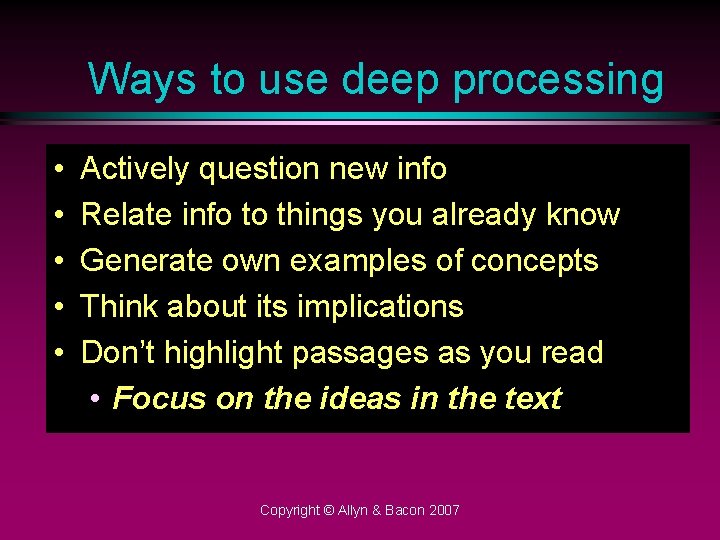
Ways to use deep processing • • • Actively question new info Relate info to things you already know Generate own examples of concepts Think about its implications Don’t highlight passages as you read • Focus on the ideas in the text Copyright © Allyn & Bacon 2007
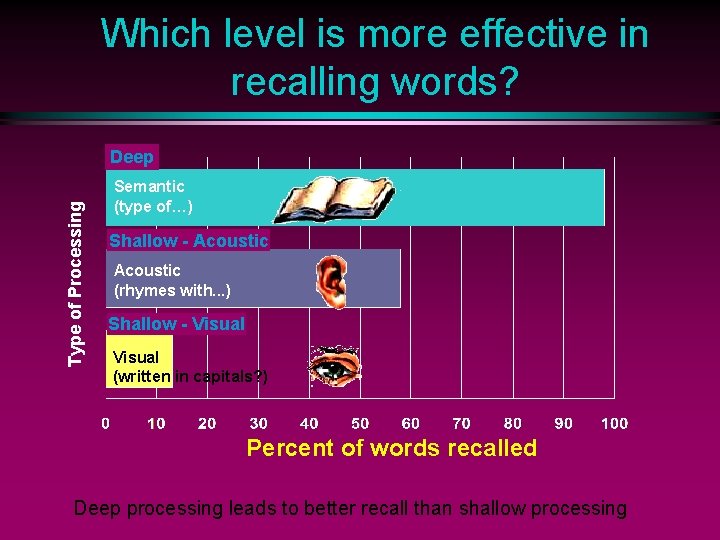
Which level is more effective in recalling words? Type of Processing Deep Semantic (type of…) Shallow - Acoustic (rhymes with. . . ) Shallow - Visual (written in capitals? ) Percent of words recalled Deep processing leads to better recall than Copyright © Allyn & Bacon 2007 shallow processing
CAN I? • Describe capacity and length of LTM • Describe the 4 types of LTM Copyright © Allyn & Bacon 2007
- Slides: 20