
I bet you didnt know How to clean
I bet you didn’t know… How to clean water using a sieve! Teacher Guide Curriculum Areas Materials Separating mixtures Dissolving Ages 4 -11 years
Copyright The materials included in these resources are ©Primary Science Teaching Trust 2019, but may be freely reproduced by teachers in schools for educational purposes, subject to the source being credited. Materials may not be used for promotional or commercial purposes without the express permission of the PSTT. On no account may copies be offered for sale. Disclaimer Primary Science Teaching Trust (PSTT) is not liable for the actions or activities of any reader or anyone else who uses the information in this document or the associated classroom materials. PSTT assumes no liability with regard to injuries or damage to property that may occur as a result of using the information contained in these plans. PSTT recommends that a full risk assessment is carried out before undertaking in the classroom any of the practical investigations contained in the power point. Safety note PSTT advises teachers to refer to either CLEAPSS website or SSERC website for up to date health and safety information when planning practical activities for children. This power point is intended to be a guide for teachers for their reference although they may wish to show certain slides in the classroom. We would welcome any feedback on these materials.
Who are the scientists? 1. 2. 3. 4. National Graphene Institute, University of Manchester. School of Chemical Engineering and Analytical Science, University of Manchester. School of Physics and Astronomy, University of Manchester. School of Materials, University of Manchester. Why are there so many different people from different departments in the University working on this project? How did they manage to work together on this project?
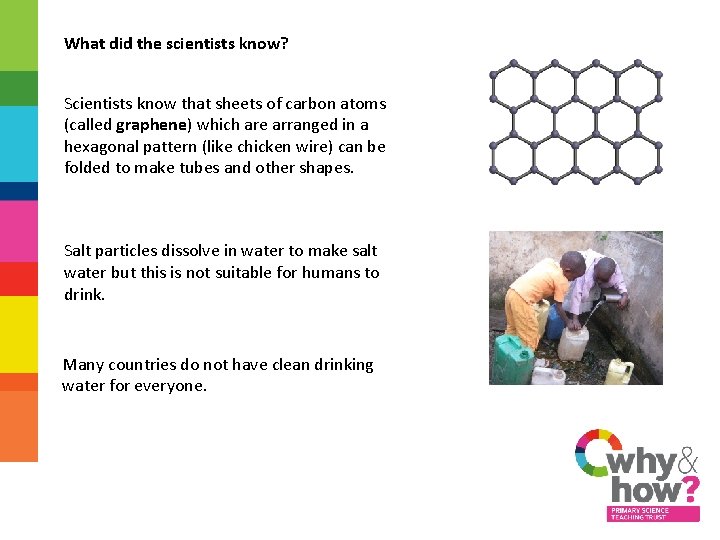
What did the scientists know? Scientists know that sheets of carbon atoms (called graphene) which are arranged in a hexagonal pattern (like chicken wire) can be folded to make tubes and other shapes. Salt particles dissolve in water to make salt water but this is not suitable for humans to drink. Many countries do not have clean drinking water for everyone.
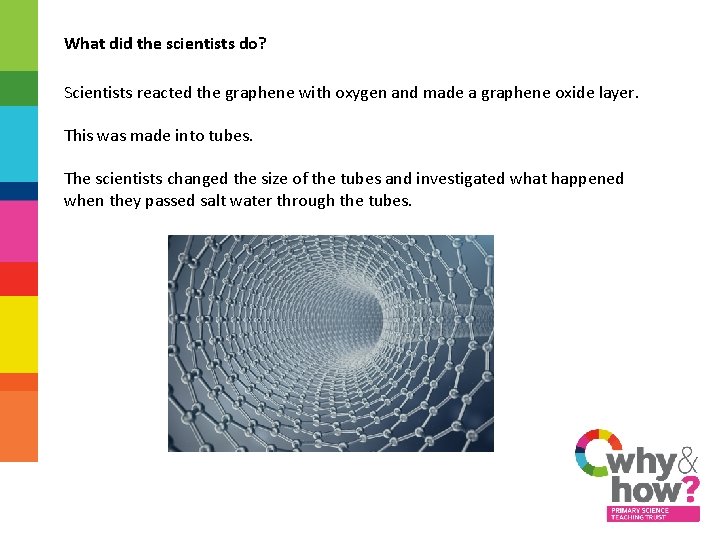
What did the scientists do? Scientists reacted the graphene with oxygen and made a graphene oxide layer. This was made into tubes. The scientists changed the size of the tubes and investigated what happened when they passed salt water through the tubes.
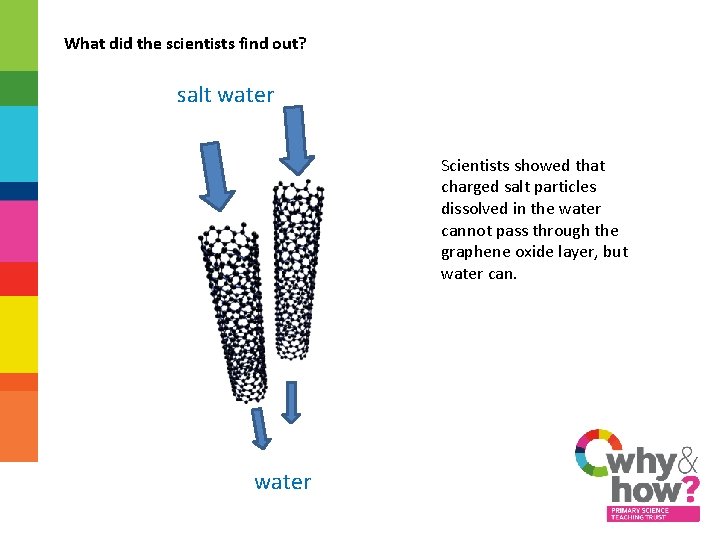
What did the scientists find out? salt water Scientists showed that charged salt particles dissolved in the water cannot pass through the graphene oxide layer, but water can. water
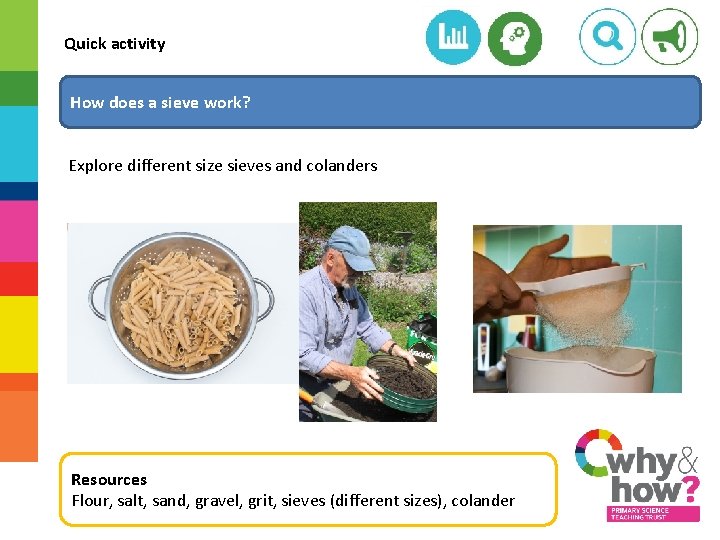
Quick activity How does a sieve work? Explore different size sieves and colanders Resources Flour, salt, sand, gravel, grit, sieves (different sizes), colander
![Longer investigation [1] How does a sieve work? or Make a sieve using paper/card.](http://slidetodoc.com/presentation_image_h/35a87d27bc4049e0e9161a153aeaa8fc/image-8.jpg "Longer investigation [1] How does a sieve work? or Make a sieve using paper/card.")
Longer investigation [1] How does a sieve work? or Make a sieve using paper/card. Make a sieve using construction toys Resources Paper/card, scissors, glue, Lego (or similar construction bricks), small objects to be separated
![Longer investigation [2] Can you make a model to explain how researchers are cleaning](http://slidetodoc.com/presentation_image_h/35a87d27bc4049e0e9161a153aeaa8fc/image-9.jpg "Longer investigation [2] Can you make a model to explain how researchers are cleaning")
Longer investigation [2] Can you make a model to explain how researchers are cleaning water? Resources mesh bags, mesh fabrics, bird netting, modelling clay, paper, card, scissors jelly babies, cocktail sticks, or Tip: Children could make model particles of appropriate sizes to represent the water and salt particles.
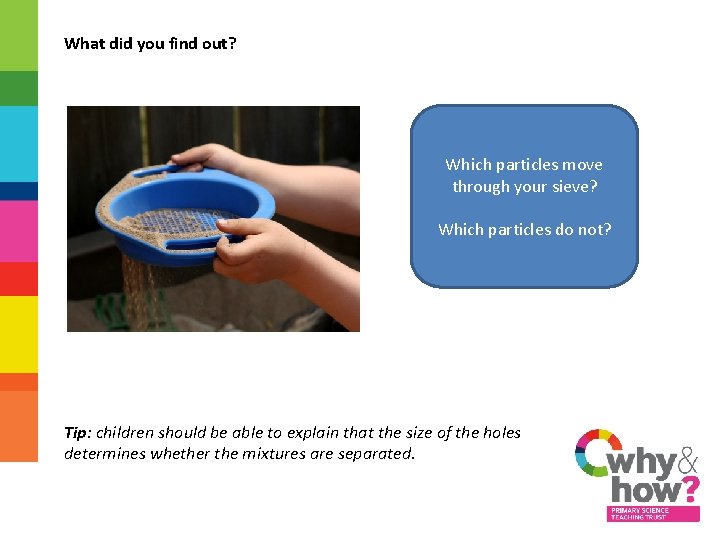
What did you find out? Which particles move through your sieve? Which particles do not? Tip: children should be able to explain that the size of the holes determines whether the mixtures are separated.
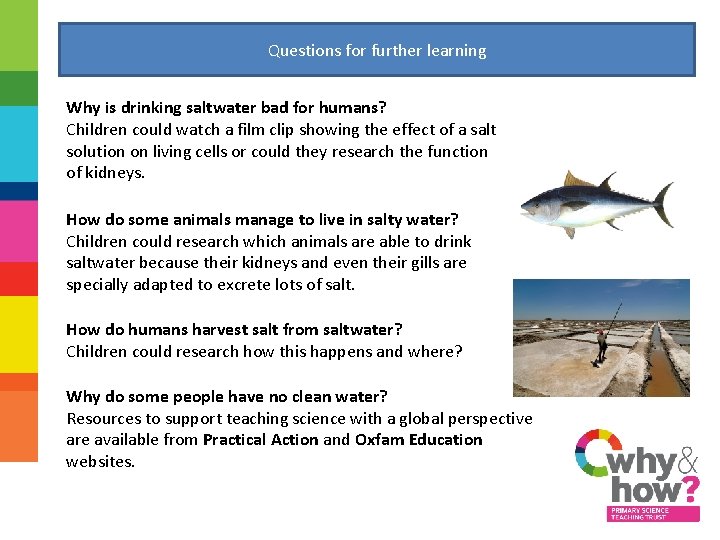
Questions for further learning Why is drinking saltwater bad for humans? Children could watch a film clip showing the effect of a salt solution on living cells or could they research the function of kidneys. How do some animals manage to live in salty water? Children could research which animals are able to drink saltwater because their kidneys and even their gills are specially adapted to excrete lots of salt. How do humans harvest salt from saltwater? Children could research how this happens and where? Why do some people have no clean water? Resources to support teaching science with a global perspective are available from Practical Action and Oxfam Education websites.
Maths links Area of learning Activity Relative sizes of solids Separating mixtures Measuring accurately (cm or mm) Comparing the sizes of particles and holes
Writing links Area of learning Activity Persuasive writing write a letter to a funding organisation asking for money to develop molecular sieves Instructions How to separate a mixture of … Non-chronological report Write an explanation of the model molecular sieve Newspaper report Describe what life is like for families who do not have access to clean water
For more information on the Primary Science Teaching Trust and access to a large selection of PSTT resources, visit our website: pstt. org. uk /primaryscienceteachingtrust @pstt_whyhow To help you find high quality resources to support your primary science teaching quickly and easily, we provide links to excellent resources for teachers, children and families on our Wow Science website : wowscience. co. uk and we regularly provide further suggestions on how to use these in the classroom through social media platforms: /wowscience @Wow. Science. HQ
- Slides: 14