
I Bar Removable Partial Dentures DR SHAISTA AFROZ
I Bar Removable Partial Dentures DR SHAISTA AFROZ
• Support for distal extension partial denture – Teeth – Soft Tissue • Teeth are less displaceable and less compressible • A design which distributes the load evenly without overloading the teeth or soft tissue
Historically, teeth serving as distal extension abutments were at increased risk for early tooth loss. The two most commonly cited causes for abutment loss were – Overloading – periodontal disease.
![]-bar design • 1963 - Kratochvil • This philosophy was based upon use of](http://slidetodoc.com/presentation_image/2edea2b6ca51bcb059b098a1a97ed681/image-4.jpg "]-bar design • 1963 - Kratochvil • This philosophy was based upon use of")
]-bar design • 1963 - Kratochvil • This philosophy was based upon use of : – I-bar retentive element, – Mesial rest, – Distal proximal plate ( long distal guiding plane that extends to the tooth-tissue junction) • ( Proponents of the I-bar philosophy claimed that the resultant clasp design minimized torquing forces and directed occlusal loads parallel to the long axes of abutments. )
Design Concepts Rationale : The most posterior rests are placed on the mesial surfaces of the abutment teeth for the following reasons: – During the application of occlusal loads, rests serve as rotational centers. As the distance from the rotational center to the denture base is increased, the associated radius becomes larger, and the accompanying arc becomes more linear. – Consequently, the forces are directed vertically onto the bearing tissues beneath the denture base.
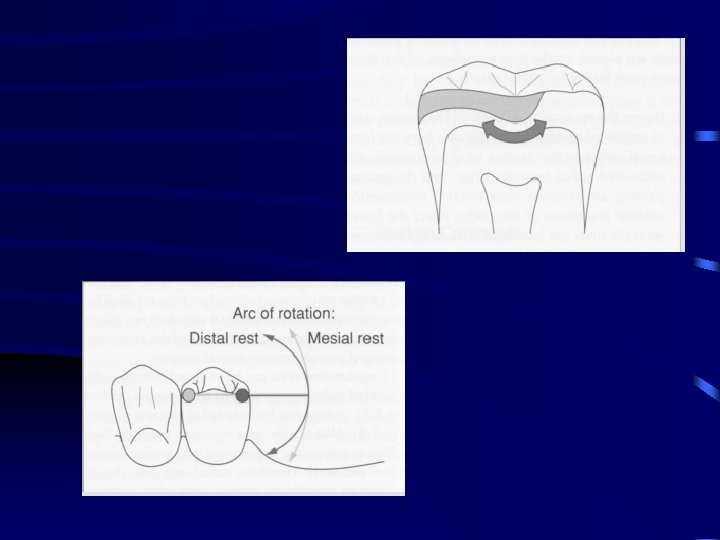
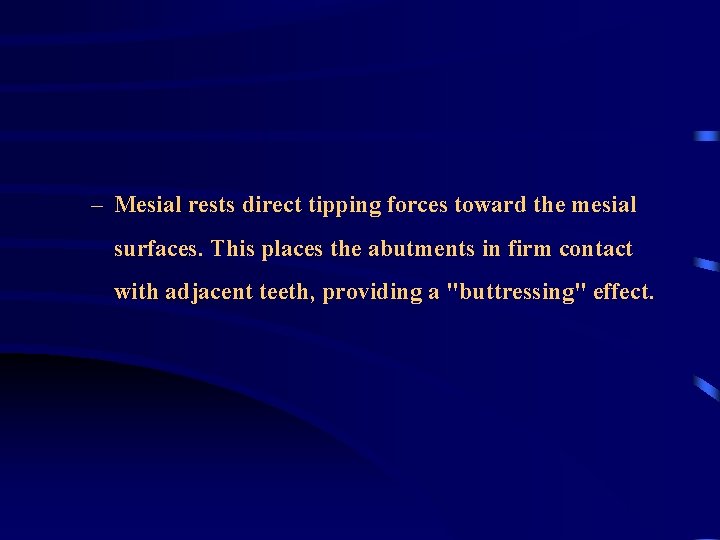
– Mesial rests direct tipping forces toward the mesial surfaces. This places the abutments in firm contact with adjacent teeth, providing a "buttressing" effect.
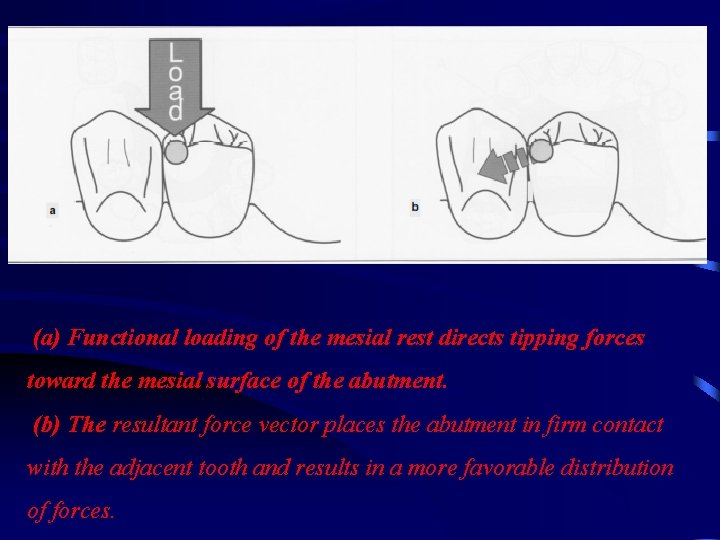
(a) Functional loading of the mesial rest directs tipping forces toward the mesial surface of the abutment. (b) The resultant force vector places the abutment in firm contact with the adjacent tooth and results in a more favorable distribution of forces.
Proximal plates Guiding planes are prepared on proximal tooth surfaces adjacent to edentulous spaces. Proximal plates cover these guiding planes from marginal ridge to tooth-tissue junction and extend onto the attached gingiva for 2 mm This design 1. Permits improved stabilization of the prosthesis 2. Reunites and stabilizes remaining teeth within the dental arch

3. Improves retentive characteristics by limiting/defining the path of insertion and removal. 4. Protects the tooth-tissue junction by reducing food impaction between the tooth and the proximal plate. 5. Provides reciprocation during insertion and removal of the prosthesis 6. Distributes occlusal forces throughout the arch.
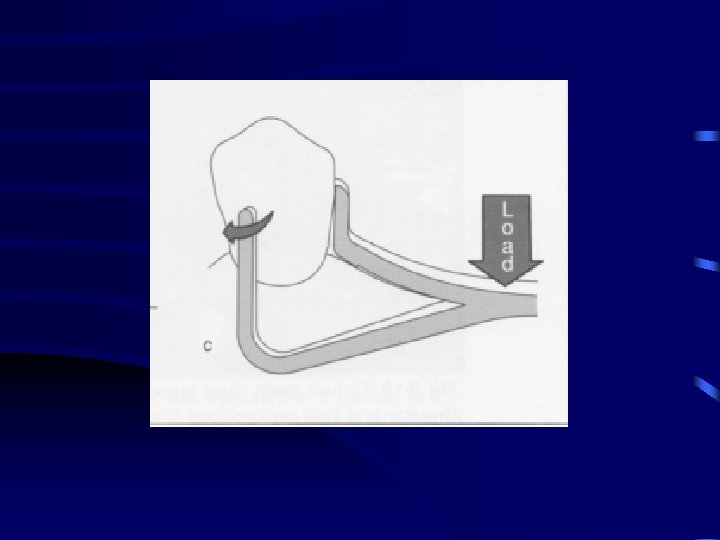
I bar direct retainer Following Kratochvil's guidance, direct retention is provided I-bar retentive elements – The clasp terminus engages an undercut at the height of mesiodistal contour or slightly mesial to it. – This position of the I-bar in relation to the height of contour allows the clasp terminus to move passively toward the mesial embrasure space when a load is applied to the denture base.
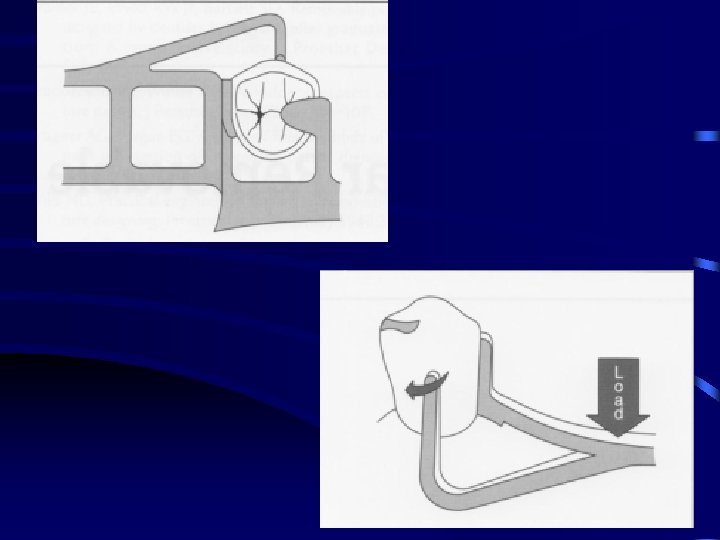
The following important advantages are gained with the 1 -bar configuration: 1. Food accumulation is minimized because tooth contours are not significantly altered. 2. The clasp terminus disengages from the tooth when an occlusal load is applied to the adjacent distal extension base. 3. Because the approach arm does not contact the abutment, lateral forces are minimized.
Disadvantages of the 1 -bar stem from its minimal tooth contact and small clasp terminus. The following are of consequence only if the design concept is not properly executed: 1. Less horizontal stability than other types of clasp assemblies 2. Less retention
Physiologic Adjustment of Extension Base Removable Partial Dentures To allow movement of the partial denture around the axis of rotation and to better distribute an occlusal load to the edentulous ridge, it is necessary to reduce binding between the framework and the abutments. This is accomplished by precise adjustment of the removable partial denture framework under physiologic loading conditions.
• The rests of a properly adjusted framework should rotate in their rest seats without lifting. • In the passive state, the rests make full contact with the rest preparations, and extension bases are closely adapted to the soft tissues. • In function, movement is dependent upon the resiliency of the supporting soft tissues.
Design Variations Physical considerations and alternate components • Commonly encountered difficulties include – Tipped abutments, – Unfavourable soft tissue contours, – poorly positioned frenum attachments.
• Tipping of abutments may complicate retention and clasping in several ways. • Buccolingual tipping frequently creates excessive undercuts or eliminates undercuts entirely. • When tipping creates an excessive undercut, the solutions include (1) enameloplasty to reduce the undercut or (2) the placement of a cast restoration to provide improved abutment contours.

When tipping results in an inadequate undercut, the solutions are (1) preparation of an undercut via enameloplasty (2) use of an existing undercut on the opposite surface (i. elingual vs buccal).
Rest, proximal plate, and I-bar (RPI) • Krol, – opposed to extensive tooth preparation, developed a design modification requiring less tooth alteration. • Rationale – stress control with minimal hard and soft tissue coverage.
• Krol's clasp assembly includes the three elements of Kratochvil's system: – Mesial rest, – Proximal plate, – I-bar • Each element, however, has undergone significant change to meet "minimal coverage“ criteria.
• Rest – preparations are less extensive in the RPI system. • Extend only into the triangular fossa in molars • Canine rest seats - circular, concave depressions prepared in mesial marginal ridges.
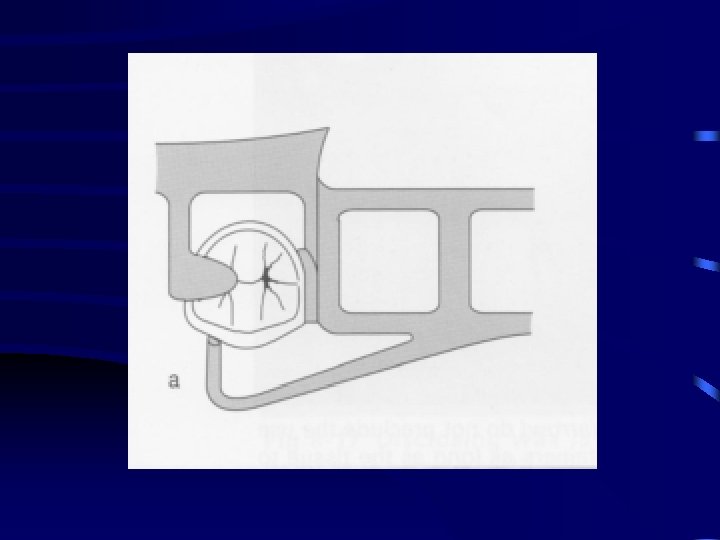
Proximal Plate • The prepared guiding plane is 2 to 3 mm high occlusogingivally, and the proximal plate contacts only the apical 1 mm of the guiding plane. • Relief -at the tooth-tissue junction to allow the proximal plate to disengage when loaded. • The stated purpose - improve gingival health by opening embrasure spaces. • Limitations- impaction of food
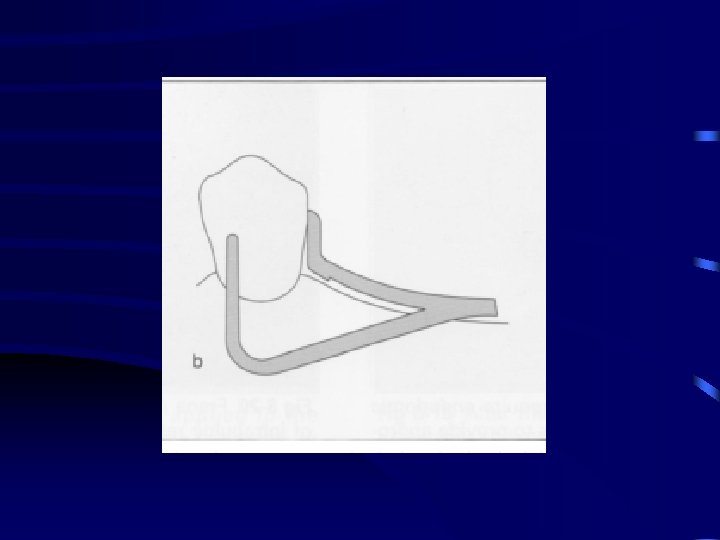
Modifications in I-bar configuration and placement compensate for reduce tooth contact by the proximal plate. The I-bar terminus - pod shaped to allow additional tooth contact, the vertical portion of the clasp arm - more mesial position to achieve efficient reciprocation from the smaller proximal plate.
Conclusion The most valid indicators of distal extension removable partial denture success are: (1) abutment teeth that are periodontally healthy and well maintained; (2) a partial denture framework that fits the teeth well; and (3) a denture base that fits the supporting soft tissues well, ideally derived from an altered cast technique.
REFERENCES MC CRACKEN’S REMOVABLE PARTIAL DENTURE STEWART’S REMOVABLE PROSTHDONTTICS ALL THE TEXT AND PICTURES ARE TAKEN FROM MCCRACKEN’S REMOVABLE PROSTHODONTICS AND STEWERT’S CLINICAL REMOVABLE PROSTHODONTICS FOR THE SAKE OF STUDENT’S EDUCATION.
- Slides: 30