
I Attention Getter A Link B Thesis II
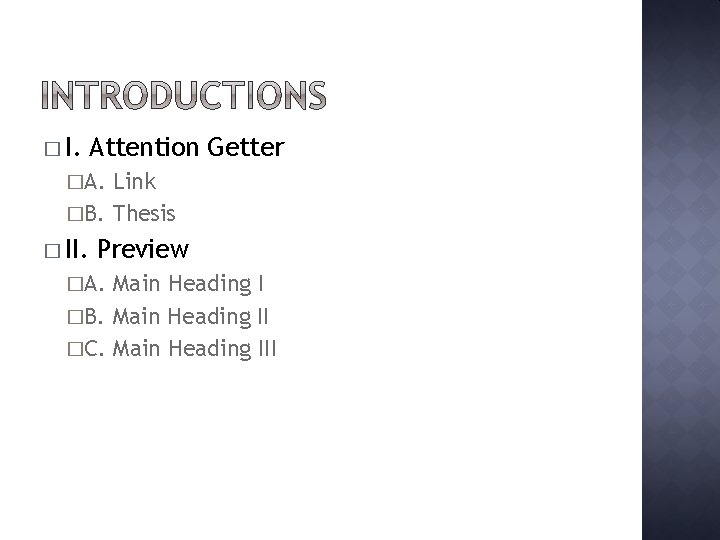
� I. Attention Getter �A. Link �B. Thesis � II. Preview �A. Main Heading I �B. Main Heading II �C. Main Heading III
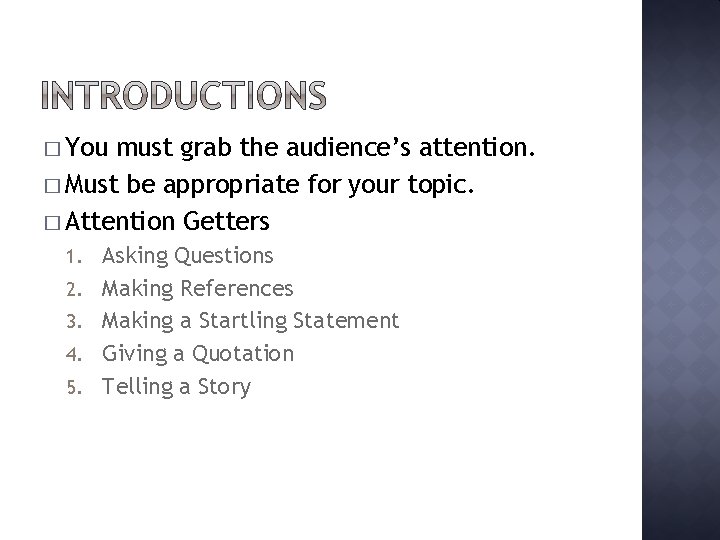
� You must grab the audience’s attention. � Must be appropriate for your topic. � Attention Getters 1. 2. 3. 4. 5. Asking Questions Making References Making a Startling Statement Giving a Quotation Telling a Story
� Gets audience members directly involved. � Makes them participants in your speech. � Makes your audience curious. � Usually best to use rhetorical questions.
� Allows you to work with your audience. � Can make references to: �People in the audience �Surroundings �Significance of the Occasion � Use good taste and common sense! �Should get you a positive start, not put your speech in jeopardy.
� Used to “jolt” your audience. � Can be used to make your audience more interested in your topic. � Can also use startling statistics or information. � Do not use information that could be taken the wrong way or offend your audience.
� Repeating someone’s exact words. � Easy to find one that suits your speech. � Should be clear and appropriate for your speech. � Use authors that are reliable and trusted. � Be sure to reference who you are quoting and tie it into your speech topic.
� Narrative: The telling of a story. � Illustrations and personal accounts can give you an “in” with the audience. � Should be short and related to the topic. � Should hold the interest of the audience and lead clearly into your topic.
� Serves two purposes: Comes between the Attention Getter and the Thesis Statement and connects the two. 2. Builds a “Bridge” between the audience and the topic. 1. � Helps the audience see the connection between your attention getter and the topic. � Helps to tie them to your topic.
� Should clarify the overall goal of your speech. � Should state your specific topic. � Should clarify your angle or slant on the topic � It’s okay to say, “This leads me to my thesis, which is…”
� Usually one sentence at the end of the Introduction. � Gives the audience an overview of the major areas that will be discussed. � Let’s the audience know what to listen for. � Includes the Main Headings.
� I. Summary �A. Restate Main Heading I �B. Restate Main Heading 2 �C. Restate Main Heading 3 � II. Clincher
� Reminds the audience of the Main Headings. � It’s quick, make your point and move on.
� Helps you make a solid final impression. � Ends your speech. � Clinches your argument. � Makes a memorable final impression � A good idea is to tie it to your Attention Getter. � Fit the mood of your speech. � Make sense. � Brings finality to your speech.
- Slides: 14