
I am writing to complain about Complaints and
‘I am writing to complain about. . . ’ Complaints, and how we handle them in the best way we can.
This session • Why we’re running this session • What we will cover: 1. Introduction 2. How do we avoid complaints or diffuse them as they arise 3. The life of a complaint 4. The Scottish Public Services Ombudsman 5. Questions
Before we begin… • In 2018/19 there were 4, 578, 955 patient interactions in Acute Services • In that same year, there were 3970 complaints • This equates to 0. 087%
And also. . . • A complaint does not mean you are bad at your job • It does not negate all the good work you have done • We can’t please all the people all the time • We recognise that being involved in a complaint can be stressful, and we are here to support you, as well as patients / families
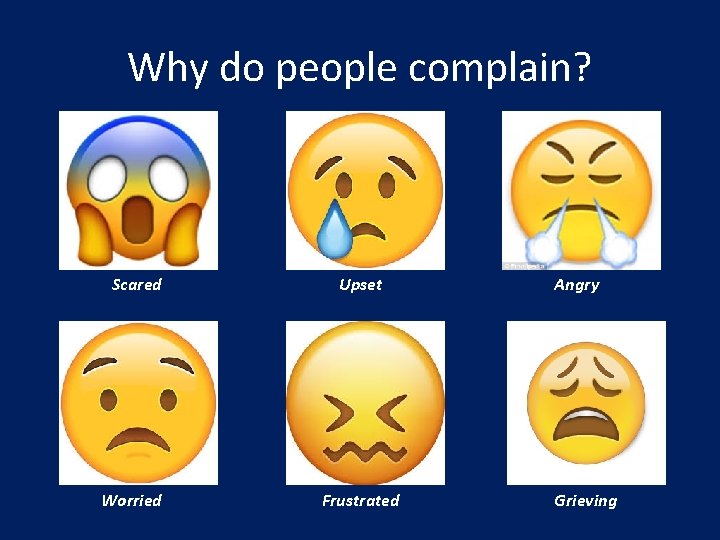
Why do people complain? Scared Worried Upset Frustrated Angry Grieving

Complaints and Perception. . .
What complainants tell us ‘I am writing to express my disgust and dismay at the way my daughter, and her husband were treated’ ‘. . . that no one had informed her added to her stress and anxiety’ ‘I would like to also receive assurances that what I experienced will never be allowed to happen again to another patient, and that appropriate steps have been put in place to ensure this. ’ ‘The saddest part of all of this is that we will never know what may have been if so many things had been different. Things that should have been different. This is the burden we live with each and every day. Simply, what if. . . ? ’ ‘We feel very let down’ ‘I am exhausted by this whole process and upset at our treatment which has lacked compassion and sensitivity. ’
What is a complaint? In the end, people don’t view their life as merely the average of all its moments. For human beings, life is meaningful because it is a story. A story has a sense of a whole, and its core is determined by the significant moments, the ones where something happens. . .
Why do Complaints Matter? • A complaint is a type of feedback, which is vital to help us hear patients and their families perspective • We can then use what we have learned from a complaint to improve services • It is an opportunity for us to restore faith and confidence
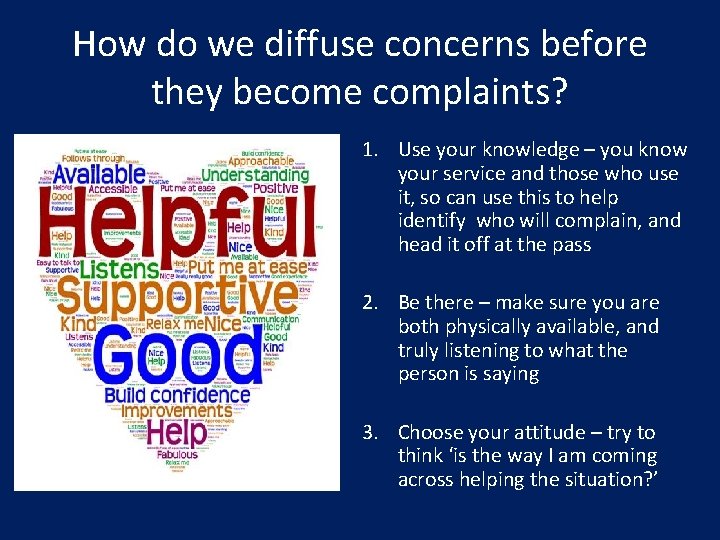
How do we diffuse concerns before they become complaints? 1. Use your knowledge – you know your service and those who use it, so can use this to help identify who will complain, and head it off at the pass 2. Be there – make sure you are both physically available, and truly listening to what the person is saying 3. Choose your attitude – try to think ‘is the way I am coming across helping the situation? ’
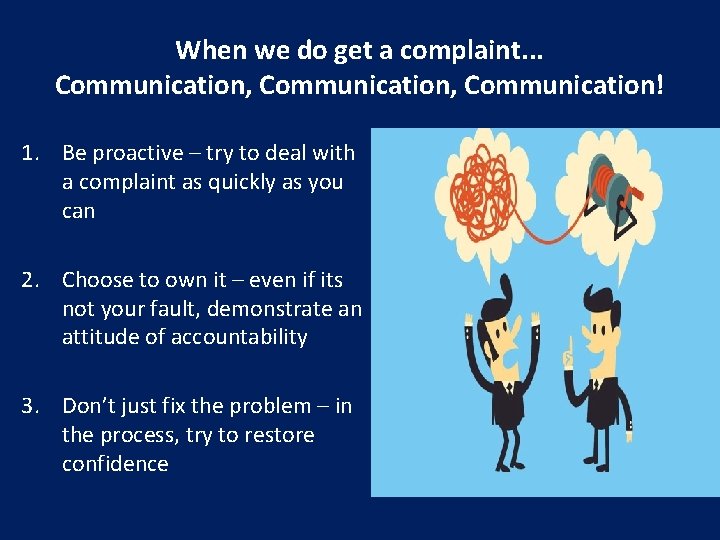
When we do get a complaint. . . Communication, Communication! 1. Be proactive – try to deal with a complaint as quickly as you can 2. Choose to own it – even if its not your fault, demonstrate an attitude of accountability 3. Don’t just fix the problem – in the process, try to restore confidence
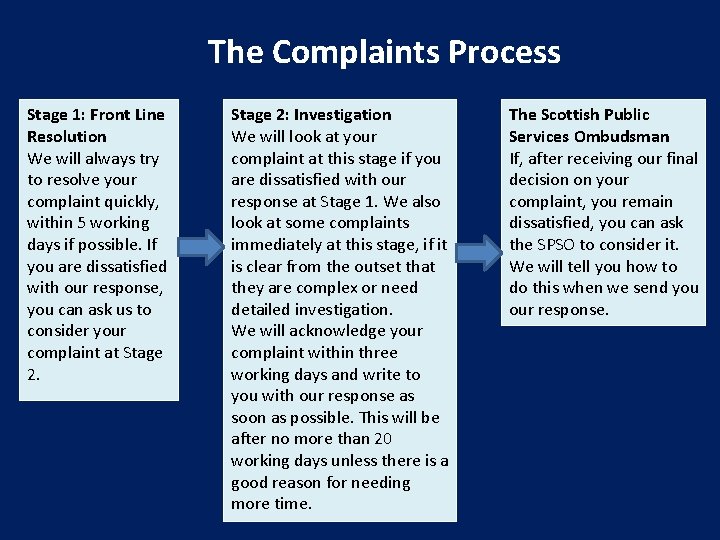
The Complaints Process Stage 1: Front Line Resolution We will always try to resolve your complaint quickly, within 5 working days if possible. If you are dissatisfied with our response, you can ask us to consider your complaint at Stage 2: Investigation We will look at your complaint at this stage if you are dissatisfied with our response at Stage 1. We also look at some complaints immediately at this stage, if it is clear from the outset that they are complex or need detailed investigation. We will acknowledge your complaint within three working days and write to you with our response as soon as possible. This will be after no more than 20 working days unless there is a good reason for needing more time. The Scottish Public Services Ombudsman If, after receiving our final decision on your complaint, you remain dissatisfied, you can ask the SPSO to consider it. We will tell you how to do this when we send you our response.
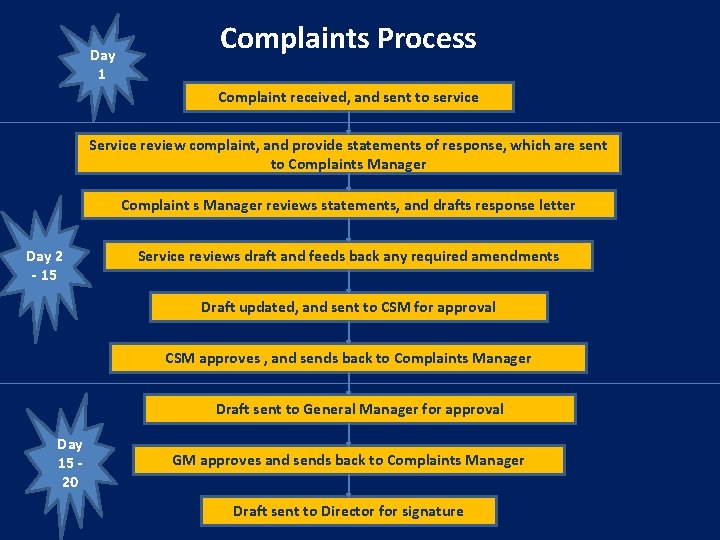
Day 1 Complaints Process Complaint received, and sent to service Service review complaint, and provide statements of response, which are sent to Complaints Manager Complaint s Manager reviews statements, and drafts response letter Day 2 - 15 Service reviews draft and feeds back any required amendments Draft updated, and sent to CSM for approval CSM approves , and sends back to Complaints Manager Draft sent to General Manager for approval Day 15 - 20 GM approves and sends back to Complaints Manager Draft sent to Director for signature
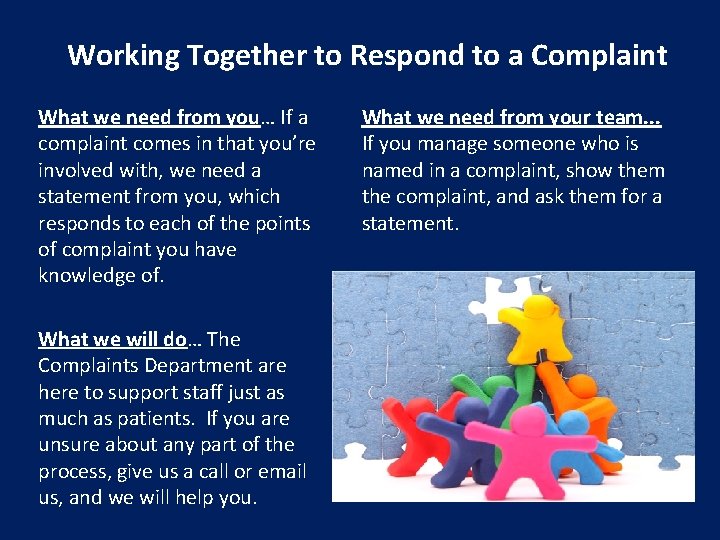
Working Together to Respond to a Complaint What we need from you… If a complaint comes in that you’re involved with, we need a statement from you, which responds to each of the points of complaint you have knowledge of. What we will do… The Complaints Department are here to support staff just as much as patients. If you are unsure about any part of the process, give us a call or email us, and we will help you. What we need from your team. . . If you manage someone who is named in a complaint, show them the complaint, and ask them for a statement.
My statement in response. . . It is your response – no one should tell you what to write Medical terminology - can you explain what it means? If the system failed, what is in place to fix it? It should be typed, factual, clear and thorough Referencing policies or guidelines is useful Direct quotes from case notes or clinical letters are useful
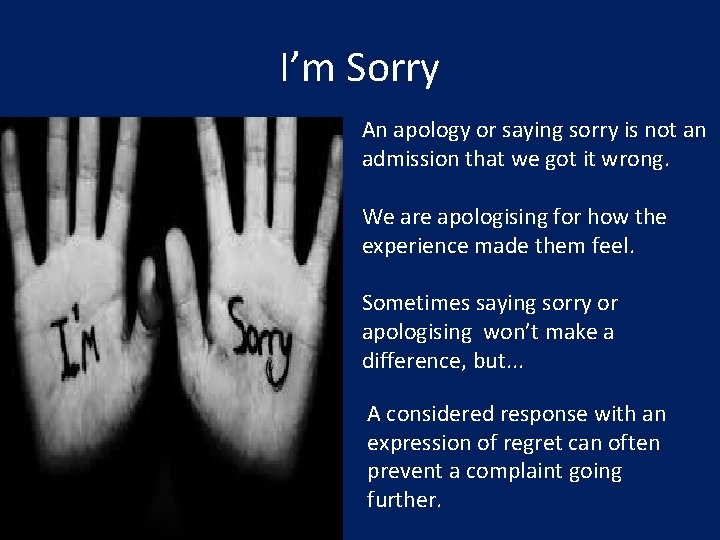
I’m Sorry An apology or saying sorry is not an admission that we got it wrong. We are apologising for how the experience made them feel. Sometimes saying sorry or apologising won’t make a difference, but. . . A considered response with an expression of regret can often prevent a complaint going further.
A Good Complaint Response is. . . Empathetic Honest Clear Personalised Thorough Consistent Professional Demonstrates learning
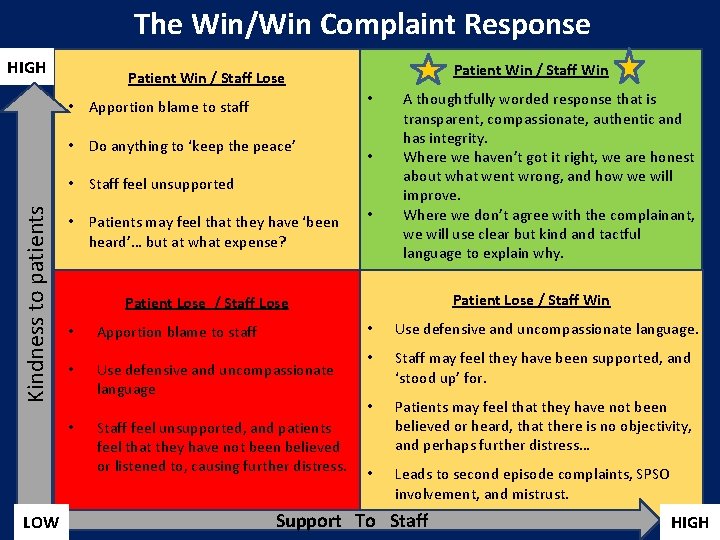
The Win/Win Complaint Response HIGH Kindness to patients Ki n d n e ss • • Apportion blame to staff • Do anything to ‘keep the peace’ • • Staff feel unsupported t o • Patients may feel that they have ‘been heard’… but at what expense? P at Patient Lose / Staff Lose i • Apportion blame to staff e n t • Use defensive and uncompassionate language s • LOW Patient Win / Staff Win Patient Win / Staff Lose Staff feel unsupported, and patients feel that they have not been believed or listened to, causing further distress. • A thoughtfully worded response that is transparent, compassionate, authentic and has integrity. Where we haven’t got it right, we are honest about what went wrong, and how we will improve. Where we don’t agree with the complainant, we will use clear but kind and tactful language to explain why. Patient Lose / Staff Win • Use defensive and uncompassionate language. • Staff may feel they have been supported, and ‘stood up’ for. • Patients may feel that they have not been believed or heard, that there is no objectivity, and perhaps further distress… • Leads to second episode complaints, SPSO involvement, and mistrust. Support To Staff HIGH
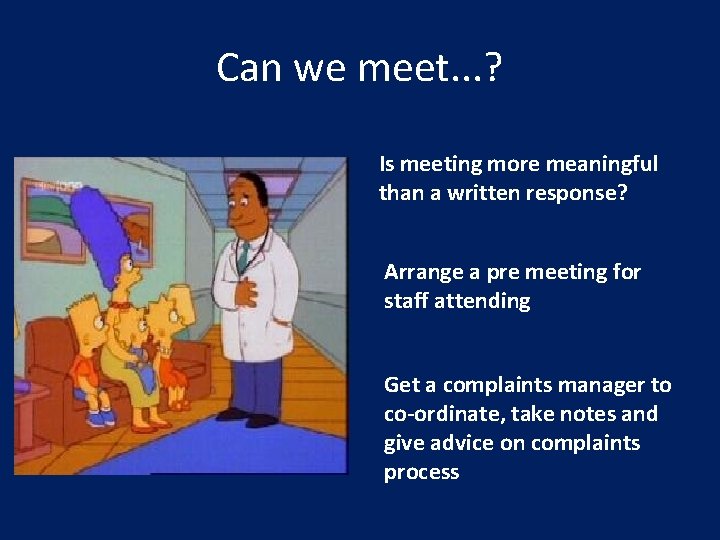
Can we meet. . . ? Is meeting more meaningful than a written response? Arrange a pre meeting for staff attending Get a complaints manager to co-ordinate, take notes and give advice on complaints process
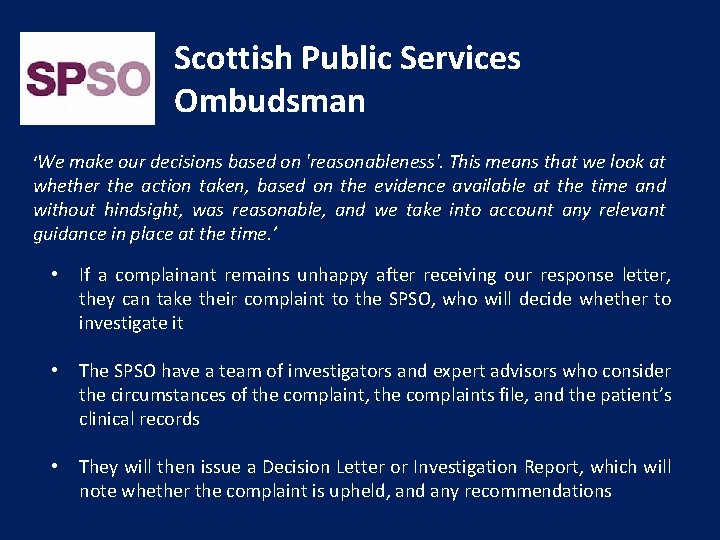
Scottish Public Services Ombudsman ‘We make our decisions based on 'reasonableness'. This means that we look at whether the action taken, based on the evidence available at the time and without hindsight, was reasonable, and we take into account any relevant guidance in place at the time. ’ • If a complainant remains unhappy after receiving our response letter, they can take their complaint to the SPSO, who will decide whether to investigate it • The SPSO have a team of investigators and expert advisors who consider the circumstances of the complaint, the complaints file, and the patient’s clinical records • They will then issue a Decision Letter or Investigation Report, which will note whether the complaint is upheld, and any recommendations
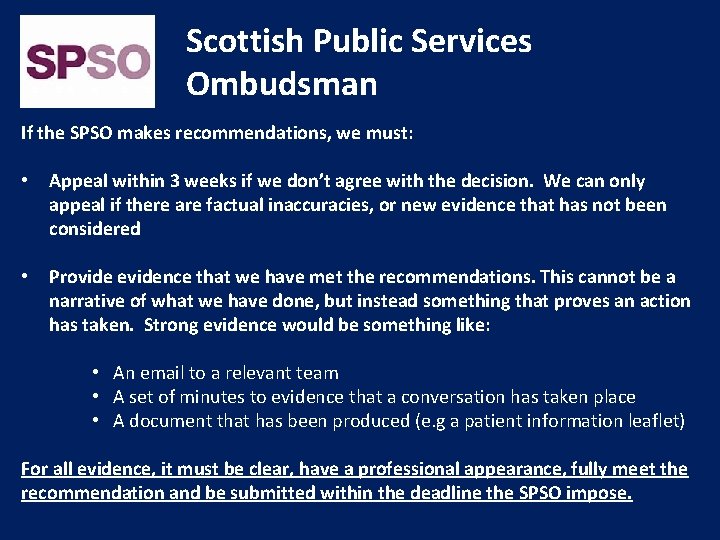
Scottish Public Services Ombudsman If the SPSO makes recommendations, we must: • Appeal within 3 weeks if we don’t agree with the decision. We can only appeal if there are factual inaccuracies, or new evidence that has not been considered • Provide evidence that we have met the recommendations. This cannot be a narrative of what we have done, but instead something that proves an action has taken. Strong evidence would be something like: • An email to a relevant team • A set of minutes to evidence that a conversation has taken place • A document that has been produced (e. g a patient information leaflet) For all evidence, it must be clear, have a professional appearance, fully meet the recommendation and be submitted within the deadline the SPSO impose.

Questions?
- Slides: 22