
I 3 Hypotheses on the Formation of the
- Slides: 52
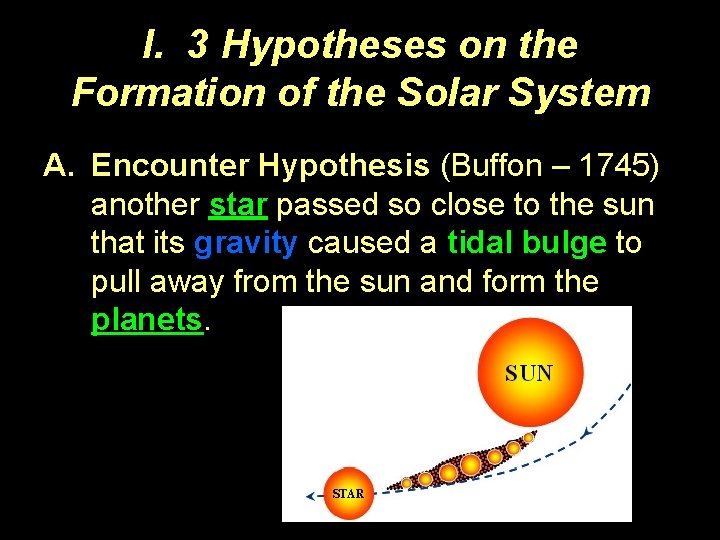
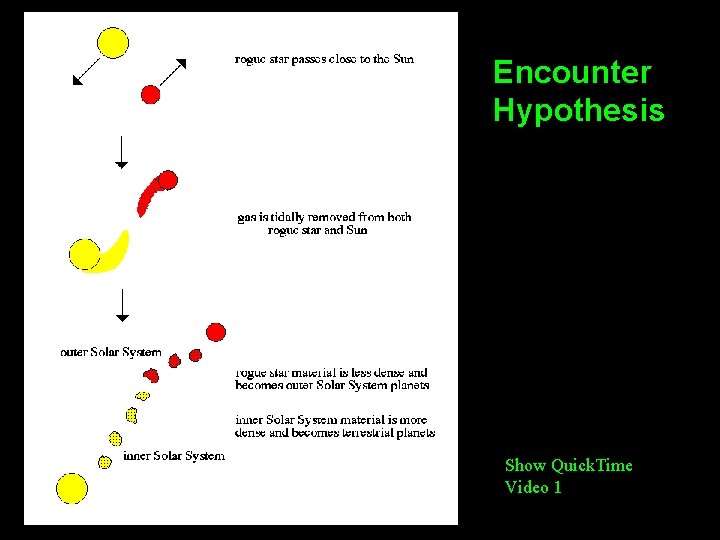
I. 3 Hypotheses on the Formation of the Solar System A. Encounter Hypothesis (Buffon – 1745) another star passed so close to the sun that its gravity caused a tidal bulge to pull away from the sun and form the planets.
Encounter Hypothesis Show Quick. Time Video 1
3 Hypotheses on the Formation of the Solar System A. Encounter Hypothesis – Weaknesses: 1. Very unlikely (1 in 100 billion chance! - like fixing your radiator by shooting it so the bullet will plug the hole!) 2. Planets should be closer to the sun than they are.
3 Hypotheses on the Formation of the Solar System A. Encounter Hypothesis – Weaknesses: 3. The Sun and planets should have almost identical compositions, but the Sun has no Deuterium ( 1 H 2 ) at all, but the planets do have 1 H 2 ! 4. The sun spins too slowly (slower than it should at the center)
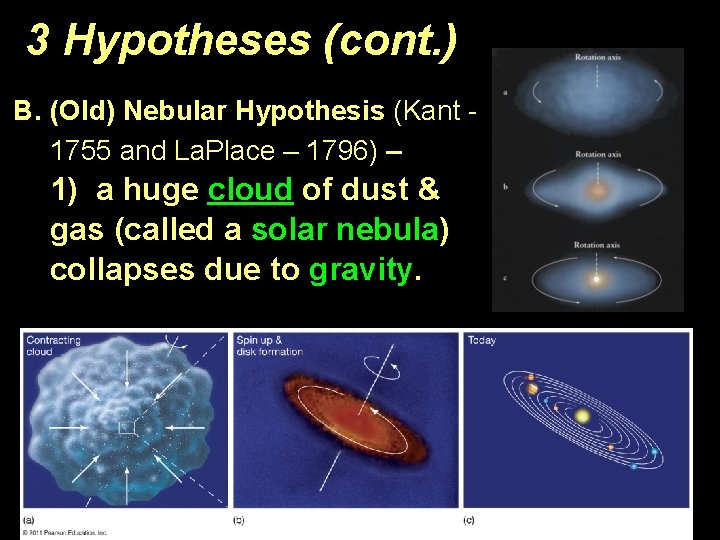
3 Hypotheses (cont. ) B. (Old) Nebular Hypothesis (Kant - 1755 and La. Place – 1796) – 1) a huge cloud of dust & gas (called a solar nebula) collapses due to gravity.
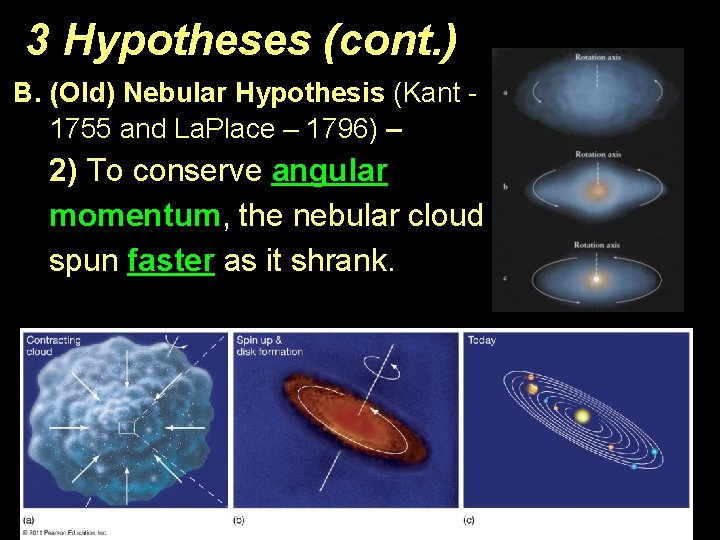
3 Hypotheses (cont. ) B. (Old) Nebular Hypothesis (Kant - 1755 and La. Place – 1796) – 2) To conserve angular momentum, the nebular cloud spun faster as it shrank.
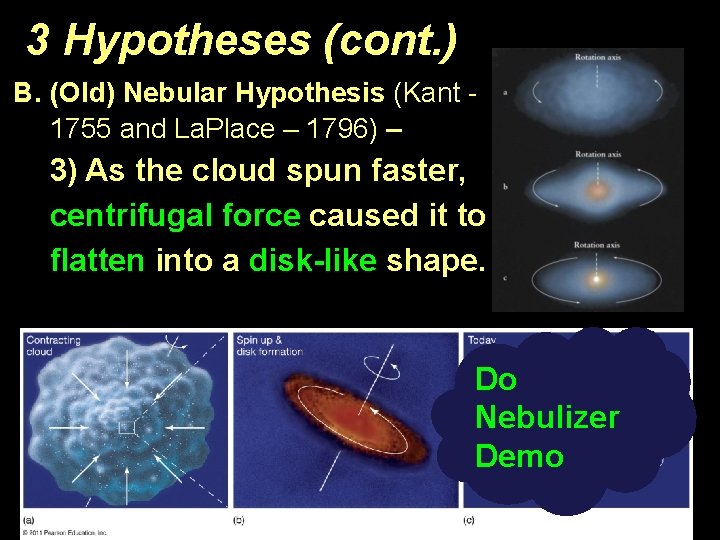
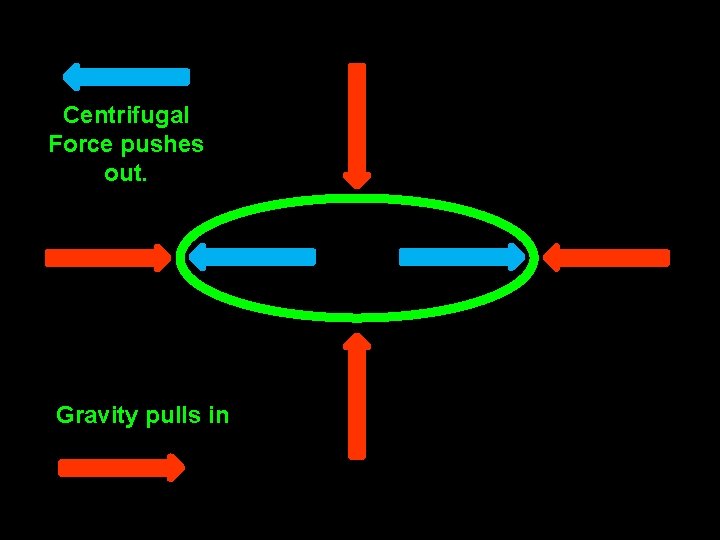
3 Hypotheses (cont. ) B. (Old) Nebular Hypothesis (Kant - 1755 and La. Place – 1796) – 3) As the cloud spun faster, centrifugal force caused it to flatten into a disk-like shape. Do Nebulizer Demo
Centrifugal Force pushes out. Gravity pulls in
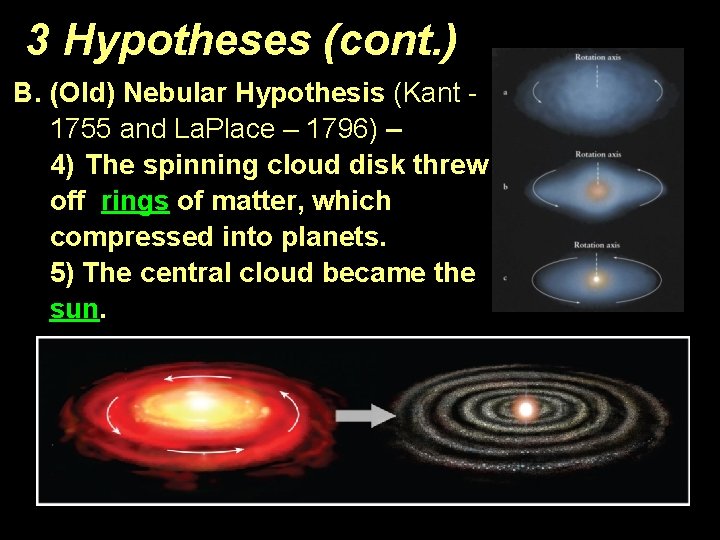
3 Hypotheses (cont. ) B. (Old) Nebular Hypothesis (Kant - 1755 and La. Place – 1796) – 4) The spinning cloud disk threw off rings of matter, which compressed into planets. 5) The central cloud became the sun.
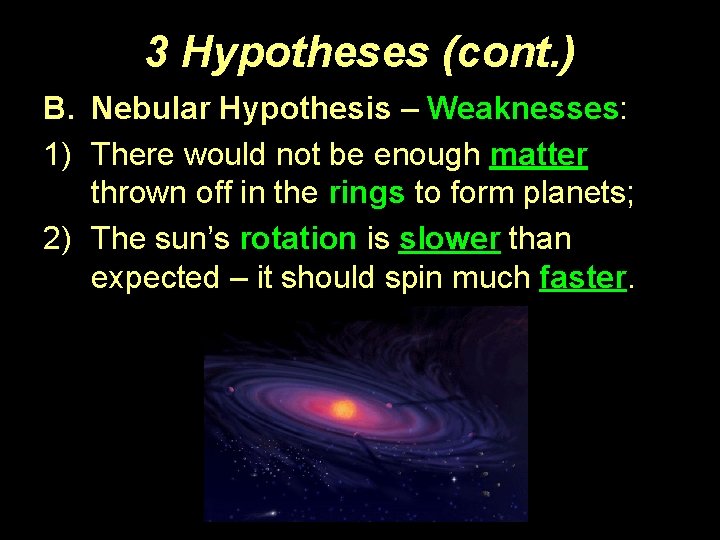
3 Hypotheses (cont. ) B. Nebular Hypothesis – Weaknesses: 1) There would not be enough matter thrown off in the rings to form planets; 2) The sun’s rotation is slower than expected – it should spin much faster.
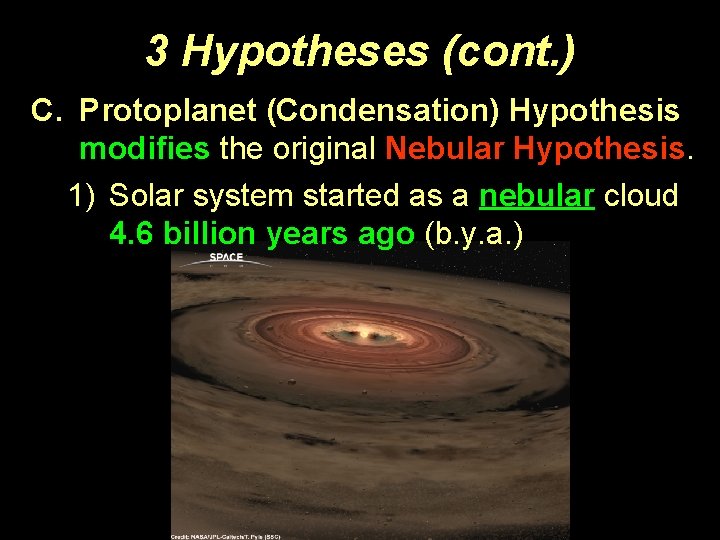
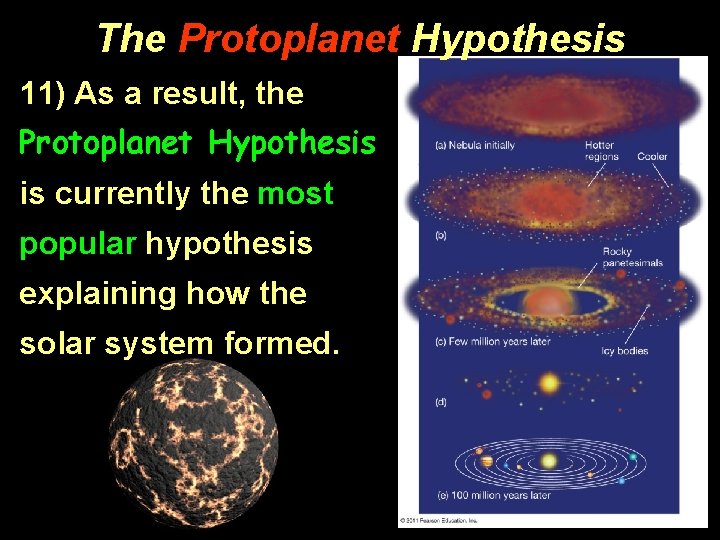
3 Hypotheses (cont. ) C. Protoplanet (Condensation) Hypothesis modifies the original Nebular Hypothesis. 1) Solar system started as a nebular cloud 4. 6 billion years ago (b. y. a. )
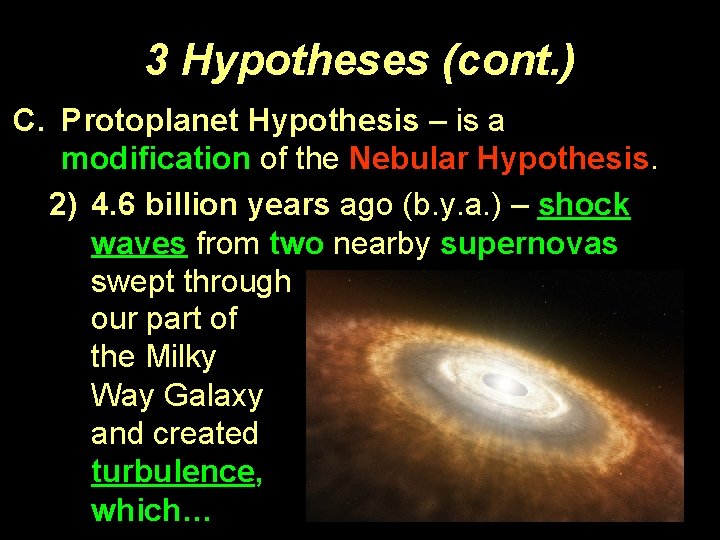
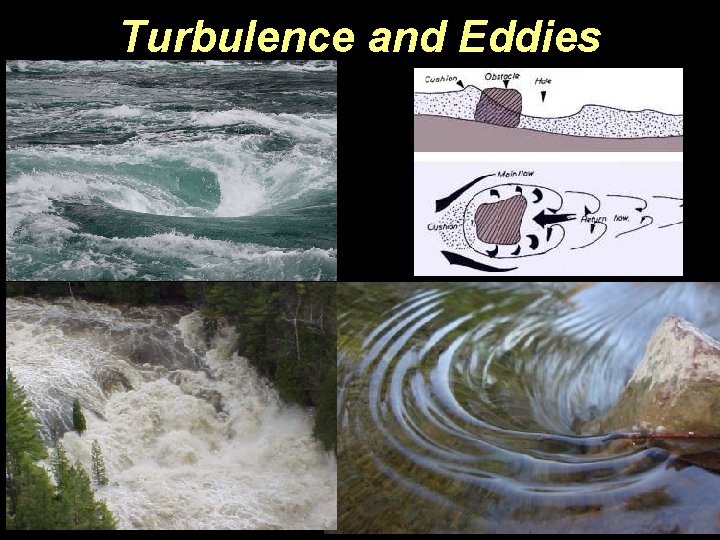
3 Hypotheses (cont. ) C. Protoplanet Hypothesis – is a modification of the Nebular Hypothesis. 2) 4. 6 billion years ago (b. y. a. ) – shock waves from two nearby supernovas swept through our part of the Milky Way Galaxy and created turbulence, which…
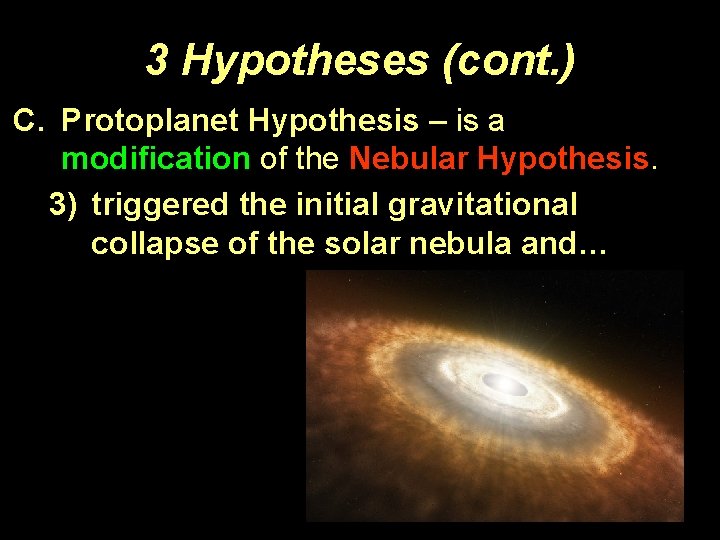
3 Hypotheses (cont. ) C. Protoplanet Hypothesis – is a modification of the Nebular Hypothesis. 3) triggered the initial gravitational collapse of the solar nebula and…
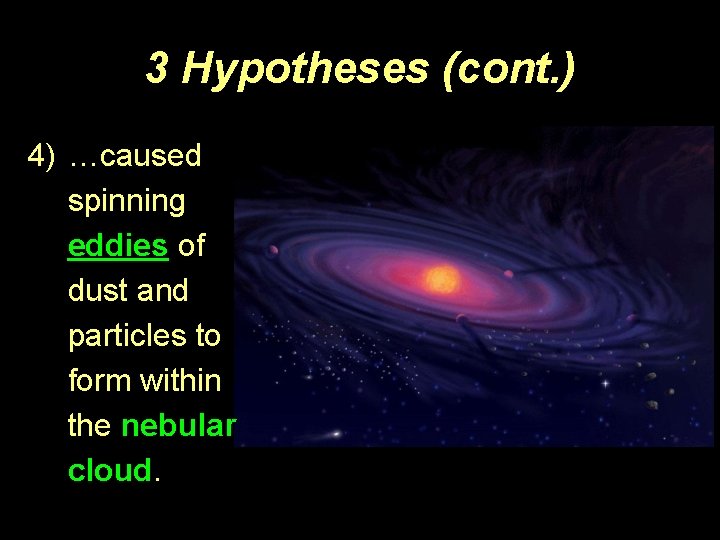
3 Hypotheses (cont. ) 4) …caused spinning eddies of dust and particles to form within the nebular cloud.
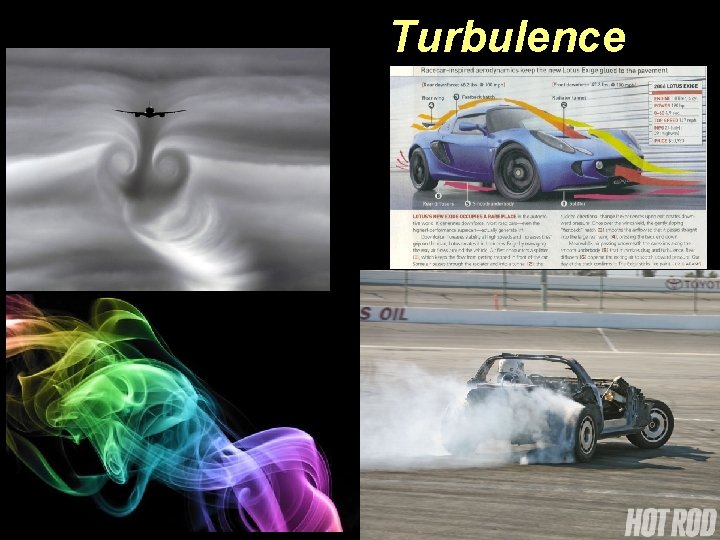
Turbulence
Turbulence and Eddies
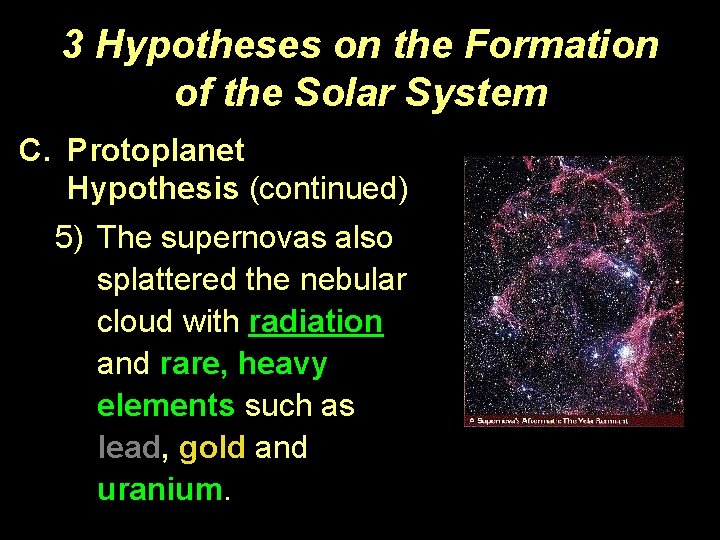
3 Hypotheses on the Formation of the Solar System C. Protoplanet Hypothesis (continued) 5) The supernovas also splattered the nebular cloud with radiation and rare, heavy elements such as lead, gold and uranium.
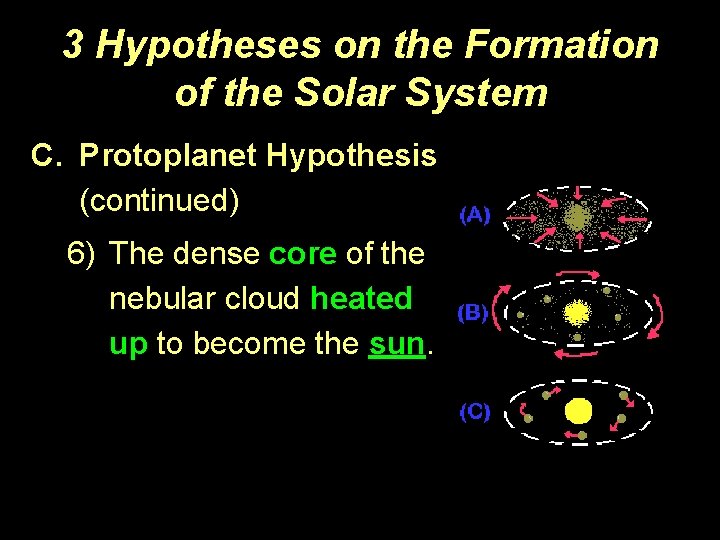
3 Hypotheses on the Formation of the Solar System C. Protoplanet Hypothesis (continued) 6) The dense core of the nebular cloud heated up to become the sun.
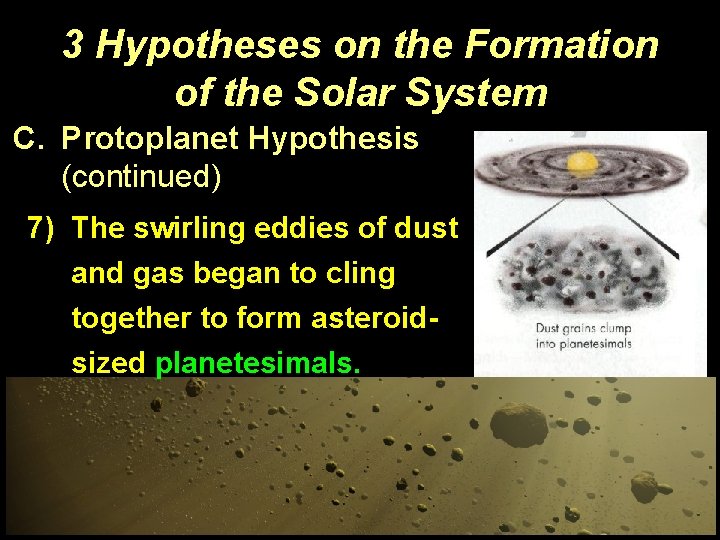
3 Hypotheses on the Formation of the Solar System C. Protoplanet Hypothesis (continued) 7) The swirling eddies of dust and gas began to cling together to form asteroidsized planetesimals. Show Quick. Time Video 3
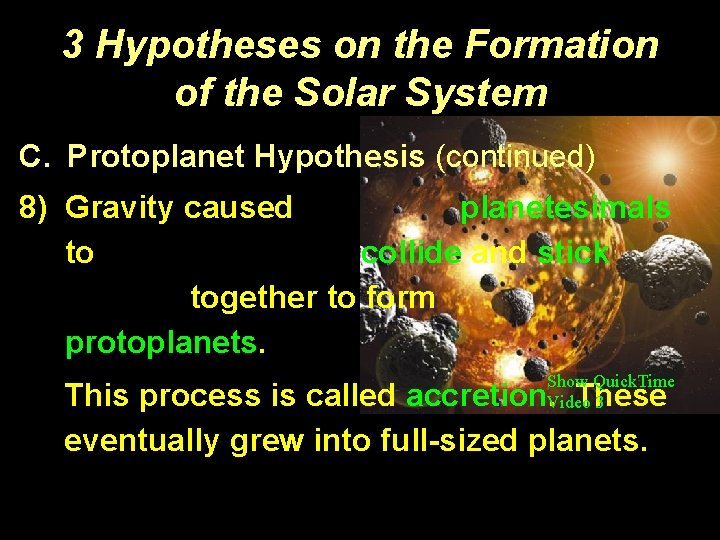
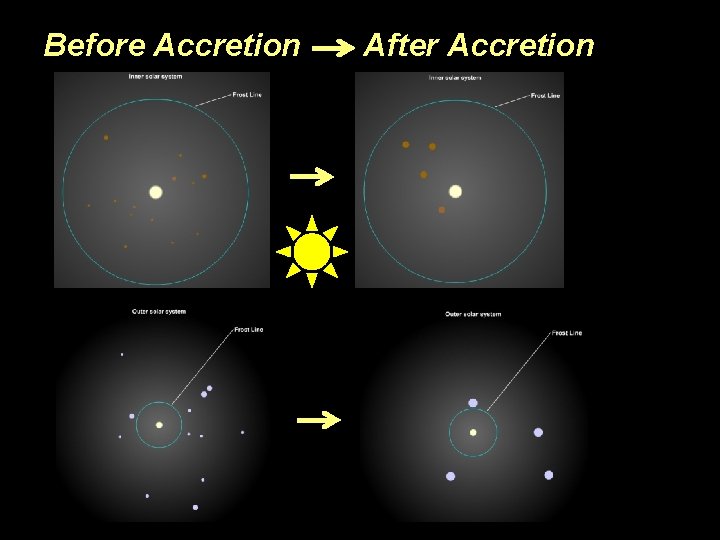
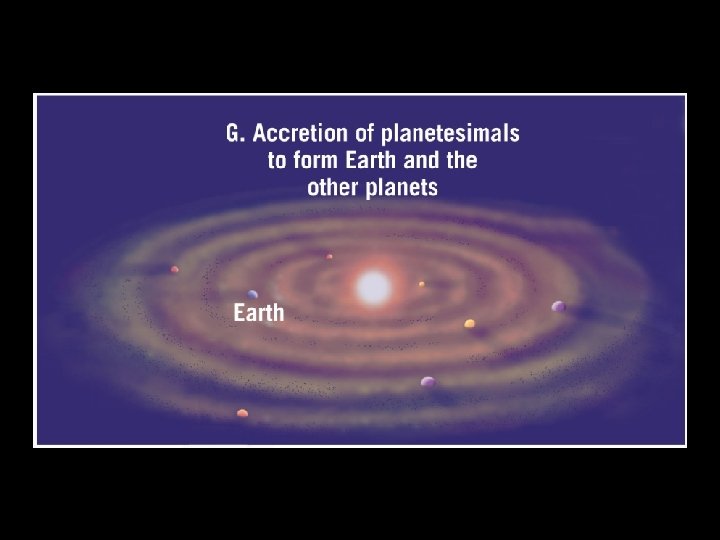
3 Hypotheses on the Formation of the Solar System C. Protoplanet Hypothesis (continued) 8) Gravity caused planetesimals to collide and stick together to form protoplanets. Show Quick. Time Video 3 This process is called accretion. These eventually grew into full-sized planets.
Before Accretion After Accretion
9) The Protoplanet Hypothesis explains the weaknesses of the other 2 hypotheses and all of the known evidence about the solar system. ***
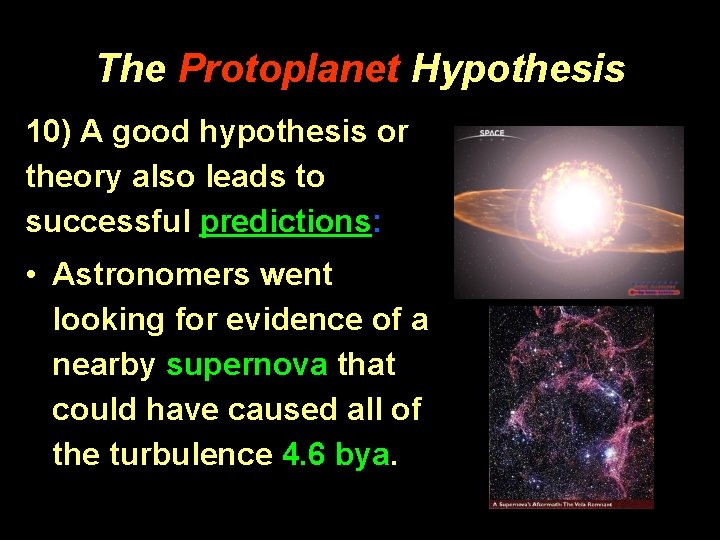
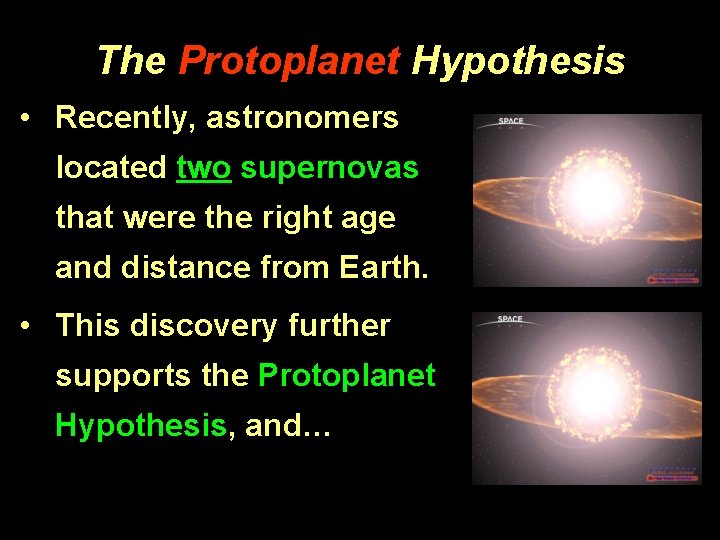
The Protoplanet Hypothesis 10) A good hypothesis or theory also leads to successful predictions: • Astronomers went looking for evidence of a nearby supernova that could have caused all of the turbulence 4. 6 bya.
The Protoplanet Hypothesis • Recently, astronomers located two supernovas that were the right age and distance from Earth. • This discovery further supports the Protoplanet Hypothesis, and…
The Protoplanet Hypothesis 11) As a result, the Protoplanet Hypothesis is currently the most popular hypothesis explaining how the solar system formed.
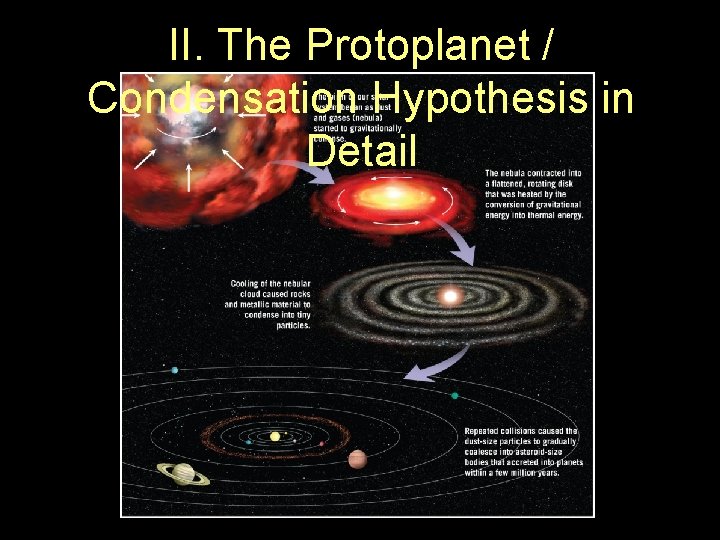
II. The Protoplanet / Condensation Hypothesis in Detail
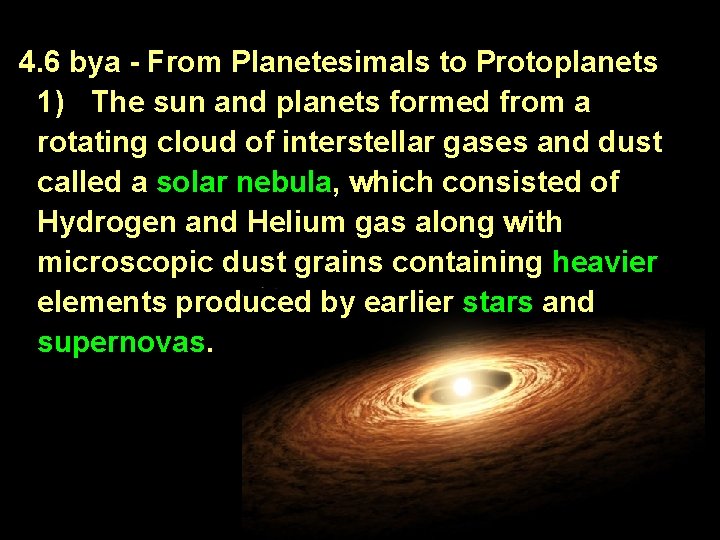
4. 6 bya - From Planetesimals to Protoplanets 1) The sun and planets formed from a rotating cloud of interstellar gases and dust called a solar nebula, which consisted of Hydrogen and Helium gas along with microscopic dust grains containing heavier elements produced by earlier stars and supernovas.
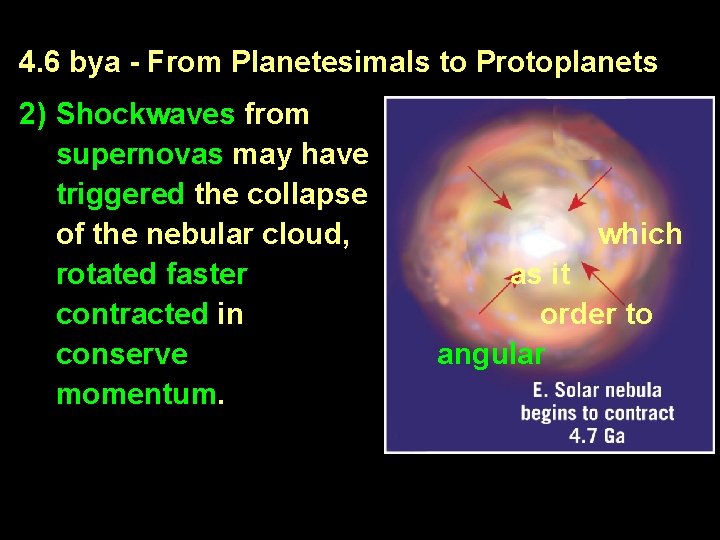
4. 6 bya - From Planetesimals to Protoplanets 2) Shockwaves from supernovas may have triggered the collapse of the nebular cloud, rotated faster contracted in conserve momentum. which as it order to angular
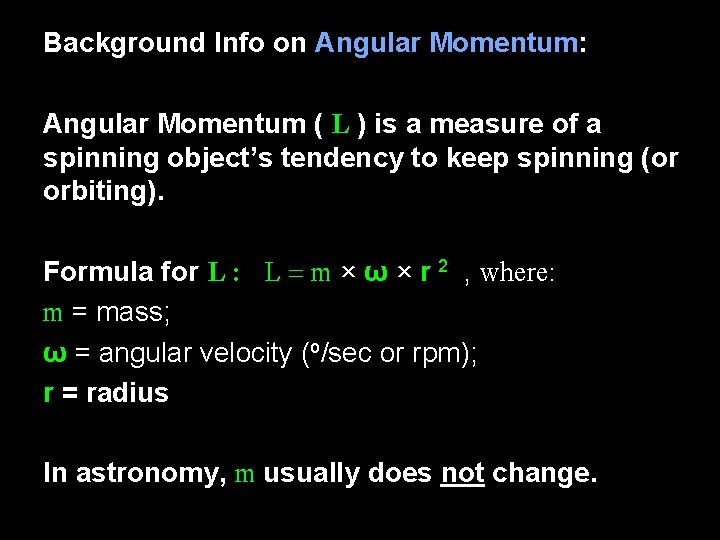
Background Info on Angular Momentum: Angular Momentum ( L ) is a measure of a spinning object’s tendency to keep spinning (or orbiting). Formula for L : L = m × ω × r 2 , where: m = mass; ω = angular velocity (o/sec or rpm); r = radius In astronomy, m usually does not change.
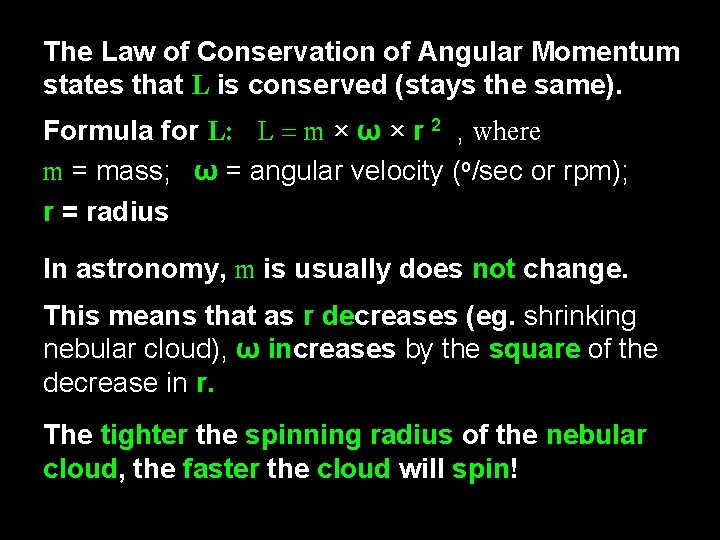
The Law of Conservation of Angular Momentum states that L is conserved (stays the same). Formula for L: L = m × ω × r 2 , where m = mass; ω = angular velocity (o/sec or rpm); r = radius In astronomy, m is usually does not change. This means that as r decreases (eg. shrinking nebular cloud), ω increases by the square of the decrease in r. The tighter the spinning radius of the nebular cloud, the faster the cloud will spin!
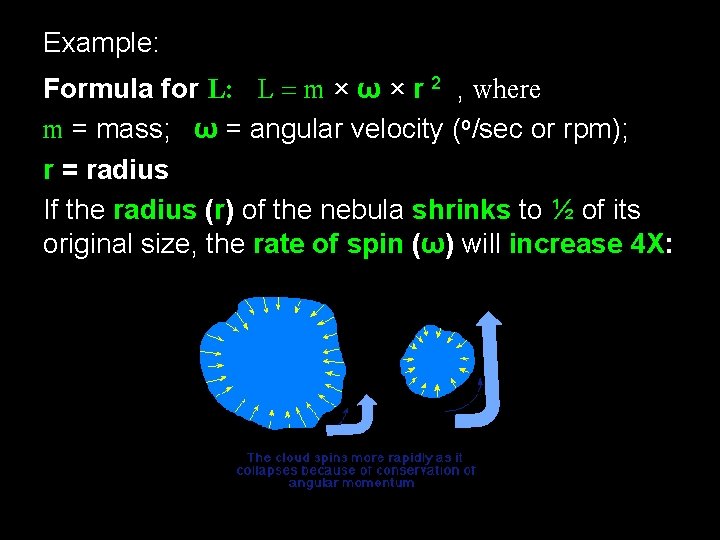
Example: Formula for L: L = m × ω × r 2 , where m = mass; ω = angular velocity (o/sec or rpm); r = radius If the radius (r) of the nebula shrinks to ½ of its original size, the rate of spin (ω) will increase 4 X:
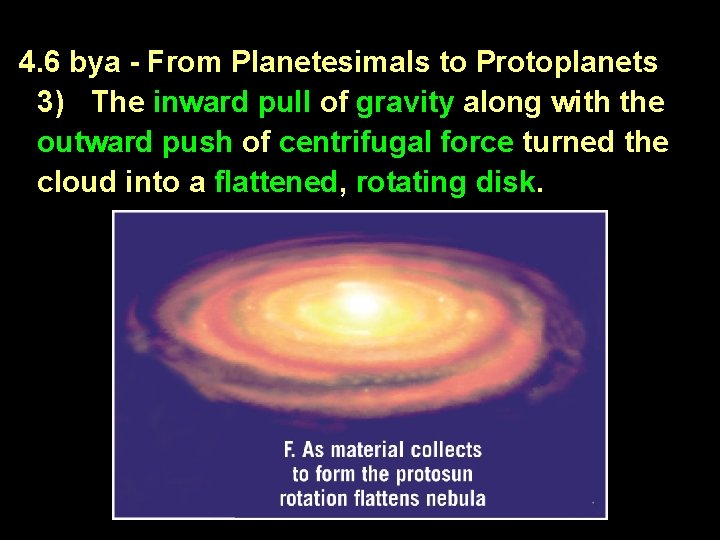
4. 6 bya - From Planetesimals to Protoplanets 3) The inward pull of gravity along with the outward push of centrifugal force turned the cloud into a flattened, rotating disk.
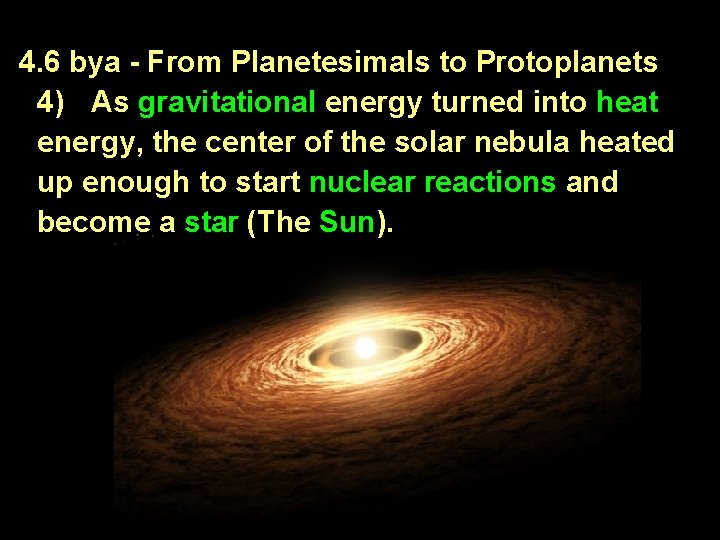
4. 6 bya - From Planetesimals to Protoplanets 4) As gravitational energy turned into heat energy, the center of the solar nebula heated up enough to start nuclear reactions and become a star (The Sun).
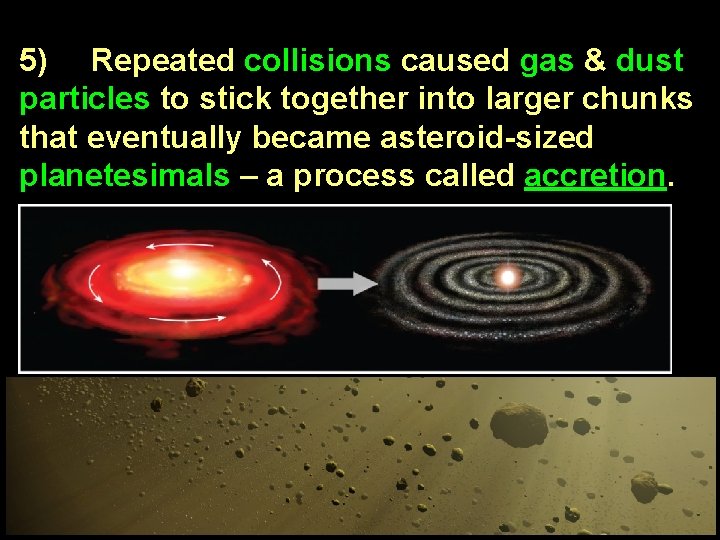
5) Repeated collisions caused gas & dust particles to stick together into larger chunks that eventually became asteroid-sized planetesimals – a process called accretion.
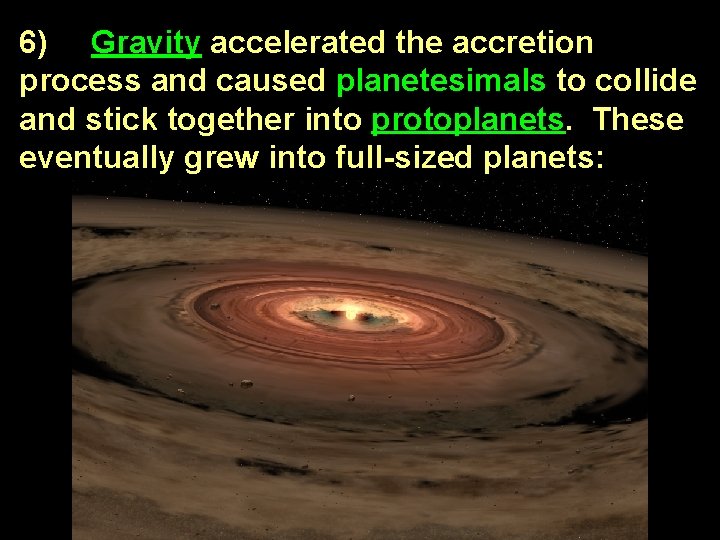
6) Gravity accelerated the accretion process and caused planetesimals to collide and stick together into protoplanets. These eventually grew into full-sized planets:
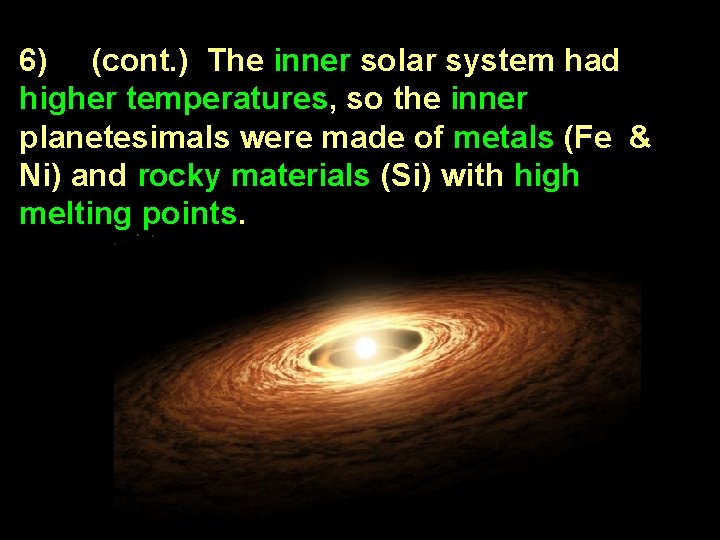
6) (cont. ) The inner solar system had higher temperatures, so the inner planetesimals were made of metals (Fe & Ni) and rocky materials (Si) with high melting points.
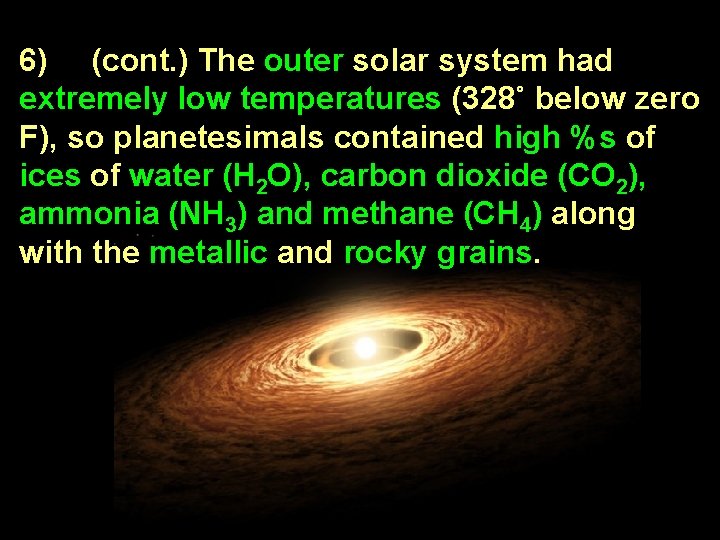
6) (cont. ) The outer solar system had extremely low temperatures (328˚ below zero F), so planetesimals contained high %s of ices of water (H 2 O), carbon dioxide (CO 2), ammonia (NH 3) and methane (CH 4) along with the metallic and rocky grains.
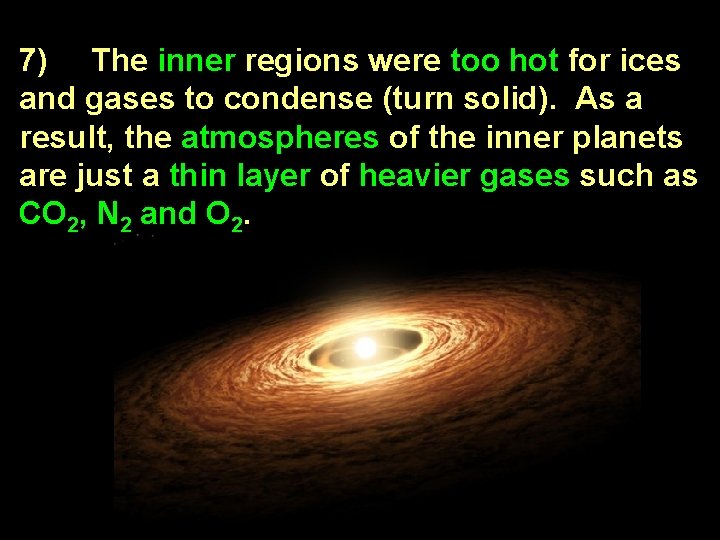
7) The inner regions were too hot for ices and gases to condense (turn solid). As a result, the atmospheres of the inner planets are just a thin layer of heavier gases such as CO 2, N 2 and O 2.
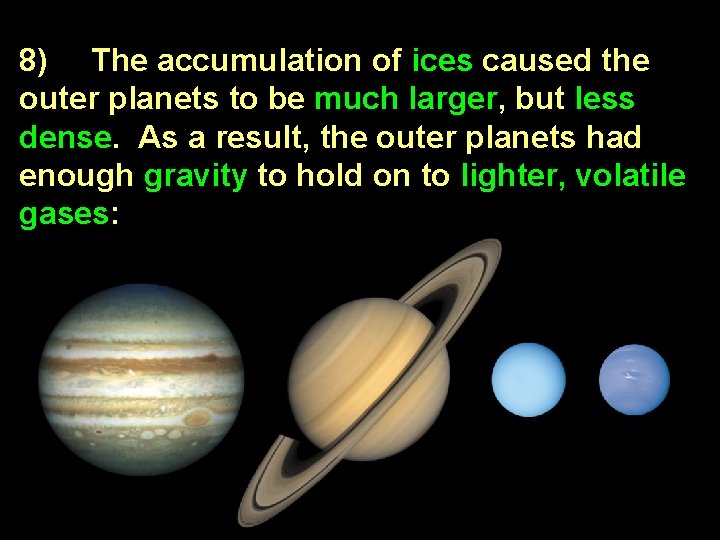
8) The accumulation of ices caused the outer planets to be much larger, but less dense. As a result, the outer planets had enough gravity to hold on to lighter, volatile gases:
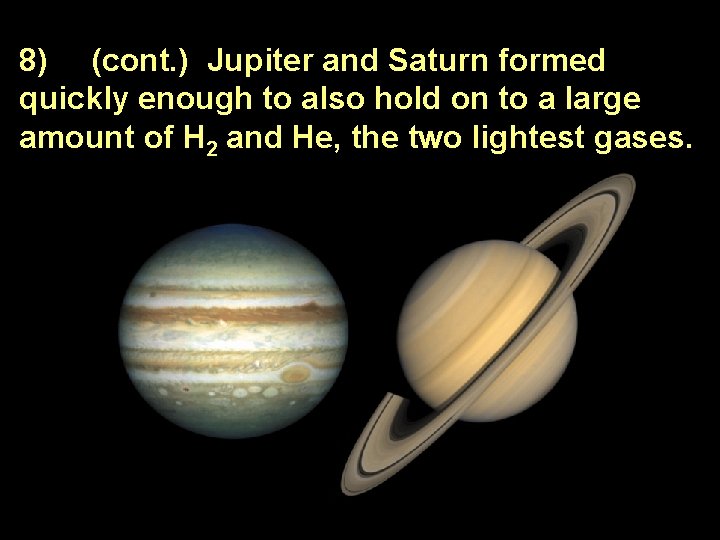
8) (cont. ) Jupiter and Saturn formed quickly enough to also hold on to a large amount of H 2 and He, the two lightest gases.
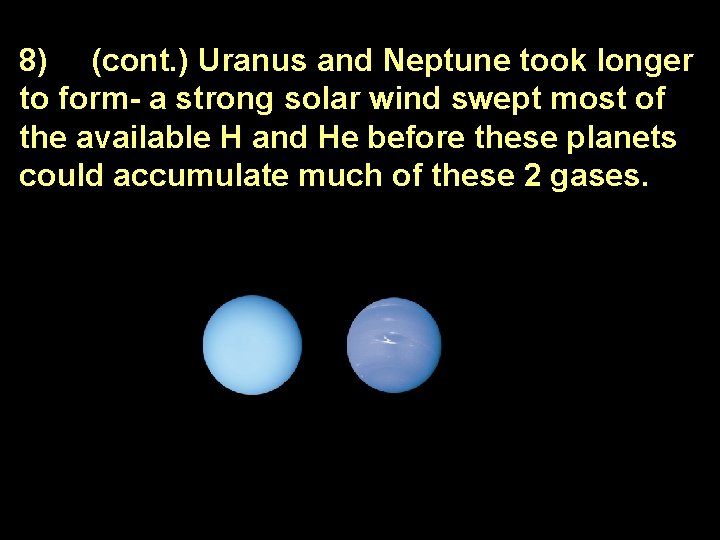
8) (cont. ) Uranus and Neptune took longer to form- a strong solar wind swept most of the available H and He before these planets could accumulate much of these 2 gases.
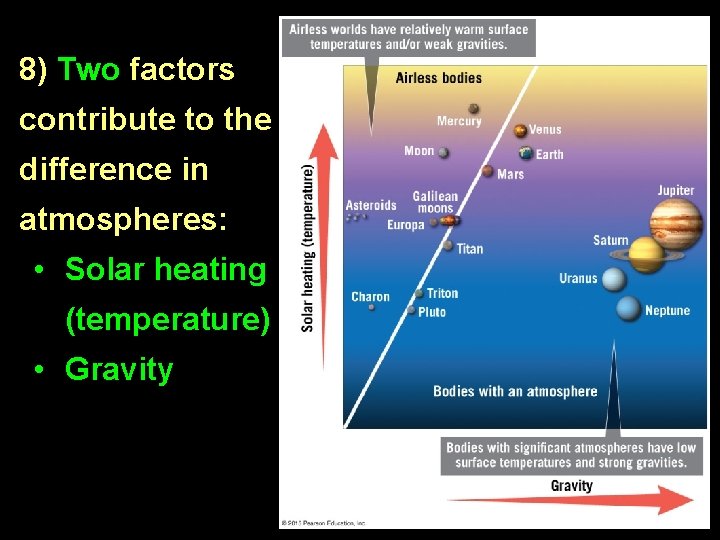
8) Two factors contribute to the difference in atmospheres: • Solar heating (temperature) • Gravity
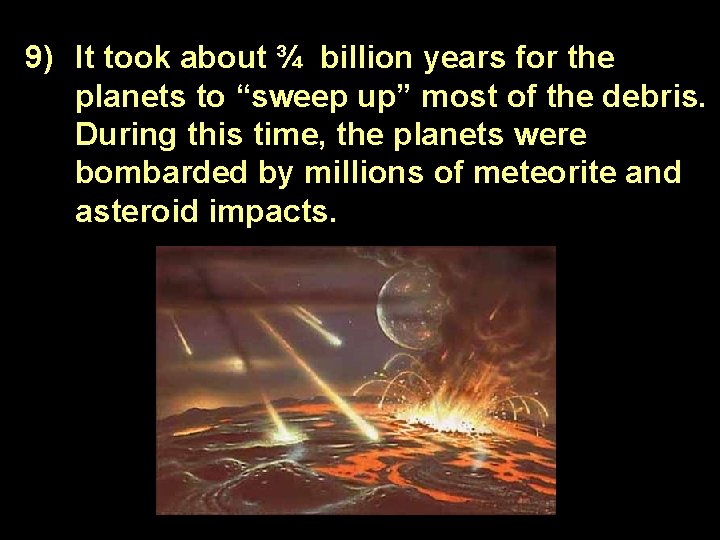
9) It took about ¾ billion years for the planets to “sweep up” most of the debris. During this time, the planets were bombarded by millions of meteorite and asteroid impacts.
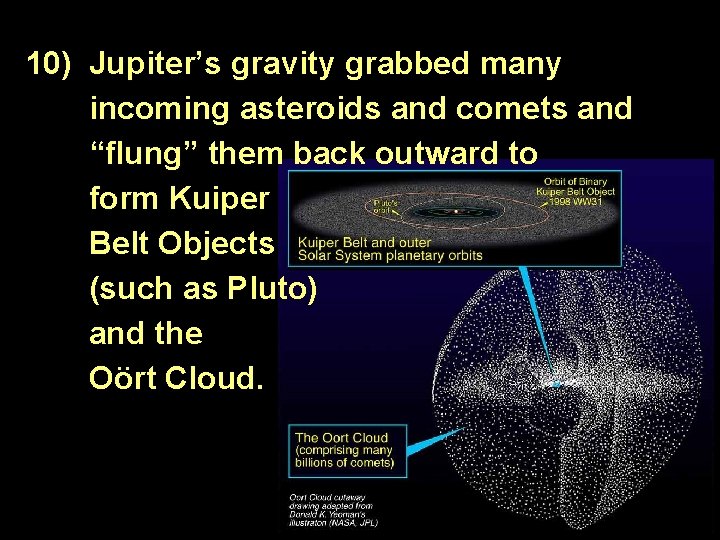
10) Jupiter’s gravity grabbed many incoming asteroids and comets and “flung” them back outward to form Kuiper Belt Objects (such as Pluto) and the Oört Cloud.
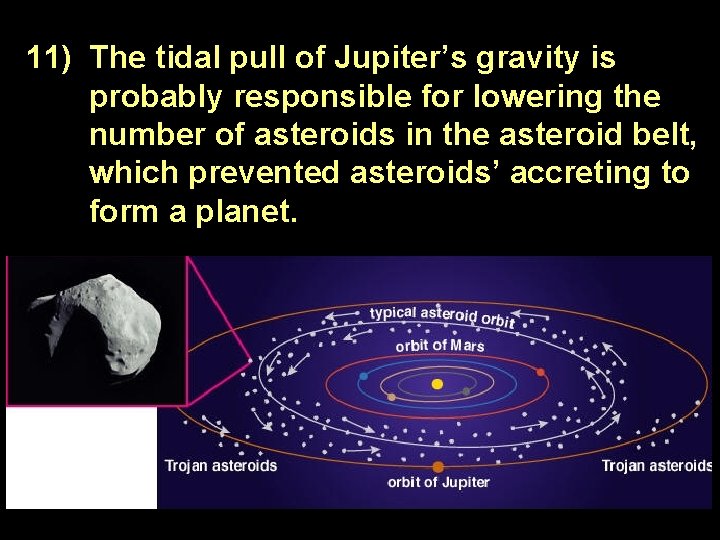
11) The tidal pull of Jupiter’s gravity is probably responsible for lowering the number of asteroids in the asteroid belt, which prevented asteroids’ accreting to form a planet.
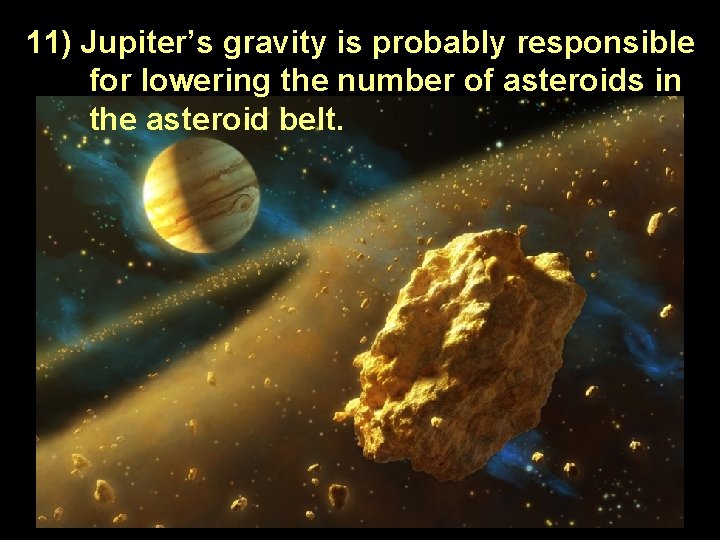
11) Jupiter’s gravity is probably responsible for lowering the number of asteroids in the asteroid belt.
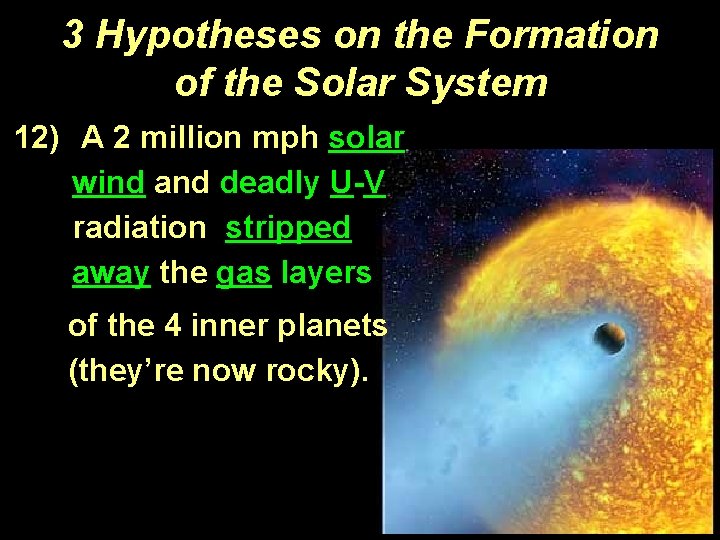
3 Hypotheses on the Formation of the Solar System 12) A 2 million mph solar wind and deadly U-V radiation stripped away the gas layers of the 4 inner planets (they’re now rocky).
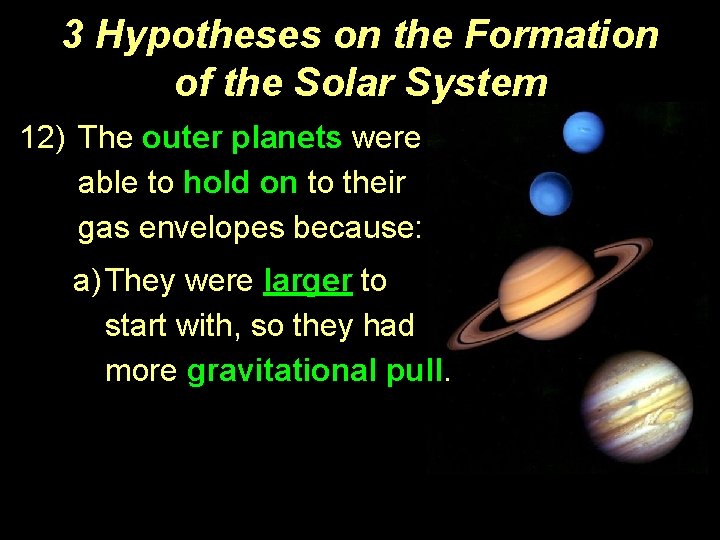
3 Hypotheses on the Formation of the Solar System 12) The outer planets were able to hold on to their gas envelopes because: a) They were larger to start with, so they had more gravitational pull.
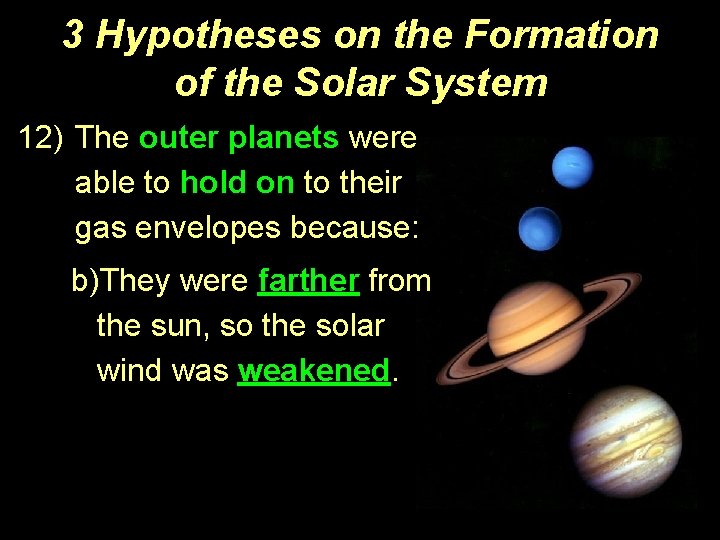
3 Hypotheses on the Formation of the Solar System 12) The outer planets were able to hold on to their gas envelopes because: b)They were farther from the sun, so the solar wind was weakened.
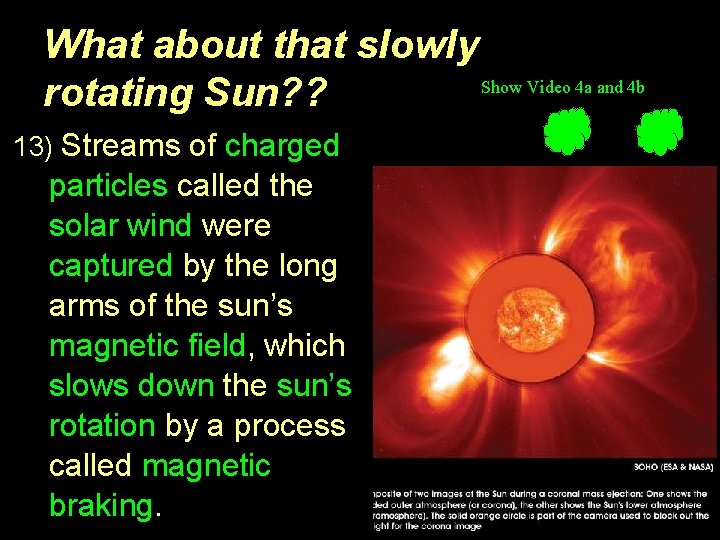
What about that slowly Show Video 4 a and 4 b rotating Sun? ? 13) Streams of charged particles called the solar wind were captured by the long arms of the sun’s magnetic field, which slows down the sun’s rotation by a process called magnetic braking.