
HZB HighQ 0 Optimization by thermal cycling Axel
HZB High-Q 0 Optimization by thermal cycling Axel Neumann for Oliver Kugeler , Julia Vogt, Jens Knobloch, Sarah Aull TTC CW-SRF meeting Ithaca, NY
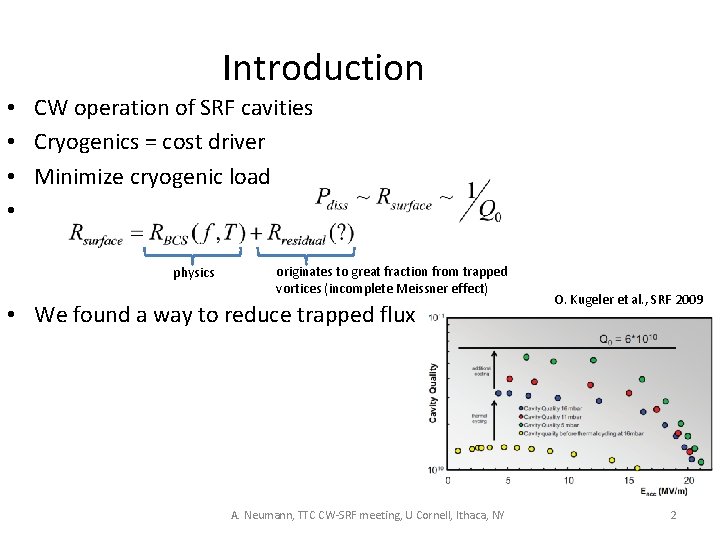
Introduction • CW operation of SRF cavities • Cryogenics = cost driver • Minimize cryogenic load • physics originates to great fraction from trapped vortices (incomplete Meissner effect) • We found a way to reduce trapped flux A. Neumann, TTC CW-SRF meeting, U Cornell, Ithaca, NY O. Kugeler et al. , SRF 2009 2
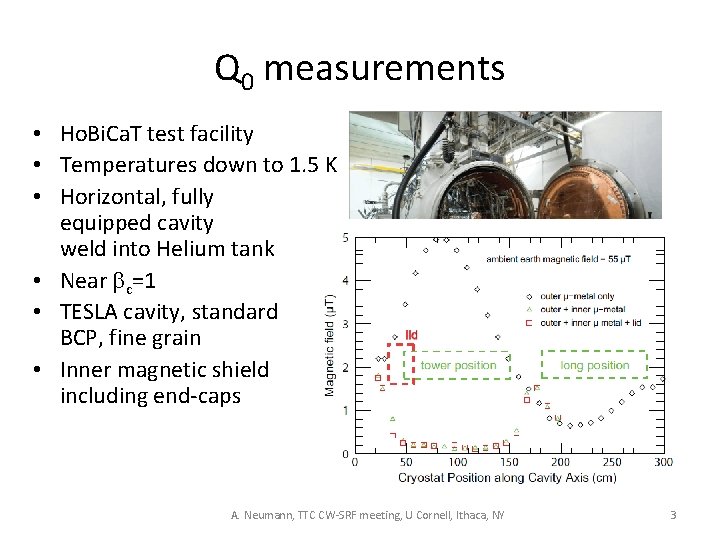
Q 0 measurements • Ho. Bi. Ca. T test facility • Temperatures down to 1. 5 K • Horizontal, fully equipped cavity weld into Helium tank • Near bc=1 • TESLA cavity, standard BCP, fine grain • Inner magnetic shield including end-caps A. Neumann, TTC CW-SRF meeting, U Cornell, Ithaca, NY 3
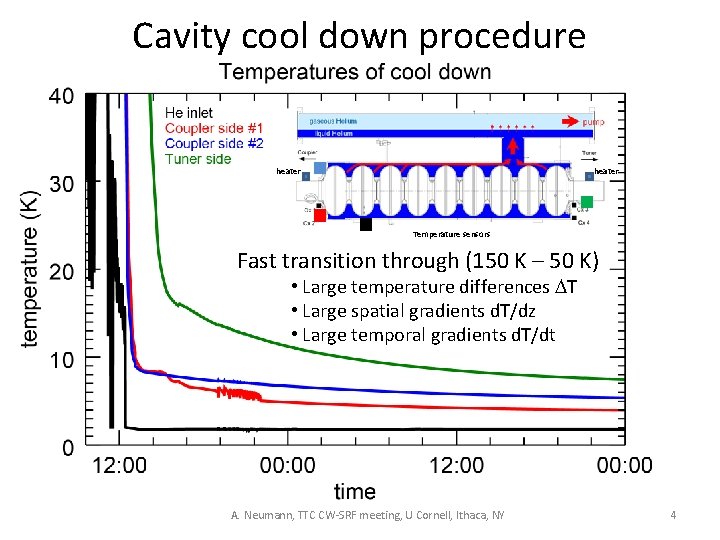
Cavity cool down procedure heater Temperature sensors Fast transition through (150 K – 50 K) • Large temperature differences DT • Large spatial gradients d. T/dz • Large temporal gradients d. T/dt A. Neumann, TTC CW-SRF meeting, U Cornell, Ithaca, NY 4
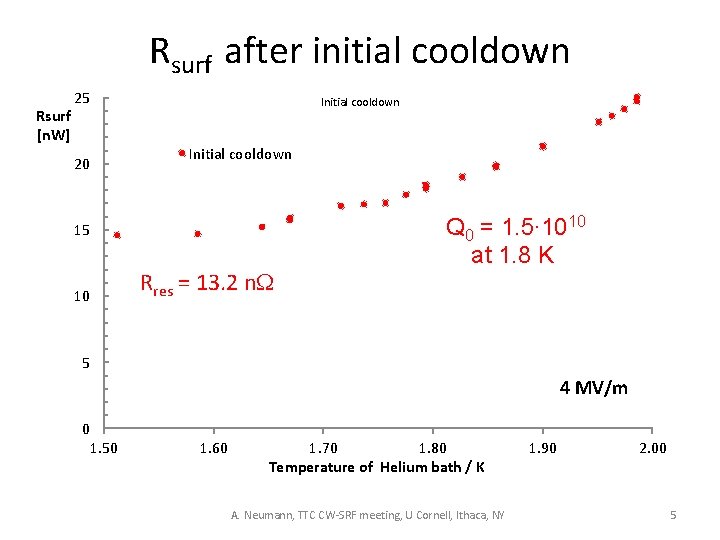
Rsurf after initial cooldown Rsurf [n. W] 25 20 Initial cooldown 15 10 Rres = 13. 2 n. W Q 0 = 1. 5∙ 1010 at 1. 8 K 5 4 MV/m 0 1. 50 1. 60 1. 70 1. 80 Temperature of Helium bath / K A. Neumann, TTC CW-SRF meeting, U Cornell, Ithaca, NY 1. 90 2. 00 5
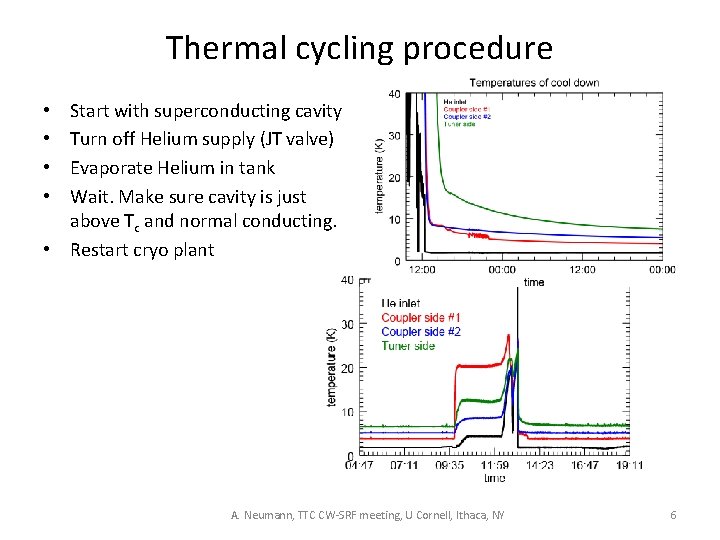
Thermal cycling procedure Start with superconducting cavity Turn off Helium supply (JT valve) Evaporate Helium in tank Wait. Make sure cavity is just above Tc and normal conducting. • Restart cryo plant • • A. Neumann, TTC CW-SRF meeting, U Cornell, Ithaca, NY 6
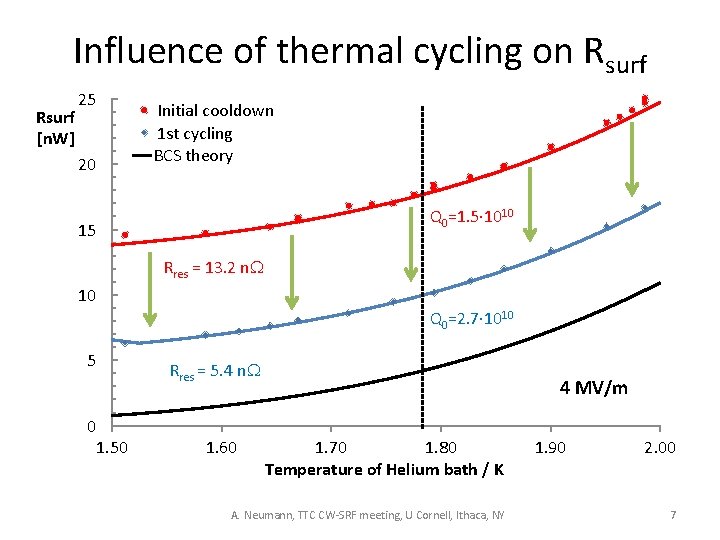
Influence of thermal cycling on Rsurf [n. W] 25 20 Initial cooldown 1 st cycling BCS theory Q 0=1. 5· 1010 15 Rres = 13. 2 n. W 10 Q 0=2. 7· 1010 5 0 1. 50 Rres = 5. 4 n. W 1. 60 4 MV/m 1. 70 1. 80 Temperature of Helium bath / K A. Neumann, TTC CW-SRF meeting, U Cornell, Ithaca, NY 1. 90 2. 00 7
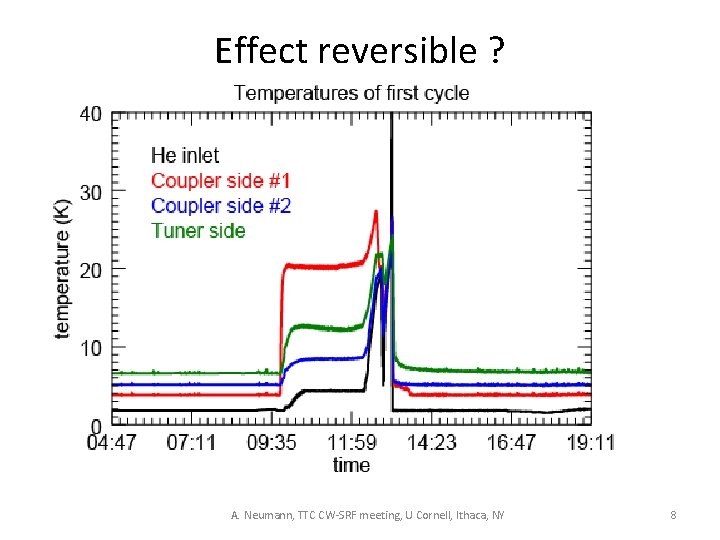
Effect reversible ? A. Neumann, TTC CW-SRF meeting, U Cornell, Ithaca, NY 8
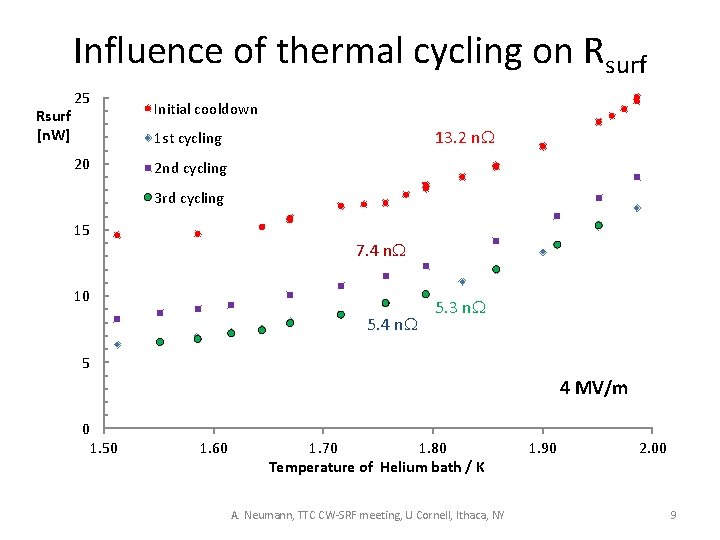
Influence of thermal cycling on Rsurf [n. W] 25 Initial cooldown 13. 2 n. W 1 st cycling 20 2 nd cycling 3 rd cycling 15 7. 4 n. W 10 5. 4 n. W 5. 3 n. W 5 4 MV/m 0 1. 50 1. 60 1. 70 1. 80 Temperature of Helium bath / K A. Neumann, TTC CW-SRF meeting, U Cornell, Ithaca, NY 1. 90 2. 00 9
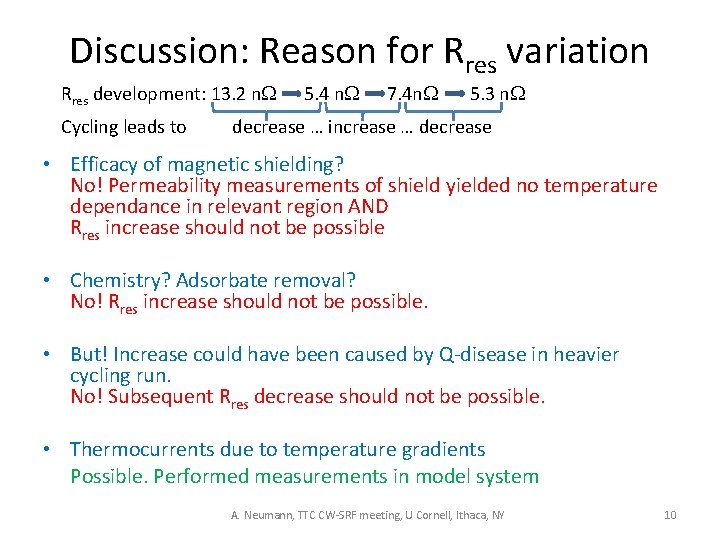
Discussion: Reason for Rres variation Rres development: 13. 2 n. W Cycling leads to 5. 4 n. W 7. 4 n. W 5. 3 n. W decrease … increase … decrease • Efficacy of magnetic shielding? No! Permeability measurements of shield yielded no temperature dependance in relevant region AND Rres increase should not be possible • Chemistry? Adsorbate removal? No! Rres increase should not be possible. • But! Increase could have been caused by Q-disease in heavier cycling run. No! Subsequent Rres decrease should not be possible. • Thermocurrents due to temperature gradients Possible. Performed measurements in model system A. Neumann, TTC CW-SRF meeting, U Cornell, Ithaca, NY 10
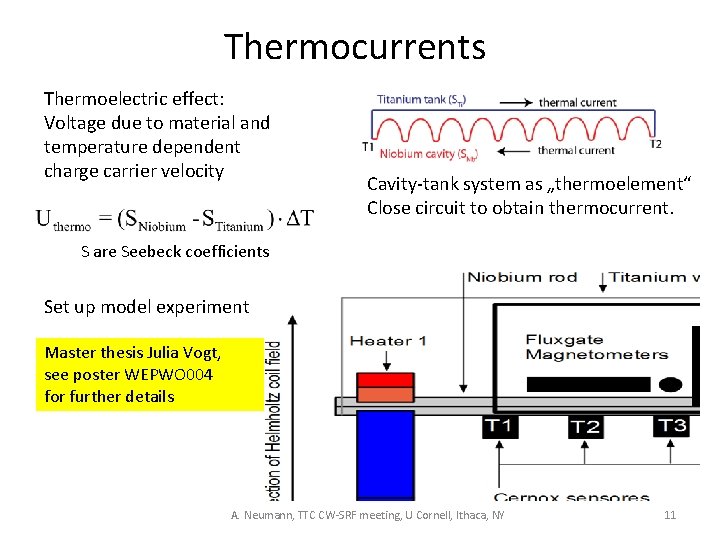
Thermocurrents Thermoelectric effect: Voltage due to material and temperature dependent charge carrier velocity Cavity-tank system as „thermoelement“ Close circuit to obtain thermocurrent. S are Seebeck coefficients Set up model experiment Master thesis Julia Vogt, see poster WEPWO 004 for further details A. Neumann, TTC CW-SRF meeting, U Cornell, Ithaca, NY 11
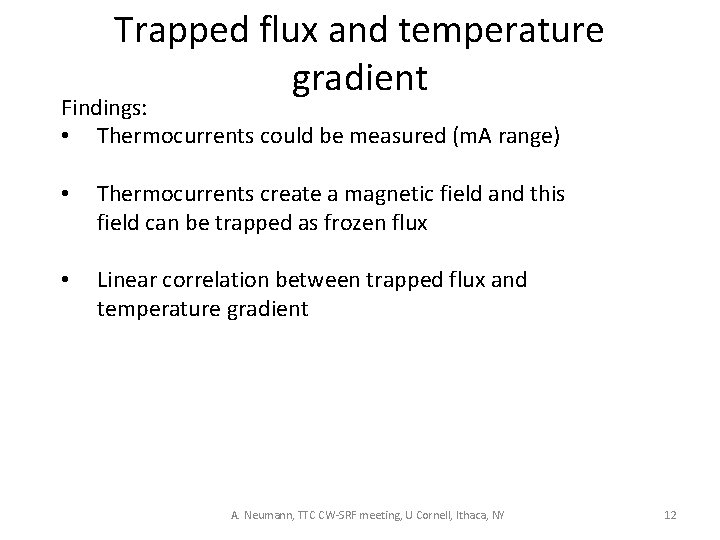
Trapped flux and temperature gradient Findings: • Thermocurrents could be measured (m. A range) • Thermocurrents create a magnetic field and this field can be trapped as frozen flux • Linear correlation between trapped flux and temperature gradient A. Neumann, TTC CW-SRF meeting, U Cornell, Ithaca, NY 12
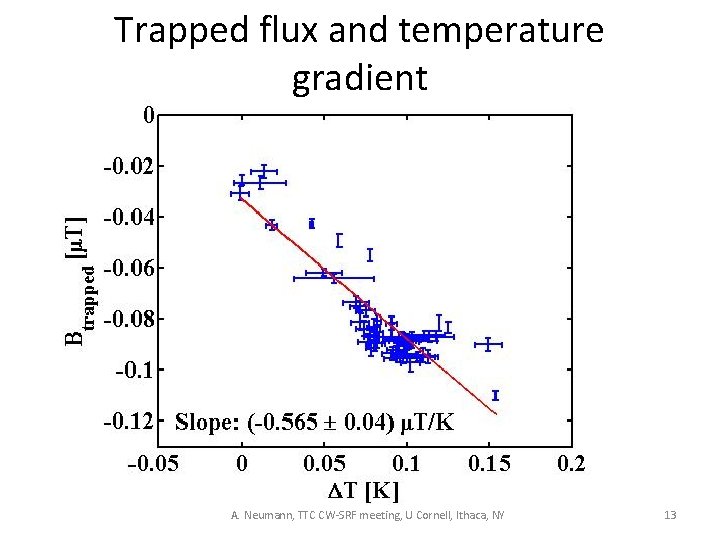
Trapped flux and temperature gradient A. Neumann, TTC CW-SRF meeting, U Cornell, Ithaca, NY 13
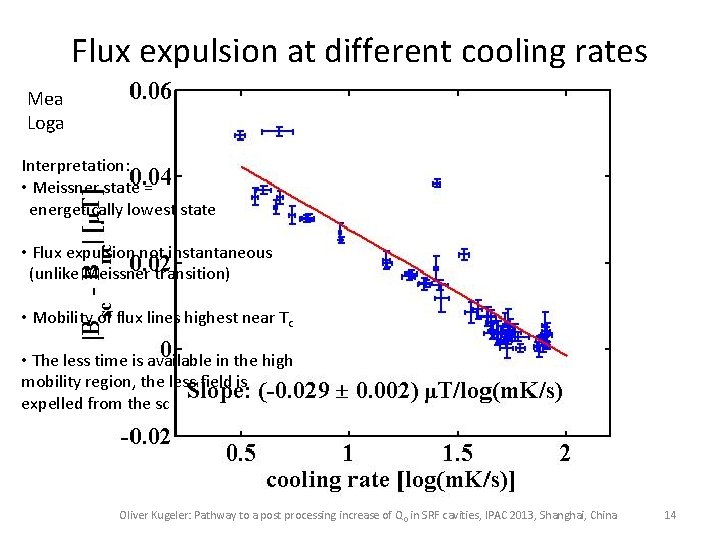
Flux expulsion at different cooling rates Measurement: Keep rod isothermal and cool through Tc Logarithmic dependence of expelled flux from cooling rate Interpretation: • Meissner state = energetically lowest state • Flux expulsion not instantaneous (unlike Meissner transition) • Mobility of flux lines highest near Tc • The less time is available in the high mobility region, the less field is expelled from the sc Oliver Kugeler: Pathway to a post processing increase of Q 0 in SRF cavities, IPAC 2013, Shanghai, China 14
Conclusion • Improve Q 0 by thermal cycling • Factor of 2 improvement is demonstrated • It appears that thermal currents are responsible for extra flux trapping A. Neumann, TTC CW-SRF meeting, U Cornell, Ithaca, NY 15
Acknowledgement Julia Vogt (Master thesis on flux dynamics) Sarah Aull (Diploma thesis on trapped flux) Jens Knobloch Michael Schuster, Sascha Klauke, Andre Frahm, Dirk Pflückhahn, Stefan Rotterdam (Experimental support) • Hans-Peter Vogel, Research Instruments (for providing Niobium rod) • • A. Neumann, TTC CW-SRF meeting, U Cornell, Ithaca, NY 16
- Slides: 16