
HYSWEEP PATCH TESTING HYSWEEP Calibration of a Multibeam
HYSWEEP® PATCH TESTING

® HYSWEEP Calibration of a Multibeam System Running a Patch Test on Single and Dual Head Multibeam Systems PROJECT: SAMPLE PATCH TEST SINGLE HEAD 11/4/2020 HYPACK® 2009 Training Seminar 2
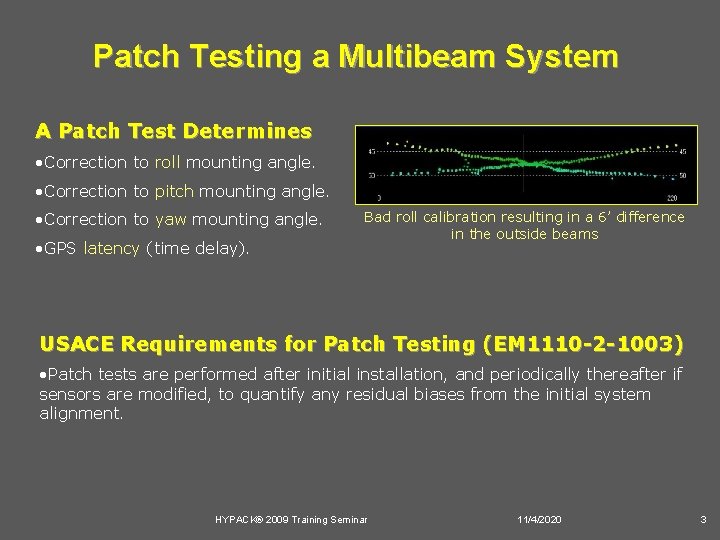
Patch Testing a Multibeam System A Patch Test Determines • Correction to roll mounting angle. • Correction to pitch mounting angle. • Correction to yaw mounting angle. • GPS latency (time delay). Bad roll calibration resulting in a 6’ difference in the outside beams USACE Requirements for Patch Testing (EM 1110 -2 -1003) • Patch tests are performed after initial installation, and periodically thereafter if sensors are modified, to quantify any residual biases from the initial system alignment. HYPACK® 2009 Training Seminar 11/4/2020 3
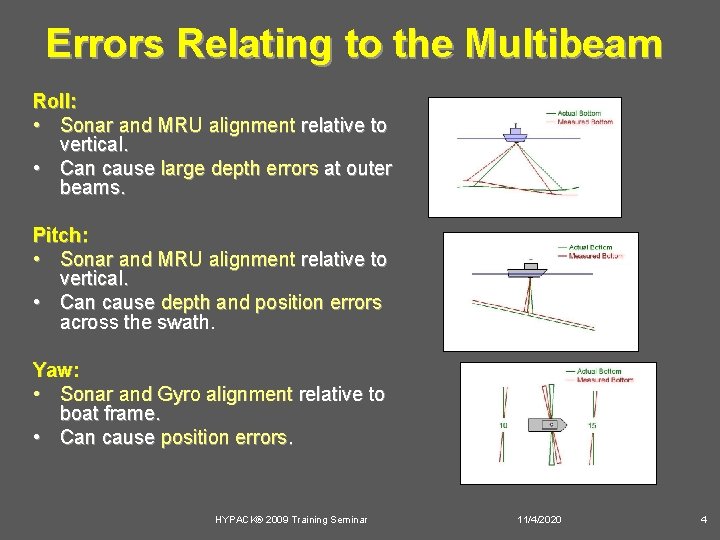
Errors Relating to the Multibeam Roll: • Sonar and MRU alignment relative to vertical. • Can cause large depth errors at outer beams. Pitch: • Sonar and MRU alignment relative to vertical. • Can cause depth and position errors across the swath. Yaw: • Sonar and Gyro alignment relative to boat frame. • Can cause position errors. HYPACK® 2009 Training Seminar 11/4/2020 4
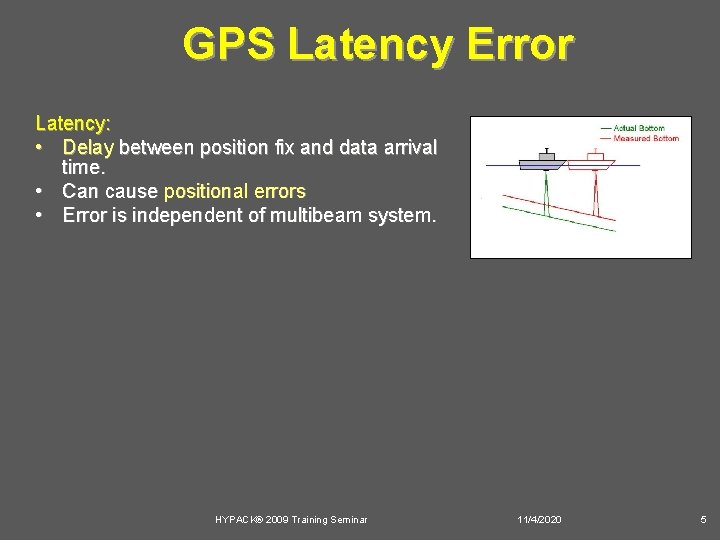
GPS Latency Error Latency: • Delay between position fix and data arrival time. • Can cause positional errors • Error is independent of multibeam system. HYPACK® 2009 Training Seminar 11/4/2020 5

Patch Test Survey • • Roll: Line A-B - Reciprocal lines, flat bottom. Survey speed. Pitch: Line C-D – Reciprocal lines, sloping bottom. Survey speed. Yaw: Lines C-D, E-F – Offset lines, sloping bottom. Survey speed. Latency: Line C-D – Same line and direction, differing speed, sloping bottom. Watch for settlement differences. Dual Head • Different geometry to overlap port and starboard heads separately. • Roll, pitch and yaw tests require 3 lines instead of 2. • Some dual head systems in engineered mounting frames can be treated as single head. HYPACK® 2009 Training Seminar 11/4/2020 6
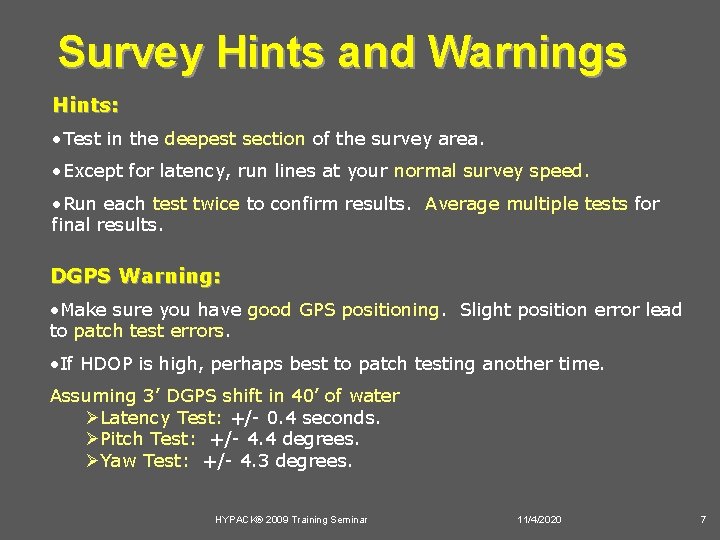
Survey Hints and Warnings Hints: • Test in the deepest section of the survey area. • Except for latency, run lines at your normal survey speed. • Run each test twice to confirm results. Average multiple tests for final results. DGPS Warning: • Make sure you have good GPS positioning. Slight position error lead to patch test errors. • If HDOP is high, perhaps best to patch testing another time. Assuming 3’ DGPS shift in 40’ of water ØLatency Test: +/- 0. 4 seconds. ØPitch Test: +/- 4. 4 degrees. ØYaw Test: +/- 4. 3 degrees. HYPACK® 2009 Training Seminar 11/4/2020 7
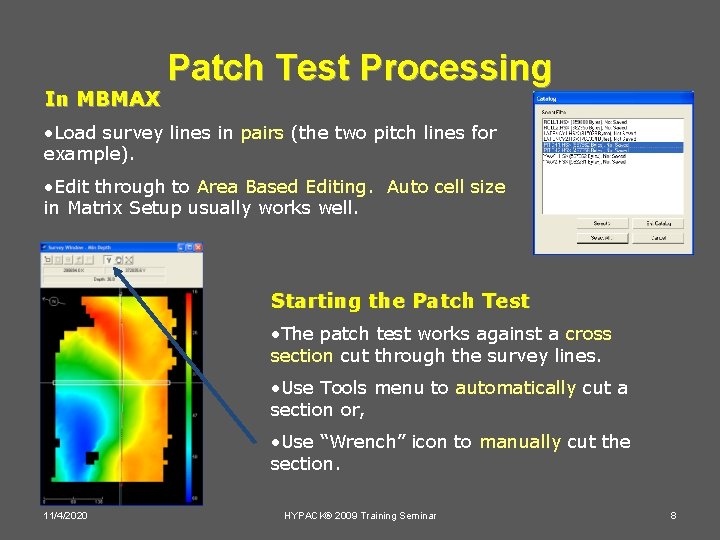
In MBMAX Patch Test Processing • Load survey lines in pairs (the two pitch lines for example). • Edit through to Area Based Editing. Auto cell size in Matrix Setup usually works well. Starting the Patch Test • The patch test works against a cross section cut through the survey lines. • Use Tools menu to automatically cut a section or, • Use “Wrench” icon to manually cut the section. 11/4/2020 HYPACK® 2009 Training Seminar 8

How It Works Numerical Method • The cross sections are calculated at various angle offsets. For example; pitch offset from -10 to 10 degrees at one degree steps. • An error value is calculated at each offset. Error = average depth difference between cross sections. • Minimum error is usually the correct offset. But not always. Good Fit Poor Fit • Cross sections overlay well. • Cross sections overlay poorly. • Error is at the minimum point. • Large error. 11/4/2020 HYPACK® 2009 Training Seminar 9

The Patch Test Window Select Test • Pick the tab corresponding to the test you want to run. Results • Read test results here. Select Sonar Head • For dual head systems, select head 1 or 2 Error Graph Cross Sections • X axis is angle or time adjustment. • Red is the first line, green is the second. • Y axis is the error; difference between cross sections. Override Vertical Adjustment • Moves the first line up or down if needed. 11/4/2020 HYPACK® 2009 Training Seminar • Select Next or Previous adjustment. 10

Roll Test Single Head • Angle step of 0. 1 degree. Can go to 0. 05. • Good overlap in cross sections. • Good “U-Shaped” error curve. Dual Head • Totally different result for each head. HYPACK® 2009 Training Seminar 11/4/2020 11
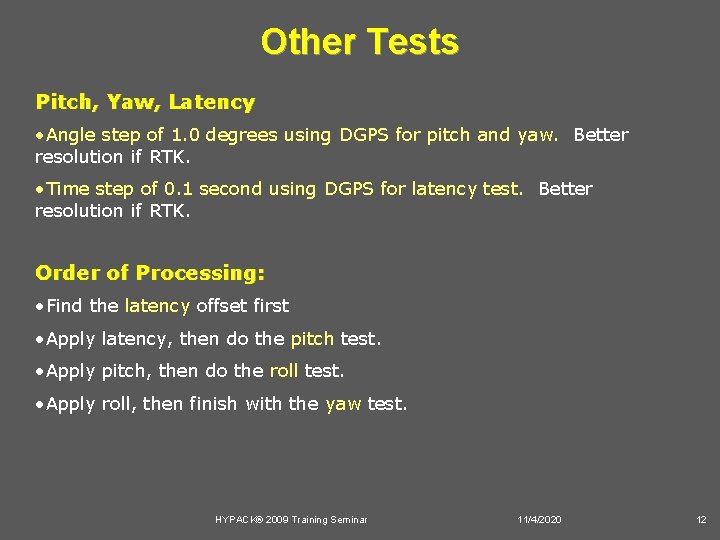
Other Tests Pitch, Yaw, Latency • Angle step of 1. 0 degrees using DGPS for pitch and yaw. Better resolution if RTK. • Time step of 0. 1 second using DGPS for latency test. Better resolution if RTK. Order of Processing: • Find the latency offset first • Apply latency, then do the pitch test. • Apply pitch, then do the roll test. • Apply roll, then finish with the yaw test. HYPACK® 2009 Training Seminar 11/4/2020 12
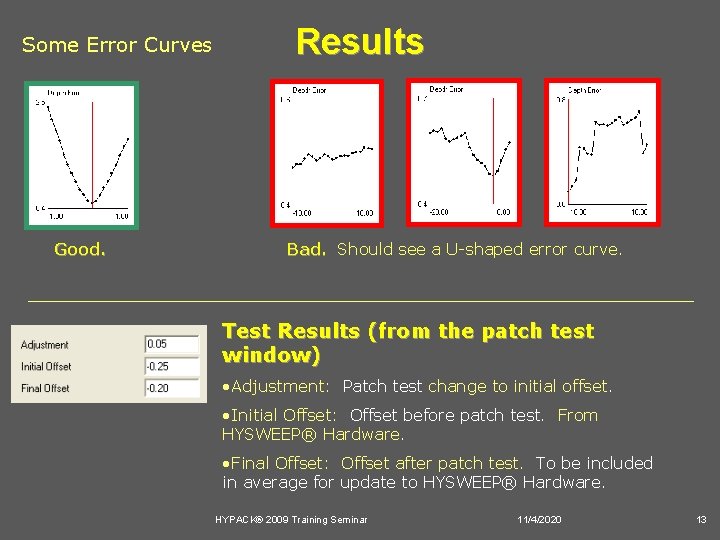
Some Error Curves Good. Results Bad. Should see a U-shaped error curve. Test Results (from the patch test window) • Adjustment: Patch test change to initial offset. • Initial Offset: Offset before patch test. From HYSWEEP® Hardware. • Final Offset: Offset after patch test. To be included in average for update to HYSWEEP® Hardware. HYPACK® 2009 Training Seminar 11/4/2020 13
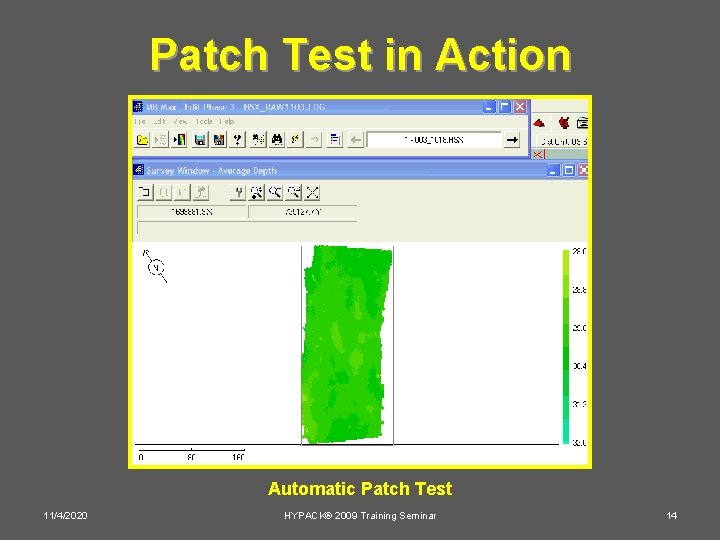
Patch Test in Action Automatic Patch Test 11/4/2020 HYPACK® 2009 Training Seminar 14
- Slides: 14