
Hysteresis or Bistable Behavior The Ubiquity of Oscillating
Hysteresis, or Bistable Behavior
The Ubiquity of Oscillating Systems in the World One of the very common phenomena in the world are systems that oscillate between two or more states, like. . . 1 The, the daily heating and cooling cycle, 2 Or, the seasonal cycles, 3 Or cycles of populations, 4 Or waves of economic expansion followed by recession. 5 Or, sleeping and waking.
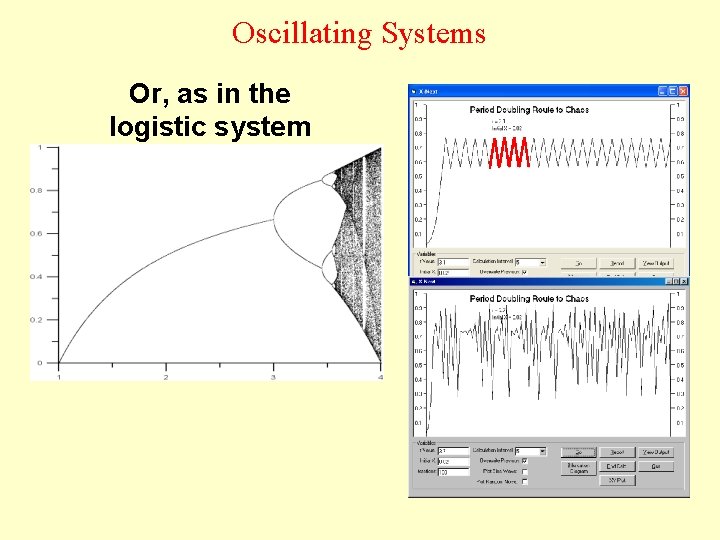
Oscillating Systems Or, as in the logistic system
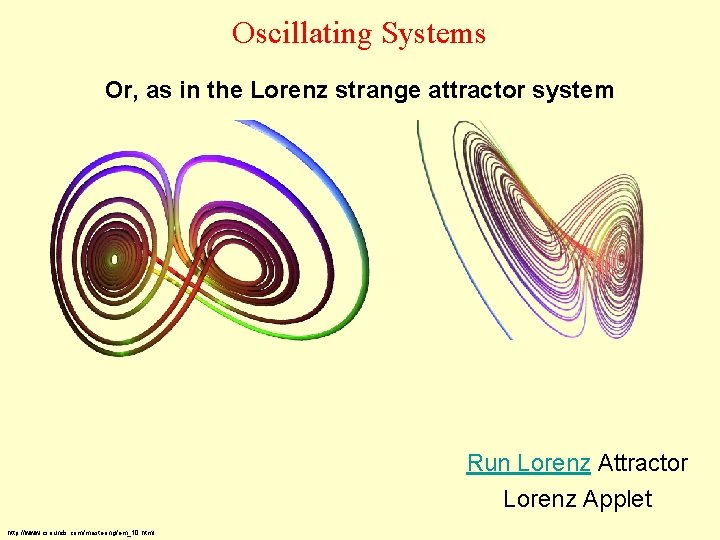
Oscillating Systems Or, as in the Lorenz strange attractor system Run Lorenz Attractor Lorenz Applet http: //www. csounds. com/mastering/em_10. html
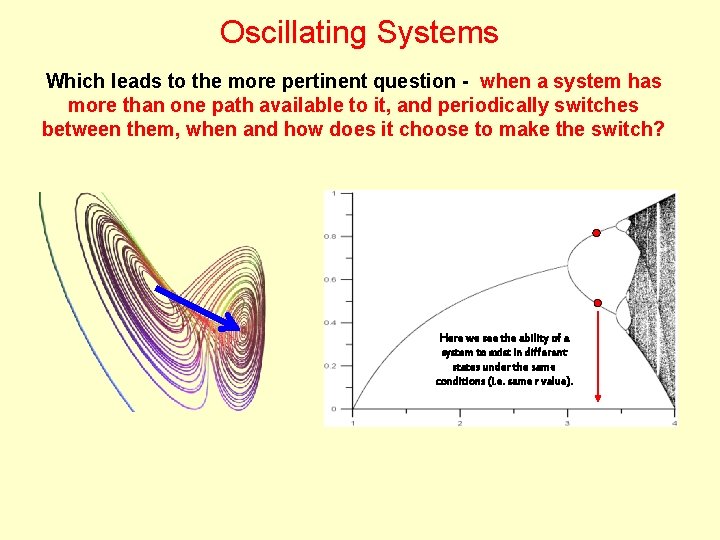
Oscillating Systems Which leads to the more pertinent question - when a system has more than one path available to it, and periodically switches between them, when and how does it choose to make the switch? Here we see the ability of a system to exist in different states under the same conditions (i. e. same r value).
Hysteresis a. k. a. Bistable Behavior Has two different meanings, and we need to understand both. 1. The lag in response between a cause and its effect. AND 2. The ability of a system to exist in different states under the same conditions.
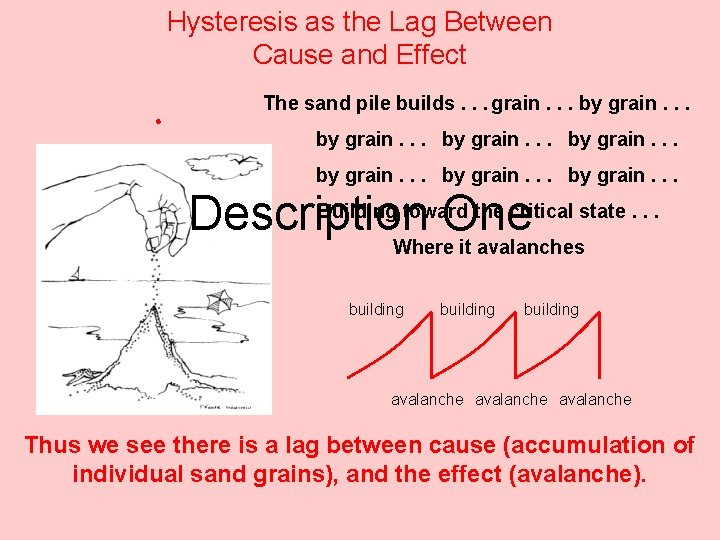
Hysteresis as the Lag Between Cause and Effect The sand pile builds. . . grain. . . by grain. . . Building toward the critical state. . . Description One Where it avalanches building avalanche Thus we see there is a lag between cause (accumulation of individual sand grains), and the effect (avalanche).
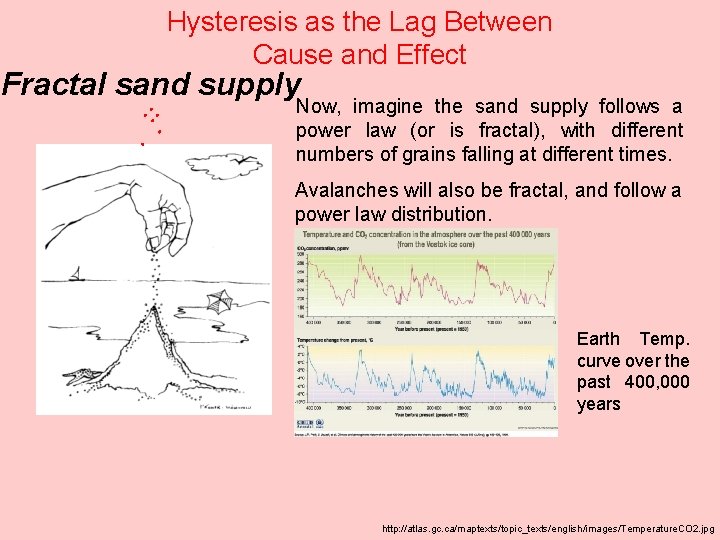
Hysteresis as the Lag Between Cause and Effect Fractal sand supply Now, imagine the sand supply follows a power law (or is fractal), with different numbers of grains falling at different times. Avalanches will also be fractal, and follow a power law distribution. Earth Temp. curve over the past 400, 000 years http: //atlas. gc. ca/maptexts/topic_texts/english/images/Temperature. CO 2. jpg
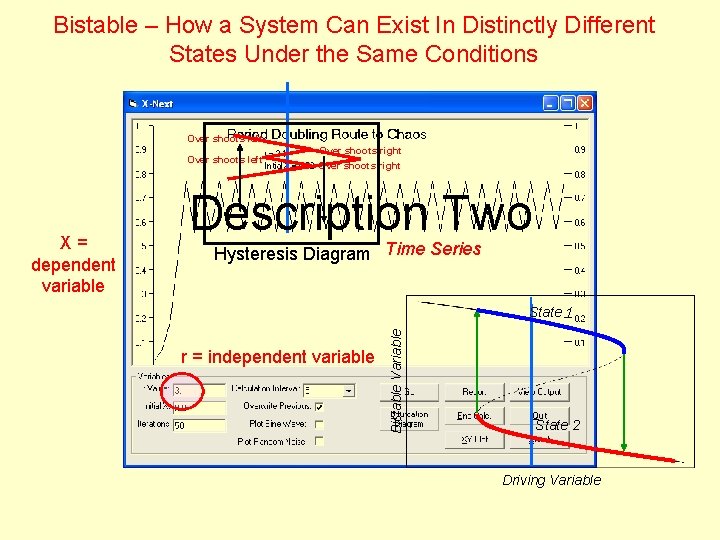
Bistable – How a System Can Exist In Distinctly Different States Under the Same Conditions Over shoots left Description Two Hysteresis Diagram Time Series State 1 r = independent variable Bistable Variable X= dependent variable Over shoots right State 2 Driving Variable
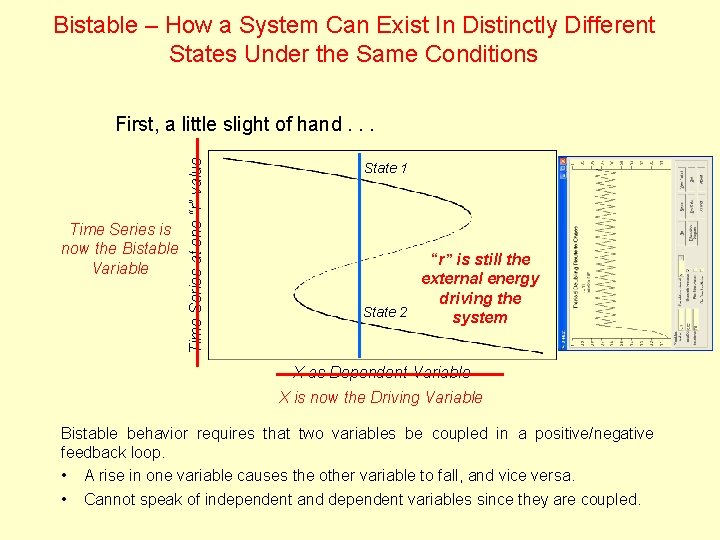
Bistable – How a System Can Exist In Distinctly Different States Under the Same Conditions Time Series is now the Bistable Variable Time Series at one “r” value First, a little slight of hand. . . State 1 “r” is still the external energy driving the State 2 system X as Dependent Variable X is now the Driving Variable Bistable behavior requires that two variables be coupled in a positive/negative feedback loop. • A rise in one variable causes the other variable to fall, and vice versa. • Cannot speak of independent and dependent variables since they are coupled.
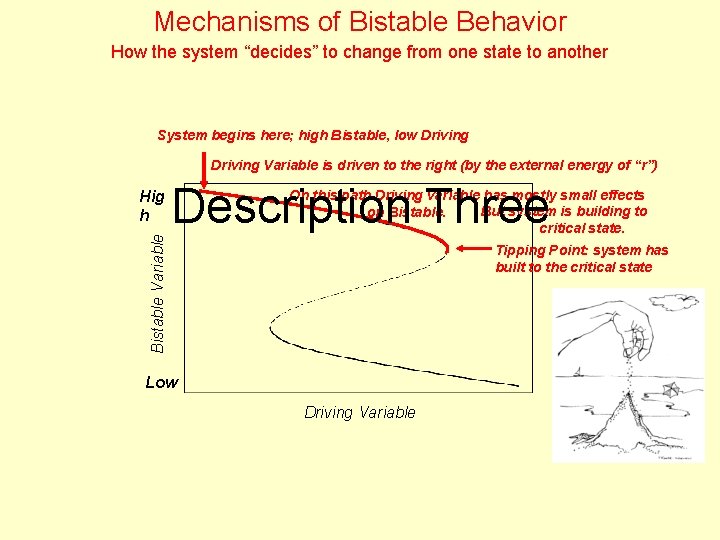
Mechanisms of Bistable Behavior How the system “decides” to change from one state to another System begins here; high Bistable, low Driving Variable is driven to the right (by the external energy of “r”) Description Three Bistable Variable Hig h On this path Driving variable has mostly small effects But system is building to on Bistable. critical state. Tipping Point: system has built to the critical state Low Driving Variable
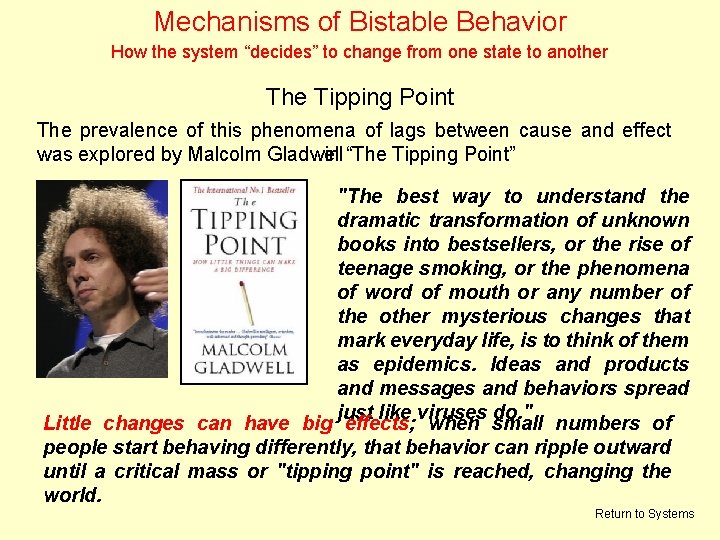
Mechanisms of Bistable Behavior How the system “decides” to change from one state to another The Tipping Point The prevalence of this phenomena of lags between cause and effect was explored by Malcolm Gladwell in “The Tipping Point” "The best way to understand the dramatic transformation of unknown books into bestsellers, or the rise of teenage smoking, or the phenomena of word of mouth or any number of the other mysterious changes that mark everyday life, is to think of them as epidemics. Ideas and products and messages and behaviors spread just like viruses do. " Little changes can have big effects; when small numbers of people start behaving differently, that behavior can ripple outward until a critical mass or "tipping point" is reached, changing the world. Return to Systems
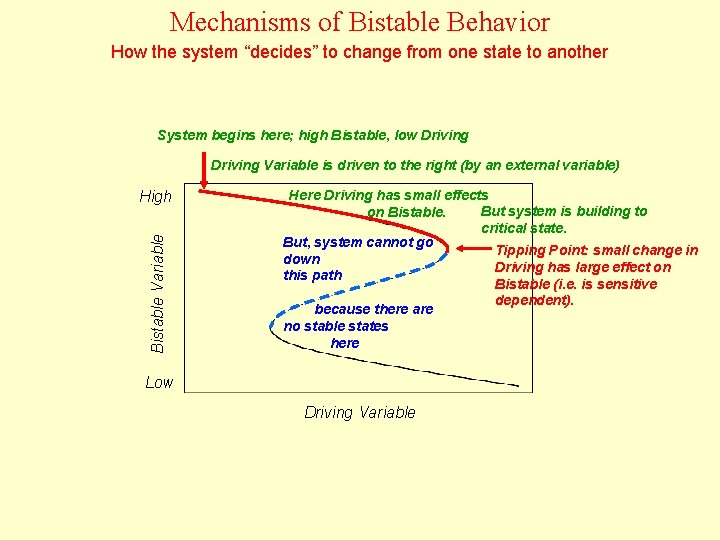
Mechanisms of Bistable Behavior How the system “decides” to change from one state to another System begins here; high Bistable, low Driving Variable is driven to the right (by an external variable) Bistable Variable High Here Driving has small effects But system is building to on Bistable. critical state. But, system cannot go Tipping Point: small change in down Driving has large effect on this path Bistable (i. e. is sensitive dependent). because there are no stable states here Low Driving Variable
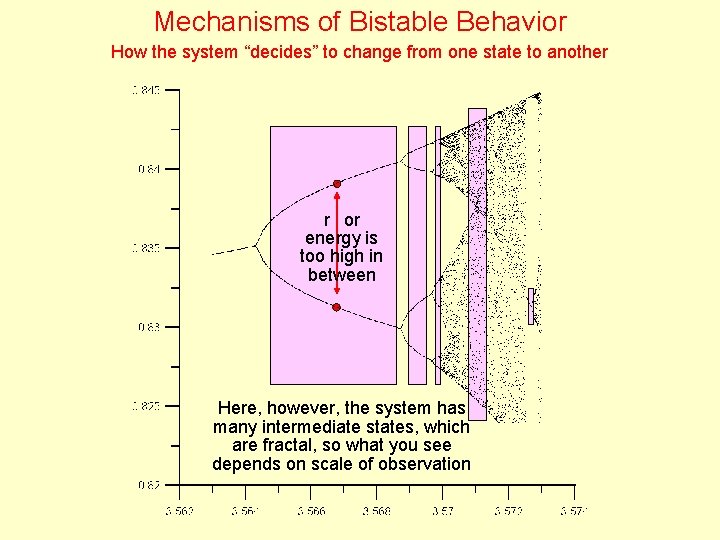
Mechanisms of Bistable Behavior How the system “decides” to change from one state to another r or energy is too high in between Here, however, the system has many intermediate states, which are fractal, so what you see depends on scale of observation
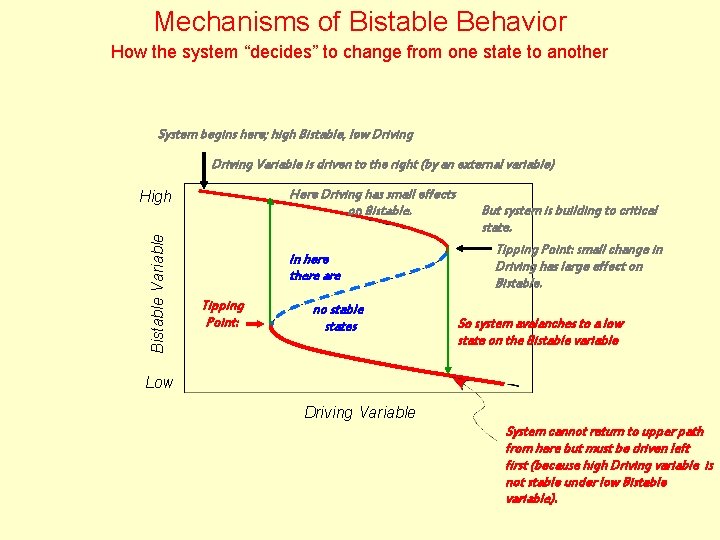
Mechanisms of Bistable Behavior How the system “decides” to change from one state to another System begins here; high Bistable, low Driving Variable is driven to the right (by an external variable) Here Driving has small effects on Bistable Variable High In here there are Tipping Point: no stable states But system is building to critical state. Tipping Point: small change in Driving has large effect on Bistable. So system avalanches to a low state on the Bistable variable Low Driving Variable System cannot return to upper path from here but must be driven left first (because high Driving variable is not stable under low Bistable variable).
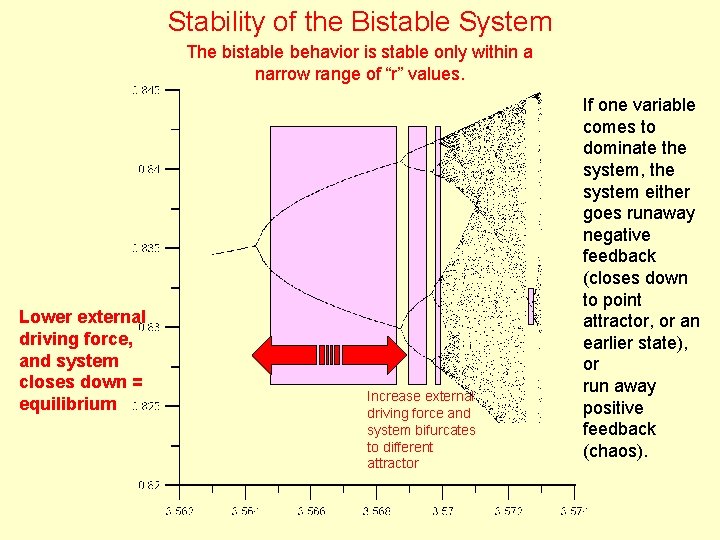
Stability of the Bistable System The bistable behavior is stable only within a narrow range of “r” values. Lower external driving force, and system closes down = equilibrium Increase external driving force and system bifurcates to different attractor If one variable comes to dominate the system, the system either goes runaway negative feedback (closes down to point attractor, or an earlier state), or run away positive feedback (chaos).
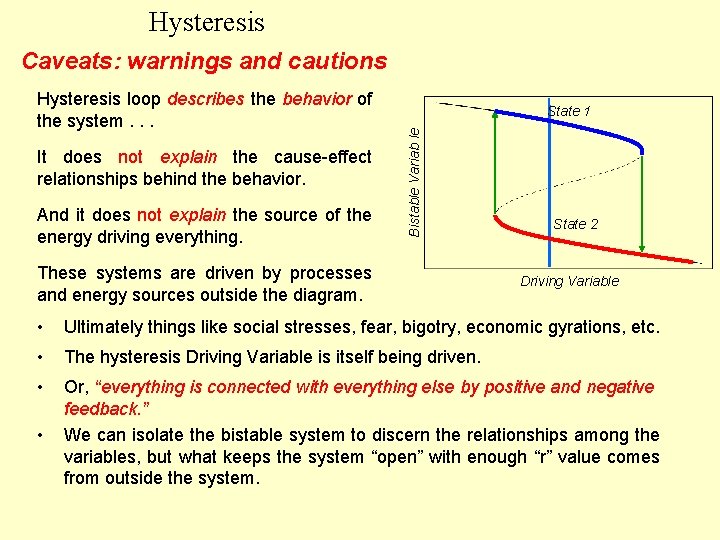
Hysteresis Caveats: warnings and cautions It does not explain the cause-effect relationships behind the behavior. And it does not explain the source of the energy driving everything. State 1 Bistable Variab le Hysteresis loop describes the behavior of the system. . . These systems are driven by processes and energy sources outside the diagram. State 2 Driving Variable • Ultimately things like social stresses, fear, bigotry, economic gyrations, etc. • The hysteresis Driving Variable is itself being driven. • Or, “everything is connected with everything else by positive and negative feedback. ” We can isolate the bistable system to discern the relationships among the variables, but what keeps the system “open” with enough “r” value comes from outside the system. •
NOA Oscillation ENSO La Nina and El Nino Oscillation
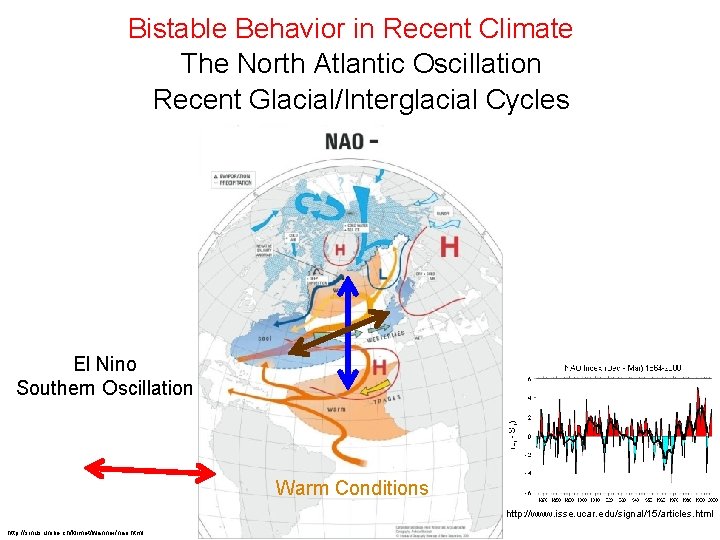
Bistable Behavior in Recent Climate The North Atlantic Oscillation Recent Glacial/Interglacial Cycles El Nino Southern Oscillation Deep. Warm Freeze Conditions http: //www. isse. ucar. edu/signal/15/articles. html http: //sinus. unibe. ch/klimet/wanner/nao. html
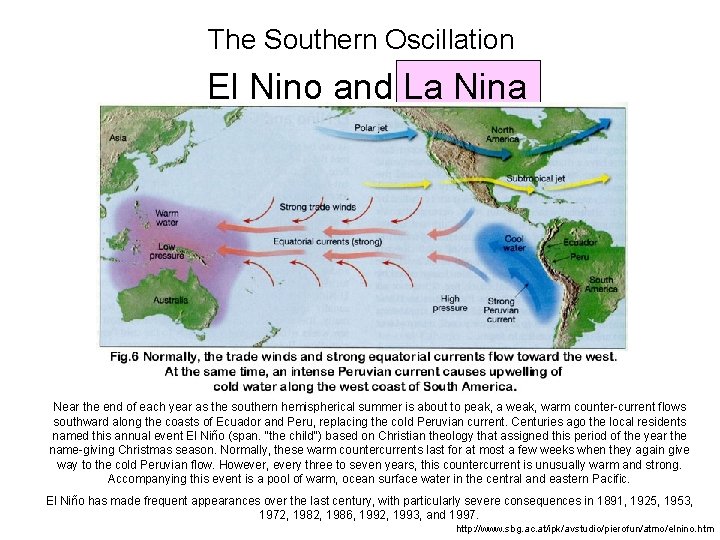
The Southern Oscillation El Nino and La Nina Near the end of each year as the southern hemispherical summer is about to peak, a weak, warm counter-current flows southward along the coasts of Ecuador and Peru, replacing the cold Peruvian current. Centuries ago the local residents named this annual event El Niño (span. "the child") based on Christian theology that assigned this period of the year the name-giving Christmas season. Normally, these warm countercurrents last for at most a few weeks when they again give way to the cold Peruvian flow. However, every three to seven years, this countercurrent is unusually warm and strong. Accompanying this event is a pool of warm, ocean surface water in the central and eastern Pacific. El Niño has made frequent appearances over the last century, with particularly severe consequences in 1891, 1925, 1953, 1972, 1986, 1992, 1993, and 1997. http: //www. sbg. ac. at/ipk/avstudio/pierofun/atmo/elnino. htm
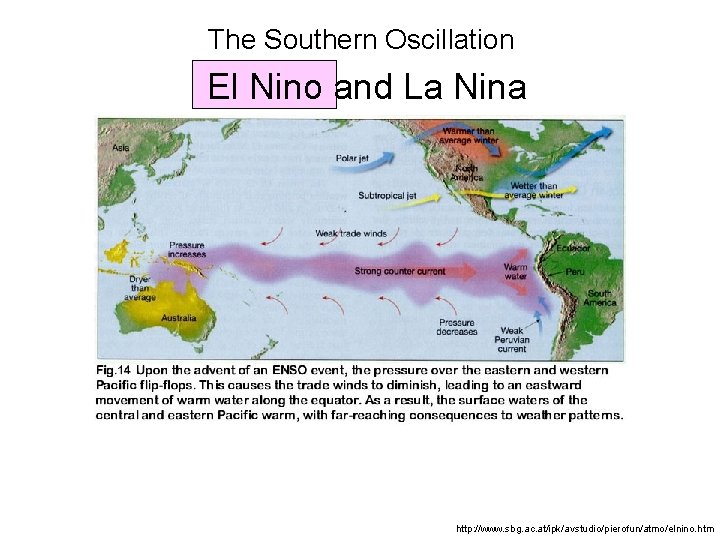
The Southern Oscillation El Nino and La Nina http: //www. sbg. ac. at/ipk/avstudio/pierofun/atmo/elnino. htm
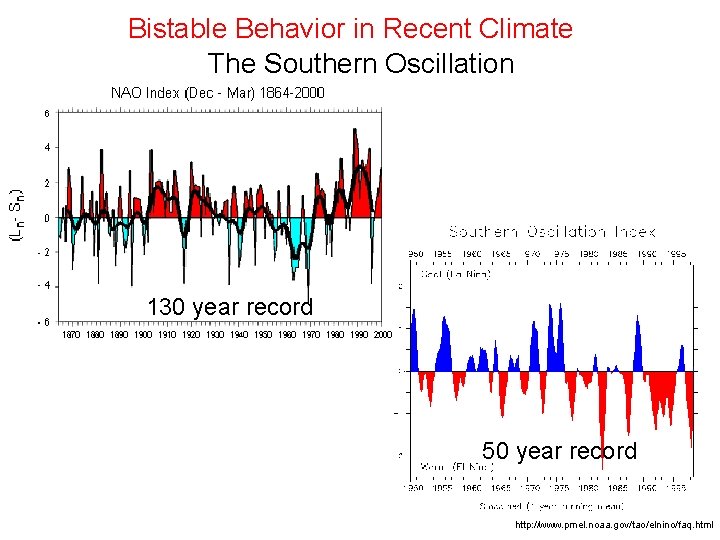
Bistable Behavior in Recent Climate The Southern Oscillation 130 year record 50 year record http: //www. pmel. noaa. gov/tao/elnino/faq. html
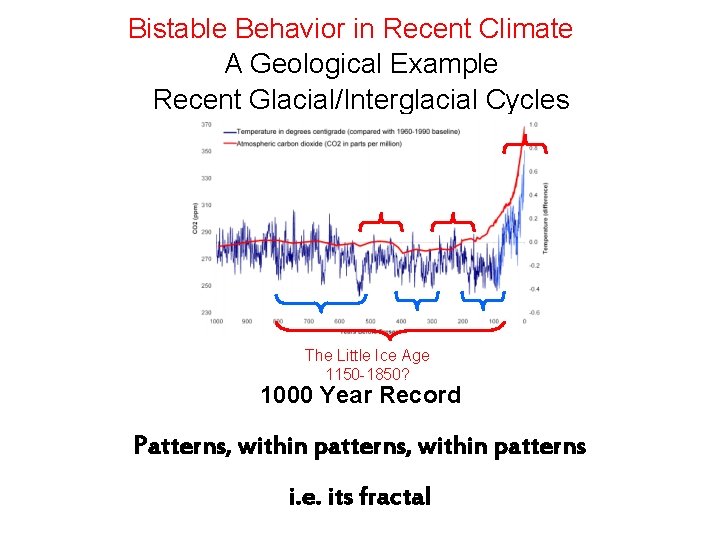
Bistable Behavior in Recent Climate A Geological Example Recent Glacial/Interglacial Cycles The Little Ice Age 1150 -1850? 1000 Year Record Patterns, within patterns i. e. its fractal
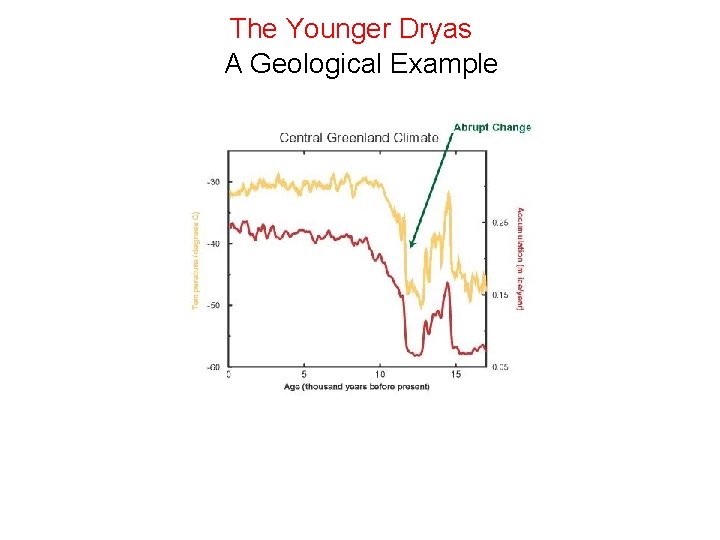
The Younger Dryas A Geological Example
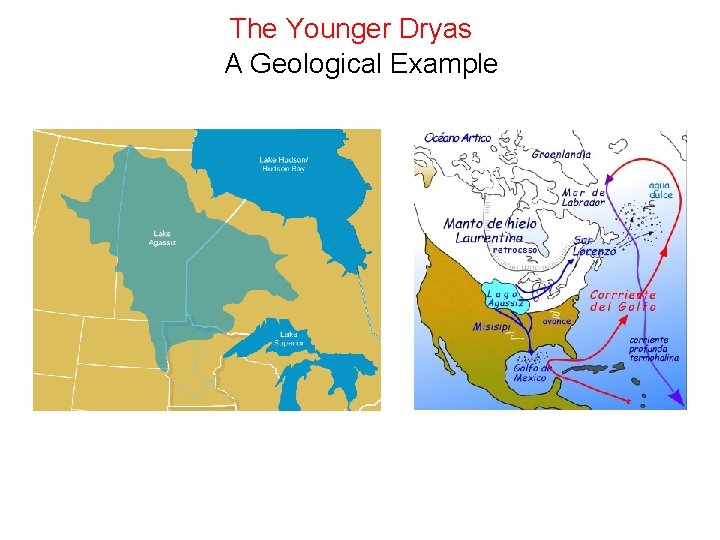
The Younger Dryas A Geological Example
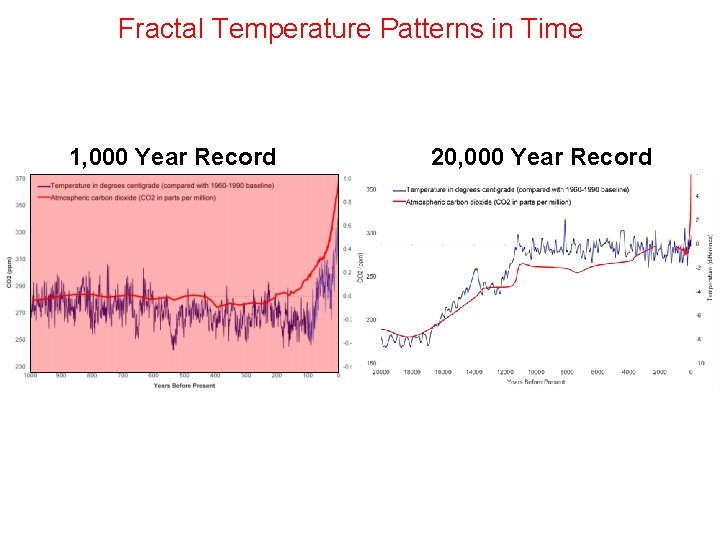
Fractal Temperature Patterns in Time 1, 000 Year Record 20, 000 Year Record
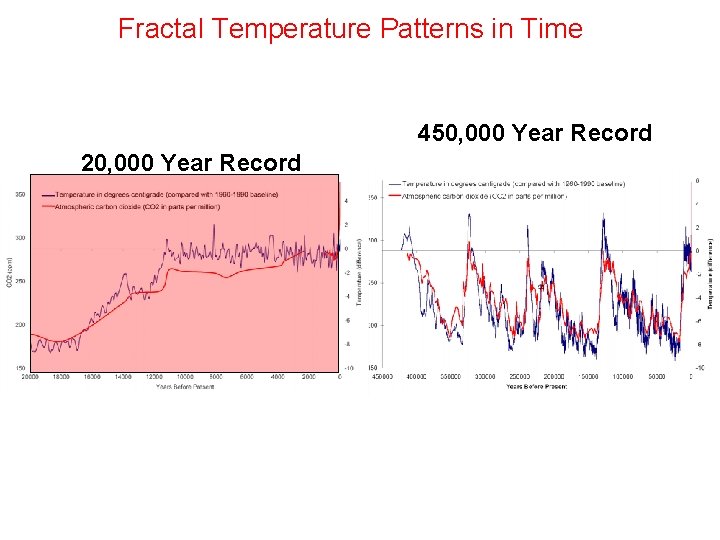
Fractal Temperature Patterns in Time 450, 000 Year Record 20, 000 Year Record

The Future in Plain Sight: The Rise of the "True Believers" and Other Clues to the Coming Instability Eugene Linden, 2002 “Today’s Baby Boomers had the privilege of growing up in one of the most stable periods in the vast sweep of human history. As of this writing, more than fifty years have passed without catastrophic conflict between great powers. This fiftyyear hiatus falls within a period of 150 years of extreme climate stability that has only recently begun to change. Finally, the 150 -year stretch falls within an eight-thousandyear period in which climate has been relatively clement compared with the record of the past million years or so. Since our distant ancestors last saw real instability, humans have invented agriculture, writing, cities, and commerce, flown to the moon, and multiplied from some few million souls to roughly 5. 6 billion. ”
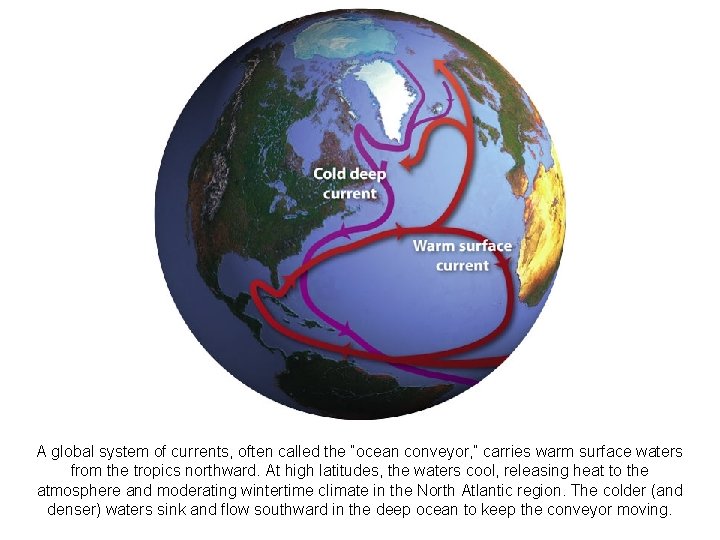
A global system of currents, often called the “ocean conveyor, ” carries warm surface waters from the tropics northward. At high latitudes, the waters cool, releasing heat to the atmosphere and moderating wintertime climate in the North Atlantic region. The colder (and denser) waters sink and flow southward in the deep ocean to keep the conveyor moving.
Bistable Behavior in Recent Climate The Day After Tomorrow
Bistable Behavior in Recent Climate The Day After Tomorrow
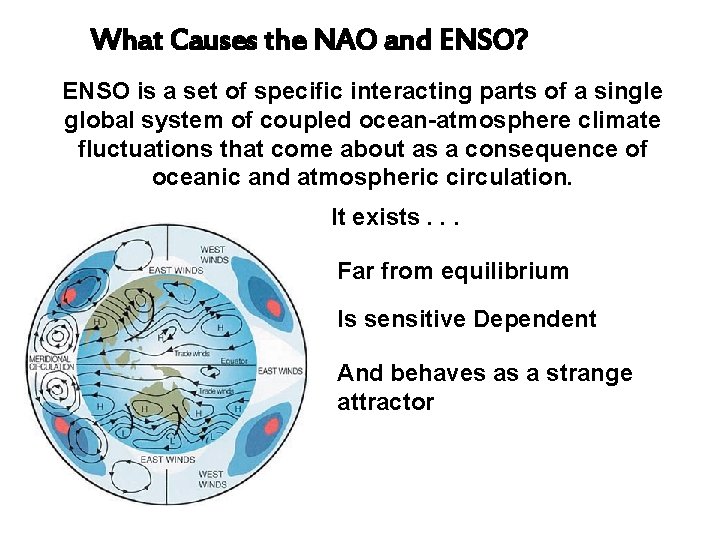
What Causes the NAO and ENSO? ENSO is a set of specific interacting parts of a single global system of coupled ocean-atmosphere climate fluctuations that come about as a consequence of oceanic and atmospheric circulation. It exists. . . Far from equilibrium Is sensitive Dependent And behaves as a strange attractor
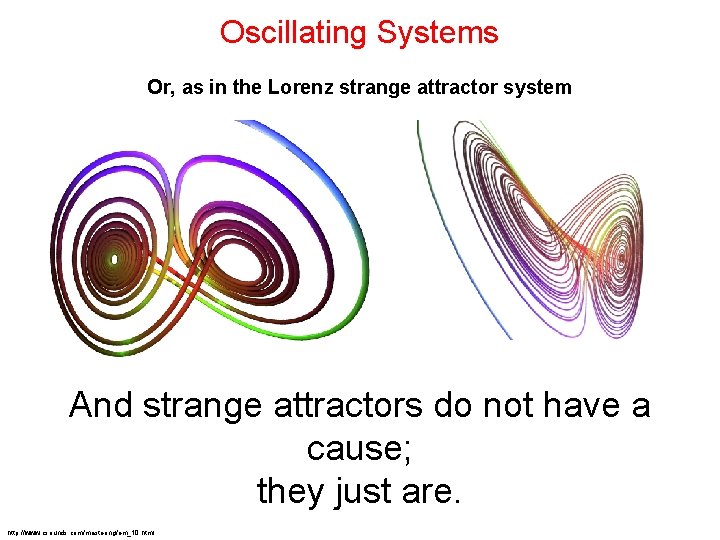
Oscillating Systems Or, as in the Lorenz strange attractor system And strange attractors do not have a cause; they just are. http: //www. csounds. com/mastering/em_10. html
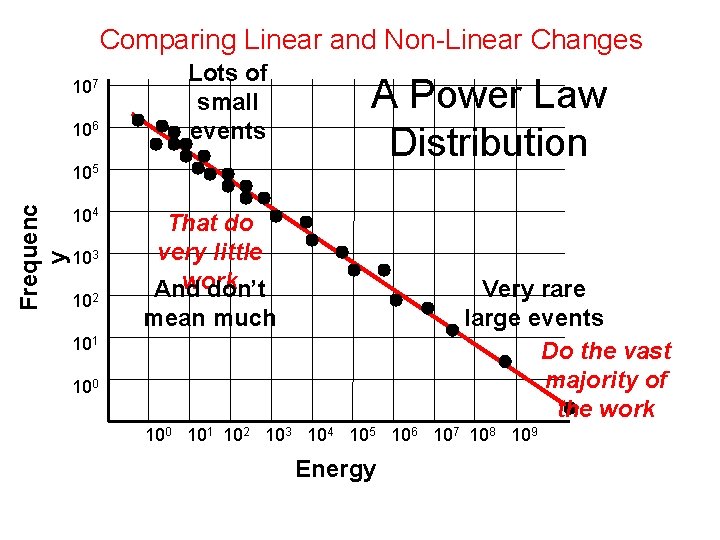
Comparing Linear and Non-Linear Changes 107 106 Lots of small events Frequenc y 105 104 103 102 A Power Law Distribution That do very little work And don’t Very rare large events Do the vast majority of the work mean much 101 100 101 102 103 104 105 106 107 108 109 Energy
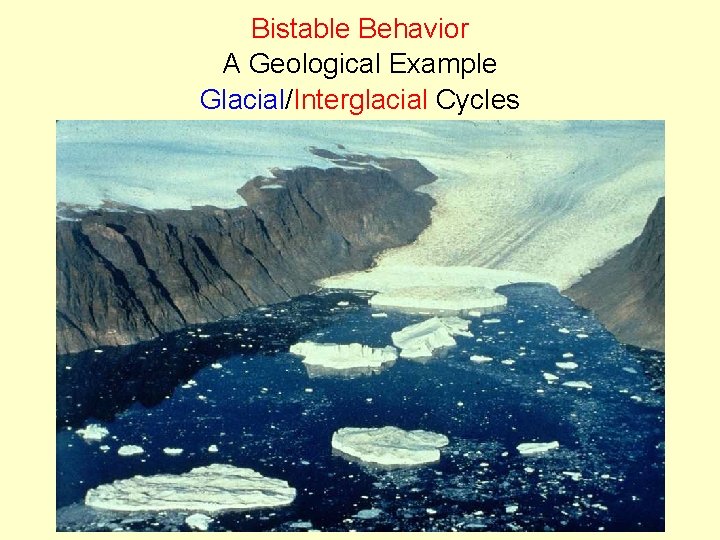
Bistable Behavior A Geological Example Glacial/Interglacial Cycles
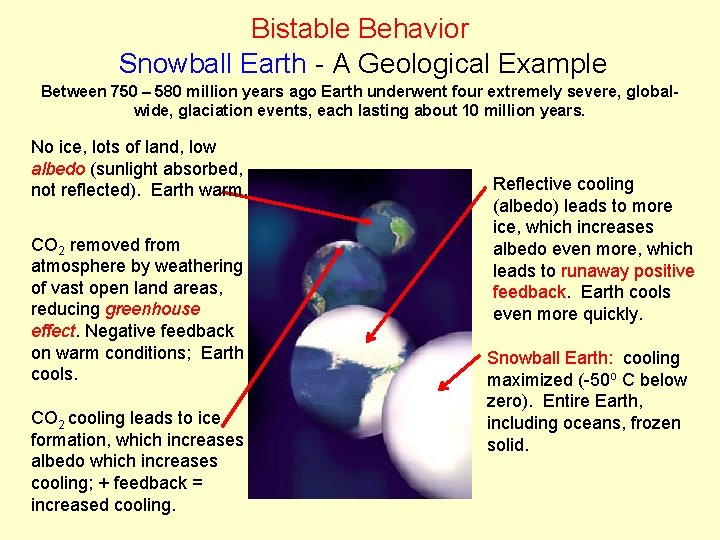
Bistable Behavior Snowball Earth - A Geological Example Between 750 – 580 million years ago Earth underwent four extremely severe, globalwide, glaciation events, each lasting about 10 million years. No ice, lots of land, low albedo (sunlight absorbed, not reflected). Earth warm. CO 2 removed from atmosphere by weathering of vast open land areas, reducing greenhouse effect. Negative feedback on warm conditions; Earth cools. CO 2 cooling leads to ice formation, which increases albedo which increases cooling; + feedback = increased cooling. Reflective cooling (albedo) leads to more ice, which increases albedo even more, which leads to runaway positive feedback. Earth cools even more quickly. Snowball Earth: cooling maximized (-50 o C below zero). Entire Earth, including oceans, frozen solid.
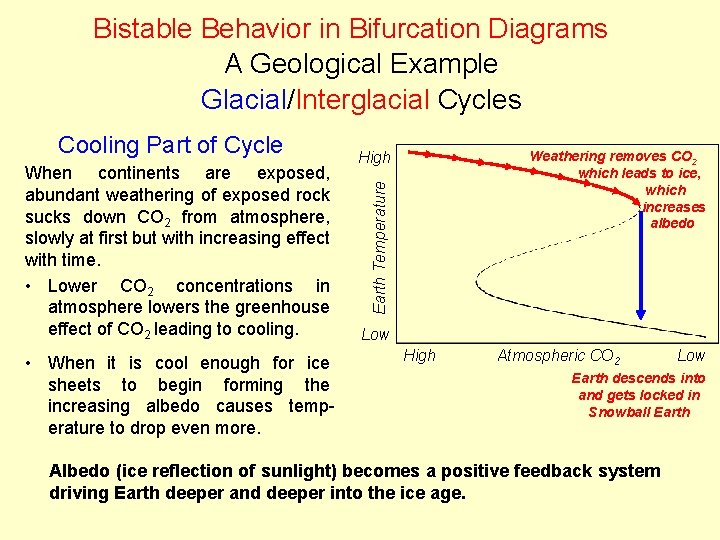
Bistable Behavior in Bifurcation Diagrams A Geological Example Glacial/Interglacial Cycles When continents are exposed, abundant weathering of exposed rock sucks down CO 2 from atmosphere, slowly at first but with increasing effect with time. • Lower CO 2 concentrations in atmosphere lowers the greenhouse effect of CO 2 leading to cooling. • When it is cool enough for ice sheets to begin forming the increasing albedo causes temperature to drop even more. Weathering removes CO 2 which leads to ice, which increases albedo High Earth Temperature Cooling Part of Cycle Low High Atmospheric CO 2 Low Earth descends into and gets locked in Snowball Earth Albedo (ice reflection of sunlight) becomes a positive feedback system driving Earth deeper and deeper into the ice age.
This is the way the world ends Not with a bang but a whimper. The Hollow Men T. S. Eliot (1925)
Bistable Behavior A Geological Example Reversal of Snowball Earth There is no extrinsic reason for Snowball Earth to have come to an end. Once locked into the positive feedback loop of cooling, leading to more cooling the Earth should have become stuck there. The reason it did not become stuck was Intrinsic, the Earth is an open, dissipative system, and what it dissipates is tectonic energy – energy from its molten interior.
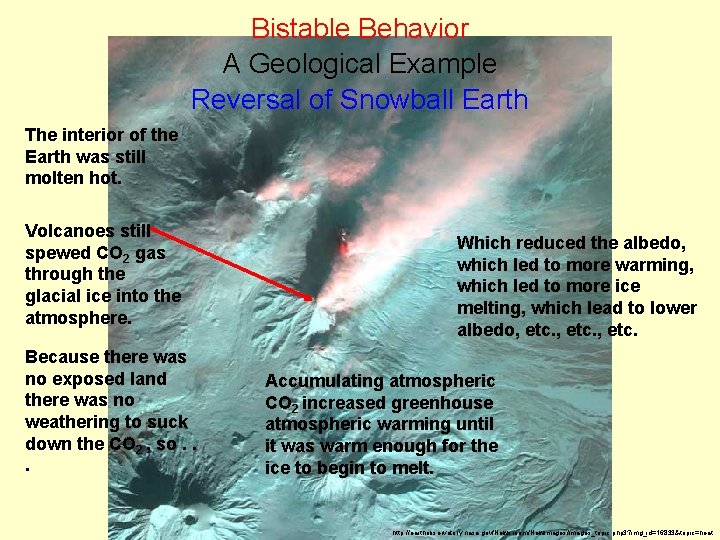
Bistable Behavior A Geological Example Reversal of Snowball Earth The interior of the Earth was still molten hot. Volcanoes still spewed CO 2 gas through the glacial ice into the atmosphere. Because there was no exposed land there was no weathering to suck down the CO 2 , so. . . Which reduced the albedo, which led to more warming, which led to more ice melting, which lead to lower albedo, etc. Accumulating atmospheric CO 2 increased greenhouse atmospheric warming until it was warm enough for the ice to begin to melt. http: //earthobservatory. nasa. gov/Newsroom/New. Images/images_topic. php 3? img_id=16833&topic=heat
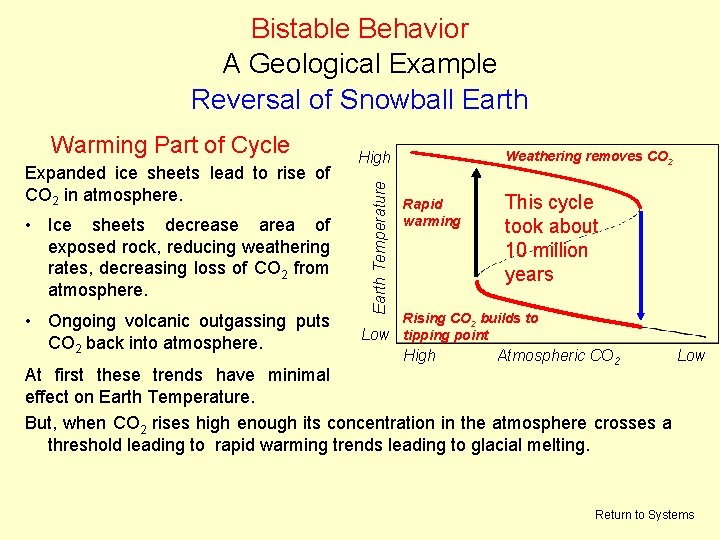
Bistable Behavior A Geological Example Reversal of Snowball Earth Expanded ice sheets lead to rise of CO 2 in atmosphere. • Ice sheets decrease area of exposed rock, reducing weathering rates, decreasing loss of CO 2 from atmosphere. • Ongoing volcanic outgassing puts CO 2 back into atmosphere. Weathering removes CO 2 High Earth Temperature Warming Part of Cycle Rapid warming This cycle took about 10 million years Rising CO 2 builds to Low tipping point High Atmospheric CO 2 Low At first these trends have minimal effect on Earth Temperature. But, when CO 2 rises high enough its concentration in the atmosphere crosses a threshold leading to rapid warming trends leading to glacial melting. Return to Systems
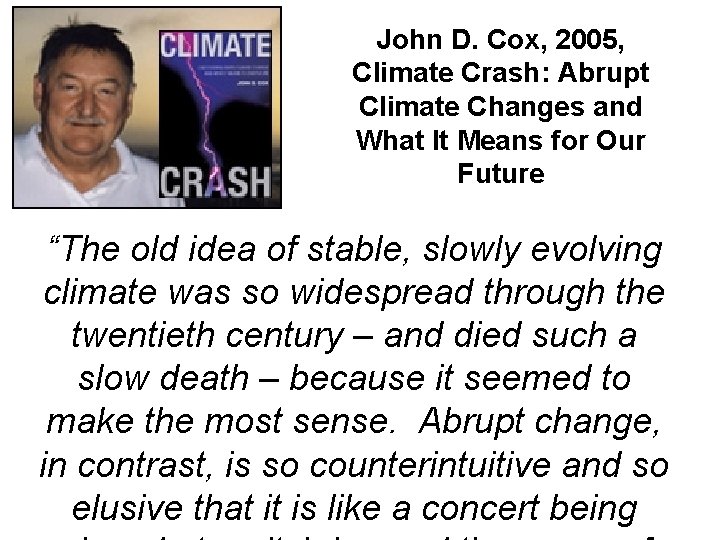
John D. Cox, 2005, Climate Crash: Abrupt Climate Changes and What It Means for Our Future “The old idea of stable, slowly evolving climate was so widespread through the twentieth century – and died such a slow death – because it seemed to make the most sense. Abrupt change, in contrast, is so counterintuitive and so elusive that it is like a concert being
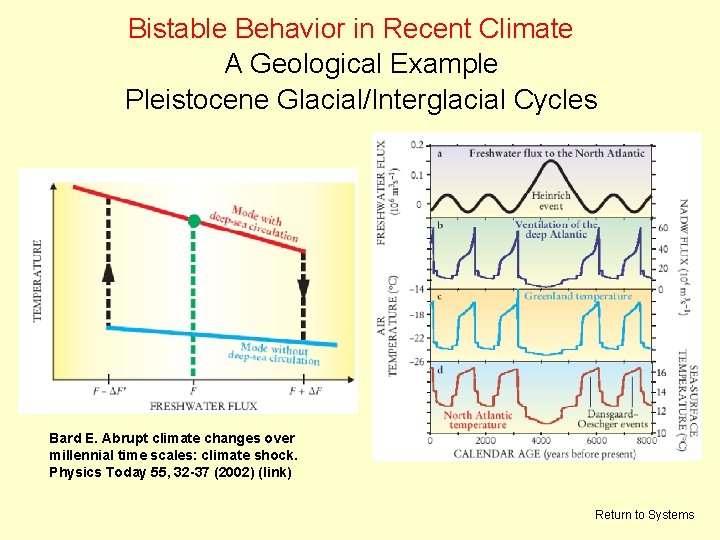
Bistable Behavior in Recent Climate A Geological Example Pleistocene Glacial/Interglacial Cycles Bard E. Abrupt climate changes over millennial time scales: climate shock. Physics Today 55, 32 -37 (2002) (link) Return to Systems
The significant problems we face today cannot be solved with the same level of thinking we were at when we created them. Albert Einstein
- Slides: 44