
Hypotonia After 5 Years Of Age Abeer Hani
Hypotonia After 5 Years Of Age Abeer Hani, MD Assistant Professor of Pediatrics and Neurology Lebanese American University 14 th Annual LPS meeting 13/9/2019
Disclosures • None
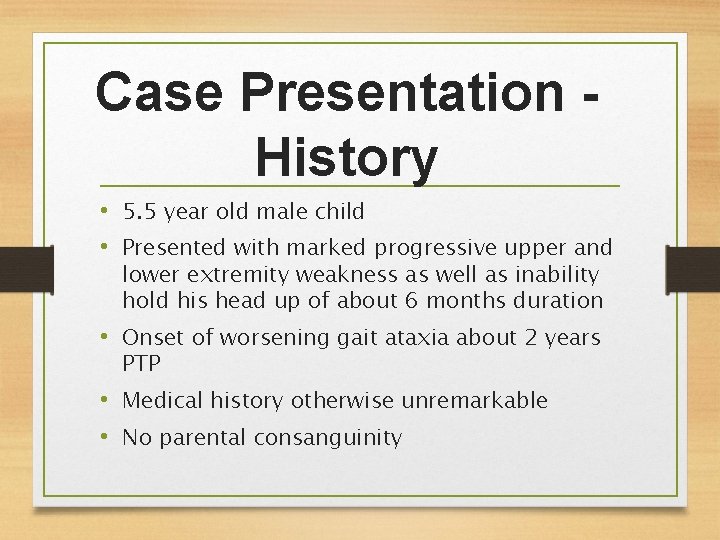
Case Presentation History • 5. 5 year old male child • Presented with marked progressive upper and lower extremity weakness as well as inability hold his head up of about 6 months duration • Onset of worsening gait ataxia about 2 years PTP • Medical history otherwise unremarkable • No parental consanguinity
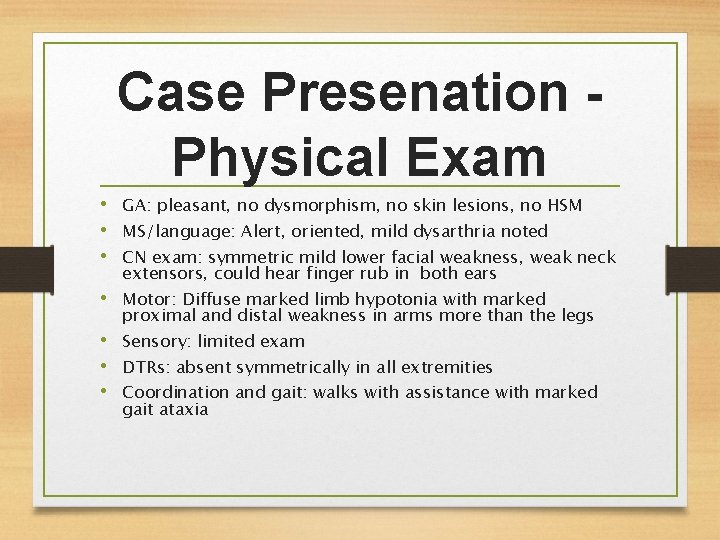
Case Presenation Physical Exam • GA: pleasant, no dysmorphism, no skin lesions, no HSM • MS/language: Alert, oriented, mild dysarthria noted • CN exam: symmetric mild lower facial weakness, weak neck extensors, could hear finger rub in both ears • Motor: Diffuse marked limb hypotonia with marked proximal and distal weakness in arms more than the legs • Sensory: limited exam • DTRs: absent symmetrically in all extremities • Coordination and gait: walks with assistance with marked gait ataxia
Case Presentation What Is The Diagnosis? • Neurodegenerative disease • Metabolic disease • Motor neuron disease • Genetic etiology
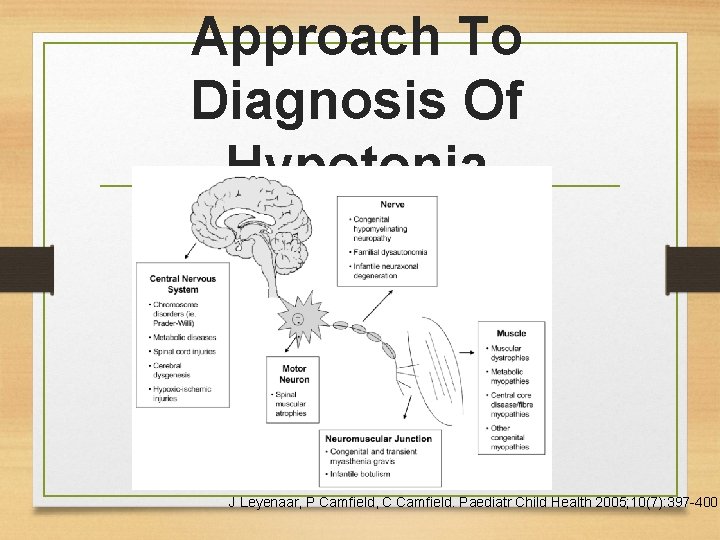
Approach To Diagnosis Of Hypotonia J Leyenaar, P Camfield, C Camfield. Paediatr Child Health 2005; 10(7): 397 -400
Case - Workup Done • • MRI brain: mild cerebellar atrophy CPK, AFP, TSH/f. T 4: normal. EMG/NCS: severe sensory neuronopathy Genetic testing: homozygous pathogenic variant in SLC 52 A 2 gene �� Dx: autosomal recessive Brown-Vialetto-Van Laere syndrome type 2 = Riboflavin transporter deficiency neuronopathy
What Is Riboflavin Transporter Deficiency? • Progressive motor neuron disease • Onset usually in infancy or childhood before 8 years of age, rarely in third decade • Characterized by: • Motor neuronopathy (manifest as proximal and distal limb weakness, often with severe distal wasting and breathing problems due to paralysis of the diaphragm) • Sensory neuronopathy (manifest as gait ataxia) • Cranial neuronopathy (manifest as optic atrophy, sensorineural deafness, and bulbar palsy) https: //www. ncbi. nlm. nih. gov/books/NBK 299312/
Diagnosis Of Riboflavin Transporter • Clinical findings Deficiency • • Neurophysiologic findings Neuroimaging findings Laboratory findings Identification on molecular genetic testing of biallelic pathogenic variants in either SLC 52 A 2 or SLC 52 A 3 genes https: //www. ncbi. nlm. nih. gov/books/NBK 299312/
Treatment Of Riboflavin Transporter Deficiency • Lifelong high-dose oral supplementation of riboflavin between 10 mg and 50 mg/kg/day • Supportive care includes: • • • respiratory support physiotherapy to avoid contractures occupational therapy to support activities of daily living orthotics for limb and trunk bracing speech and language therapy to avoid choking and respiratory problems wheel chair as needed low vision aids as needed routine management of scoliosis to avoid long-term respiratory problems routine management of depression. https: //www. ncbi. nlm. nih. gov/books/NBK 299312/
Back to our case… • Riboflavin was started upon Dx and advanced • Improvement of neck extensor weakness and proximal weakness in the arms and legs • Improved gait ataxia • Younger brother at age of 2 years tested positive for the homozygous variant and was started on riboflavin while asymptomatic
Take-Home Message • Careful evaluation and identification of cause of hypotonia is important • Do workup of hypotonia • Identify treatable causes of hypotonia • Guide therapy based on etiology of the hypotonia
Thank You… Abeer Hani, MD abeer. hani@gmail. com 03/005158
- Slides: 13