
Hypothyroidism Learning Objectives 1 Describe different classes of
Hypothyroidism Learning Objectives: 1 - Describe different classes of drugs used in hypothyroidism and their mechanism of action. 2 -Understand their pharmacological effects clinical uses and adverse effects 3 - Recognize treatment of special cases of hypothyroidism such as myxedema coma Color index: Important Note Extra Editing File
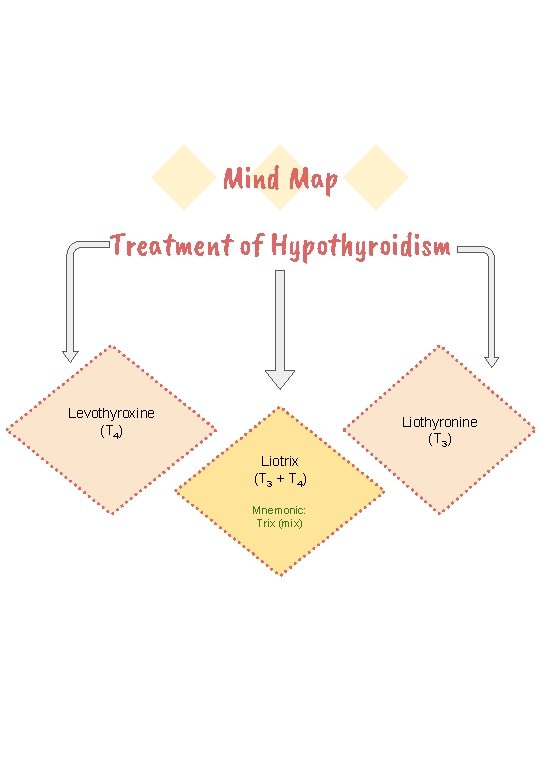
Mind Map Treatment of Hypothyroidism Levothyroxine (T 4) Liothyronine (T 3) Liotrix (T 3 + T 4) Mnemonic: Trix (mix)
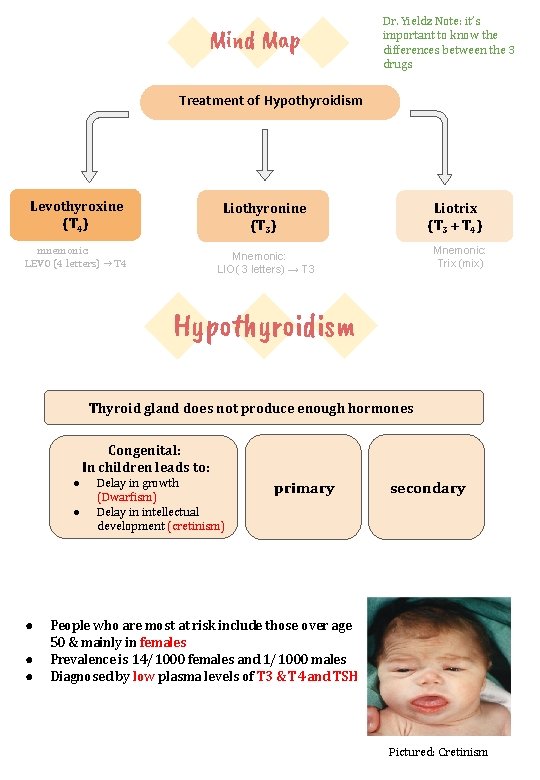
Mind Map Dr. Yieldz Note: it’s important to know the differences between the 3 drugs Treatment of Hypothyroidism Levothyroxine (T 4) Liothyronine (T 3) mnemonic: LEVO (4 letters) → T 4 Liotrix (T 3 + T 4) Mnemonic: Trix (mix) Mnemonic: LIO( 3 letters) → T 3 Hypothyroidism Thyroid gland does not produce enough hormones Congenital: In children leads to: ● ● ● Delay in growth (Dwarfism) Delay in intellectual development (cretinism) primary secondary People who are most at risk include those over age 50 & mainly in females Prevalence is 14/1000 females and 1/1000 males Diagnosed by low plasma levels of T 3 & T 4 and TSH Pictured: Cretinism
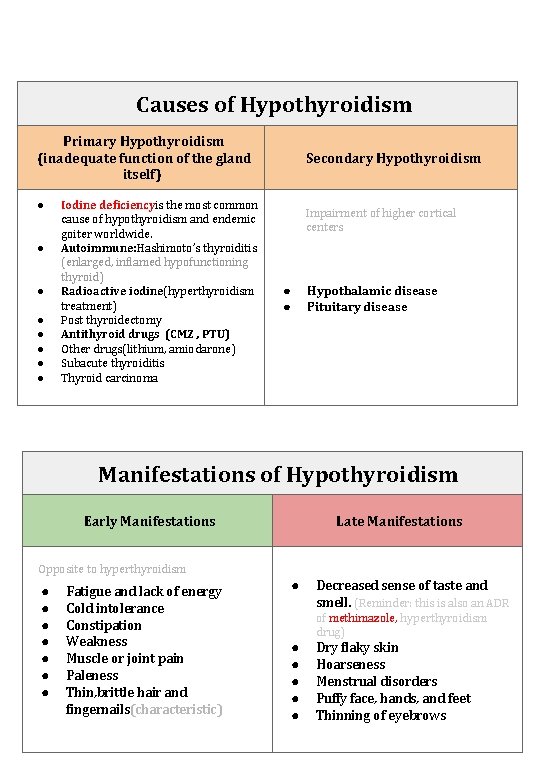
Causes of Hypothyroidism Primary Hypothyroidism (inadequate function of the gland itself) ● ● ● ● Iodine deficiencyis the most common cause of hypothyroidism and endemic goiter worldwide. Autoimmune: Hashimoto’s thyroiditis (enlarged, inflamed hypofunctioning thyroid) Radioactive iodine(hyperthyroidism treatment) Post thyroidectomy Antithyroid drugs (CMZ , PTU) Other drugs(lithium, amiodarone) Subacute thyroiditis Thyroid carcinoma Secondary Hypothyroidism Impairment of higher cortical centers Hypothalamic disease Pituitary disease ● ● Manifestations of Hypothyroidism Early Manifestations Late Manifestations Opposite to hyperthyroidism ● ● ● ● Fatigue and lack of energy Cold intolerance Constipation Weakness Muscle or joint pain Paleness Thin, brittle hair and fingernails(characteristic) ● Decreased sense of taste and smell. (Reminder: this is also an ADR of methimazole, hyperthyroidism drug) ● ● ● Dry flaky skin Hoarseness Menstrual disorders Puffy face, hands, and feet Thinning of eyebrows
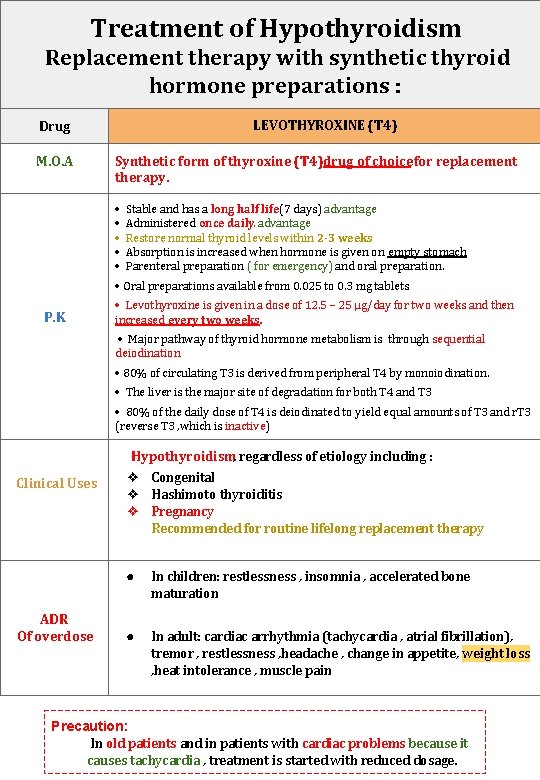
Treatment of Hypothyroidism Replacement therapy with synthetic thyroid hormone preparations : LEVOTHYROXINE (T 4) Drug M. O. A Synthetic form of thyroxine (T 4), drug of choicefor replacement therapy. • • • Stable and has a long half life(7 days) advantage Administered once daily. advantage Restore normal thyroid levels within 2 -3 weeks Absorption is increased when hormone is given on empty stomach Parenteral preparation ( for emergency) and oral preparation. • Oral preparations available from 0. 025 to 0. 3 mg tablets P. K • Levothyroxine is given in a dose of 12. 5 – 25 μg/day for two weeks and then increased every two weeks. • Major pathway of thyroid hormone metabolism is through sequential deiodination • 80% of circulating T 3 is derived from peripheral T 4 by monoiodination. • The liver is the major site of degradation for both T 4 and T 3 • 80% of the daily dose of T 4 is deiodinated to yield equal amounts of T 3 and r. T 3 (reverse T 3 , which is inactive) Hypothyroidism, regardless of etiology including : Clinical Uses ADR Of overdose ❖ Congenital ❖ Hashimoto thyroiditis ❖ Pregnancy Recommended for routine lifelong replacement therapy ● In children: restlessness , insomnia , accelerated bone maturation ● In adult: cardiac arrhythmia (tachycardia , atrial fibrillation), tremor , restlessness , headache , change in appetite, weight loss , heat intolerance , muscle pain Precaution: In old patients and in patients with cardiac problems because it causes tachycardia , treatment is started with reduced dosage.
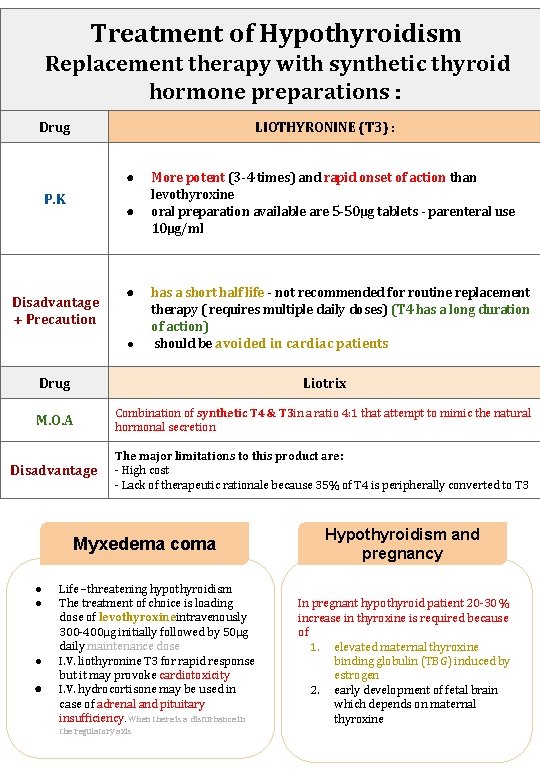
Treatment of Hypothyroidism Replacement therapy with synthetic thyroid hormone preparations : Drug LIOTHYRONINE (T 3) : ● P. K ● Disadvantage + Precaution ● ● More potent (3 -4 times) and rapid onset of action than levothyroxine oral preparation available are 5 -50μg tablets - parenteral use 10μg/ml has a short half life - not recommended for routine replacement therapy ( requires multiple daily doses) (T 4 has a long duration of action) should be avoided in cardiac patients Drug Liotrix M. O. A Combination of synthetic T 4 & T 3 in a ratio 4: 1 that attempt to mimic the natural hormonal secretion Disadvantage The major limitations to this product are: - High cost - Lack of therapeutic rationale because 35% of T 4 is peripherally converted to T 3 Myxedema coma ● ● Life –threatening hypothyroidism The treatment of choice is loading dose of levothyroxineintravenously 300 -400μg initially followed by 50μg daily maintenance dose I. V. liothyronine T 3 for rapid response but it may provoke cardiotoxicity I. V. hydrocortisone may be used in case of adrenal and pituitary insufficiency. When there is a disturbance in the regulatory axis Hypothyroidism and pregnancy In pregnant hypothyroid patient 20 -30 % increase in thyroxine is required because of 1. elevated maternal thyroxine binding globulin (TBG) induced by estrogen 2. early development of fetal brain which depends on maternal thyroxine
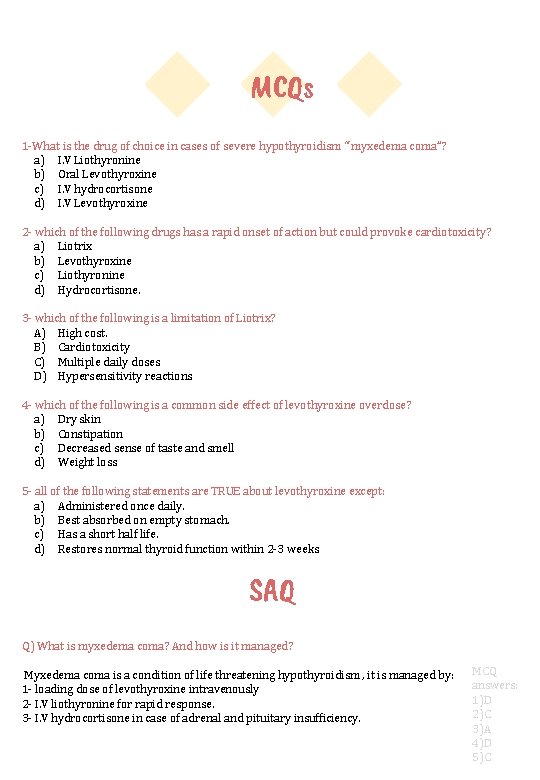
MCQs 1 -What is the drug of choice in cases of severe hypothyroidism “ myxedema coma”? a) I. V Liothyronine b) Oral Levothyroxine c) I. V hydrocortisone d) I. V Levothyroxine 2 - which of the following drugs has a rapid onset of action but could provoke cardiotoxicity? a) Liotrix b) Levothyroxine c) Liothyronine d) Hydrocortisone. 3 - which of the following is a limitation of Liotrix? A) High cost. B) Cardiotoxicity C) Multiple daily doses D) Hypersensitivity reactions 4 - which of the following is a common side effect of levothyroxine overdose? a) Dry skin b) Constipation c) Decreased sense of taste and smell d) Weight loss 5 - all of the following statements are TRUE about levothyroxine except: a) Administered once daily. b) Best absorbed on empty stomach. c) Has a short half life. d) Restores normal thyroid function within 2 -3 weeks SAQ Q) What is myxedema coma? And how is it managed? Myxedema coma is a condition of life threatening hypothyroidism , it is managed by: 1 - loading dose of levothyroxine intravenously 2 - I. V liothyronine for rapid response. 3 - I. V hydrocortisone in case of adrenal and pituitary insufficiency. MCQ answers: 1)D 2)C 3)A 4)D 5)C
Team Leaders: Majed Aljohani Layan Al. Mana Thank you to those who worked on this lecture: Sarah Al. Kathiri Rawan Al. Tamimi Hind Al. Oraier Rahaf Al. Thnayan Shahad Al. Tayash Al. Johara Al. Shunaifi Ghada Al. Haidari Munira Al. Hadlg Sultan Alnasser References: ✓ Doctors’ slides and notes @Pharma 4370 Pharm 437@gmail. com
- Slides: 8