
Hypothesis Testing for Population Proportion BMR 617 Alejandro
Hypothesis Testing for Population Proportion BMR 617 Alejandro Nato, Ph. D. March 2, 2020 Marshall University Joan C. Edwards School of Medicine
General Steps in a Hypothesis Test • Check assumptions and write the null and alternative hypotheses (they should be mutually exclusive and exhaustive) • Calculate a test statistic • Determine a p-value associated with the test statistic • recall what was mentioned in previous lecture about p-values • the smaller the p-value, the more that is in favor of the alternative hypothesis • Choose between the null and alternative hypotheses • Make your conclusion
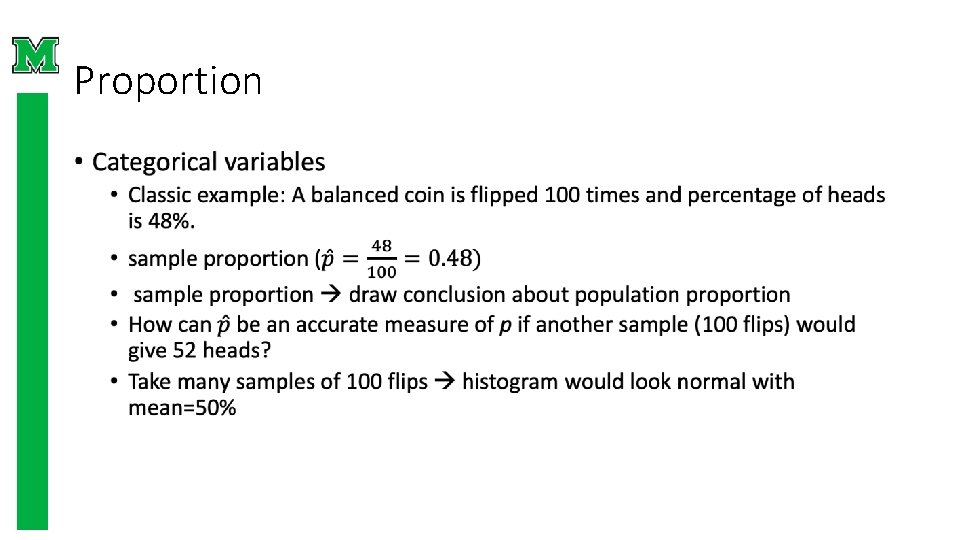
Proportion •
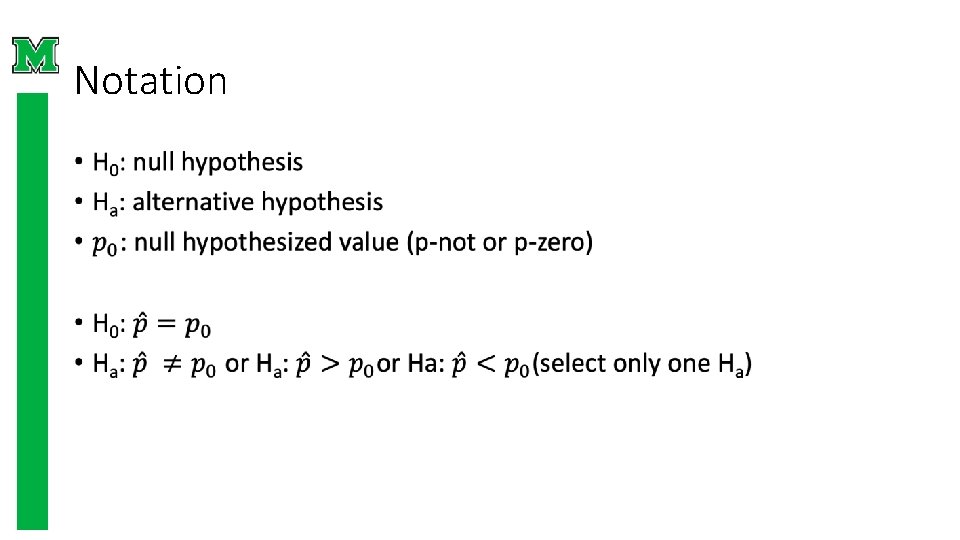
Notation •
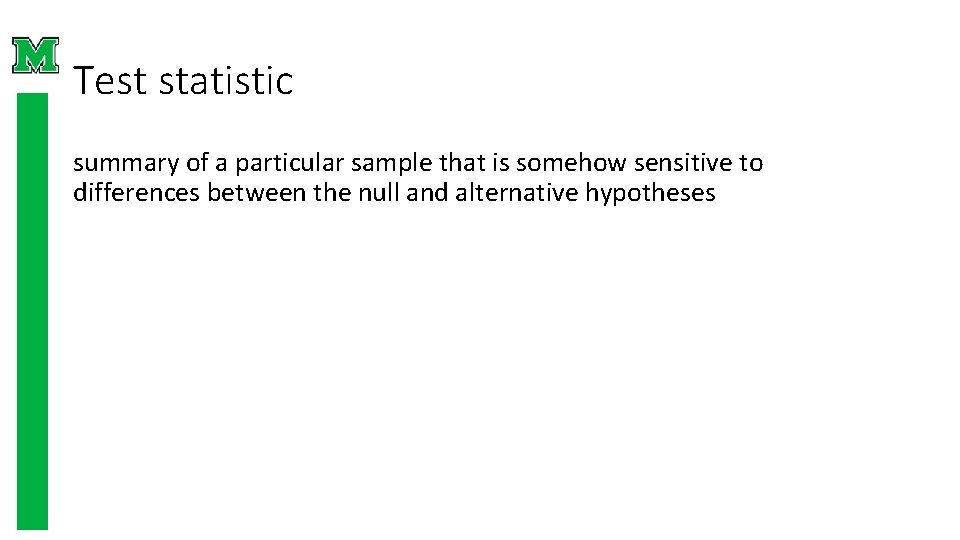
Test statistic summary of a particular sample that is somehow sensitive to differences between the null and alternative hypotheses
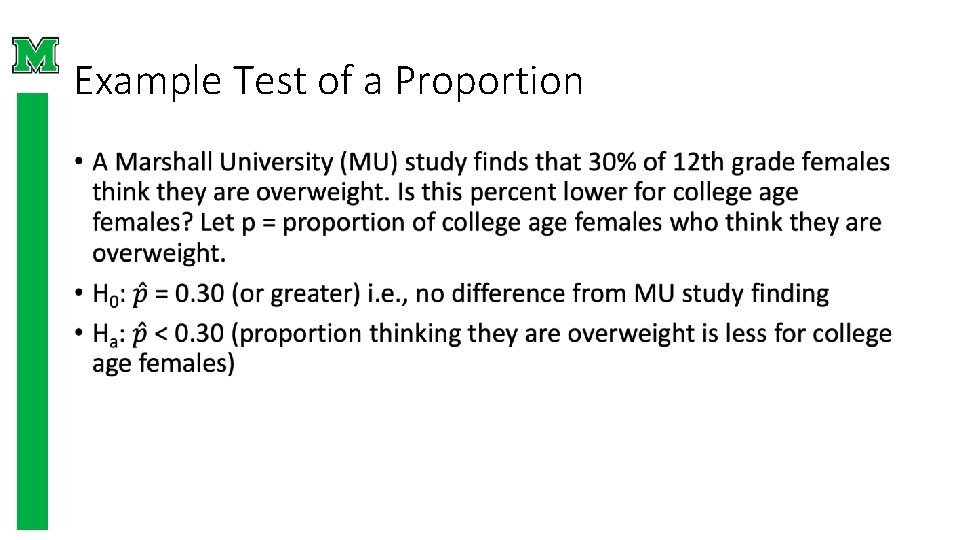
Example Test of a Proportion •

One Proportion Z Test •
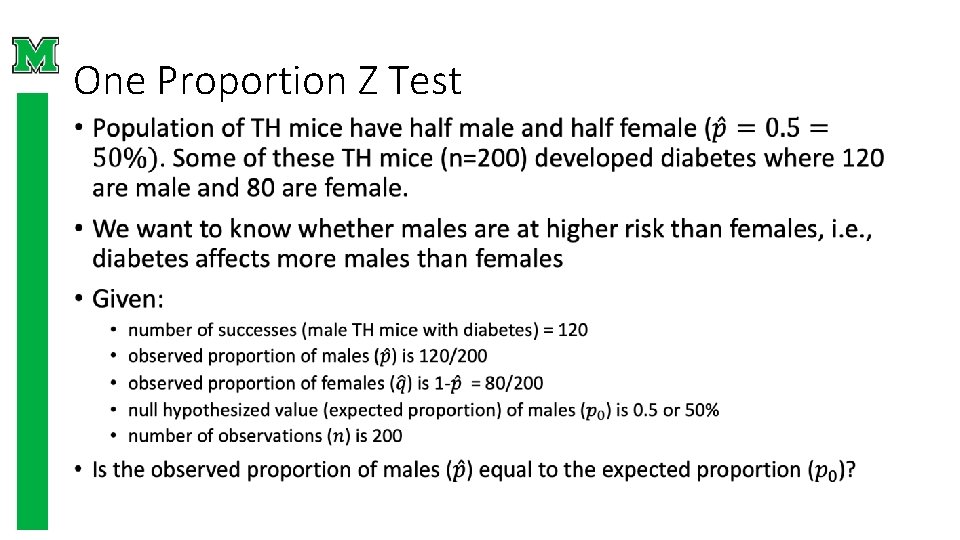
One Proportion Z Test •
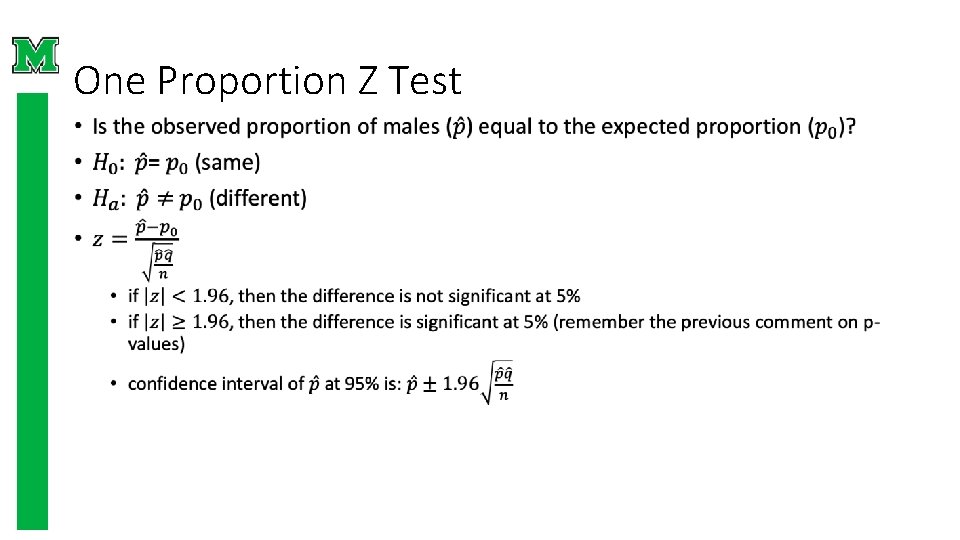
One Proportion Z Test •
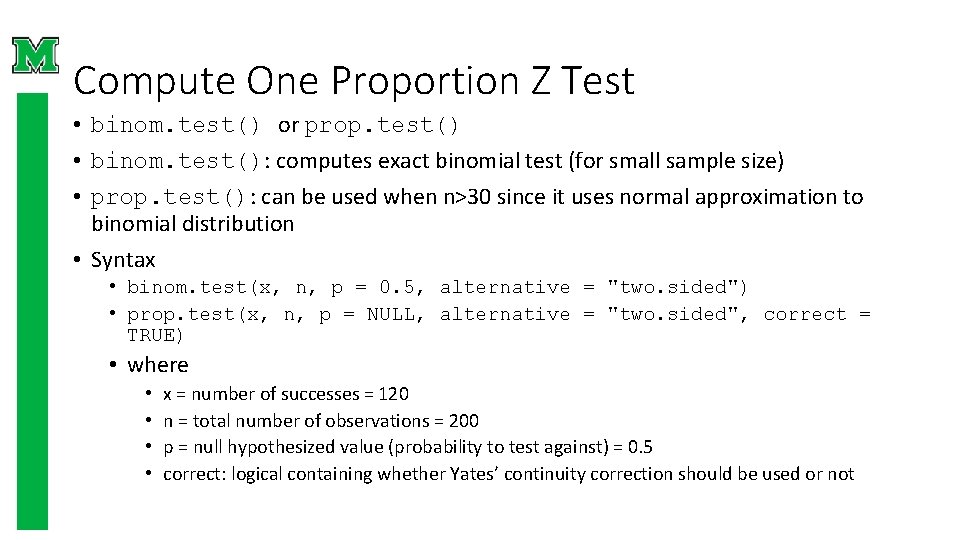
Compute One Proportion Z Test • binom. test() or prop. test() • binom. test(): computes exact binomial test (for small sample size) • prop. test(): can be used when n>30 since it uses normal approximation to binomial distribution • Syntax • binom. test(x, n, p = 0. 5, alternative = "two. sided") • prop. test(x, n, p = NULL, alternative = "two. sided", correct = TRUE) • where • • x = number of successes = 120 n = total number of observations = 200 p = null hypothesized value (probability to test against) = 0. 5 correct: logical containing whether Yates’ continuity correction should be used or not
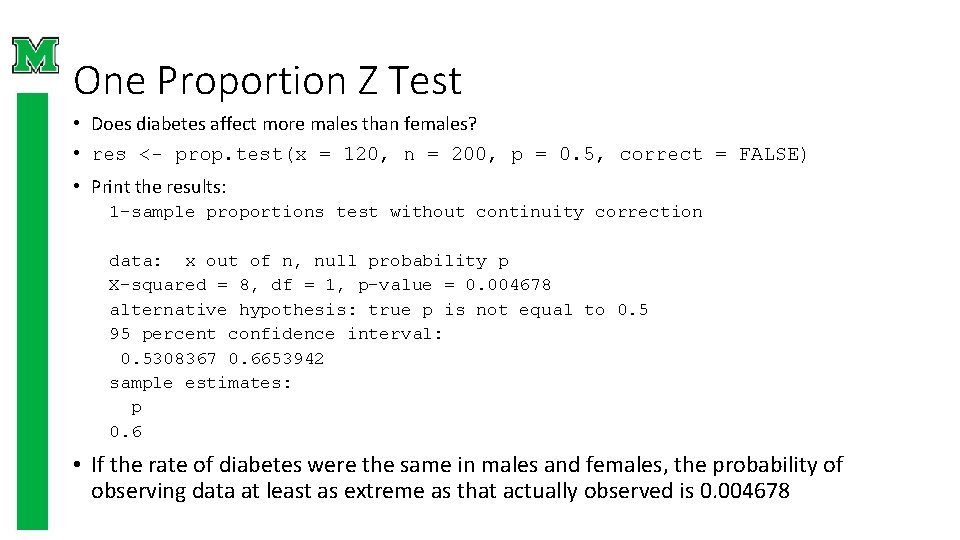
One Proportion Z Test • Does diabetes affect more males than females? • res <- prop. test(x = 120, n = 200, p = 0. 5, correct = FALSE) • Print the results: 1 -sample proportions test without continuity correction data: x out of n, null probability p X-squared = 8, df = 1, p-value = 0. 004678 alternative hypothesis: true p is not equal to 0. 5 95 percent confidence interval: 0. 5308367 0. 6653942 sample estimates: p 0. 6 • If the rate of diabetes were the same in males and females, the probability of observing data at least as extreme as that actually observed is 0. 004678
- Slides: 11