
Hypothesis Knowledge Stocks and Knowledge Creation Capability The

Hypothesis Knowledge Stocks and Knowledge Creation Capability Ø The number of years of experience of a firm’s TMT and knowledge workers in a firm is positively associated with the firm’s knowledge creation capability. Ø The number of years of education of a firm’s TMT and knowledge workers is positively associated with the firm’s knowledge creation capability. Ø The level of functional heterogeneity of a firm’s TMT and knowledge workers is positively associated with the firm’s knowledge creation capability.
Hypothesis Ego Networks and Knowledge Creation Capability 1. The number of TMTs’ and knowledge workers’ direct contacts in a firm is positively related to the firm’s knowledge creation capability. 2. The range of TMTs’ and knowledge workers’ contacts in a firm is positively related to the firm’s knowledge creation capability. 3. The strength of ties in the TMTs’ and knowledge workers’ sets of relations in a firm is positively related to a firm’s knowledge creation capability.
Hypothesis Organizational Climate & Knowledge Creation Capability 1. A climate that stresses risk taking (as opposed to control) is positively related to a firm’s knowledge creation capability. 2. A climate that stresses teamwork (as opposed to individualism) is positively related to a firm’s knowledge creation capability.
METHODS Ø Data were collected from three key sources: Ø Detailed questionnaires completed by TMTs and knowledge workers. Ø A structured interview with the CEO of each firm. Ø Archival data from company records.
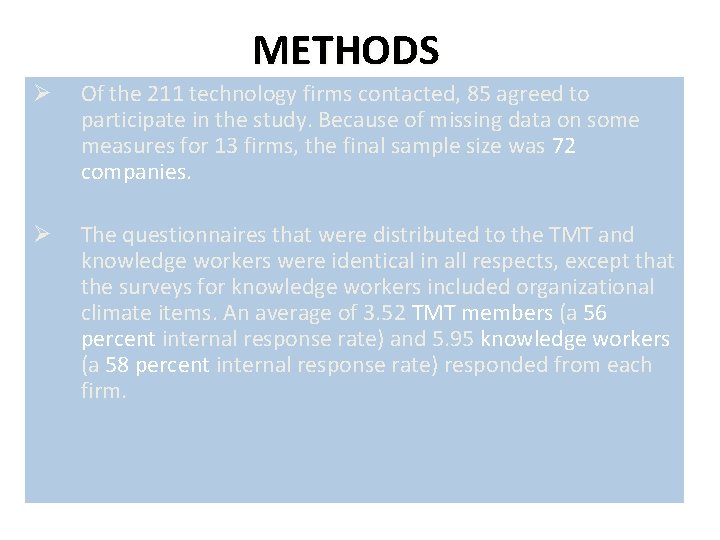
METHODS Ø Of the 211 technology firms contacted, 85 agreed to participate in the study. Because of missing data on some measures for 13 firms, the final sample size was 72 companies. Ø The questionnaires that were distributed to the TMT and knowledge workers were identical in all respects, except that the surveys for knowledge workers included organizational climate items. An average of 3. 52 TMT members (a 56 percent internal response rate) and 5. 95 knowledge workers (a 58 percent internal response rate) responded from each firm.
Variable Definition & Measurement Ø Knowledge stocks. Ø Ego networks. Ø Number of direct contacts. Ø Network range. Ø Strength of ties. Ø Organizational climate. Ø Firm-level knowledge creation capability. Ø Number of new products and services.
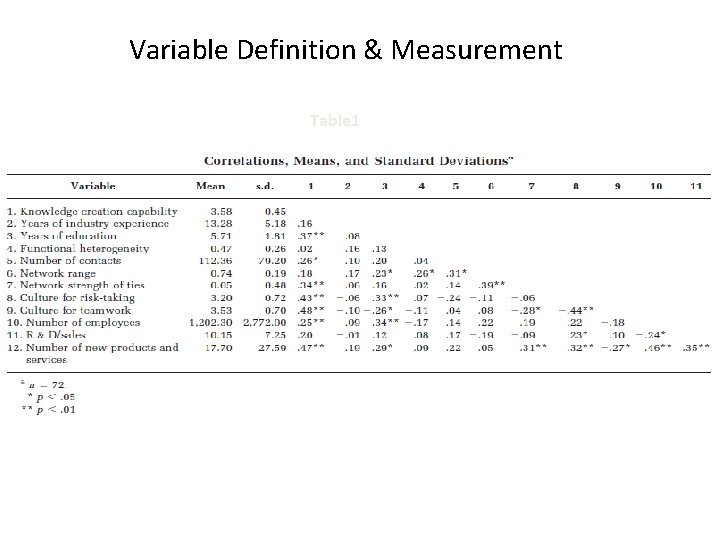
Variable Definition & Measurement Table 1
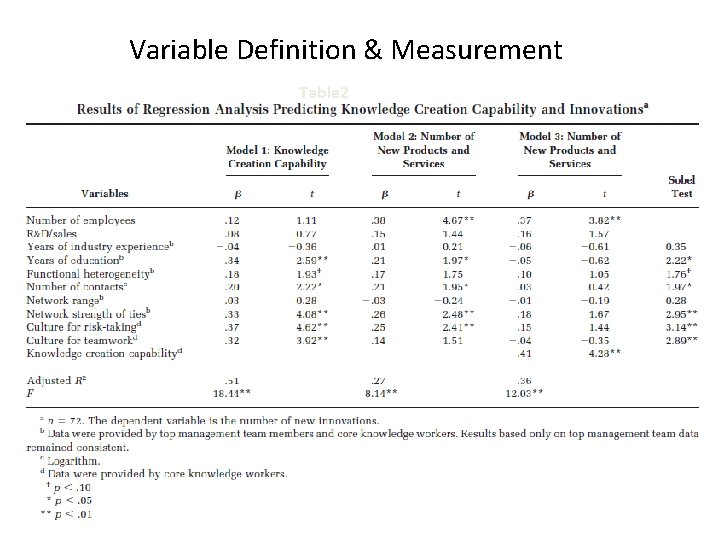
Variable Definition & Measurement Table 2
RESULTS Ø With regard to the stocks of knowledge hypotheses, Ø we found that years of education was positively related to knowledge creation capability ; functional heterogeneity was marginally positively related to it; and experience was unrelated. Ø With regard to the ego network hypotheses, Ø we found a positive relationship between the log of the number of direct contacts and firm knowledge creation capability. the strength of network ties was positively related to knowledge creation capability. Network range was not related to this capability.
RESULTS Ø Ø Ø Both of our measures of organizational climate were positively related to knowledge creation capability, supporting Hypotheses 3. Table 2, model 3, also reports regression results with the number of new products and services as the dependent variable. Supporting Hypothesis 4, a firm’s knowledge creation capability was positively related to its number of new products and services. Other than organizational size, none of the variables in the model were directly related to the level of innovation.
DISCUSSION Ø Ø This research was designed to answer two questions: Ø How does the existing and accessible knowledge in a firm impact the firm’s knowledge creation capability. Ø how does the knowledge creation capability affect the level of firm innovation? We found that certain aspects of existing and accessible knowledge did impact a firm’s knowledge creation capability, which, in turn, impacted the level of new products and services introduced.
DISCUSSION Ø Our findings that number of direct contacts and strength of ties were related to firm knowledge creation capability support Nahapiet and Ghoshal’s (1998) contention that social networks can be useful in the invention of new knowledge. Ø In future research, efforts should be made to identify which organizational ties should be strong and where organizations should instead leverage weak ties. Ø We speculate that network range did not show significant coefficients here because there was very little variation in this measure at the firm level.

- Slides: 14