
Hypothermia Significant problem in neonates at birth and
Hypothermia • Significant problem in neonates at birth and beyond • Mortality rate twice in hypothermic babies • Contributes to significant morbidity & mortality Teaching Aids: NNF NH- 1
Why are newborns prone to develop hypothermia • Larger surface area per unit body weight • Decreased thermal insulation due to lack of subcutaneous fat (LBW infant) • Reduced amount of brown fat (LBW infant) Teaching Aids: NNF NH- 2
Non-shivering thermogenesis • Heat is produced by increasing the metabolism especially in brown adipose tissue • Blood is warmed as it passes through the brown fat and it in turn warms the body Teaching Aids: NNF NH- 3
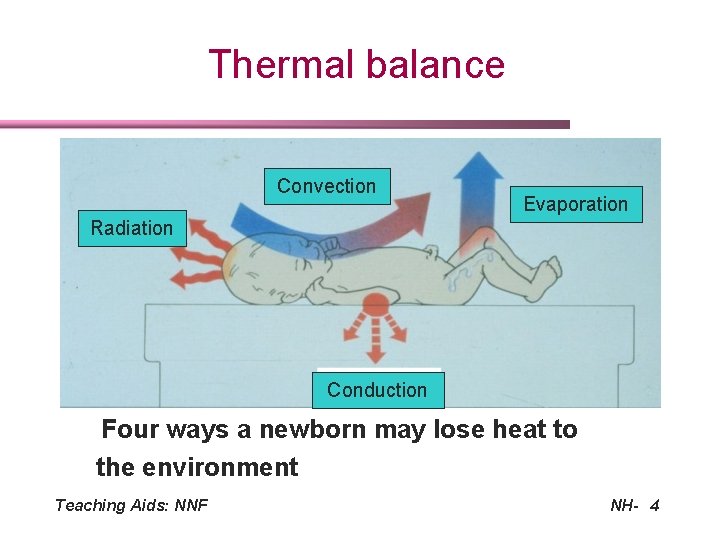
Thermal balance Convection Evaporation Radiation Conduction Four ways a newborn may lose heat to the environment Teaching Aids: NNF NH- 4
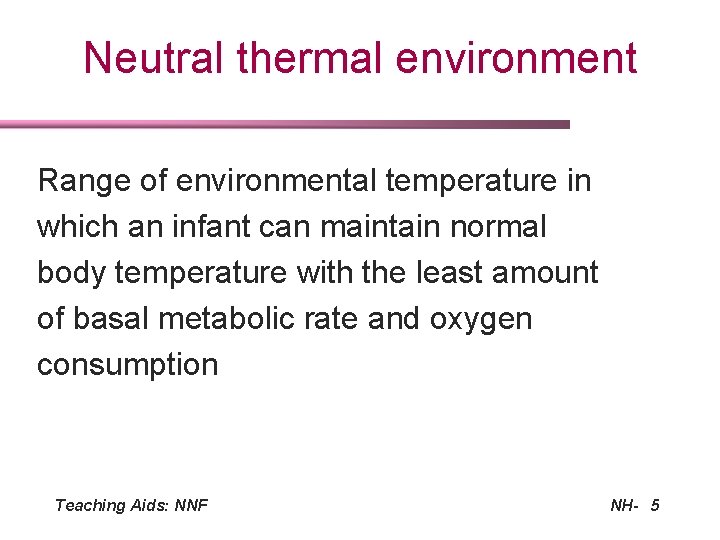
Neutral thermal environment Range of environmental temperature in which an infant can maintain normal body temperature with the least amount of basal metabolic rate and oxygen consumption Teaching Aids: NNF NH- 5

Axillary temperature in the newborn ( 0 C) Normal range Cold stress Moderate hypothermia Severe hypothermia Teaching Aids: NNF 37. 5 o 36. 5 o Cause for concern 36. 0 o Danger, warm baby 32. 0 o Outlook grave, skilled care urgently needed NH- 6
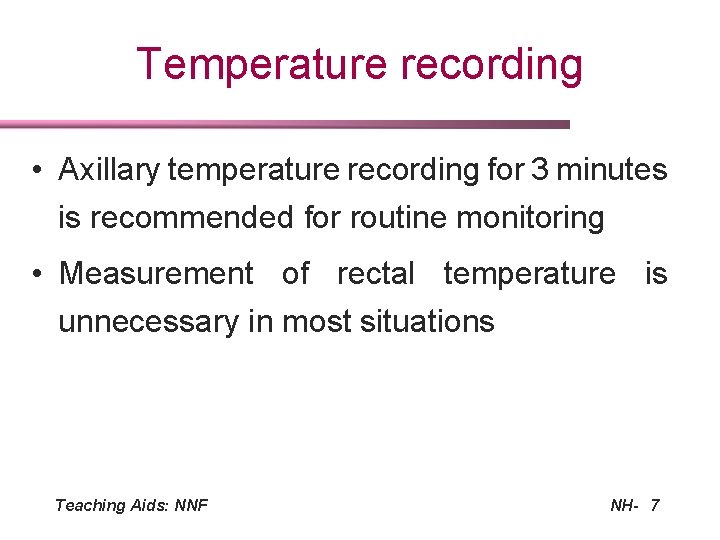
Temperature recording • Axillary temperature recording for 3 minutes is recommended for routine monitoring • Measurement of rectal temperature is unnecessary in most situations Teaching Aids: NNF NH- 7
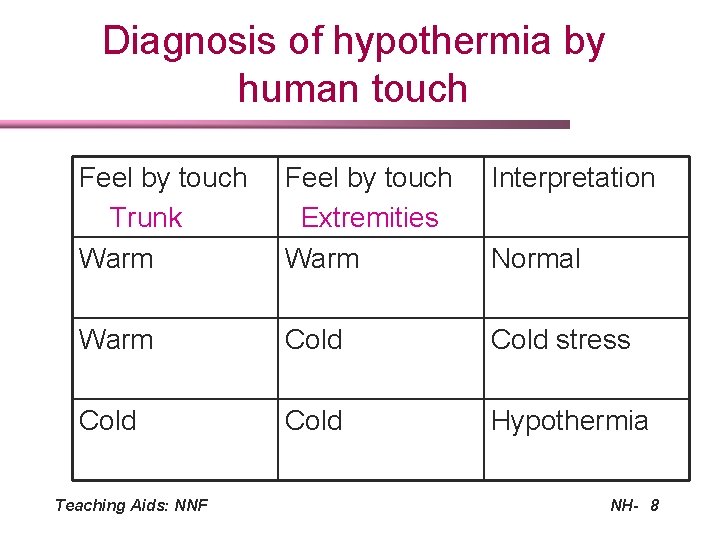
Diagnosis of hypothermia by human touch Feel by touch Trunk Warm Feel by touch Extremities Warm Interpretation Warm Cold stress Cold Hypothermia Teaching Aids: NNF Normal NH- 8
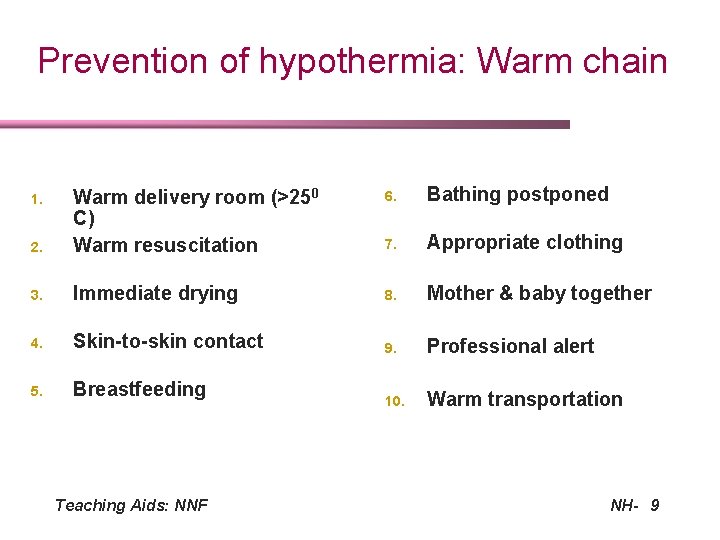
Prevention of hypothermia: Warm chain 6. Bathing postponed 2. Warm delivery room (>250 C) Warm resuscitation 7. Appropriate clothing 3. Immediate drying 8. Mother & baby together 4. Skin-to-skin contact 9. Professional alert 5. Breastfeeding 10. Warm transportation 1. Teaching Aids: NNF NH- 9
Prevention of hypothermia at birth • Conduct delivery in a warm room • Dry baby including head immediately with warm clean towel • Wrap baby in pre-warmed linen; cover the head and the limbs • Place the baby skin to skin on the mother • Postpone bathing Teaching Aids: NNF NH- 10
Kangaroo care • Assists in maintaining temperature • Facilitates breastfeeding • Increases duration of breastfeeding • Improves mother-baby bonding Teaching Aids: NNF NH- 11
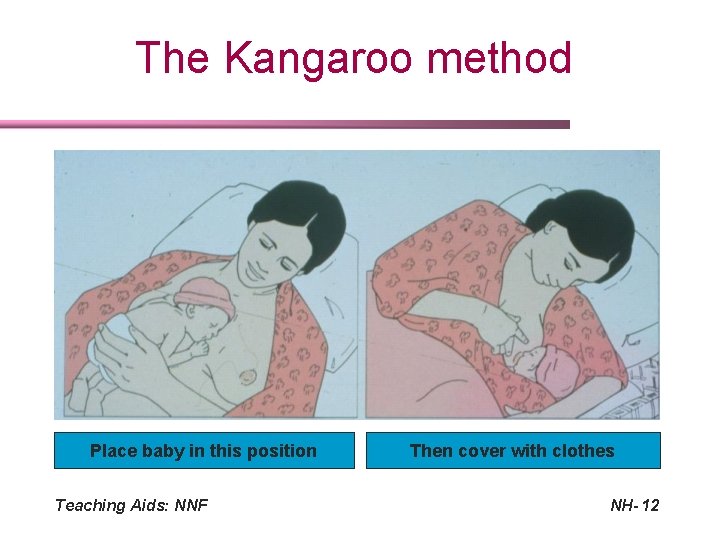
The Kangaroo method Place baby in this position Teaching Aids: NNF Then cover with clothes NH- 12
Bathing the baby Timing of bath n n n Small&/or LBW: Till the cord falls or preferably till 2. 5 kg weight Sick /admitted in nursery: No bath Term baby: Postpone till next day Procedure n n n n Teaching Aids: NNF Warm room and warm water Bathe quickly and gently Dry quickly and thoroughly Wrap in a warm, dry towel Dress and wrap infant Use a cap Keep close to mother NH- 13
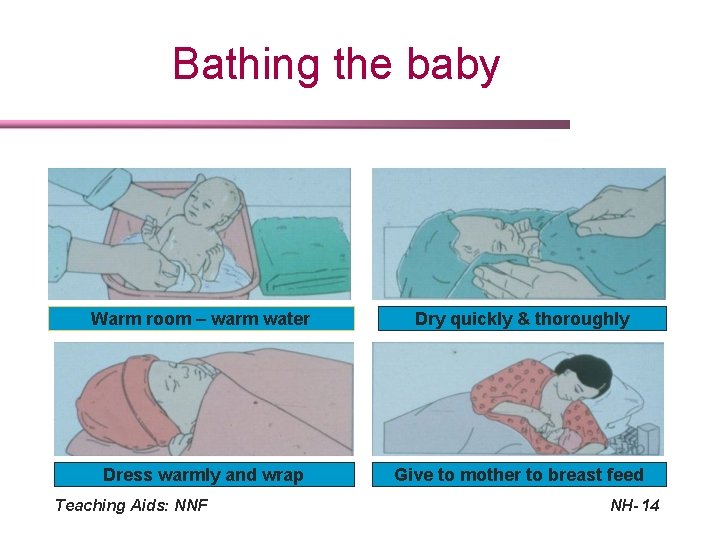
Bathing the baby Warm room – warm water Dry quickly & thoroughly Dress warmly and wrap Give to mother to breast feed Teaching Aids: NNF NH- 14
Cot-nursing in hospital (mother sick) • Cover adequately • Keep in thermoneutral environment • Monitor temperature 3 hourly during initial postnatal days Teaching Aids: NNF NH- 15
Prevention of hypothermia (during transport) • Let temperature stabilize before transport • Document temperature and take remedial measures • Carry close to chest, if possible in kangaroo position • Cover adequately, avoid undressing • Use thermocol box with pre-warmed linen or plastic sheet or water filled mattress with thermostat Teaching Aids: NNF NH- 16
Signs and symptoms of hypothermia • Peripheral vasoconstriction - acrocyanosis, cold extremities - decreased peripheral perfusion • CNS depression - lethargy, bradycardia, apnea, poor feeding Teaching Aids: NNF NH- 17
Signs and symptoms (cont. . ) • Increased pulmonary artery pressure - respiratory distress, tachypnea • Chronic signs - weight loss, failure to thrive Teaching Aids: NNF NH- 18
Management: Cold stress • Cover adequately - remove cold clothes and replace with warm clothes • Warm room/bed • Take measures to reduce heat loss • Ensure skin-to-skin contact with mother; if not possible, keep next to mother after fully covering the baby • Breast feeding Monitor axillary temperature every ½ hour till it reaches 36. 50 C, then hourly for next 4 hours, 2 hourly for 12 hours thereafter and 3 hourly as a routine Teaching Aids: NNF NH- 19
Management: Moderate hypothermia(32. 0°C to 35. 9°C ) • Skin to skin contact • Warm room/bed • Take measures to reduce heat loss • Provide extra heat - 200 W bulb - Heater, warmer, incubator - Apply warm towels Teaching Aids: NNF NH- 20
Management: Severe hypothermia (<320 C ) • Provide extra heat preferably under radiant warmer or air heated incubator - rapidly warm till 340 C, then slow re-warming • Take measures to reduce heat loss • IV fluids: 60 -80 ml/kg of 10% Dextrose • Oxygen, Inj. vitamin K 1 mg in term & 0. 5 mg in preterm • If still hypothermic, consider antibiotics assuming sepsis Monitor HR, BP, Glucose (if available) Teaching Aids: NNF NH- 21
Hyperthermia > 37. 50 C • Problem in summer months • May indicate infection in term babies • Irritable, increased HR & RR • Flushed face, hot & dry skin • Apathetic, lethargic and pale • Stupor, coma, convulsions if temperature > 410 C Teaching Aids: NNF NH- 22
Management of hyperthermia • Place the baby in a normal temperature environment (25 to 280 C), away from any source of heat • Undress the baby partially or fully, if necessary • Give frequent breast feeds • If temperature > 390 C, sponge the baby with tap water; don’t use cold / ice water for sponge • Measure the temperature hourly till it becomes normal Teaching Aids: NNF NH- 23
Conclusion • Prevent hypothermia, maintain “Warm chain” • Ensure closer monitoring and stricter preventive measures for LBW and other at risk neonates • Early detection by human touch and prompt remedial measures are key for reducing this preventable morbidity Teaching Aids: NNF NH- 24
- Slides: 24