
Hypothalamic pituitary hormones By S Bohlooli Ph D
Hypothalamic & pituitary hormones By: S. Bohlooli, Ph. D School of Medicine, Ardabil University of Medical Sciences (Ar. UMS)
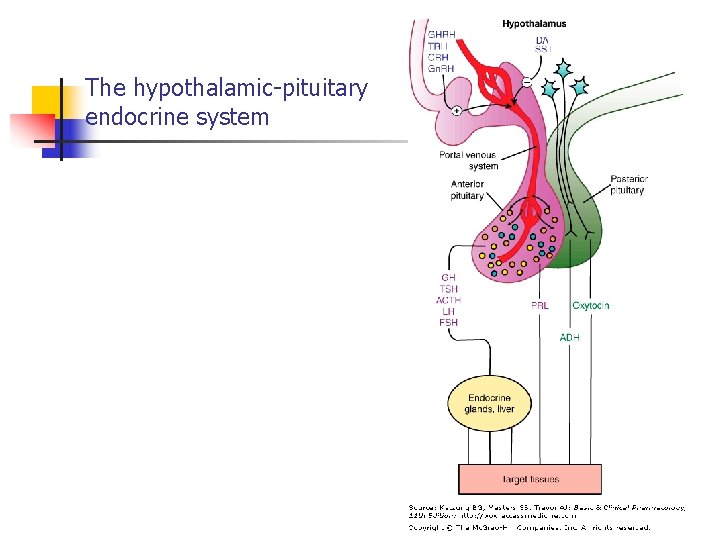
The hypothalamic-pituitary endocrine system
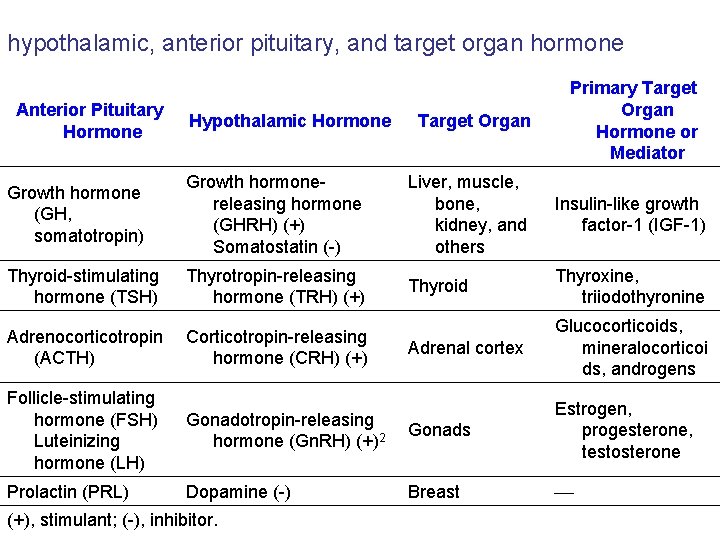
hypothalamic, anterior pituitary, and target organ hormone Anterior Pituitary Hormone Hypothalamic Hormone Target Organ Primary Target Organ Hormone or Mediator Growth hormone (GH, somatotropin) Growth hormonereleasing hormone (GHRH) (+) Somatostatin (-) Liver, muscle, bone, kidney, and others Insulin-like growth factor-1 (IGF-1) Thyroid-stimulating hormone (TSH) Thyrotropin-releasing hormone (TRH) (+) Thyroid Thyroxine, triiodothyronine Adrenal cortex Glucocorticoids, mineralocorticoi ds, androgens Adrenocorticotropin Corticotropin-releasing (ACTH) hormone (CRH) (+) Follicle-stimulating hormone (FSH) Luteinizing hormone (LH) Gonadotropin-releasing hormone (Gn. RH) (+)2 Gonads Estrogen, progesterone, testosterone Prolactin (PRL) Dopamine (-) Breast ¾ (+), stimulant; (-), inhibitor.
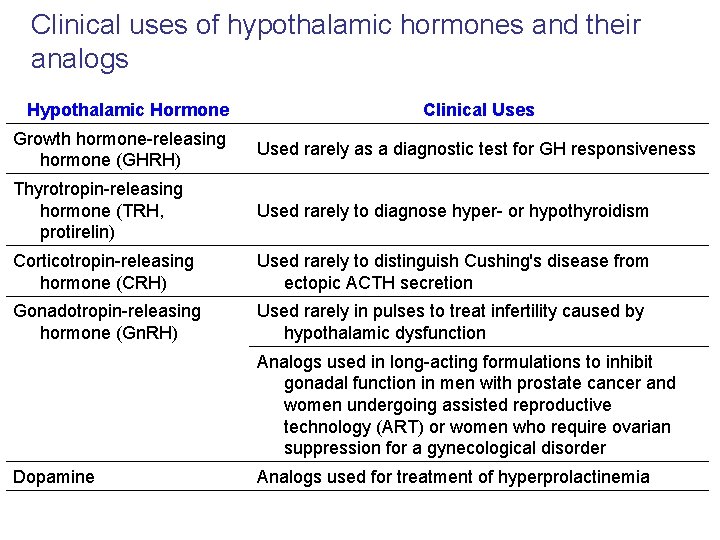
Clinical uses of hypothalamic hormones and their analogs Hypothalamic Hormone Clinical Uses Growth hormone-releasing hormone (GHRH) Used rarely as a diagnostic test for GH responsiveness Thyrotropin-releasing hormone (TRH, protirelin) Used rarely to diagnose hyper- or hypothyroidism Corticotropin-releasing hormone (CRH) Used rarely to distinguish Cushing's disease from ectopic ACTH secretion Gonadotropin-releasing hormone (Gn. RH) Used rarely in pulses to treat infertility caused by hypothalamic dysfunction Analogs used in long-acting formulations to inhibit gonadal function in men with prostate cancer and women undergoing assisted reproductive technology (ART) or women who require ovarian suppression for a gynecological disorder Dopamine Analogs used for treatment of hyperprolactinemia
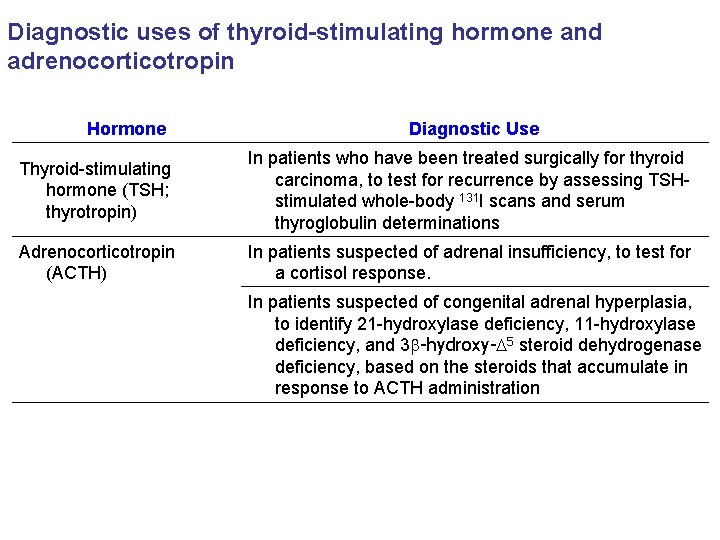
Diagnostic uses of thyroid-stimulating hormone and adrenocorticotropin Hormone Diagnostic Use Thyroid-stimulating hormone (TSH; thyrotropin) In patients who have been treated surgically for thyroid carcinoma, to test for recurrence by assessing TSHstimulated whole-body 131 I scans and serum thyroglobulin determinations Adrenocorticotropin (ACTH) In patients suspected of adrenal insufficiency, to test for a cortisol response. In patients suspected of congenital adrenal hyperplasia, to identify 21 -hydroxylase deficiency, 11 -hydroxylase deficiency, and 3 -hydroxy-D 5 steroid dehydrogenase deficiency, based on the steroids that accumulate in response to ACTH administration
Pharmacologic Applications of hypothalamic and pituitary hormones n n n Replacement therapy for hormone deficiency states Antagonists for diseases that result from excess production of pituitary hormones Diagnostic tools for identifying several endocrine abnormalities
GROWTH HORMONE (SOMATOTROPIN)
Introduction n Peptide hormones Important effects on lipid and carbohydrate metabolism Its effects are primarily mediated via n n insulin-like growth factor 1 (IGF-1, somatomedin C) insulin-like growth factor 2 (IGF-2).
Chemistry & Pharmacokinetics n STRUCTURE: n n is a 191 -amino-acid peptide with two sulfhydryl bridges rh. GH n n Somatropin has a 191 -amino-acids Somatrem has 192 amino acids
Pharmacodynamics n n Mediates its effects via cell surface receptors of the JAK/STAT cytokine receptor superfamily Has complex effects on n n growth, body composition carbohydrate, protein, and lipid metabolism The growth-promoting effects are mediated through IGF-1 GH has anabolic effects in muscle and catabolic effects in lipid cells
Clinical Pharmacology n n n GROWTH HORMONE DEFICIENCY PEDIATRIC PATIENTS WITH SHORT STATURE Other Uses of Growth Hormone
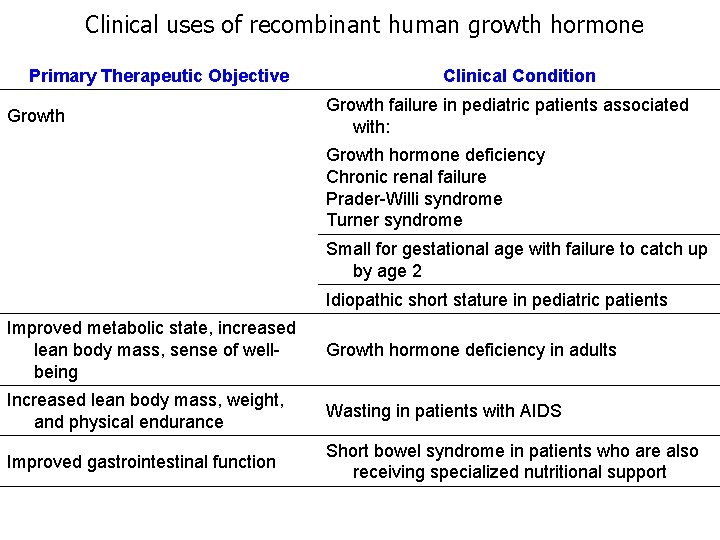
Clinical uses of recombinant human growth hormone Primary Therapeutic Objective Clinical Condition Growth failure in pediatric patients associated with: Growth hormone deficiency Chronic renal failure Prader-Willi syndrome Turner syndrome Small for gestational age with failure to catch up by age 2 Idiopathic short stature in pediatric patients Improved metabolic state, increased lean body mass, sense of wellbeing Growth hormone deficiency in adults Increased lean body mass, weight, and physical endurance Wasting in patients with AIDS Improved gastrointestinal function Short bowel syndrome in patients who are also receiving specialized nutritional support
Toxicity & Contraindications n A rarely reported side effect is intracranial hypertension, which may manifest as vision changes, headache, nausea, or vomiting
MECASERMIN n Is a complex of n n recombinant human IGF-1 (rh. IGF-1) recombinant human insulin-like growth factor-binding protein-3 (rh. IGFBP-3) For treatment of severe IGF-1 deficiency The most important adverse effect is hypoglycemia
GROWTH HORMONE ANTAGONISTS n Somatostatin n It inhibits the release of GH, glucagon, insulin, and gastrin has limited therapeutic usefulness Octreotide n reduces symptoms caused by a variety of hormone -secreting tumors n n acromegaly; the carcinoid syndrome; gastrinoma; glucagonoma; nesidioblastosis the watery diarrhea, hypokalemia, and achlorhydria (WDHA) syndrome; and diabetic diarrhea.
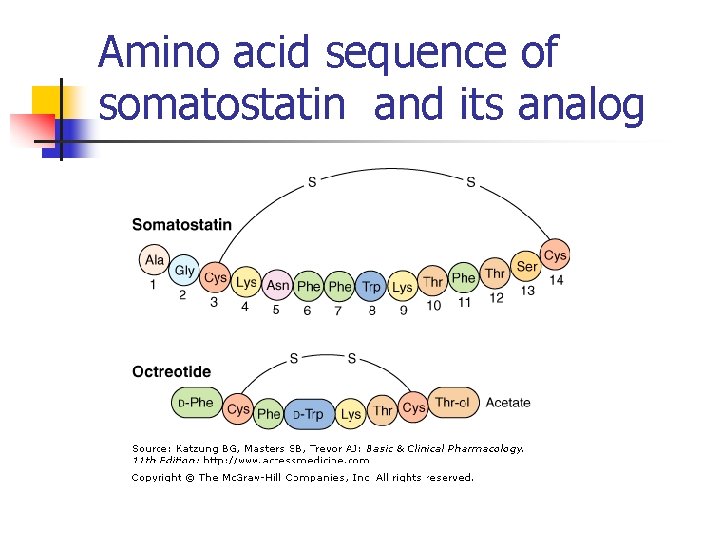
Amino acid sequence of somatostatin and its analog
Pegvisomant n n n Is a GH receptor antagonist Useful for the treatment of acromegaly The polyethylene glycol (PEG) derivative of a mutant GH, B 2036,
THE GONADOTROPINS n n FSH LH human Chorionic Gonadotropin (h. CG) Are dimers that share n n an identical chain in addition to a distinct chain
Chemistry & Pharmacokinetics n n MENOTROPINS FOLLICLE-STIMULATING HORMONE n n n LUTEINIZING HORMONE n n Urofollitropin, follitropin alfa and follitropin beta Lutropin, HUMAN CHORIONIC GONADOTROPIN
Pharmacodynamics n Effects through G protein-coupled receptors
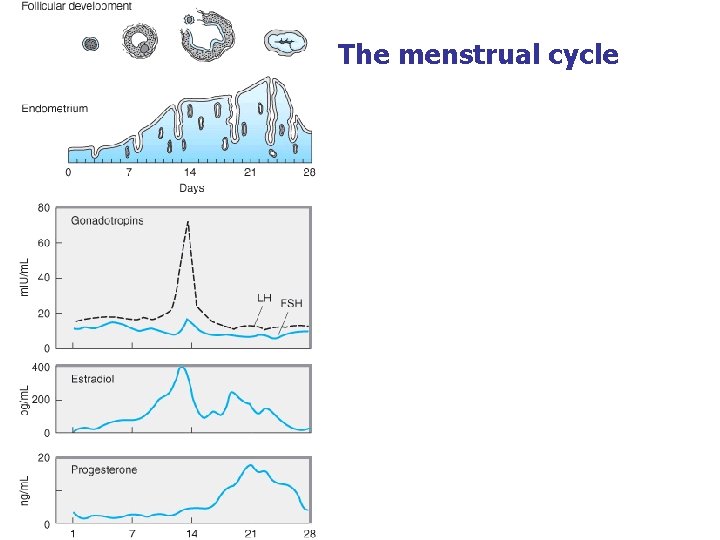
The menstrual cycle
Clinical Pharmacology n OVULATION INDUCTION n to induce ovulation in women with anovulation due to: n n hypogonadotropic hypogonadism polycystic ovary syndrome obesity MALE INFERTILITY
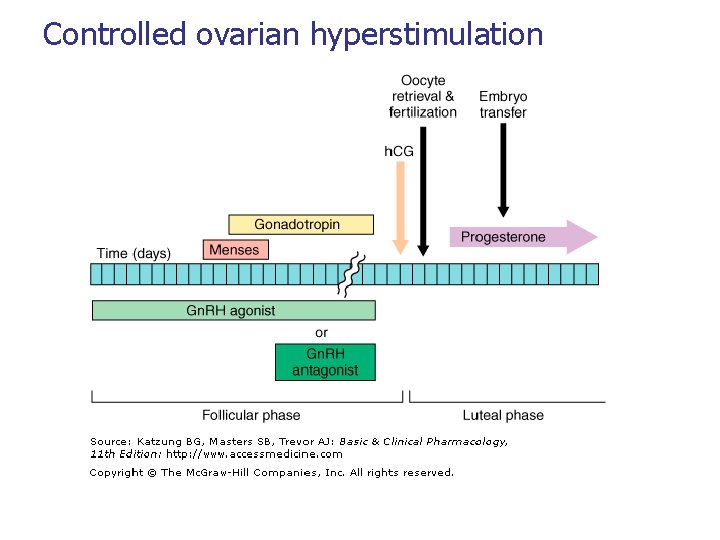
Controlled ovarian hyperstimulation
Toxicity & Contraindications n n n ovarian hyperstimulation syndrome multiple pregnancies Headache, depression, edema, precocious puberty
GONADOTROPIN-RELEASING HORMONE & ITS ANALOGS n n Pulsatile Gn. RH secretion is required to stimulate the gonadotroph cell to produce and release LH and FSH Sustained, nonpulsatile administration of Gn. RH or Gn. RH analogs inhibits the release of FSH and LH by the pituitary
Chemistry & Pharmacokinetics n STRUCTURE n n Gn. RH is a decapeptide found in all mammals Gonadorelin is an acetate salt of synthetic human Gn. RH Synthetic analogs include goserelin, histrelin, leuprolide, nafarelin, and triptorelin. PHARMACOKINETICS n Gn. RH analogs can be administered subcutaneously, intramuscularly, via nasal spray or as a subcutaneous implant
Pharmacodynamics n Gn. RH exhibit complex dose-response relationships that change dramatically from the fetal period through the end of puberty.
Clinical Pharmacology n STIMULATION n n Female infertility Male infertility Diagnosis of LH responsiveness SUPPRESSION n n n Controlled ovarian hyperstimulation Endometriosis Uterine leiomyomata (uterine fibroids) Prostate cancer Central precocious puberty Other n advanced breast and ovarian cancer
Toxicity n n Headache, light-headedness, nausea, and flushing Contraindications to the use of Gn. RH agonists in women include n pregnancy and breast-feeding
GNRH RECEPTOR ANTAGONISTS n Ganirelix and cetrorelix n Pharmacokinetics n n Clinical Pharmacology n n absorbed rapidly after subcutaneous injection preventing the LH surge during controlled ovarian hyperstimulation Toxicity n nausea and headache

PROLACTIN n n Is a 198 -amino-acid peptide hormone Its structure resembles that of GH

DOPAMINE AGONISTS n n Bromocriptine , cabergoline, pergolid and Quinagolide Pharmacokinetics n n Clinical Pharmacology n n All available dopamine agonists are active as oral preparations HYPERPROLACTINEMIA PHYSIOLOGIC LACTATION ACROMEGALY Toxicity & Contraindications n nausea, headache, light-headedness, orthostatic hypotension, and fatigue
- Slides: 32