
Hyponatremia and Hypernatremia Austin Bidman Angela Bousman Scott
Hyponatremia and Hypernatremia Austin Bidman Angela Bousman Scott Bowman Naomi Bryant Jasmin Du Hopi Jayne Medline Kasper Hannah Myers Nicole Reynolds Emma Salud Abby Weaver Lindsey Yeung
Hyponatremia • Serum sodium level <136 m. Eq/L • Causes: – Pure sodium level – Low sodium intake – Dilutional hyponatremia (compulsive water drinking) – Syndrome of inappropriate ADA • ADH secretion in the absence of hypovolemia or hyperosmolality • Hyponatremia with hypervolemia
Hyponatremia • Manifestations: – Lethargy, confusion, decreased reflexes, seizures, muscle twitches, headache, coma and death – If ECF and hypovolemia: • Hypotension, tachycardia, decreased urine output – If dilutional from excess water: • Weight gain, edema, ascites, JVD
Hyponatremia • But how do you correct it? – Mild: restrict water intake to 500 -1000 ml/day – If ECF volume deficit-give saline, will excrete extra water if kidneys are OK – Emergency-hypertonic saline plus diuretic – CORRECT SLOWLY: risk of myelinosis resulting in death or permanent neurologic injury can occur
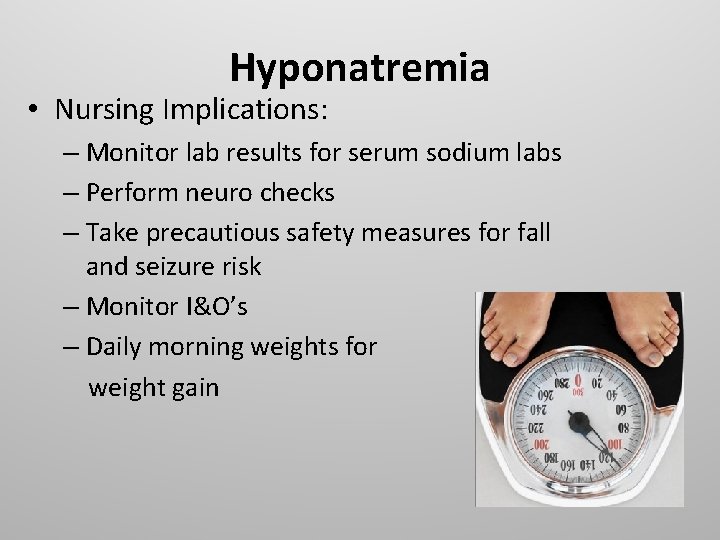
Hyponatremia • Nursing Implications: – Monitor lab results for serum sodium labs – Perform neuro checks – Take precautious safety measures for fall and seizure risk – Monitor I&O’s – Daily morning weights for weight gain
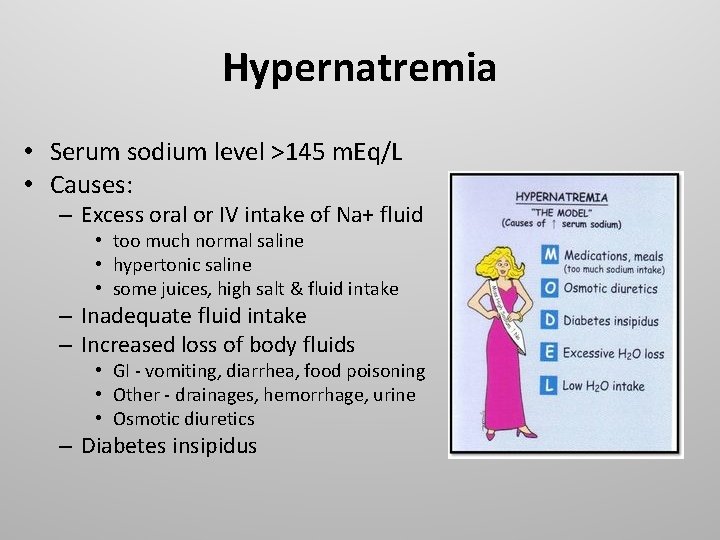
Hypernatremia • Serum sodium level >145 m. Eq/L • Causes: – Excess oral or IV intake of Na+ fluid • too much normal saline • hypertonic saline • some juices, high salt & fluid intake – Inadequate fluid intake – Increased loss of body fluids • GI - vomiting, diarrhea, food poisoning • Other - drainages, hemorrhage, urine • Osmotic diuretics – Diabetes insipidus
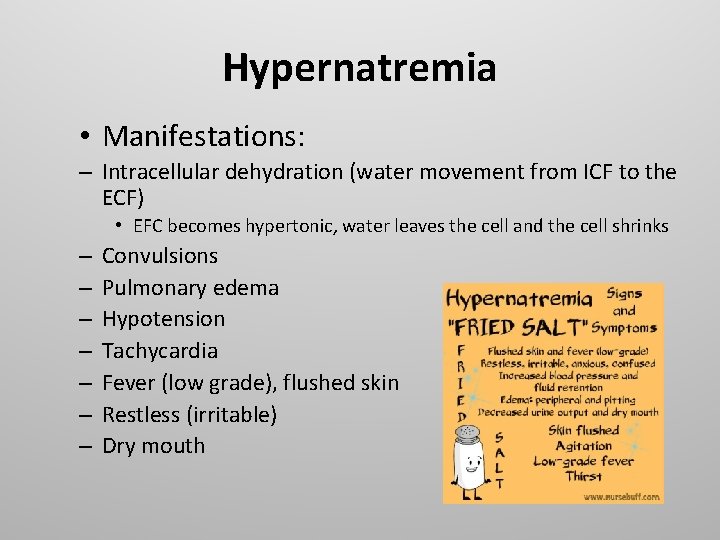
Hypernatremia • Manifestations: – Intracellular dehydration (water movement from ICF to the ECF) • EFC becomes hypertonic, water leaves the cell and the cell shrinks – – – – Convulsions Pulmonary edema Hypotension Tachycardia Fever (low grade), flushed skin Restless (irritable) Dry mouth
Hypernatremia • But how do you correct it? – Stop fluid loss and give H 2 O! • Administer fluids SLOWLY to prevent: – rapid movement of H 20 into brain cells (cerebral edema) – �Seizures – �Brain injury – �Death • Type of fluid to give - HYPOTONIC - why? – It has a lower osmolarity than normal blood plasma – It causes a fluid shift out of the blood vessels goes INTO THE CELLS – It hydrates cells while reducing fluid in the circulatory system Examples: 0. 45% Sodium Chloride (0. 45% Na. Cl), 0. 33% Na. Cl, 0. 2% Na. Cl, 2. 5% dextrose in H 20
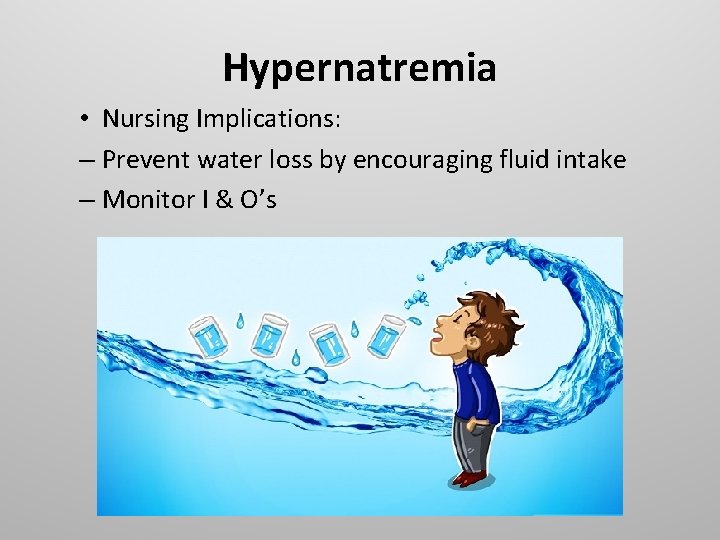
Hypernatremia • Nursing Implications: – Prevent water loss by encouraging fluid intake – Monitor I & O’s
Case Study 1: Chipotle Chick 23 year old female patient who LOVES Chipotle, despite what the news says she remains a loyal customer, because she “has to get her burrito fix, with extra guac, of course!” After her 2 nd burrito of the week (its only Tuesday) she finds herself spending lots of time in the bathroom. After finally being able to leave the bathroom… She started to feel light headed, anxious, feverish, and like her heart is pounding out of her chest, eventually gave in to web MD, still in denial, she called her nursing student friend frantically explaining her symptoms. What electrolyte imbalance does this poor girl most likely have? What does she need to do to fix it?
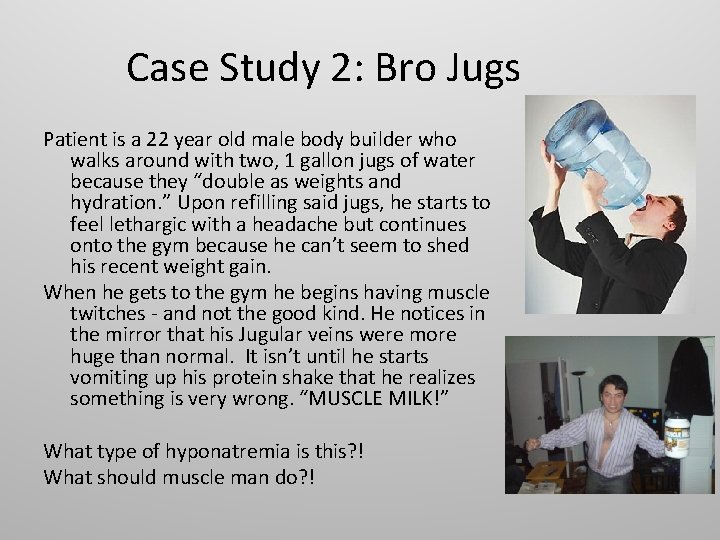
Case Study 2: Bro Jugs Patient is a 22 year old male body builder who walks around with two, 1 gallon jugs of water because they “double as weights and hydration. ” Upon refilling said jugs, he starts to feel lethargic with a headache but continues onto the gym because he can’t seem to shed his recent weight gain. When he gets to the gym he begins having muscle twitches - and not the good kind. He notices in the mirror that his Jugular veins were more huge than normal. It isn’t until he starts vomiting up his protein shake that he realizes something is very wrong. “MUSCLE MILK!” What type of hyponatremia is this? ! What should muscle man do? !
- Slides: 11