
HYPOCALCEMIA MBBS 2011 BATCH 060814 CALCIUM Total body
HYPOCALCEMIA MBBS 2011 BATCH 06/08/14
CALCIUM • Total body calcium content- 1 -2 kg • 99% of it is within the bone in the form of hydroxyapatite • It is present both in ICF & ECF • In blood total calcium concentration- 8. 5 -10. 5 mg/dl • It is present in two forms in blood- (both ≈ 50% each) 1. bound form- bound ionically to proteins and other anions 2. unbound form- free ionic form
• Normally ionic unbound form in the ECF is maintained within an exquisitely narrow range through a series of feedback mechanisms that involve PTH and active vitamin D metabolite. • Calcium is impotant for many physiological processes such as neuromuscular signaling, cardiac contractility, blood coagulation and hormone secretion. • Recommended dietary intake- 1000 -1200 mg/day
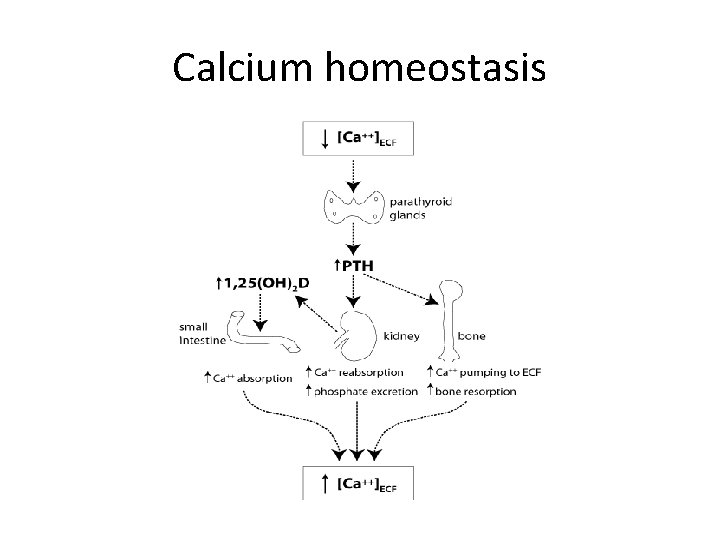
Calcium homeostasis
HYPOCALCEMIA • Serum calcium < 8. 4 mg/dl with a normal serum albumin. Or an ionized calcium < 4. 2 mg/dl. • It must be differentiated from pseudohypocalcemia, in which total calcium is reduced due to hypoalbuminemia, but ionized (physiologically active) fraction remains within normal range. • An algorithm to correct for protein changes adjusts the total serum calcium (in mg/d. L) upward by 0. 8 times the deficit in serum albumin (g/d. L) or by 0. 5 times the deficit in serum immunoglobulin (in g/d. L).
CAUSES 1. Hypocalcemia associated with hypoparathyroidism • • • parathyroid agenesis parathyroid destruction reduced parathyroid function 2. Associated with high parathyroid hormone levels (secondary hyperparathyroidism) • • • Vit D deficiency or impaired action Parathyroid hormone resistance syndromes Drugs
Clinical manifestations • May be asymptomatic (when mild and chronic) • Moderate to severe hypocalcemia is associated with paresthesias, usually of the fingers, toes, and circumoral regions, and is caused by increased neuromuscular irritability. • Chvostek's sign- twitching of the circumoral muscles in response to gentle tapping of the facial nerve just anterior to the ear. (may be present in 10% of normal individuals) • Trousseau's sign- Carpal spasm induced by inflation of a blood pressure cuff to 20 mm. Hg above the patient's systolic blood pressure for 3 min. • Severe hypocalcemia can induce seizures, carpopedal spasm, bronchospasm, and prolongation of the QT interval.
Investigations • • Total and ionic calcium Serum albumin Serum PTH Serum Phosphorus Vitamin D Serum Mg Serum alkaline phosphatase

Approach to Hypocalcemia
ECG manifestations • P wave, QRS complex unaffected. • Prolong QT interval (because of elongation of S-T segment) • The prolongation of QT interval is inversely proportional to the serum calcium level. • T wave is usually normal in duration, configuration and amplitude. • Hypocalcemia is the only condition which can prolong the ST segment without affecting the T wave.
TREATMENT • Depends on the severity of the hypocalcemia, the rapidity with which it develops, and the accompanying complications. • Acute, symptomatic hypocalcemia is initially managed with i/v calcium gluconate (10% w/v) 1 ampul diluted in 50 m. L of 5% D or NS given over 5 min. • Continuing hypocalcemia often requires a constant intravenous infusion ( i. e. 10 ampuls of calcium gluconate in 1 L of 5% D or normal saline over 24 h). • Accompanying hypomagnesemia, if present, should be treated with appropriate magnesium supplementation
• Chronic hypocalcemia due to hypoparathyroidism- treated with calcium supplements (1000– 1500 mg/d in divided doses) and either vitamin D 2 or D 3 or calcitriol. • Vitamin D deficiency is treated using vitamin D supplementation, with the dose depending on the severity of the deficit and the underlying cause. • The treatment goal is to bring serum calcium into the low normal range and to avoid hypercalciuria, which may lead to nephrolithiasis. • When hypocalcemia is associated with severe hyperphosphatemia, reduction of phosphorus should precede aggressive calcium supplementation.
- Slides: 12