
Hyphema Presented by Dr Aina A S Outline

Hyphema Presented by Dr Aina A. S.
Outline w Defination w Causes w Classification/grading w Clinical features w Complication w Management w Prognosis w Conclusion
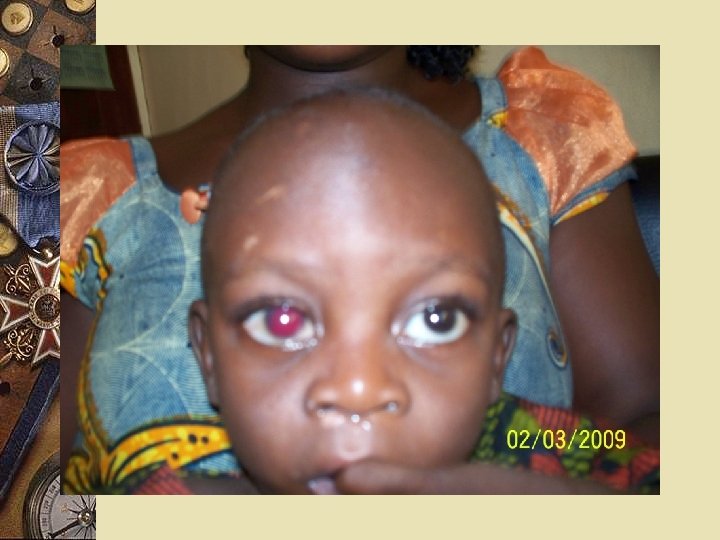
Defination w Hyphema is the presence of red blood cells in the anterior chamber of the eye. w A minimal amount of tiny red blood cells suspended in the aqueous humour is termed a microhyphema. it is visible only with Slit lamp. w A little blood in the aqueous can cause a significant decrease in VA.

Causes w Traumatic w Spontaneous – neovascularization (eg, diabetes mellitus, ischemia, cicatrix formation, CRVO) – vascular anormalies (eg, juvenile xanthogranuloma) – ocular neoplasms (eg, retinoblastoma, iris melanoma) – inflammatory processes(uveitis) – haematological disorders (eg SCD, heamophilia, leakemia) – Surgery (intra op, early post op & late post op) – laser trabeculoplasty or iridotomy – Anticoagulation therapy such as warfarin, aspirin w idiopathic
Traumatic w Blunt or penetrating. w Ranges from serious injury to trivial ones w Affects both children and adult. Males>> females. w These includes impact from missiles, balls, rocks, projectile toys, air gun pellets, hockey pucks, wood, RTA, and the human fist. w Accidental or intentional(Surgery)
Grading of Hyphema w Grade 1 - Layered blood occupying less than one third of the AC w Grade 2 - Blood filling one third to one half of the AC w Grade 3 - Layered blood filling one half to less than total of the AC w Grade 4 - Total clotted blood, often referred to as blackball or 8 -ball hyphema or button hole.
w It can also be done by measuring (in millimeters) the hyphema from the inferior 6 -o'clock limbus. w Digital imaging analysis is also useful and objective but is available in only a few research or academic facilities. w Also in percentage.
Clinical features w Depend on the severity of the injury. w It includes diminished visual acuity, pain, photophobia, lacrimation, headache, vomiting, nausea and somnolence/lethargy. w Elevated Intraocular Pressure – more commonly associated with near total or total hyphemas however it can occur in hyphema of any magnitude. – Usually occurs in the acute phase ≈ 24 hrs this is then followed by a period of normal or below normal pressure from the 2 nd -6 th day.
w The early period of elevated IOP is probably the result of trabecular plugging by erythrocytes and fibrin. w This follows period of reduced pressure most likely due to reduced aqueous production and uveitis, and it may actually increase the chance of secondary hemorrhage. This period of hypotony is commonly followed by a subsequent rise in IOP, probably coincidental with the recovery of the ciliary body. w It now later subsides with recovery of the trabecular meshwork and disappearance of the hyphema. w Careful monitoring of the IOP is important and may determine the course of treatment.
w Exceptions in 75% to total hyphema in whom pressure elevation frequently has its onset simultaneously with the initial hyphema and remains continually elevated until the hyphema has had considerable resolution. w When large segments of the AC angle are irreparably damaged. w When organization of the fibrin or clot produces extensive peripheral anterior synechiae, the IOP rises, becoming intractable glaucoma.
Causes of raised IOP w RBC blocking aqueous drainage w Inflammatory cells blocking aqueous drainage w Posterior Synechiae w Peripheral Anterior Synechiae w 8 ball hyphema
Complications w Secondary Hemorrhage w Posterior synechiae. w Peripheral anterior synechiae. w Corneal bloodstaining. w Optic atrophy w Secondary glaucoma
Secondary Hemorrhage w It worsens the prognosis and occurs in 25% of all patients with hyphema. w Probably due to lysis and retraction of the clot and fibrin aggregates that have occluded the initially traumatized vessel. w It is commoner in the young and occurs about 3 rd 4 th day though can still occur 7 th day posttrauma. w Grade 3 to Grade 4 hyphema w Heamophilia is known to be asso. with high incidence of rebleeding.
Posterior synechiae. w Usually in patients with traumatic hyphema. This complication is 20 to iritis or iridocyclitis. However, they are relatively rare complications in patients who are medically treated. w Posterior synechiae occur more frequently in patients who have had surgical evacuation of the hyphema.
Peripheral anterior synechiae. w Occur frequently in medically treated patients in whom the hyphema has remained in the AC for a prolonged period, typically 9 or more days. w The pathogenesis may be due to a prolonged iritis asso. with the initial trauma and/or chemical iritis resulting from blood in the AC also the clot in the chamber angle may subsequently organize, producing trabecular meshwork fibrosis that closes the angle.
Corneal bloodstaining w It primarily occurs in patients with a total hyphema and asso. elevation of IOP. w factors that affect endothelial integrity may enhance it occurrence– Initial state of the corneal endothelium; decreased viability resulting from trauma or advanced age (eg, cornea guttata) – Surgical trauma to the endothelium – Large amount of formed clot in contact with the endothelium. (Total hyphema ≈ 6 days) – Prolonged elevation of IOP > 25 mm. Hg. w It starts centrally and spread peripherally.
Optic atrophy w It can result from either acute, transiently elevated IOP or chronically elevated IOP. w Pallor occurs with constant pressure of 50 mm Hg or higher for 5 days or 35 mm Hg or higher for 7 days. w SCD patient can develop disc pallor with pressure of 35 mm. Hg in 2 -4 days.
Secondary glaucoma w Prolong elevated IOP may lead to glaucoma. w As gradual clearing of the hyphema occurs, with erythrocytes losing hemoglobin and becoming ghost cells in the vitreous cavity. w The ghost cells then circulate forward into the AC, with resultant trabecular blockage due to the distorted, bulky configuration of the crenated red blood cell. w So this delayed elevation of IOP may cause ghost cell glaucoma, particularly in patients with poor facility of outflow.
w When large segments of the AC angle are irreparably damaged and/or when organization of the fibrin or clot produces extensive peripheral anterior synechiae, the elevated IOP continues, becoming intractable glaucoma.
Other complications of Hyphema w w w w w Choroidal rupture. Macular scarring. Retinal detachment. Vitreous hemorrhage. Zonular dialysis. Lens opacities Angle-recession glaucoma. Secondary macular edema Sympathetic Ophthalmitis.
Management w Take a good history-trauma, PMH, POH w Complain of monocular worsening of visual acuity from normal vision to light perception. w Proper examination– – – Assess the level/grade Asso. Ocular injuries. Ocular motility. Pupillary function. Gonioscopy. Visual field assessment
Work-up w w Full blood count Hemoglobin electrophoresis Ocular USS prothrombin time (PT) and partial thromboplastin time (PTT). w X-ray of the orbit w Infrequently, a B-scan and/or a CT scan may be necessary to rule out an intraocular tumor or a foreign body. w Rarely, an iris fluorescein angiogram may be needed if early iris neovascularization is suspected as an underlying cause of the hyphema.
Medical Management w The usual treatment of patients with hyphema include hospitalization, bed rest, bilateral patching, topical cycloplegics, topical steroids, systemic steroids, topical antiglaucomatous medications, systemic CAI and sedation. w Avoid any antiplatelet drug such as aspirin and NSAIDS.
Hospitalization w If the hyphema occupies more than one third of the AC. w IOP elevated beyond 30 mm Hg. w If patient has Sickle cell trait or anaemia or rebleed. w severe loss or decrease in vision. w Non-compliant patients. w While on bed; nurse in Fowler's position(300 -450). w Daily measuring of IOP, 2 X IOP if elevated. w Daily Slit lamp exam so as identify early stages of cornea staining.
Surgical Intervention w Surgical intervention is usually indicated on or after the 4 th day. Indications includesw Microscopic corneal blood staining (at any time) w Total hyphema with intraocular pressures of 50 mm Hg or more for 4 days (to prevent optic atrophy) w Total hyphemas or hyphemas filling >75% of the AC present for 6 days with pressures of 25 mm Hg or more (to prevent corneal bloodstaining) w Hyphemas > 50% of the AC retained longer than 89 days (to prevent peripheral anterior synechiae) w In patients with sickle cell trait or sickle cell disease who have hyphemas of any size that are associated with IOP of >35 mm Hg for more than 24 hours.
Techniques to surgery w Hyphema evacuation with closed vitrectomy instrumentation. w Paracentesis w Irrigation and aspiration through a small incision w Clot irrigation with trabeculectomy w Hyphema surgery should be preceded by intravenous acetazolamide and mannitol if the IOP is elevated. w It should be performed under GA in all patients.
Complications of surgery w include damage to the – corneal endothelium, – the lens – the iris w prolapse of the intraocular contents w rebleeding and w increased synechiae formation.
Hyphema in SCD w The sickled erythrocytes obstruct the trabecular meshwork more effectively than healthy cells, and a consequent elevation of intraocular pressure occurs with lesser amounts of hyphema. w Use of CAI is highly cautioned in SCD because it causes metabolic acidosis and this will provoke crisis in them.
w Uveitis-glaucoma-hyphema (UGH) syndrome is seen weeks to months after surgery. w It is associated with archaic design AC IOLs and sulcus PC IOLs, the treatment may require removal of the lens that is causing the problem and replacing it with another lens.
Prognosis w The success of hyphema treatment is judged by the recovery of VA, is good in ≈ 75% of patients. w It is directly related to the following– Grade of hyphema – Amount of associated damage to other ocular structures (ie, choroidal rupture, macular scarring, Retinal detachment) – Whether secondary hemorrhage occurs – Whether complications of glaucoma, corneal blood staining, or optic atrophy occur.
Conclusion w Hyphema is one of the ocular conditions that can eventually lead to total blindness good and adequate knowledge of its management will definitely go a long way in reducing incidence of visual loss in our community. w The eye is an organ that represents only 0. 3% of the total surface area of the human body. However, loss of vision in one or both eyes has been classified as 24% or 85% whole person impairment or disability, respectively.

w Finally i enjoy all my fellow eye care providers to be thorough and hardworking in discharging their duties whole heartedly so that we can together minimize the global burden of visual impairment and hence achieve VISION 2020 ‘RIGHT TO SIGHT’.

THANK YOU FOR LISTENING
- Slides: 35