
Hyperthyroidism Defintion u THYROTOXICOSIS v Increased thyroid hormone







- Slides: 72
Hyperthyroidism
Defintion u THYROTOXICOSIS v Increased thyroid hormone levels with biological effects on tissues and systems u HYPERTIROIDISM v Hyperfunction of thyroid gland
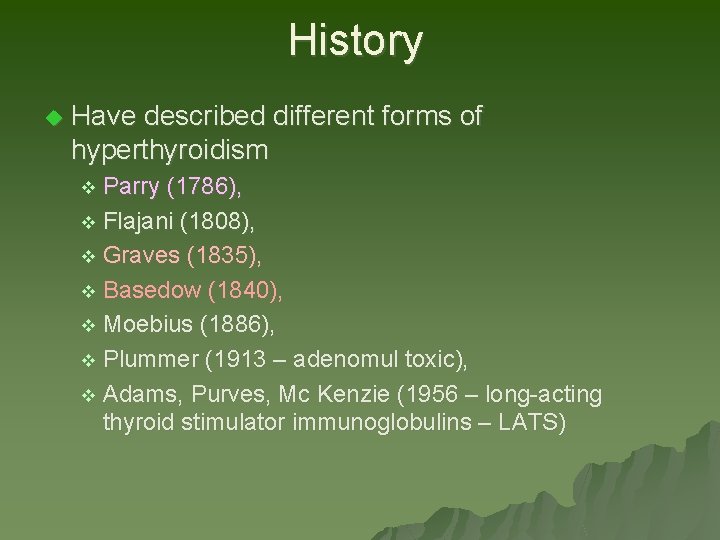
History u Have described different forms of hyperthyroidism v Parry (1786), v Flajani (1808), v Graves (1835), v Basedow (1840), v Moebius (1886), v Plummer (1913 – adenomul toxic), v Adams, Purves, Mc Kenzie (1956 – long-acting thyroid stimulator immunoglobulins – LATS)
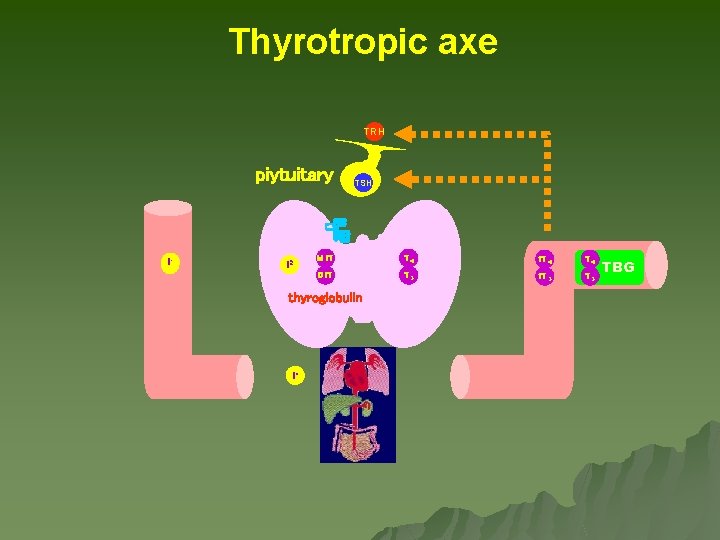
Thyrotropic axe TRH piytuitary II- I 2 TSH MIT T 44 f. T 44 T 4 DIT T 33 f. T 33 T 3 thyroglobulin I I-- TBG
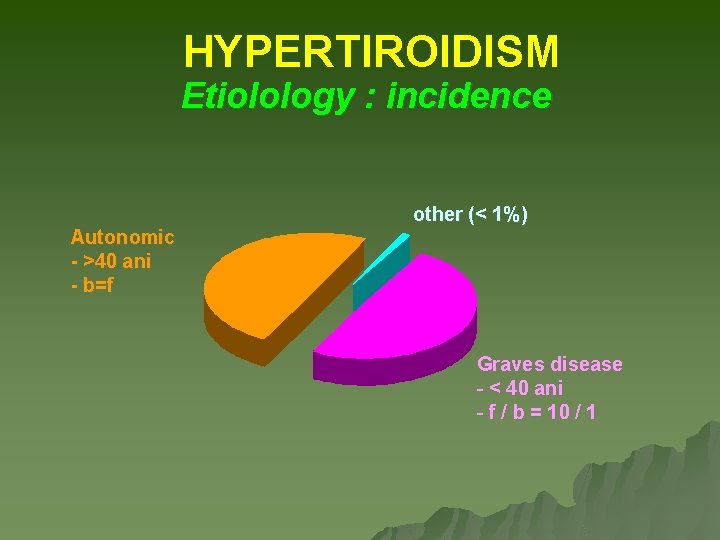
HYPERTIROIDISM Etiolology : incidence Autonomic - >40 ani - b=f other (< 1%) Graves disease - < 40 ani - f / b = 10 / 1
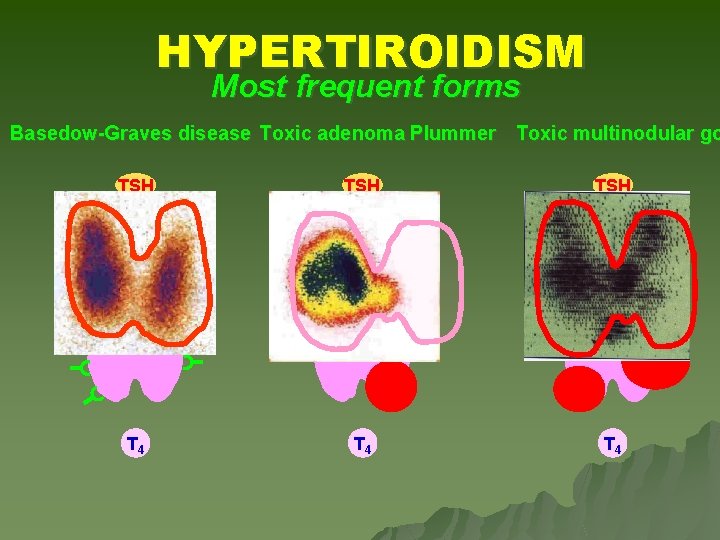
HYPERTIROIDISM Most frequent forms Basedow-Graves disease Toxic adenoma Plummer Toxic multinodular go TSH TSH T 4 T 4
Hypertiroidism – etiology A. tirotoxicosis with hyperthyroidism 1. Thyroid stimulation u u u TSI v Graves disease v TSH v thyrotropinoma Resistance to thryoid hormone action v Refetoff syndromes Human Chorionc Gonadotropin v Trophoblastic tumors v hiperemesis gravidarum 3. Iodine induced u 2. Autonomous thyroid function u u u Toxic adenoma Toxic multinodular goiter Non-autoimmune difuse hyperthyroidism(familiala, sporadic? ) Thyroid carcinoma follicular struma ovarii Jod-Basedow v Iodine contrast media, amiodarone (thyroid excess and autonomous thyroid function)
Hypertiroidism - etiology B. Thyrotoxicosis without hyperfunction of the thyroid gland 4. Distruction u thyroiditis v subacute de Quervain thyroiditis v Silent thyroiditis u Drug induced (amiodarone, interferon-alfa) u Irradiation, 5. External intake u Iatrogenic u Factitia u foods ( « hamburger thyrotoxicosis » )
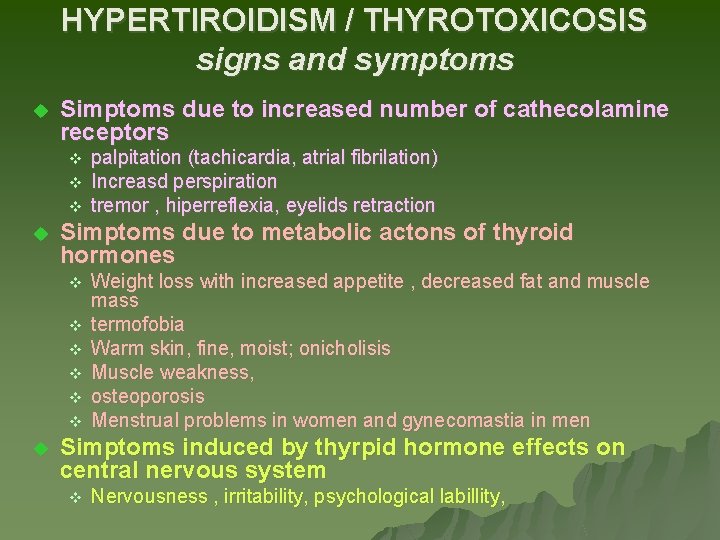
HYPERTIROIDISM / THYROTOXICOSIS signs and symptoms u Simptoms due to increased number of cathecolamine receptors v v v u Simptoms due to metabolic actons of thyroid hormones v v v u palpitation (tachicardia, atrial fibrilation) Increasd perspiration tremor , hiperreflexia, eyelids retraction Weight loss with increased appetite , decreased fat and muscle mass termofobia Warm skin, fine, moist; onicholisis Muscle weakness, osteoporosis Menstrual problems in women and gynecomastia in men Simptoms induced by thyrpid hormone effects on central nervous system v Nervousness , irritability, psychological labillity,
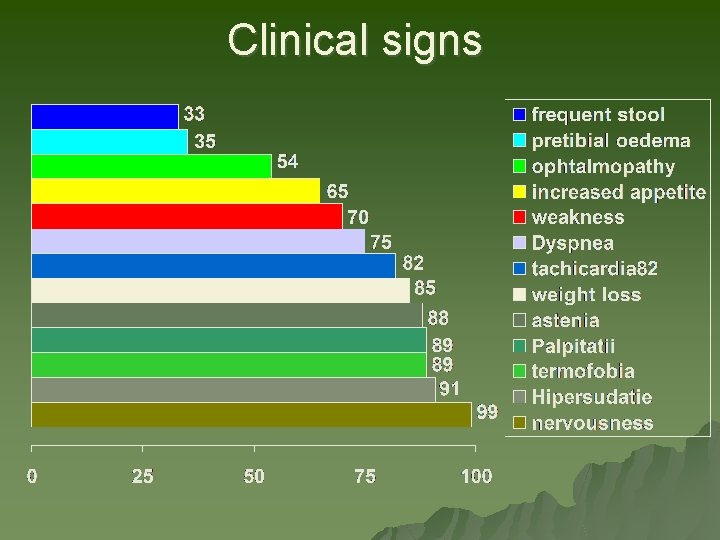
Clinical signs
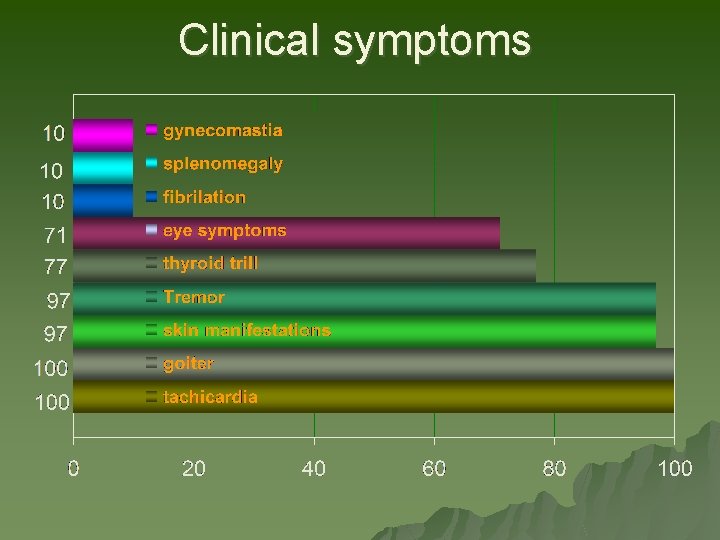
Clinical symptoms
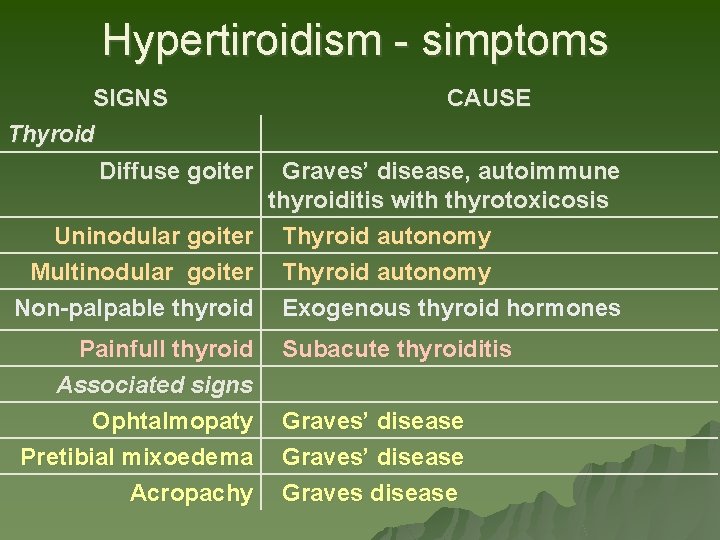
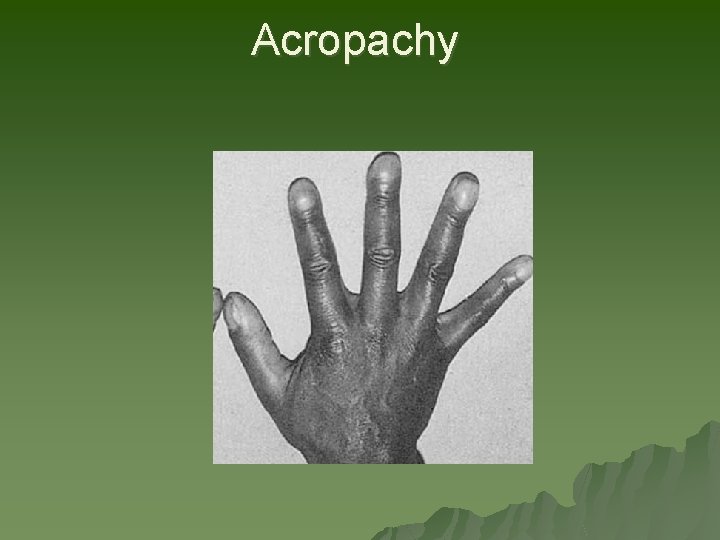
Hypertiroidism - simptoms SIGNS Thyroid Diffuse goiter Uninodular goiter Multinodular goiter Non-palpable thyroid Painfull thyroid Associated signs Ophtalmopaty Pretibial mixoedema Acropachy CAUSE Graves’ disease, autoimmune thyroiditis with thyrotoxicosis Thyroid autonomy Exogenous thyroid hormones Subacute thyroiditis Graves’ disease Graves disease
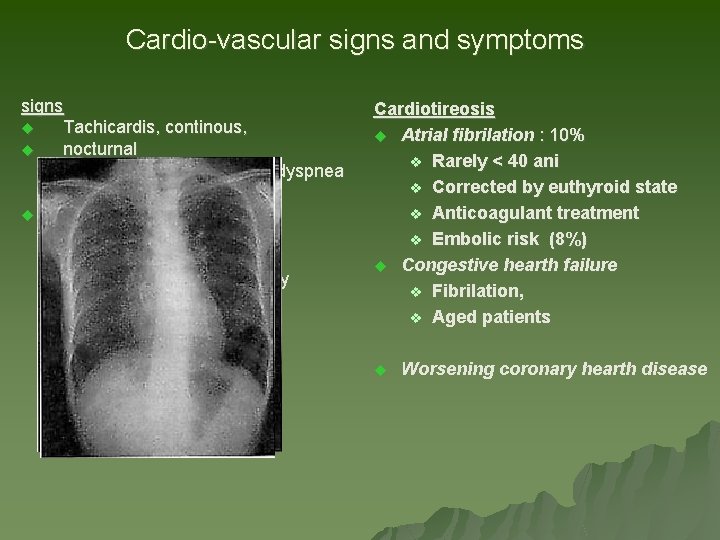
Cardio-vascular signs and symptoms signs u Tachicardis, continous, u nocturnal t + effort associated dyspnea v Systolic Hypertension u Increased cardiac output v FC v peripheral resistance v miocardial contractility Cardiotireosis u Atrial fibrilation : 10% v Rarely < 40 ani v Corrected by euthyroid state v Anticoagulant treatment v Embolic risk (8%) u Congestive hearth failure v Fibrilation, v Aged patients u Worsening coronary hearth disease
Neuro muscular signs Nervosness, irritability, u Emotional disturbance u Disturbance of attention and mood. u v Pseudo psychotic forms u Tremor Muscle weakness u Rapid reflexes, u Amiotrophy (pseudo miopathic forms) u Hypokaliemic periodic paralysis u
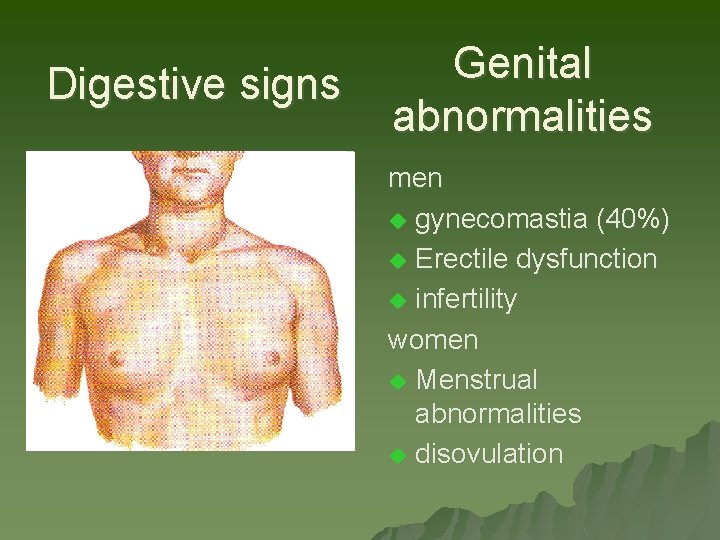
Digestive signs u Tranzit accelerat (motor) v pseudodiaree = poli exoneratie u Anomalii hepatice v Icter, citoliza, hipocolesterolemie Genital abnormalities men u gynecomastia (40%) u Erectile dysfunction u infertility women u Menstrual abnormalities u disovulation
Bone abnormalities Skin problems Decreased BMD : distruction>formation u Spontaneous fractures u Hypercalcemia, hypercalciuria u alkaline phosphatase and osteocalcin u u pruritus u Localized edema u Alopecia Metabolic abnormalities Hypocholesterolemia u Hyperglicemie, worsening of diabetes mellitus u
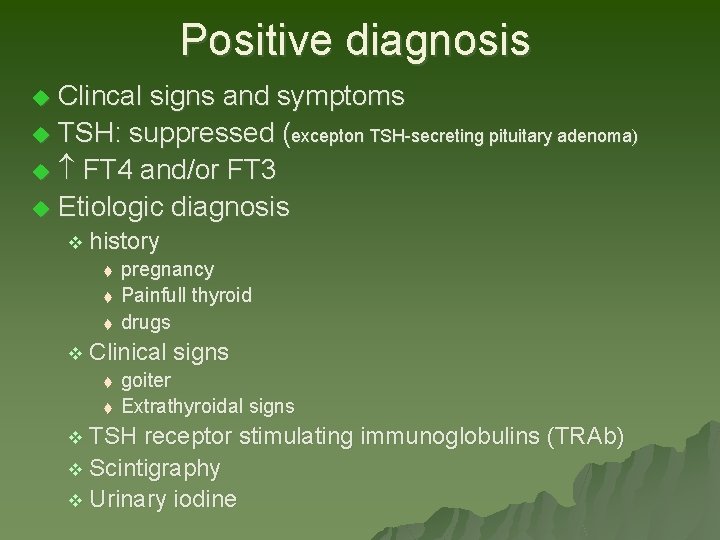
Positive diagnosis Clincal signs and symptoms u TSH: suppressed (excepton TSH-secreting pituitary adenoma) u FT 4 and/or FT 3 u Etiologic diagnosis u v history t t t pregnancy Painfull thyroid drugs v Clinical signs t t goiter Extrathyroidal signs v TSH receptor stimulating immunoglobulins (TRAb) v Scintigraphy v Urinary iodine
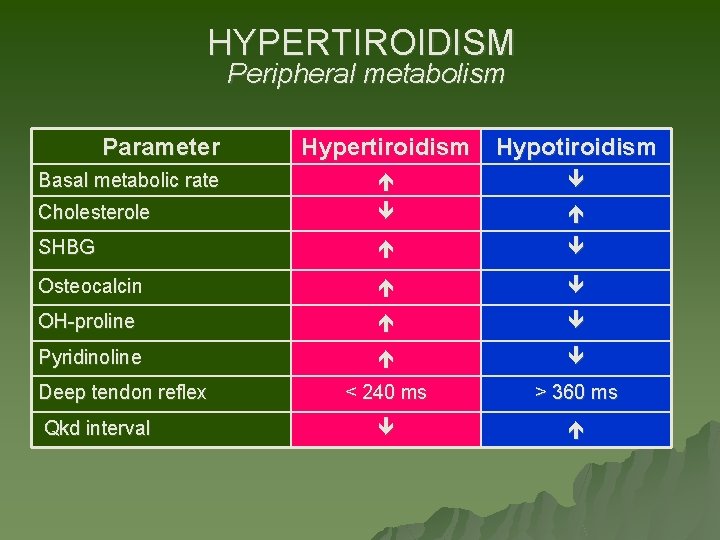
HYPERTIROIDISM Peripheral metabolism Parameter Hypertiroidism Hypotiroidism Basal metabolic rate Cholesterole SHBG Osteocalcin OH-proline Pyridinoline < 240 ms > 360 ms Deep tendon reflex Qkd interval
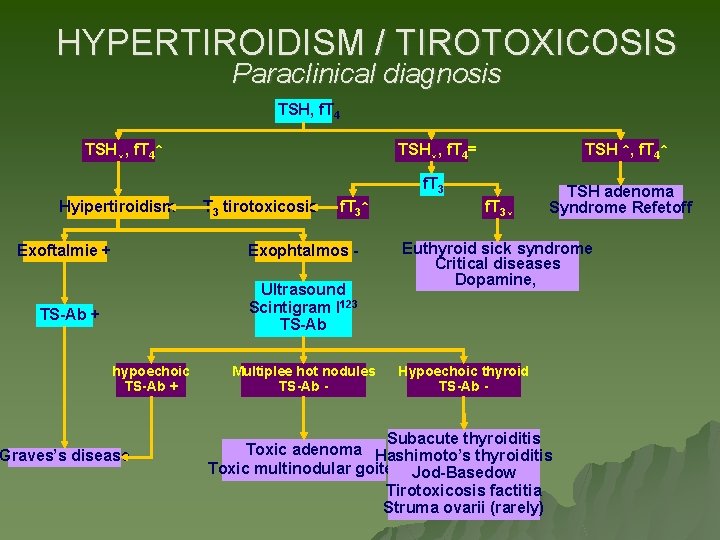
HYPERTIROIDISM / TIROTOXICOSIS Paraclinical diagnosis TSH, f. T 4 TSH↓, f. T 4↑ TSH↓, f. T 4= TSH ↑, f. T 4↑ f. T 3 Hyipertiroidism Exoftalmie + T 3 tirotoxicosis f. T 3↑ Exophtalmos Ultrasound Scintigram I 123 TS-Ab + hypoechoic TS-Ab + Graves’s disease Multiplee hot nodules TS-Ab - f. T 3↓ TSH adenoma Syndrome Refetoff Euthyroid sick syndrome Critical diseases Dopamine, Hypoechoic thyroid TS-Ab - Subacute thyroiditis Toxic adenoma Hashimoto’s thyroiditis Toxic multinodular goiter Jod-Basedow Tirotoxicosis factitia Struma ovarii (rarely)
HYPERTIROIDIS / THIROTOXICOSIS Imagery: Graves’disease Thyroid ultrasound
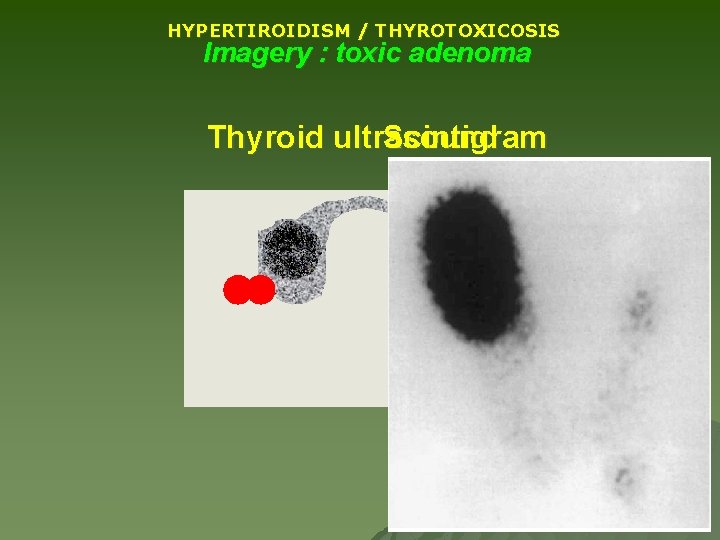
HYPERTIROIDISM / THYROTOXICOSIS Imagery : toxic adenoma Thyroid ultrasound Scintigram
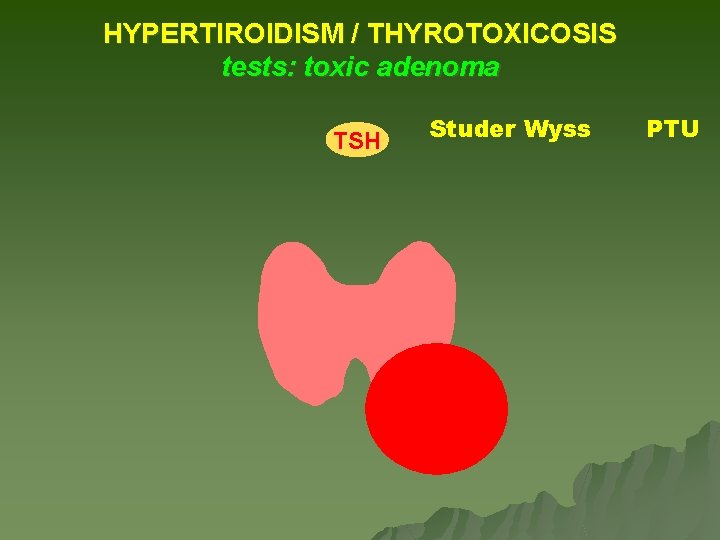
HYPERTIROIDISM / THYROTOXICOSIS tests: toxic adenoma TSH Studer Wyss T 4 PTU
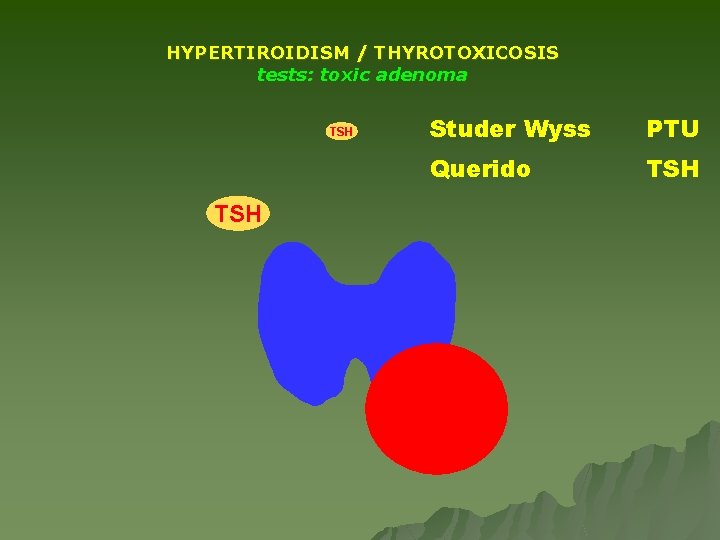
HYPERTIROIDISM / THYROTOXICOSIS tests: toxic adenoma TSH Studer Wyss PTU Querido TSH T 4
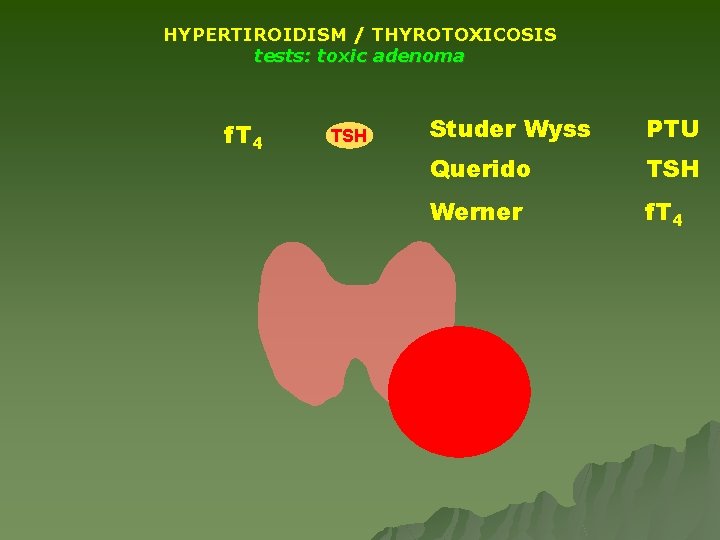
HYPERTIROIDISM / THYROTOXICOSIS tests: toxic adenoma f. T 4 TSH Studer Wyss PTU Querido TSH Werner f. T 4
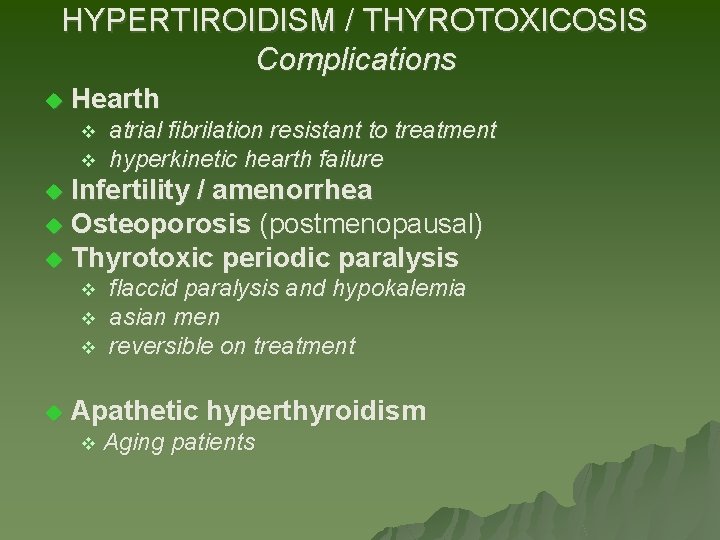
HYPERTIROIDISM / THYROTOXICOSIS Complications u Hearth v atrial fibrilation resistant to treatment v hyperkinetic hearth failure Infertility / amenorrhea u Osteoporosis (postmenopausal) u Thyrotoxic periodic paralysis u v flaccid paralysis and hypokalemia v asian men v reversible on treatment u Apathetic hyperthyroidism v Aging patients
Thyrotoxic crisis (thyrotoxic storm) u Etiology v determinant factors t Undertreated thyrotoxicosis t Recently developed untreated hyperthyroidism v Precipitating factors v medical ²infecţions ²Diabetic ketoacidosis ²Lung embolism ²Labor or pregnancy ²Premature stopping treatment ²I 131 treatment t surgery
Thyrotoxic crisis u severe signs and symptoms of thyrotoxicosis usevere hipermetabolism vfever t over >38 o. C (til 41 -42 o. C) v. Neuro-psychological symptoms t “thyrotoxic encephalopathy" - vcardio-vascular symptoms t tachicardia - >140/min, t arhitmias (atrial fibrillation ) t Hearth failure (left, global) t Variations of arterial blood pressure vgastro-intestinal symptoms t Mimikin acute abdomena t Jaundice (index of severity)
Graves disease u Most frequent cause of hyperthyroidism v Prevalence 1% t t 19/1000 ♀ 1, 6/1000 ♂ (Sex ratio 7 / 10) v Incidence 2 - 3 cases / year /1000 ♀ Young female patient, psychological trauma u Autoimmune, familial u v Asociated with other autoimune diseases: t tip 1 DM, adrenal insufficiency, vitiligo, miastenia gravis v Stimulating immunoglobulins
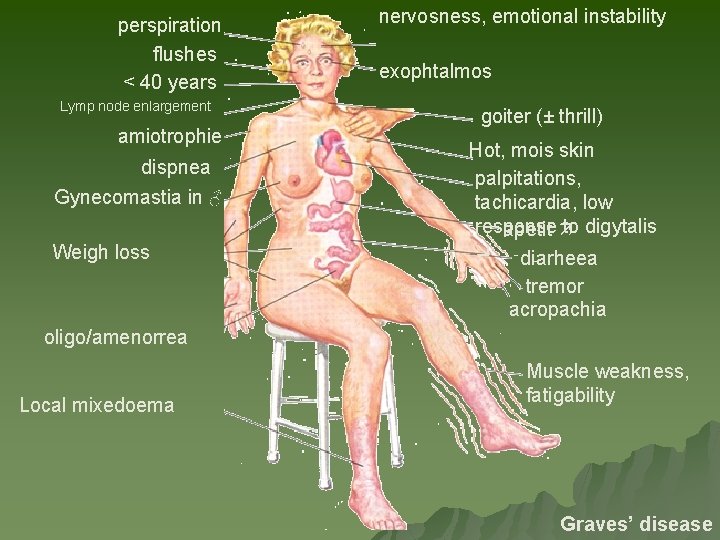
perspiration flushes < 40 years Lymp node enlargement amiotrophie dispnea Gynecomastia in ♂ Weigh loss nervosness, emotional instability exophtalmos goiter (± thrill) Hot, mois skin palpitations, tachicardia, low response to digytalis apetit diarheea tremor acropachia oligo/amenorrea Local mixedoema Muscle weakness, fatigability Graves’ disease
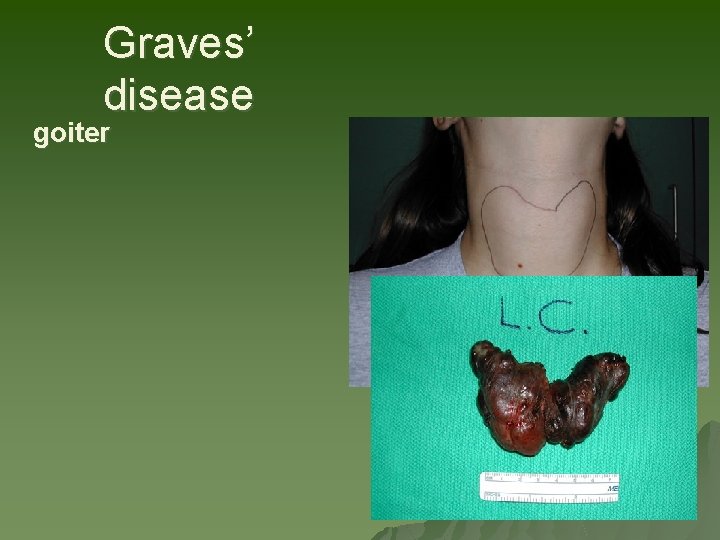
Graves’ disease goiter
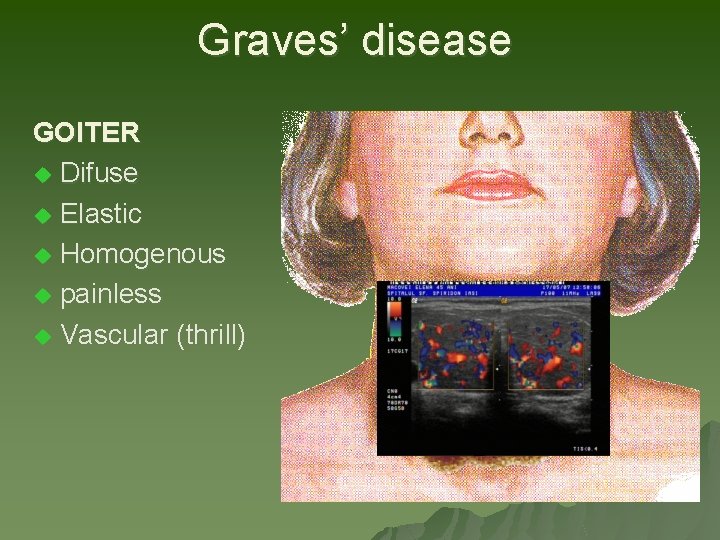
Graves’ disease GOITER u Difuse u Elastic u Homogenous u painless u Vascular (thrill)
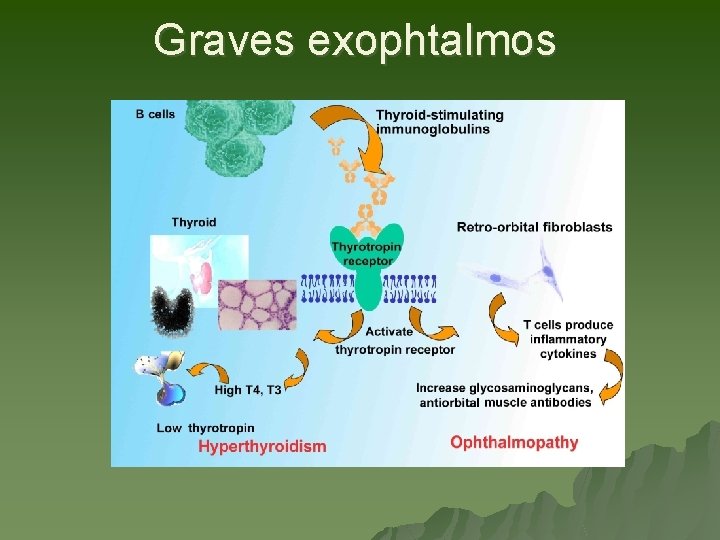
Graves exophtalmos
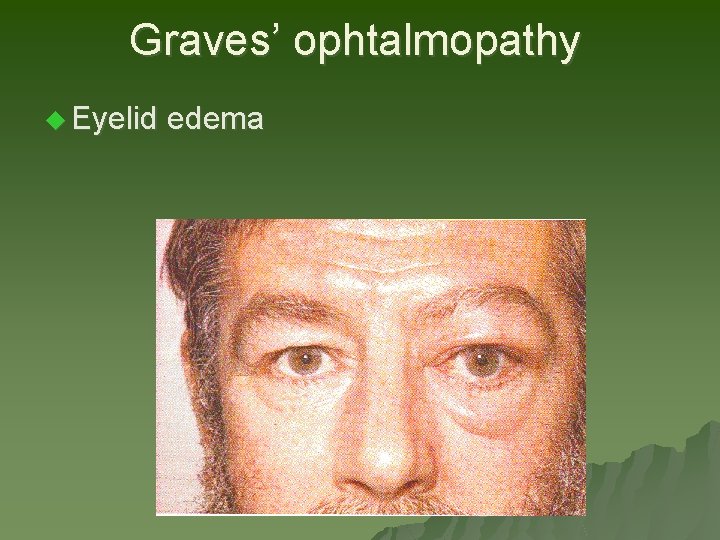
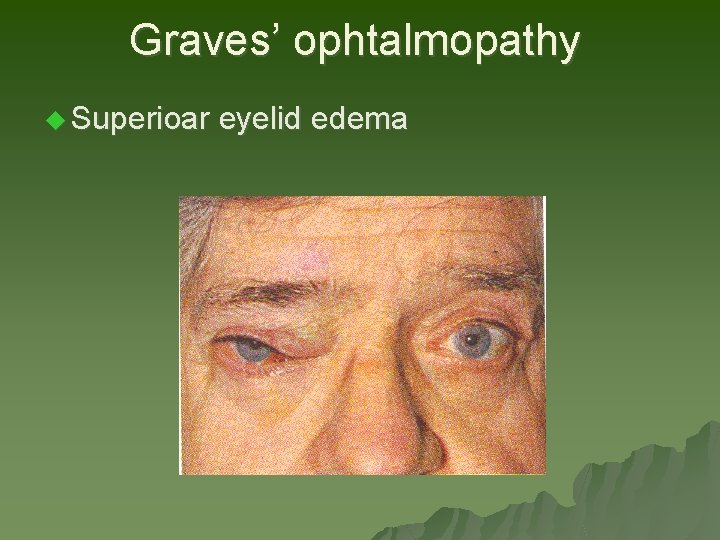
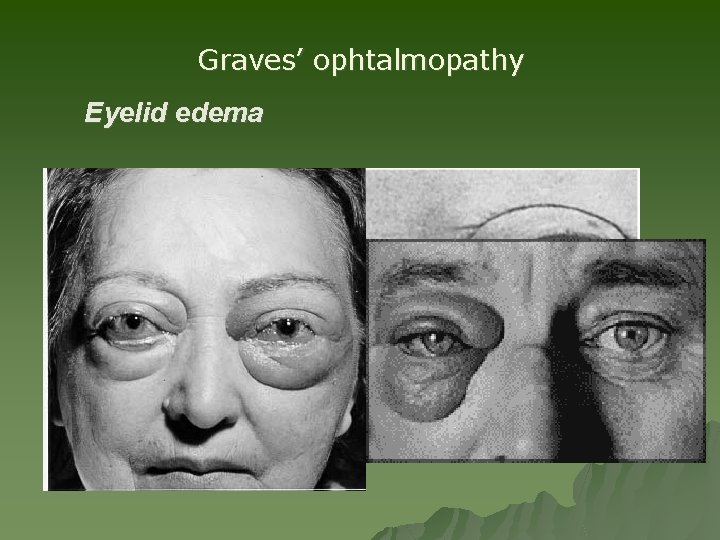
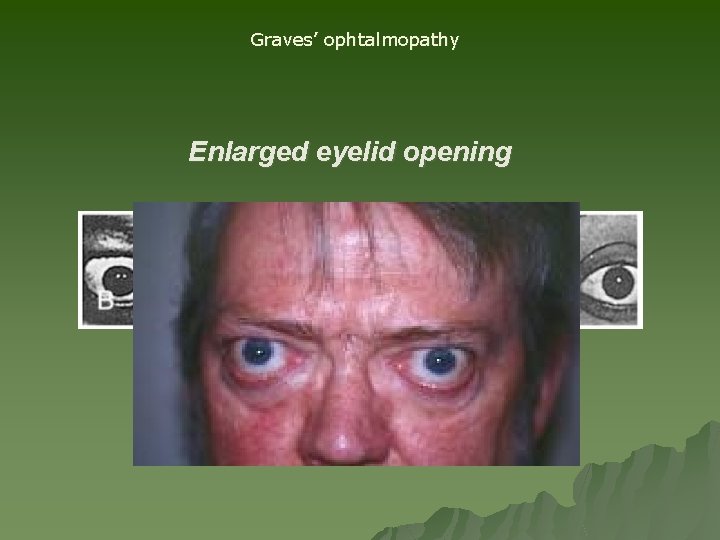
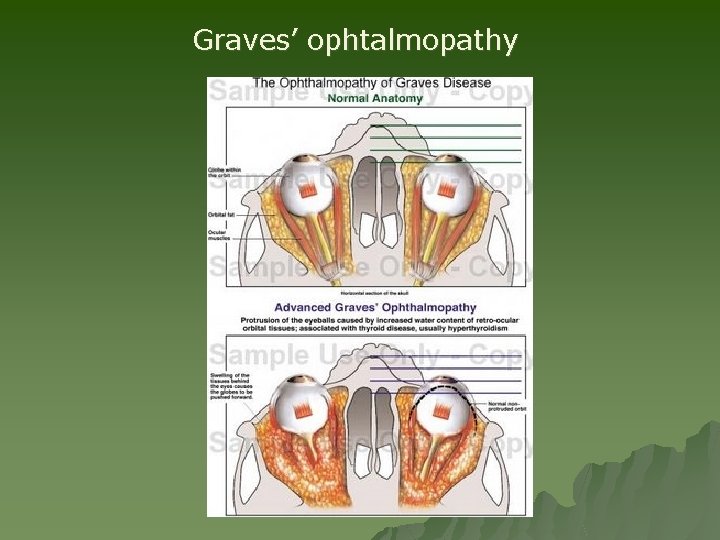
Graves ophtamopathy u u u u Eyelid edema, periorbital edema, proptosis Increase tears production Incomplete close eyelids during night Fotofobia, Eye disconfort, pruritus, “alergy Painfull eyes, associated or not with eye mouvments Dyplopia v Intermitent: when patinets is tired v Inconstant v Constant: when reading
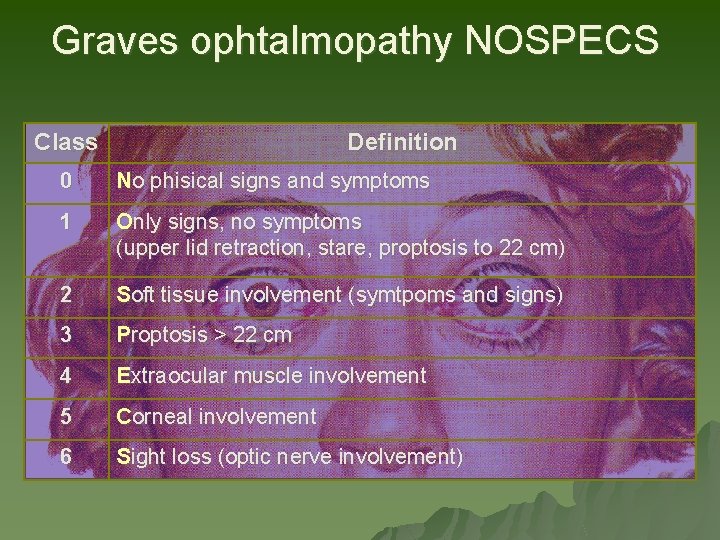
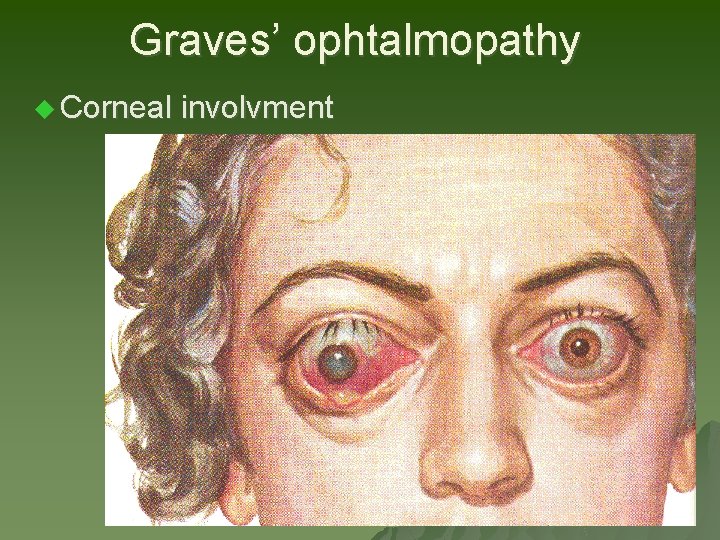
Graves ophtalmopathy NOSPECS Class Definition 0 No phisical signs and symptoms 1 Only signs, no symptoms (upper lid retraction, stare, proptosis to 22 cm) 2 Soft tissue involvement (symtpoms and signs) 3 Proptosis > 22 cm 4 Extraocular muscle involvement 5 Corneal involvement 6 Sight loss (optic nerve involvement)
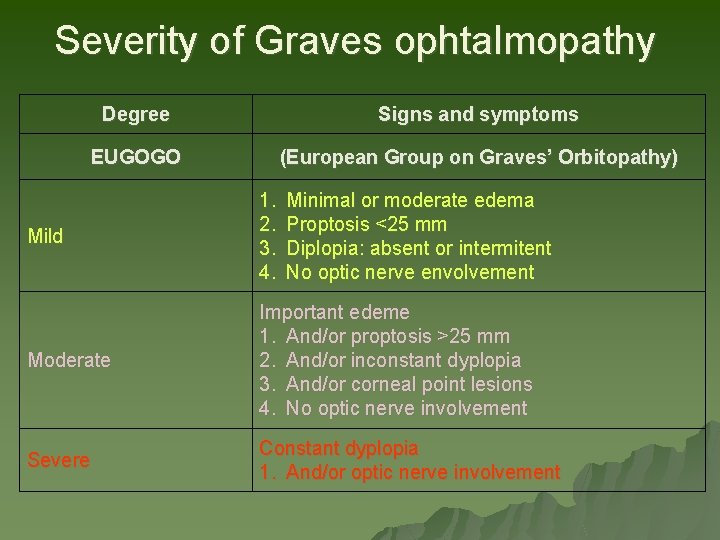
Severity of Graves ophtalmopathy Degree Signs and symptoms EUGOGO (European Group on Graves’ Orbitopathy) Mild 1. 2. 3. 4. Moderate Important edeme 1. And/or proptosis >25 mm 2. And/or inconstant dyplopia 3. And/or corneal point lesions 4. No optic nerve involvement Severe Constant dyplopia 1. And/or optic nerve involvement Minimal or moderate edema Proptosis <25 mm Diplopia: absent or intermitent No optic nerve envolvement
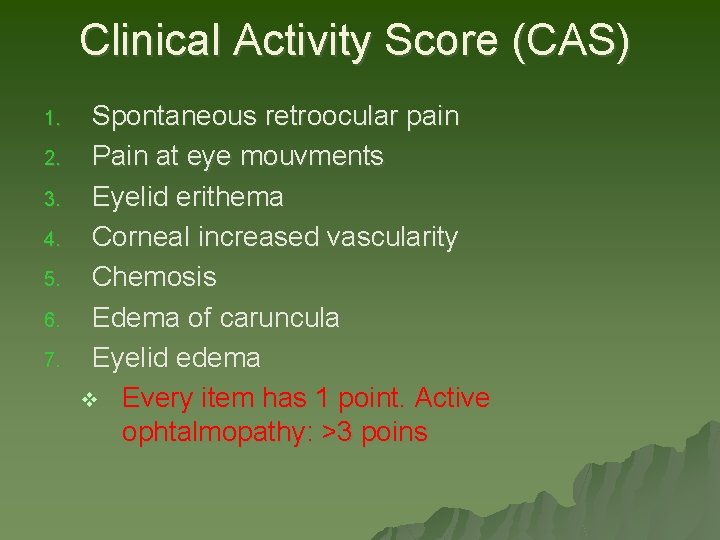
Clinical Activity Score (CAS) 1. 2. 3. 4. 5. 6. 7. Spontaneous retroocular pain Pain at eye mouvments Eyelid erithema Corneal increased vascularity Chemosis Edema of caruncula Eyelid edema v Every item has 1 point. Active ophtalmopathy: >3 poins
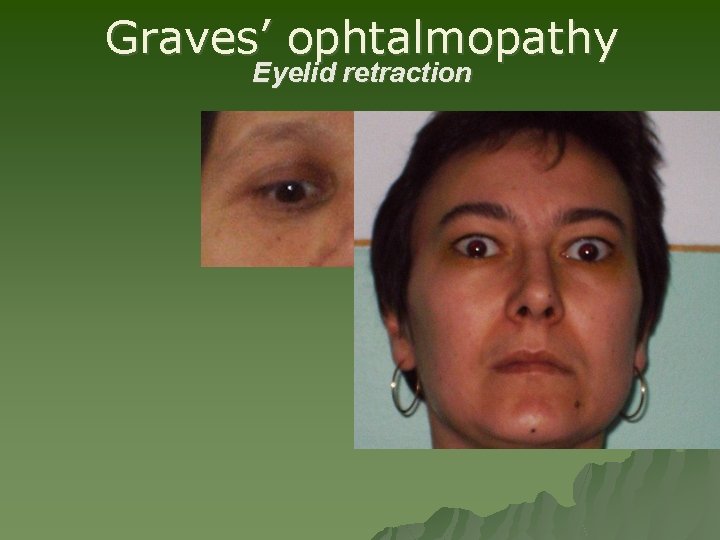
Graves’ ophtalmopathy Eyelid retraction
Graves’ ophtalmopathy u Eyelid edema
Graves’ ophtalmopathy u Superioar eyelid edema
Graves’ ophtalmopathy Eyelid edema
Graves’ ophtalmopathy Enlarged eyelid opening
Graves’ ophtalmopathy u Corneal involvment
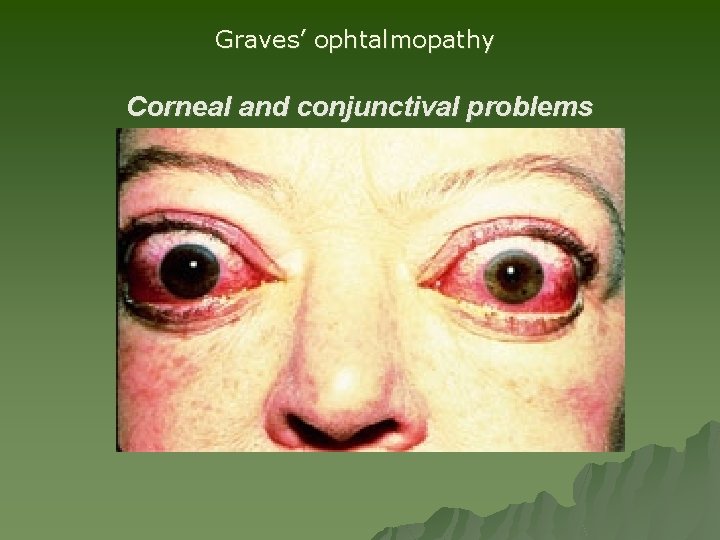
Graves’ ophtalmopathy Corneal and conjunctival problems
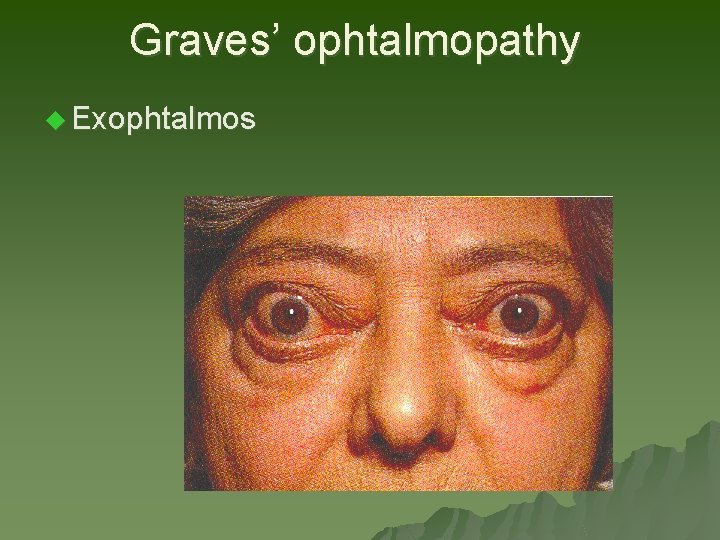
Graves’ ophtalmopathy u Exophtalmos
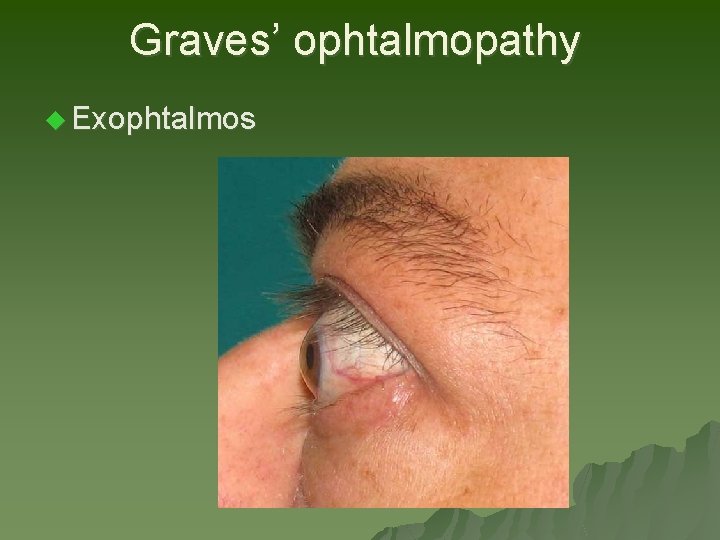
Graves’ ophtalmopathy u Exophtalmos
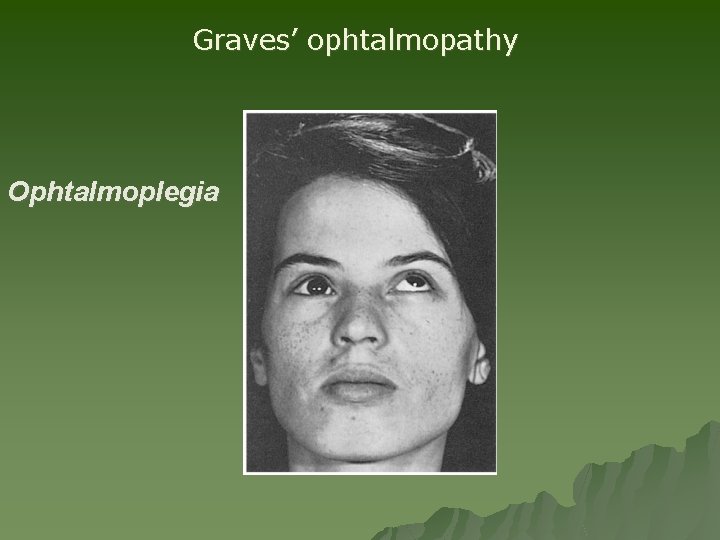
Graves’ ophtalmopathy Ophtalmoplegia
Graves’ ophtalmopathy
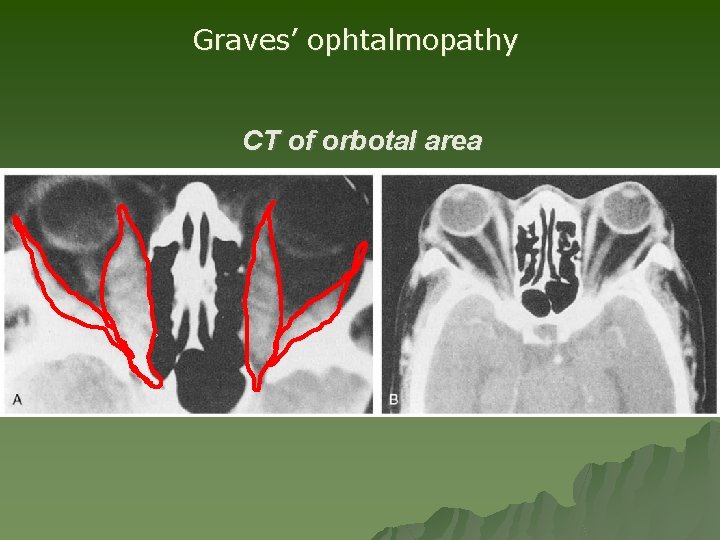
Graves’ ophtalmopathy CT of orbotal area
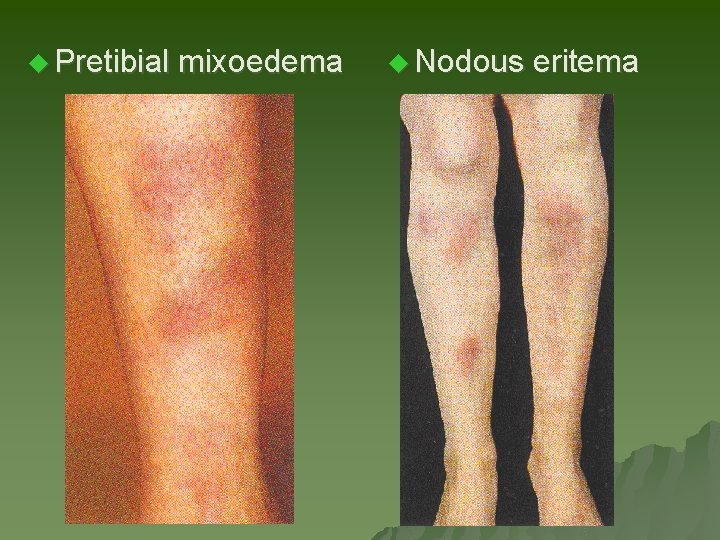
u Pretibial mixoedema u Nodous eritema
Acropachy
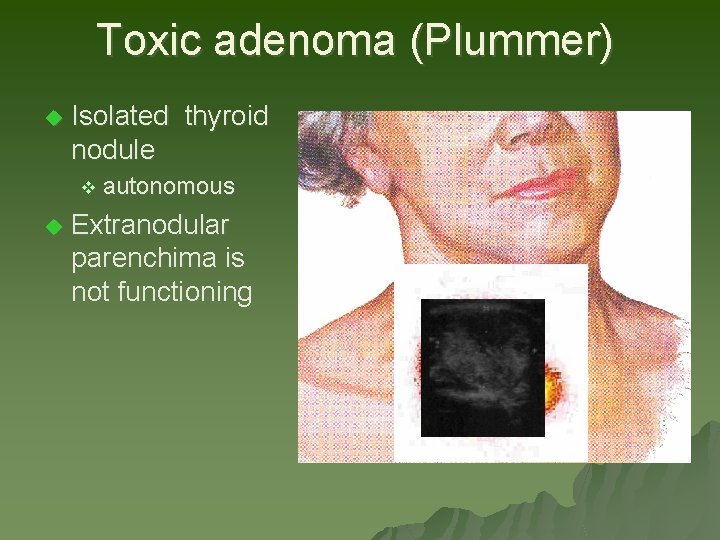
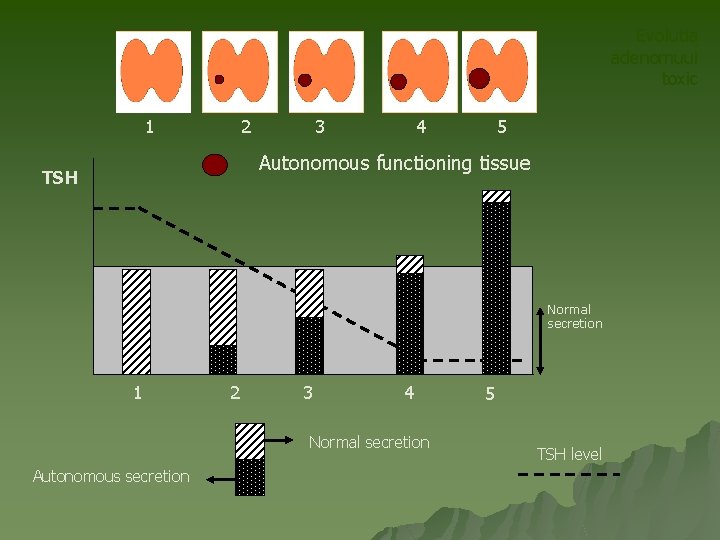
Toxic adenoma (Plummer) u Isolated thyroid nodule v autonomous u Extranodular parenchima is not functioning
Evolutia adenomuui toxic 1 2 3 4 5 Autonomous functioning tissue TSH Normal secretion 1 2 3 4 Normal secretion Autonomous secretion 5 TSH level
Toxic multinodular goiter u Hearth signs and symptoms are dominant v 10 - 15 % of atrial fibrillation in aged patients is associated with TMG v Hearth failure u Compressive goiter
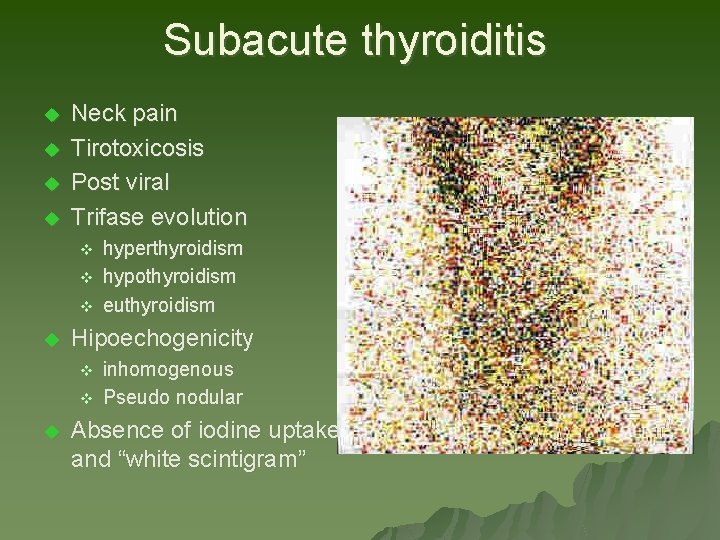
Subacute thyroiditis u u Neck pain Tirotoxicosis Post viral Trifase evolution v v v u Hipoechogenicity v v u hyperthyroidism hypothyroidism euthyroidism inhomogenous Pseudo nodular Absence of iodine uptake and “white scintigram” hipertiroidism eutiroidism hipotiroidism
HYPERTHIROIDISM / THYROTOXICOSIS Age-related characteristics Newborns • neonatal Graves disease (goiter exophtalmos, thyrotoxicosis) • temporarly • permanent • familial non-autoimmune thyrotoxicosis Children • Graves disease • increased growth rate Aging patients • Toxic adenoma / TMNG / Graves • clinical signs are less obvious • suspected when • it is an unexpected weight loss • atrial fibrilation and hearth failure unresponssive to digitalis
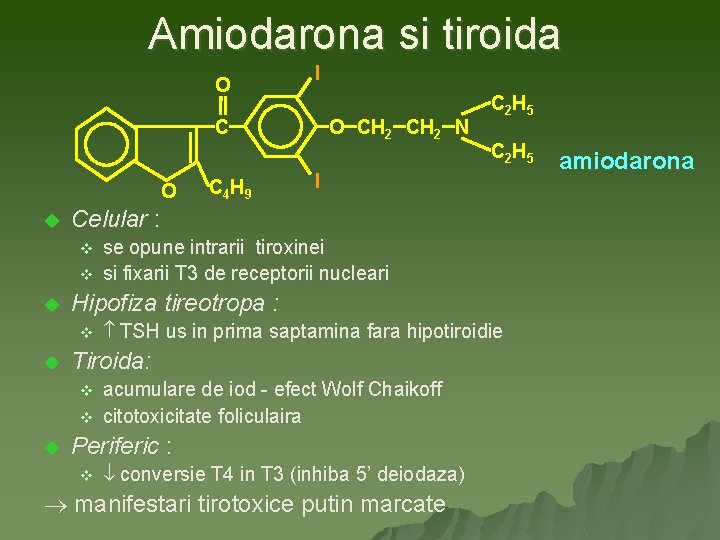
Amiodarona si tiroida O I C O u v se opune intrarii tiroxinei si fixarii T 3 de receptorii nucleari TSH us in prima saptamina fara hipotiroidie Tiroida: v v u I Hipofiza tireotropa : v u C 2 H 5 Celular : v u C 4 H 9 O CH 2 N C 2 H 5 acumulare de iod - efect Wolf Chaikoff citotoxicitate foliculaira Periferic : v conversie T 4 in T 3 (inhiba 5’ deiodaza) manifestari tirotoxice putin marcate amiodarona
Amiodarone –induced hyperthyroidism Type I : hyperfunctional (previous thyroid autoimmunity) Type II : distructive (previous normal thyroid) women 1/2 men 2/3 N, Scintigram positive absente Scintigram absent Normal and Tg volume Normal volume Hypervascularity (grad 1 -3) Hipoechoic, hipovascular (grad 0) Classic treatment ATS 6 -9 month KCLO 4 Potasium perclorate Glucocorticoids Prognosis Sponaneous regression (3 -6 Spontaneous regression month) (3 -6 month) Prolonged hyperthyroidism Transitory hypothyroidism Affected individuals 123 I uptake IL 6 Ultrasound Echodoppler
Thyrotoxicosis treatment AIM: to decrease thyroid hormones to normal levels u Distruction of thyroid 1. v v surgery Radio iodine u Inhibition of thyroid hormone synthesis (ATD) v v Antithyroid drugs Glucocorticoids adjuvant therapy Decreases conversion of T 4 to T 3 3. inhibition 2. v v ATD glucorticoids (high doses) propranolol iodine u Reduction of receptor coupling v v -blokers plasmaferesis
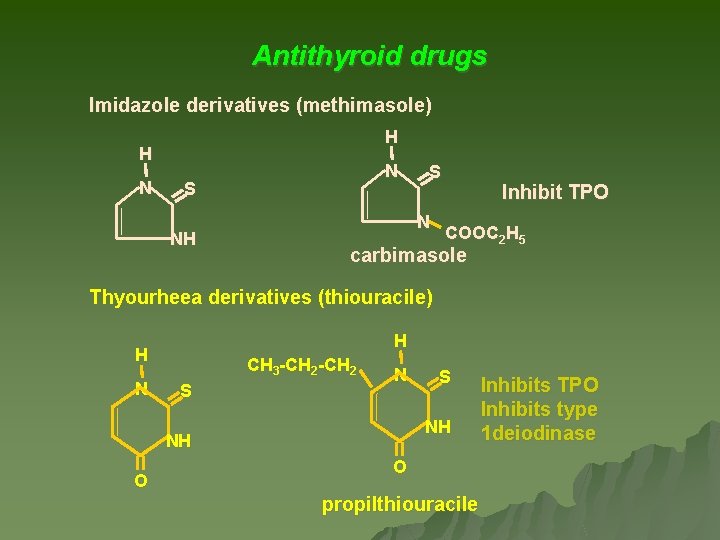
Antithyroid drugs Imidazole derivatives (methimasole) H H N N S NH S N Inhibit TPO COOC 2 H 5 carbimasole Thyourheea derivatives (thiouracile) H H N CH 3 -CH 2 S N NH NH O S O propilthiouracile Inhibits TPO Inhibits type 1 deiodinase
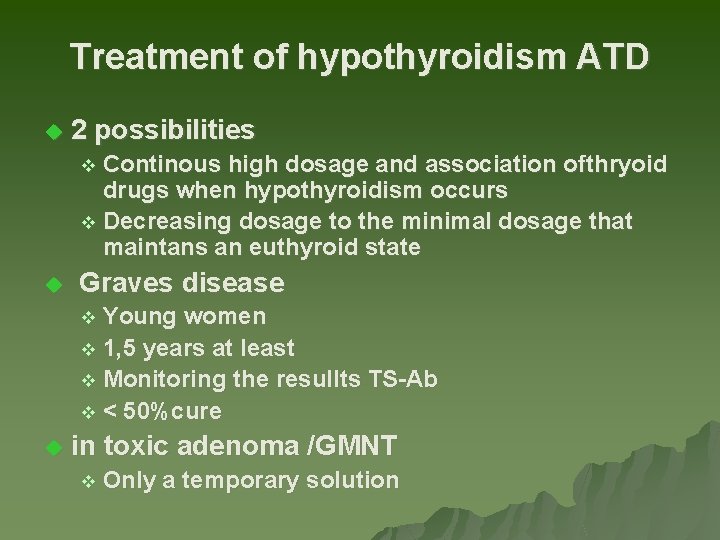
Treatment of hypothyroidism ATD u 2 possibilities v Continous high dosage and association ofthryoid drugs when hypothyroidism occurs v Decreasing dosage to the minimal dosage that maintans an euthyroid state u Graves disease v Young women v 1, 5 years at least v Monitoring the resullts TS-Ab v < 50%cure u in toxic adenoma /GMNT v Only a temporary solution
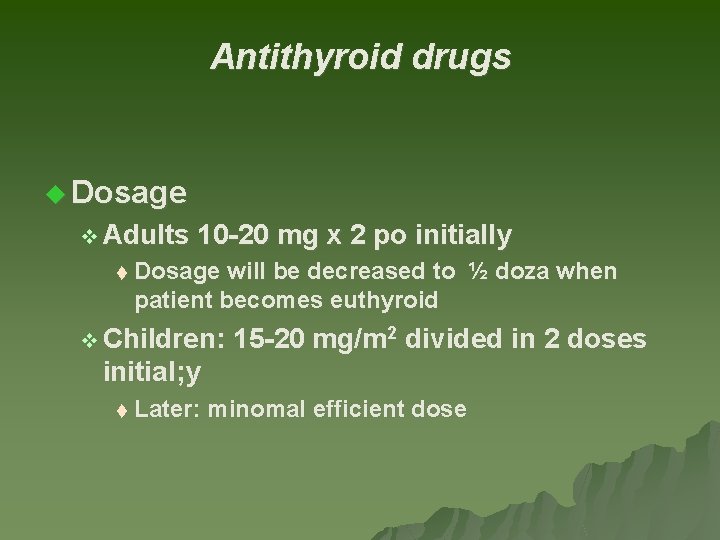
Antithyroid drugs u Dosage v Adults 10 -20 mg x 2 po initially t Dosage will be decreased to ½ doza when patient becomes euthyroid v Children: 15 -20 mg/m 2 divided in 2 doses initial; y t Later: minomal efficient dose
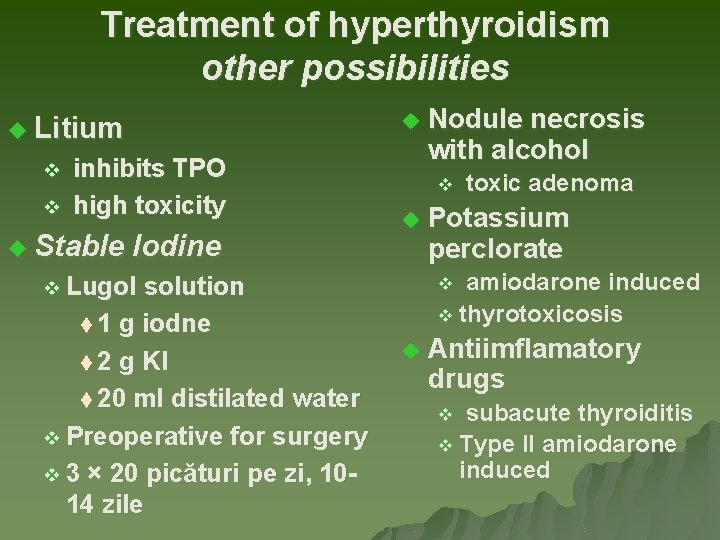
Treatment of hyperthyroidism other possibilities u u Litium v inhibits TPO v high toxicity u Stable Iodine v toxic adenoma u v thyrotoxicosis t 1 g iodne t 20 ml distilated water v Preoperative for surgery v 3 × 20 picături pe zi, 10 - 14 zile Potassium perclorate v amiodarone induced v Lugol solution t 2 g KI Nodule necrosis with alcohol u Antiimflamatory drugs v subacute thyroiditis v Type II amiodarone induced
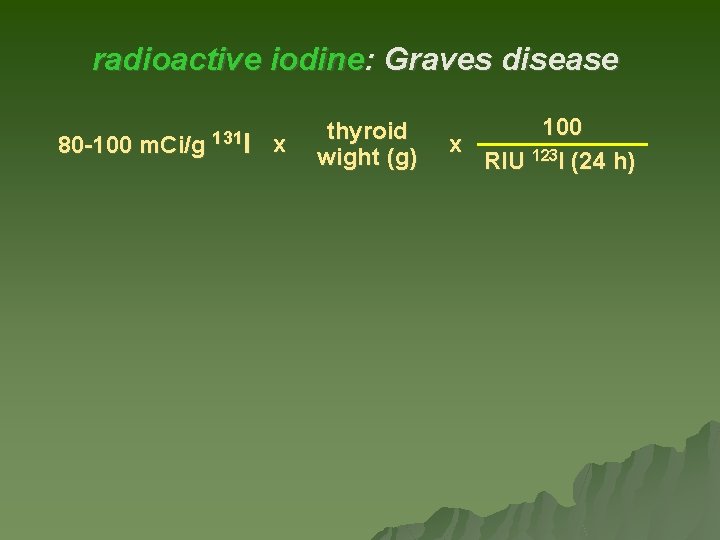
radioactive iodine: Graves disease 80 -100 m. Ci/g 131 I x thyroid wight (g) 100 x RIU 123 I (24 h)
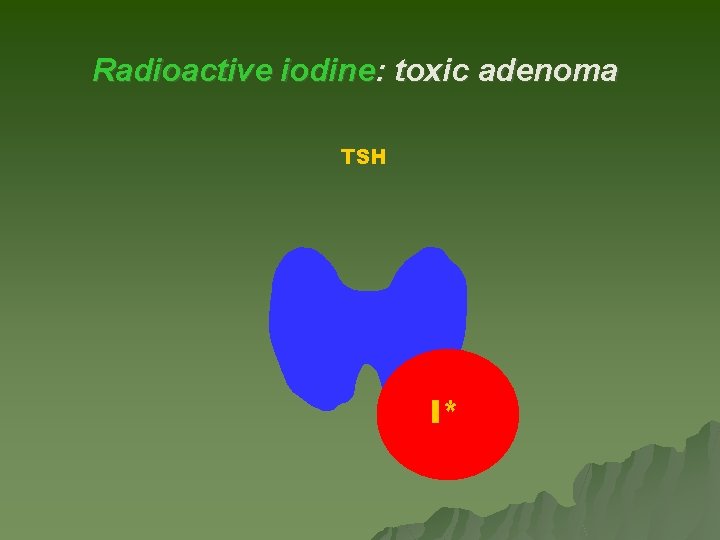
Radioactive iodine: toxic adenoma TSH I* T 4
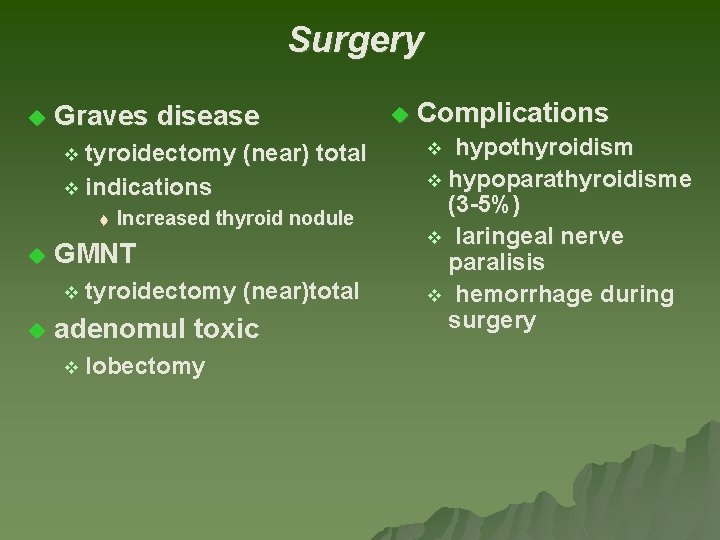
Surgery u Graves disease v tyroidectomy (near) total v indications t u Increased thyroid nodule GMNT v tyroidectomy (near)total u adenomul toxic v lobectomy u Complications v hypothyroidism v hypoparathyroidisme (3 -5%) v laringeal nerve paralisis v hemorrhage during surgery
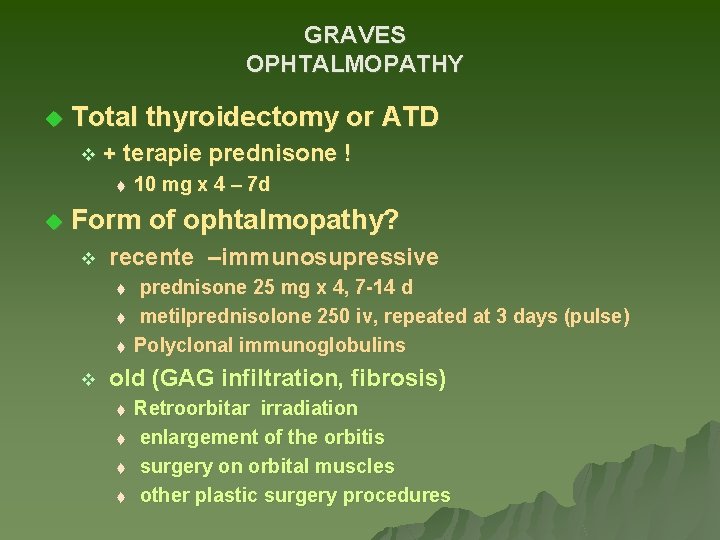
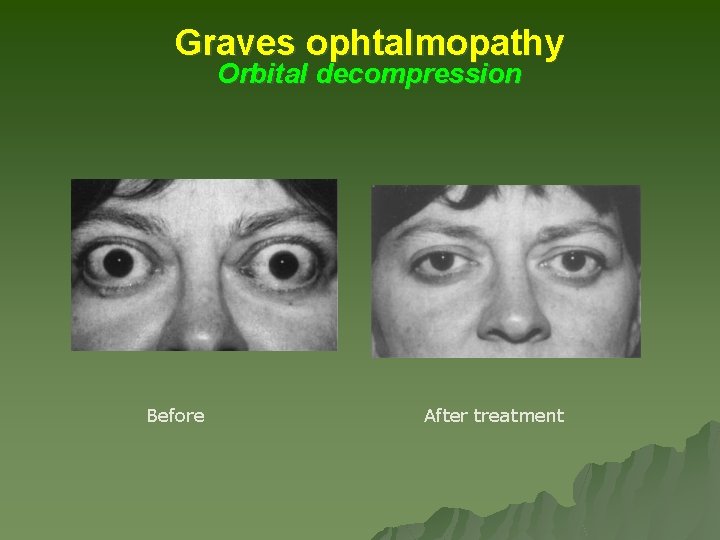
GRAVES OPHTALMOPATHY u Total thyroidectomy or ATD v + terapie prednisone ! t u 10 mg x 4 – 7 d Form of ophtalmopathy? v recente –immunosupressive t t t prednisone 25 mg x 4, 7 -14 d metilprednisolone 250 iv, repeated at 3 days (pulse) Polyclonal immunoglobulins v old (GAG infiltration, fibrosis) t t Retroorbitar irradiation enlargement of the orbitis surgery on orbital muscles other plastic surgery procedures
Tratamentul exoftalmiei basedowiene Decompresie orbitara Inainte Dupa tratament
Graves ophtalmopathy Orbital decompression Before After treatment
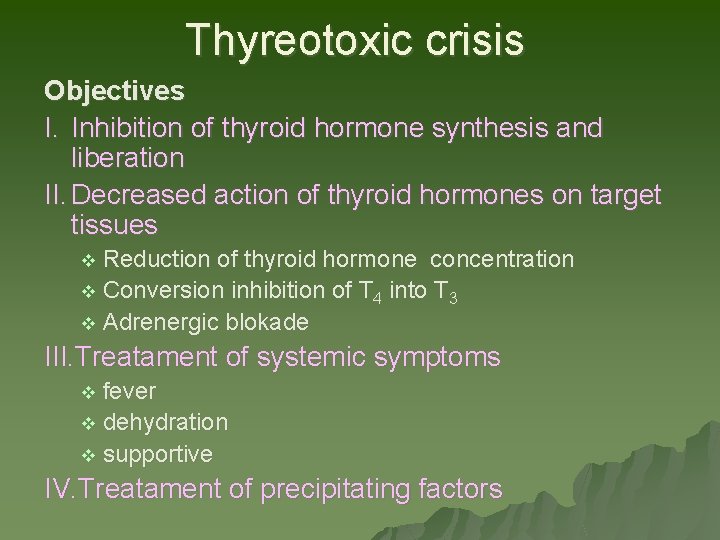
Thyreotoxic crisis Objectives I. Inhibition of thyroid hormone synthesis and liberation II. Decreased action of thyroid hormones on target tissues v Reduction of thyroid hormone concentration v Conversion inhibition of T 4 into T 3 v Adrenergic blokade III. Treatament of systemic symptoms v fever v dehydration v supportive IV. Treatament of precipitating factors
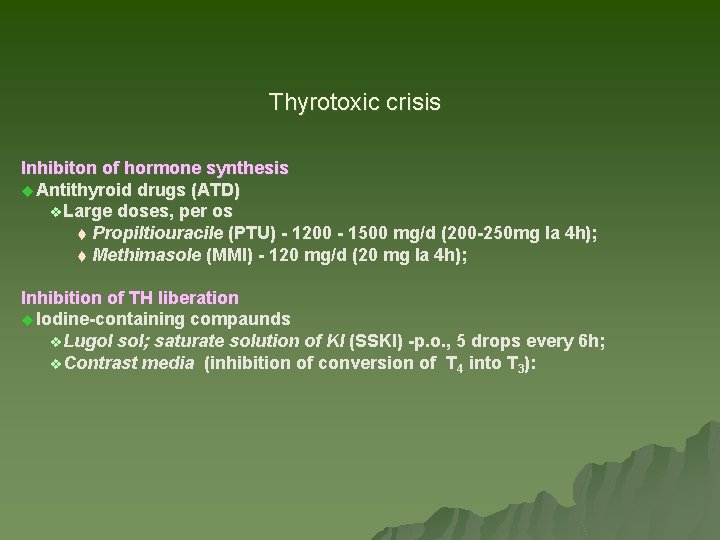
Thyrotoxic crisis Inhibiton of hormone synthesis u Antithyroid drugs (ATD) v Large doses, per os t Propiltiouracile (PTU) - 1200 - 1500 mg/d (200 -250 mg la 4 h); t Methimasole (MMI) - 120 mg/d (20 mg la 4 h); Inhibition of TH liberation u Iodine-containing compaunds v Lugol sol; saturate solution of KI (SSKI) -p. o. , 5 drops every 6 h; v Contrast media (inhibition of conversion of T 4 into T 3):
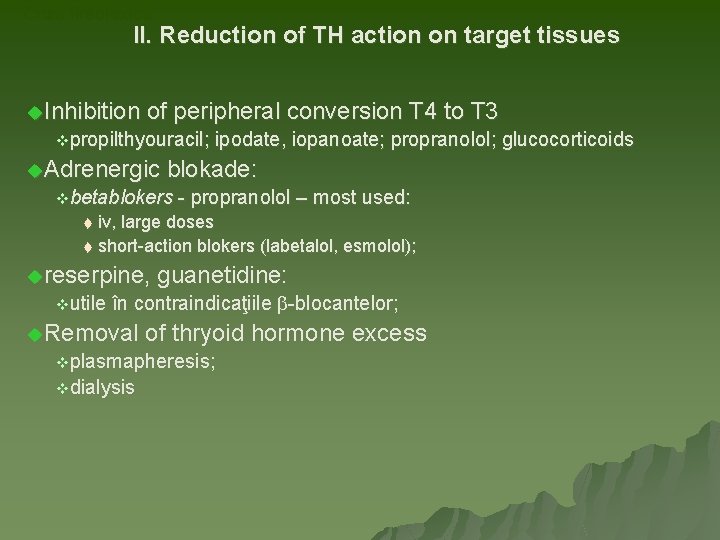
Criza tireotoxica II. Reduction of TH action on target tissues u. Inhibition of peripheral conversion T 4 to T 3 vpropilthyouracil; ipodate, iopanoate; propranolol; glucocorticoids u. Adrenergic blokade: vbetablokers - propranolol – most used: t iv, large doses t short-action blokers (labetalol, esmolol); ureserpine, guanetidine: vutile în contraindicaţiile -blocantelor; u. Removal of thryoid hormone excess vplasmapheresis; vdialysis
Thyrotoxic crisis Treatment od systemic symptoms u fever t. Coated with cold sheets vdrugs tparacetamole u Dihydration u heath failure u glucocorticods IV. Treatment of precipitating factors