
Hypertension in Pregnancy District I ACOG Medical Student

- Slides: 17
Hypertension in Pregnancy District I ACOG Medical Student Education Module 2011
Etiology & Definition n Complicates 10 -20% of pregnancies n Elevation of BP ≥ 140 mm. Hg systolic and/or ≥ 90 mm. Hg diastolic, on two occasions at least 6 hours apart.
Categories Chronic Hypertension n Gestational Hypertension n Preeclampsia superimposed on Chronic Hypertension n
Chronic Hypertension “Preexisting Hypertension” n Definition n Systolic pressure ≥ 140 mm. Hg, diastolic pressure ≥ 90 mm. Hg, or both. n Presents before 20 th week of pregnancy or persists longer then 12 weeks postpartum. n n Causes Primary = “Essential Hypertension” n Secondary = Result of other medical condition (ie: renal disease) n
Prenatal Care for Chronic Hypertensives n n Electrocardiogram should be obtained in women with long-standing hypertension. Baseline laboratory tests n n n Urinalysis, urine culture, and serum creatinine, glucose, and electrolytes Tests will rule out renal disease, and identify comorbidities such as diabetes mellitus. Women with proteinuria on a urine dipstick should have a quantitative test for urine protein.
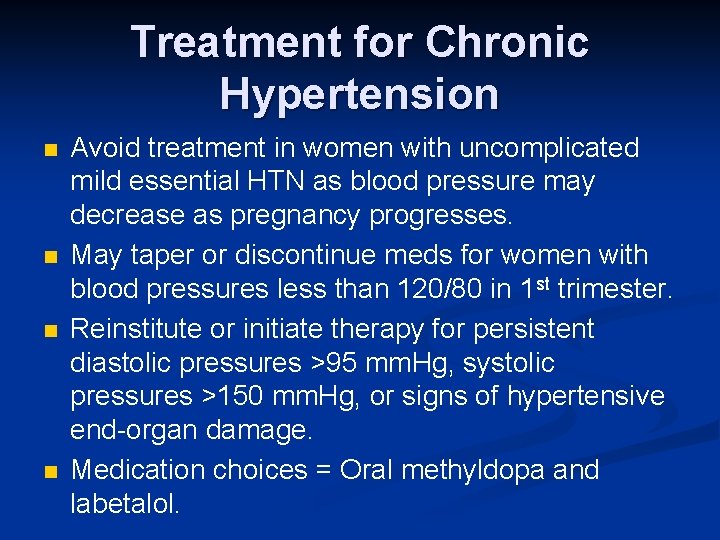
Treatment for Chronic Hypertension n n Avoid treatment in women with uncomplicated mild essential HTN as blood pressure may decrease as pregnancy progresses. May taper or discontinue meds for women with blood pressures less than 120/80 in 1 st trimester. Reinstitute or initiate therapy for persistent diastolic pressures >95 mm. Hg, systolic pressures >150 mm. Hg, or signs of hypertensive end-organ damage. Medication choices = Oral methyldopa and labetalol.
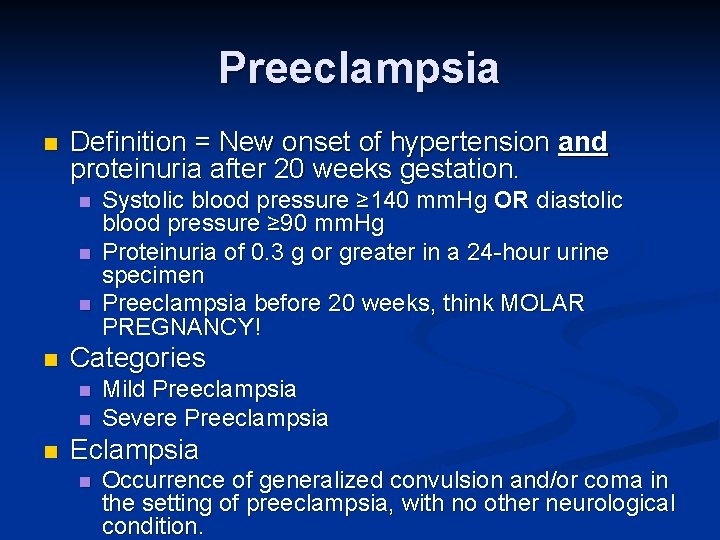
Preeclampsia n Definition = New onset of hypertension and proteinuria after 20 weeks gestation. n n Categories n n n Systolic blood pressure ≥ 140 mm. Hg OR diastolic blood pressure ≥ 90 mm. Hg Proteinuria of 0. 3 g or greater in a 24 -hour urine specimen Preeclampsia before 20 weeks, think MOLAR PREGNANCY! Mild Preeclampsia Severe Preeclampsia Eclampsia n Occurrence of generalized convulsion and/or coma in the setting of preeclampsia, with no other neurological condition.
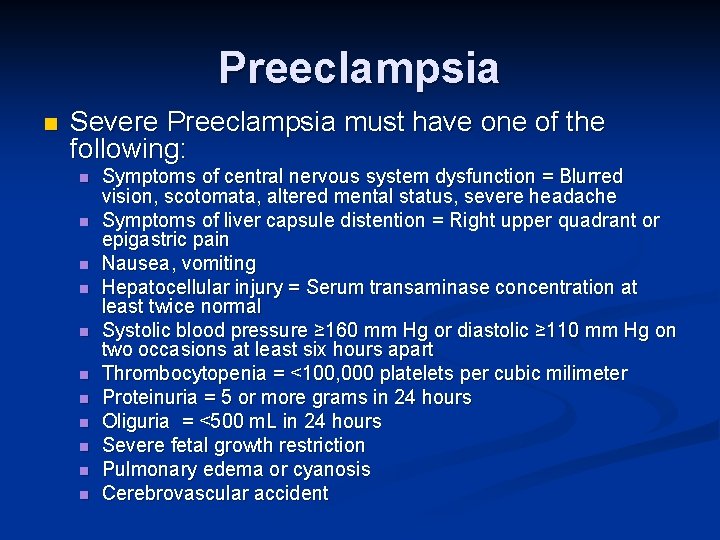
Preeclampsia n Severe Preeclampsia must have one of the following: n n n Symptoms of central nervous system dysfunction = Blurred vision, scotomata, altered mental status, severe headache Symptoms of liver capsule distention = Right upper quadrant or epigastric pain Nausea, vomiting Hepatocellular injury = Serum transaminase concentration at least twice normal Systolic blood pressure ≥ 160 mm Hg or diastolic ≥ 110 mm Hg on two occasions at least six hours apart Thrombocytopenia = <100, 000 platelets per cubic milimeter Proteinuria = 5 or more grams in 24 hours Oliguria = <500 m. L in 24 hours Severe fetal growth restriction Pulmonary edema or cyanosis Cerebrovascular accident
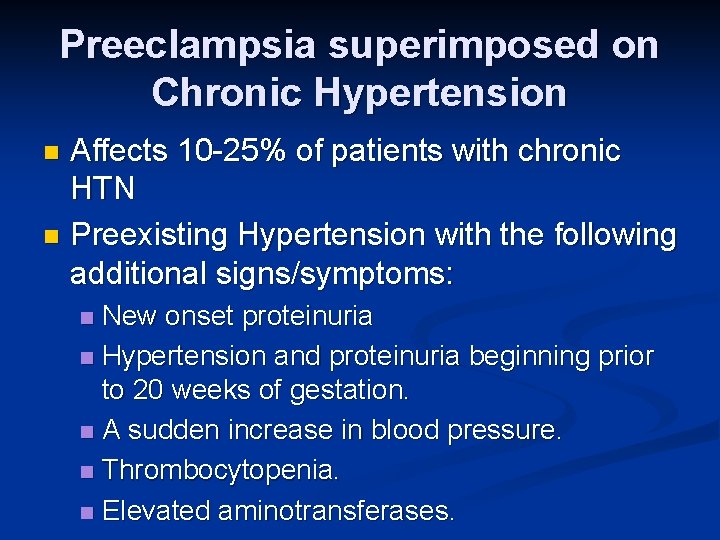
Preeclampsia superimposed on Chronic Hypertension Affects 10 -25% of patients with chronic HTN n Preexisting Hypertension with the following additional signs/symptoms: n New onset proteinuria n Hypertension and proteinuria beginning prior to 20 weeks of gestation. n A sudden increase in blood pressure. n Thrombocytopenia. n Elevated aminotransferases. n
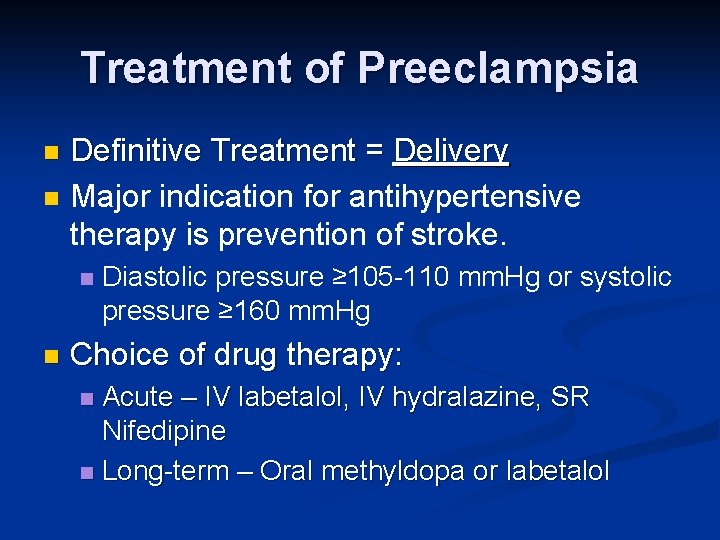
Treatment of Preeclampsia n n Definitive Treatment = Delivery Major indication for antihypertensive therapy is prevention of stroke. n n Diastolic pressure ≥ 105 -110 mm. Hg or systolic pressure ≥ 160 mm. Hg Choice of drug therapy: Acute – IV labetalol, IV hydralazine, SR Nifedipine n Long-term – Oral methyldopa or labetalol n
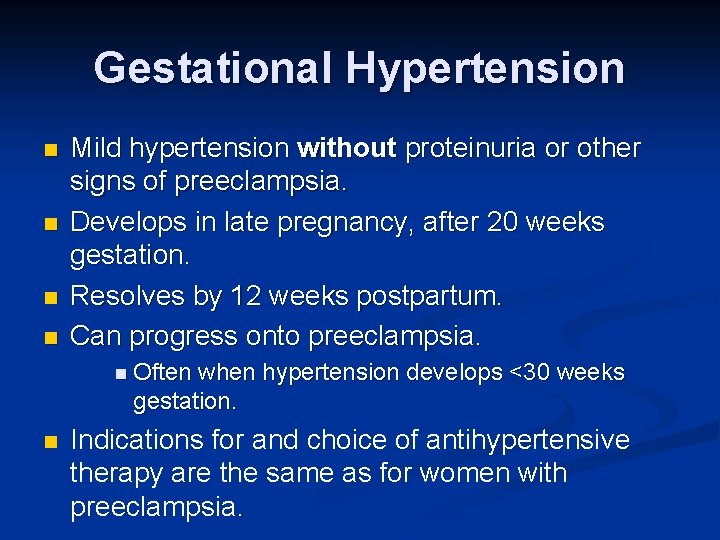
Gestational Hypertension n n Mild hypertension without proteinuria or other signs of preeclampsia. Develops in late pregnancy, after 20 weeks gestation. Resolves by 12 weeks postpartum. Can progress onto preeclampsia. n Often when hypertension develops <30 weeks gestation. n Indications for and choice of antihypertensive therapy are the same as for women with preeclampsia.
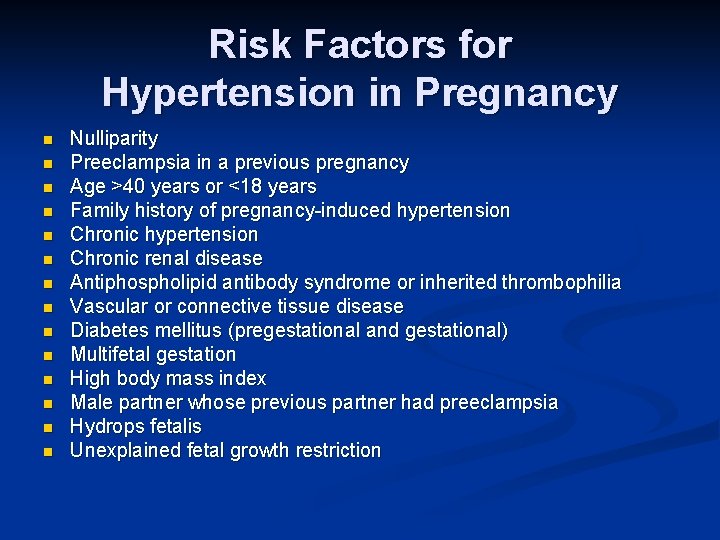
Risk Factors for Hypertension in Pregnancy n n n n Nulliparity Preeclampsia in a previous pregnancy Age >40 years or <18 years Family history of pregnancy-induced hypertension Chronic renal disease Antiphospholipid antibody syndrome or inherited thrombophilia Vascular or connective tissue disease Diabetes mellitus (pregestational and gestational) Multifetal gestation High body mass index Male partner whose previous partner had preeclampsia Hydrops fetalis Unexplained fetal growth restriction
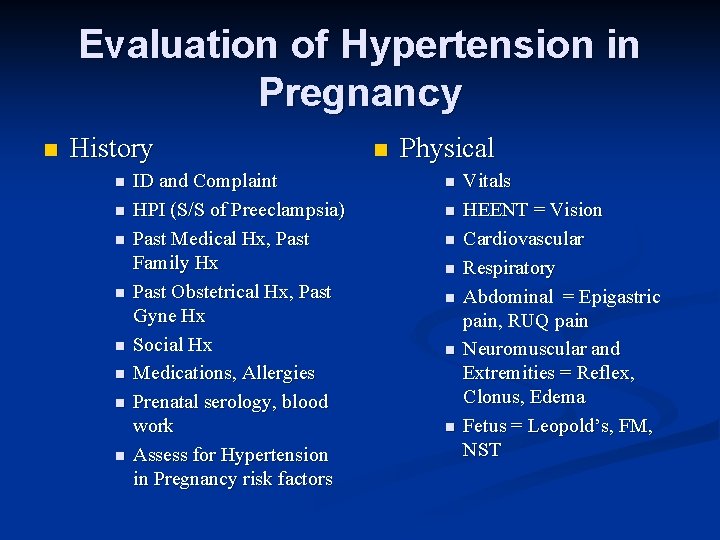
Evaluation of Hypertension in Pregnancy n History n n n n ID and Complaint HPI (S/S of Preeclampsia) Past Medical Hx, Past Family Hx Past Obstetrical Hx, Past Gyne Hx Social Hx Medications, Allergies Prenatal serology, blood work Assess for Hypertension in Pregnancy risk factors n Physical n n n n Vitals HEENT = Vision Cardiovascular Respiratory Abdominal = Epigastric pain, RUQ pain Neuromuscular and Extremities = Reflex, Clonus, Edema Fetus = Leopold’s, FM, NST
Evaluation of Hypertension in Pregnancy n Laboratory Tests n CBC (Hgb, Plts) n Renal Function (Cr, UA, Albumin) n Liver Function (AST, ALP, LD) n Coagulation (PT, PTT, INR, Fibrinogen) n Urine Protein (Dipstick, 24 hour)
Management of Hypertension in Pregnancy n Depends on severity of hypertension and gestational age!!!! n Observational Management n Restricted activity n Close Maternal and Fetal Monitoring n n n BP Monitoring S/S of preeclampsia Fetal growth and well being (NST, and U/S) n Routine weekly or biweekly blood work
Management of Hypertension in Pregnancy n Medical Management n Acute Therapy = IV Labetalol, IV Hydralazine, SR Nifedipine n Expectant Therapy = Oral Labetalol, Methyldopa, Nifedipine n Eclampsia prevention = Mg. SO 4 n Contraindicated antihypertensive drugs n ACE inhibitors n Angiotensin receptor antagonists
Management of Hypertension in Pregnancy n Proceed with Delivery n Vaginal Delivery VS Cesarean Section n Depends on severity of hypertension! n May need to administer antenatal corticosteroids depending on gestation! n Only cure is DELIVERY!!!