
Hypersonics 101 Learning to Fly Beyond Mach 5
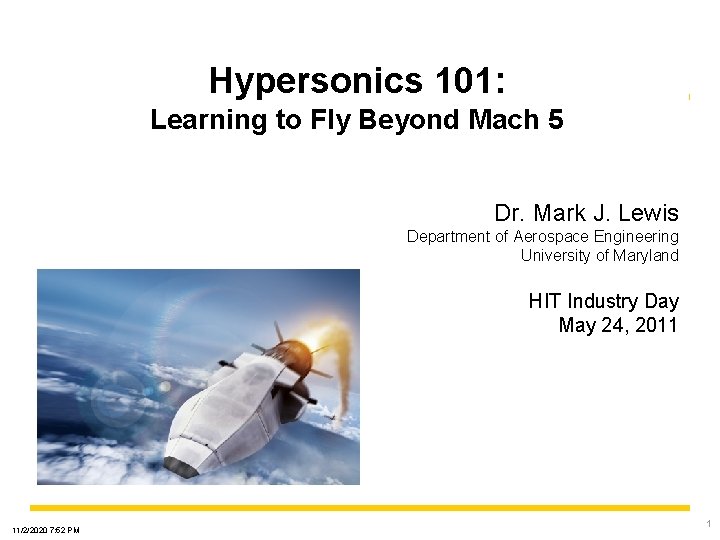
Hypersonics 101: Learning to Fly Beyond Mach 5 Dr. Mark J. Lewis Department of Aerospace Engineering University of Maryland HIT Industry Day May 24, 2011 11/2/2020 7: 52 PM 1

What Is “Hypersonic”? • No fixed definition, but • Usually means flight in excess of Mach 5 (or 6 or 4…) • Shock waves pressed close to surface • Heating rates significant, especially at edges, transition • Chemistry may be important (inside and outside) • In modern use, typically powered by airbreathing engines, but could be rocket powered or gliding. Airbreathing at Mach 5+ is hard! 11/2/2020 7: 52 PM 2

Future Hypersonic Vehicles • Weapons -Blunt-body reentry -High-lift (maneuvering) reentry -Cruise missiles -LRS missiles • Aircraft -Recce/strike -Transatmospheric -Airbreathing global cruise • Access-to-Space Two-stage-to-orbit hybrid airbreathing Two-stage-to-orbit fully airbreathing Single-Stage-to-Orbit (NASP) 11/2/2020 7: 52 PM 3
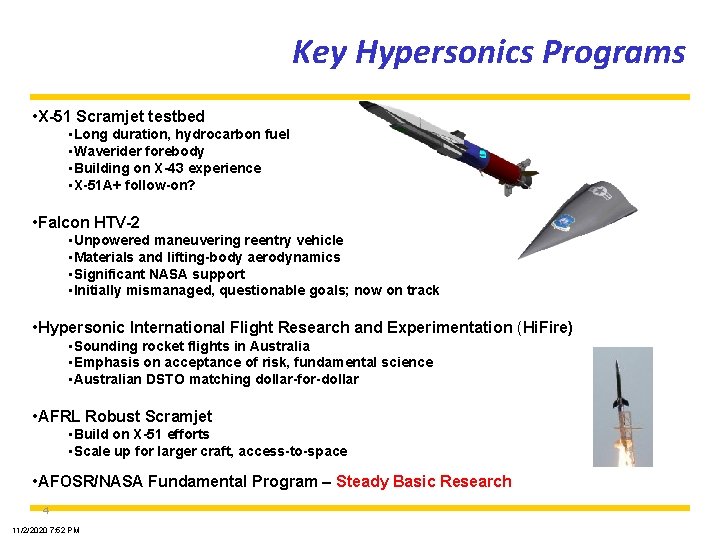
Key Hypersonics Programs • X-51 Scramjet testbed • Long duration, hydrocarbon fuel • Waverider forebody • Building on X-43 experience • X-51 A+ follow-on? • Falcon HTV-2 • Unpowered maneuvering reentry vehicle • Materials and lifting-body aerodynamics • Significant NASA support • Initially mismanaged, questionable goals; now on track • Hypersonic International Flight Research and Experimentation (Hi. Fire) • Sounding rocket flights in Australia • Emphasis on acceptance of risk, fundamental science • Australian DSTO matching dollar-for-dollar • AFRL Robust Scramjet • Build on X-51 efforts • Scale up for larger craft, access-to-space • AFOSR/NASA Fundamental Program – Steady Basic Research 4 11/2/2020 7: 52 PM
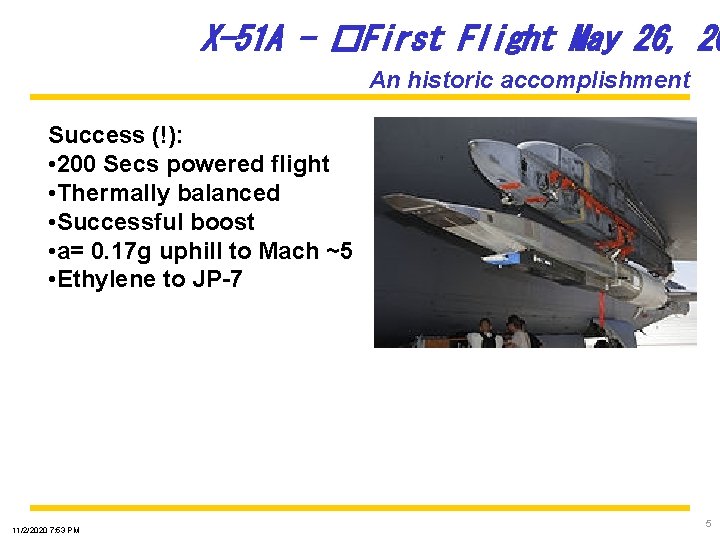
X-51 A - �First Flight May 26, 20 An historic accomplishment Success (!): • 200 Secs powered flight • Thermally balanced • Successful boost • a= 0. 17 g uphill to Mach ~5 • Ethylene to JP-7 11/2/2020 7: 53 PM 5

X-51 A - �Second Flight Status Cause of Flight 1 anomalies identified (maybe…) • Seal reinforced • Fuel schedule logic changed Scheduled for June, 2011 • Delayed by weather • Attempted flight aborted • Failure on B-52 Cause for concern? • 70% new personnel including flight crew • New (very old) airplane 11/2/2020 7: 53 PM 6
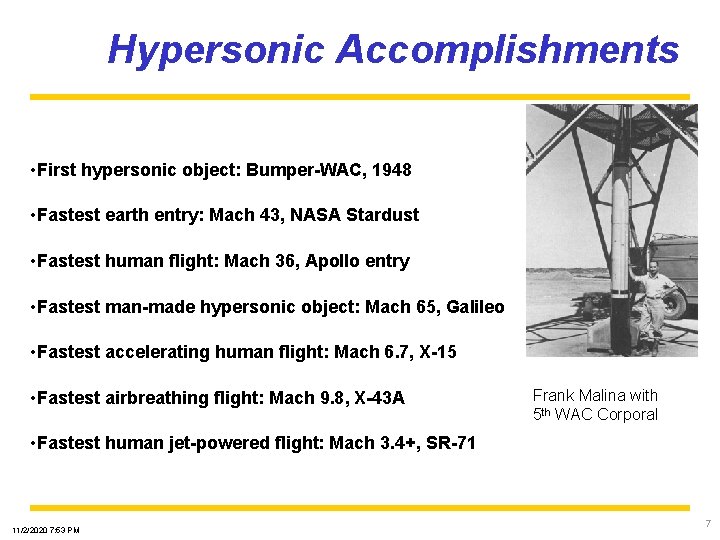
Hypersonic Accomplishments • First hypersonic object: Bumper-WAC, 1948 • Fastest earth entry: Mach 43, NASA Stardust • Fastest human flight: Mach 36, Apollo entry • Fastest man-made hypersonic object: Mach 65, Galileo • Fastest accelerating human flight: Mach 6. 7, X-15 • Fastest airbreathing flight: Mach 9. 8, X-43 A Frank Malina with 5 th WAC Corporal • Fastest human jet-powered flight: Mach 3. 4+, SR-71 11/2/2020 7: 53 PM 7
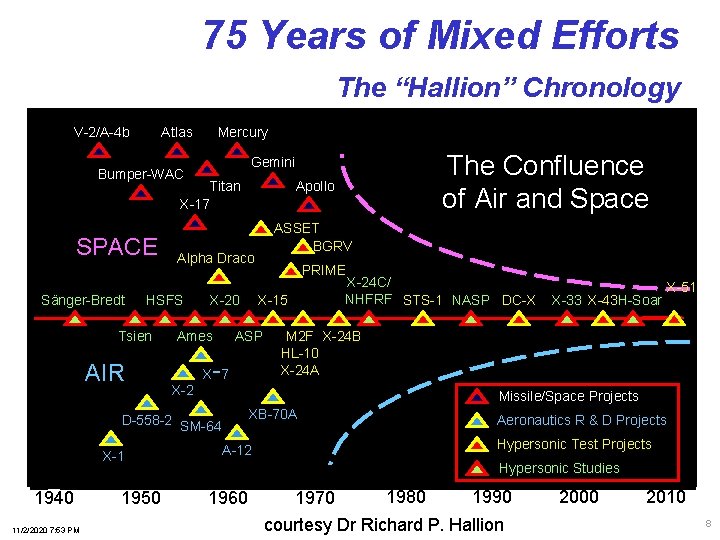
75 Years of Mixed Efforts The “Hallion” Chronology V-2/A-4 b Atlas Mercury Titan X-17 SPACE Sänger-Bredt Tsien AIR X-20 Ames 1940 11/2/2020 7: 53 PM 1950 ASSET BGRV X-15 - X 7 X-2 PRIME ASP X-24 C/ NHFRF STS-1 NASP DC-X X-33 X-43 H-Soar X-51 M 2 F X-24 B HL-10 X-24 A Missile/Space Projects XB-70 A D-558 -2 SM-64 X-1 Apollo Alpha Draco HSFS The Confluence of Air and Space Gemini Bumper-WAC A-12 Aeronautics R & D Projects Hypersonic Test Projects Hypersonic Studies 1960 1990 1980 1970 courtesy Dr Richard P. Hallion 2000 2010 8
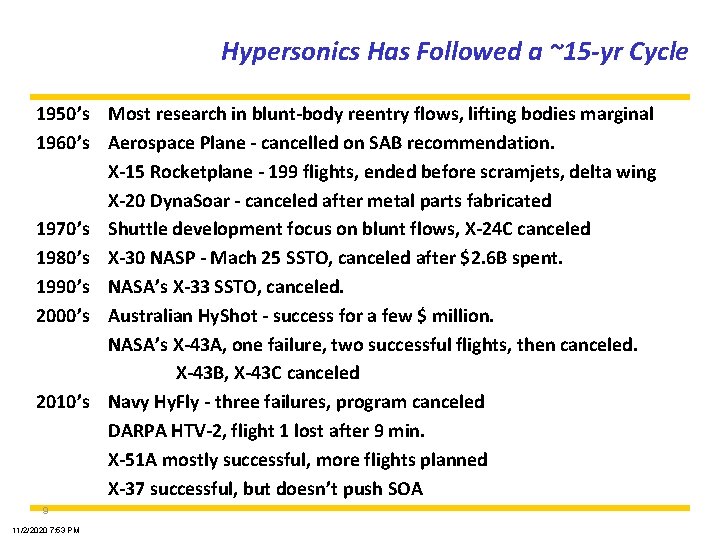
Hypersonics Has Followed a ~15 -yr Cycle 1950’s Most research in blunt-body reentry flows, lifting bodies marginal 1960’s Aerospace Plane - cancelled on SAB recommendation. X-15 Rocketplane - 199 flights, ended before scramjets, delta wing X-20 Dyna. Soar - canceled after metal parts fabricated 1970’s Shuttle development focus on blunt flows, X-24 C canceled 1980’s X-30 NASP - Mach 25 SSTO, canceled after $2. 6 B spent. 1990’s NASA’s X-33 SSTO, canceled. 2000’s Australian Hy. Shot - success for a few $ million. NASA’s X-43 A, one failure, two successful flights, then canceled. X-43 B, X-43 C canceled 2010’s Navy Hy. Fly - three failures, program canceled DARPA HTV-2, flight 1 lost after 9 min. X-51 A mostly successful, more flights planned X-37 successful, but doesn’t push SOA 9 11/2/2020 7: 53 PM
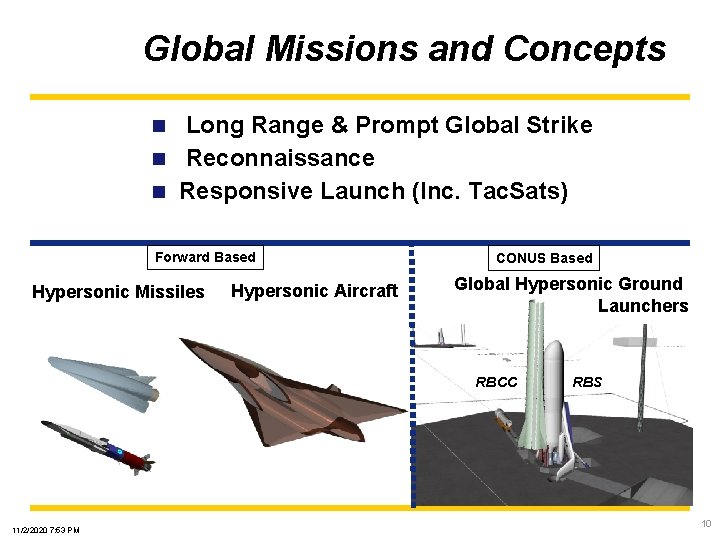
Global Missions and Concepts Long Range & Prompt Global Strike n Reconnaissance n Responsive Launch (Inc. Tac. Sats) n Forward Based Hypersonic Missiles Hypersonic Aircraft CONUS Based Global Hypersonic Ground Launchers RBCC 11/2/2020 7: 53 PM RBS 10
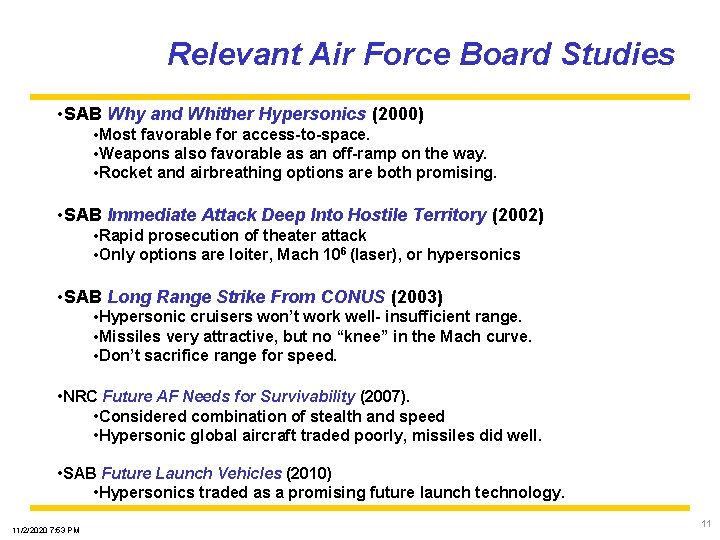
Relevant Air Force Board Studies • SAB Why and Whither Hypersonics (2000) • Most favorable for access-to-space. • Weapons also favorable as an off-ramp on the way. • Rocket and airbreathing options are both promising. • SAB Immediate Attack Deep Into Hostile Territory (2002) • Rapid prosecution of theater attack • Only options are loiter, Mach 106 (laser), or hypersonics • SAB Long Range Strike From CONUS (2003) • Hypersonic cruisers won’t work well- insufficient range. • Missiles very attractive, but no “knee” in the Mach curve. • Don’t sacrifice range for speed. • NRC Future AF Needs for Survivability (2007). • Considered combination of stealth and speed • Hypersonic global aircraft traded poorly, missiles did well. • SAB Future Launch Vehicles (2010) • Hypersonics traded as a promising future launch technology. 11/2/2020 7: 53 PM 11
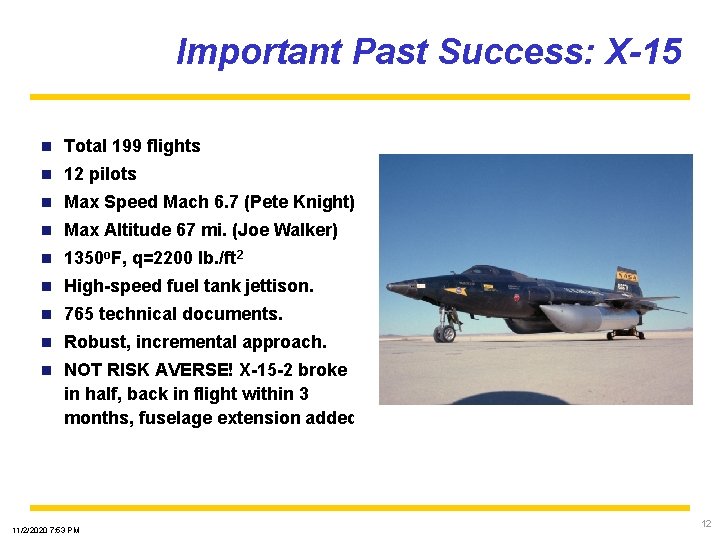
Important Past Success: X-15 n Total 199 flights n 12 pilots n Max Speed Mach 6. 7 (Pete Knight) n Max Altitude 67 mi. (Joe Walker) n 1350 o. F, q=2200 lb. /ft 2 n High-speed fuel tank jettison. n 765 technical documents. n Robust, incremental approach. n NOT RISK AVERSE! X-15 -2 broke in half, back in flight within 3 months, fuselage extension added. 11/2/2020 7: 53 PM 12

Some Significant Failures X-30 National Aerospace Plane (NASP) 1986 -1990 Intended as SSTO, canceled after $2 B spent. 11/2/2020 7: 53 PM 13
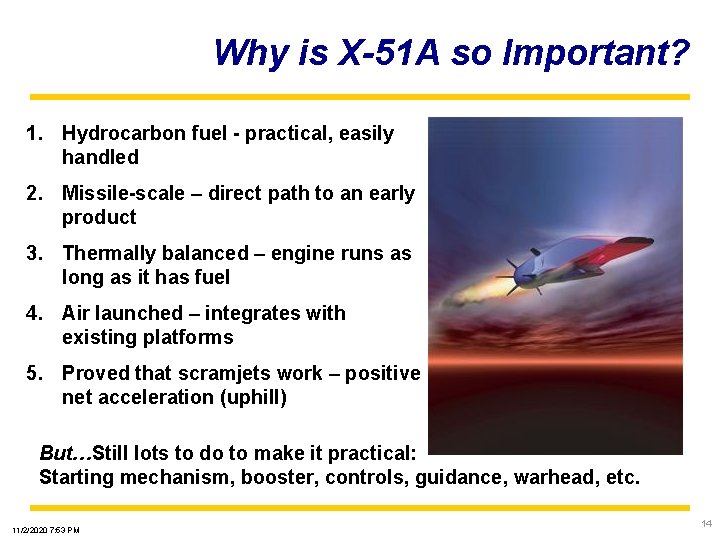
Why is X-51 A so Important? 1. Hydrocarbon fuel - practical, easily handled 2. Missile-scale – direct path to an early product 3. Thermally balanced – engine runs as long as it has fuel 4. Air launched – integrates with existing platforms 5. Proved that scramjets work – positive net acceleration (uphill) But…Still lots to do to make it practical: Starting mechanism, booster, controls, guidance, warhead, etc. 11/2/2020 7: 53 PM 14
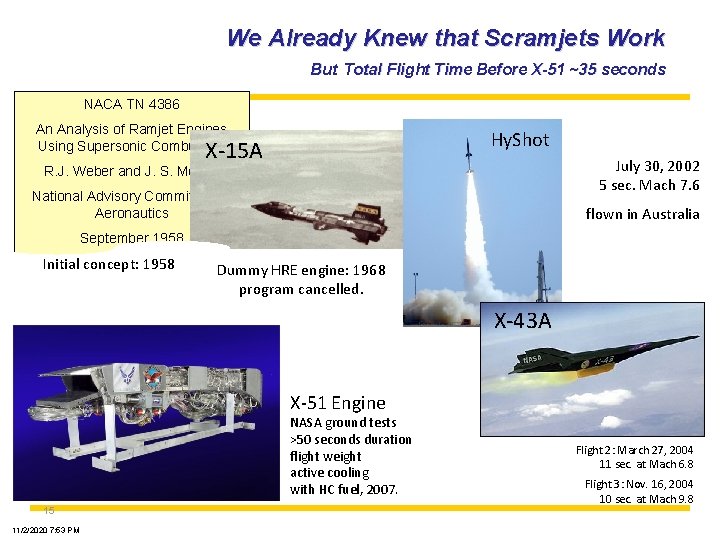
We Already Knew that Scramjets Work But Total Flight Time Before X-51 ~35 seconds NACA TN 4386 An Analysis of Ramjet Engines Using Supersonic Combustion Hy. Shot X-15 A July 30, 2002 5 sec. Mach 7. 6 R. J. Weber and J. S. Mc. Kay National Advisory Committee on Aeronautics flown in Australia September 1958 Initial concept: 1958 Dummy HRE engine: 1968 program cancelled. X-43 A X-51 Engine NASA ground tests >50 seconds duration flight weight active cooling with HC fuel, 2007. 15 11/2/2020 7: 53 PM Flight 2: March 27, 2004 11 sec. at Mach 6. 8 Flight 3: Nov. 16, 2004 10 sec. at Mach 9. 8
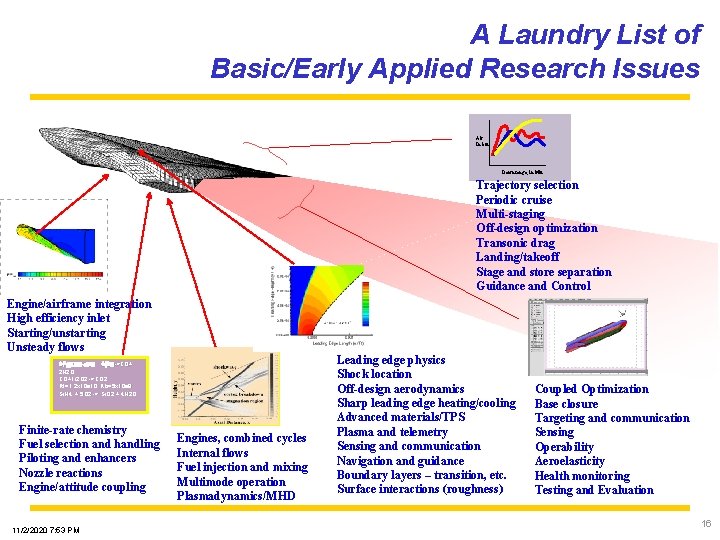
A Laundry List of Basic/Early Applied Research Issues Alt. In km Downrange, in Mm Trajectory selection Periodic cruise Multi-staging Off-design optimization Transonic drag Landing/takeoff Stage and store separation Guidance and Control Engine/airframe integration High efficiency inlet Starting/unstarting Unsteady flows CH 4+3/2 CO 2 ->CO+ 2 H 2 O CO+1/2 O 2 ->CO 2 Kf=1. 2 x 10 e 10 Kb=5 x 10 e 8 Si. H 4 + 5 O 2 -> Si. O 2 + 4 H 2 O Finite-rate chemistry Fuel selection and handling Piloting and enhancers Nozzle reactions Engine/attitude coupling 11/2/2020 7: 53 PM Engines, combined cycles Internal flows Fuel injection and mixing Multimode operation Plasmadynamics/MHD Leading edge physics Shock location Off-design aerodynamics Sharp leading edge heating/cooling Advanced materials/TPS Plasma and telemetry Sensing and communication Navigation and guidance Boundary layers – transition, etc. Surface interactions (roughness) Coupled Optimization Base closure Targeting and communication Sensing Operability Aeroelasticity Health monitoring Testing and Evaluation 16
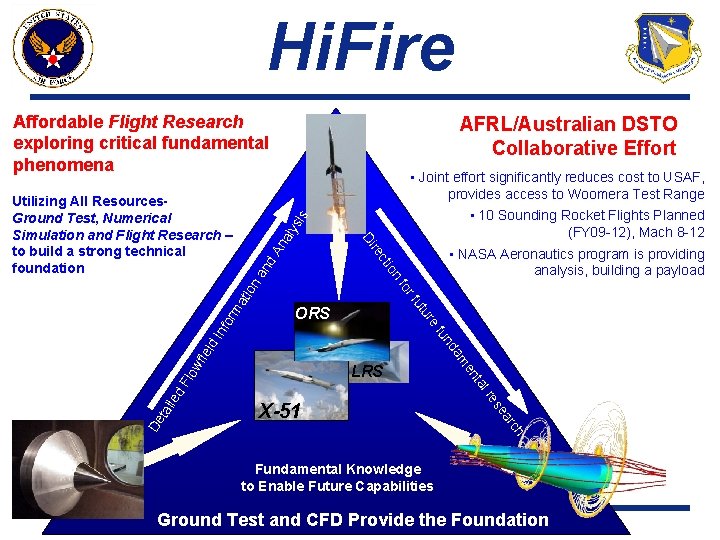
Hi. Fire Affordable Flight Research exploring critical fundamental phenomena is An a lys ut nd rf ati on a • Joint effort significantly reduces cost to USAF, provides access to Woomera Test Range • 10 Sounding Rocket Flights Planned (FY 09 -12), Mach 8 -12 • NASA Aeronautics program is providing analysis, building a payload fo ORS e ur rm n iel Flo wf ed tai l De ch ar se re X-51 l ta en LRS am nd fu d. I nfo o cti re Di Utilizing All Resources. Ground Test, Numerical Simulation and Flight Research – to build a strong technical foundation AFRL/Australian DSTO Collaborative Effort Fundamental Knowledge to Enable Future Capabilities Ground Test and CFD Provide the Foundation Integrity - Service - Excellence
Highlighted Basic Fluids Issues • Hypersonic boundary layers • Transition at high speeds poorly understood • Surface coupling including roughness effects • Thinning and three-dimensional effects • Influence on freestream – compound flow phenomena • Leading edge physics • Shocks on sharp geometries – analysis is lacking • Rarefied effects – challenging computational solutions • Strong interactions – especially at small scale • Unsteady flow • Shocks at high-speed – steady or unsteady, and why? • Shock interactions – extreme heating rates possible • Internal flows – especially important for scramjet mixing. • Why did X-51 unstart? And why did it re-start? ? 11/2/2020 7: 53 PM 18
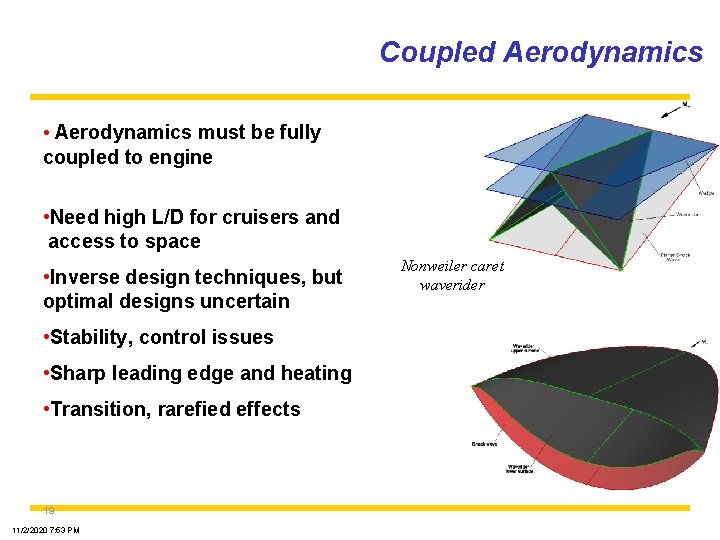
Coupled Aerodynamics • Aerodynamics must be fully coupled to engine • Need high L/D for cruisers and access to space • Inverse design techniques, but optimal designs uncertain • Stability, control issues • Sharp leading edge and heating • Transition, rarefied effects 19 11/2/2020 7: 53 PM Nonweiler caret waverider

Best Engine Cycle Scramjets Turbines Complex integration • • Ram/Scramjet operation from Mach 2+ to Mach 6 Mach 4 turbine for acceleration to Ram/Scramjet takeover / overlap? Inlet / exhaust flowpath integration and hypersonic engine operability? Role of rockets? Rocket-Based or Turbine-Based? Which to Do? 20 11/2/2020 7: 53 PM
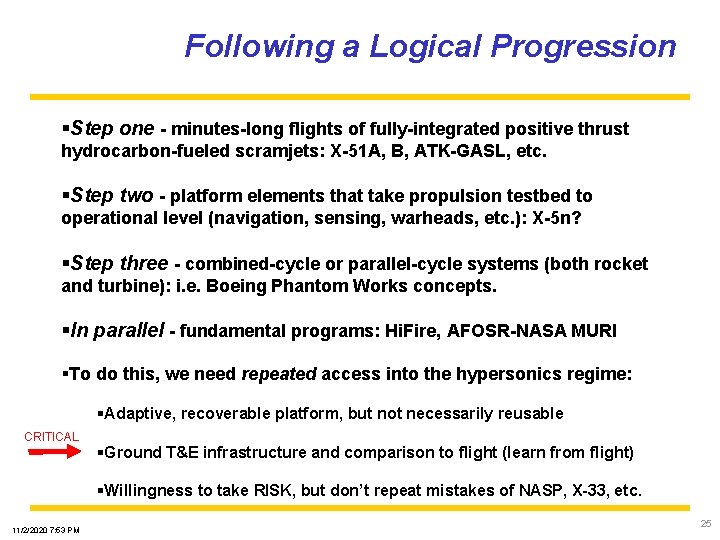
Answering Our Questions §Step one - minutes-long flights of fully-integrated positive thrust hydrocarbon-fueled scramjets: X-51 A, B, ATK-GASL, etc. §Step two - platform elements that take propulsion testbed to operational level (navigation, sensing, warheads, etc. ): X-5 n? §Step three - combined-cycle or parallel-cycle systems (both rocket and turbine): i. e. Boeing Phantom Works concepts. §In parallel - fundamental programs: Hi. Fire, AFOSR-NASA MURI §To do this, we need repeated access into the hypersonics regime: §Adaptive, recoverable platform, but not necessarily reusable §Ground T&E infrastructure and comparison to flight (learn from flight) §Willingness to take RISK, but don’t repeat mistakes of NASP, X-33, etc. 11/2/2020 7: 53 PM 21
Following a Logical Progression §Step one - minutes-long flights of fully-integrated positive thrust hydrocarbon-fueled scramjets: X-51 A, B, ATK-GASL, etc. §Step two - platform elements that take propulsion testbed to operational level (navigation, sensing, warheads, etc. ): X-5 n? §Step three - combined-cycle or parallel-cycle systems (both rocket and turbine): i. e. Boeing Phantom Works concepts. §In parallel - fundamental programs: Hi. Fire, AFOSR-NASA MURI §To do this, we need repeated access into the hypersonics regime: §Adaptive, recoverable platform, but not necessarily reusable §Ground T&E infrastructure and comparison to flight (learn from flight) §Willingness to take RISK, but don’t repeat mistakes of NASP, X-33, etc. 11/2/2020 7: 53 PM 22
Following a Logical Progression §Step one - minutes-long flights of fully-integrated positive thrust hydrocarbon-fueled scramjets: X-51 A, B, ATK-GASL, etc. §Step two - platform elements that take propulsion testbed to operational level (navigation, sensing, warheads, etc. ): X-5 n? §Step three - combined-cycle or parallel-cycle systems (both rocket and turbine): i. e. Boeing Phantom Works concepts. §In parallel - fundamental programs: Hi. Fire, AFOSR-NASA MURI §To do this, we need repeated access into the hypersonics regime: §Adaptive, recoverable platform, but not necessarily reusable §Ground T&E infrastructure and comparison to flight (learn from flight) §Willingness to take RISK, but don’t repeat mistakes of NASP, X-33, etc. 11/2/2020 7: 53 PM 23
Following a Logical Progression §Step one - minutes-long flights of fully-integrated positive thrust hydrocarbon-fueled scramjets: X-51 A, B, ATK-GASL, etc. §Step two - platform elements that take propulsion testbed to operational level (navigation, sensing, warheads, etc. ): X-5 n? §Step three - combined-cycle or parallel-cycle systems (both rocket and turbine): i. e. Boeing Phantom Works concepts. §In parallel - fundamental programs: Hi. Fire, AFOSR-NASA MURI §To do this, we need repeated access into the hypersonics regime: §Adaptive, recoverable platform, but not necessarily reusable §Ground T&E infrastructure and comparison to flight (learn from flight) §Willingness to take RISK, but don’t repeat mistakes of NASP, X-33, etc. 11/2/2020 7: 53 PM 24
Following a Logical Progression §Step one - minutes-long flights of fully-integrated positive thrust hydrocarbon-fueled scramjets: X-51 A, B, ATK-GASL, etc. §Step two - platform elements that take propulsion testbed to operational level (navigation, sensing, warheads, etc. ): X-5 n? §Step three - combined-cycle or parallel-cycle systems (both rocket and turbine): i. e. Boeing Phantom Works concepts. §In parallel - fundamental programs: Hi. Fire, AFOSR-NASA MURI §To do this, we need repeated access into the hypersonics regime: §Adaptive, recoverable platform, but not necessarily reusable CRITICAL §Ground T&E infrastructure and comparison to flight (learn from flight) §Willingness to take RISK, but don’t repeat mistakes of NASP, X-33, etc. 11/2/2020 7: 53 PM 25
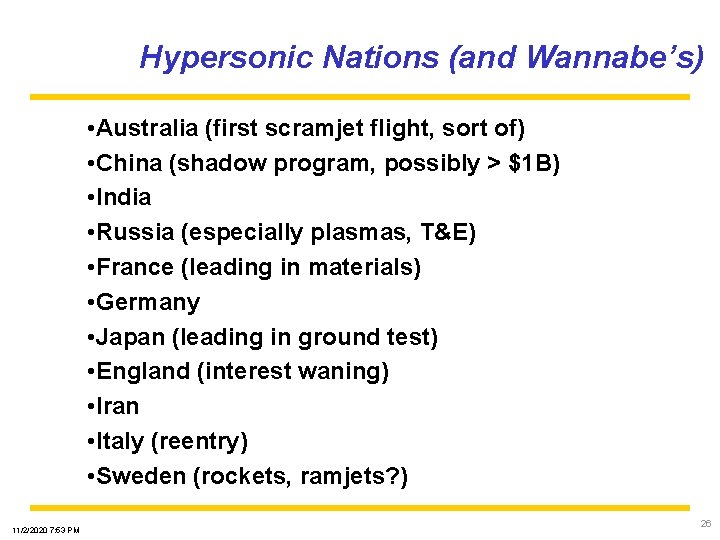
Hypersonic Nations (and Wannabe’s) • Australia (first scramjet flight, sort of) • China (shadow program, possibly > $1 B) • India • Russia (especially plasmas, T&E) • France (leading in materials) • Germany • Japan (leading in ground test) • England (interest waning) • Iran • Italy (reentry) • Sweden (rockets, ramjets? ) 11/2/2020 7: 53 PM 26
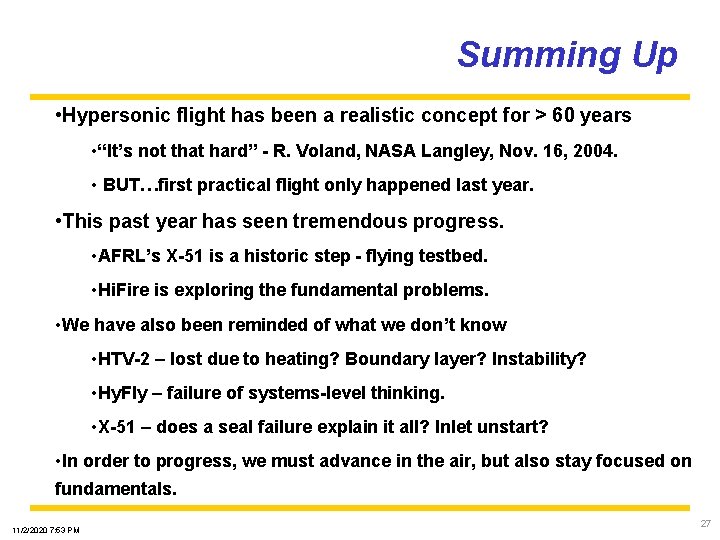
Summing Up • Hypersonic flight has been a realistic concept for > 60 years • “It’s not that hard” - R. Voland, NASA Langley, Nov. 16, 2004. • BUT…first practical flight only happened last year. • This past year has seen tremendous progress. • AFRL’s X-51 is a historic step - flying testbed. • Hi. Fire is exploring the fundamental problems. • We have also been reminded of what we don’t know • HTV-2 – lost due to heating? Boundary layer? Instability? • Hy. Fly – failure of systems-level thinking. • X-51 – does a seal failure explain it all? Inlet unstart? • In order to progress, we must advance in the air, but also stay focused on fundamentals. 11/2/2020 7: 53 PM 27
![“Speed is imperative for effective action [and] safety against enemy counter-measures. ” Theodore von](http://slidetodoc.com/presentation_image/43c70225a36a5f022d5df2af2a2e0e48/image-28.jpg "“Speed is imperative for effective action [and] safety against enemy counter-measures. ” Theodore von")
“Speed is imperative for effective action [and] safety against enemy counter-measures. ” Theodore von Kármán, Science: Key to Air Supremacy, 1946. “If the Air Force is to execute faster than an enemy in the 21 st century. . . the only alternative is to go faster. ” SAB, New World Vistas, 1995. “Speed is THE critical issue” UK Air Chief Marshall Sir Jock Stirrup, RUSI 2005 11/2/2020 7: 53 PM 28

QUESTIONS? 11/2/2020 7: 53 PM 29
- Slides: 29