
HYPERSAFE A LIGHTWEIGHT APPROACH TO PROVIDE LIFETIME HYPERVISOR



- Slides: 20
HYPERSAFE: A LIGHTWEIGHT APPROACH TO PROVIDE LIFETIME HYPERVISOR CONTROL-FLOW INTEGRITY Self Protection for the Hypervisor
INTRODUCTION Paper: Hyper. Safe: A Lightweight Approach to Provide Lifetime Hypervisor Control-Flow Integrity Authors: Zhi Wang and Xuxian Jiang Department of Computer Science, North Carolina State University Presented at: 31 st IEEE Symposium on Security & Privacy, Oakland, CA USA, May 2010
INTRODUCTION Figures in presentation credited to original paper and presentation Presentation by Jon Rhoades – Digital Forensics Program – UCF Questions during presentation are welcome
FOR CONTEXT WHAT IS IT? Present Hyper. Safe A framework capability to protect Virtualization Hypervisors from security threats Primary Two Techniques � Non-bypassable memory lockdown � Restricted pointer indexing The framework has been used for a prototype system for Bit. Visor and Xen
HYPERVISOR Virtual Machine Manager Controls when and how the Virtual Machines start and stop Access to VM settings Allocates and manages resources for the Virtual Machines � Established � Running Examples of Hypervisors � Xen, VMware ESX
WHAT ARE THREATS VMs vulnerable if Hypervisor is hacked Xen 2007 -9 26 security vulnerabilities identified* VMware ESX 2007 -9 18 security vulnerabilities identified* Code base for Hypervisors growing � Xen 230 K lines of code Hypervisor runs at lowest level of software stack * Source: National Vulnerability Database
WHY PROTECT THE HYPERVISOR Rapid growth in adoption of Virtual Machines � 16% of server workload in 2010 � 50% by 2012 (estimated) VM escape attacks � Break out of a VM and access Hyper. Visor Hypervisor based rootkits If you get control of Hypervisor you have control of the VMs � Console access � Physical access
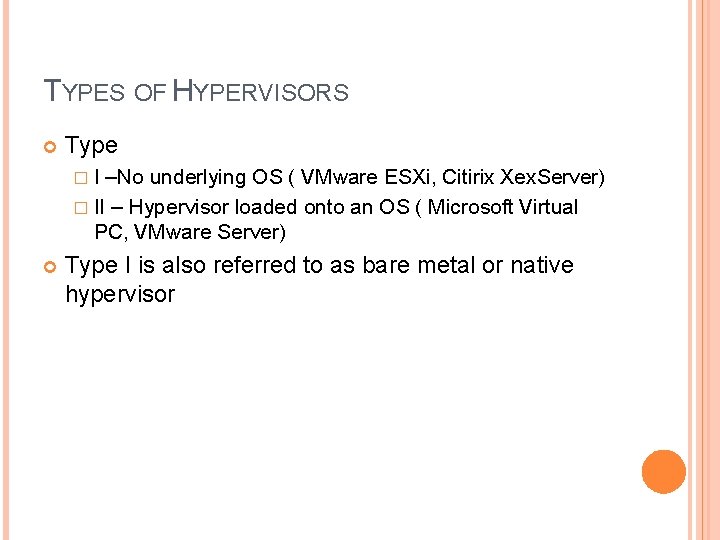
TYPES OF HYPERVISORS Type �I –No underlying OS ( VMware ESXi, Citirix Xex. Server) � II – Hypervisor loaded onto an OS ( Microsoft Virtual PC, VMware Server) Type I is also referred to as bare metal or native hypervisor
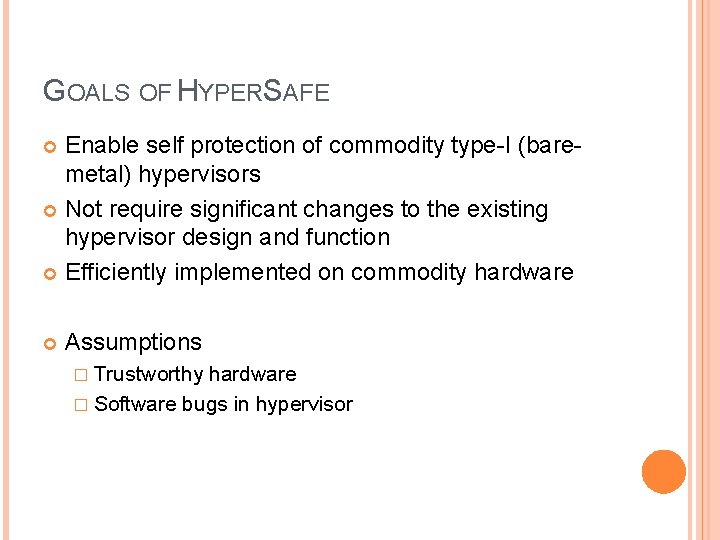
GOALS OF HYPERSAFE Enable self protection of commodity type-I (baremetal) hypervisors Not require significant changes to the existing hypervisor design and function Efficiently implemented on commodity hardware Assumptions � Trustworthy hardware � Software bugs in hypervisor
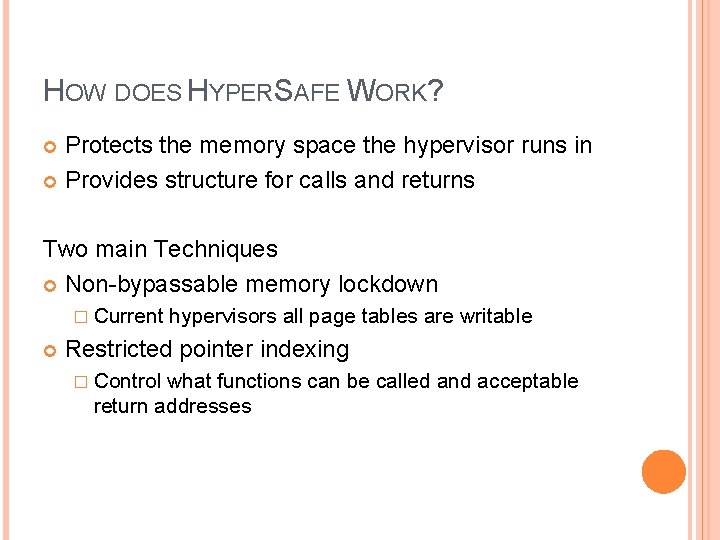
HOW DOES HYPERSAFE WORK? Protects the memory space the hypervisor runs in Provides structure for calls and returns Two main Techniques Non-bypassable memory lockdown � Current hypervisors all page tables are writable Restricted pointer indexing � Control what functions can be called and acceptable return addresses
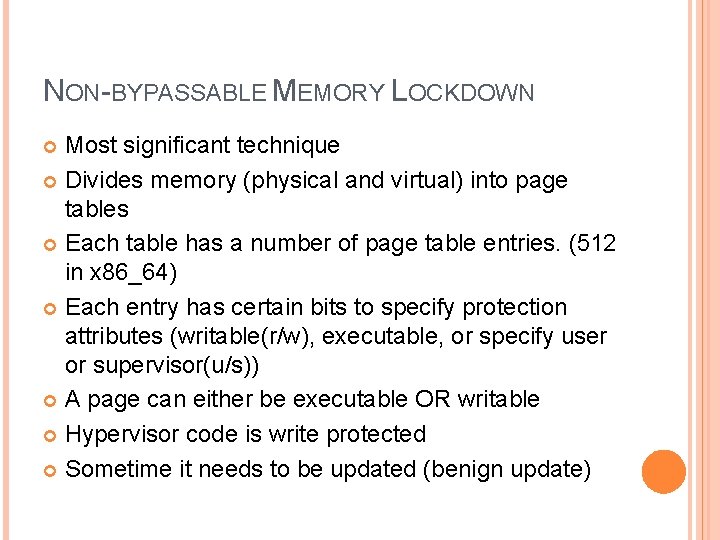
NON-BYPASSABLE MEMORY LOCKDOWN Most significant technique Divides memory (physical and virtual) into page tables Each table has a number of page table entries. (512 in x 86_64) Each entry has certain bits to specify protection attributes (writable(r/w), executable, or specify user or supervisor(u/s)) A page can either be executable OR writable Hypervisor code is write protected Sometime it needs to be updated (benign update)
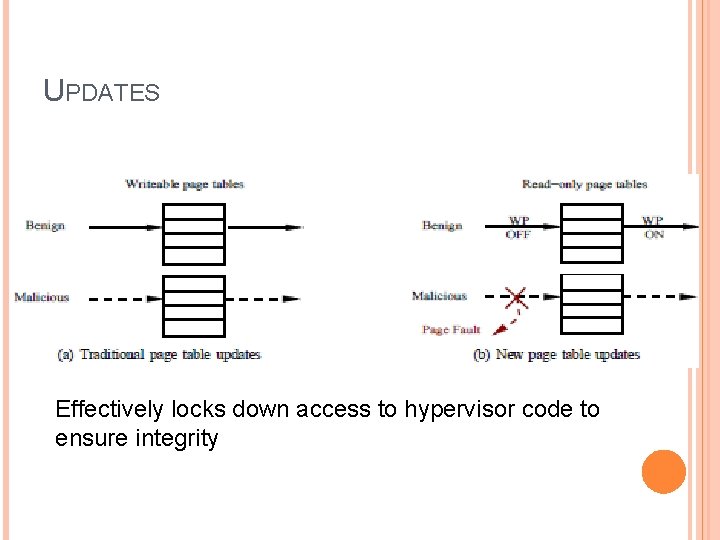
BENIGN UPDATE Sometimes executable memory needs to be updated / written to Supervisor only not User Technique uses the W P bit (Write Protect) in hardware On initial load set page tables read only and W P bit on On benign update clear W P bit, make the change, then set the W P bit on Hyper. Safe can ensure the action matches a security policy During process disable interrupts then re-enable
UPDATES Effectively locks down access to hypervisor code to ensure integrity
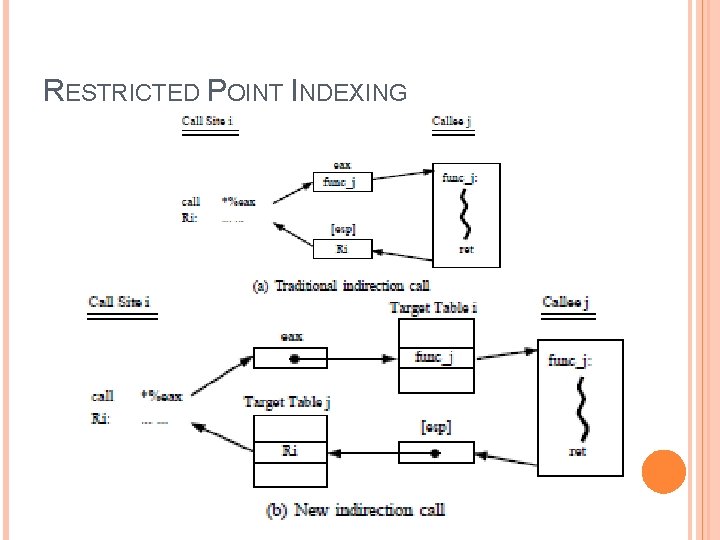
RESTRICTED POINTER INDEXING Restrict control of functions and return addresses from the user space Establishes tables maintained in protected memory for approved function and ret calls The table contains the pointers to the approved functions and returns
RESTRICTED POINT INDEXING
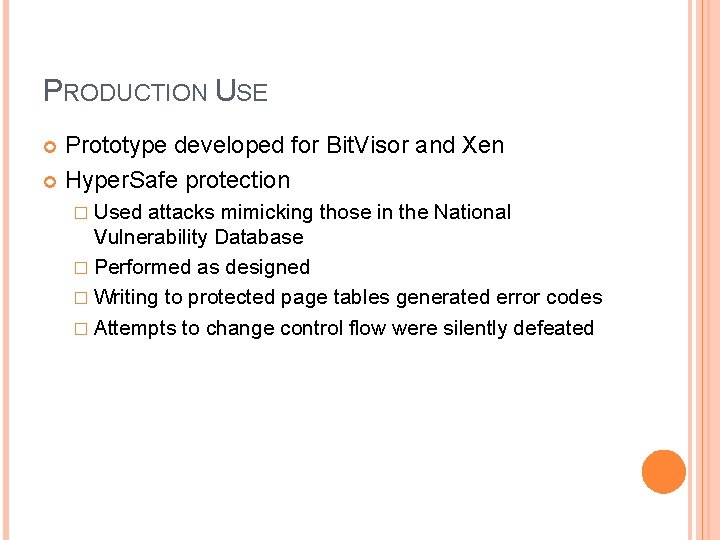
PRODUCTION USE Prototype developed for Bit. Visor and Xen Hyper. Safe protection � Used attacks mimicking those in the National Vulnerability Database � Performed as designed � Writing to protected page tables generated error codes � Attempts to change control flow were silently defeated
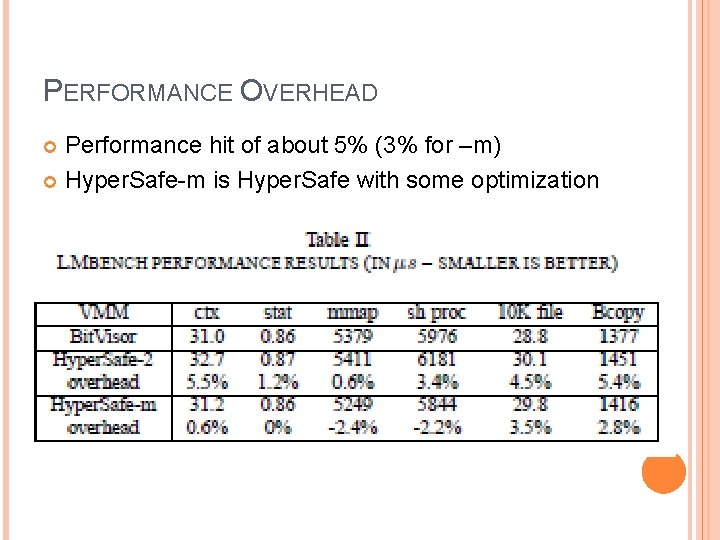
PERFORMANCE OVERHEAD Performance hit of about 5% (3% for –m) Hyper. Safe-m is Hyper. Safe with some optimization
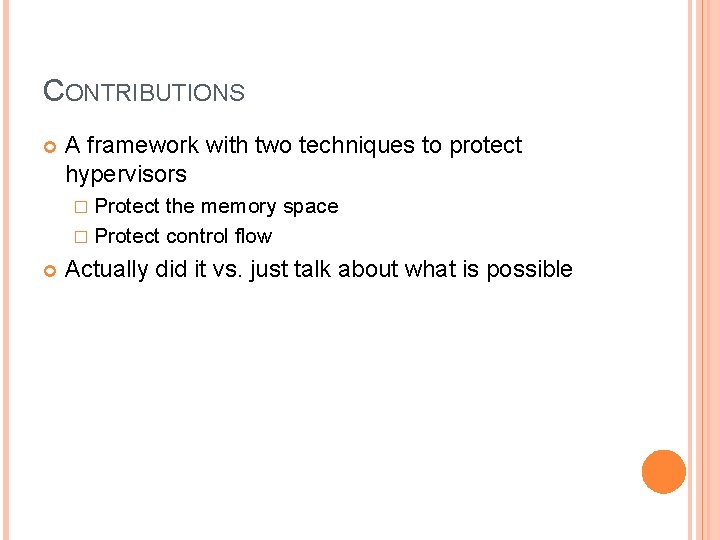
CONTRIBUTIONS A framework with two techniques to protect hypervisors � Protect the memory space � Protect control flow Actually did it vs. just talk about what is possible
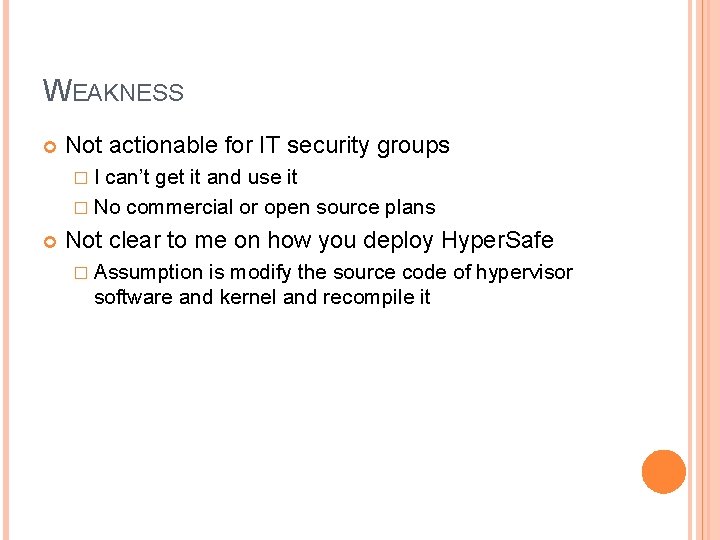
WEAKNESS Not actionable for IT security groups �I can’t get it and use it � No commercial or open source plans Not clear to me on how you deploy Hyper. Safe � Assumption is modify the source code of hypervisor software and kernel and recompile it
IMPROVEMENT Get it in the field � Partner with hypervisor vendors � VMware would be a big one