
Hyperloop Magnetic Levitation Halbach Array Simulations COMSOL Conference
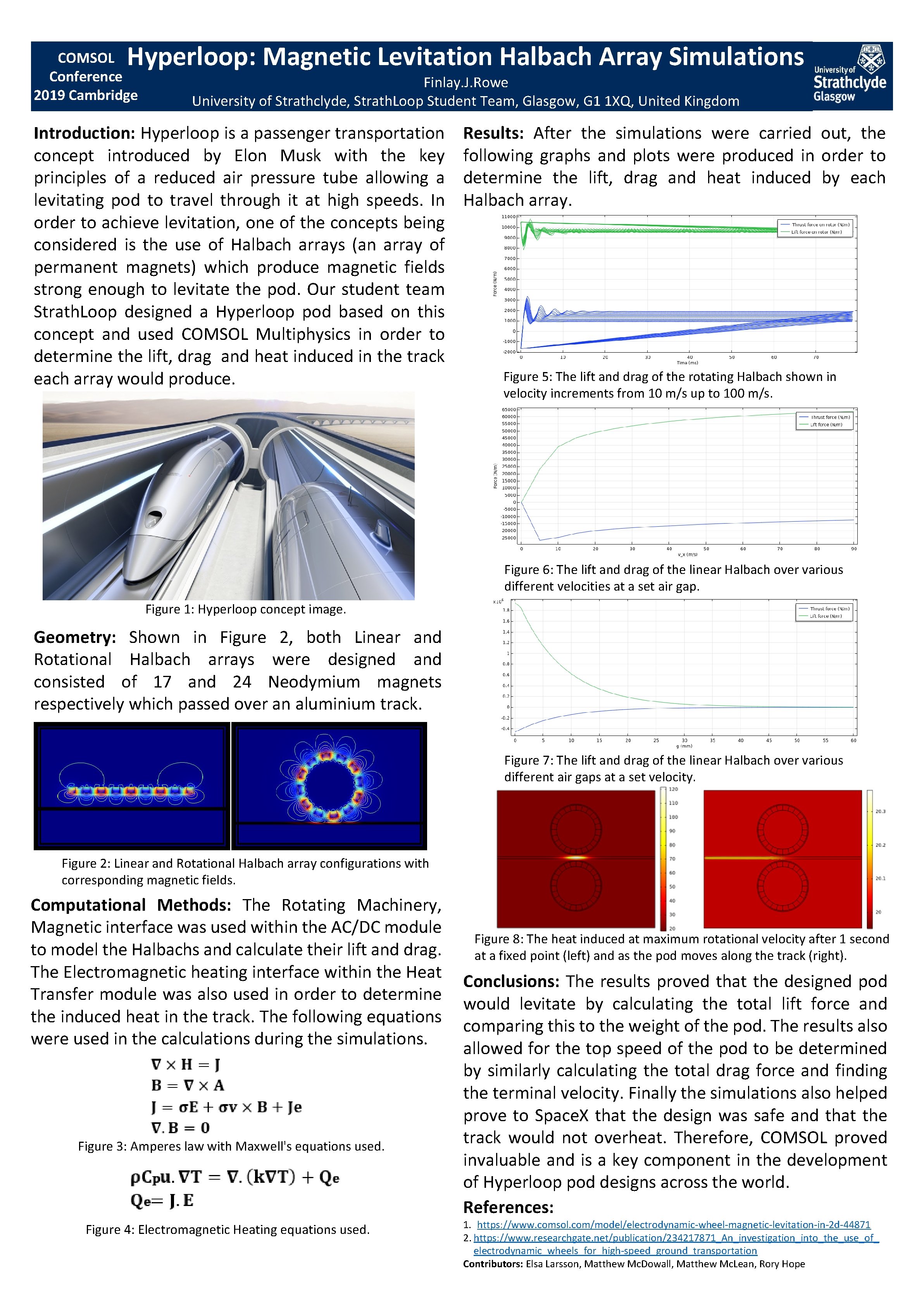
Hyperloop: Magnetic Levitation Halbach Array Simulations COMSOL Conference 2019 Cambridge Finlay. J. Rowe University of Strathclyde, Strath. Loop Student Team, Glasgow, G 1 1 XQ, United Kingdom Introduction: Hyperloop is a passenger transportation concept introduced by Elon Musk with the key principles of a reduced air pressure tube allowing a levitating pod to travel through it at high speeds. In order to achieve levitation, one of the concepts being considered is the use of Halbach arrays (an array of permanent magnets) which produce magnetic fields strong enough to levitate the pod. Our student team Strath. Loop designed a Hyperloop pod based on this concept and used COMSOL Multiphysics in order to determine the lift, drag and heat induced in the track each array would produce. Results: After the simulations were carried out, the following graphs and plots were produced in order to determine the lift, drag and heat induced by each Halbach array. Figure 5: The lift and drag of the rotating Halbach shown in velocity increments from 10 m/s up to 100 m/s. Figure 6: The lift and drag of the linear Halbach over various different velocities at a set air gap. Figure 1: Hyperloop concept image. Geometry: Shown in Figure 2, both Linear and Rotational Halbach arrays were designed and consisted of 17 and 24 Neodymium magnets respectively which passed over an aluminium track. Figure 7: The lift and drag of the linear Halbach over various different air gaps at a set velocity. Figure 2: Linear and Rotational Halbach array configurations with corresponding magnetic fields. Computational Methods: The Rotating Machinery, Magnetic interface was used within the AC/DC module to model the Halbachs and calculate their lift and drag. The Electromagnetic heating interface within the Heat Transfer module was also used in order to determine the induced heat in the track. The following equations were used in the calculations during the simulations. Figure 3: Amperes law with Maxwell's equations used. Figure 4: Electromagnetic Heating equations used. Figure 8: The heat induced at maximum rotational velocity after 1 second at a fixed point (left) and as the pod moves along the track (right). Conclusions: The results proved that the designed pod would levitate by calculating the total lift force and comparing this to the weight of the pod. The results also allowed for the top speed of the pod to be determined by similarly calculating the total drag force and finding the terminal velocity. Finally the simulations also helped prove to Space. X that the design was safe and that the track would not overheat. Therefore, COMSOL proved invaluable and is a key component in the development of Hyperloop pod designs across the world. References: 1. https: //www. comsol. com/model/electrodynamic-wheel-magnetic-levitation-in-2 d-44871 2. https: //www. researchgate. net/publication/234217871_An_investigation_into_the_use_of_ electrodynamic_wheels_for_high-speed_ground_transportation Contributors: Elsa Larsson, Matthew Mc. Dowall, Matthew Mc. Lean, Rory Hope
- Slides: 1