
Hyperintensionality and Impossible Worlds An Introduction David Chalmers
Hyperintensionality and Impossible Worlds: An Introduction David Chalmers
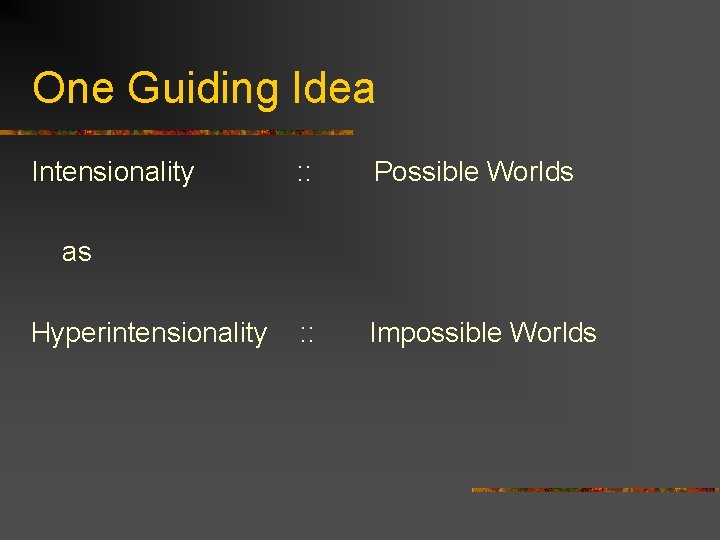
One Guiding Idea Intensionality : : Possible Worlds : : Impossible Worlds as Hyperintensionality
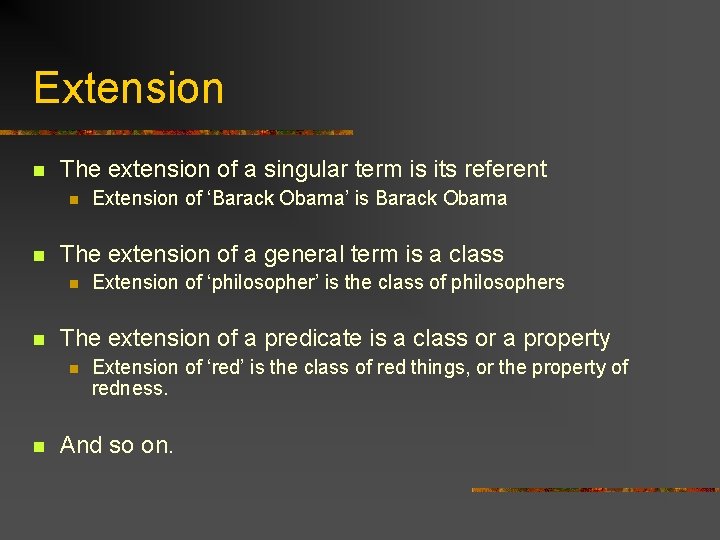
Extension n The extension of a singular term is its referent n n The extension of a general term is a class n n Extension of ‘philosopher’ is the class of philosophers The extension of a predicate is a class or a property n n Extension of ‘Barack Obama’ is Barack Obama Extension of ‘red’ is the class of red things, or the property of redness. And so on.
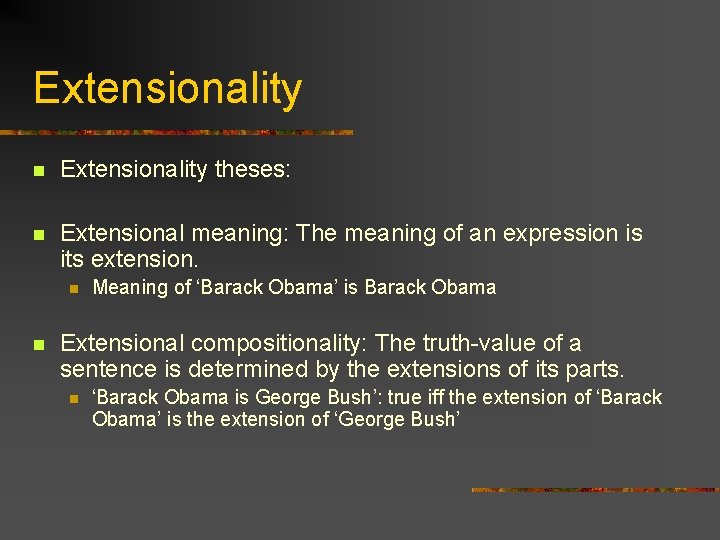
Extensionality n Extensionality theses: n Extensional meaning: The meaning of an expression is its extension. n n Meaning of ‘Barack Obama’ is Barack Obama Extensional compositionality: The truth-value of a sentence is determined by the extensions of its parts. n ‘Barack Obama is George Bush’: true iff the extension of ‘Barack Obama’ is the extension of ‘George Bush’

Intensionality n Challenges to extensionality theses: n Intensional Meaning: Coextensive expressions have intuitively different meanings, with different cognitive significance n ‘The Morning Star’, ‘The Evening Star’ n Frege: ‘The MS is the ES’ is cognitively significant n Intensional Compositionality: Substituting coextensive expressions can change truth-value n ‘It is possible that the MS is not the ES’: true n ‘It is possible that the ES is not the ES’: false n ‘It is possible that…’ is an intensional context.
Strategy 1: Intensions n Strategy 1: Meaning isn’t an extension but an intension n Carnap: The intension of an expression is a function from possible worlds to extensions n Intension of ‘the morning star’ picks out the morning star in all worlds n ‘The morning star’ and ‘The evening star’ have same extension, different intension n Truth-value of a sentence (with an intensional context) is determined by the intensions of its parts n ‘It is possible that the MS isn’t the ES’ is true because there’s a world where the intension of ‘the MS isn’t the ES’ is true.
Strategy 2: Structure n Strategy 2: Appeal to internal structure in these expressions n E. g. Russell: ‘the morning star is F’ is equivalent to ‘there exists a unique star visible in the morning and it is F’ n n n Then ‘the morning star’ and ‘the evening star’ will be associated with different structures The truth-value of a sentence may still be determined by the extensions of its parts. No need for possible worlds and intensions: structure plus extension can do the work.
Strategy 3: Denial n Strategy 3: Deny the difference in meaning n E. g. Kripke (for names, although not descriptions) n n ‘Hesperus’ and ‘Phosphorus’ have the same meaning ‘It is possible that Hesperus is not Phosphorus’ is false. The cognitive difference is not a difference in meaning. So again, extension (plus structure) does the job.
Hyperintensionality n Hyperintensional Meaning: Cointensive expressions (necessarily equivalent, same intension) have intuitively different meanings. n n n Hyperintensional Composition: Substituting cointensive expressions can change truth-values n n n ‘Hesperus’, ‘Phosphorus’ (post-Kripke) ‘ 77+44’, ‘ 121’ ‘It is a priori that H=H’ vs ‘It is a priori that H=P’ ‘John believes that 77+44=121’ vs ‘John believes that 121=121’ ‘It is a priori that…’, ‘John believes that…’ are hyperintensional contexts
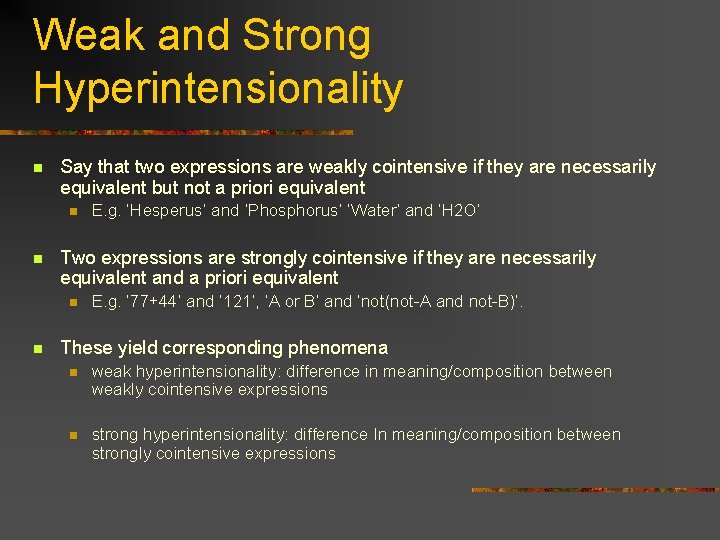
Weak and Strong Hyperintensionality n Say that two expressions are weakly cointensive if they are necessarily equivalent but not a priori equivalent n n Two expressions are strongly cointensive if they are necessarily equivalent and a priori equivalent n n E. g. ‘Hesperus’ and ‘Phosphorus’ ‘Water’ and ‘H 2 O’ E. g. ‘ 77+44’ and ‘ 121’, ‘A or B’ and ‘not(not-A and not-B)’. These yield corresponding phenomena n weak hyperintensionality: difference in meaning/composition between weakly cointensive expressions n strong hyperintensionality: difference In meaning/composition between strongly cointensive expressions
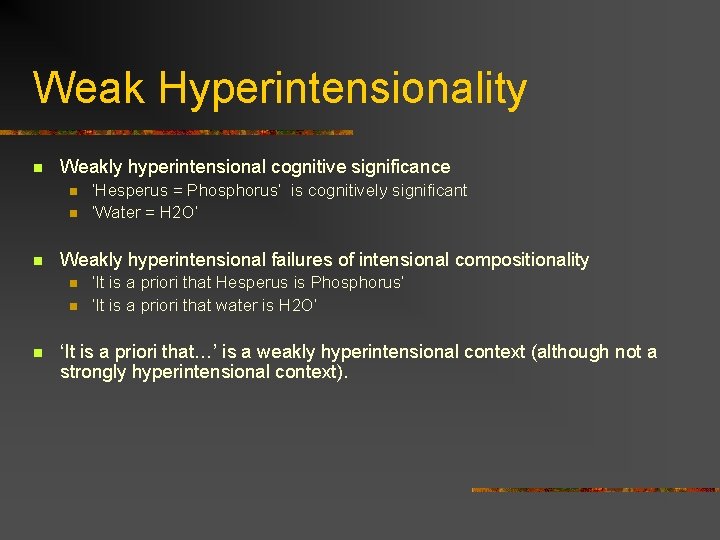
Weak Hyperintensionality n Weakly hyperintensional cognitive significance n n n Weakly hyperintensional failures of intensional compositionality n n n ‘Hesperus = Phosphorus’ is cognitively significant ‘Water = H 2 O’ ‘It is a priori that Hesperus is Phosphorus’ ‘It is a priori that water is H 2 O’ ‘It is a priori that…’ is a weakly hyperintensional context (although not a strongly hyperintensional context).
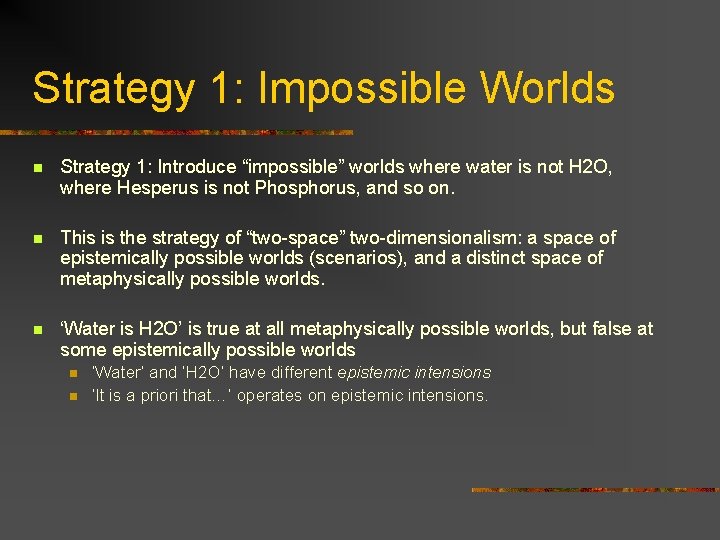
Strategy 1: Impossible Worlds n Strategy 1: Introduce “impossible” worlds where water is not H 2 O, where Hesperus is not Phosphorus, and so on. n This is the strategy of “two-space” two-dimensionalism: a space of epistemically possible worlds (scenarios), and a distinct space of metaphysically possible worlds. n ‘Water is H 2 O’ is true at all metaphysically possible worlds, but false at some epistemically possible worlds n n ‘Water’ and ‘H 2 O’ have different epistemic intensions ‘It is a priori that…’ operates on epistemic intensions.
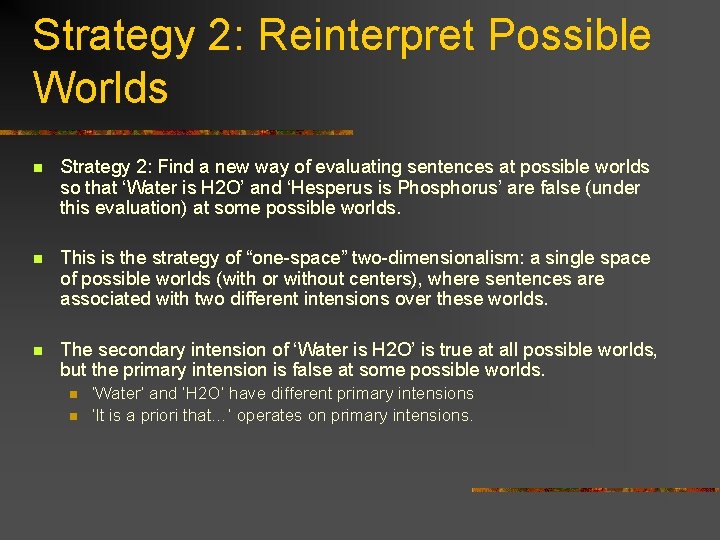
Strategy 2: Reinterpret Possible Worlds n Strategy 2: Find a new way of evaluating sentences at possible worlds so that ‘Water is H 2 O’ and ‘Hesperus is Phosphorus’ are false (under this evaluation) at some possible worlds. n This is the strategy of “one-space” two-dimensionalism: a single space of possible worlds (with or without centers), where sentences are associated with two different intensions over these worlds. n The secondary intension of ‘Water is H 2 O’ is true at all possible worlds, but the primary intension is false at some possible worlds. n n ‘Water’ and ‘H 2 O’ have different primary intensions ‘It is a priori that…’ operates on primary intensions.
Strategy 3: Appeal to Structure n Strategy 3: Find some relevant difference in the internal structure of (the logical form of) ‘Hesperus’ and ‘Phosphorus’, or ‘water’ and ‘H 2 O’. n E. g. the descriptivist about names: n ‘Hesperus’ = ‘the morning star’, ‘Phosphorus’ = ‘the evening star’
Strategy 4: Denial n Strategy 4: Deny that there is any weak hyperintensionality of meaning (cf. direct reference theorists) n The difference in cognitive significance between ‘Hesperus’ and ‘Phosphorus’ is not a semantic difference n ‘It is a priori that…’ is not a weakly hyperintensional context n E. g. ‘It is a priori that Hesperus is Phosphorus’ is true.
Strong Hyperintensionality n Strongly hyperintensional cognitive significance n n n ‘ 44+77 = 121’ is cognitively significant (although a priori) ‘(A or B) iff (not-A and not-B))’ is cognitively significant (although a priori) Strongly hyperintensional failures of intensional compositionality n n ‘John believes that 121=121’ ‘John believes that 44+77=121’ n N. B. Two-dimensionalism alone doesn’t help here, as a priori equivalent expressions have the same primary/epistemic intensions n ‘John believes that…’ is a strongly hyperintensional context.
Strategy 1: Impossible Worlds n Natural suggestion: There are impossible worlds (or scenarios) where n n n ‘ 44+77=121’ is false ‘(A or B) iff (not-A and not-B))’ is false Expressions can be associated with hyperintensions: functions from possible and impossible worlds to extensions. n n n ‘ 44+77’ and ‘ 121’ have the same intension, the same primary/epistemic intension, but different hyperintensions. A priori truths are cognitively significant because they have nontrivial hyperintensions? Strongly hyperintensional operators such as ‘John believes that’ operate on hyperintensions. Strongly hyperintensional cognitive significance ‘ 44+77 = 121’ is cognitively significant (although a priori) ‘(A or B) iff (not-A and not-B))’ is cognitively significant (although a priori)
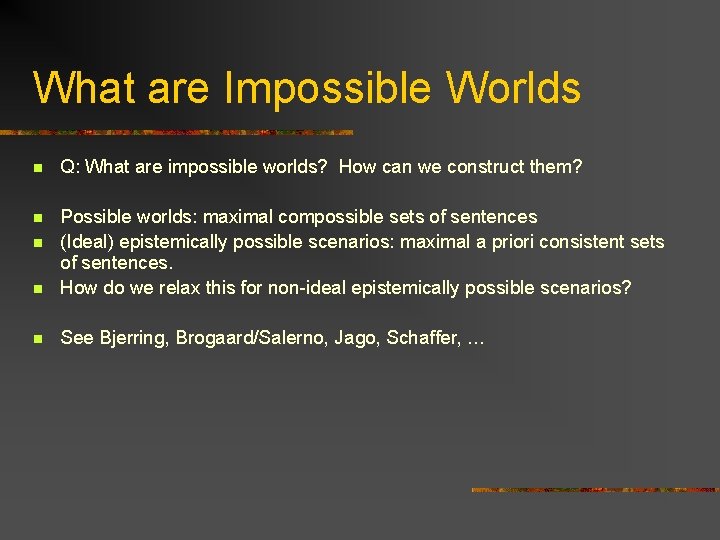
What are Impossible Worlds n Q: What are impossible worlds? How can we construct them? n n Possible worlds: maximal compossible sets of sentences (Ideal) epistemically possible scenarios: maximal a priori consistent sets of sentences. How do we relax this for non-ideal epistemically possible scenarios? n See Bjerring, Brogaard/Salerno, Jago, Schaffer, … n
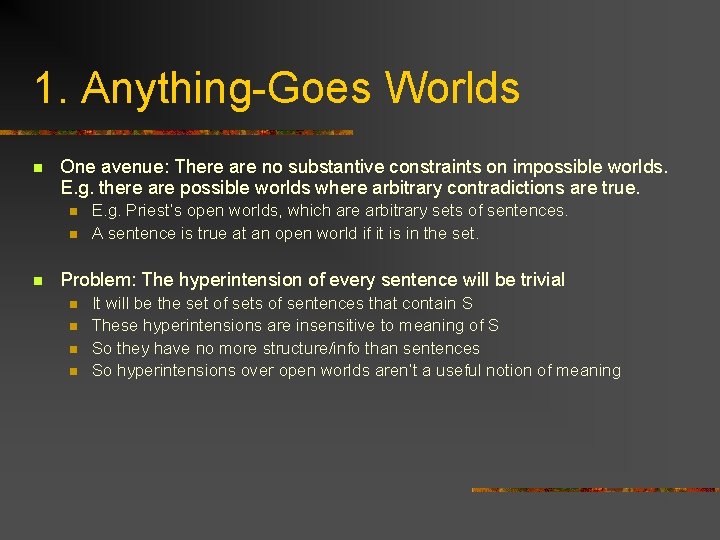
1. Anything-Goes Worlds n One avenue: There are no substantive constraints on impossible worlds. E. g. there are possible worlds where arbitrary contradictions are true. n n n E. g. Priest’s open worlds, which are arbitrary sets of sentences. A sentence is true at an open world if it is in the set. Problem: The hyperintension of every sentence will be trivial n n It will be the set of sets of sentences that contain S These hyperintensions are insensitive to meaning of S So they have no more structure/info than sentences So hyperintensions over open worlds aren’t a useful notion of meaning
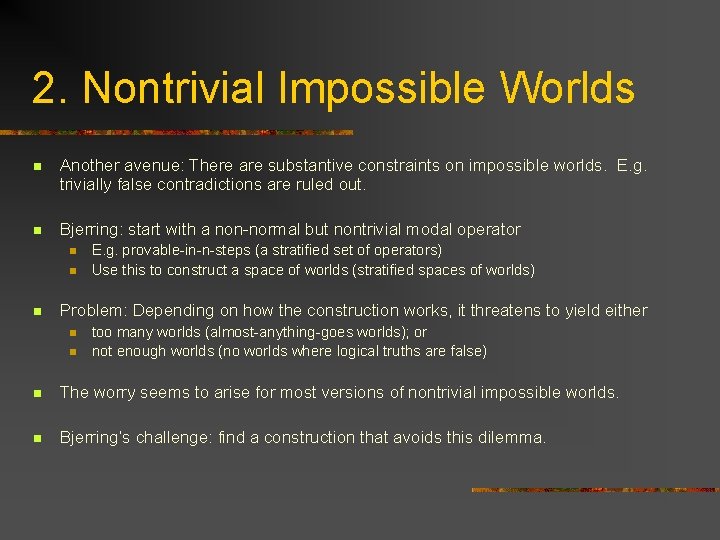
2. Nontrivial Impossible Worlds n Another avenue: There are substantive constraints on impossible worlds. E. g. trivially false contradictions are ruled out. n Bjerring: start with a non-normal but nontrivial modal operator n n n E. g. provable-in-n-steps (a stratified set of operators) Use this to construct a space of worlds (stratified spaces of worlds) Problem: Depending on how the construction works, it threatens to yield either n n too many worlds (almost-anything-goes worlds); or not enough worlds (no worlds where logical truths are false) n The worry seems to arise for most versions of nontrivial impossible worlds. n Bjerring’s challenge: find a construction that avoids this dilemma.
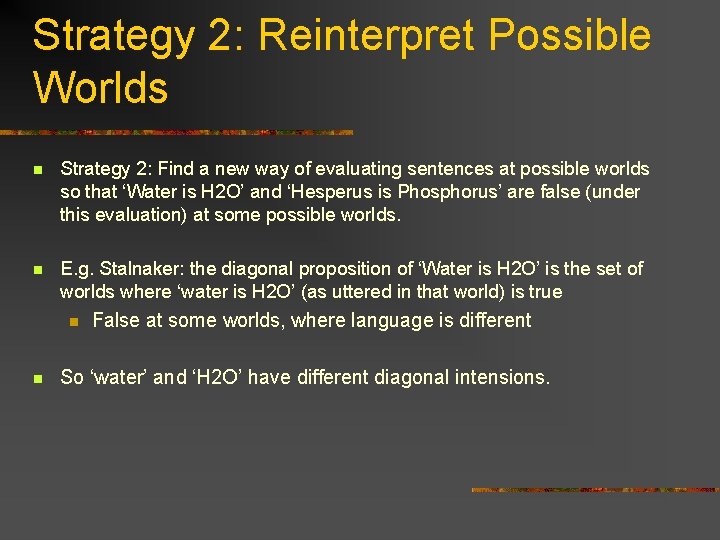
Strategy 2: Reinterpret Possible Worlds n Strategy 2: Find a new way of evaluating sentences at possible worlds so that ‘Water is H 2 O’ and ‘Hesperus is Phosphorus’ are false (under this evaluation) at some possible worlds. n E. g. Stalnaker: the diagonal proposition of ‘Water is H 2 O’ is the set of worlds where ‘water is H 2 O’ (as uttered in that world) is true n n False at some worlds, where language is different So ‘water’ and ‘H 2 O’ have different diagonal intensions.
Problems n n Problems for Stalnaker’s metalinguistic strategy n Diagonal intensions ignore meaning and have no more interesting structure then sentences n They treat nontrivial impossibilities and trivial impossibilities just the same. n They don’t seem to capture what we are entertaining when we wonder about the truth of some mathematical theorem Q: Any other version of a reinterpreting-possible-worlds strategy? (Schwarz? )
Strategy 3: Appeal to Structure n Strategy 3: Find internal structure in strongly cointensive expressions: e. g. ‘ 44+77’ and ‘ 121’ have different structure n n 2 D version of this strategy: sentences are associated with structured primary intensions (or: enriched intensions) n n n Represent these as structured intensions (Cresswell). E. g. ‘Hesperus is Hesperus’, ‘Hesperus is Phosphorus’: same structure, different basic intensions ‘ 44+77’, ‘ 121’: different structures One can argue that something like these structured intensions yield an adequate treatment of attitude ascriptions and other strongly hyperintensional contexts.
Problem n Problem: This will only work if there are no pairs of simple expressions with the same (primary) intension but cognitive/compositional differences. n n Are there? Not obvious. n n If there are, then structure won’t help. Maybe the best case involve fiction/legend names with primary intensions that have no referent at any scenario. Also: Even if this works, it would be very nice to have impossible worlds for various explanatory purposes, e. g. the analysis of epistemic possibility.
Strategy 4: Denial n Strategy 4: Denial of strong hyperintensionality n Strongly hyperintensional differences in cognitive significance are psychological differences, not semantic differences n There are no strongly hyperintensional contexts (so ‘Lois knows that Superman is Clark Kent’ is true).
Strategy 5: Inferentialism n Strategy 5: There is a semantic difference between strongly cointensive expressions, but this isn’t best represented using intensions and extensions. n Instead, it’s a difference in inferential role (Restall)
Strategy 6: Properties of Expressions n Strategy 6: There is a difference between strongly cointensive expressions, but this isn’t best represented using intensions and extensions. n Instead, it’s a difference in “properties of expressions” (Bigelow)
Other Perspectives n One can also approach these issues from the perspective of n Modal logic (Kripke-style semantics for non-normal modal operators) n Epistemology and epistemic logic (Hintikka-style analysis of nonideal epistemic possibility) n Philosophy of mind/cognition (making sense of rational processes in non-ideal agents) n Metaphysics (analyzing the coherence and nature of impossible worlds)
Onward n Onward into the impossible…
- Slides: 29