
Hyperheuristics Tutorial John Woodward John Woodwardcs stir ac

- Slides: 145
Hyper-heuristics Tutorial John Woodward (John. Woodward@cs. stir. ac. uk) CHORDS Research Group, Stirling University (http: //www. maths. stir. ac. uk/research/groups/chords/) Daniel R. Tauritz (dtauritz@acm. org) Natural Computation Laboratory, Missouri University of Science and Technology (http: //web. mst. edu/~tauritzd/nc-lab/) Permission to make digital or hard copies of part or all of this work for personal or classroom use is granted without fee provided that copies are not made or distributed for profit or commercial advantage and that copies bear this notice and the full citation on the first page. Copyrights for third-party components of this work must be honored. For all other uses, contact the Owner/Author. 22 May 2021 Copyright is held by the owner/author(s). GECCO'15 Companion, July 11 -15, 2015, Madrid, Spain ACM 978 -1 -4503 -3488 -4/15/07. http: //dx. doi. org/10. 1145/2739482. 2756579
John’s perspective of hyperheuristics 22 May 2021 John R. Woodward, Daniel R. Tauritz 2
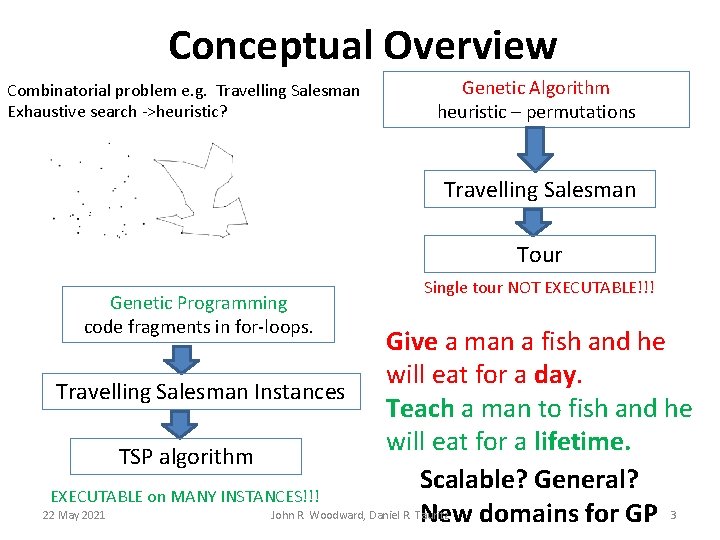
Conceptual Overview Combinatorial problem e. g. Travelling Salesman Exhaustive search ->heuristic? Genetic Algorithm heuristic – permutations Travelling Salesman Tour Genetic Programming code fragments in for-loops. Single tour NOT EXECUTABLE!!! Give a man a fish and he will eat for a day. Travelling Salesman Instances Teach a man to fish and he will eat for a lifetime. TSP algorithm Scalable? General? EXECUTABLE on MANY INSTANCES!!! 22 May 2021 John R. Woodward, Daniel R. Tauritz New domains for GP 3
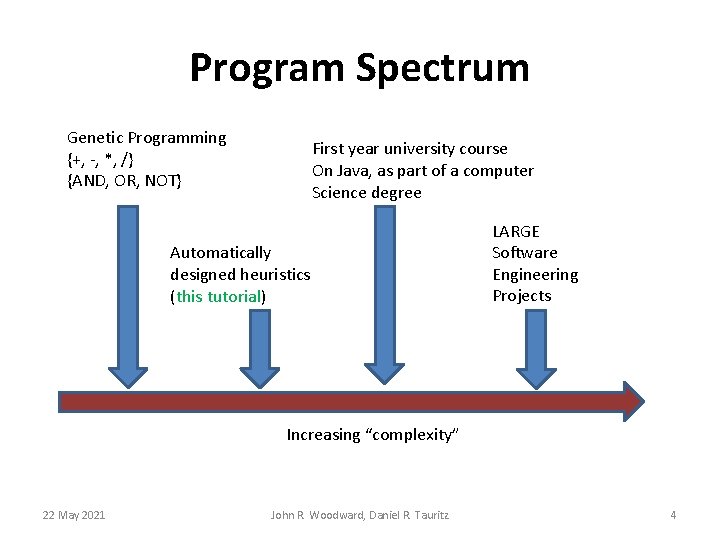
Program Spectrum Genetic Programming {+, -, *, /} {AND, OR, NOT} First year university course On Java, as part of a computer Science degree Automatically designed heuristics (this tutorial) LARGE Software Engineering Projects Increasing “complexity” 22 May 2021 John R. Woodward, Daniel R. Tauritz 4
Plan: From Evolution to Automatic Design 1. Evolution, Genetic Algorithms and Genetic Programming 2. Motivations (conceptual and theoretical) 3. Examples of Automatic Generation: • • Evolutionary Algorithms (selection, mutation, crossover) Black Box Search Algorithms Bin packing Evolutionary Programming 4. Visualization 5. Step-by-step guide 6. Wrap up (comparison, history, conclusions, summary, etc. ) 7. Questions (during AND after…), please! Now is a good time to say you are in the wrong room 22 May 2021 John R. Woodward, Daniel R. Tauritz 5
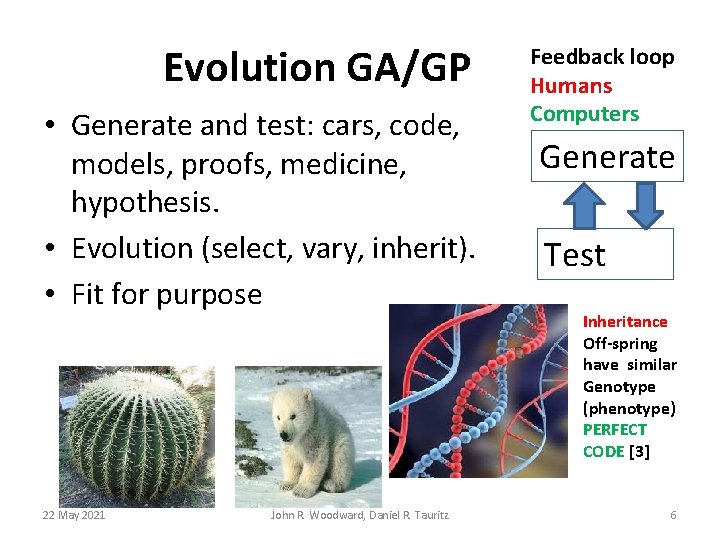
Evolution GA/GP • Generate and test: cars, code, models, proofs, medicine, hypothesis. • Evolution (select, vary, inherit). • Fit for purpose 22 May 2021 John R. Woodward, Daniel R. Tauritz Feedback loop Humans Computers Generate Test Inheritance Off-spring have similar Genotype (phenotype) PERFECT CODE [3] 6
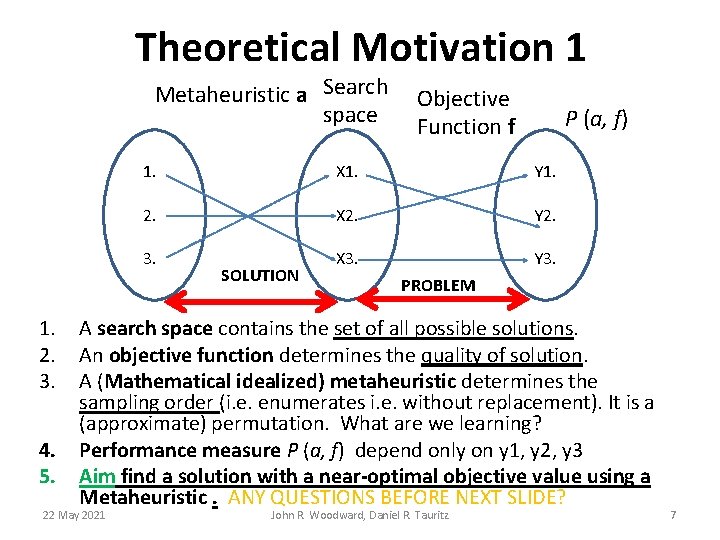
Theoretical Motivation 1 Metaheuristic a Search space 1. 2. 3. 4. 5. Objective Function f P (a, f) 1. X 1. Y 1. 2. x 1 X 2. x 1 Y 2. x 1 3. X 3. Y 3. SOLUTION PROBLEM A search space contains the set of all possible solutions. An objective function determines the quality of solution. A (Mathematical idealized) metaheuristic determines the sampling order (i. e. enumerates i. e. without replacement). It is a (approximate) permutation. What are we learning? Performance measure P (a, f) depend only on y 1, y 2, y 3 Aim find a solution with a near-optimal objective value using a Metaheuristic. ANY QUESTIONS BEFORE NEXT SLIDE? 22 May 2021 John R. Woodward, Daniel R. Tauritz 7
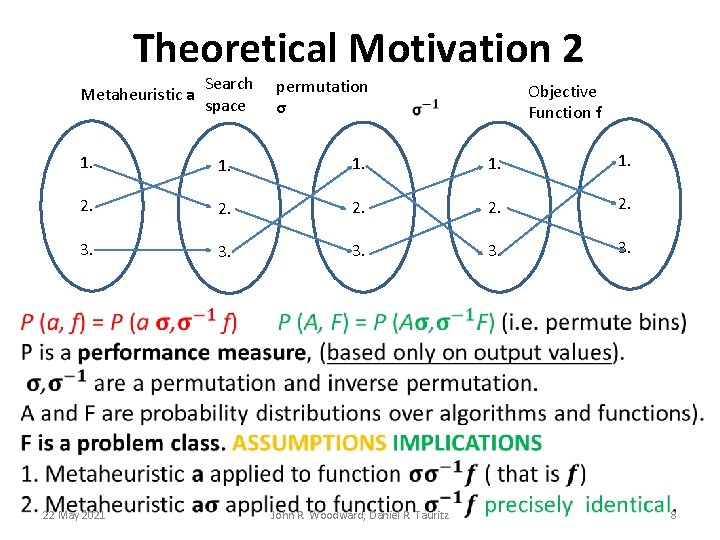
Theoretical Motivation 2 Metaheuristic a Search space permutation σ Objective Function f 1. 1. 1. 2. x 1 3. 3. 3. • 22 May 2021 John R. Woodward, Daniel R. Tauritz 8
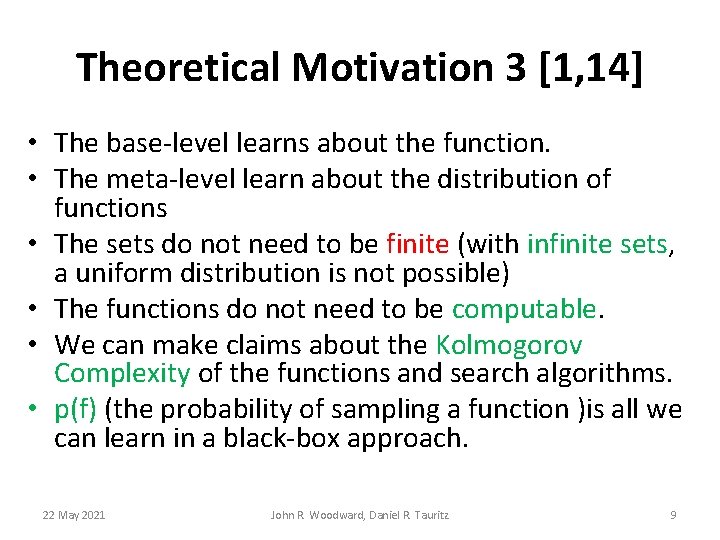
Theoretical Motivation 3 [1, 14] • The base-level learns about the function. • The meta-level learn about the distribution of functions • The sets do not need to be finite (with infinite sets, a uniform distribution is not possible) • The functions do not need to be computable. • We can make claims about the Kolmogorov Complexity of the functions and search algorithms. • p(f) (the probability of sampling a function )is all we can learn in a black-box approach. 22 May 2021 John R. Woodward, Daniel R. Tauritz 9
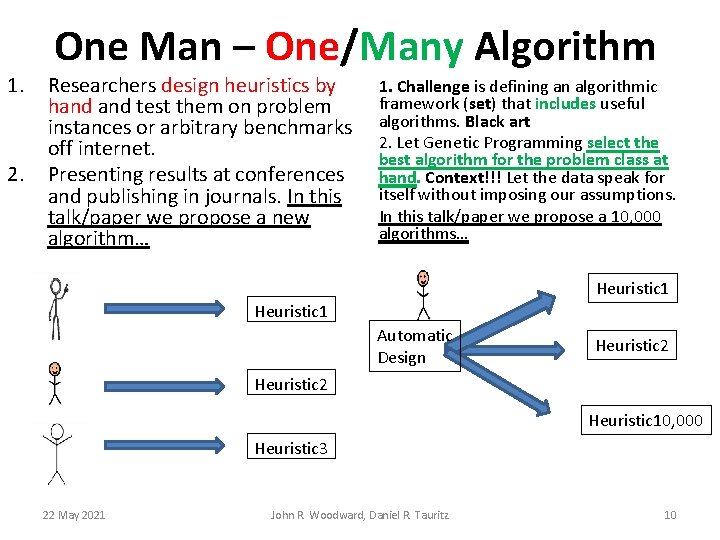
1. 2. One Man – One/Many Algorithm Researchers design heuristics by hand test them on problem instances or arbitrary benchmarks off internet. Presenting results at conferences and publishing in journals. In this talk/paper we propose a new algorithm… 1. Challenge is defining an algorithmic framework (set) that includes useful algorithms. Black art 2. Let Genetic Programming select the best algorithm for the problem class at hand. Context!!! Let the data speak for itself without imposing our assumptions. In this talk/paper we propose a 10, 000 algorithms… Heuristic 1 Automatic Design Heuristic 2 Heuristic 10, 000 Heuristic 3 22 May 2021 John R. Woodward, Daniel R. Tauritz 10
Daniel’s perspective of hyperheuristics 22 May 2021 John R. Woodward, Daniel R. Tauritz 11
Real-World Challenges • Researchers strive to make algorithms increasingly general-purpose • But practitioners have very specific needs • Designing custom algorithms tuned to particular problem instance distributions and/or computational architectures can be very time consuming 22 May 2021 John R. Woodward, Daniel R. Tauritz 12
Automated Design of Algorithms • Addresses the need for custom algorithms • But due to high computational complexity, only feasible for repeated problem solving • Hyper-heuristics accomplish automated design of algorithms by searching program space 22 May 2021 John R. Woodward, Daniel R. Tauritz 13
Hyper-heuristics • Hyper-heuristics are a special type of meta-heuristic – Step 1: Extract algorithmic primitives from existing algorithms – Step 2: Search the space of programs defined by the extracted primitives • While Genetic Programming (GP) is particularly well suited for executing Step 2, other meta-heuristics can be, and have been, employed • The type of GP employed matters [24] 22 May 2021 John R. Woodward, Daniel R. Tauritz 14
Case Study 1: The Automated Design of Selection Heuristics 22 May 2021 John R. Woodward, Daniel R. Tauritz 15
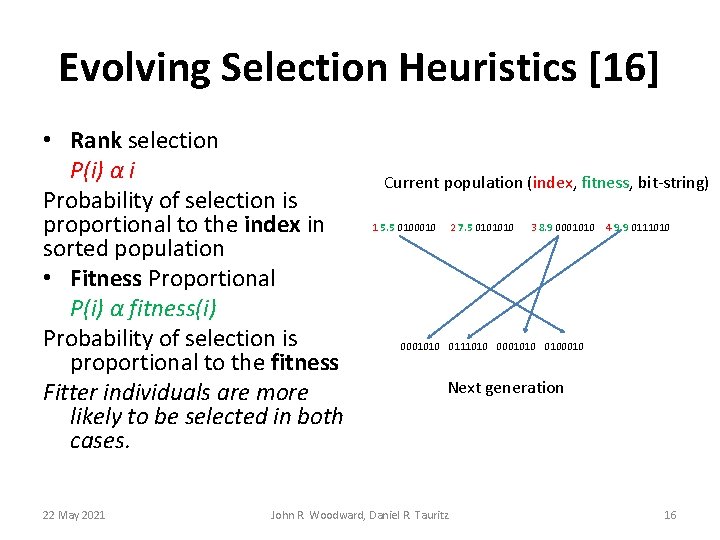
Evolving Selection Heuristics [16] • Rank selection P(i) α i Probability of selection is proportional to the index in sorted population • Fitness Proportional P(i) α fitness(i) Probability of selection is proportional to the fitness Fitter individuals are more likely to be selected in both cases. 22 May 2021 Current population (index, fitness, bit-string) 1 5. 5 0100010 2 7. 5 0101010 3 8. 9 0001010 4 9. 9 0111010 0001010 0100010 Next generation John R. Woodward, Daniel R. Tauritz 16
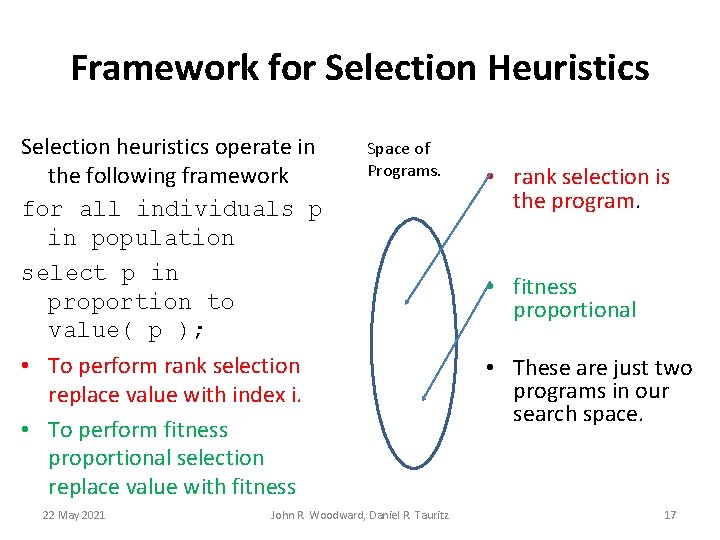
Framework for Selection Heuristics Selection heuristics operate in the following framework for all individuals p in population select p in proportion to value( p ); • To perform rank selection replace value with index i. • To perform fitness proportional selection replace value with fitness 22 May 2021 Space of Programs. John R. Woodward, Daniel R. Tauritz • rank selection is the program. • fitness proportional • These are just two programs in our search space. 17
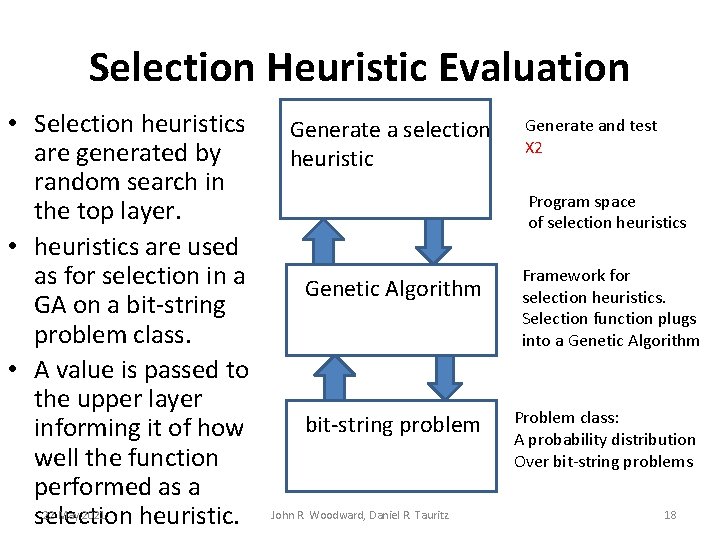
Selection Heuristic Evaluation • Selection heuristics are generated by random search in the top layer. • heuristics are used as for selection in a GA on a bit-string problem class. • A value is passed to the upper layer informing it of how well the function performed as a 22 May 2021 selection heuristic. Generate a selection heuristic test Generate and test X 2 Program space of selection heuristics Genetic Algorithm test bit-string problem Genetic Algorithm bit-string problem John R. Woodward, Daniel R. Tauritz Framework for selection heuristics. Selection function plugs into a Genetic Algorithm Problem class: A probability distribution Over bit-string problems 18
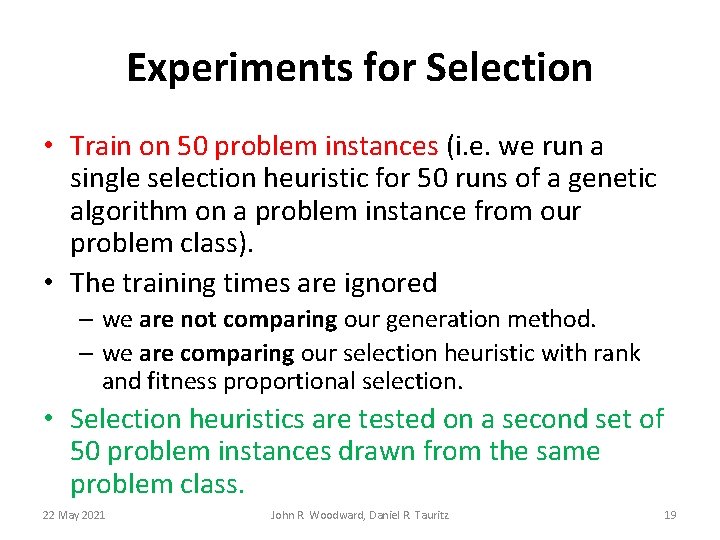
Experiments for Selection • Train on 50 problem instances (i. e. we run a single selection heuristic for 50 runs of a genetic algorithm on a problem instance from our problem class). • The training times are ignored – we are not comparing our generation method. – we are comparing our selection heuristic with rank and fitness proportional selection. • Selection heuristics are tested on a second set of 50 problem instances drawn from the same problem class. 22 May 2021 John R. Woodward, Daniel R. Tauritz 19
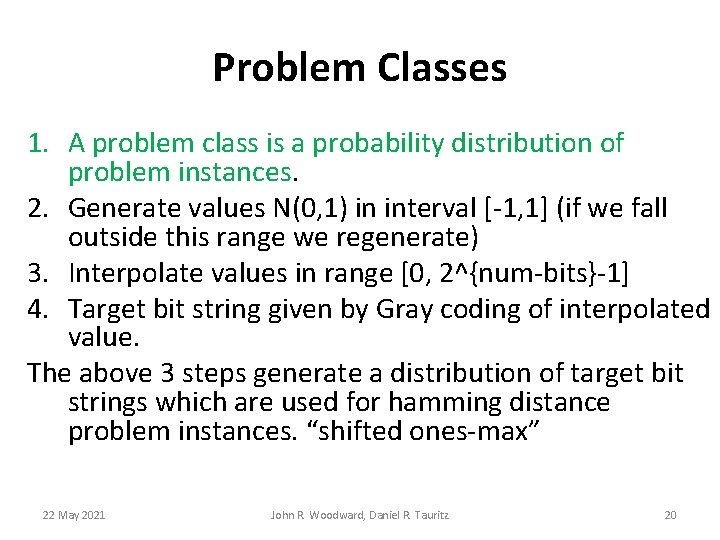
Problem Classes 1. A problem class is a probability distribution of problem instances. 2. Generate values N(0, 1) in interval [-1, 1] (if we fall outside this range we regenerate) 3. Interpolate values in range [0, 2^{num-bits}-1] 4. Target bit string given by Gray coding of interpolated value. The above 3 steps generate a distribution of target bit strings which are used for hamming distance problem instances. “shifted ones-max” 22 May 2021 John R. Woodward, Daniel R. Tauritz 20
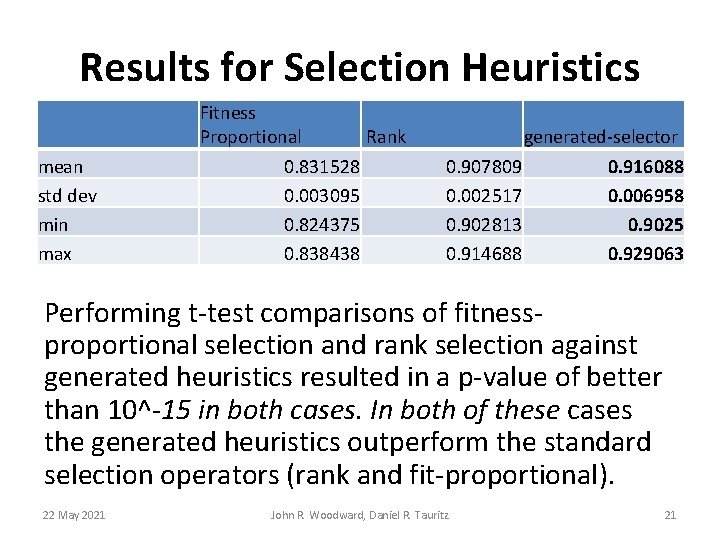
Results for Selection Heuristics mean std dev min max Fitness Proportional Rank 0. 831528 0. 003095 0. 824375 0. 838438 generated-selector 0. 907809 0. 916088 0. 002517 0. 006958 0. 902813 0. 9025 0. 914688 0. 929063 Performing t-test comparisons of fitnessproportional selection and rank selection against generated heuristics resulted in a p-value of better than 10^-15 in both cases. In both of these cases the generated heuristics outperform the standard selection operators (rank and fit-proportional). 22 May 2021 John R. Woodward, Daniel R. Tauritz 21
Take Home Points • automatically designing selection heuristics. • We should design heuristics for problem classes i. e. with a context/niche/setting. • This approach is human-competitive (and human cooperative). • Meta-bias is necessary if we are to tackle multiple problem instances. • Think frameworks not individual algorithms – we don’t want to solve problem instances we want to solve classes (i. e. many instances from the class)! 22 May 2021 John R. Woodward, Daniel R. Tauritz 22
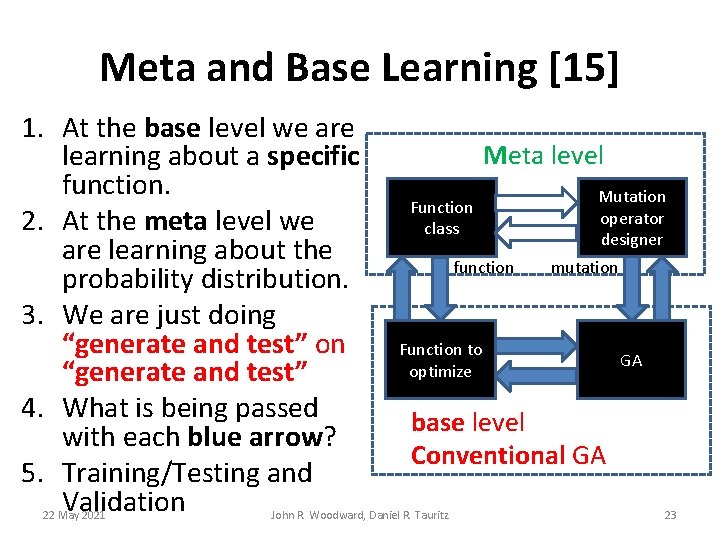
Meta and Base Learning [15] 1. At the base level we are learning about a specific function. 2. At the meta level we are learning about the probability distribution. 3. We are just doing “generate and test” on “generate and test” 4. What is being passed with each blue arrow? 5. Training/Testing and Validation 22 May 2021 Meta level Function class function Mutation operator designer mutation Function to optimize GA base level Conventional GA John R. Woodward, Daniel R. Tauritz 23
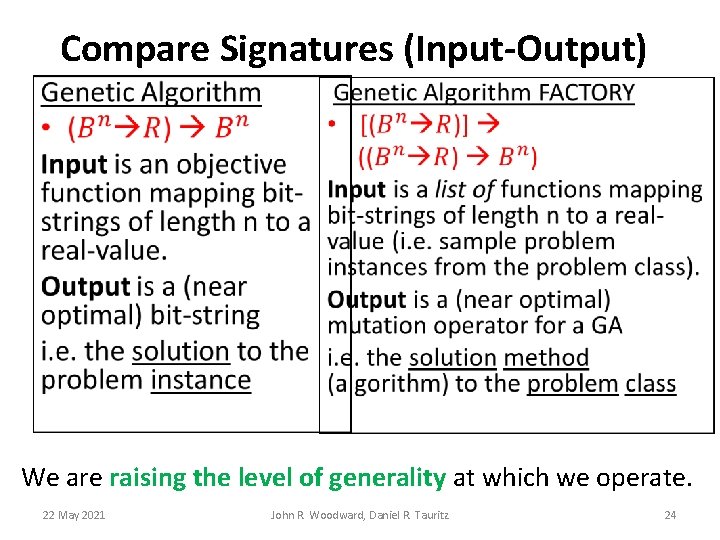
Compare Signatures (Input-Output) • We are raising the level of generality at which we operate. 22 May 2021 John R. Woodward, Daniel R. Tauritz 24
Case Study 2: The Automated Design of Crossover Operators [20] 22 May 2021 John R. Woodward, Daniel R. Tauritz 25
Motivation • Performance Sensitive to Crossover Selection • Identifying & Configuring Best Traditional Crossover is Time Consuming • Existing Operators May Be Suboptimal • Optimal Operator May Change During Evolution 22 May 2021 John R. Woodward, Daniel R. Tauritz 26
Some Possible Solutions • Meta-EA – Exceptionally time consuming • Self-Adaptive Algorithm Selection – Limited by algorithms it can choose from 22 May 2021 John R. Woodward, Daniel R. Tauritz 27
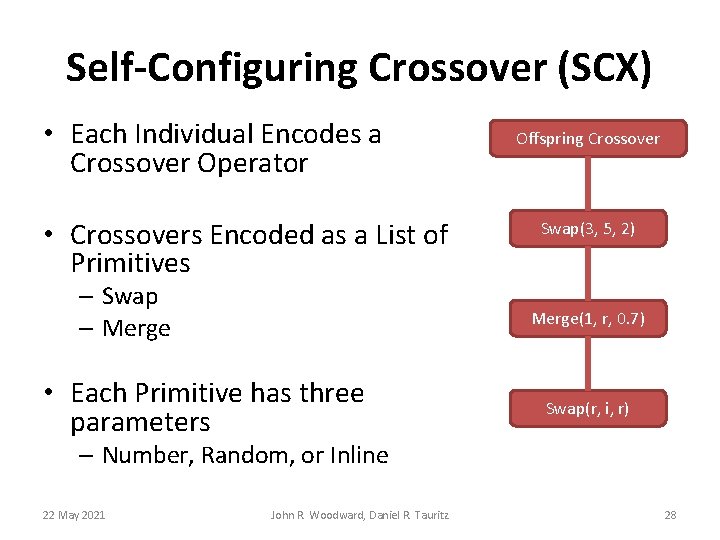
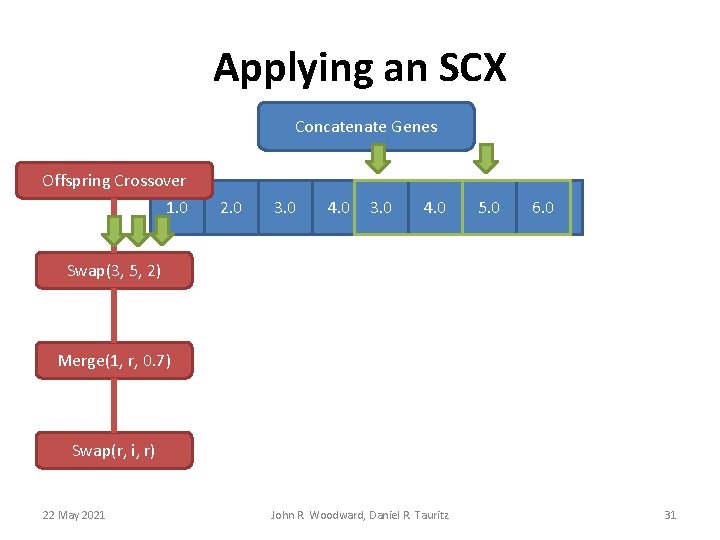
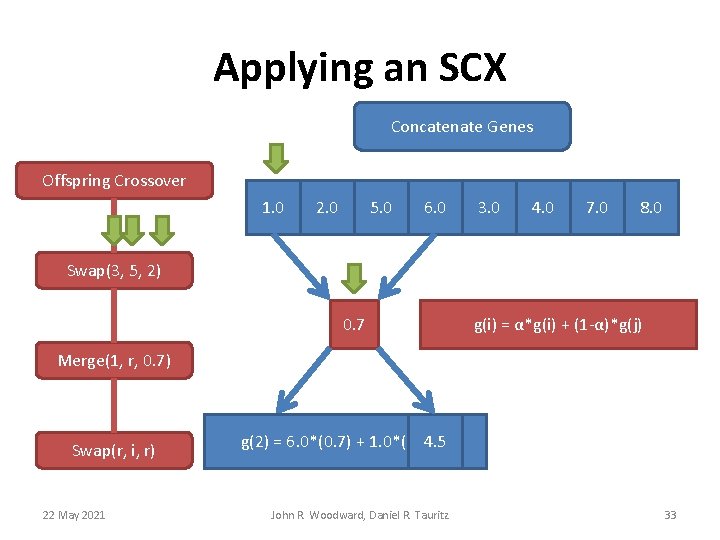
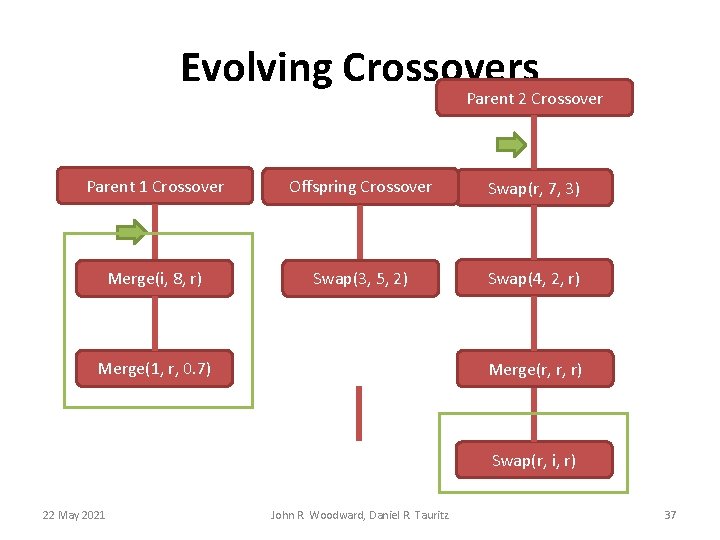
Self-Configuring Crossover (SCX) • Each Individual Encodes a Crossover Operator • Crossovers Encoded as a List of Primitives – Swap – Merge Offspring Crossover Swap(3, 5, 2) Merge(1, r, 0. 7) • Each Primitive has three parameters Swap(r, i, r) – Number, Random, or Inline 22 May 2021 John R. Woodward, Daniel R. Tauritz 28
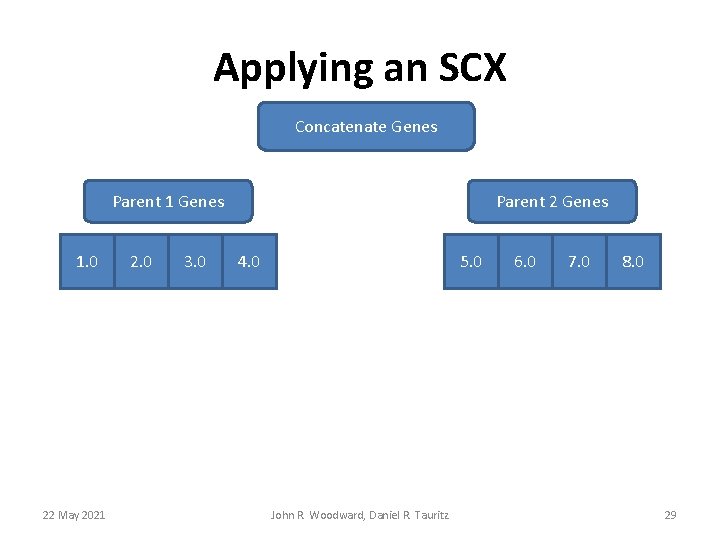
Applying an SCX Concatenate Genes Parent 1 Genes 1. 0 22 May 2021 2. 0 3. 0 Parent 2 Genes 4. 0 5. 0 John R. Woodward, Daniel R. Tauritz 6. 0 7. 0 8. 0 29
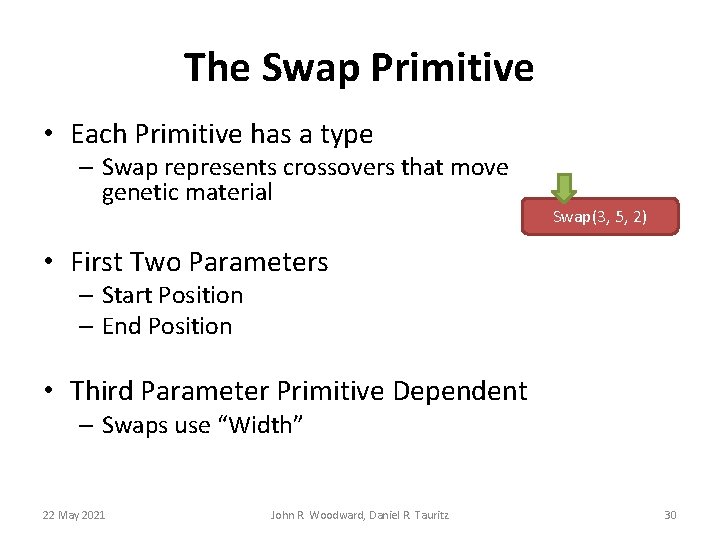
The Swap Primitive • Each Primitive has a type – Swap represents crossovers that move genetic material Swap(3, 5, 2) • First Two Parameters – Start Position – End Position • Third Parameter Primitive Dependent – Swaps use “Width” 22 May 2021 John R. Woodward, Daniel R. Tauritz 30
Applying an SCX Concatenate Genes Offspring Crossover 1. 0 2. 0 3. 0 4. 0 3. 0 5. 0 4. 0 6. 0 5. 0 7. 0 6. 0 8. 0 Swap(3, 5, 2) Merge(1, r, 0. 7) Swap(r, i, r) 22 May 2021 John R. Woodward, Daniel R. Tauritz 31
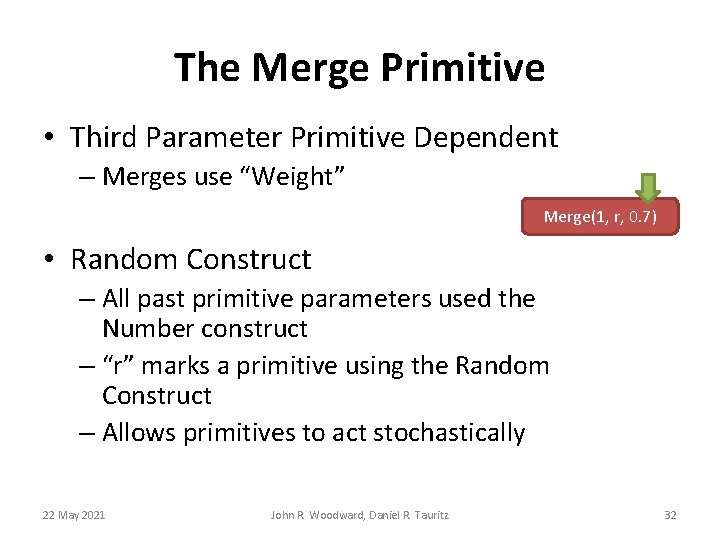
The Merge Primitive • Third Parameter Primitive Dependent – Merges use “Weight” Merge(1, r, 0. 7) • Random Construct – All past primitive parameters used the Number construct – “r” marks a primitive using the Random Construct – Allows primitives to act stochastically 22 May 2021 John R. Woodward, Daniel R. Tauritz 32
Applying an SCX Concatenate Genes Offspring Crossover 1. 0 2. 0 5. 0 6. 0 3. 0 4. 0 7. 0 8. 0 Swap(3, 5, 2) 0. 7 g(i) = α*g(i) + (1 -α)*g(j) Merge(1, r, 0. 7) Swap(r, i, r) 22 May 2021 g(1)2. 5 g(2) = 6. 0*(0. 7) 1. 0*(0. 7) + 1. 0*(1 -0. 7) 6. 0*(1 -0. 7) 4. 5 John R. Woodward, Daniel R. Tauritz 33
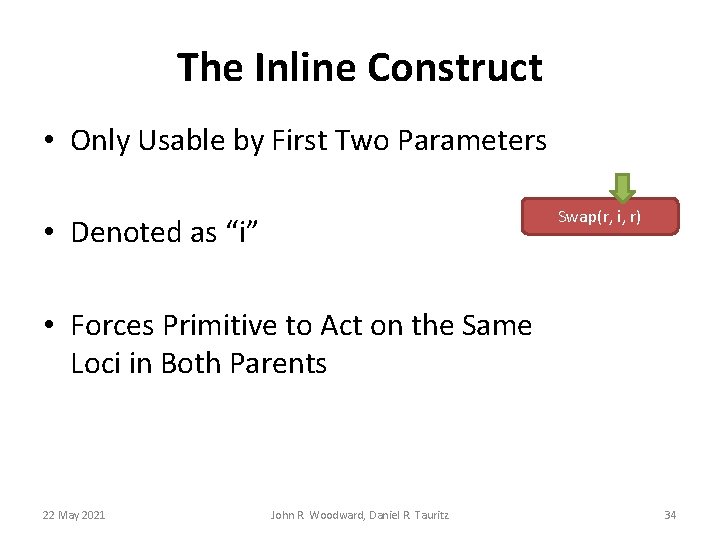
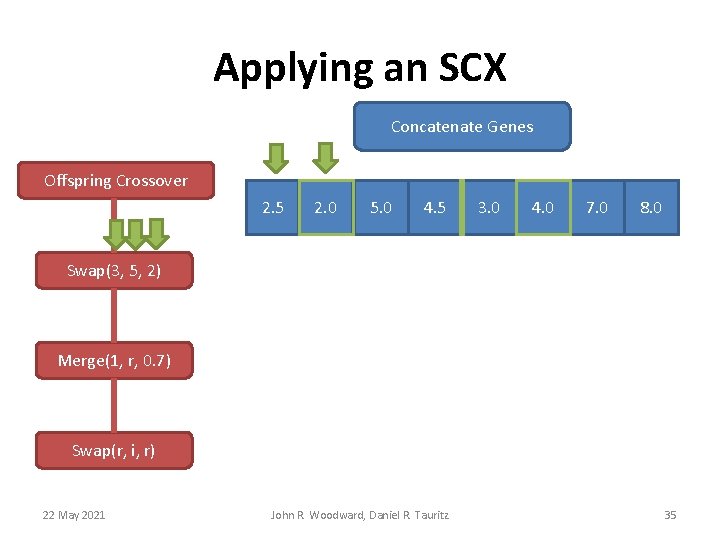
The Inline Construct • Only Usable by First Two Parameters Swap(r, i, r) • Denoted as “i” • Forces Primitive to Act on the Same Loci in Both Parents 22 May 2021 John R. Woodward, Daniel R. Tauritz 34
Applying an SCX Concatenate Genes Offspring Crossover 2. 5 2. 0 5. 0 4. 5 3. 0 4. 0 7. 0 8. 0 Swap(3, 5, 2) Merge(1, r, 0. 7) Swap(r, i, r) 22 May 2021 John R. Woodward, Daniel R. Tauritz 35
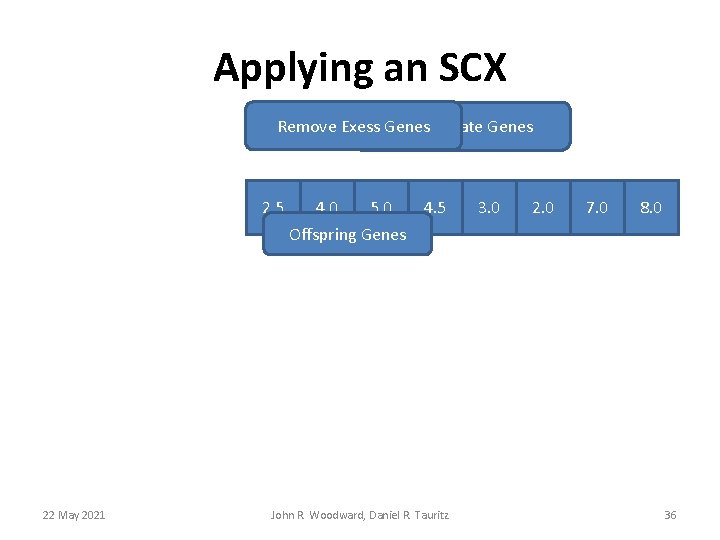
Applying an SCX Remove Exess Genes Concatenate Genes 2. 5 22 May 2021 4. 0 5. 0 4. 5 Offspring Genes John R. Woodward, Daniel R. Tauritz 3. 0 2. 0 7. 0 8. 0 36
Evolving Crossovers Parent 2 Crossover Parent 1 Crossover Offspring Crossover Swap(r, 7, 3) Merge(i, 8, r) Swap(3, 5, 2) Swap(4, 2, r) Merge(1, r, 0. 7) Merge(r, r, r) Swap(r, i, r) 22 May 2021 John R. Woodward, Daniel R. Tauritz 37
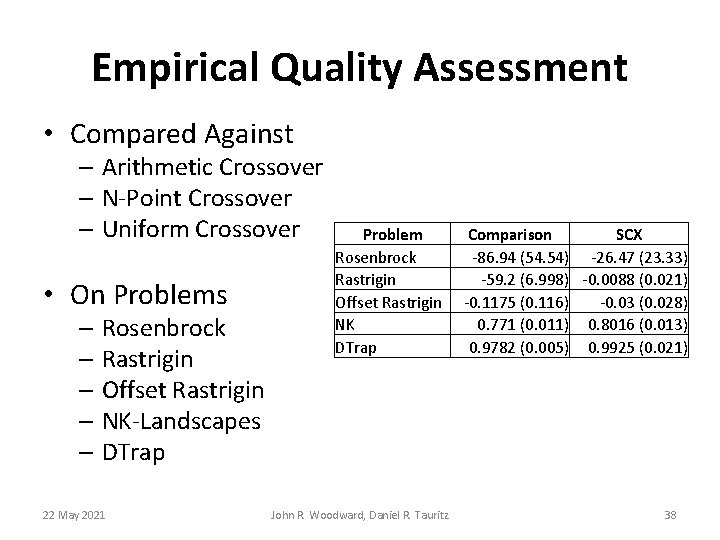
Empirical Quality Assessment • Compared Against – Arithmetic Crossover – N-Point Crossover – Uniform Crossover • On Problems – Rosenbrock – Rastrigin – Offset Rastrigin – NK-Landscapes – DTrap 22 May 2021 Problem Rosenbrock Rastrigin Offset Rastrigin NK DTrap John R. Woodward, Daniel R. Tauritz Comparison SCX -86. 94 (54. 54) -26. 47 (23. 33) -59. 2 (6. 998) -0. 0088 (0. 021) -0. 1175 (0. 116) -0. 03 (0. 028) 0. 771 (0. 011) 0. 8016 (0. 013) 0. 9782 (0. 005) 0. 9925 (0. 021) 38
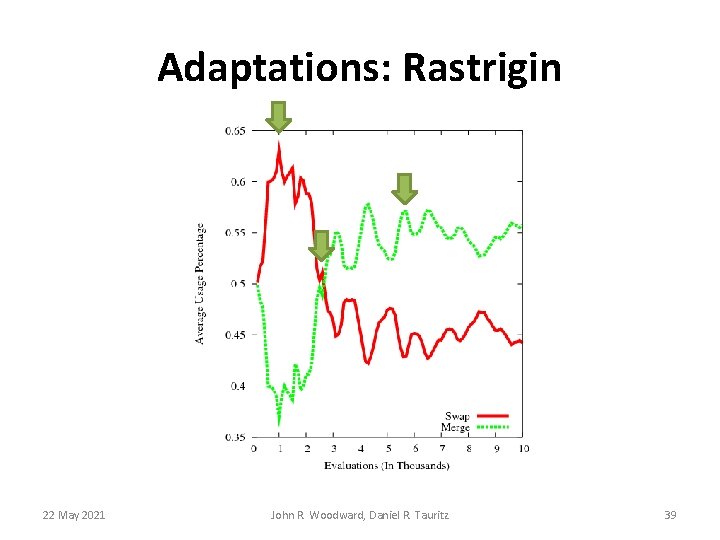
Adaptations: Rastrigin 22 May 2021 John R. Woodward, Daniel R. Tauritz 39
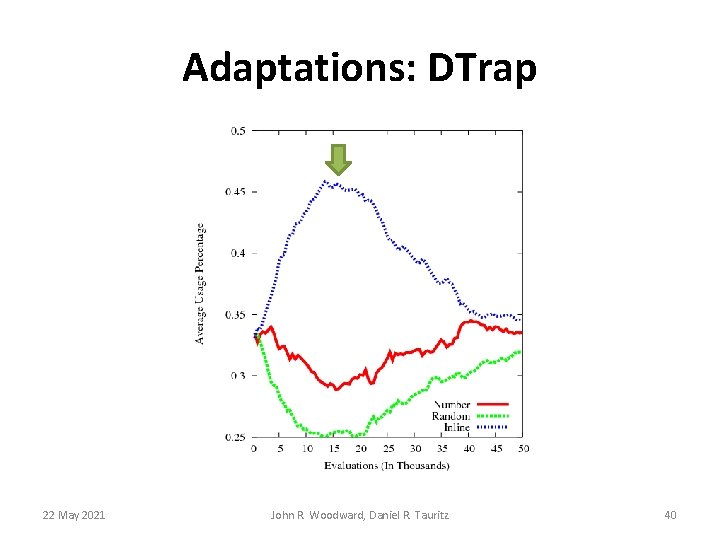
Adaptations: DTrap 22 May 2021 John R. Woodward, Daniel R. Tauritz 40
SCX Overhead • Requires No Additional Evaluation • Adds No Significant Increase in Run Time – All linear operations • Adds Initial Crossover Length Parameter – Testing showed results fairly insensitive to this parameter – Even worst settings tested achieved better results than comparison operators 22 May 2021 John R. Woodward, Daniel R. Tauritz 41
Conclusions • Remove Need to Select Crossover Algorithm • Better Fitness Without Significant Overhead • Benefits From Dynamically Changing Operator • Promising Approach for Evolving Crossover Operators for Additional Representations (e. g. , Permutations) 22 May 2021 John R. Woodward, Daniel R. Tauritz 42
Additions to Genetic Programming 1. final program is part human constrained part (forloop) machine generated (body of for-loop). 2. In GP the initial population is typically randomly created. Here we (can) initialize the population with already known good solutions (which also confirms that we can express the solutions). (improving rather than evolving from scratch) – standing on shoulders of giants. Like genetically modified crops – we start from existing crops. 3. Evolving on problem classes (samples of problem instances drawn from a problem class) not instances. 22 May 2021 John R. Woodward, Daniel R. Tauritz 43
Problem Classes Do Occur 1. Problem classes are probability distributions over problem instances. 2. Travelling Salesman 1. Distribution of cities over different counties 2. E. g. USA is square, Japan is long and narrow. 3. Bin Packing & Knapsack Problem 1. The items are drawn from some probability distribution. 4. Problem classes do occur in the real-world 5. Next slides demonstrate problem classes and scalability with on-line bin packing. 22 May 2021 John R. Woodward, Daniel R. Tauritz 44
Case Study 3: The Automated Design of Mutation Operators 22 May 2021 John R. Woodward, Daniel R. Tauritz 45
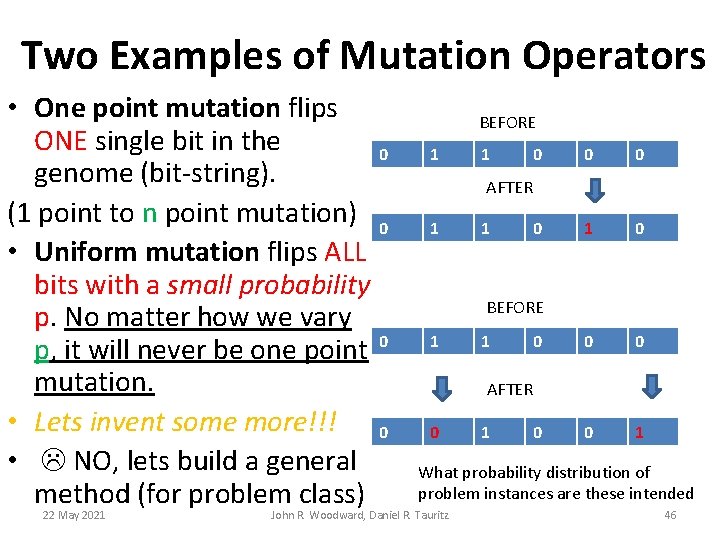
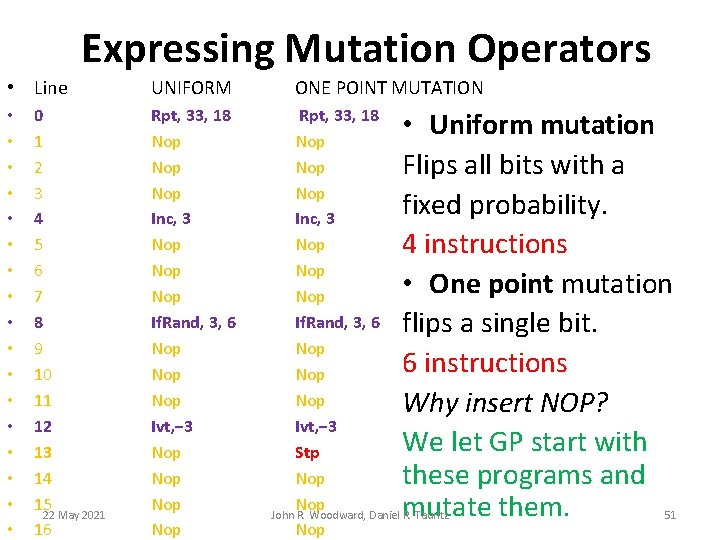
Two Examples of Mutation Operators • One point mutation flips ONE single bit in the 0 genome (bit-string). (1 point to n point mutation) 0 • Uniform mutation flips ALL bits with a small probability p. No matter how we vary p, it will never be one point 0 mutation. • Lets invent some more!!! 0 • NO, lets build a general method (for problem class) 22 May 2021 BEFORE 1 1 0 0 0 0 1 AFTER 1 1 BEFORE 1 1 0 AFTER 0 1 0 What probability distribution of problem instances are these intended John R. Woodward, Daniel R. Tauritz 46
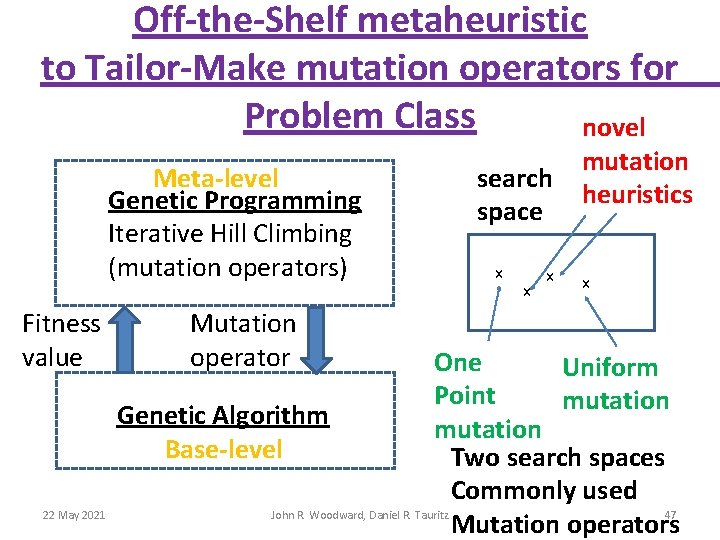
Off-the-Shelf metaheuristic to Tailor-Make mutation operators for Problem Class novel Meta-level Genetic Programming Iterative Hill Climbing (mutation operators) Fitness value 22 May 2021 Mutation operator search space x x x mutation heuristics x One Uniform Point mutation Genetic Algorithm mutation Base-level Two search spaces Commonly used John R. Woodward, Daniel R. Tauritz 47 Mutation operators
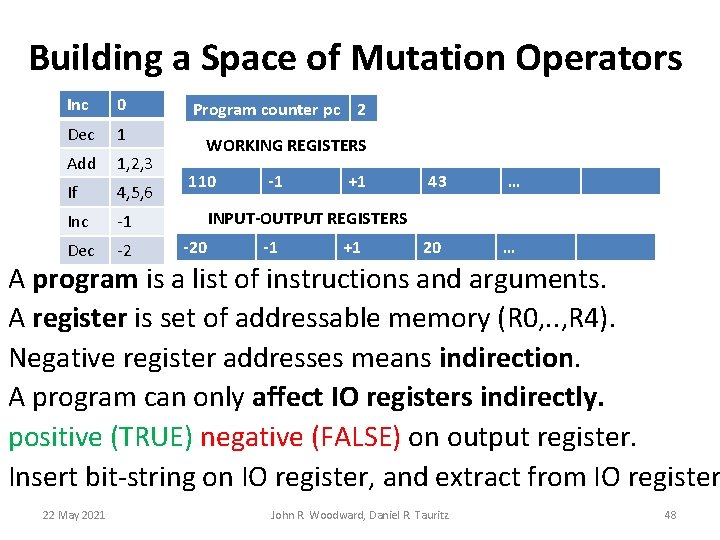
Building a Space of Mutation Operators Inc 0 Dec 1 Add 1, 2, 3 If 4, 5, 6 Inc -1 Dec -2 Program counter pc 2 WORKING REGISTERS 110 -1 +1 43 … 20 … INPUT-OUTPUT REGISTERS -20 -1 +1 A program is a list of instructions and arguments. A register is set of addressable memory (R 0, . . , R 4). Negative register addresses means indirection. A program can only affect IO registers indirectly. positive (TRUE) negative (FALSE) on output register. Insert bit-string on IO register, and extract from IO register 22 May 2021 John R. Woodward, Daniel R. Tauritz 48
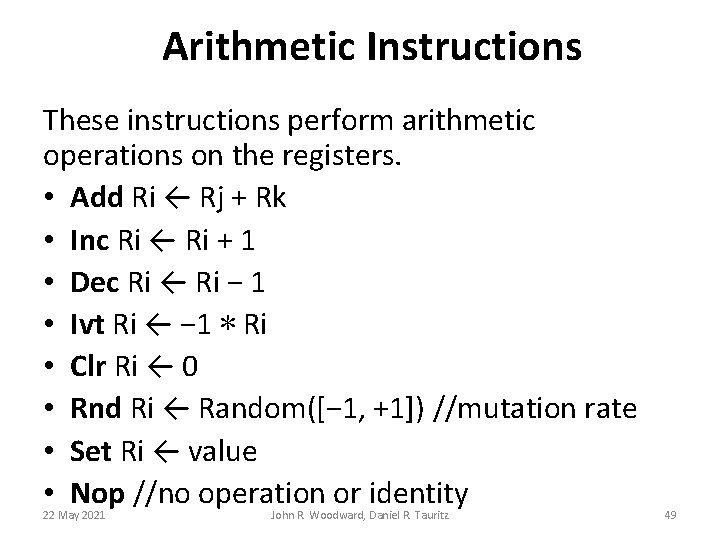
Arithmetic Instructions These instructions perform arithmetic operations on the registers. • Add Ri ← Rj + Rk • Inc Ri ← Ri + 1 • Dec Ri ← Ri − 1 • Ivt Ri ← − 1 ∗ Ri • Clr Ri ← 0 • Rnd Ri ← Random([− 1, +1]) //mutation rate • Set Ri ← value • Nop //no operation or identity 22 May 2021 John R. Woodward, Daniel R. Tauritz 49
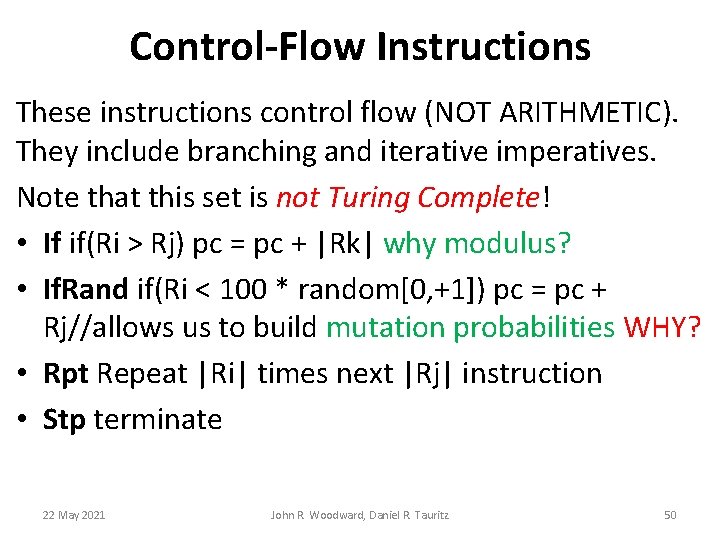
Control-Flow Instructions These instructions control flow (NOT ARITHMETIC). They include branching and iterative imperatives. Note that this set is not Turing Complete! • If if(Ri > Rj) pc = pc + |Rk| why modulus? • If. Rand if(Ri < 100 * random[0, +1]) pc = pc + Rj//allows us to build mutation probabilities WHY? • Rpt Repeat |Ri| times next |Rj| instruction • Stp terminate 22 May 2021 John R. Woodward, Daniel R. Tauritz 50
Expressing Mutation Operators • Line • • • • • 0 1 2 3 4 5 6 7 8 9 10 11 12 13 14 15 22 May 2021 16 UNIFORM Rpt, 33, 18 Nop Nop Inc, 3 Nop Nop If. Rand, 3, 6 Nop Nop Ivt, − 3 Nop Nop ONE POINT MUTATION Rpt, 33, 18 Nop Nop Inc, 3 Nop Nop If. Rand, 3, 6 Nop Nop Ivt, − 3 Stp Nop John R. Woodward, Daniel R. Tauritz Nop • Uniform mutation Flips all bits with a fixed probability. 4 instructions • One point mutation flips a single bit. 6 instructions Why insert NOP? We let GP start with these programs and mutate them. 51
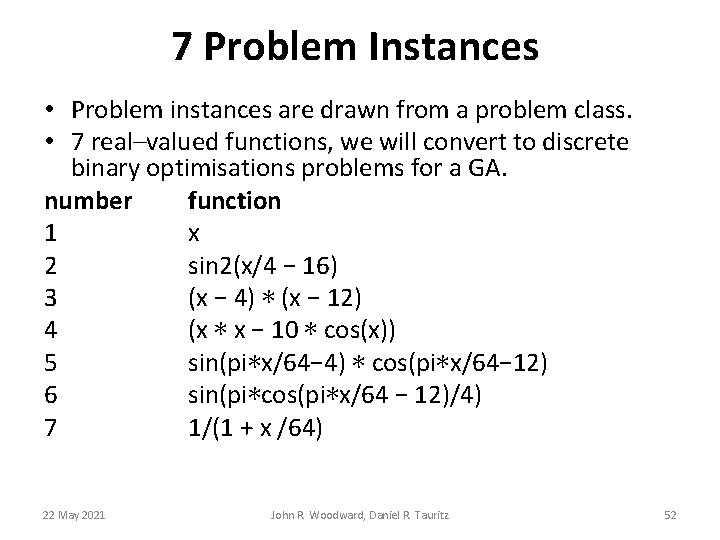
7 Problem Instances • Problem instances are drawn from a problem class. • 7 real–valued functions, we will convert to discrete binary optimisations problems for a GA. number function 1 x 2 sin 2(x/4 − 16) 3 (x − 4) ∗ (x − 12) 4 (x ∗ x − 10 ∗ cos(x)) 5 sin(pi∗x/64− 4) ∗ cos(pi∗x/64− 12) 6 sin(pi∗cos(pi∗x/64 − 12)/4) 7 1/(1 + x /64) 22 May 2021 John R. Woodward, Daniel R. Tauritz 52
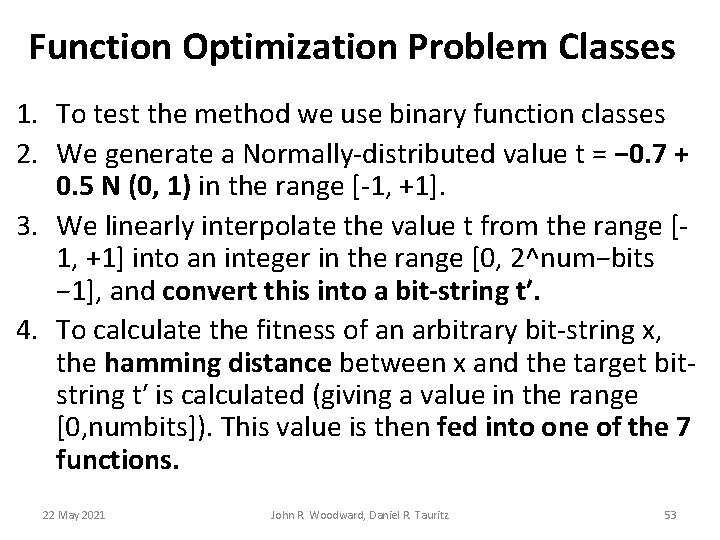
Function Optimization Problem Classes 1. To test the method we use binary function classes 2. We generate a Normally-distributed value t = − 0. 7 + 0. 5 N (0, 1) in the range [-1, +1]. 3. We linearly interpolate the value t from the range [1, +1] into an integer in the range [0, 2^num−bits − 1], and convert this into a bit-string t′. 4. To calculate the fitness of an arbitrary bit-string x, the hamming distance between x and the target bitstring t′ is calculated (giving a value in the range [0, numbits]). This value is then fed into one of the 7 functions. 22 May 2021 John R. Woodward, Daniel R. Tauritz 53
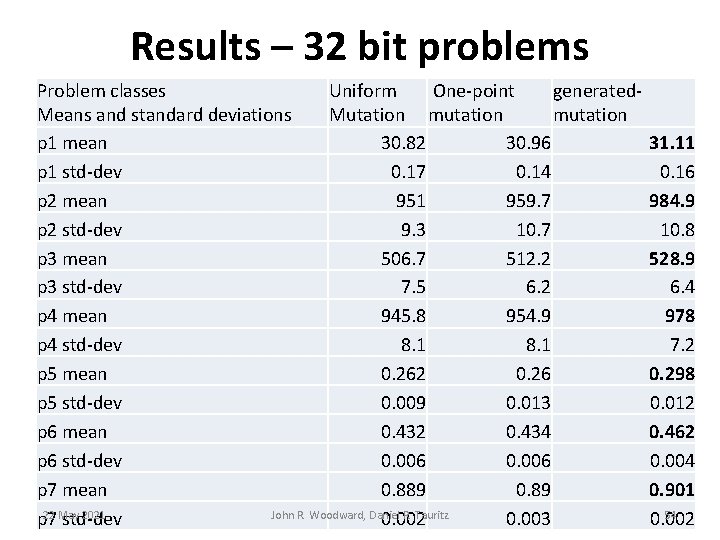
Results – 32 bit problems Problem classes Uniform One-point generated. Means and standard deviations Mutation mutation p 1 mean 30. 82 30. 96 p 1 std-dev 0. 17 0. 14 p 2 mean 951 959. 7 p 2 std-dev 9. 3 10. 7 p 3 mean 506. 7 512. 2 p 3 std-dev 7. 5 6. 2 p 4 mean 945. 8 954. 9 p 4 std-dev 8. 1 p 5 mean 0. 262 0. 26 p 5 std-dev 0. 009 0. 013 p 6 mean 0. 432 0. 434 p 6 std-dev 0. 006 p 7 mean 0. 889 0. 89 22 May 2021 John R. Woodward, Daniel R. Tauritz p 7 std-dev 0. 002 0. 003 31. 11 0. 16 984. 9 10. 8 528. 9 6. 4 978 7. 2 0. 298 0. 012 0. 462 0. 004 0. 901 54 0. 002
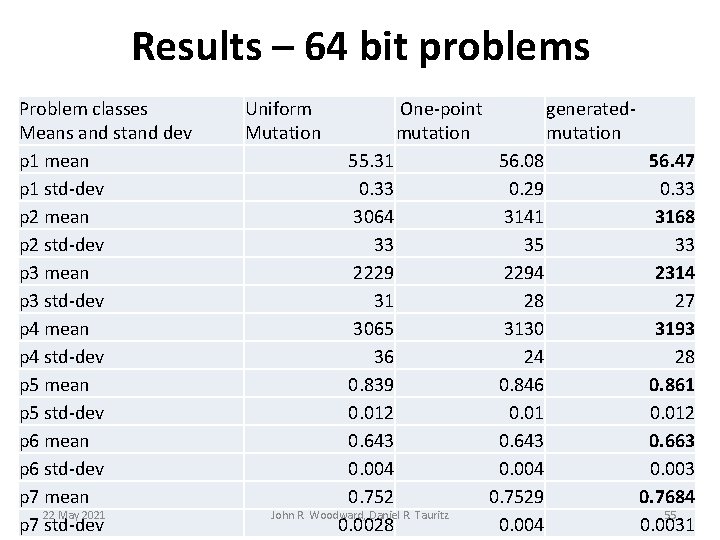
Results – 64 bit problems Problem classes Means and stand dev p 1 mean p 1 std-dev p 2 mean p 2 std-dev p 3 mean p 3 std-dev p 4 mean p 4 std-dev p 5 mean p 5 std-dev p 6 mean p 6 std-dev p 7 mean 22 May 2021 p 7 std-dev Uniform Mutation One-point mutation 55. 31 0. 33 3064 33 2229 31 3065 36 0. 839 0. 012 0. 643 0. 004 0. 752 John R. Woodward, Daniel R. Tauritz 0. 0028 generatedmutation 56. 08 0. 29 3141 35 2294 28 3130 24 0. 846 0. 01 0. 643 0. 004 0. 7529 0. 004 56. 47 0. 33 3168 33 2314 27 3193 28 0. 861 0. 012 0. 663 0. 003 0. 7684 55 0. 0031
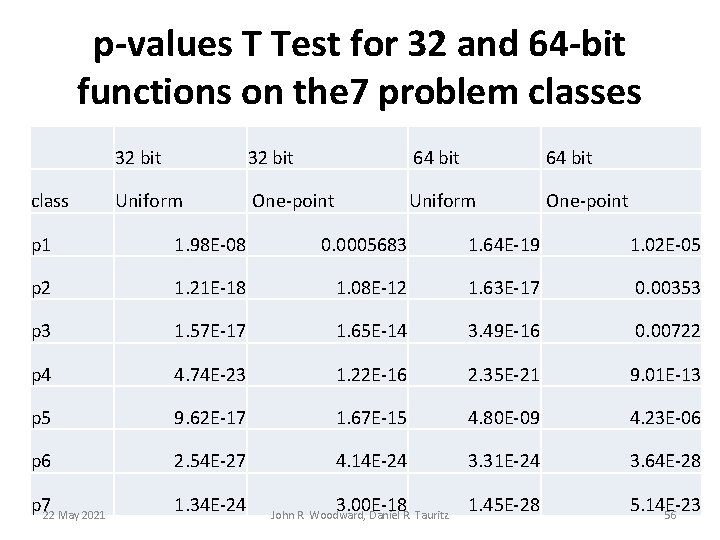
p-values T Test for 32 and 64 -bit functions on the 7 problem classes class 32 bit 64 bit Uniform One-point p 1 1. 98 E-08 0. 0005683 1. 64 E-19 1. 02 E-05 p 2 1. 21 E-18 1. 08 E-12 1. 63 E-17 0. 00353 p 3 1. 57 E-17 1. 65 E-14 3. 49 E-16 0. 00722 p 4 4. 74 E-23 1. 22 E-16 2. 35 E-21 9. 01 E-13 p 5 9. 62 E-17 1. 67 E-15 4. 80 E-09 4. 23 E-06 p 6 2. 54 E-27 4. 14 E-24 3. 31 E-24 3. 64 E-28 p 722 May 2021 1. 34 E-24 3. 00 E-18 1. 45 E-28 5. 14 E-23 56 John R. Woodward, Daniel R. Tauritz
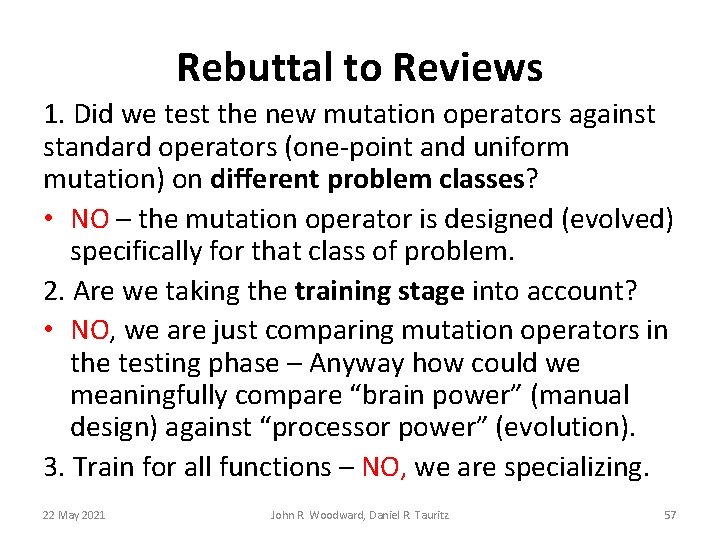
Rebuttal to Reviews 1. Did we test the new mutation operators against standard operators (one-point and uniform mutation) on different problem classes? • NO – the mutation operator is designed (evolved) specifically for that class of problem. 2. Are we taking the training stage into account? • NO, we are just comparing mutation operators in the testing phase – Anyway how could we meaningfully compare “brain power” (manual design) against “processor power” (evolution). 3. Train for all functions – NO, we are specializing. 22 May 2021 John R. Woodward, Daniel R. Tauritz 57
Case Study 4: The Automated Design of Black Box Search Algorithms [21, 23, 25] 22 May 2021 John R. Woodward, Daniel R. Tauritz 58
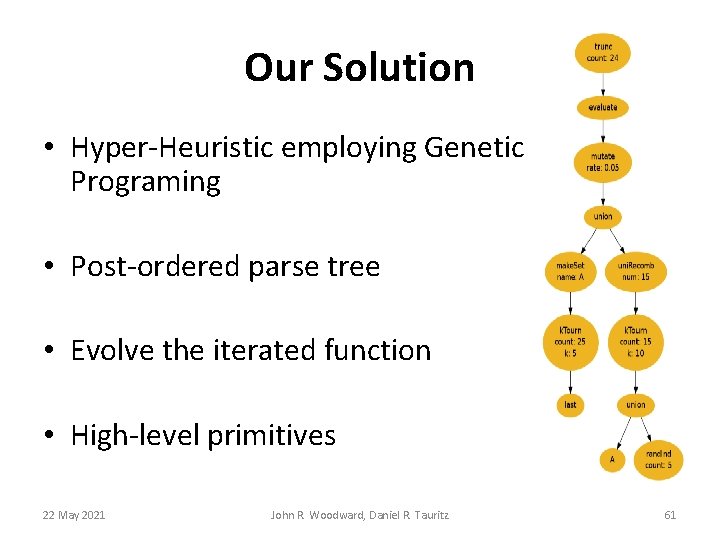
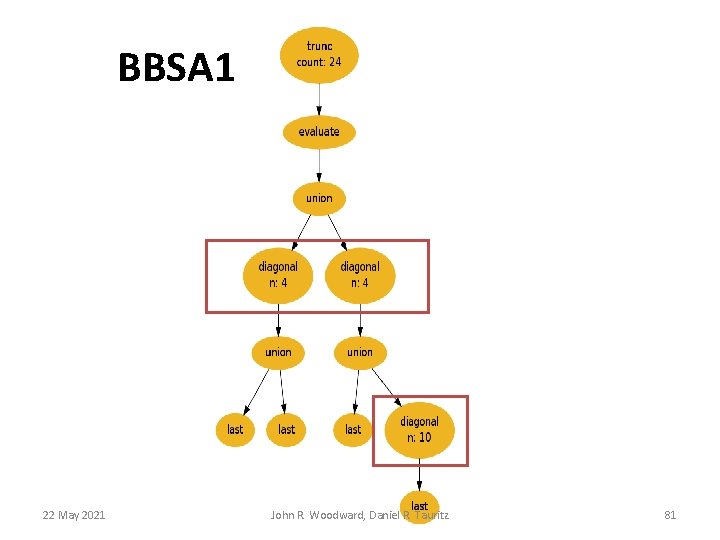
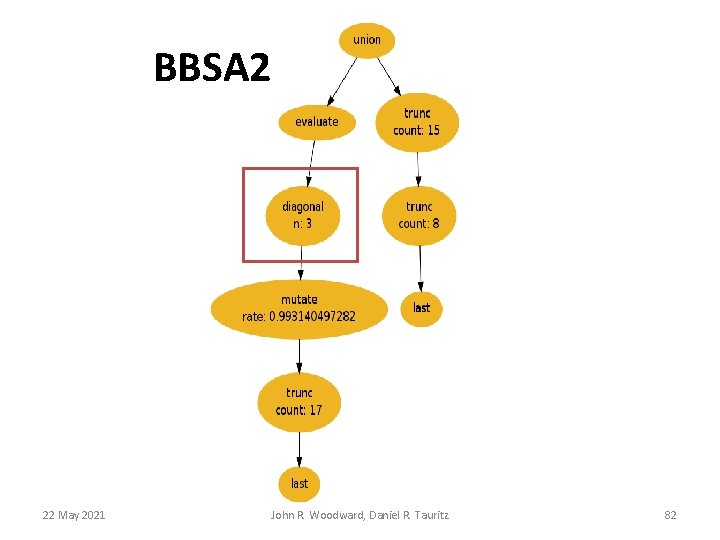
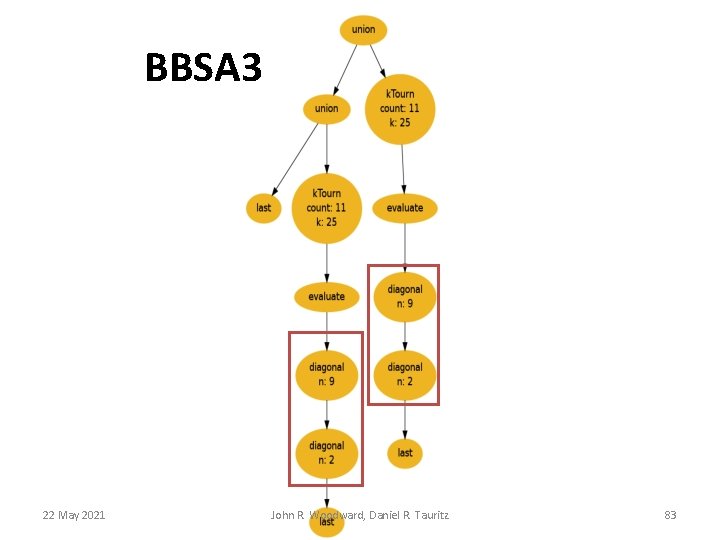
Approach • Hyper-Heuristic employing Genetic Programing • Post-ordered parse tree • Evolve the iterated function 22 May 2021 John R. Woodward, Daniel R. Tauritz 59
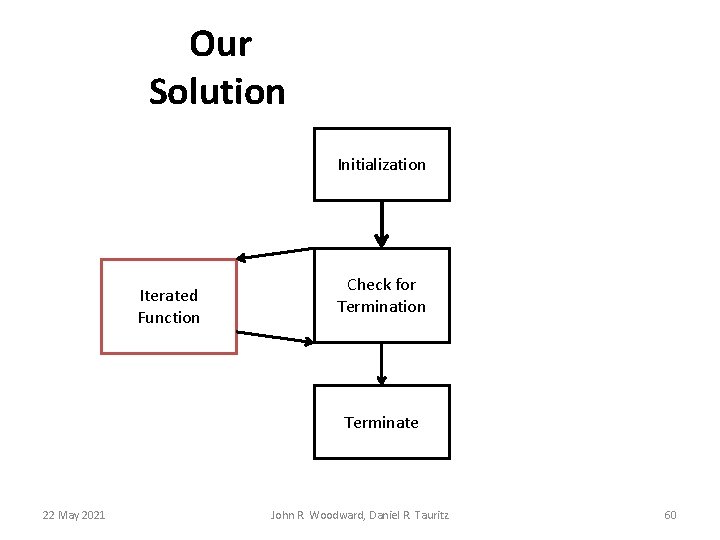
Our Solution Initialization Iterated Function Check for Termination Terminate 22 May 2021 John R. Woodward, Daniel R. Tauritz 60
Our Solution • Hyper-Heuristic employing Genetic Programing • Post-ordered parse tree • Evolve the iterated function • High-level primitives 22 May 2021 John R. Woodward, Daniel R. Tauritz 61
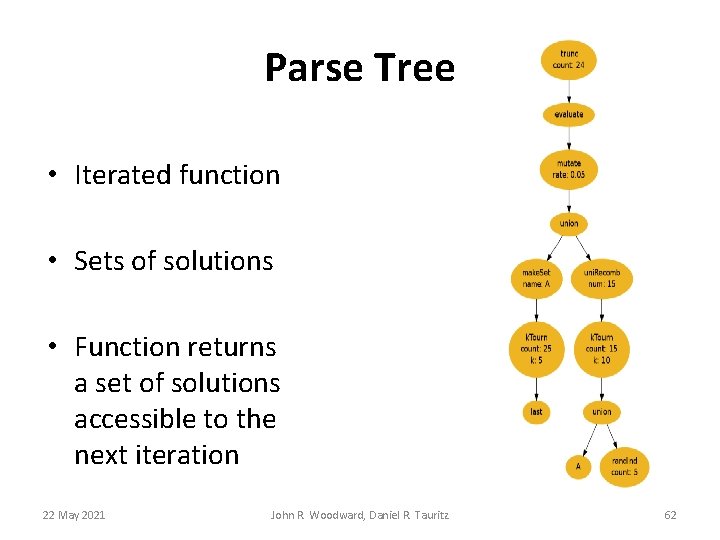
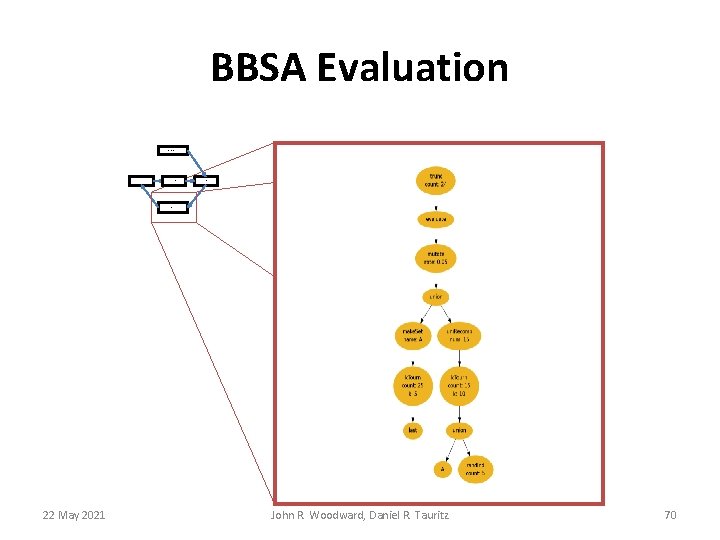
Parse Tree • Iterated function • Sets of solutions • Function returns a set of solutions accessible to the next iteration 22 May 2021 John R. Woodward, Daniel R. Tauritz 62
Primitive Types • Variation Primitives • Selection Primitives • Set Primitives • Evaluation Primitive • Terminal Primitives 22 May 2021 John R. Woodward, Daniel R. Tauritz 63
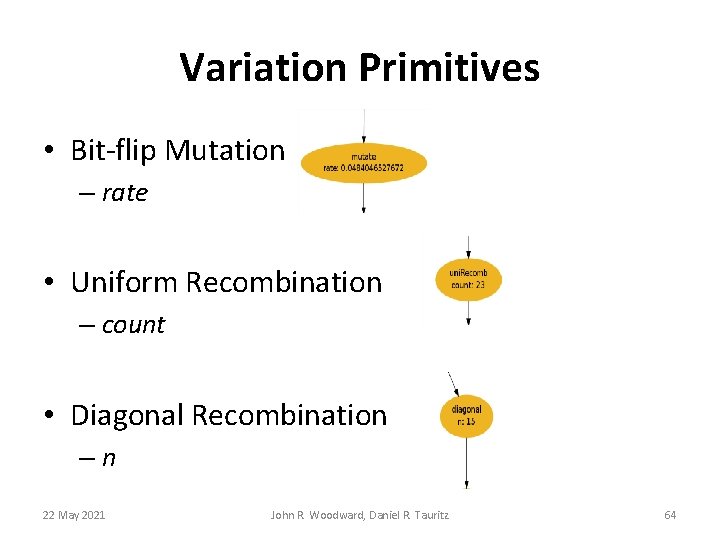
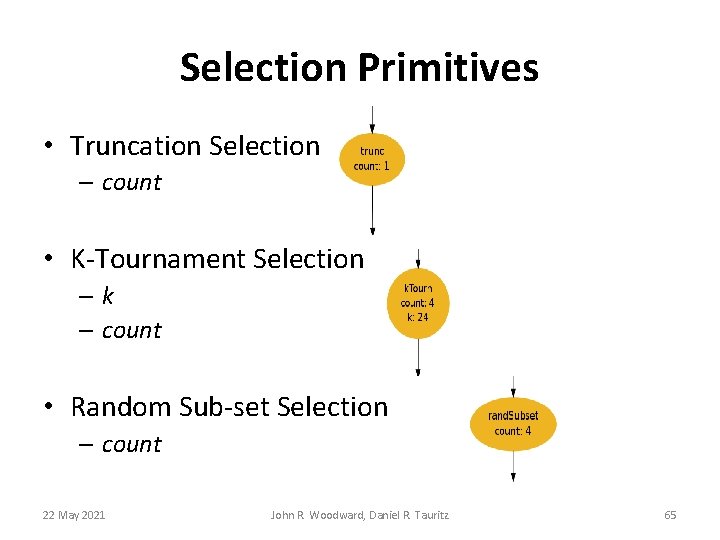
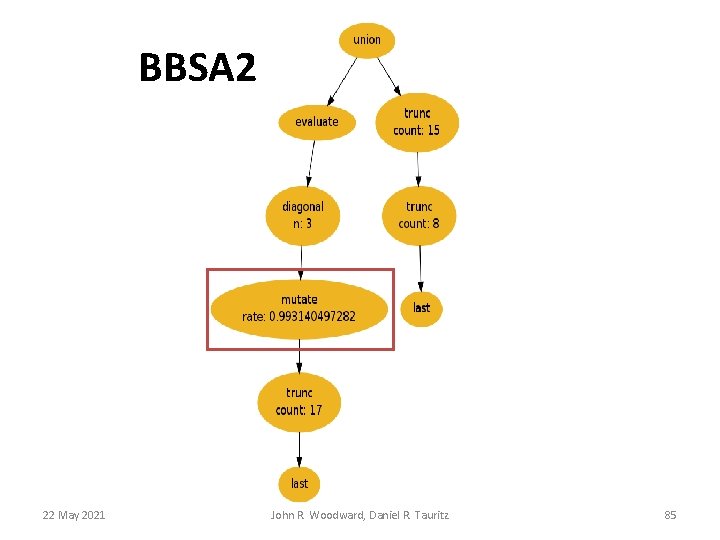
Variation Primitives • Bit-flip Mutation – rate • Uniform Recombination – count • Diagonal Recombination –n 22 May 2021 John R. Woodward, Daniel R. Tauritz 64
Selection Primitives • Truncation Selection – count • K-Tournament Selection –k – count • Random Sub-set Selection – count 22 May 2021 John R. Woodward, Daniel R. Tauritz 65
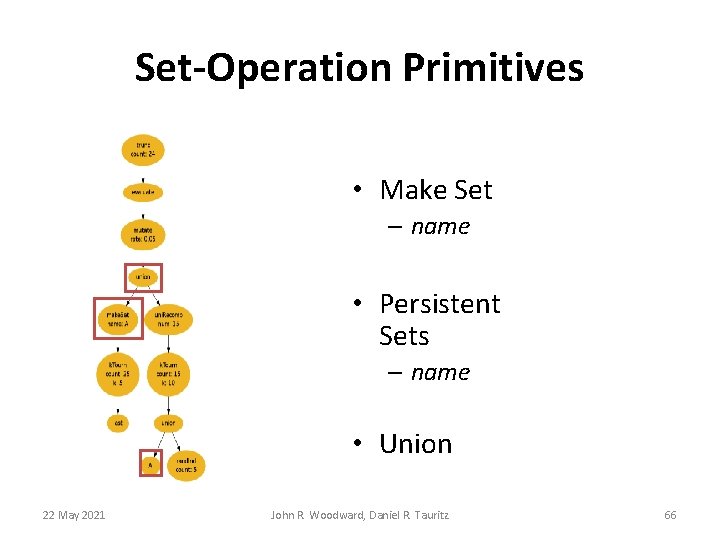
Set-Operation Primitives • Make Set – name • Persistent Sets – name • Union 22 May 2021 John R. Woodward, Daniel R. Tauritz 66
Evaluation Primitive • Evaluates the nodes passed in • Allows multiple operations and accurate selections within an iteration – Allows for deception 22 May 2021 John R. Woodward, Daniel R. Tauritz 67
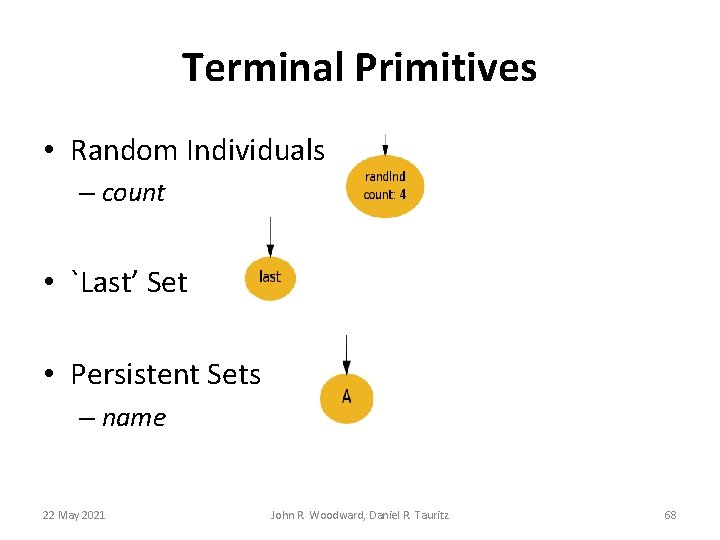
Terminal Primitives • Random Individuals – count • `Last’ Set • Persistent Sets – name 22 May 2021 John R. Woodward, Daniel R. Tauritz 68
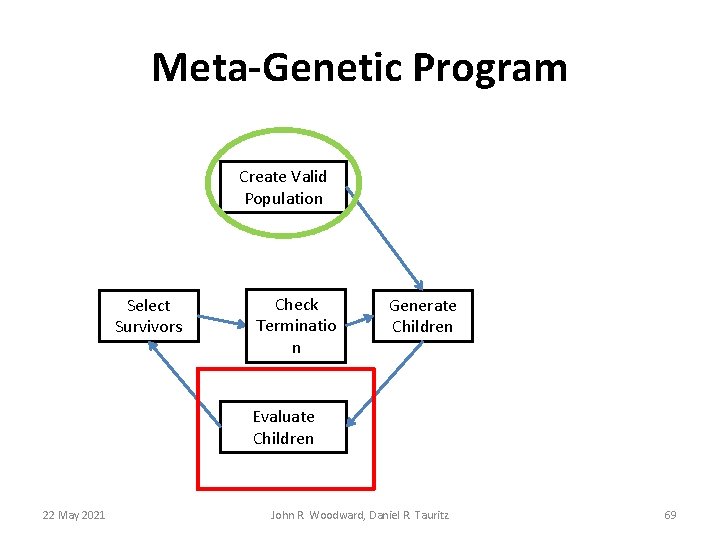
Meta-Genetic Program Create Valid Population Select Survivors Check Terminatio n Generate Children Evaluate Children 22 May 2021 John R. Woodward, Daniel R. Tauritz 69
BBSA Evaluation Create Valid Population Select Survivors Generate Children Evaluate Children 22 May 2021 John R. Woodward, Daniel R. Tauritz 70
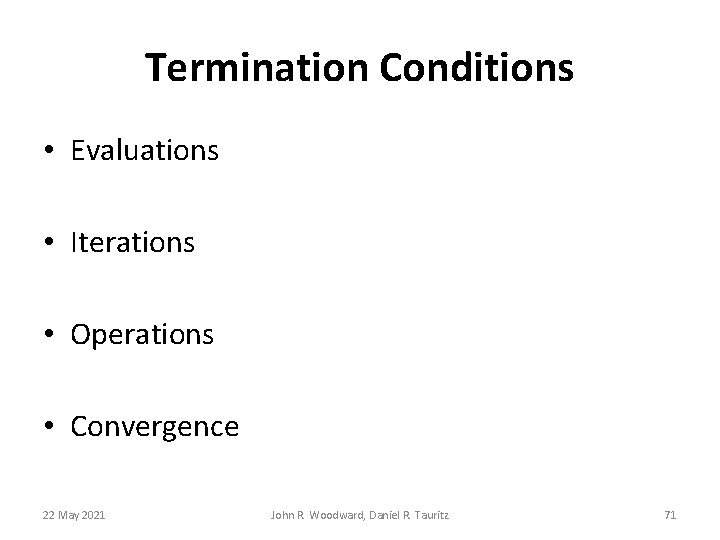
Termination Conditions • Evaluations • Iterations • Operations • Convergence 22 May 2021 John R. Woodward, Daniel R. Tauritz 71
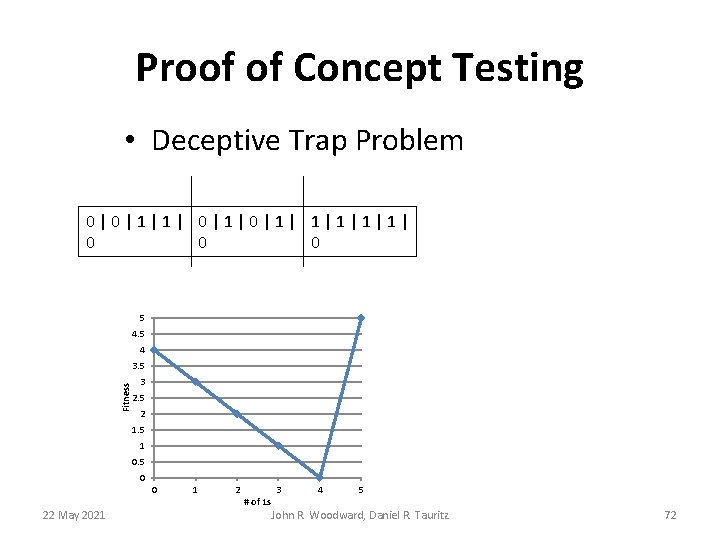
Proof of Concept Testing • Deceptive Trap Problem 0|0|1|1| 0|1| 1|1| 0 0 0 5 4 Fitness 3. 5 3 2. 5 2 1. 5 1 0. 5 0 0 22 May 2021 1 2 # of 1 s 3 4 5 John R. Woodward, Daniel R. Tauritz 72
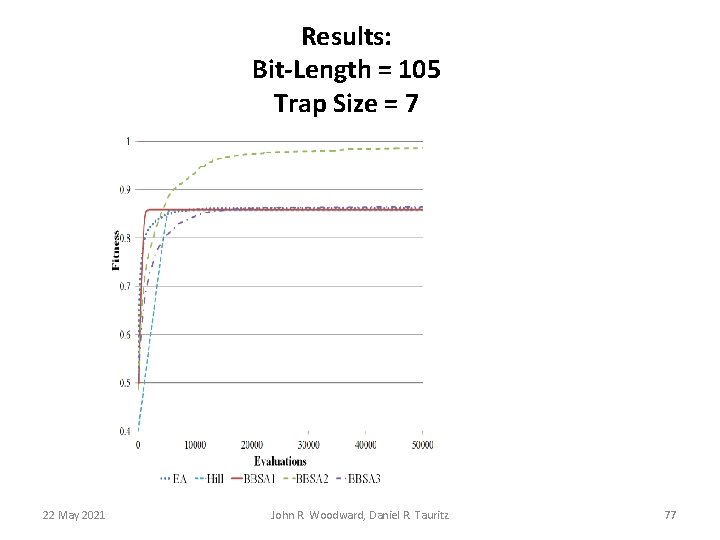
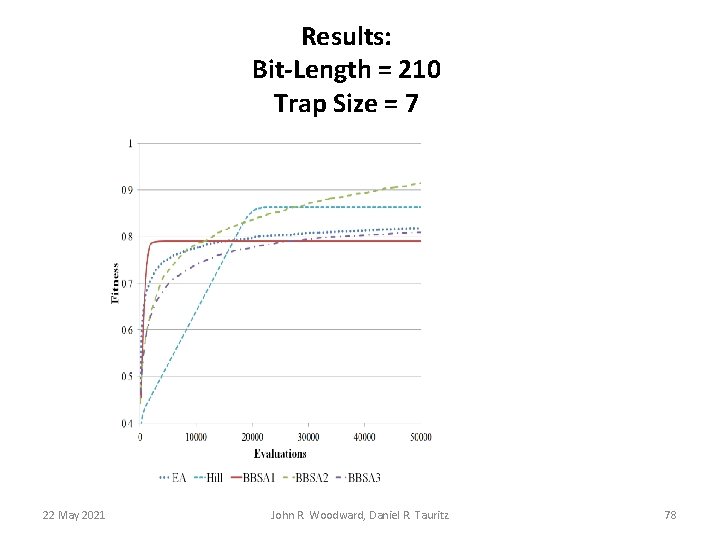
Proof of Concept Testing (cont. ) • Evolved Problem Configuration – Bit-length = 100 – Trap Size = 5 • Verification Problem Configurations – Bit-length = 100, Trap Size = 5 – Bit-length = 200, Trap Size = 5 – Bit-length = 105, Trap Size = 7 – Bit-length = 210, Trap Size = 7 22 May 2021 John R. Woodward, Daniel R. Tauritz 73
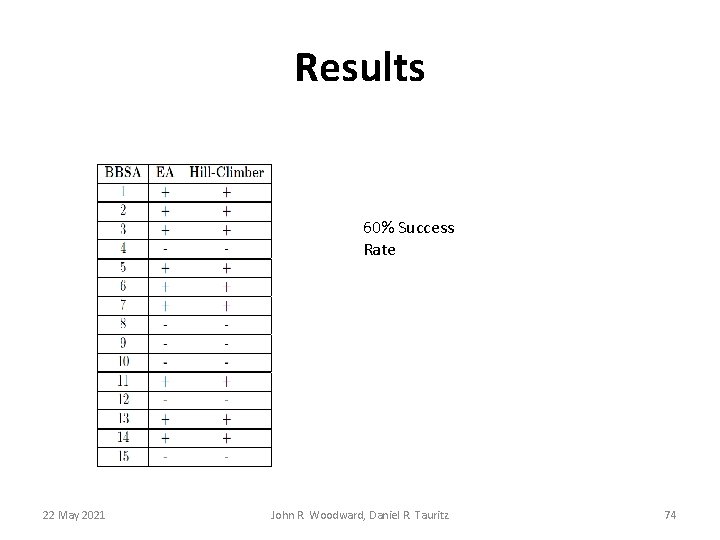
Results 60% Success Rate 22 May 2021 John R. Woodward, Daniel R. Tauritz 74
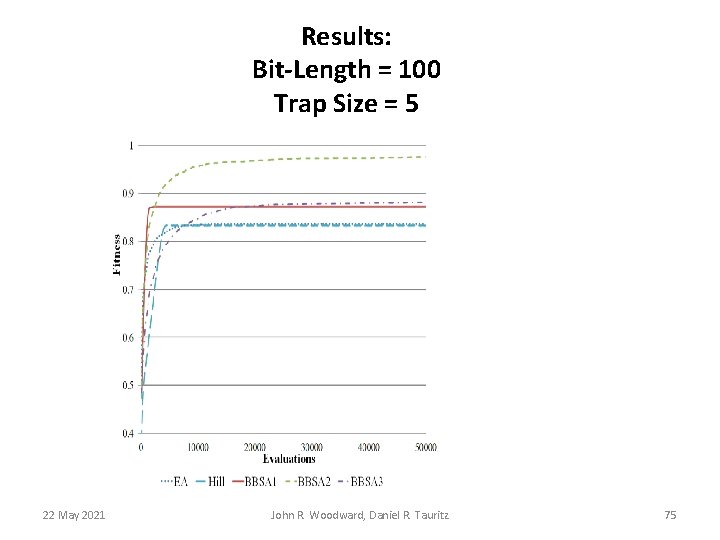
Results: Bit-Length = 100 Trap Size = 5 22 May 2021 John R. Woodward, Daniel R. Tauritz 75
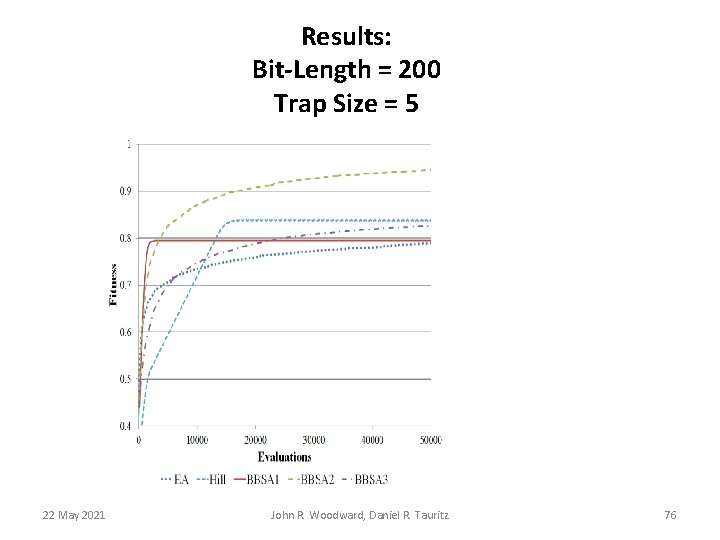
Results: Bit-Length = 200 Trap Size = 5 22 May 2021 John R. Woodward, Daniel R. Tauritz 76
Results: Bit-Length = 105 Trap Size = 7 22 May 2021 John R. Woodward, Daniel R. Tauritz 77
Results: Bit-Length = 210 Trap Size = 7 22 May 2021 John R. Woodward, Daniel R. Tauritz 78
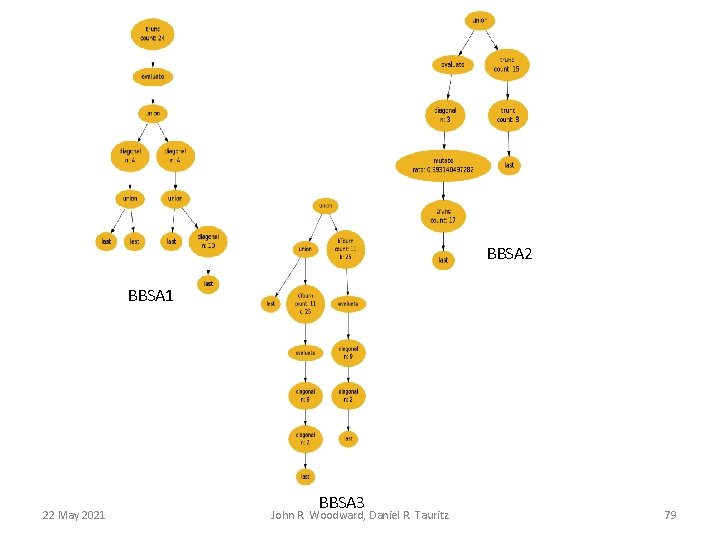
BBSA 2 BBSA 1 22 May 2021 BBSA 3 John R. Woodward, Daniel R. Tauritz 79
Insights • Diagonal Recombination 22 May 2021 John R. Woodward, Daniel R. Tauritz 80
BBSA 1 22 May 2021 John R. Woodward, Daniel R. Tauritz 81
BBSA 2 22 May 2021 John R. Woodward, Daniel R. Tauritz 82
BBSA 3 22 May 2021 John R. Woodward, Daniel R. Tauritz 83
Insights • Diagonal Recombination • Generalization 22 May 2021 John R. Woodward, Daniel R. Tauritz 84
BBSA 2 22 May 2021 John R. Woodward, Daniel R. Tauritz 85
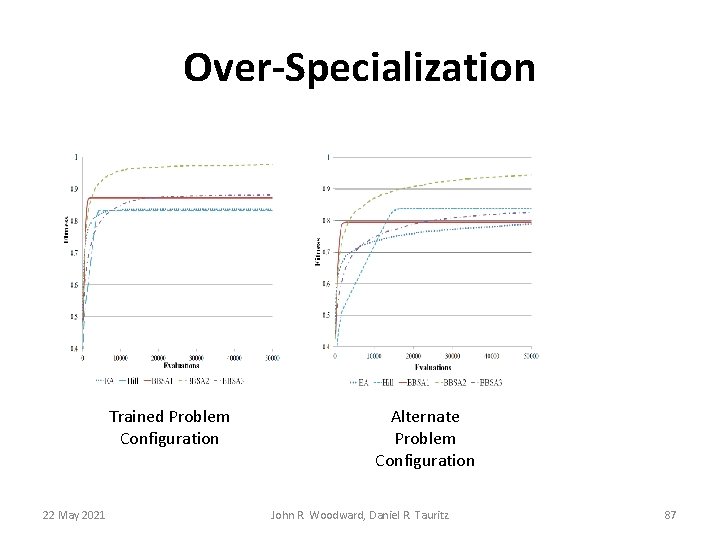
Insights • Diagonal Recombination • Generalization • Over-Specialization 22 May 2021 John R. Woodward, Daniel R. Tauritz 86
Over-Specialization Trained Problem Configuration 22 May 2021 Alternate Problem Configuration John R. Woodward, Daniel R. Tauritz 87
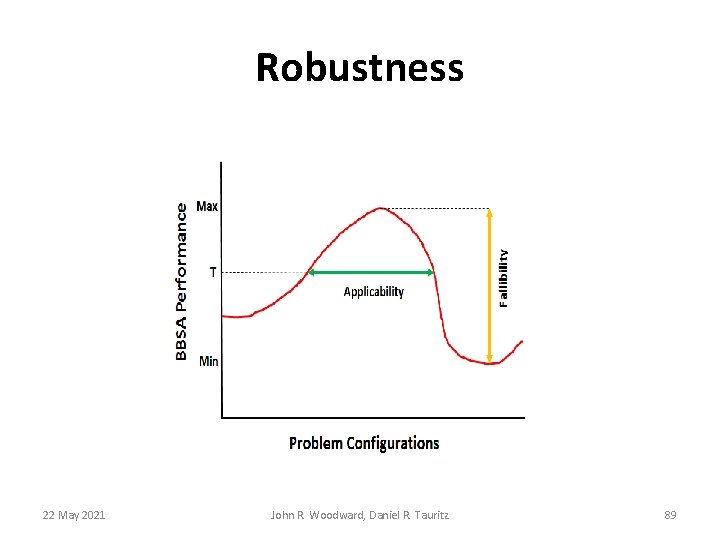
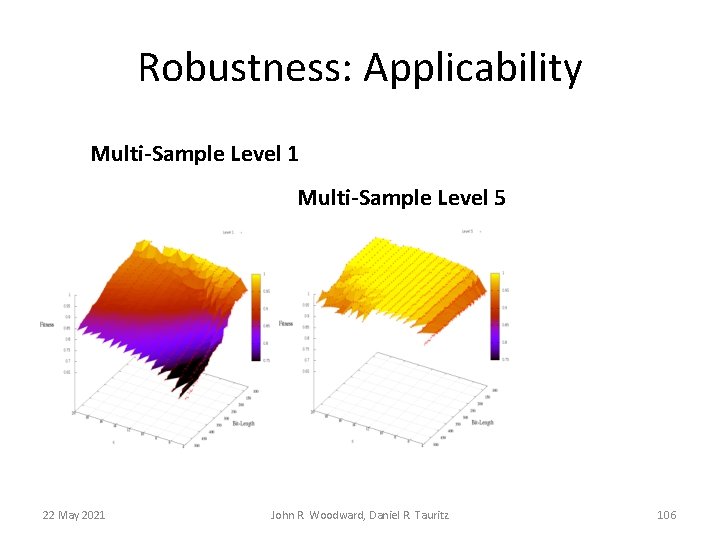
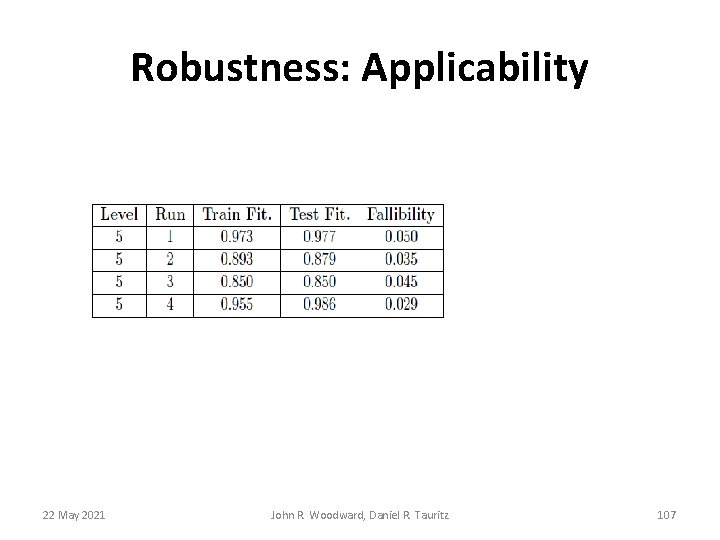
Robustness • Measures of Robustness – Applicability – Fallibility • Applicability – What area of the problem configuration space do I perform well on? • Fallibility – If a given BBSA doesn’t perform well, how much worse will I perform? 22 May 2021 John R. Woodward, Daniel R. Tauritz 88
Robustness 22 May 2021 John R. Woodward, Daniel R. Tauritz 89
Multi-Sampling • Train on multiple problem configurations • Results in more robust BBSAs • Provides the benefit of selecting the region of interest on the problem configuration landscape 22 May 2021 John R. Woodward, Daniel R. Tauritz 90
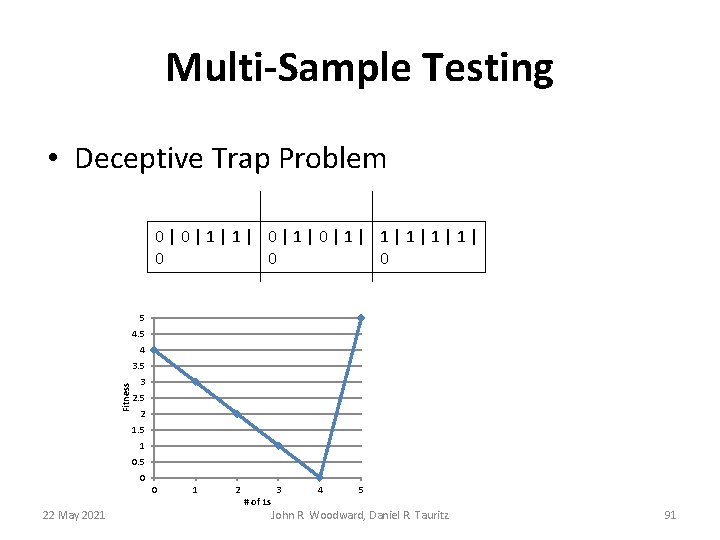
Multi-Sample Testing • Deceptive Trap Problem 0|0|1|1| 0|1| 1|1| 0 0 0 5 4 Fitness 3. 5 3 2. 5 2 1. 5 1 0. 5 0 0 22 May 2021 1 2 # of 1 s 3 4 5 John R. Woodward, Daniel R. Tauritz 91
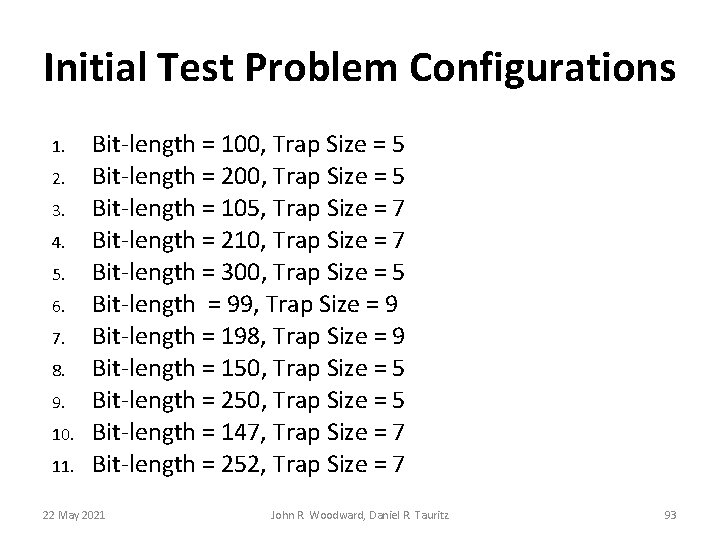
Multi-Sample Testing (cont. ) • Multi-Sampling Evolution – Levels 1 -5 • Training Problem Configurations 1. 2. 3. 4. 5. 22 May 2021 Bit-length = 100, Trap Size = 5 Bit-length = 200, Trap Size = 5 Bit-length = 105, Trap Size = 7 Bit-length = 210, Trap Size = 7 Bit-length = 300, Trap Size = 5 John R. Woodward, Daniel R. Tauritz 92
Initial Test Problem Configurations 1. 2. 3. 4. 5. 6. 7. 8. 9. 10. 11. Bit-length = 100, Trap Size = 5 Bit-length = 200, Trap Size = 5 Bit-length = 105, Trap Size = 7 Bit-length = 210, Trap Size = 7 Bit-length = 300, Trap Size = 5 Bit-length = 99, Trap Size = 9 Bit-length = 198, Trap Size = 9 Bit-length = 150, Trap Size = 5 Bit-length = 250, Trap Size = 5 Bit-length = 147, Trap Size = 7 Bit-length = 252, Trap Size = 7 22 May 2021 John R. Woodward, Daniel R. Tauritz 93
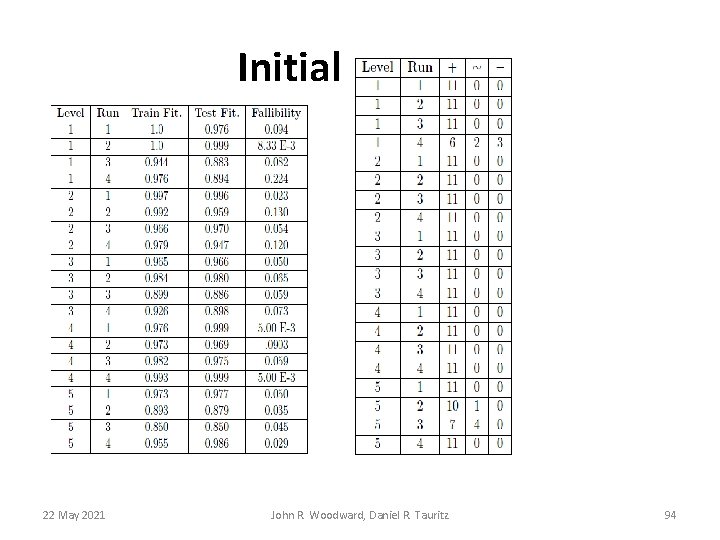
Initial Results 22 May 2021 John R. Woodward, Daniel R. Tauritz 94
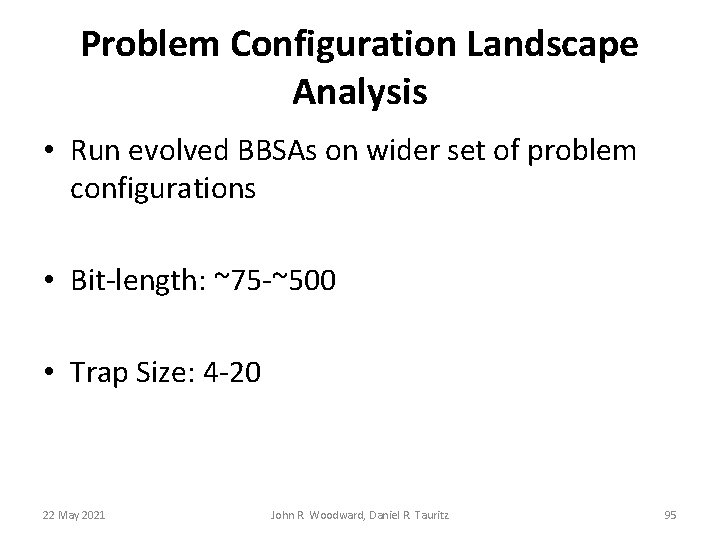
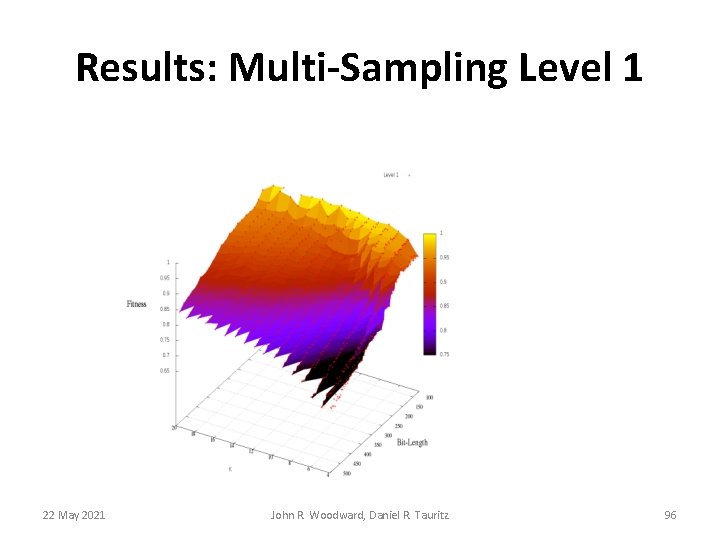
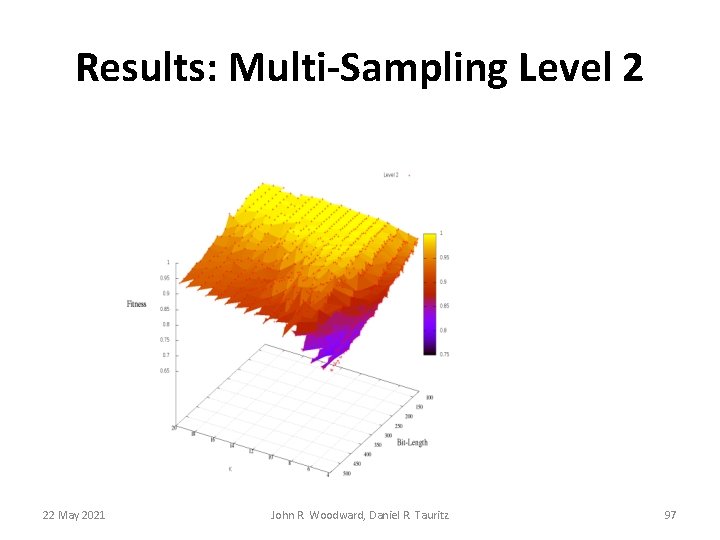
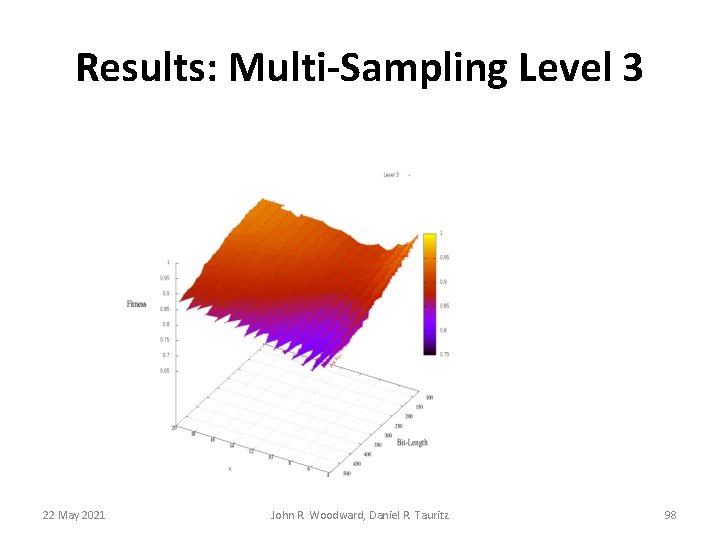
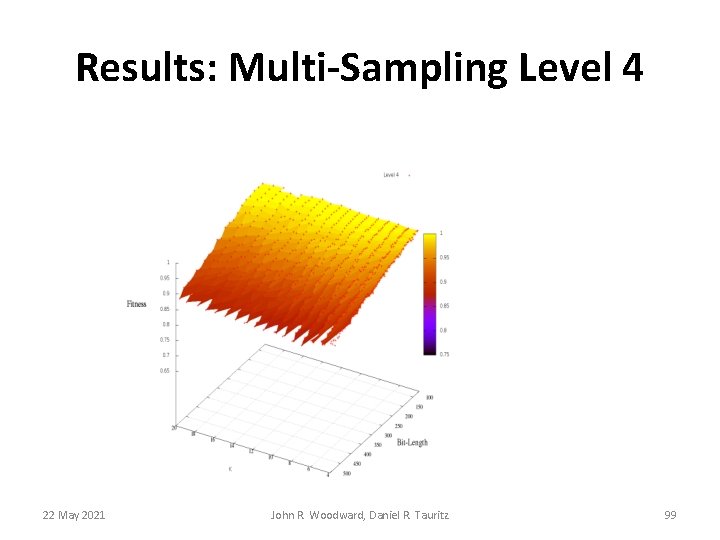
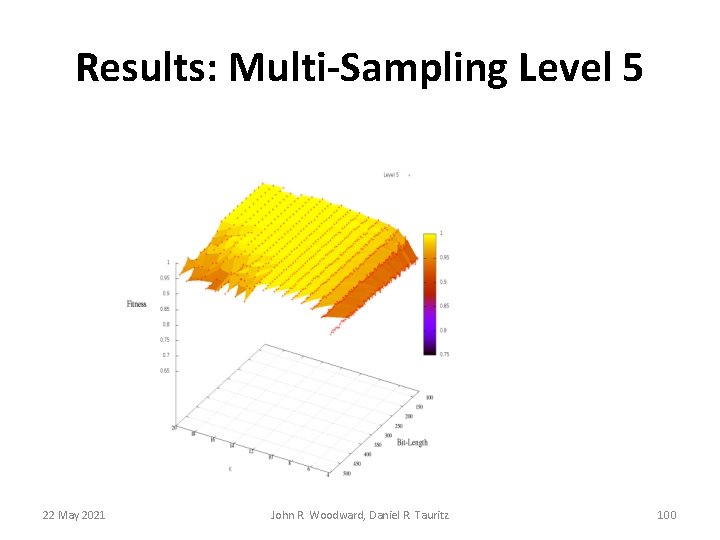
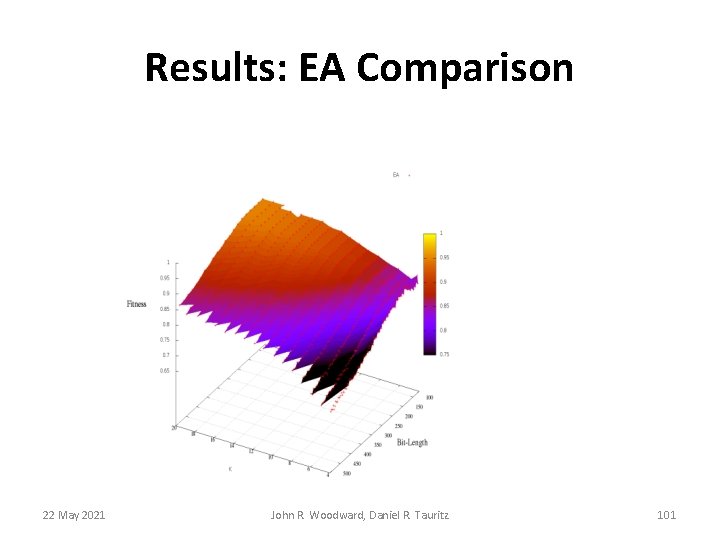
Problem Configuration Landscape Analysis • Run evolved BBSAs on wider set of problem configurations • Bit-length: ~75 -~500 • Trap Size: 4 -20 22 May 2021 John R. Woodward, Daniel R. Tauritz 95
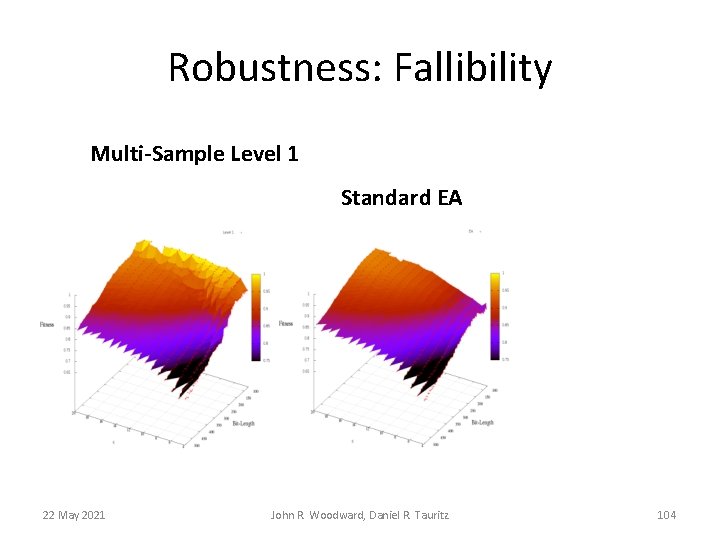
Results: Multi-Sampling Level 1 22 May 2021 John R. Woodward, Daniel R. Tauritz 96
Results: Multi-Sampling Level 2 22 May 2021 John R. Woodward, Daniel R. Tauritz 97
Results: Multi-Sampling Level 3 22 May 2021 John R. Woodward, Daniel R. Tauritz 98
Results: Multi-Sampling Level 4 22 May 2021 John R. Woodward, Daniel R. Tauritz 99
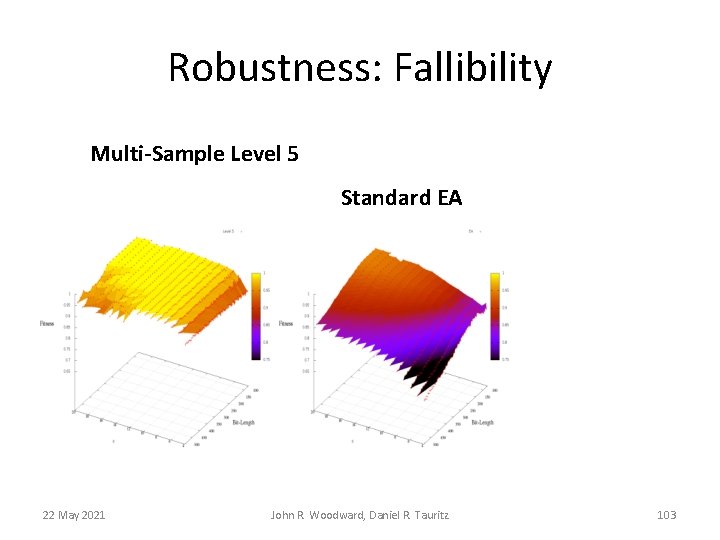
Results: Multi-Sampling Level 5 22 May 2021 John R. Woodward, Daniel R. Tauritz 100
Results: EA Comparison 22 May 2021 John R. Woodward, Daniel R. Tauritz 101
Discussion • Robustness – Fallibility 22 May 2021 John R. Woodward, Daniel R. Tauritz 102
Robustness: Fallibility Multi-Sample Level 5 Standard EA 22 May 2021 John R. Woodward, Daniel R. Tauritz 103
Robustness: Fallibility Multi-Sample Level 1 Standard EA 22 May 2021 John R. Woodward, Daniel R. Tauritz 104
Discussion • Robustness • Fallibility • Applicability 22 May 2021 John R. Woodward, Daniel R. Tauritz 105
Robustness: Applicability Multi-Sample Level 1 Multi-Sample Level 5 22 May 2021 John R. Woodward, Daniel R. Tauritz 106
Robustness: Applicability 22 May 2021 John R. Woodward, Daniel R. Tauritz 107
Drawbacks • Increased computational time – More runs per evaluation (increased wall time) – More problem configurations to optimize for (increased evaluations) 22 May 2021 John R. Woodward, Daniel R. Tauritz 108
Summary of Multi-Sample Improvements • Improved Hyper-Heuristic to evolve more robust BBSAs • Evolved custom BBSA which outperformed standard EA and were robust to changes in problem configuration 22 May 2021 John R. Woodward, Daniel R. Tauritz 109
Case Study 5: The Automated Design of Mutation Operators for Evolutionary Programming 22 May 2021 John R. Woodward, Daniel R. Tauritz 110
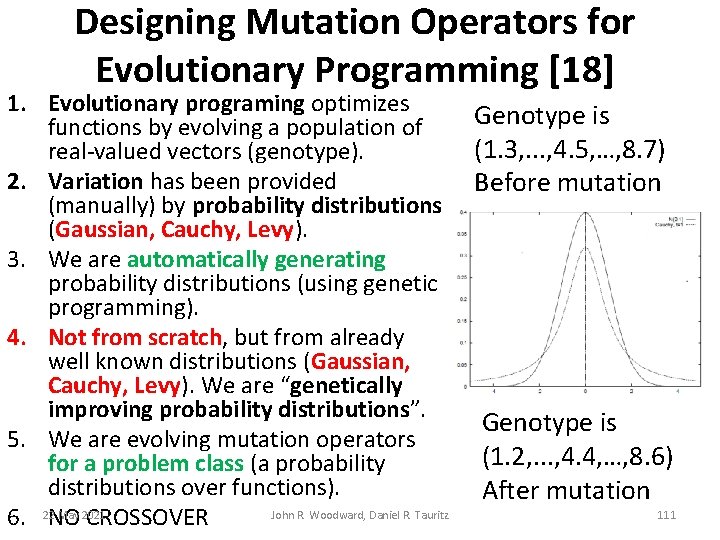
Designing Mutation Operators for Evolutionary Programming [18] 1. Evolutionary programing optimizes functions by evolving a population of real-valued vectors (genotype). 2. Variation has been provided (manually) by probability distributions (Gaussian, Cauchy, Levy). 3. We are automatically generating probability distributions (using genetic programming). 4. Not from scratch, but from already well known distributions (Gaussian, Cauchy, Levy). We are “genetically improving probability distributions”. 5. We are evolving mutation operators for a problem class (a probability distributions over functions). May 2021 John R. Woodward, Daniel R. Tauritz 6. 22 NO CROSSOVER Genotype is (1. 3, . . . , 4. 5, …, 8. 7) Before mutation Genotype is (1. 2, . . . , 4. 4, …, 8. 6) After mutation 111
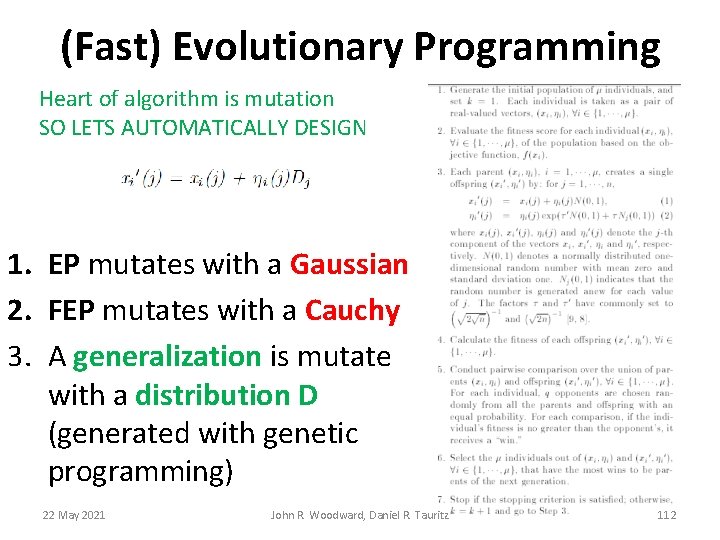
(Fast) Evolutionary Programming Heart of algorithm is mutation SO LETS AUTOMATICALLY DESIGN 1. EP mutates with a Gaussian 2. FEP mutates with a Cauchy 3. A generalization is mutate with a distribution D (generated with genetic programming) 22 May 2021 John R. Woodward, Daniel R. Tauritz 112
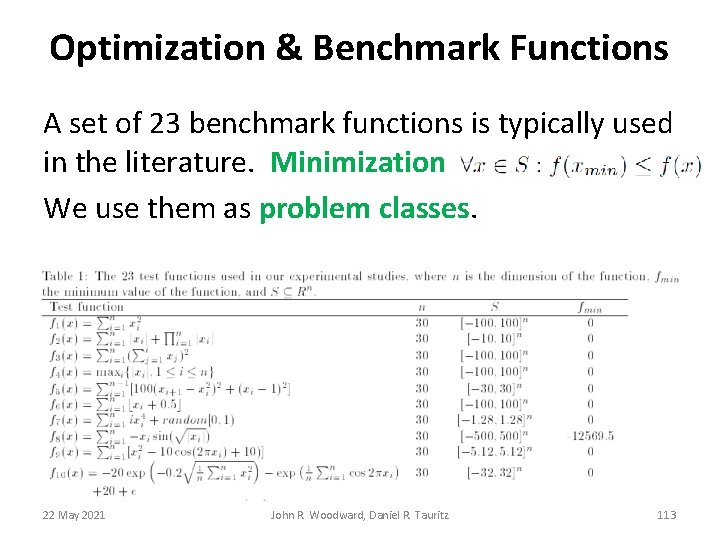
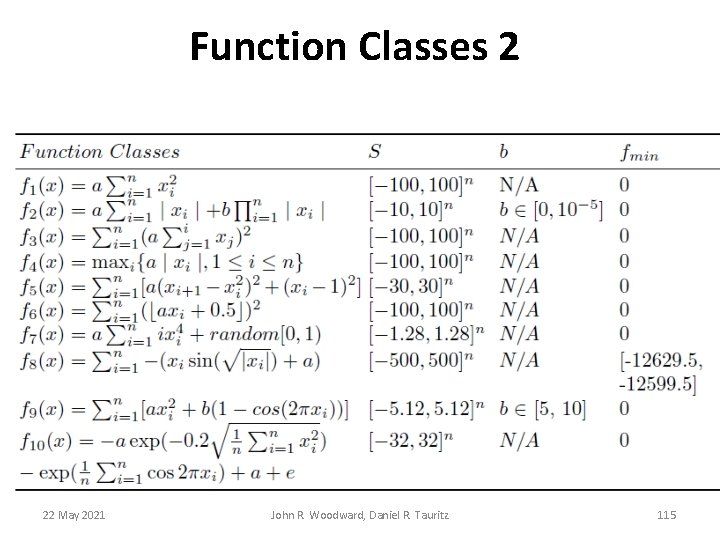
Optimization & Benchmark Functions A set of 23 benchmark functions is typically used in the literature. Minimization We use them as problem classes. 22 May 2021 John R. Woodward, Daniel R. Tauritz 113
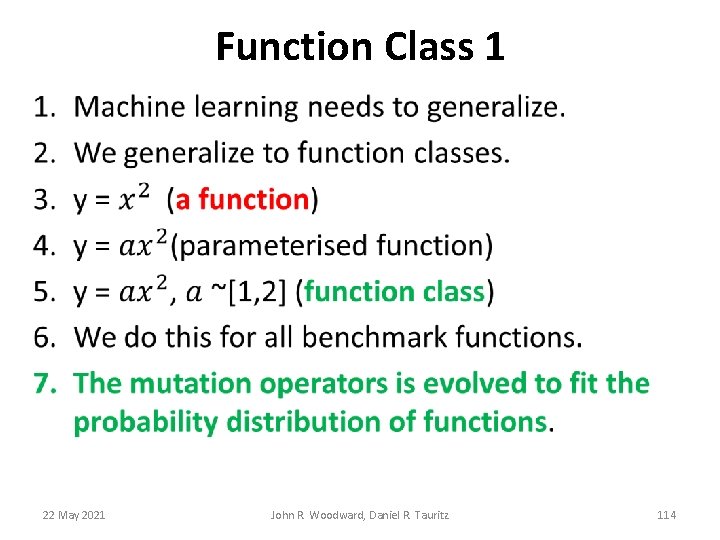
Function Class 1 • 22 May 2021 John R. Woodward, Daniel R. Tauritz 114
Function Classes 2 22 May 2021 John R. Woodward, Daniel R. Tauritz 115
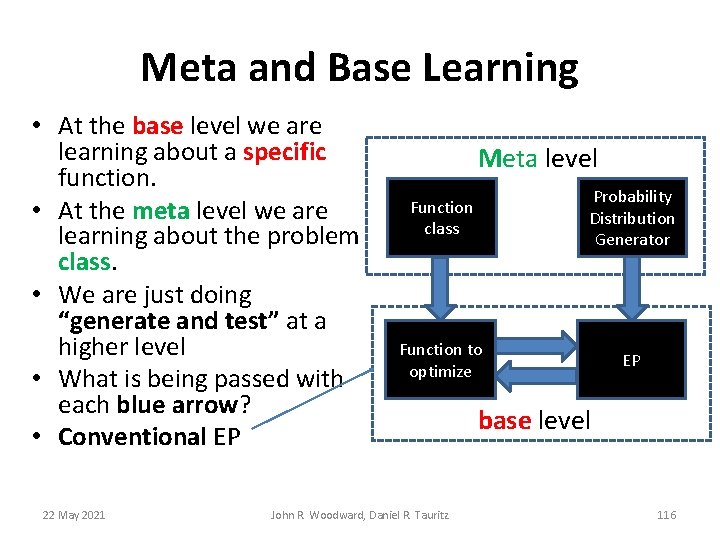
Meta and Base Learning • At the base level we are learning about a specific function. • At the meta level we are learning about the problem class. • We are just doing “generate and test” at a higher level • What is being passed with each blue arrow? • Conventional EP 22 May 2021 Meta level Function class Probability Distribution Generator Function to optimize EP John R. Woodward, Daniel R. Tauritz base level 116
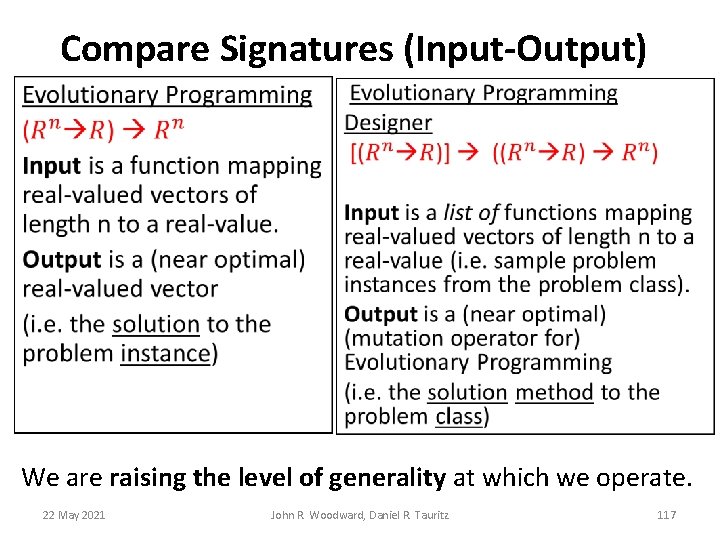
Compare Signatures (Input-Output) • We are raising the level of generality at which we operate. 22 May 2021 John R. Woodward, Daniel R. Tauritz 117
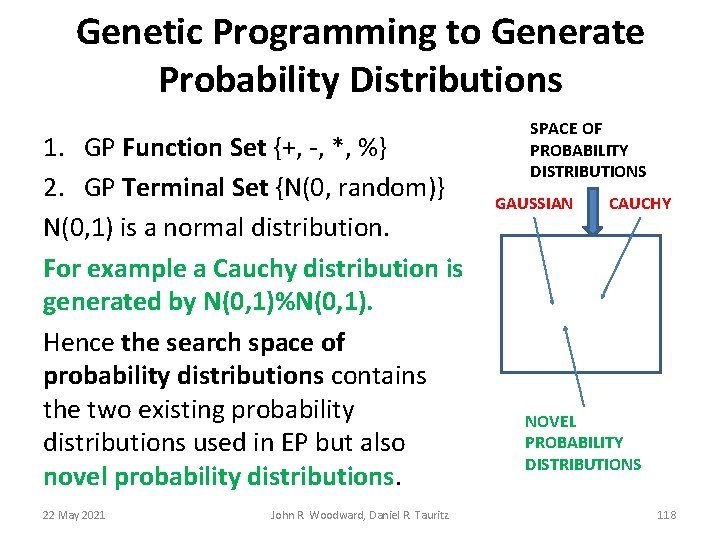
Genetic Programming to Generate Probability Distributions 1. GP Function Set {+, -, *, %} 2. GP Terminal Set {N(0, random)} N(0, 1) is a normal distribution. For example a Cauchy distribution is generated by N(0, 1)%N(0, 1). Hence the search space of probability distributions contains the two existing probability distributions used in EP but also novel probability distributions. 22 May 2021 John R. Woodward, Daniel R. Tauritz SPACE OF PROBABILITY DISTRIBUTIONS GAUSSIAN CAUCHY NOVEL PROBABILITY DISTRIBUTIONS 118
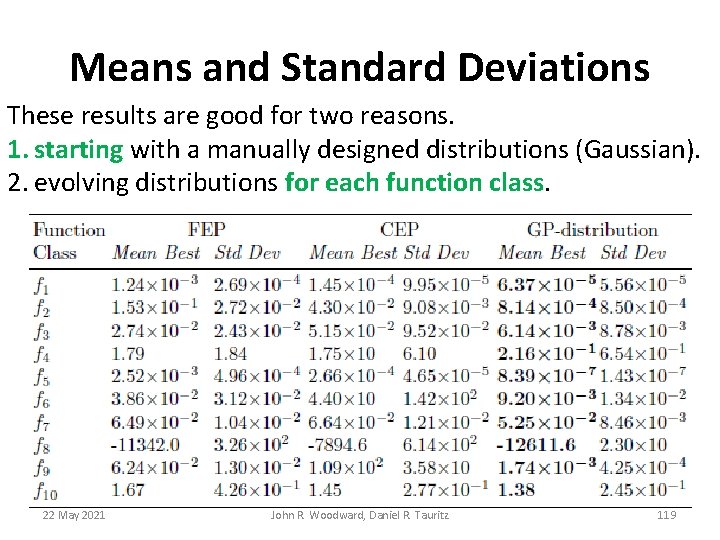
Means and Standard Deviations These results are good for two reasons. 1. starting with a manually designed distributions (Gaussian). 2. evolving distributions for each function class. 22 May 2021 John R. Woodward, Daniel R. Tauritz 119
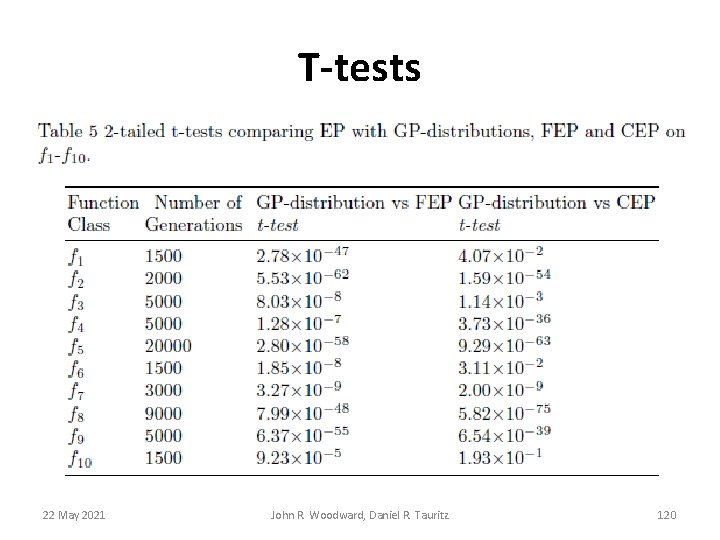
T-tests 22 May 2021 John R. Woodward, Daniel R. Tauritz 120
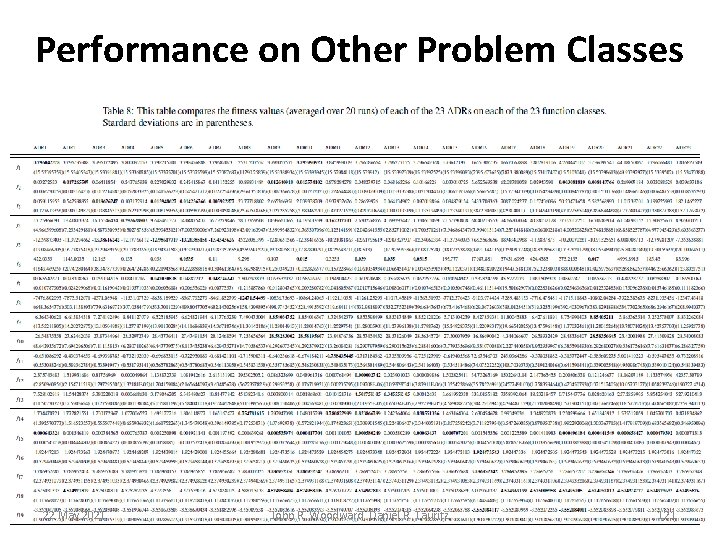
Performance on Other Problem Classes 22 May 2021 John R. Woodward, Daniel R. Tauritz 121
Case Study 6: The Automated Design of On-Line Bin Packing Algorithms 22 May 2021 John R. Woodward, Daniel R. Tauritz 122
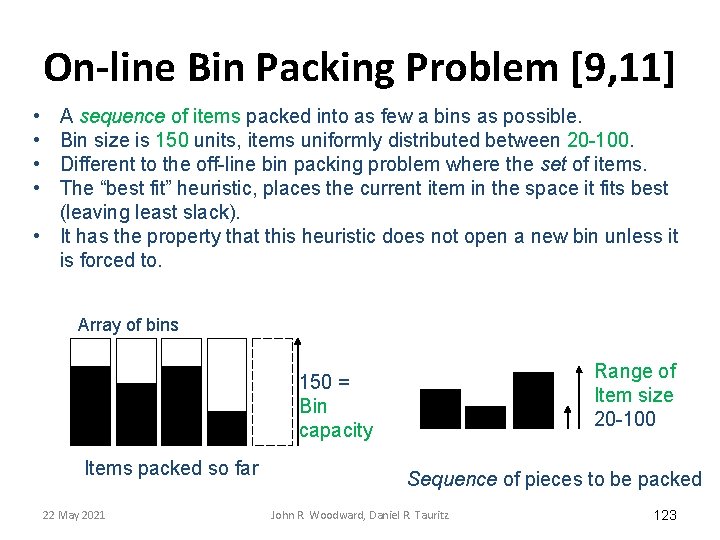
On-line Bin Packing Problem [9, 11] • • A sequence of items packed into as few a bins as possible. Bin size is 150 units, items uniformly distributed between 20 -100. Different to the off-line bin packing problem where the set of items. The “best fit” heuristic, places the current item in the space it fits best (leaving least slack). • It has the property that this heuristic does not open a new bin unless it is forced to. Array of bins Range of Item size 20 -100 150 = Bin capacity Items packed so far 22 May 2021 Sequence of pieces to be packed John R. Woodward, Daniel R. Tauritz 123
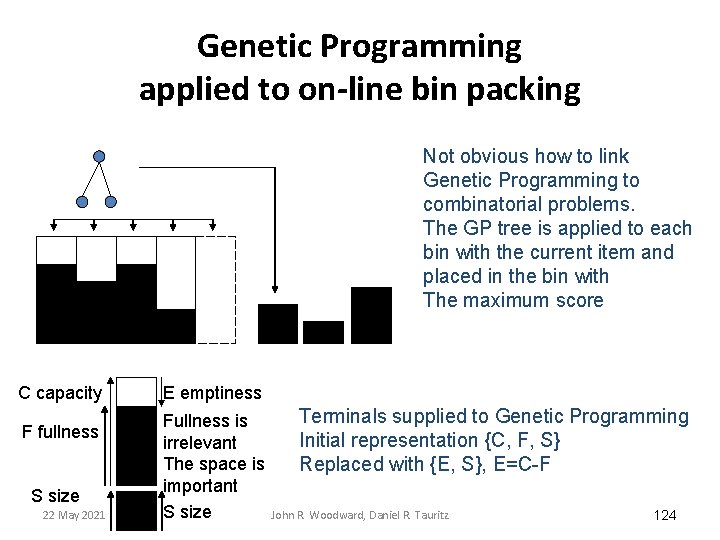
Genetic Programming applied to on-line bin packing Not obvious how to link Genetic Programming to combinatorial problems. The GP tree is applied to each bin with the current item and placed in the bin with The maximum score C capacity F fullness S size 22 May 2021 E emptiness Fullness is irrelevant The space is important S size Terminals supplied to Genetic Programming Initial representation {C, F, S} Replaced with {E, S}, E=C-F John R. Woodward, Daniel R. Tauritz 124
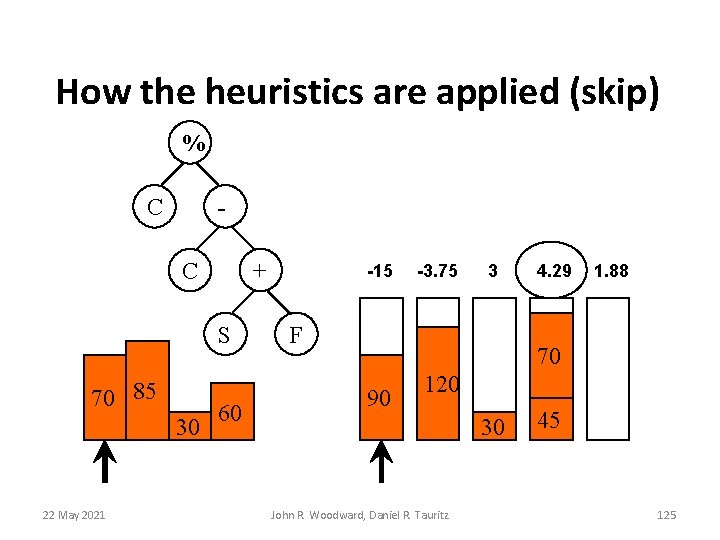
How the heuristics are applied (skip) % C + C S 70 85 30 22 May 2021 60 -15 -3. 75 3 F 4. 29 1. 88 70 90 120 30 John R. Woodward, Daniel R. Tauritz 45 125
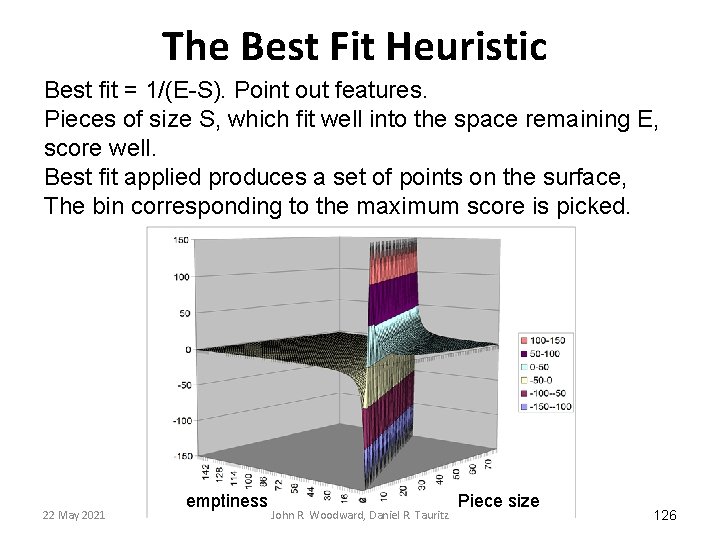
The Best Fit Heuristic Best fit = 1/(E-S). Point out features. Pieces of size S, which fit well into the space remaining E, score well. Best fit applied produces a set of points on the surface, The bin corresponding to the maximum score is picked. 22 May 2021 emptiness John R. Woodward, Daniel R. Tauritz Piece size 126
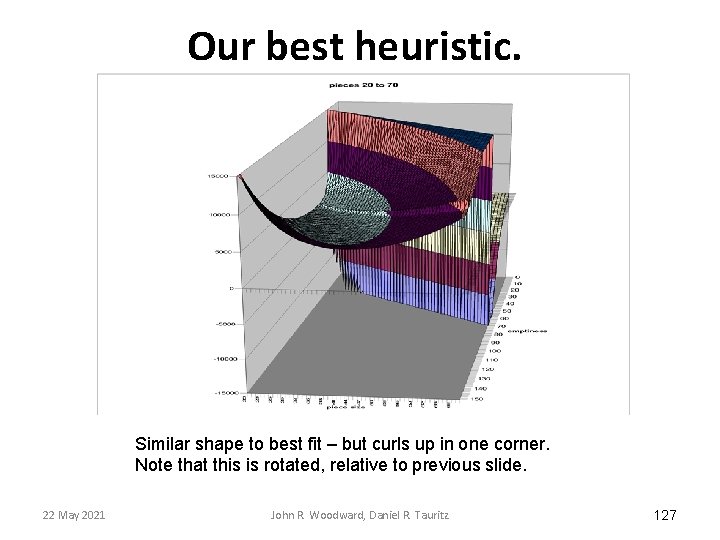
Our best heuristic. Similar shape to best fit – but curls up in one corner. Note that this is rotated, relative to previous slide. 22 May 2021 John R. Woodward, Daniel R. Tauritz 127
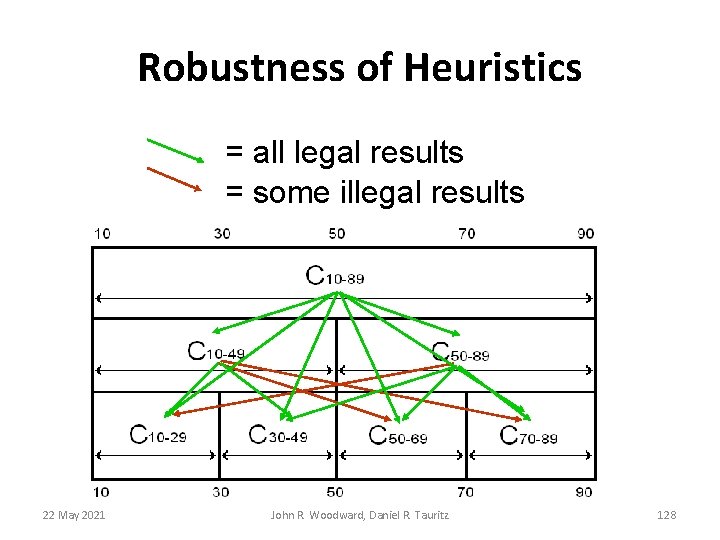
Robustness of Heuristics = all legal results = some illegal results 22 May 2021 John R. Woodward, Daniel R. Tauritz 128
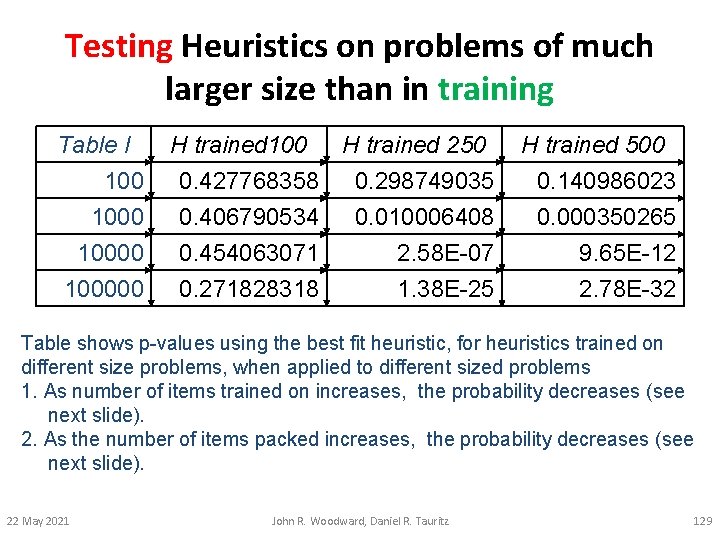
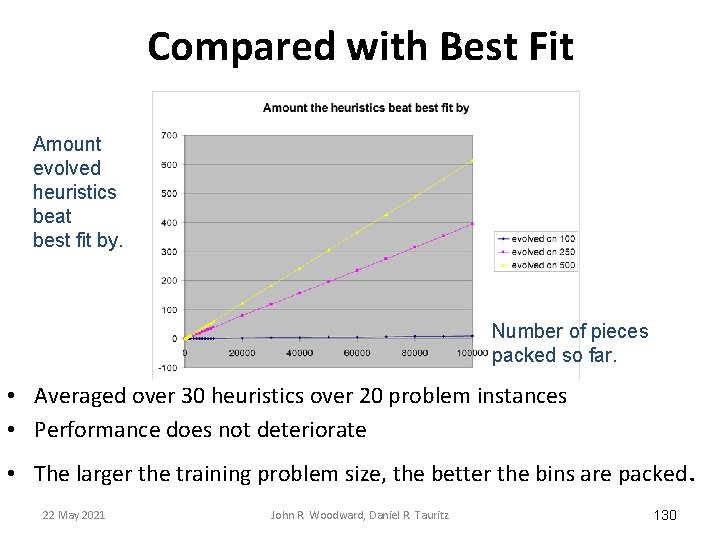
Testing Heuristics on problems of much larger size than in training Table I H trained 100 H trained 250 H trained 500 10000 0. 427768358 0. 406790534 0. 454063071 0. 298749035 0. 010006408 2. 58 E-07 0. 140986023 0. 000350265 9. 65 E-12 100000 0. 271828318 1. 38 E-25 2. 78 E-32 Table shows p-values using the best fit heuristic, for heuristics trained on different size problems, when applied to different sized problems 1. As number of items trained on increases, the probability decreases (see next slide). 2. As the number of items packed increases, the probability decreases (see next slide). 22 May 2021 John R. Woodward, Daniel R. Tauritz 129
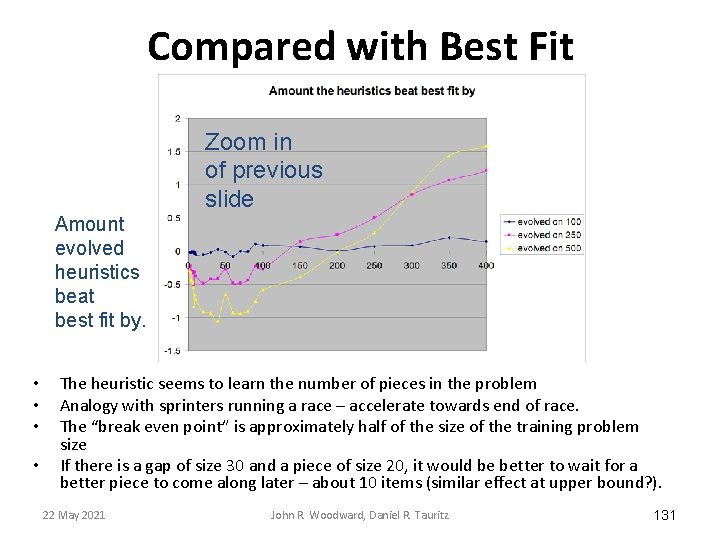
Compared with Best Fit Amount evolved heuristics beat best fit by. Number of pieces packed so far. • Averaged over 30 heuristics over 20 problem instances • Performance does not deteriorate • The larger the training problem size, the better the bins are packed. 22 May 2021 John R. Woodward, Daniel R. Tauritz 130
Compared with Best Fit Zoom in of previous slide Amount evolved heuristics beat best fit by. • • The heuristic seems to learn the number of pieces in the problem Analogy with sprinters running a race – accelerate towards end of race. The “break even point” is approximately half of the size of the training problem size If there is a gap of size 30 and a piece of size 20, it would be better to wait for a better piece to come along later – about 10 items (similar effect at upper bound? ). 22 May 2021 John R. Woodward, Daniel R. Tauritz 131
Hyper-heuristics Visualization Demo 22 May 2021 John R. Woodward, Daniel R. Tauritz 132
Step by Step Guide to Automatic Design of Algorithms [8, 12] 1. Study the literature for existing heuristics for your chosen domain (manually designed heuristics). 2. Build an algorithmic framework or template which expresses the known heuristics. 3. Let metaheuristics (e. g. Genetic Programming) search for variations on theme. 4. Train and test on problem instances drawn from the same probability distribution (like machine learning). Constructing an optimizer is machine learning (this approach prevents “cheating”). 22 May 2021 John R. Woodward, Daniel R. Tauritz 133
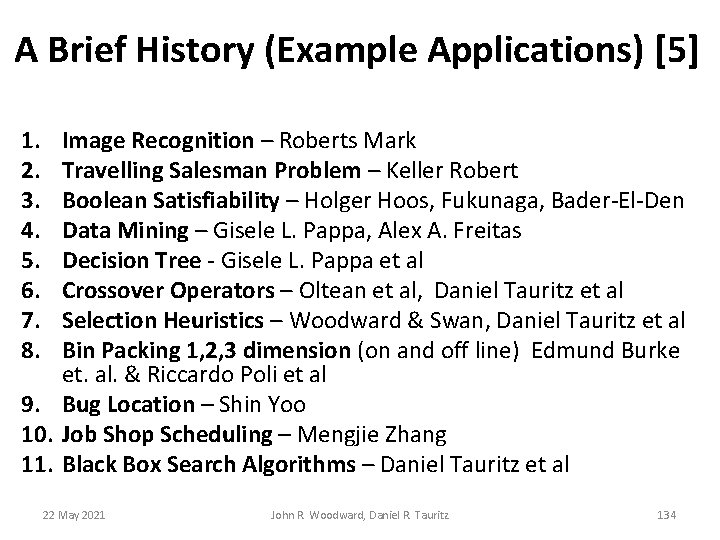
A Brief History (Example Applications) [5] 1. 2. 3. 4. 5. 6. 7. 8. Image Recognition – Roberts Mark Travelling Salesman Problem – Keller Robert Boolean Satisfiability – Holger Hoos, Fukunaga, Bader-El-Den Data Mining – Gisele L. Pappa, Alex A. Freitas Decision Tree - Gisele L. Pappa et al Crossover Operators – Oltean et al, Daniel Tauritz et al Selection Heuristics – Woodward & Swan, Daniel Tauritz et al Bin Packing 1, 2, 3 dimension (on and off line) Edmund Burke et. al. & Riccardo Poli et al 9. Bug Location – Shin Yoo 10. Job Shop Scheduling – Mengjie Zhang 11. Black Box Search Algorithms – Daniel Tauritz et al 22 May 2021 John R. Woodward, Daniel R. Tauritz 134
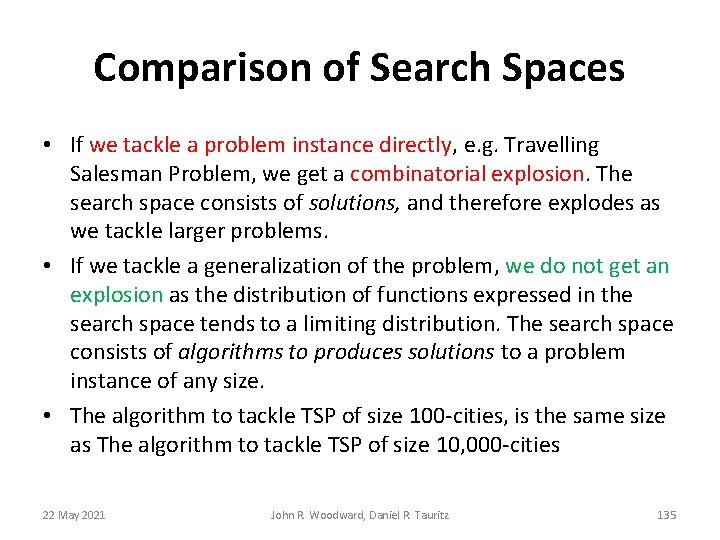
Comparison of Search Spaces • If we tackle a problem instance directly, e. g. Travelling Salesman Problem, we get a combinatorial explosion. The search space consists of solutions, and therefore explodes as we tackle larger problems. • If we tackle a generalization of the problem, we do not get an explosion as the distribution of functions expressed in the search space tends to a limiting distribution. The search space consists of algorithms to produces solutions to a problem instance of any size. • The algorithm to tackle TSP of size 100 -cities, is the same size as The algorithm to tackle TSP of size 10, 000 -cities 22 May 2021 John R. Woodward, Daniel R. Tauritz 135
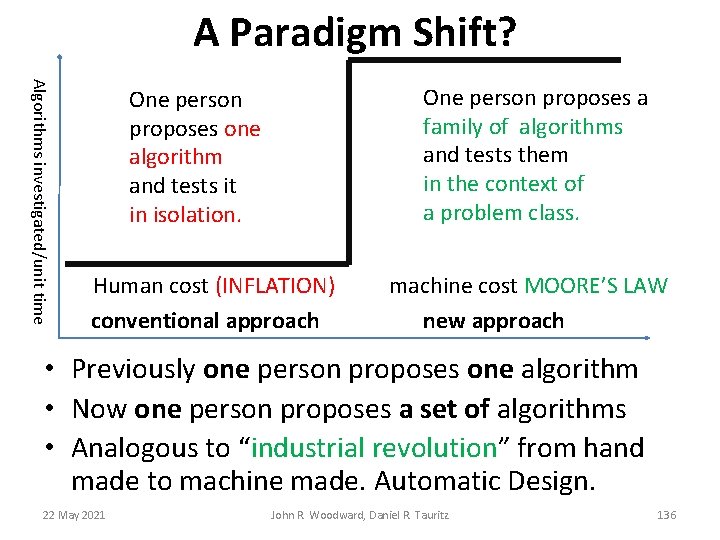
A Paradigm Shift? Algorithms investigated/unit time One person proposes a family of algorithms and tests them in the context of a problem class. One person proposes one algorithm and tests it in isolation. Human cost (INFLATION) conventional approach machine cost MOORE’S LAW new approach • Previously one person proposes one algorithm • Now one person proposes a set of algorithms • Analogous to “industrial revolution” from hand made to machine made. Automatic Design. 22 May 2021 John R. Woodward, Daniel R. Tauritz 136
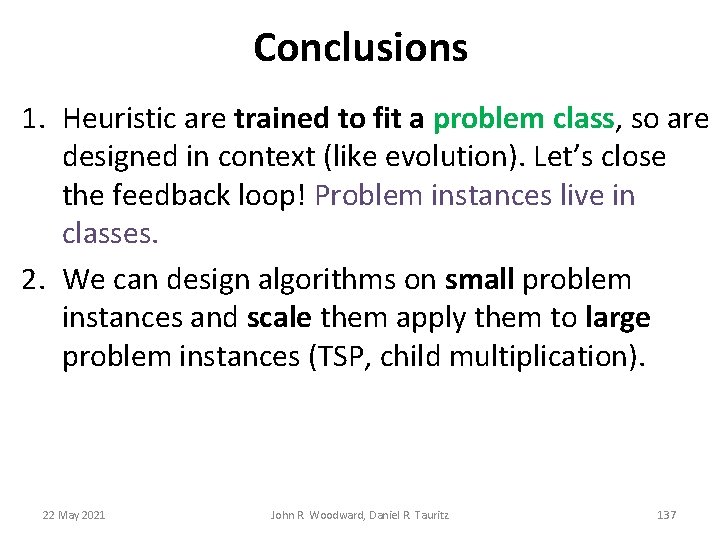
Conclusions 1. Heuristic are trained to fit a problem class, so are designed in context (like evolution). Let’s close the feedback loop! Problem instances live in classes. 2. We can design algorithms on small problem instances and scale them apply them to large problem instances (TSP, child multiplication). 22 May 2021 John R. Woodward, Daniel R. Tauritz 137
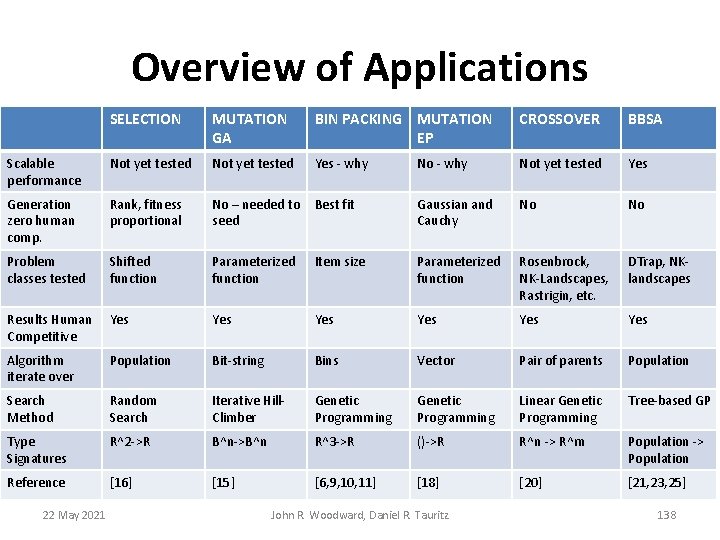
Overview of Applications SELECTION MUTATION GA BIN PACKING MUTATION EP CROSSOVER BBSA Scalable performance Not yet tested Yes - why Not yet tested Yes Generation zero human comp. Rank, fitness proportional No – needed to seed Best fit Gaussian and Cauchy No No Problem classes tested Shifted function Parameterized function Item size Parameterized function Rosenbrock, NK-Landscapes, Rastrigin, etc. DTrap, NKlandscapes Results Human Competitive Yes Yes Yes Algorithm iterate over Population Bit-string Bins Vector Pair of parents Population Search Method Random Search Iterative Hill. Climber Genetic Programming Linear Genetic Programming Tree-based GP Type Signatures R^2 ->R B^n->B^n R^3 ->R ()->R R^n -> R^m Population -> Population Reference [16] [15] [6, 9, 10, 11] [18] [20] [21, 23, 25] 22 May 2021 John R. Woodward, Daniel R. Tauritz 138
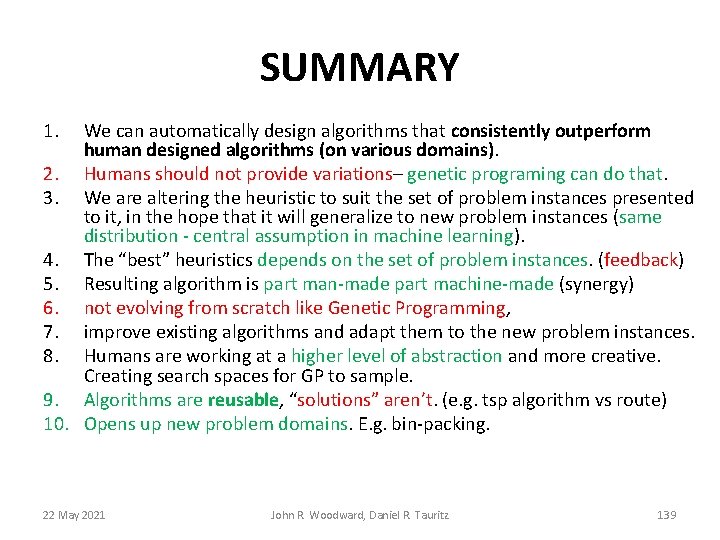
SUMMARY 1. We can automatically design algorithms that consistently outperform human designed algorithms (on various domains). 2. Humans should not provide variations– genetic programing can do that. 3. We are altering the heuristic to suit the set of problem instances presented to it, in the hope that it will generalize to new problem instances (same distribution - central assumption in machine learning). 4. The “best” heuristics depends on the set of problem instances. (feedback) 5. Resulting algorithm is part man-made part machine-made (synergy) 6. not evolving from scratch like Genetic Programming, 7. improve existing algorithms and adapt them to the new problem instances. 8. Humans are working at a higher level of abstraction and more creative. Creating search spaces for GP to sample. 9. Algorithms are reusable, “solutions” aren’t. (e. g. tsp algorithm vs route) 10. Opens up new problem domains. E. g. bin-packing. 22 May 2021 John R. Woodward, Daniel R. Tauritz 139
Related hyper-heuristics events • Evolutionary Computation for the Automated Design of Algorithms (ECADA) workshop @GECCO 2015 • Combinatorial Black Box Optimization Competition (CBBOC) @GECCO 2015 22 May 2021 John R. Woodward, Daniel R. Tauritz 140
End of File • Thank you for listening !!! • We are glad to take any – comments (+, -) – suggestions/criticisms Please email us any missing references! John Woodward (http: //www. cs. stir. ac. uk/~jrw/) Daniel Tauritz (http: //web. mst. edu/~tauritzd/) 22 May 2021 John R. Woodward, Daniel R. Tauritz 141
References 1 1. 2. 3. 4. 5. 6. 7. John Woodward. Computable and Incomputable Search Algorithms and Functions. IEEE International Conference on Intelligent Computing and Intelligent Systems (IEEE ICIS 2009), pages 871 -875, Shanghai, China, November 20 -22, 2009. John Woodward. The Necessity of Meta Bias in Search Algorithms. International Conference on Computational Intelligence and Software Engineering (Ci. SE), pages 1 -4, Wuhan, China, December 1012, 2010. John Woodward & Ruibin Bai. Why Evolution is not a Good Paradigm for Program Induction: A Critique of Genetic Programming. In Proceedings of the first ACM/SIGEVO Summit on Genetic and Evolutionary Computation, pages 593 -600, Shanghai, China, June 12 -14, 2009. Jerry Swan, John Woodward, Ender Ozcan, Graham Kendall, Edmund Burke. Searching the Hyperheuristic Design Space. Cognitive Computation, 6: 66 -73, 2014. Gisele L. Pappa, Gabriela Ochoa, Matthew R. Hyde, Alex A. Freitas, John Woodward, Jerry Swan. Contrasting meta-learning and hyper-heuristic research. Genetic Programming and Evolvable Machines, 15: 3 -35, 2014. Edmund K. Burke, Matthew Hyde, Graham Kendall, and John Woodward. Automating the Packing Heuristic Design Process with Genetic Programming. Evolutionary Computation, 20(1): 63 -89, 2012. Edmund K. Burke, Matthew R. Hyde, Graham Kendall, and John Woodward. A Genetic Programming Hyper-Heuristic Approach for Evolving Two Dimensional Strip Packing Heuristics. IEEE Transactions on Evolutionary Computation, 14(6): 942 -958, December 2010. 22 May 2021 John R. Woodward, Daniel R. Tauritz 142
References 2 8. Edmund K. Burke, Matthew R. Hyde, Graham Kendall, Gabriela Ochoa, Ender Ozcan and John R. Woodward. Exploring Hyper-heuristic Methodologies with Genetic Programming, Computational Intelligence: Collaboration, Fusion and Emergence, In C. Mumford and L. Jain (eds. ), Intelligent Systems Reference Library, Springer, pp. 177 -201, 2009. 9. Edmund K. Burke, Matthew Hyde, Graham Kendall and John R. Woodward. The Scalability of Evolved On Line Bin Packing Heuristics. In Proceedings of the IEEE Congress on Evolutionary Computation, pages 2530 -2537, September 25 -28, 2007. 10. R. Poli, John R. Woodward, and Edmund K. Burke. A Histogram-matching Approach to the Evolution of Bin-packing Strategies. In Proceedings of the IEEE Congress on Evolutionary Computation, pages 35003507, September 25 -28, 2007. 11. Edmund K. Burke, Matthew Hyde, Graham Kendall, and John Woodward. Automatic Heuristic Generation with Genetic Programming: Evolving a Jack-of-all-Trades or a Master of One, In Proceedings of the Genetic and Evolutionary Computation Conference, pages 1559 -1565, London, UK, July 2007. 12. John R. Woodward and Jerry Swan. Template Method Hyper-heuristics, Metaheuristic Design Patterns (Meta. Dee. P) workshop, GECCO Comp’ 14, pages 1437 -1438, Vancouver, Canada, July 12 -16, 2014. 13. Saemundur O. Haraldsson and John R. Woodward, Automated Design of Algorithms and Genetic Improvement: Contrast and Commonalities, 4 th Workshop on Automatic Design of Algorithms (ECADA), GECCO Comp ‘ 14, pages 1373 -1380, Vancouver, Canada, July 12 -16, 2014. 22 May 2021 John R. Woodward, Daniel R. Tauritz 143
References 3 14. John R. Woodward, Simon P. Martin and Jerry Swan. Benchmarks That Matter For Genetic Programming, 4 th Workshop on Evolutionary Computation for the Automated Design of Algorithms (ECADA), GECCO Comp ‘ 14, pages 1397 -1404, Vancouver, Canada, July 12 -16, 2014. 15. John R. Woodward and Jerry Swan. The Automatic Generation of Mutation Operators for Genetic Algorithms, 2 nd Workshop on Evolutionary Computation for the Automated Design of Algorithms (ECADA), GECCO Comp’ 12, pages 67 -74, Philadelphia, U. S. A. , July 7 -11, 2012. 16. John R. Woodward and Jerry Swan. Automatically Designing Selection Heuristics. 1 st Workshop on Evolutionary Computation for Designing Generic Algorithms, pages 583 -590, Dublin, Ireland, 2011. 17. Edmund K. Burke, Matthew Hyde, Graham Kendall, Gabriela Ochoa, Ender Ozcan, and John Woodward. A Classification of Hyper-heuristics Approaches, Handbook of Metaheuristics, pages 449 -468, International Series in Operations Research & Management Science, M. Gendreau and J-Y Potvin (Eds. ), Springer, 2010. 18. Libin Hong and John Woodward and Jingpeng Li and Ender Ozcan. Automated Design of Probability Distributions as Mutation Operators for Evolutionary Programming Using Genetic Programming. Proceedings of the 16 th European Conference on Genetic Programming (Euro. GP 2013), volume 7831, pages 85 -96, Vienna, Austria, April 3 -5, 2013. 19. Ekaterina A. Smorodkina and Daniel R. Tauritz. Toward Automating EA Configuration: the Parent Selection Stage. In Proceedings of CEC 2007 - IEEE Congress on Evolutionary Computation, pages 63 -70, Singapore, September 25 -28, 2007. 22 May 2021 John R. Woodward, Daniel R. Tauritz 144
References 4 20. Brian W. Goldman and Daniel R. Tauritz. Self-Configuring Crossover. In Proceedings of the 13 th Annual Conference Companion on Genetic and Evolutionary Computation (GECCO '11), pages 575 -582, Dublin, Ireland, July 12 -16, 2011. 21. Matthew A. Martin and Daniel R. Tauritz. Evolving Black-Box Search Algorithms Employing Genetic Programming. In Proceedings of the 15 th Annual Conference Companion on Genetic and Evolutionary Computation (GECCO '13), pages 1497 -1504, Amsterdam, The Netherlands, July 6 -10, 2013. 22. Nathaniel R. Kamrath and Brian W. Goldman and Daniel R. Tauritz. Using Supportive Coevolution to Evolve Self-Configuring Crossover. In Proceedings of the 15 th Annual Conference Companion on Genetic and Evolutionary Computation (GECCO '13), pages 1489 -1496, Amsterdam, The Netherlands, July 6 -10, 2013. 23. Matthew A. Martin and Daniel R. Tauritz. A Problem Configuration Study of the Robustness of a Black. Box Search Algorithm Hyper-Heuristic. In Proceedings of the 16 th Annual Conference Companion on Genetic and Evolutionary Computation (GECCO '14), pages 1389 -1396, Vancouver, BC, Canada, July 1216, 2014. 24. Sean Harris, Travis Bueter, and Daniel R. Tauritz. A Comparison of Genetic Programming Variants for Hyper-Heuristics. Accepted for publication in the Proceedings of the 17 th Annual Conference Companion on Genetic and Evolutionary Computation (GECCO '15), Madrid, Spain, July 11 -15, 2015. 25. Matthew A. Martin and Daniel R. Tauritz. Hyper-Heuristics: A Study On Increasing Primitive-Space. Accepted for publication in the Proceedings of the 17 th Annual Conference Companion on Genetic and Evolutionary Computation (GECCO '15), Madrid, Spain, July 11 -15, 2015. 22 May 2021 John R. Woodward, Daniel R. Tauritz 145