
HYPERBARIC OXYGEN BRAIN INJURY TREATMENT TRIAL A MULTICENTER
HYPERBARIC OXYGEN BRAIN INJURY TREATMENT TRIAL: A MULTICENTER PHASE II ADAPTIVE CLINICAL TRIAL June 11, 11: 00 a. m. – 12: 30 pm ET June 13, 3: 00 – 4: 30 pm ET Virtual Investigator Meeting June 13, 2019
Welcome Blue Jean Etiquette • To avoid an echo, please make sure you only have audio playing out of one device (either computer or phone) • Please make sure you are on mute if you are not speaking or presenting • Please do not put the line on hold, if you need to take another call, please hang up and dial back in afterwards Access to Protocol Refresher Quiz • Go to pollev. com/nataliefishe 198 Virtual Investigator Meeting June 13, 2019
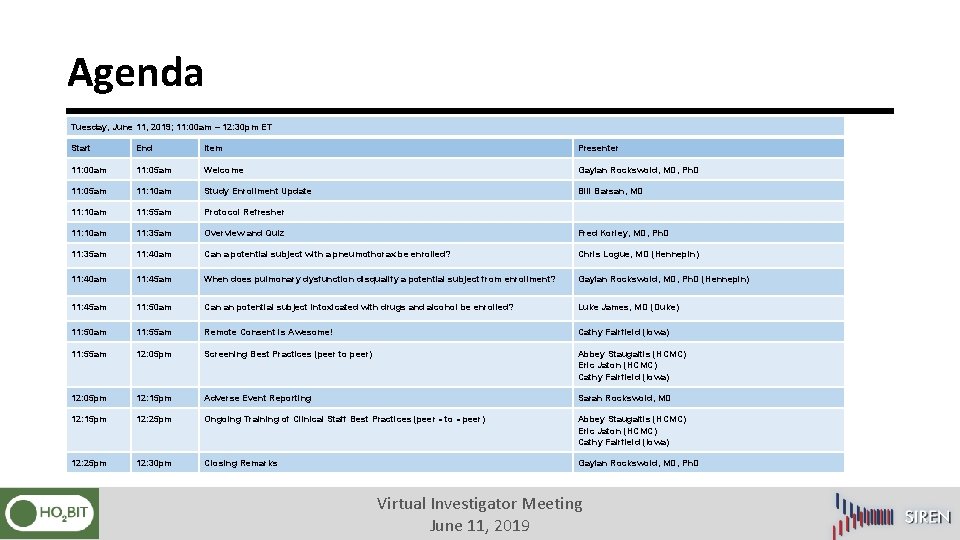
Agenda Tuesday, June 11, 2019; 11: 00 am – 12: 30 pm ET Start End Item Presenter 11: 00 am 11: 05 am Welcome Gaylan Rockswold, MD, Ph. D 11: 05 am 11: 10 am Study Enrollment Update Bill Barsan, MD 11: 10 am 11: 55 am Protocol Refresher 11: 10 am 11: 35 am Overview and Quiz Fred Korley, MD, Ph. D 11: 35 am 11: 40 am Can a potential subject with a pneumothorax be enrolled? Chris Logue, MD (Hennepin) 11: 40 am 11: 45 am When does pulmonary dysfunction disqualify a potential subject from enrollment? Gaylan Rockswold, MD, Ph. D (Hennepin) 11: 45 am 11: 50 am Can an potential subject intoxicated with drugs and alcohol be enrolled? Luke James, MD (Duke) 11: 50 am 11: 55 am Remote Consent is Awesome! Cathy Fairfield (Iowa) 11: 55 am 12: 05 pm Screening Best Practices (peer to peer) Abbey Staugaitis (HCMC) Eric Jaton (HCMC) Cathy Fairfield (Iowa) 12: 05 pm 12: 15 pm Adverse Event Reporting Sarah Rockswold, MD 12: 15 pm 12: 25 pm Ongoing Training of Clinical Staff Best Practices (peer‐to‐peer) Abbey Staugaitis (HCMC) Eric Jaton (HCMC) Cathy Fairfield (Iowa) 12: 25 pm 12: 30 pm Closing Remarks Gaylan Rockswold, MD, Ph. D Virtual Investigator Meeting June 11, 2019
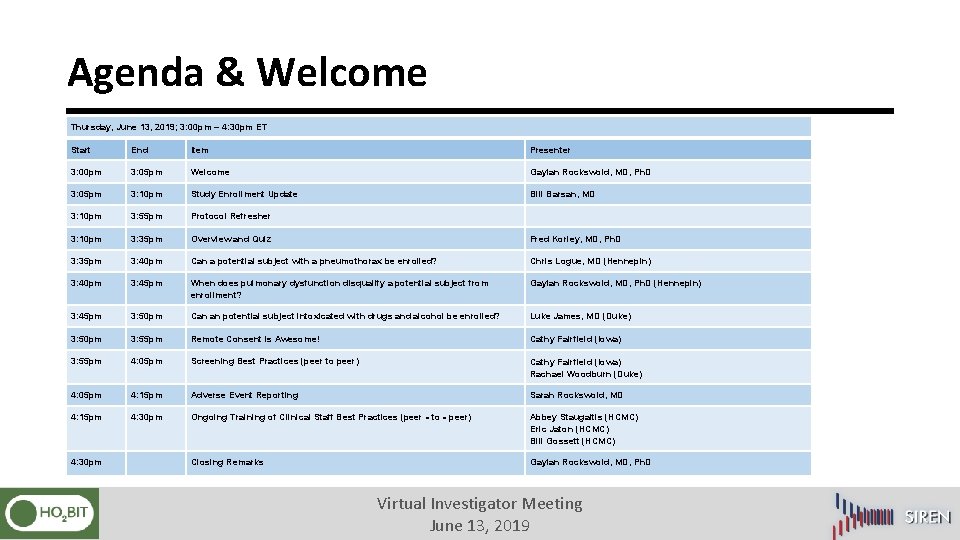
Agenda & Welcome Thursday, June 13, 2019; 3: 00 pm – 4: 30 pm ET Start End Item Presenter 3: 00 pm 3: 05 pm Welcome Gaylan Rockswold, MD, Ph. D 3: 05 pm 3: 10 pm Study Enrollment Update Bill Barsan, MD 3: 10 pm 3: 55 pm Protocol Refresher 3: 10 pm 3: 35 pm Overview and Quiz Fred Korley, MD, Ph. D 3: 35 pm 3: 40 pm Can a potential subject with a pneumothorax be enrolled? Chris Logue, MD (Hennepin) 3: 40 pm 3: 45 pm When does pulmonary dysfunction disqualify a potential subject from enrollment? Gaylan Rockswold, MD, Ph. D (Hennepin) 3: 45 pm 3: 50 pm Can an potential subject intoxicated with drugs and alcohol be enrolled? Luke James, MD (Duke) 3: 50 pm 3: 55 pm Remote Consent is Awesome! Cathy Fairfield (Iowa) 3: 55 pm 4: 05 pm Screening Best Practices (peer to peer) Cathy Fairfield (Iowa) Rachael Woodburn (Duke) 4: 05 pm 4: 15 pm Adverse Event Reporting Sarah Rockswold, MD 4: 15 pm 4: 30 pm Ongoing Training of Clinical Staff Best Practices (peer‐to‐peer) Abbey Staugaitis (HCMC) Eric Jaton (HCMC) Bill Gossett (HCMC) Closing Remarks Gaylan Rockswold, MD, Ph. D 4: 30 pm Virtual Investigator Meeting June 13, 2019
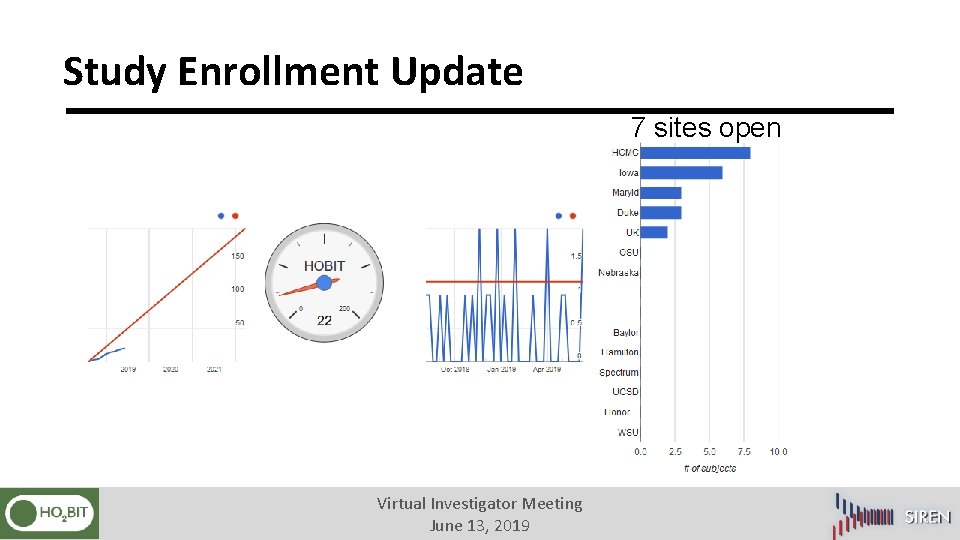
Study Enrollment Update 7 sites open Virtual Investigator Meeting June 13, 2019
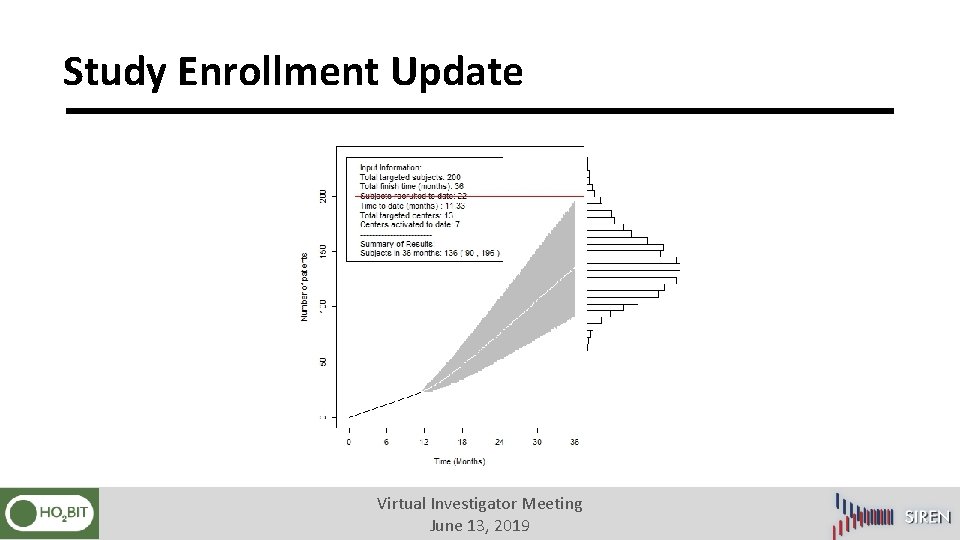
Study Enrollment Update Virtual Investigator Meeting June 13, 2019
Protocol Refresher • Overview and Quiz Access to Protocol Refresher Quiz • Go to pollev. com/nataliefishe 198 • Respond to question within 10 seconds after it is read Virtual Investigator Meeting June 13, 2019
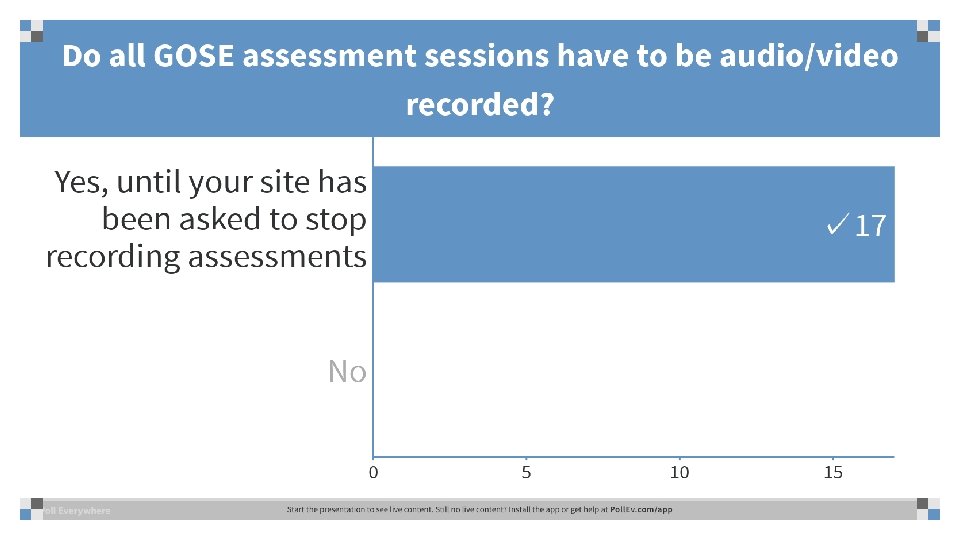
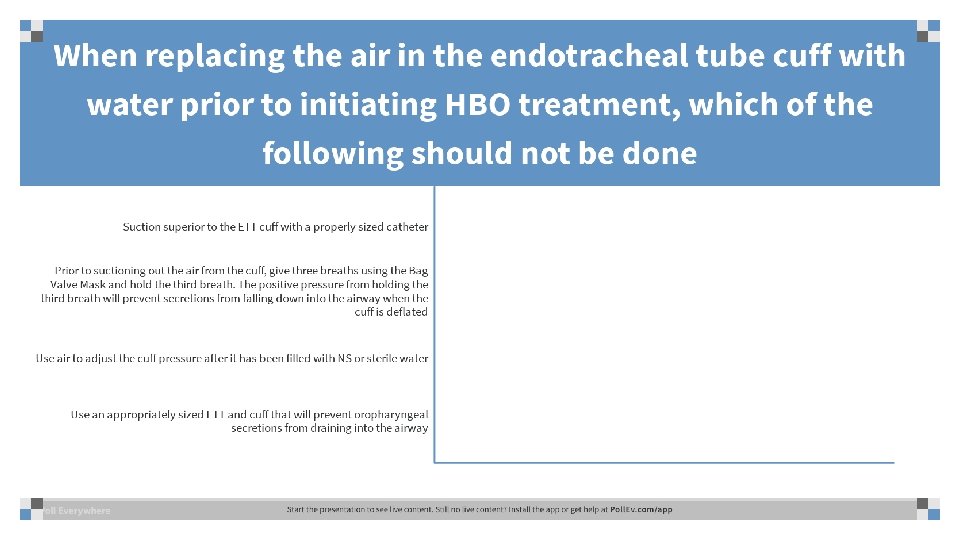
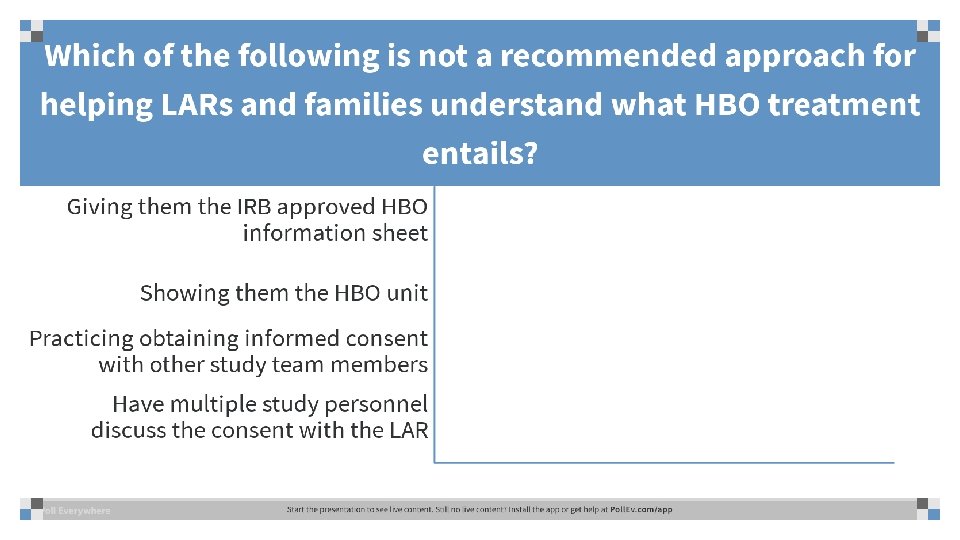
Can a Potential Subject with a Pneumothorax be Enrolled? Chris Logue MD, HCMC
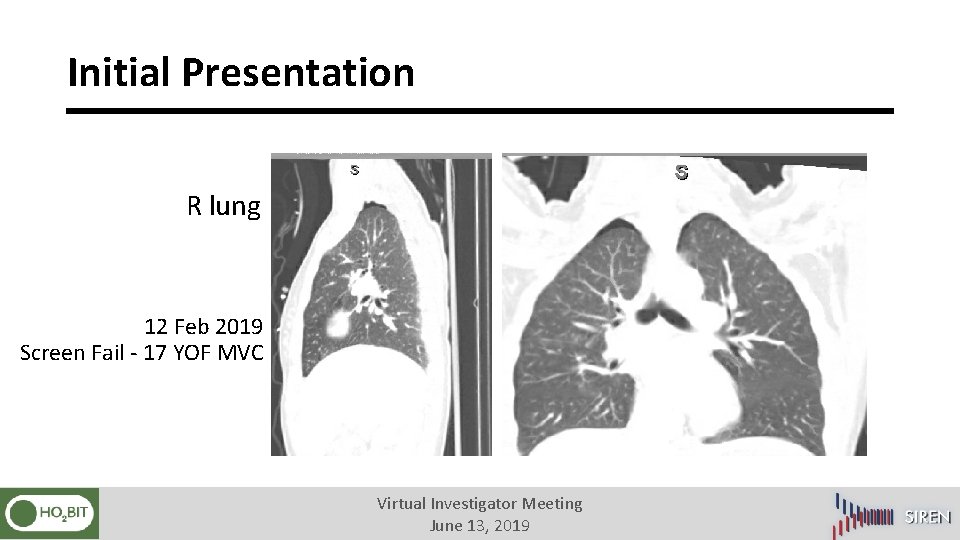
Initial Presentation R lung 12 Feb 2019 Screen Fail - 17 YOF MVC Virtual Investigator Meeting June 13, 2019
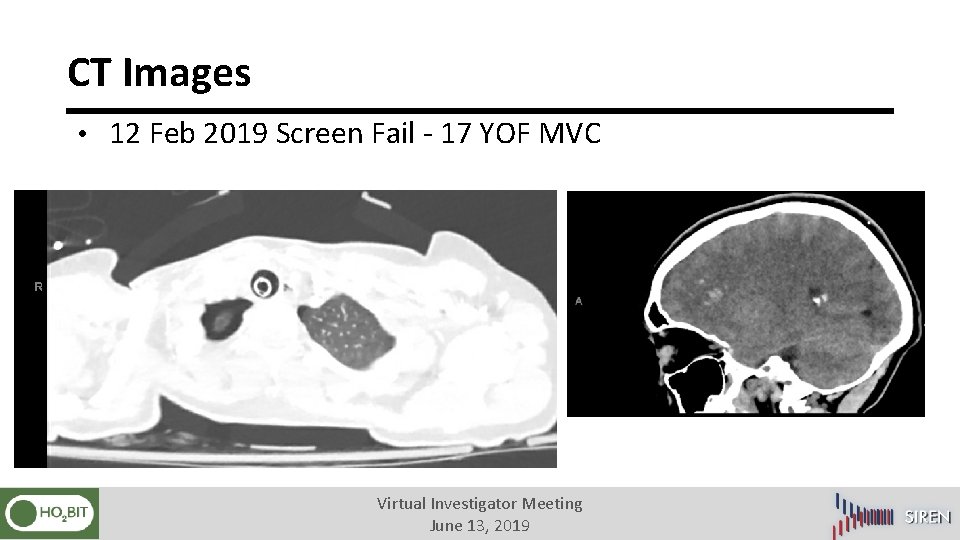
CT Images • 12 Feb 2019 Screen Fail - 17 YOF MVC Virtual Investigator Meeting June 13, 2019
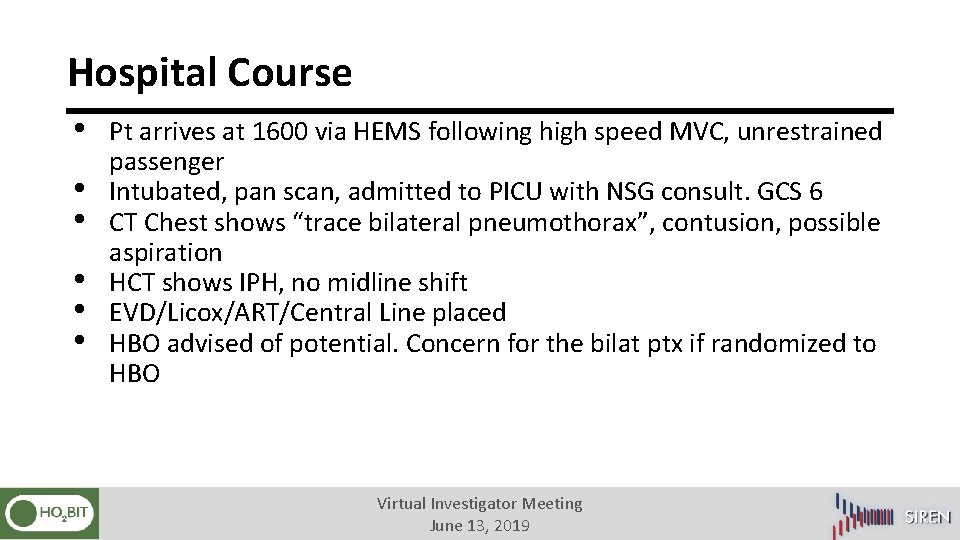
Hospital Course • • • Pt arrives at 1600 via HEMS following high speed MVC, unrestrained passenger Intubated, pan scan, admitted to PICU with NSG consult. GCS 6 CT Chest shows “trace bilateral pneumothorax”, contusion, possible aspiration HCT shows IPH, no midline shift EVD/Licox/ART/Central Line placed HBO advised of potential. Concern for the bilat ptx if randomized to HBO Virtual Investigator Meeting June 13, 2019
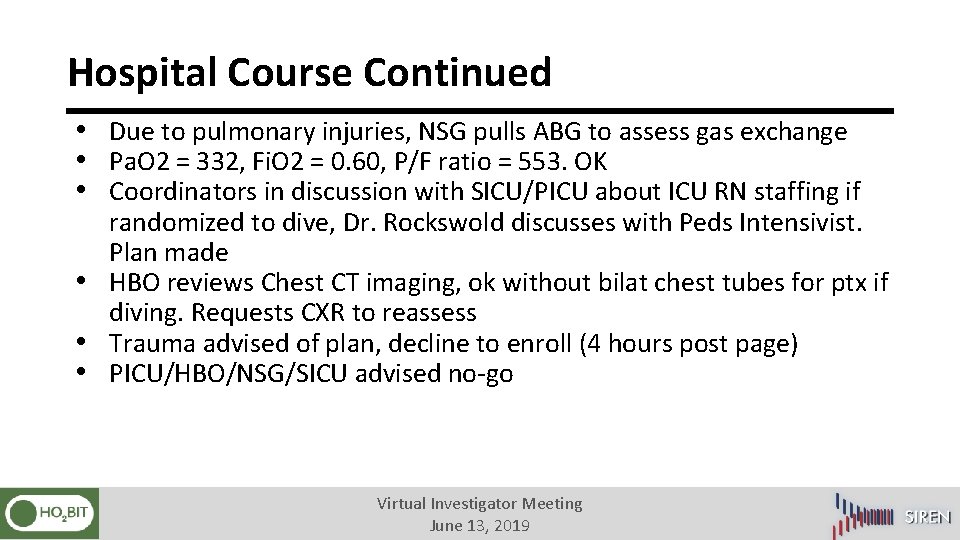
Hospital Course Continued • Due to pulmonary injuries, NSG pulls ABG to assess gas exchange • Pa. O 2 = 332, Fi. O 2 = 0. 60, P/F ratio = 553. OK • Coordinators in discussion with SICU/PICU about ICU RN staffing if randomized to dive, Dr. Rockswold discusses with Peds Intensivist. Plan made • HBO reviews Chest CT imaging, ok without bilat chest tubes for ptx if diving. Requests CXR to reassess • Trauma advised of plan, decline to enroll (4 hours post page) • PICU/HBO/NSG/SICU advised no-go Virtual Investigator Meeting June 13, 2019
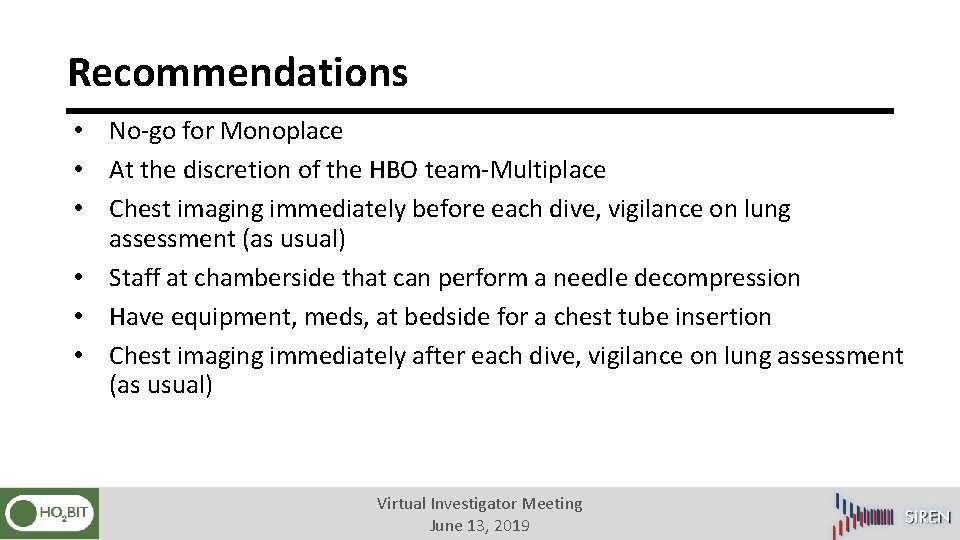
Recommendations • No-go for Monoplace • At the discretion of the HBO team-Multiplace • Chest imaging immediately before each dive, vigilance on lung assessment (as usual) • Staff at chamberside that can perform a needle decompression • Have equipment, meds, at bedside for a chest tube insertion • Chest imaging immediately after each dive, vigilance on lung assessment (as usual) Virtual Investigator Meeting June 13, 2019
When Does Pulmonary Dysfunction Disqualify a Potential Subject from Enrollment? Gaylan Rockswold, MD, Ph. D; HCMC
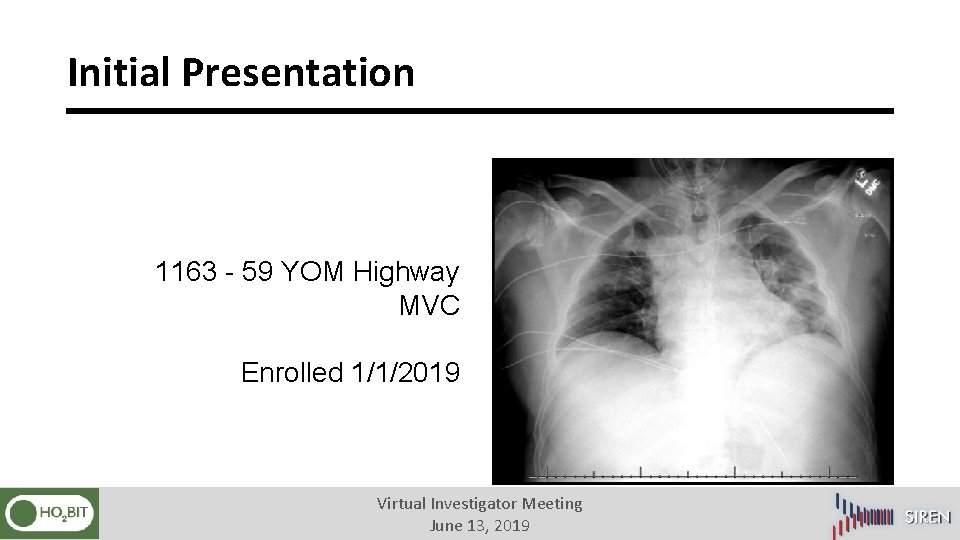
Initial Presentation 1163 - 59 YOM Highway MVC Enrolled 1/1/2019 Virtual Investigator Meeting June 13, 2019
Hospital Course 1163 – 59 YOM Highway MVC, enrolled 1/1/2019 • • Scattered SAH, R IPH Probable aspiration event prehospital GCS 6, baseline Fi. O 2 of 50% Screened for HOBIT 12/31 22: 00, enrolled at 0031 2. 5 ATA + 3 hr NBH. No P/F ratio done until pt in HBO suite Upon arrival to HBO for dive #1 - ABG drawn ABG resulted with Pa. O 2 84. Pa. O 2/Fi. O 2 = 168 P/F ratio below 200. All subsequent dives aborted for pulmonary function Virtual Investigator Meeting June 13, 2019
Recommendation • If pt Fi 02 requirement is equal or greater than 40%, and/or there is chest injury/aspiration, a P/F ratio and pulmonary status has to be evaluated prior to randomization Virtual Investigator Meeting June 13, 2019
Can a Potential Subject Intoxicated with Drugs and Alcohol be Enrolled? Luke James, MD; Duke
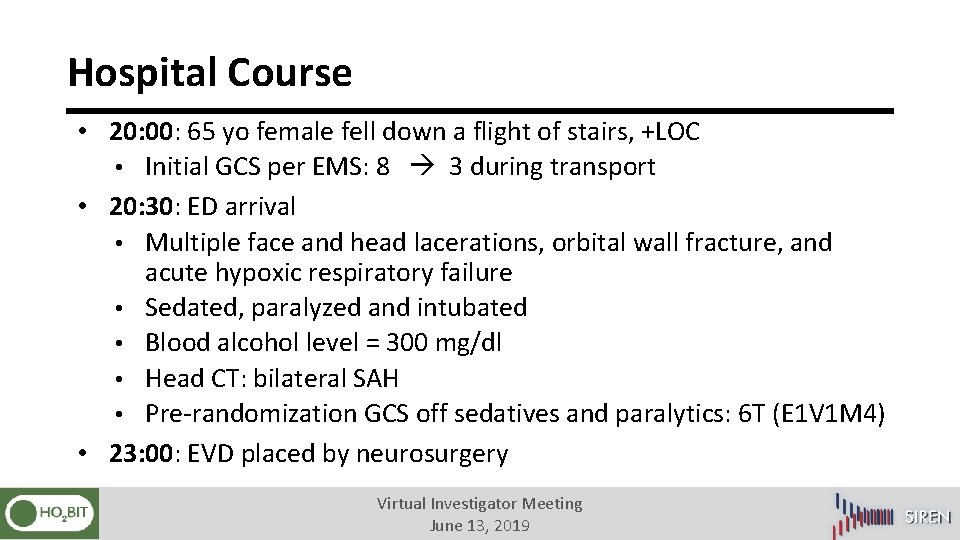
Hospital Course • 20: 00: 65 yo female fell down a flight of stairs, +LOC • Initial GCS per EMS: 8 3 during transport • 20: 30: ED arrival • Multiple face and head lacerations, orbital wall fracture, and acute hypoxic respiratory failure • Sedated, paralyzed and intubated • Blood alcohol level = 300 mg/dl • Head CT: bilateral SAH • Pre-randomization GCS off sedatives and paralytics: 6 T (E 1 V 1 M 4) • 23: 00: EVD placed by neurosurgery Virtual Investigator Meeting June 13, 2019
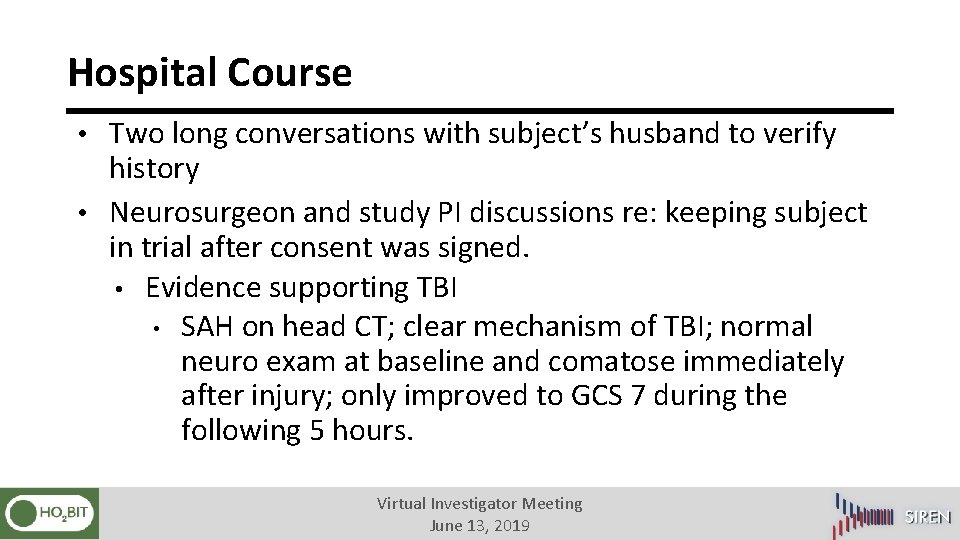
Hospital Course • Two long conversations with subject’s husband to verify history • Neurosurgeon and study PI discussions re: keeping subject in trial after consent was signed. • Evidence supporting TBI • SAH on head CT; clear mechanism of TBI; normal neuro exam at baseline and comatose immediately after injury; only improved to GCS 7 during the following 5 hours. Virtual Investigator Meeting June 13, 2019
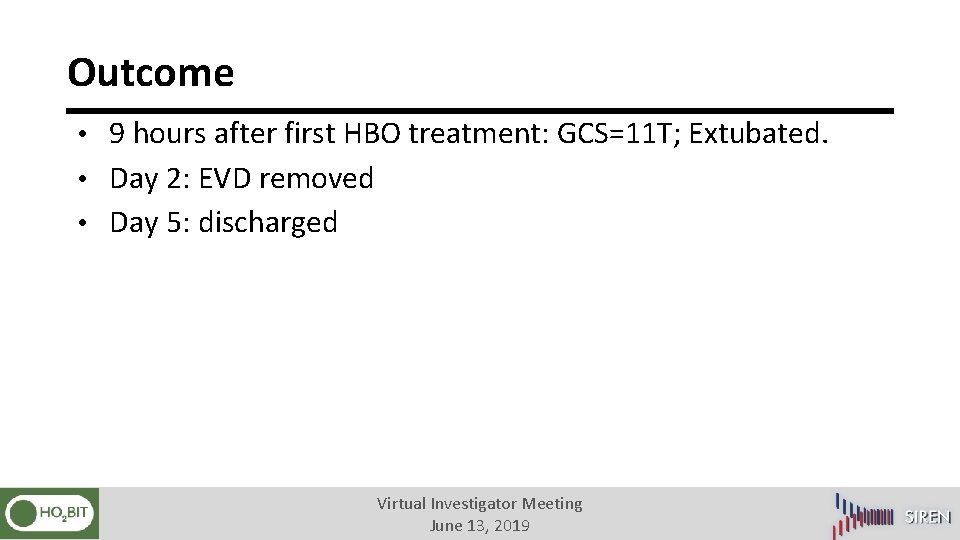
Outcome • 9 hours after first HBO treatment: GCS=11 T; Extubated. • Day 2: EVD removed • Day 5: discharged Virtual Investigator Meeting June 13, 2019
Remote Consent is Awesome! Cathy Fairfield; Iowa
Screening Best Practices Cathy Fairfield; Iowa • Using the screener form with key points to capture • Team receives Trauma pages prior to the subject arrival to ED • Research team has 24/7 coverage between being in the ED & On Call • Research team member goes to the trauma room to gather info before it is placed in Epic • Research team member talking with clinical staffneurosurgery, nursing, ED team Virtual Investigator Meeting June 13, 2019
Screening Best Practices Eric Jaton & Abbey Staugaitis; HCMC • • The NSG service is our eyes and ears for enrollments We keep it as simple as possible, and within their normal clinical decision making. Are you thinking of placing an ICP monitor in this patient? Yes? A HOBIT coordinator should be paged. Virtual Investigator Meeting June 11, 2019
Screening Best Practices Rachael Woodburn, Duke • Utilizing the ED team and the anesthesia CRU to screen for potential patients • Paging the neurosurgeons about once a week to remind them to page our designated HOBIT pager with anyone they think maybe even a slight potential. Study team will then do a “deeper dive” into the chart ASAP • Informing the hyperbaric team immediately when we think we have a potential patient to give them as much time as possible to prepare their staff and the chamber Communication is key! Virtual Investigator Meeting June 13, 2019
Adverse Event Reporting Sarah B. Rockswold, MD; HCMC
Adverse Event Reporting - Objectives • • What are the expected HOBIT SAEs Currently what are the most common HOBIT SAEs Become familiar with combining related SAEs into one event Realize the importance of reporting the temporal relationship between the adverse event and treatment Virtual Investigator Meeting June 13, 2019
Adverse Event Reporting – Expected SAEs • Signs of Pulmonary Dysfunction • Pa. O 2/Fi. O 2 ≤ 200 or requiring PEEP > 10 cm of water to maintain a Pa. O 2/Fi. O 2 ratio of > 200 • Pneumothorax induced by HBO therapy • Pneumonia Virtual Investigator Meeting June 13, 2019
Adverse Event Reporting – Expected SAEs • Critically decreased Cerebral Perfusion Pressure (CPP) • CPP < 60 mm. Hg on at least 2 consecutive measurements obtained at least 30 minutes apart • Hypercarbia during transportation • Pa. CO 2 > 45 mm. Hg on arterial blood gas obtained post-transport to HBO chamber and before HBO treatment • Seizures during HBO treatment Virtual Investigator Meeting June 13, 2019
Adverse Event Reporting – Expected SAEs • Critical hypotension -Mean arterial pressure (MAP) < 70 mm. Hg on at least 2 consecutive measurements obtained at least 30 minutes apart • For both critically decreased CPP and MAP -During the first 5 days of treatment, all episodes of either should be recorded as one SAE. The start time is the time of the first occurrence of critical decrease in CPP/MAP and the end time is when the decrease in CPP/MAP finally resolved Virtual Investigator Meeting June 13, 2019
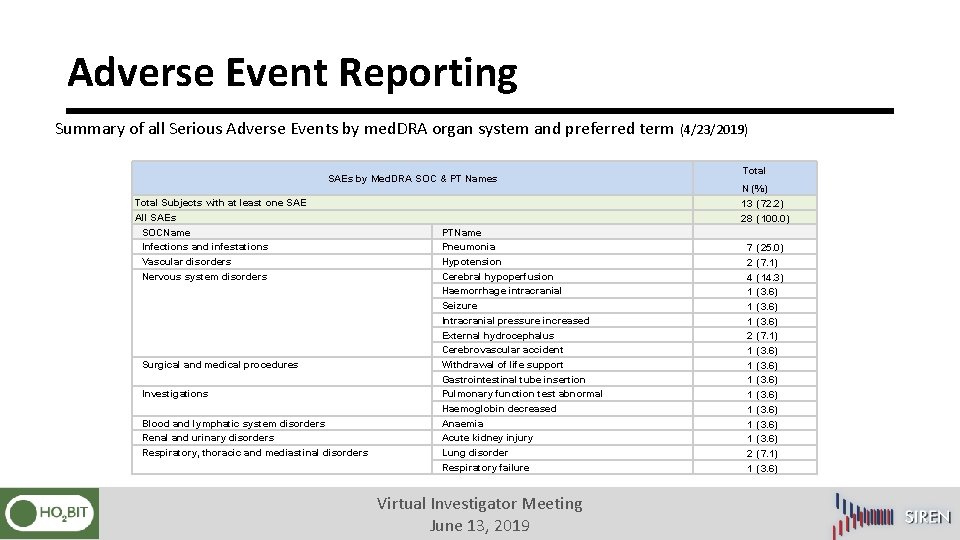
Adverse Event Reporting Summary of all Serious Adverse Events by med. DRA organ system and preferred term (4/23/2019) SAEs by Med. DRA SOC & PT Names Total Subjects with at least one SAE All SAEs SOCName Infections and infestations Vascular disorders Nervous system disorders Surgical and medical procedures Investigations Blood and lymphatic system disorders Renal and urinary disorders Respiratory, thoracic and mediastinal disorders PTName Pneumonia Hypotension Cerebral hypoperfusion Haemorrhage intracranial Seizure Intracranial pressure increased External hydrocephalus Cerebrovascular accident Withdrawal of life support Gastrointestinal tube insertion Pulmonary function test abnormal Haemoglobin decreased Anaemia Acute kidney injury Lung disorder Respiratory failure Virtual Investigator Meeting June 13, 2019 Total N (%) 13 (72. 2) 28 (100. 0) 7 2 4 1 1 1 2 1 (25. 0) (7. 1) (14. 3) (3. 6) (3. 6) (7. 1) (3. 6)
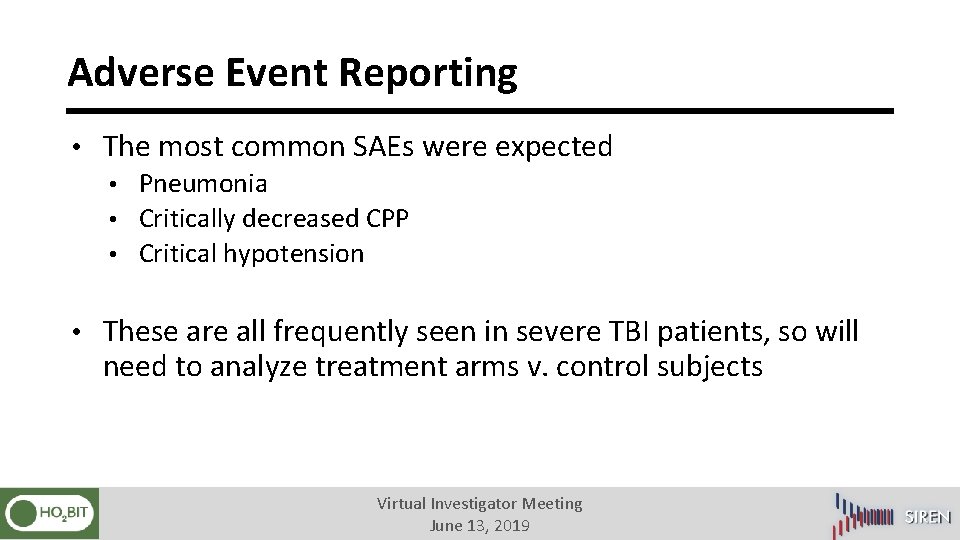
Adverse Event Reporting • The most common SAEs were expected • Pneumonia • Critically decreased CPP • Critical hypotension • These are all frequently seen in severe TBI patients, so will need to analyze treatment arms v. control subjects Virtual Investigator Meeting June 13, 2019
Adverse Event Reporting – Reporting Tips • The CCC is required to submit any SAEs that are determined to be unexpected and probably, possibly, or definitely related to the research procedures. • This notification to the IRB must occur promptly and no later than 10 business days from the time the investigator learns of the event Virtual Investigator Meeting June 13, 2019
Adverse Event Reporting – Reporting Tips • Combining groups of events reflecting identical underlying pathophysiology: • For example, if a subject has an elevated ICP and a decreased MAP/CPP all due to cerebral edema, report the cerebral edema SAE and put the ICP, MAP, CPP in the narrative • There is a SAE template that combines CPP, ICP, & MAP in the MOP within the HOBIT Safety Monitoring Plan Virtual Investigator Meeting June 13, 2019
Adverse Event Reporting – Reporting Tips • Report diagnoses not the symptoms or signs separately • Pneumonia (diagnosis) instead of cough, chest pain, fever, infiltrates on chest x-ray, and/or hypoxia Virtual Investigator Meeting June 13, 2019
Adverse Event Reporting – Reporting Tips • Death is an outcome and never a SAE • The adverse event name should be what caused the subject’s death (pathology) Virtual Investigator Meeting June 13, 2019
Adverse Event Reporting – Reporting Tips • Temporal relationship to enrollment and treatment • Prior to enrollment would not matter (unless severity worsens) • Need to have study arm, enrollment date/time, number of treatments, and end of treatment period to be in narrative • Important to note when SAEs such as CPP, hypotension, seizure occurs related to treatment (during or after) Virtual Investigator Meeting June 13, 2019
Adverse Event Reporting – Reporting Tips • The independent medical safety monitor (IMSM) does not have access to subject’s medical records. They need enough information to be able to determine the (1) severity of the event; (2) relatedness to the intervention; (3) expectedness Virtual Investigator Meeting June 13, 2019
Adverse Event Reporting – Conclusion • The most common SAEs currently are pneumonia, critically decreased CPP, and hypotension which were expected • It is important to group related SAEs together • Reporting temporal relationship to enrollment and treatment is critical Virtual Investigator Meeting June 13, 2019
Ongoing Training of Clinical Staff Eric Jaton & Abbey Staugaitis; HCMC • Our NSG service has a Friday AM conference, which we present at every 3 months (at minimum). This captures all the senior residents multiple times, and catches the rotating/juniors residents at least once during their rotation. We also make ourselves available to do 1: 1 training if a clinician expresses interest but needs help to get onboarded as an investigator • We (the research team) also have multiple debriefs after each HBO randomization one with HBO, one with NSG, and if possible, one with everybody (NSG, HBO, SICU, RT, Dr. R/PI, Research) • We have SICU cross train a few RNs that could cover a dive and follow the patient down to HBO, instead of HBO staff covering them all. This staffing flexibility is extremely important to have us ready to go 24/7 • Biweekly email blast with our local notes to the entire NSG team. I usually attach this as a forward to Natalie's newsletter Virtual Investigator Meeting June 13, 2019
Ongoing Training of Clinical Staff Cathy Fairfield; Iowa • • • Use of the HOBIT checklist Monthly meeting with HOBIT leadership team at UIHC When a new SNICU nurse is with the subject at HBOresearch team member share with him/her: • the HBO unit, the procedure of being there, what the team needs from him/her for charting in Epic Virtual Investigator Meeting June 11, 2019
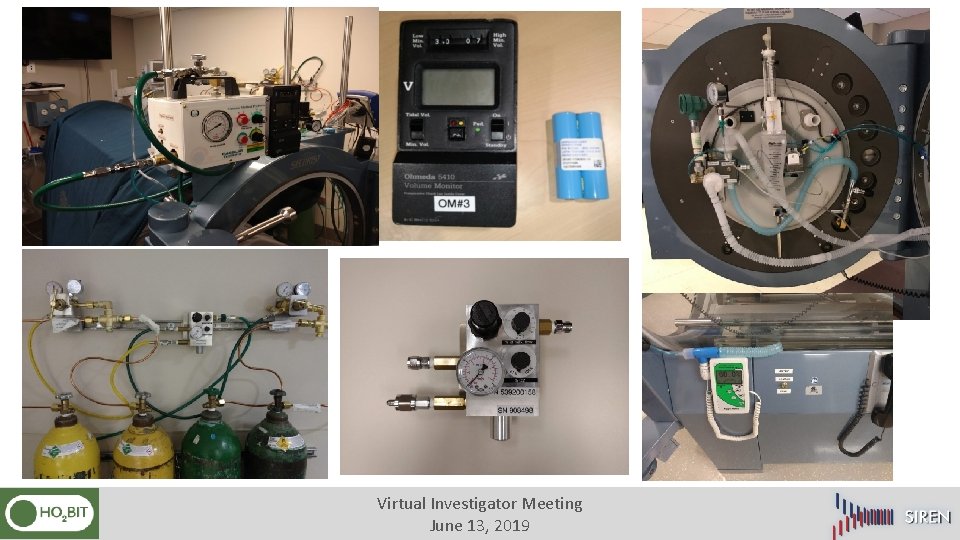
Maintaining Competency with the Magellan Ventilator And Supporting Systems Bill Gossett (HCMC) * Monoplace Sites Only
Virtual Investigator Meeting June 13, 2019
Challenges of Maintaining Competency • DSMB expressed concern with how sites would maintain skill sets to safely ventilate subjects during a hyperbaric treatment • Challenges: • New and unfamiliar equipment • Vt, PIP and I: E ratios are constantly changing during compression and decompression • There can be long gaps of time between HOBIT subjects resulting in diminished skill sets and safety • Keeping multiple individuals trained and competent to safely operate the Magellan ventilator Virtual Investigator Meeting June 13, 2019
Refresher Training • An abbreviated training video for the Magellan and supporting system is coming soon, hopefully available by next month (July) • The training video will review equipment, system set up, operation of the ventilator during a hyperbaric treatment, and simple troubleshooting • Anyone who may potentially operate the Magellan needs to watch the training video at least every three (3) months • Please keep a record of your training Virtual Investigator Meeting June 13, 2019
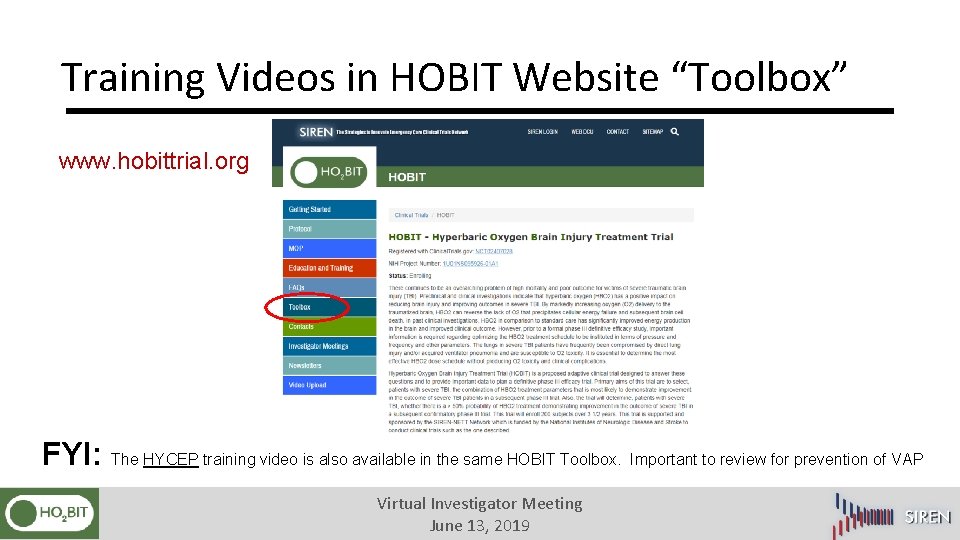
Training Videos in HOBIT Website “Toolbox” www. hobittrial. org FYI: The HYCEP training video is also available in the same HOBIT Toolbox. Important to review for prevention of VAP Virtual Investigator Meeting June 13, 2019
Closing Remarks Virtual Investigator Meeting June 13, 2019
- Slides: 57