
Hyper Log on Windowed Streams Robin Christopher Yu

Hyper. Log on Windowed Streams Robin Christopher Yu Sidhant Bansal CS 5234 — Algorithms at

The Windowed Streaming Context
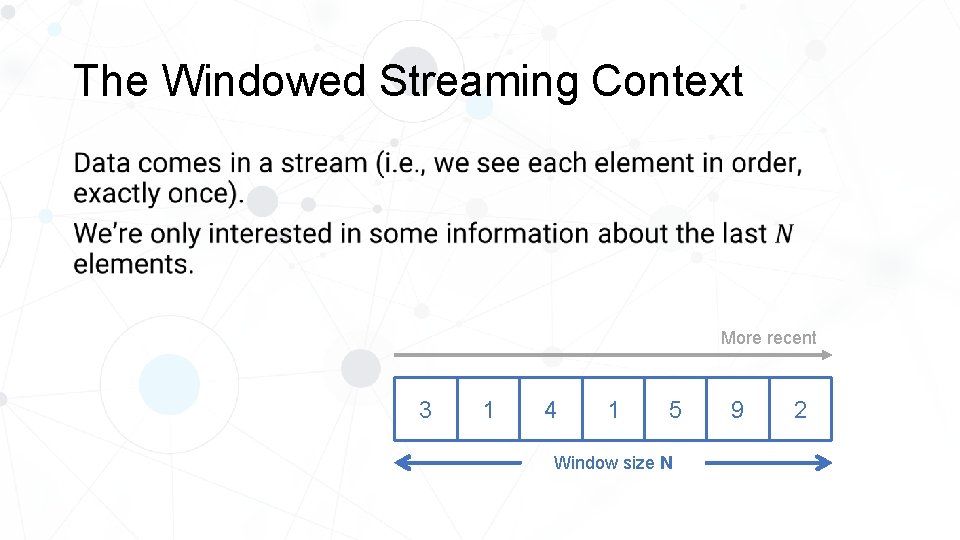
The Windowed Streaming Context • More recent 3 1 4 1 5 Window size N 9 2
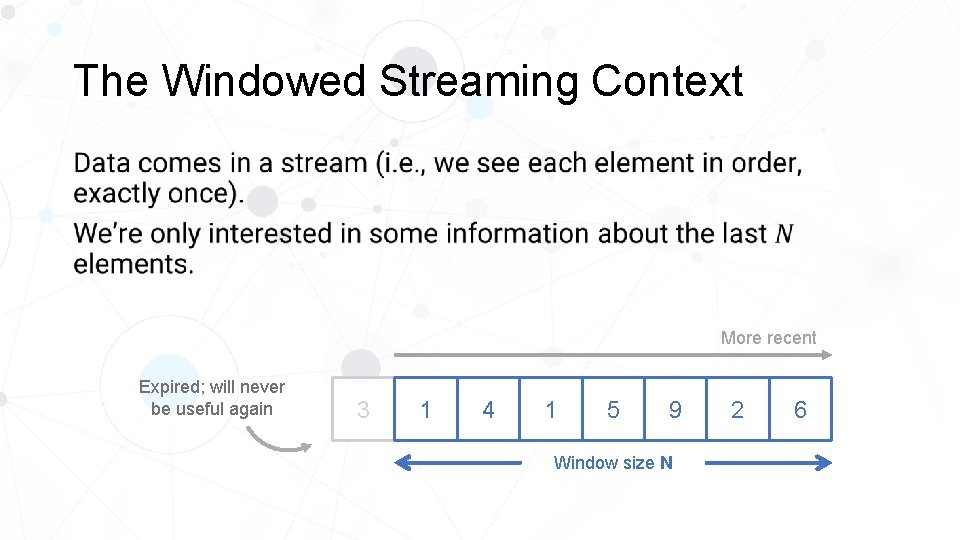
The Windowed Streaming Context • More recent Expired; will never be useful again 3 1 4 1 5 9 Window size N 2 6
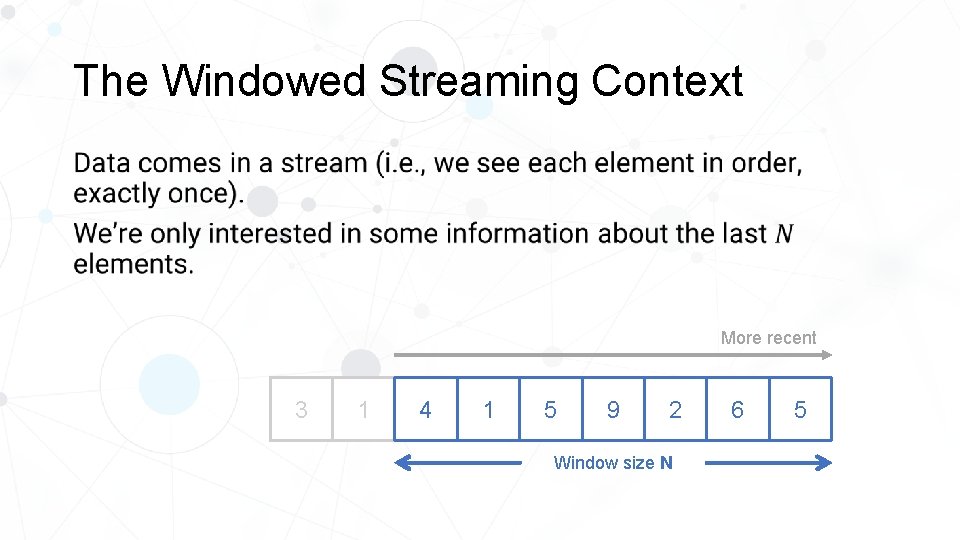
The Windowed Streaming Context • More recent 3 1 4 1 5 9 2 Window size N 6 5
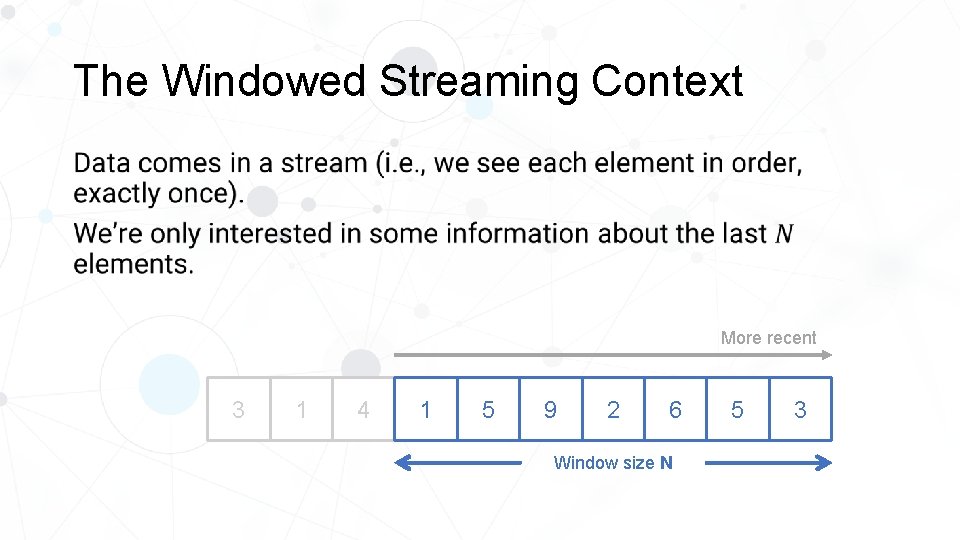
The Windowed Streaming Context • More recent 3 3 1 4 1 5 9 2 6 Window size N 5 3
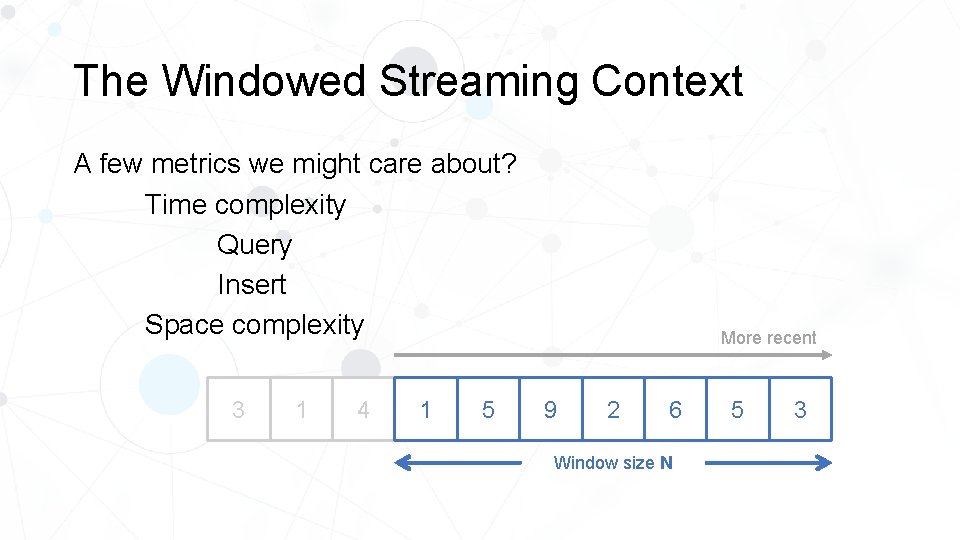
The Windowed Streaming Context A few metrics we might care about? Time complexity Query Insert Space complexity 3 3 1 4 1 5 More recent 9 2 6 Window size N 5 3

The Windowed Streaming Context • More recent 3 3 1 4 1 5 9 2 6 Window size N 5 3
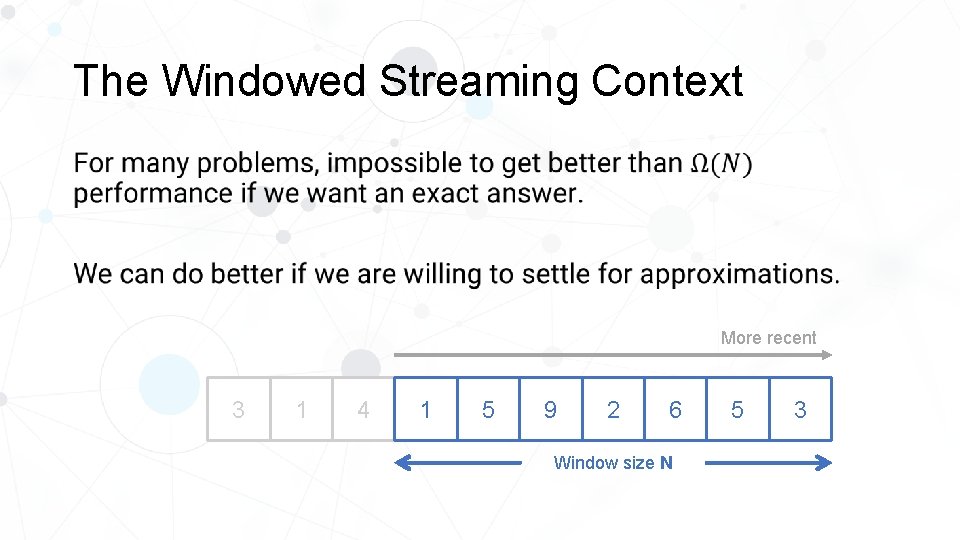
The Windowed Streaming Context • More recent 3 3 1 4 1 5 9 2 6 Window size N 5 3
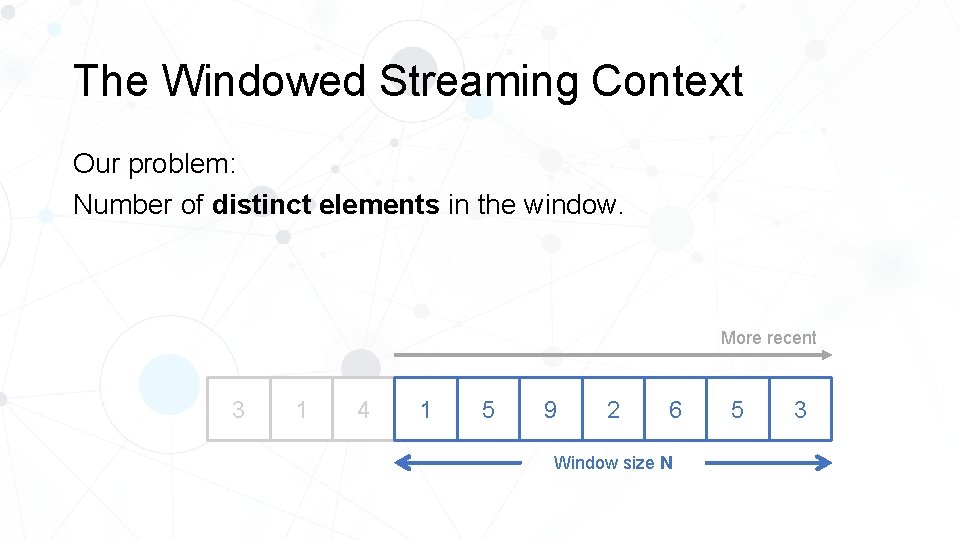
The Windowed Streaming Context Our problem: Number of distinct elements in the window. More recent 3 3 1 4 1 5 9 2 6 Window size N 5 3

Log. Log and Hyper. Log
Log. Log and Hyper. Log solves the problem posed on a streaming context but without windows. That is, the number of distinct elements across all elements seen.
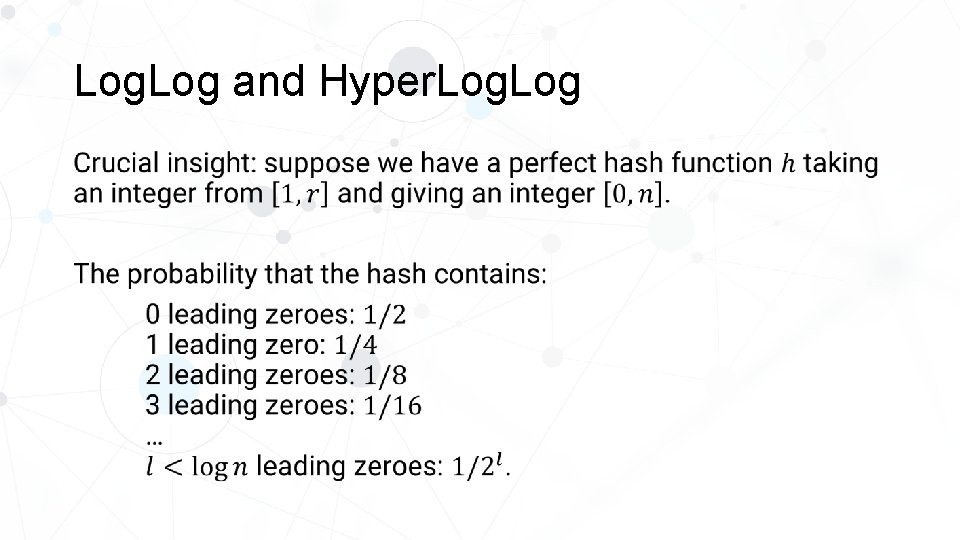
Log. Log and Hyper. Log •
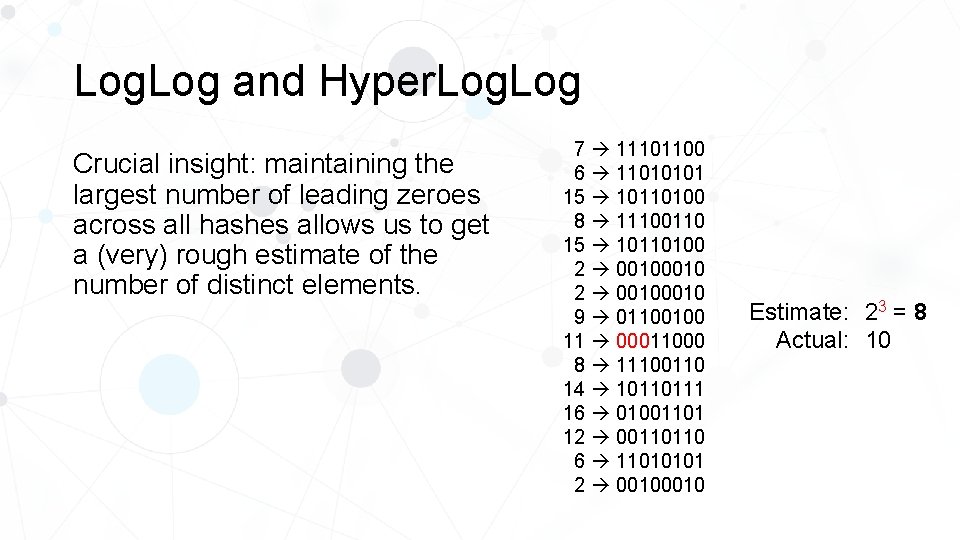
Log. Log and Hyper. Log Crucial insight: maintaining the largest number of leading zeroes across all hashes allows us to get a (very) rough estimate of the number of distinct elements. 7 11101100 6 11010101 15 10110100 8 11100110 15 10110100 2 00100010 9 01100100 11 00011000 8 11100110 14 10110111 16 01001101 12 00110110 6 11010101 2 0010 Estimate: 23 = 8 Actual: 10
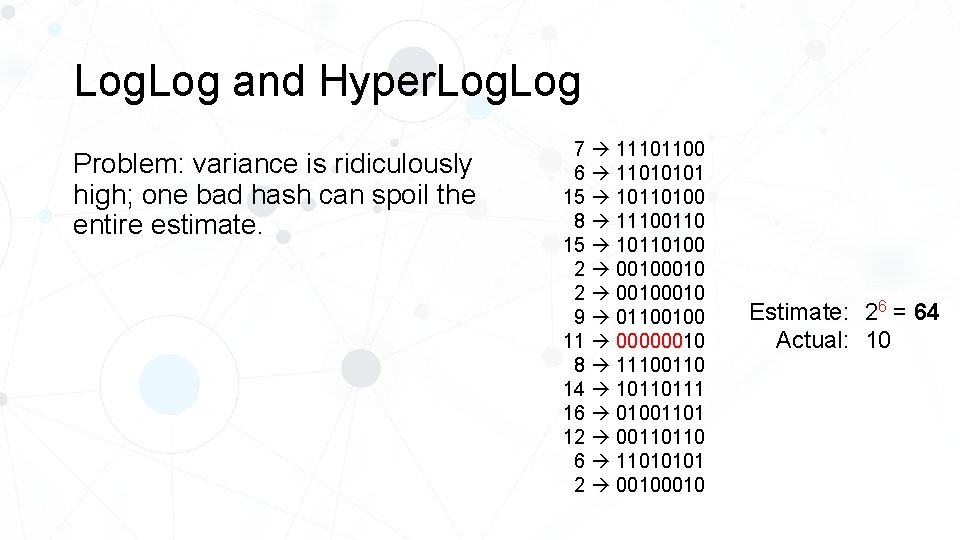
Log. Log and Hyper. Log Problem: variance is ridiculously high; one bad hash can spoil the entire estimate. 7 11101100 6 11010101 15 10110100 8 11100110 15 10110100 2 00100010 9 01100100 11 00000010 8 11100110 14 10110111 16 01001101 12 00110110 6 11010101 2 0010 Estimate: 26 = 64 Actual: 10
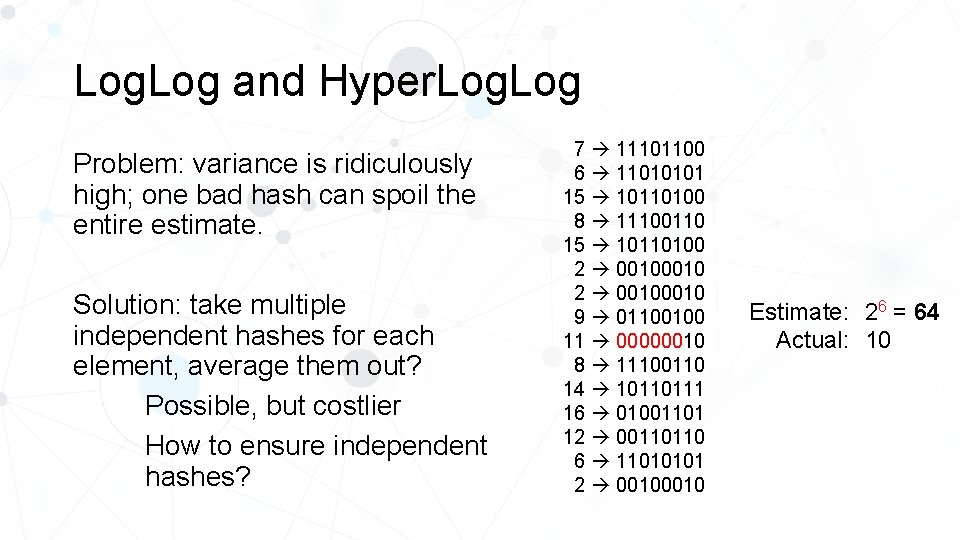
Log. Log and Hyper. Log Problem: variance is ridiculously high; one bad hash can spoil the entire estimate. Solution: take multiple independent hashes for each element, average them out? Possible, but costlier How to ensure independent hashes? 7 11101100 6 11010101 15 10110100 8 11100110 15 10110100 2 00100010 9 01100100 11 00000010 8 11100110 14 10110111 16 01001101 12 00110110 6 11010101 2 0010 Estimate: 26 = 64 Actual: 10
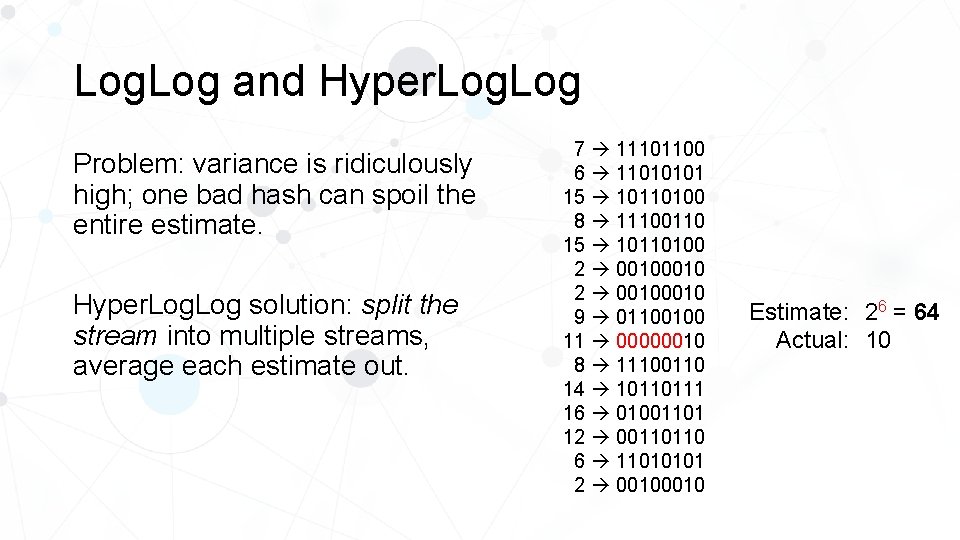
Log. Log and Hyper. Log Problem: variance is ridiculously high; one bad hash can spoil the entire estimate. Hyper. Log solution: split the stream into multiple streams, average each estimate out. 7 11101100 6 11010101 15 10110100 8 11100110 15 10110100 2 00100010 9 01100100 11 00000010 8 11100110 14 10110111 16 01001101 12 00110110 6 11010101 2 0010 Estimate: 26 = 64 Actual: 10
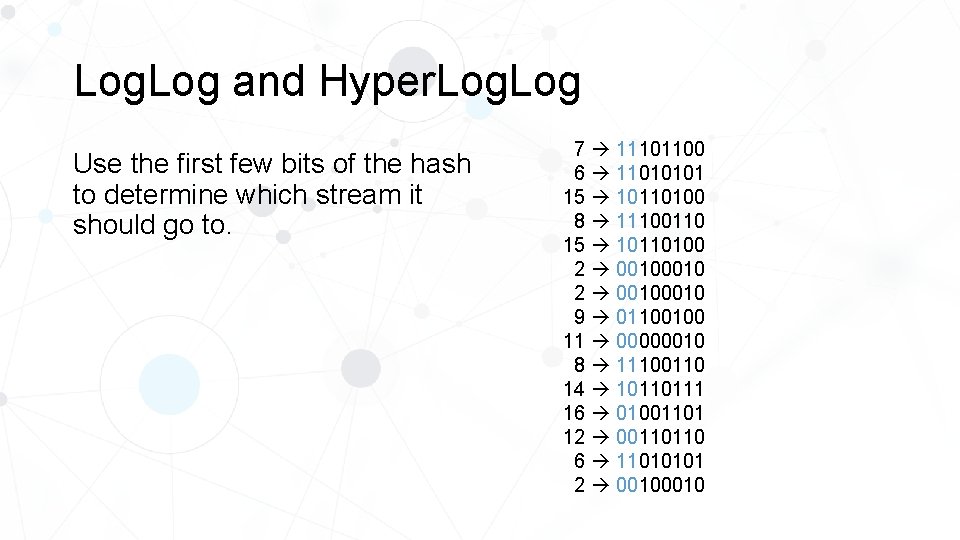
Log. Log and Hyper. Log Use the first few bits of the hash to determine which stream it should go to. 7 11101100 6 11010101 15 10110100 8 11100110 15 10110100 2 00100010 9 01100100 11 00000010 8 11100110 14 10110111 16 01001101 12 00110110 6 11010101 2 0010
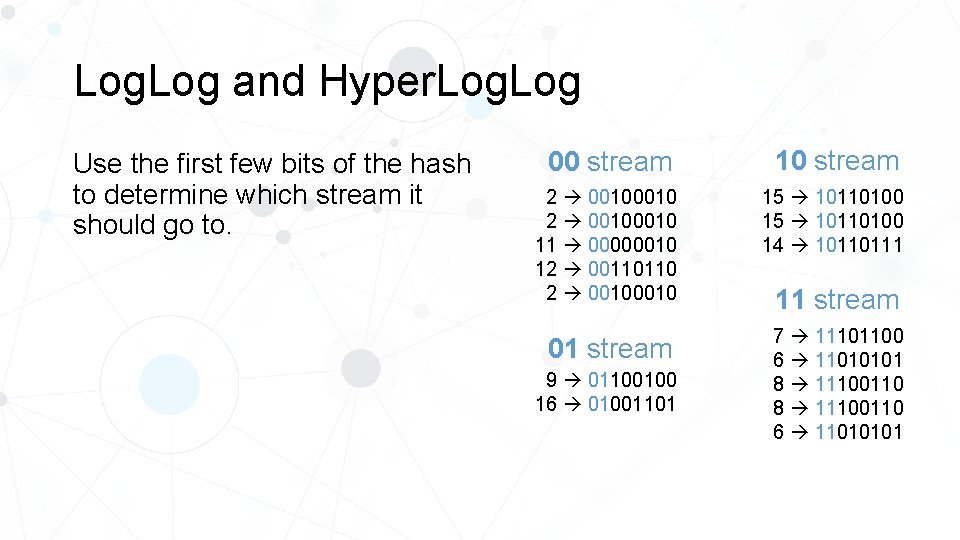
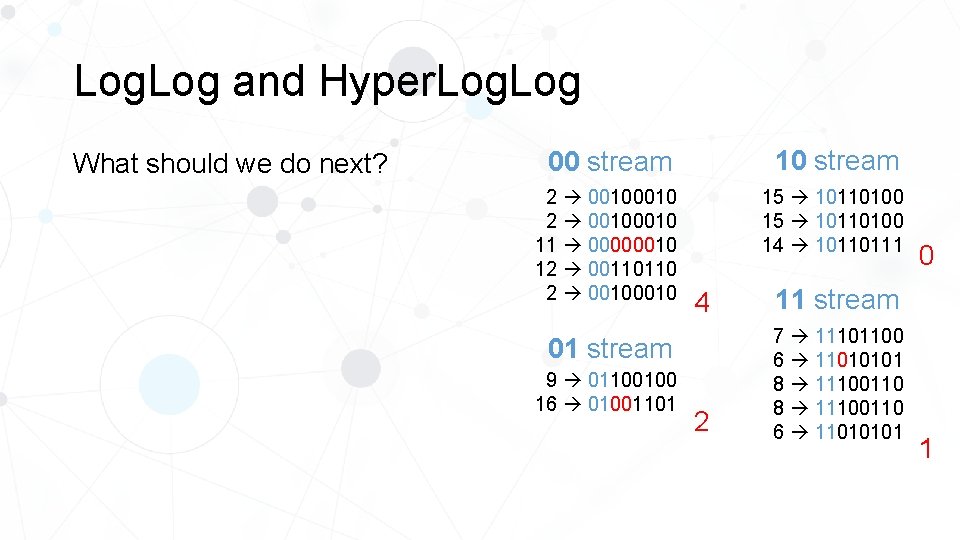
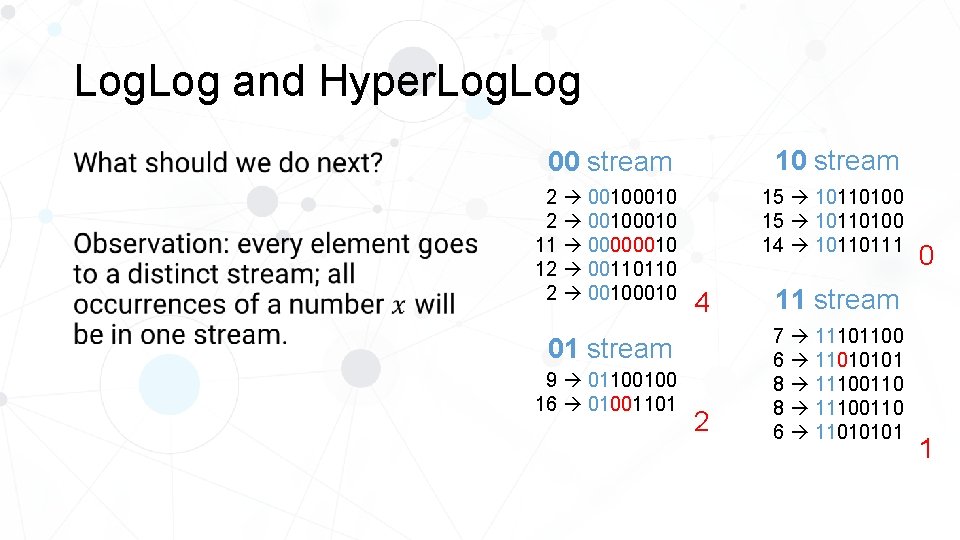
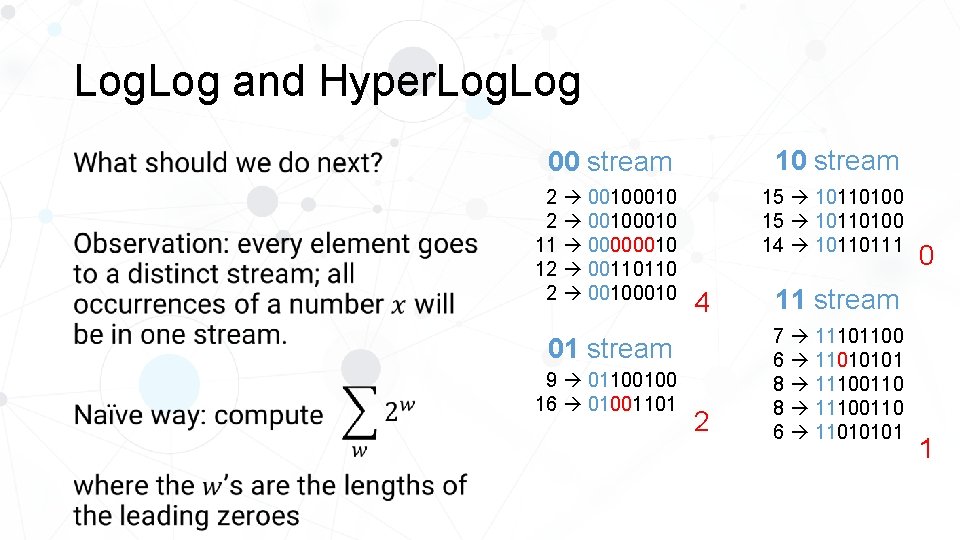
Log. Log and Hyper. Log Use the first few bits of the hash to determine which stream it should go to. 00 stream 10 stream 2 00100010 11 00000010 12 00110110 2 0010 15 10110100 14 10110111 01 stream 7 11101100 6 11010101 8 11100110 6 11010101 9 01100100 16 01001101 11 stream
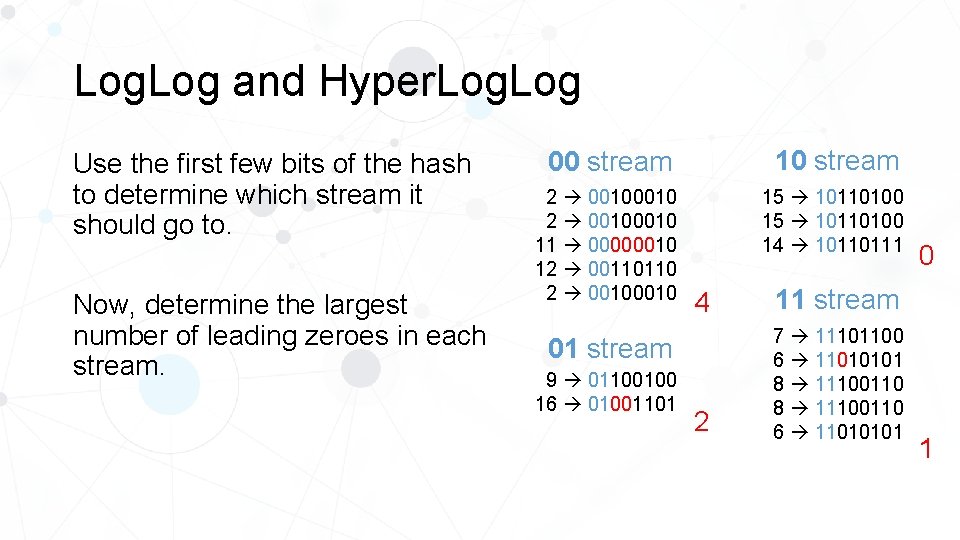
Log. Log and Hyper. Log Use the first few bits of the hash to determine which stream it should go to. Now, determine the largest number of leading zeroes in each stream. 00 stream 10 stream 2 00100010 11 00000010 12 00110110 2 0010 15 10110100 14 10110111 4 11 stream 2 7 11101100 6 11010101 8 11100110 6 11010101 01 stream 9 01100100 16 01001101 0 1
Log. Log and Hyper. Log What should we do next? 00 stream 10 stream 2 00100010 11 00000010 12 00110110 2 0010 15 10110100 14 10110111 4 11 stream 2 7 11101100 6 11010101 8 11100110 6 11010101 01 stream 9 01100100 16 01001101 0 1
Log. Log and Hyper. Log 00 stream 10 stream 2 00100010 11 00000010 12 00110110 2 0010 15 10110100 14 10110111 4 11 stream 2 7 11101100 6 11010101 8 11100110 6 11010101 01 stream 9 01100100 16 01001101 0 1
Log. Log and Hyper. Log 00 stream 10 stream 2 00100010 11 00000010 12 00110110 2 0010 15 10110100 14 10110111 4 11 stream 2 7 11101100 6 11010101 8 11100110 6 11010101 01 stream 9 01100100 16 01001101 0 1
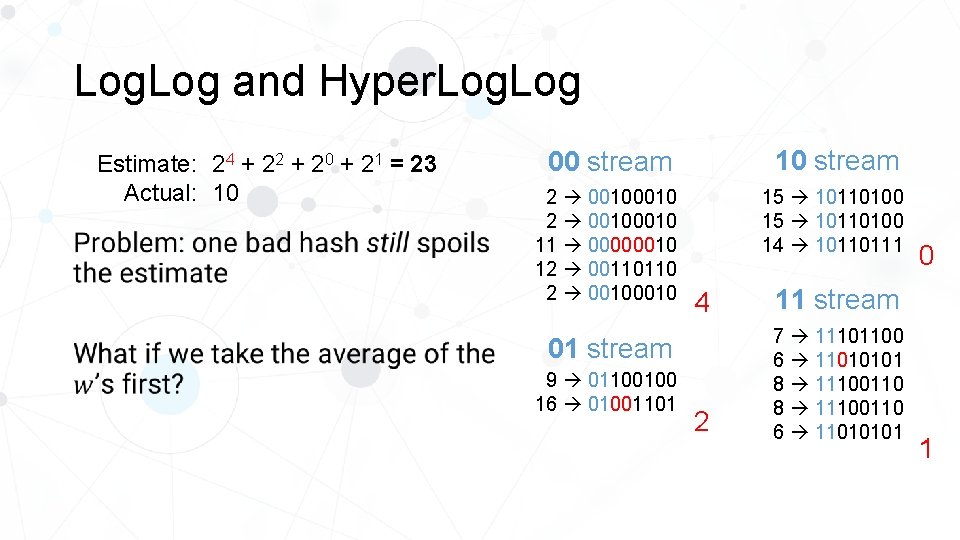
Log. Log and Hyper. Log Estimate: 24 + 22 + 20 + 21 = 23 Actual: 10 00 stream 10 stream 2 00100010 11 00000010 12 00110110 2 0010 15 10110100 14 10110111 4 11 stream 2 7 11101100 6 11010101 8 11100110 6 11010101 01 stream 9 01100100 16 01001101 0 1
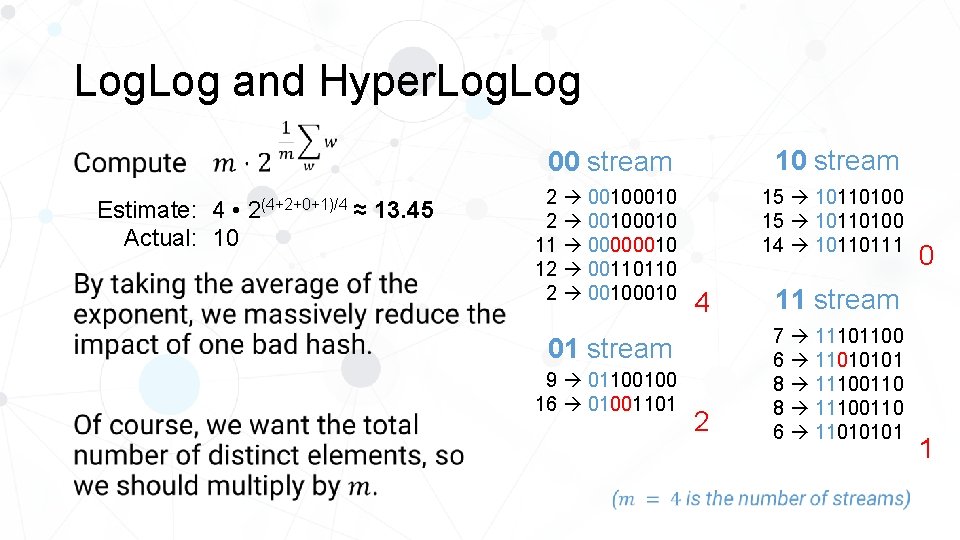
Log. Log and Hyper. Log Estimate: 4 • Actual: 10 2(4+2+0+1)/4 ≈ 13. 45 00 stream 10 stream 2 00100010 11 00000010 12 00110110 2 0010 15 10110100 14 10110111 4 11 stream 2 7 11101100 6 11010101 8 11100110 6 11010101 01 stream 9 01100100 16 01001101 0 1
Log. Log and Hyper. Log What we have described so far is the crux of the Log algorithm. However, the algorithm as described still has a tendency to overestimate. For example, running the previous case a million times gave us an average estimate of distinct values of about 15. 6, which is significantly greater than the correct value of 10.
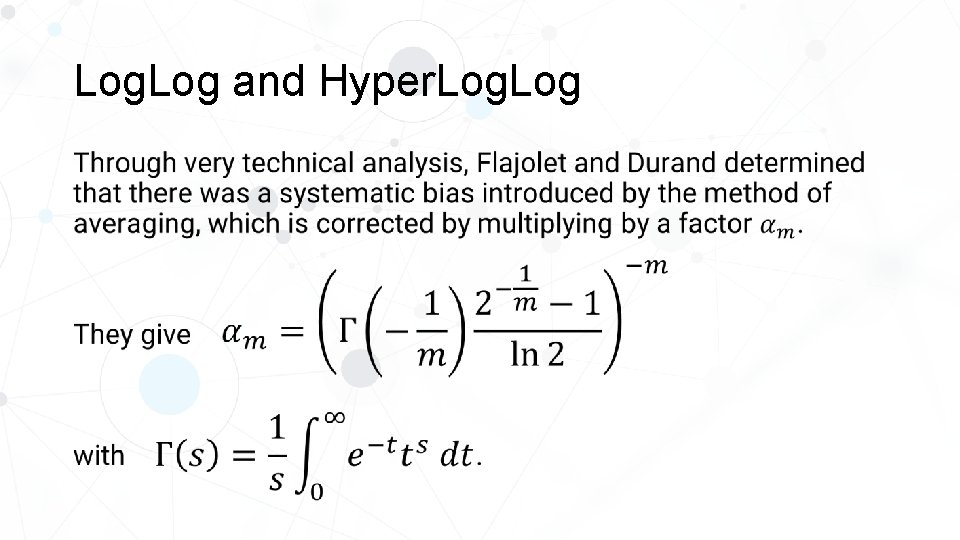
Log. Log and Hyper. Log •
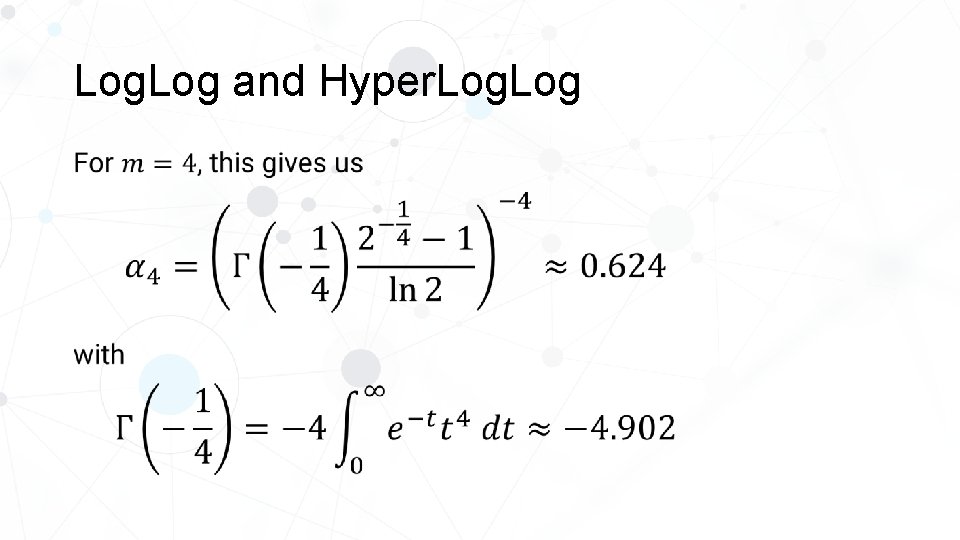
Log. Log and Hyper. Log •
Log. Log and Hyper. Log By multiplying with this constant, we can see that our average estimate is now closer to 0. 624 • 15. 6 ≈ 9. 7 which is much closer to the correct result.
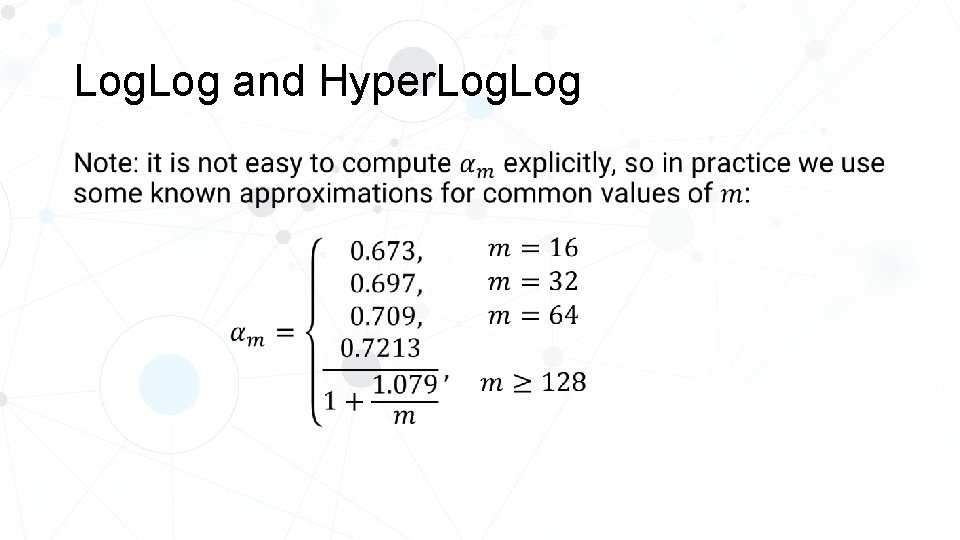
Log. Log and Hyper. Log •
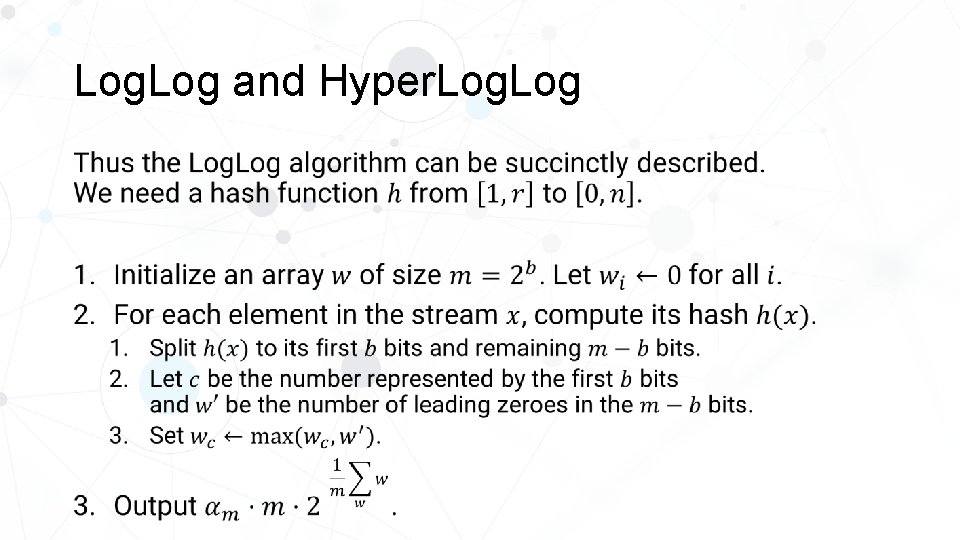
Log. Log and Hyper. Log •
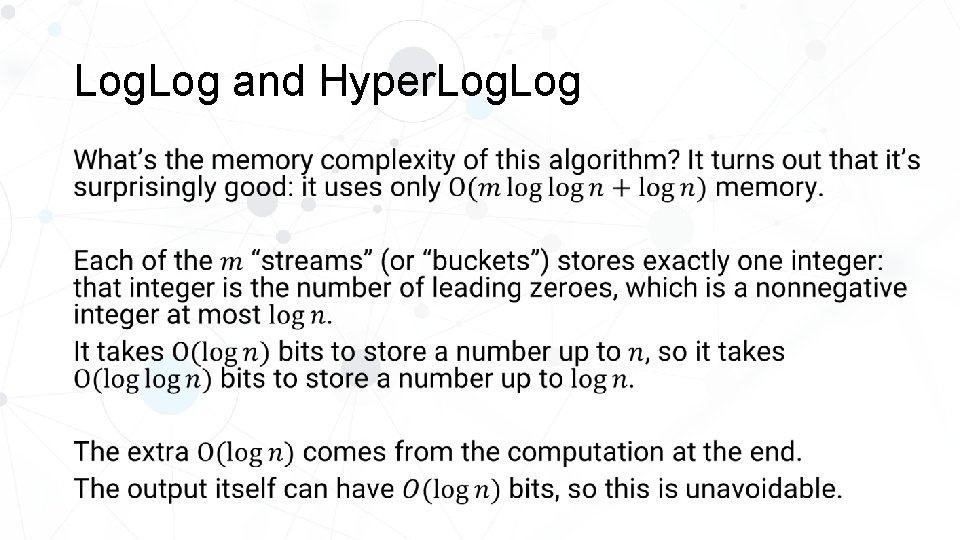
Log. Log and Hyper. Log •
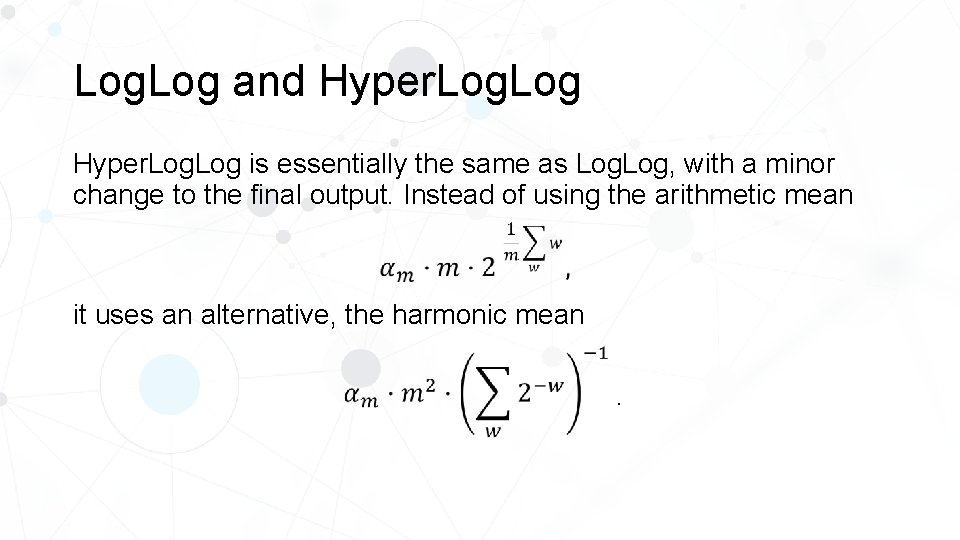
Log. Log and Hyper. Log is essentially the same as Log, with a minor change to the final output. Instead of using the arithmetic mean it uses an alternative, the harmonic mean.
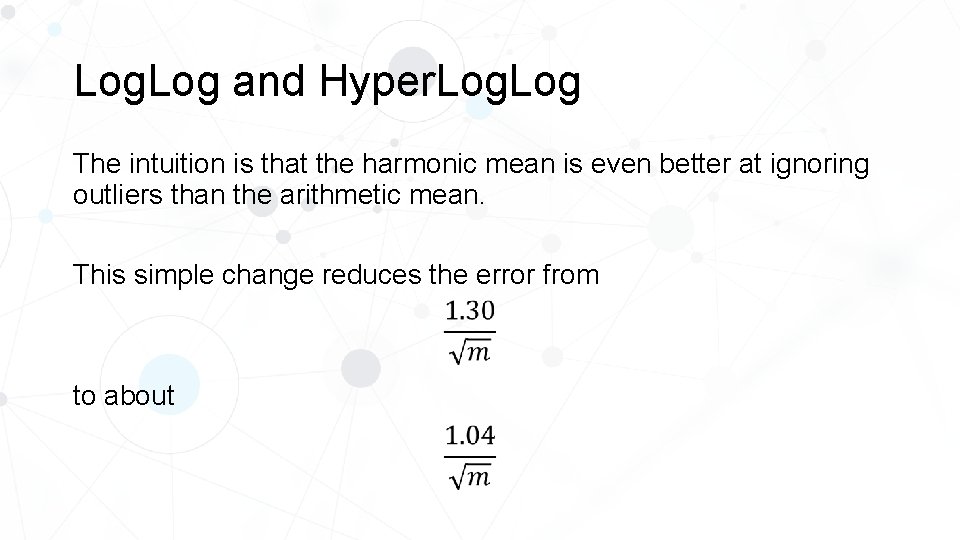
Log. Log and Hyper. Log The intuition is that the harmonic mean is even better at ignoring outliers than the arithmetic mean. This simple change reduces the error from to about
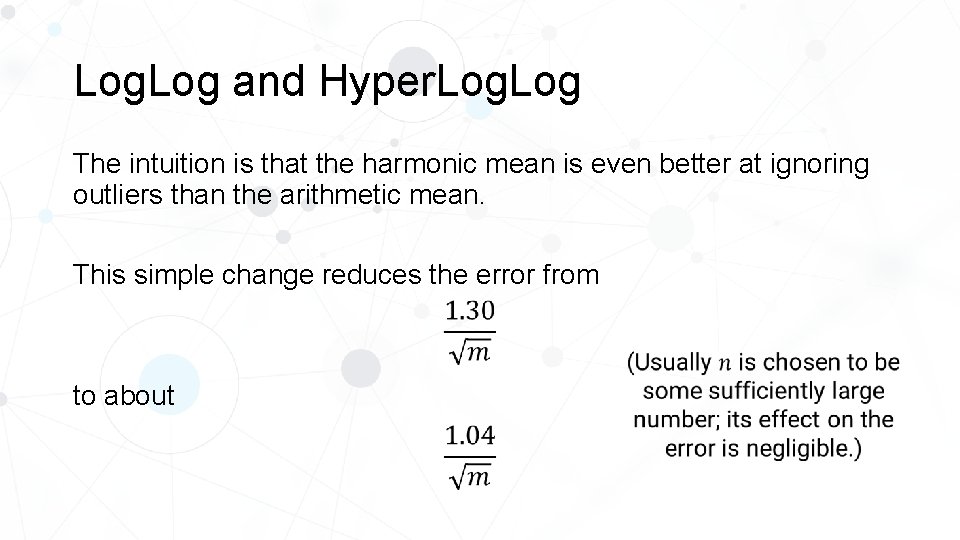
Log. Log and Hyper. Log The intuition is that the harmonic mean is even better at ignoring outliers than the arithmetic mean. This simple change reduces the error from to about

The Exponential Histogram
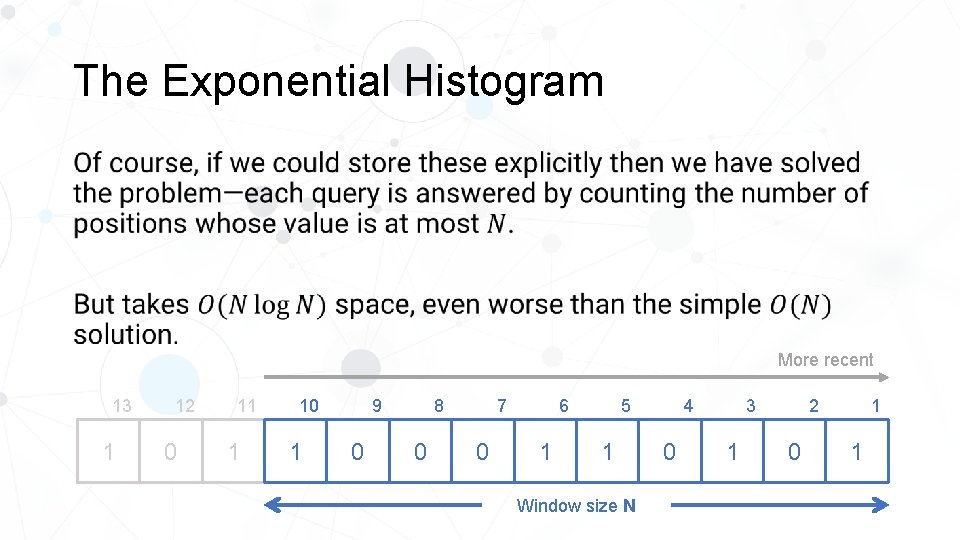
The Exponential Histogram So far, we have described a memory-efficient solution to the problem of counting the number of distinct elements. However, recall that the problem we really want to solve is counting the number of distinct elements in a window. Even seemingly trivial problems can be hard to solve efficiently in the windowed setting!
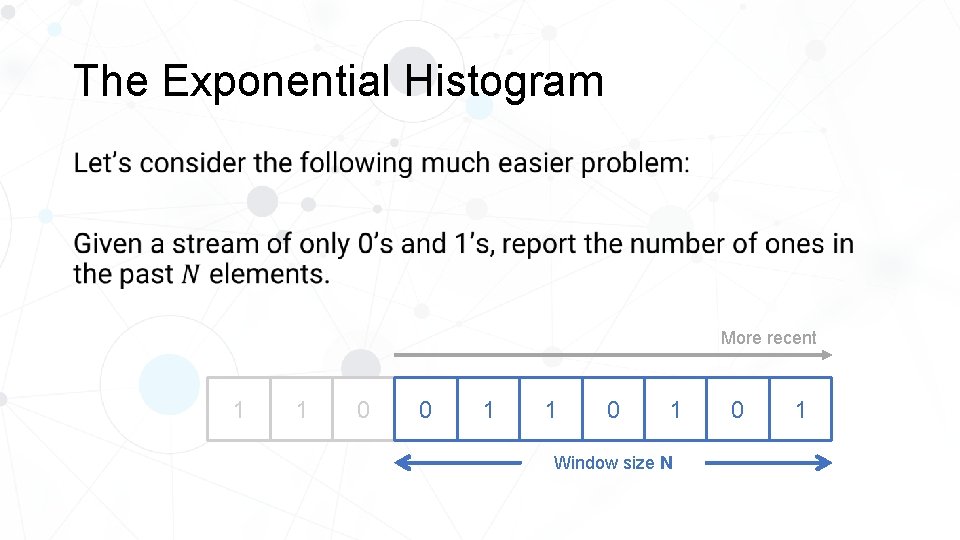
The Exponential Histogram • More recent 1 3 1 0 0 1 1 0 1 Window size N 0 1
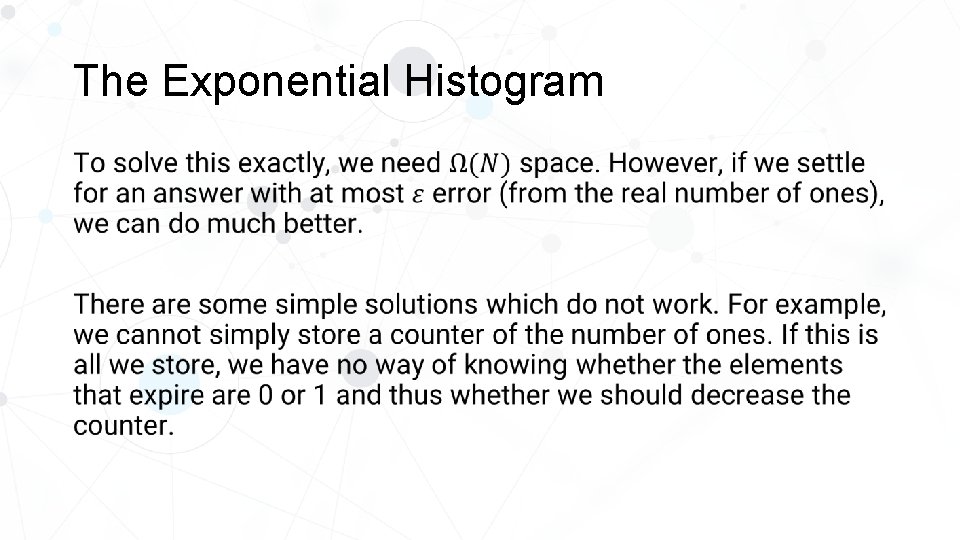
The Exponential Histogram •
The Exponential Histogram Instead, Datar et al. provide a data structure that solves this problem. By maintaining special sorts of histograms, we can keep the error bounded. We will maintain a number of buckets. Each bucket will represent the locations of a contiguous segment of elements (but we will store only the positions of the 1’s). We consider the positions relative to the most recent element, so the most recent element has position 1, then the others have positions 2, 3, and so on from latest to oldest.
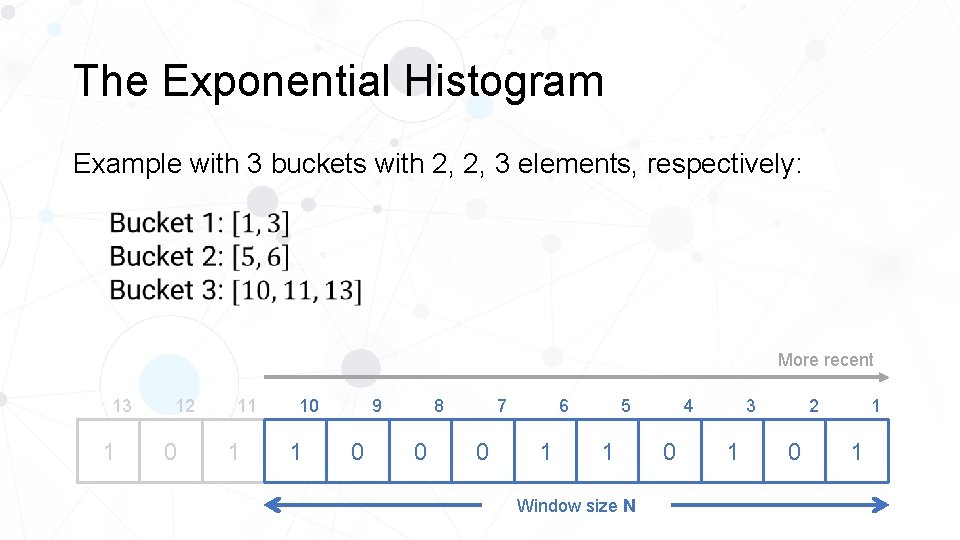
The Exponential Histogram Example with 3 buckets with 2, 2, 3 elements, respectively: More recent 13 1 12 0 11 1 10 1 8 9 0 0 0 5 6 7 1 1 Window size N 4 0 2 3 1 0 1 1
The Exponential Histogram • More recent 13 1 12 0 11 1 10 1 8 9 0 0 0 5 6 7 1 1 Window size N 4 0 2 3 1 0 1 1
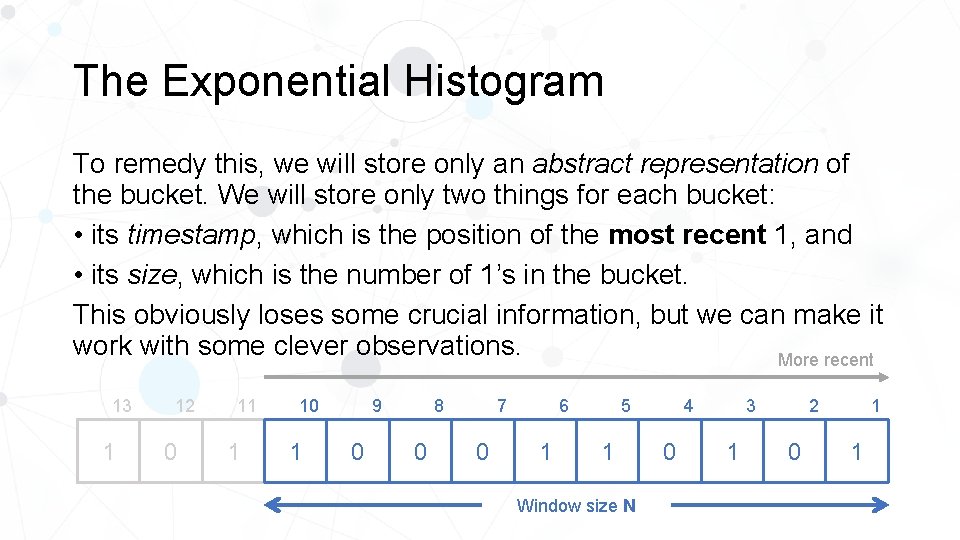
The Exponential Histogram To remedy this, we will store only an abstract representation of the bucket. We will store only two things for each bucket: • its timestamp, which is the position of the most recent 1, and • its size, which is the number of 1’s in the bucket. This obviously loses some crucial information, but we can make it work with some clever observations. More recent 13 1 12 0 11 1 10 1 8 9 0 0 0 5 6 7 1 1 Window size N 4 0 2 3 1 0 1 1
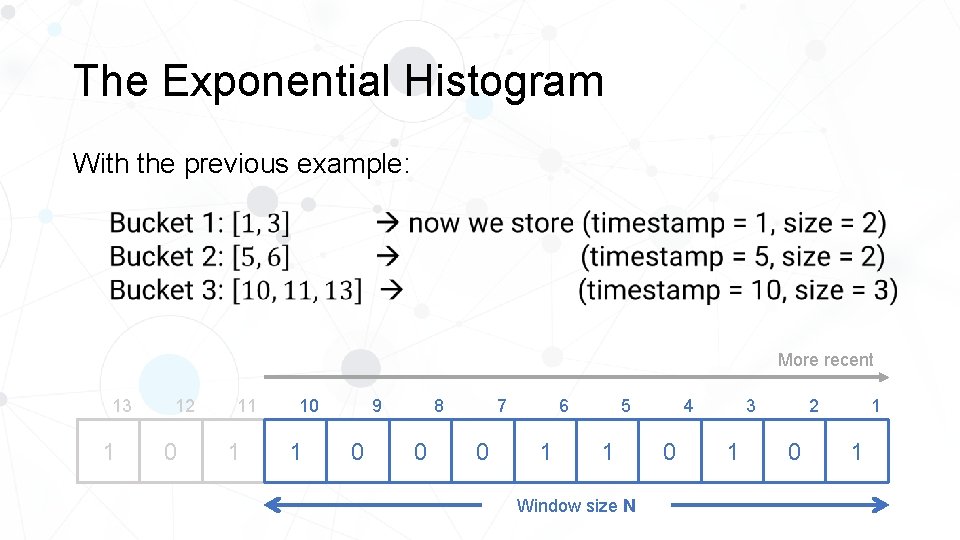
The Exponential Histogram With the previous example: More recent 13 1 12 0 11 1 10 1 8 9 0 0 0 5 6 7 1 1 Window size N 4 0 2 3 1 0 1 1
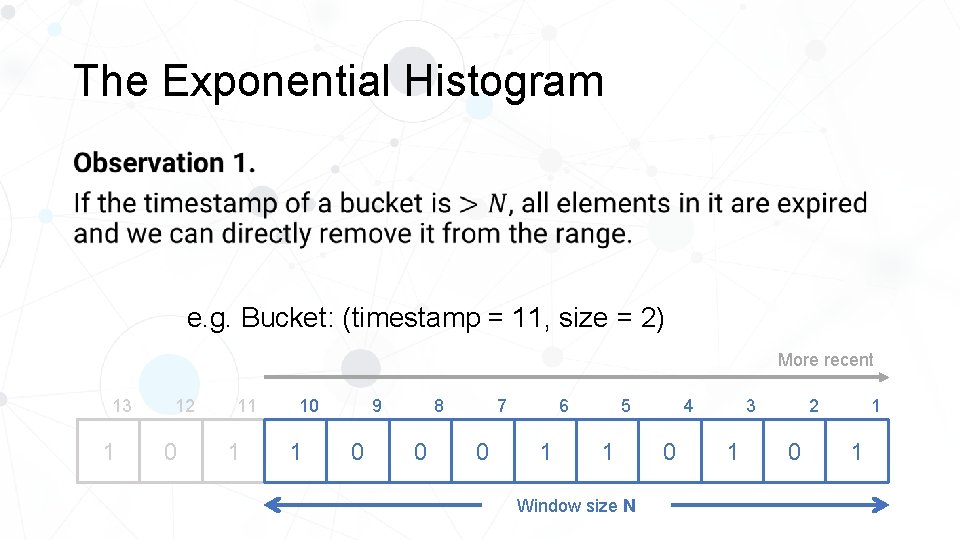
The Exponential Histogram • e. g. Bucket: (timestamp = 11, size = 2) More recent 13 1 12 0 11 1 10 1 8 9 0 0 0 5 6 7 1 1 Window size N 4 0 2 3 1 0 1 1
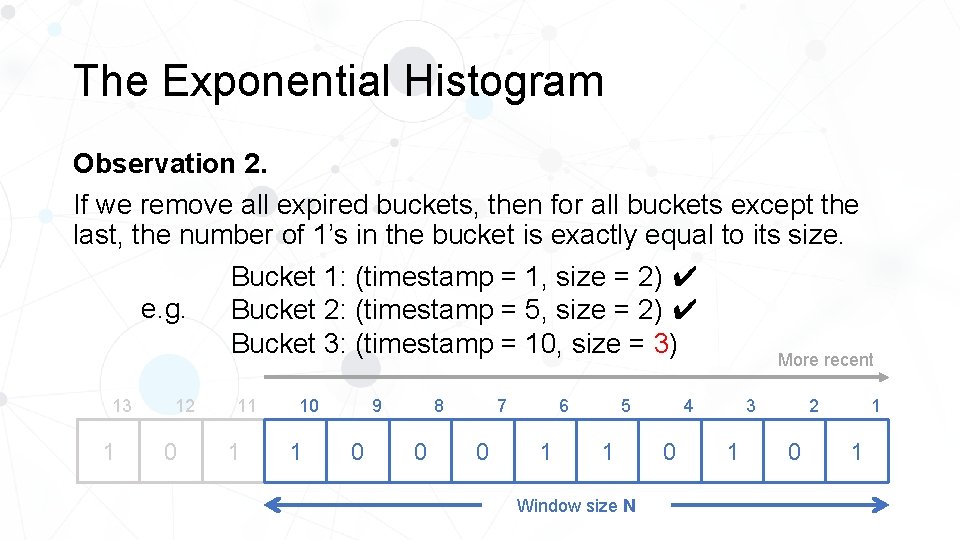
The Exponential Histogram Observation 2. If we remove all expired buckets, then for all buckets except the last, the number of 1’s in the bucket is exactly equal to its size. e. g. 13 1 12 0 Bucket 1: (timestamp = 1, size = 2) ✔ Bucket 2: (timestamp = 5, size = 2) ✔ Bucket 3: (timestamp = 10, size = 3) 11 1 10 1 8 9 0 0 0 5 6 7 1 1 Window size N More recent 4 0 2 3 1 0 1 1
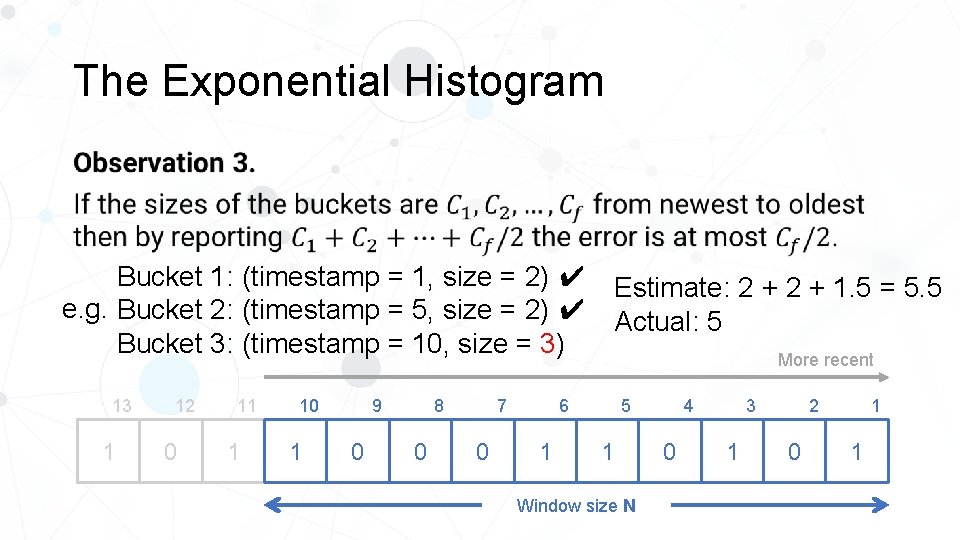
The Exponential Histogram • Bucket 1: (timestamp = 1, size = 2) ✔ e. g. Bucket 2: (timestamp = 5, size = 2) ✔ Bucket 3: (timestamp = 10, size = 3) 13 1 12 0 11 1 10 1 8 9 0 0 More recent 5 6 7 0 Estimate: 2 + 1. 5 = 5. 5 Actual: 5 1 1 Window size N 4 0 2 3 1 0 1 1
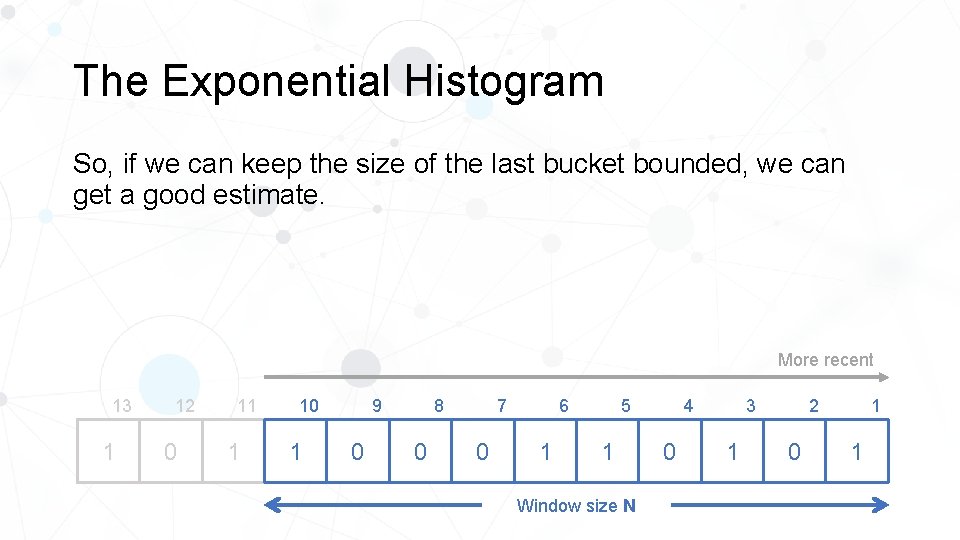
The Exponential Histogram So, if we can keep the size of the last bucket bounded, we can get a good estimate. More recent 13 1 12 0 11 1 10 1 8 9 0 0 0 5 6 7 1 1 Window size N 4 0 2 3 1 0 1 1
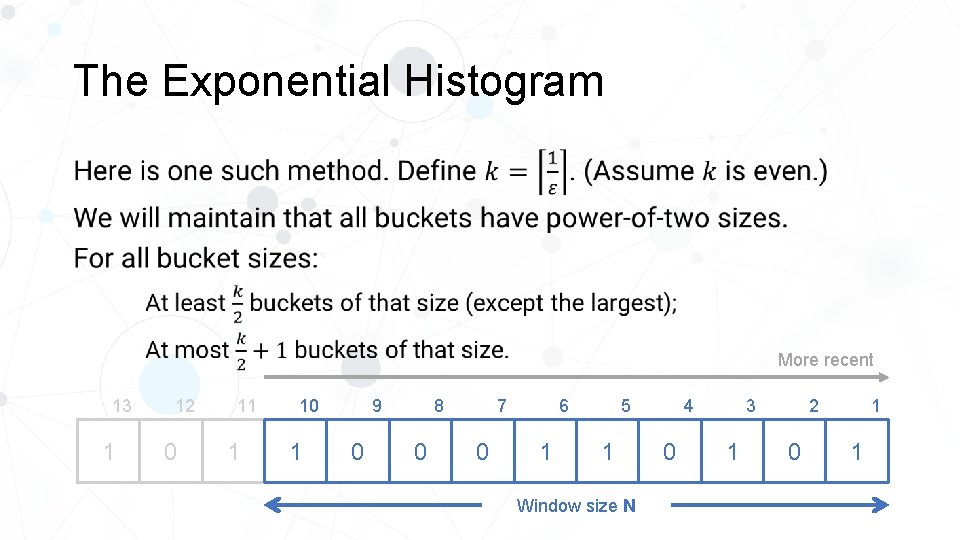
The Exponential Histogram • More recent 13 1 12 0 11 1 10 1 8 9 0 0 0 5 6 7 1 1 Window size N 4 0 2 3 1 0 1 1
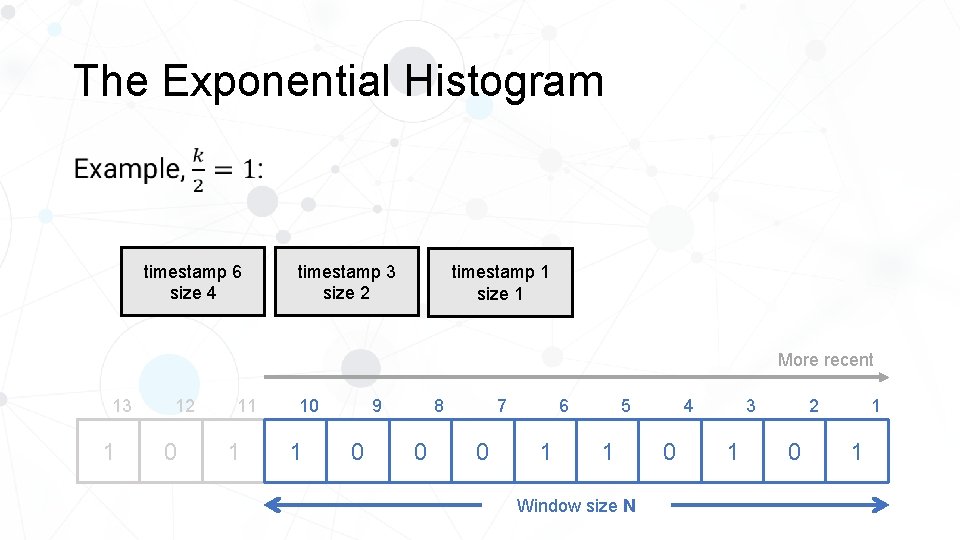
The Exponential Histogram • timestamp 6 size 4 timestamp 3 size 2 timestamp 1 size 1 More recent 13 1 12 0 11 1 10 1 8 9 0 0 0 5 6 7 1 1 Window size N 4 0 2 3 1 0 1 1
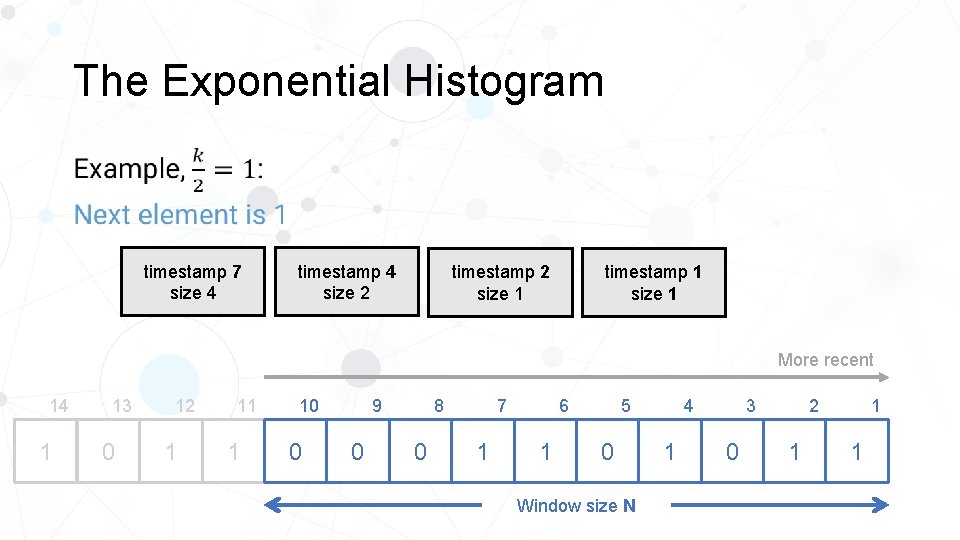
The Exponential Histogram • timestamp 7 size 4 timestamp 4 size 2 timestamp 2 size 1 timestamp 1 size 1 More recent 14 1 13 0 12 1 11 1 10 0 8 9 0 0 1 5 6 7 1 0 Window size N 4 1 2 3 0 1 1 1
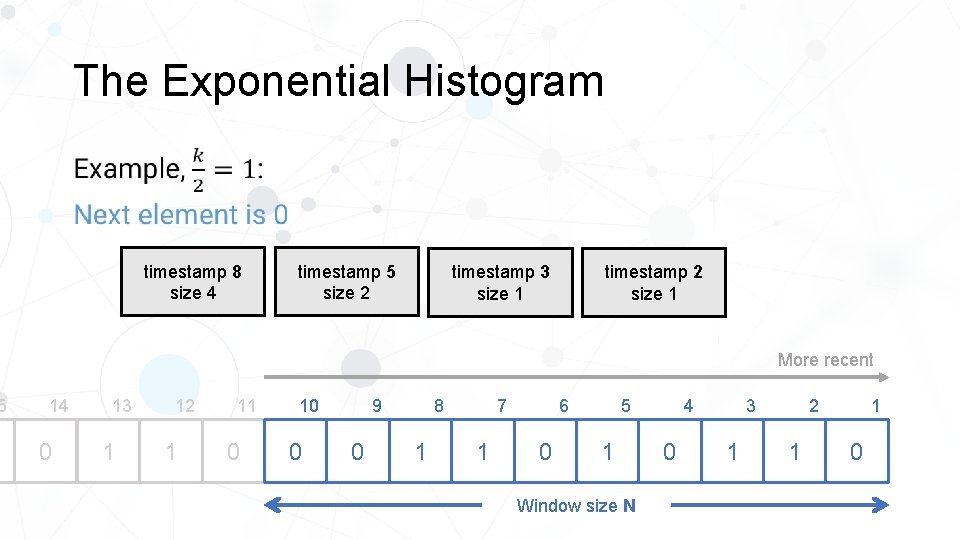
5 The Exponential Histogram • timestamp 8 size 4 timestamp 5 size 2 timestamp 3 size 1 timestamp 2 size 1 More recent 14 0 13 1 12 1 11 0 10 0 8 9 0 1 1 5 6 7 0 1 Window size N 4 0 2 3 1 1 1 0
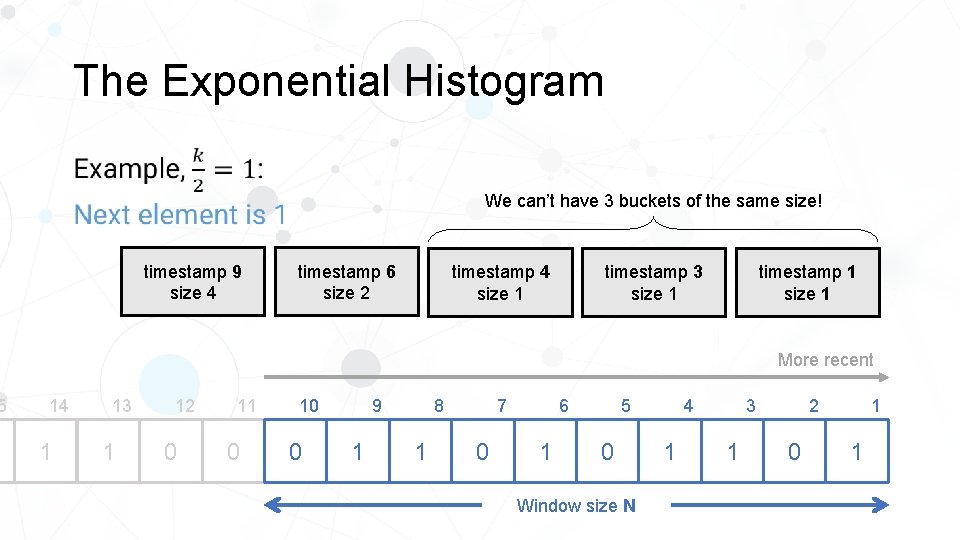
5 The Exponential Histogram • We can’t have 3 buckets of the same size! timestamp 9 size 4 timestamp 6 size 2 timestamp 4 size 1 timestamp 3 size 1 timestamp 1 size 1 More recent 14 1 13 1 12 0 11 0 10 0 8 9 1 1 0 5 6 7 1 0 Window size N 4 1 2 3 1 0 1 1
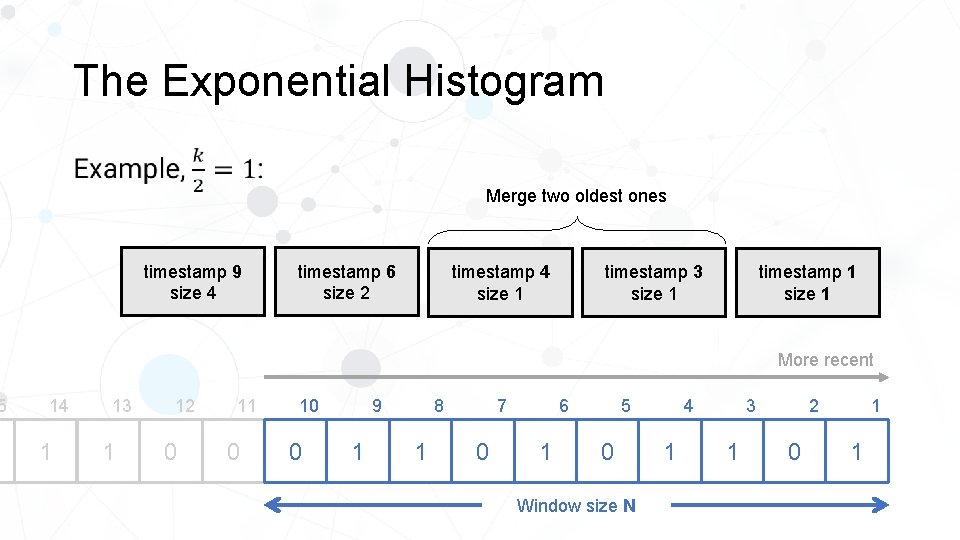
5 The Exponential Histogram • Merge two oldest ones timestamp 9 size 4 timestamp 6 size 2 timestamp 4 size 1 timestamp 3 size 1 timestamp 1 size 1 More recent 14 1 13 1 12 0 11 0 10 0 8 9 1 1 0 5 6 7 1 0 Window size N 4 1 2 3 1 0 1 1
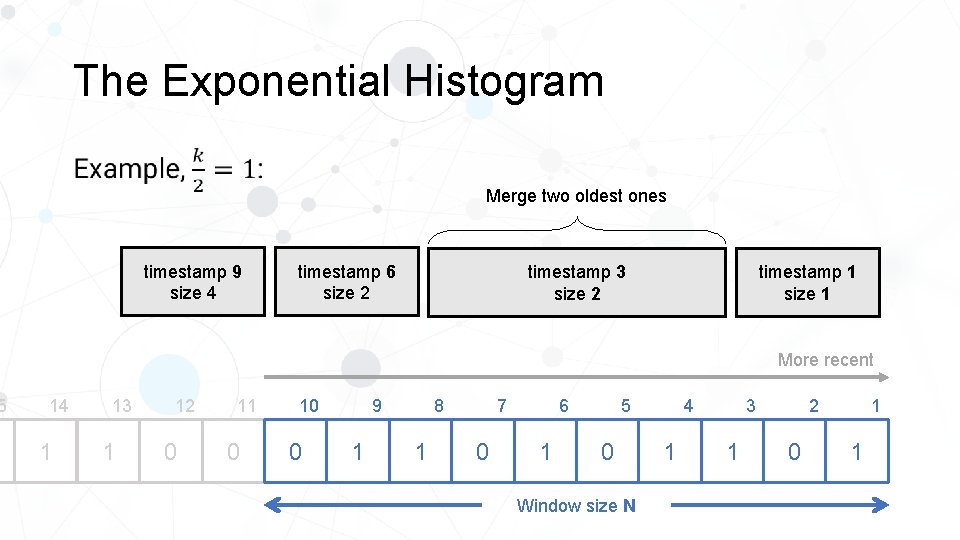
5 The Exponential Histogram • Merge two oldest ones timestamp 9 size 4 timestamp 6 size 2 timestamp 3 size 2 timestamp 1 size 1 More recent 14 1 13 1 12 0 11 0 10 0 8 9 1 1 0 5 6 7 1 0 Window size N 4 1 2 3 1 0 1 1
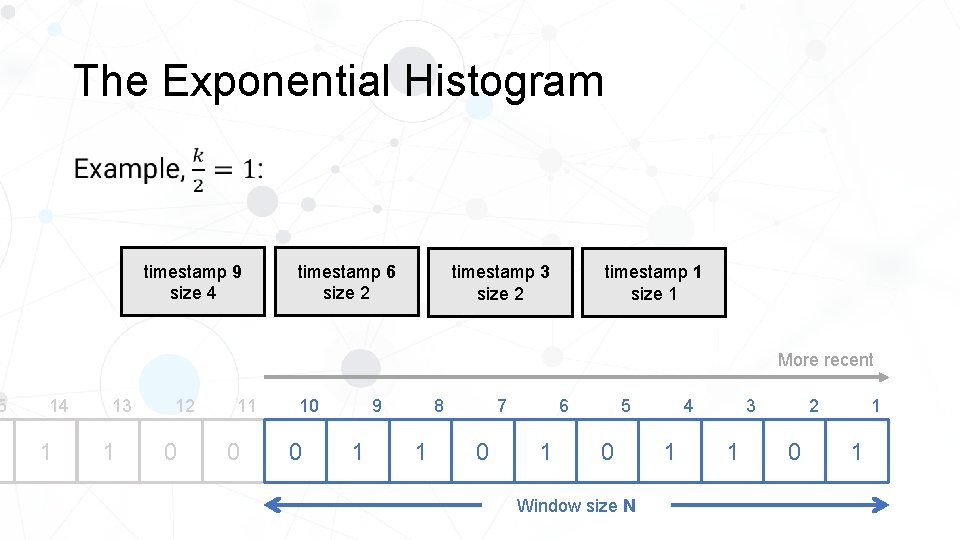
5 The Exponential Histogram • timestamp 9 size 4 timestamp 6 size 2 timestamp 3 size 2 timestamp 1 size 1 More recent 14 1 13 1 12 0 11 0 10 0 8 9 1 1 0 5 6 7 1 0 Window size N 4 1 2 3 1 0 1 1
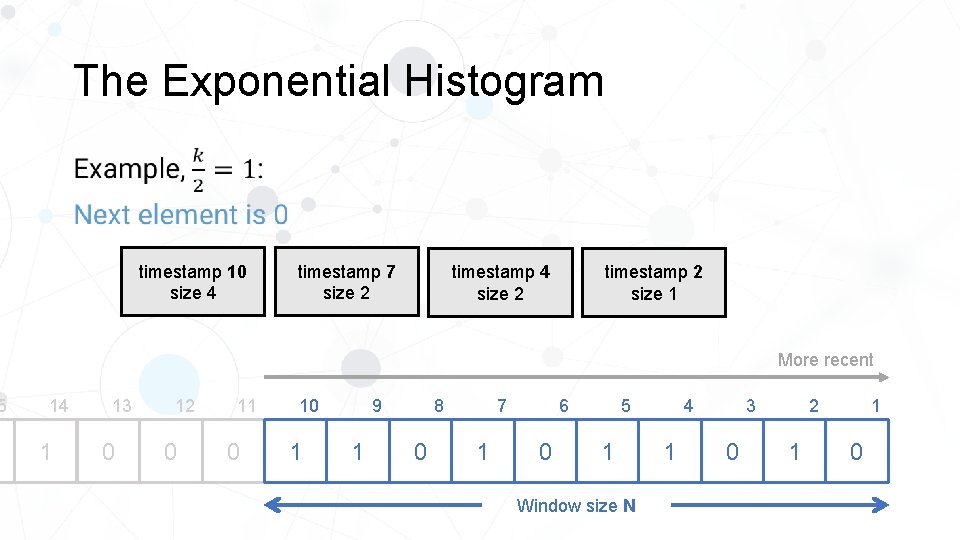
5 The Exponential Histogram • timestamp 10 size 4 timestamp 7 size 2 timestamp 4 size 2 timestamp 2 size 1 More recent 14 1 13 0 12 0 11 0 10 1 8 9 1 0 1 5 6 7 0 1 Window size N 4 1 2 3 0 1 1 0
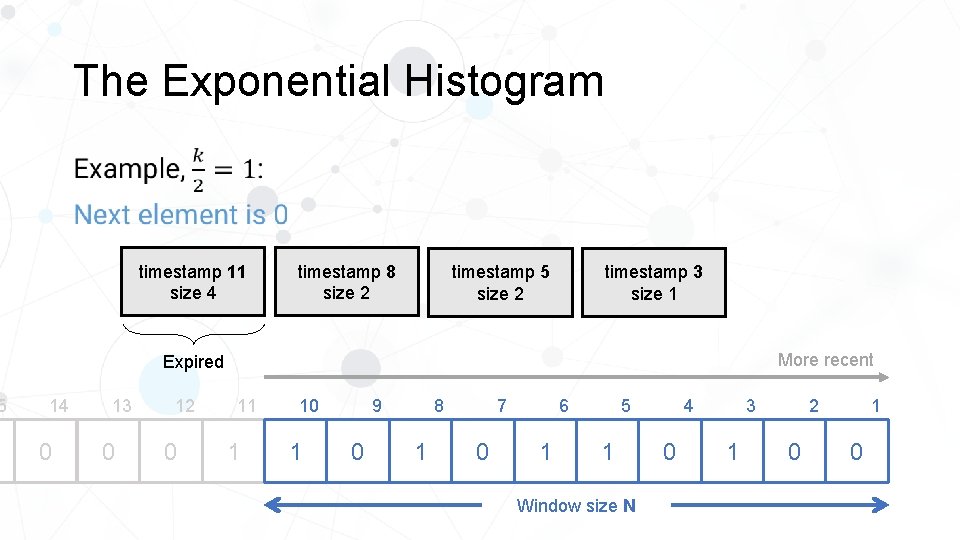
5 The Exponential Histogram • timestamp 11 size 4 timestamp 8 size 2 timestamp 5 size 2 timestamp 3 size 1 More recent Expired 14 0 13 0 12 0 11 1 10 1 8 9 0 1 0 5 6 7 1 1 Window size N 4 0 2 3 1 0
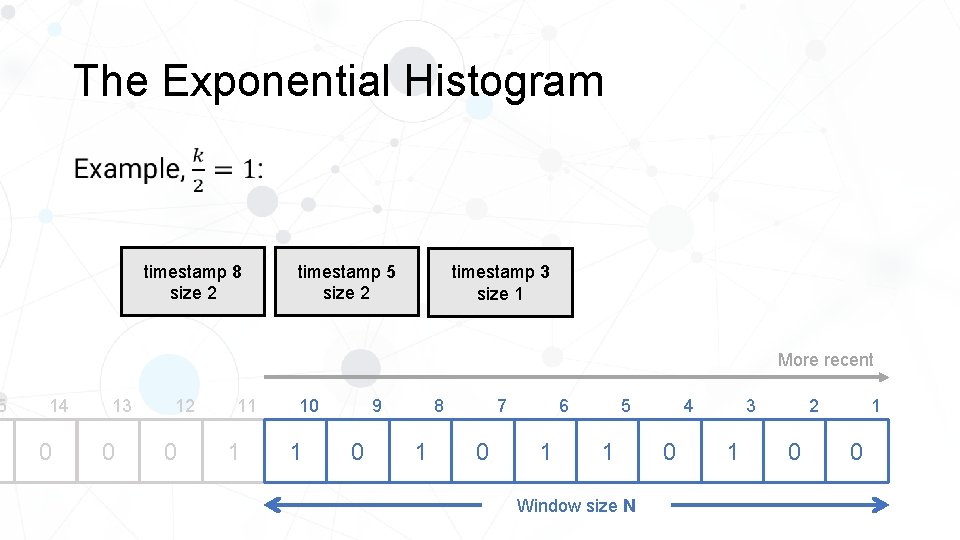
5 The Exponential Histogram • timestamp 8 size 2 timestamp 5 size 2 timestamp 3 size 1 More recent 14 0 13 0 12 0 11 1 10 1 8 9 0 1 0 5 6 7 1 1 Window size N 4 0 2 3 1 0
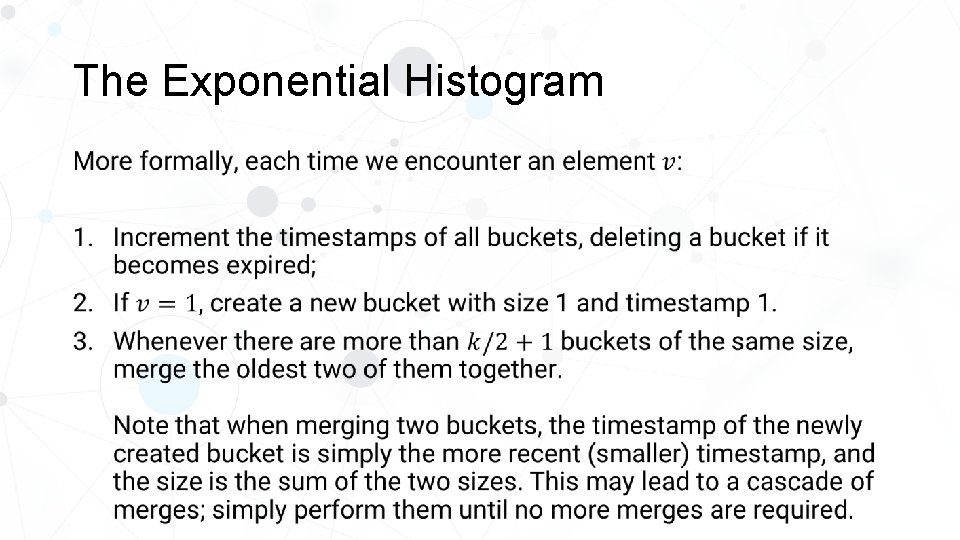
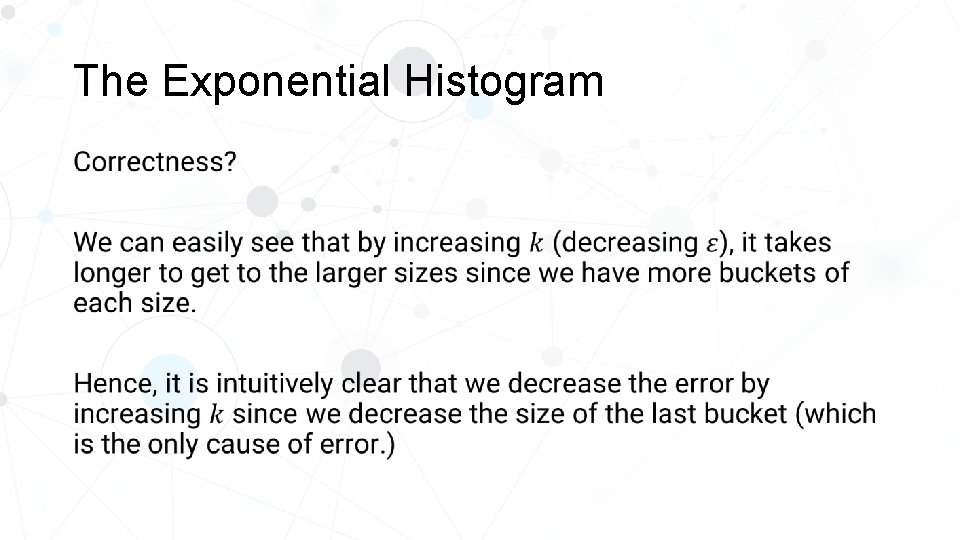
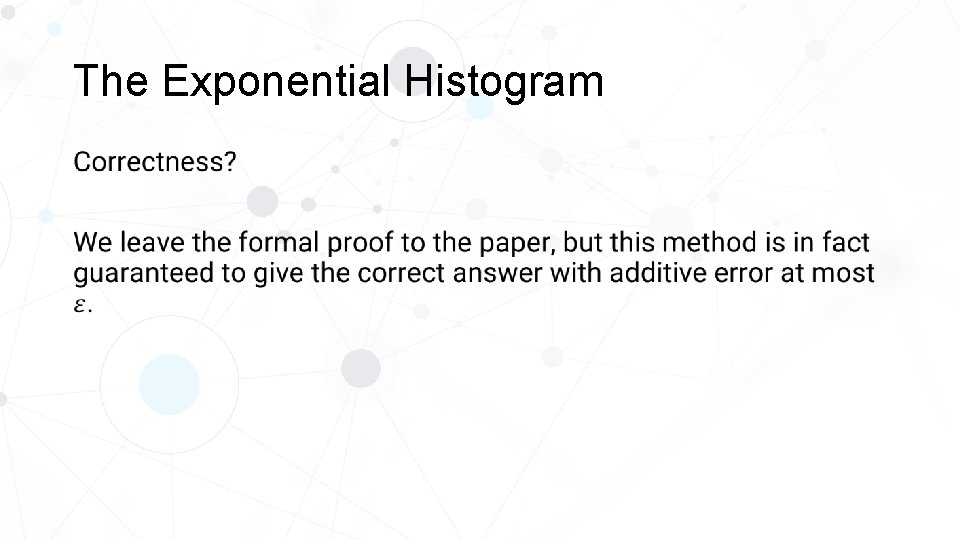
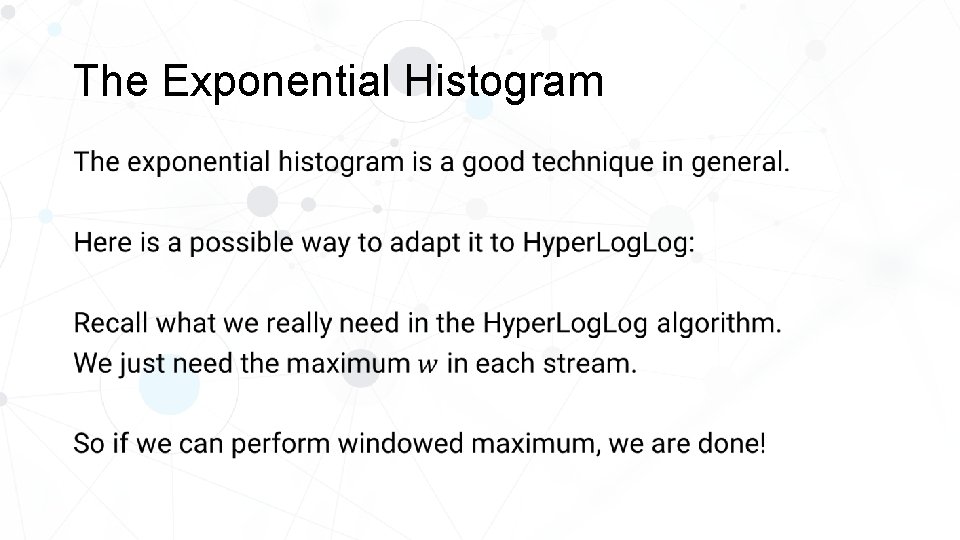
The Exponential Histogram •
The Exponential Histogram •
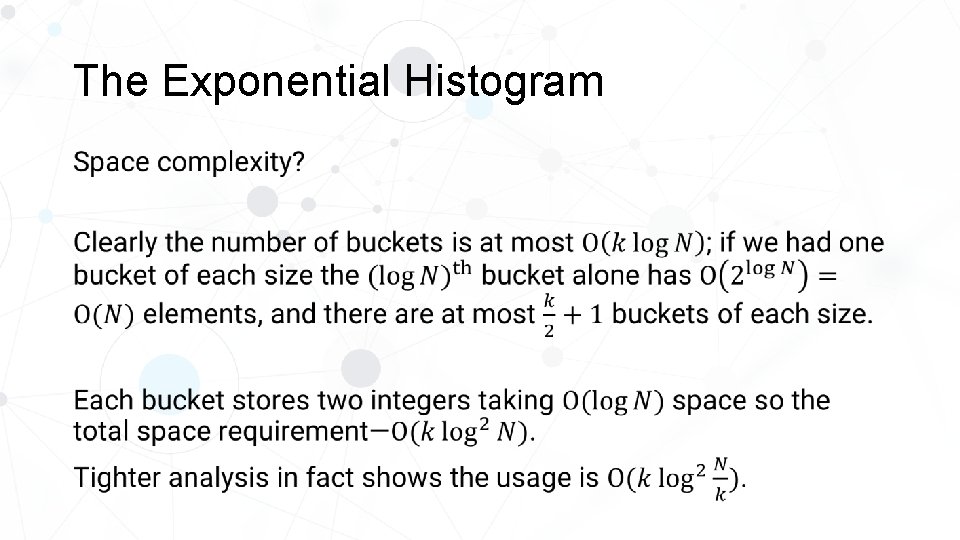
The Exponential Histogram •
The Exponential Histogram •
The Exponential Histogram •
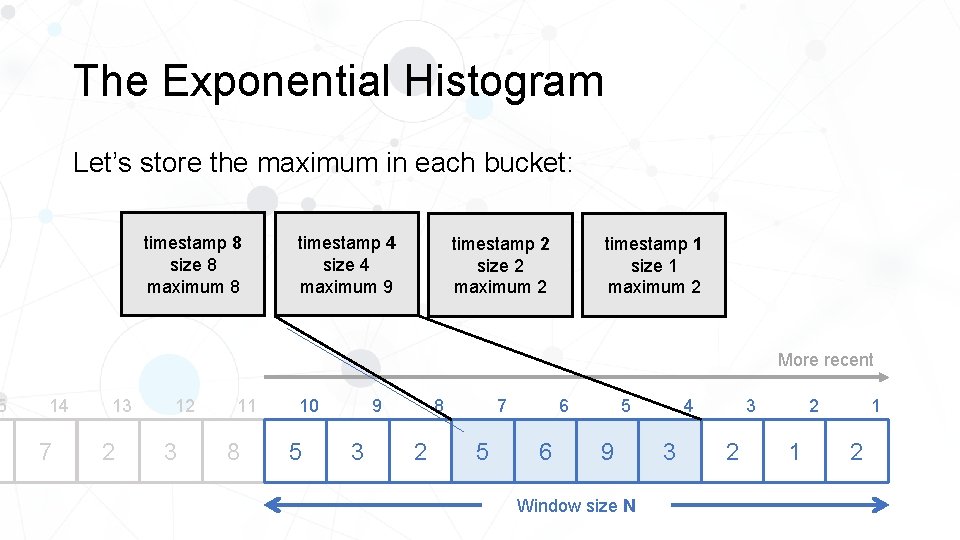
5 The Exponential Histogram Let’s store the maximum in each bucket: timestamp 8 size 8 maximum 8 timestamp 4 size 4 maximum 9 timestamp 2 size 2 maximum 2 timestamp 1 size 1 maximum 2 More recent 14 7 13 2 12 3 11 8 10 5 8 9 3 2 5 5 6 7 6 9 Window size N 4 3 2 1 1 2
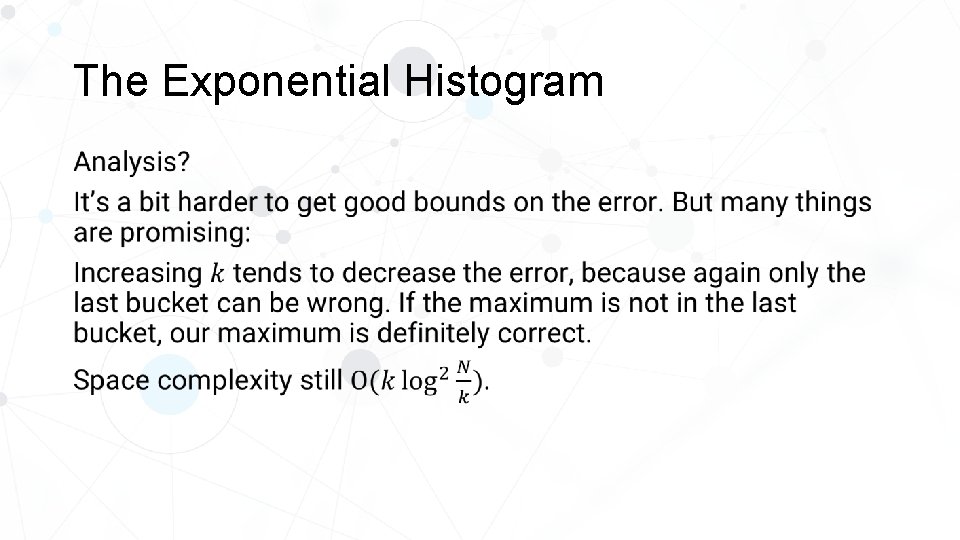
The Exponential Histogram •
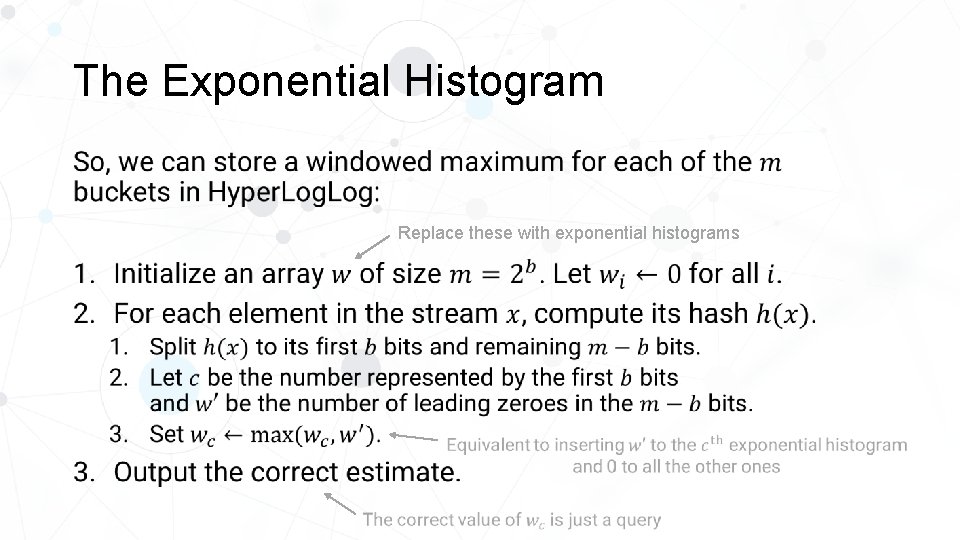
The Exponential Histogram • Replace these with exponential histograms
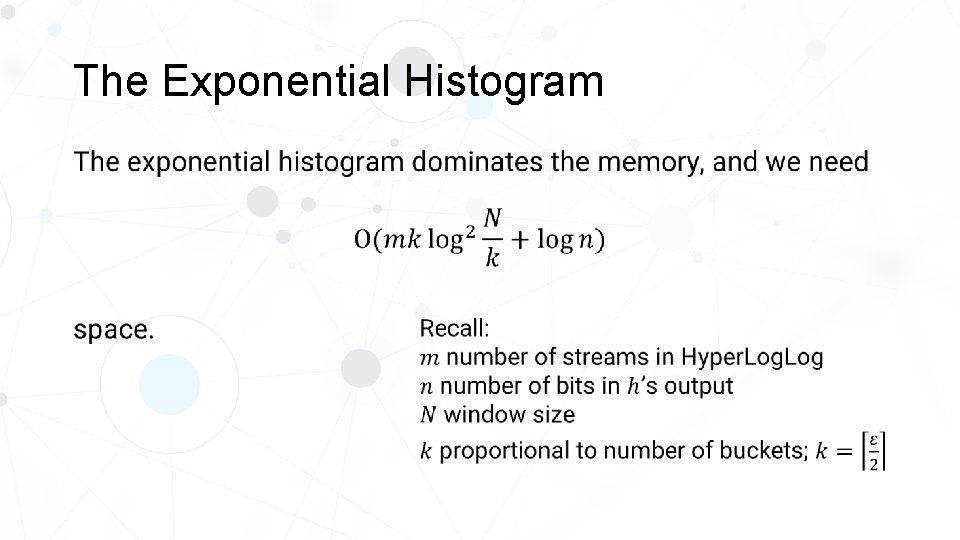
The Exponential Histogram •
The Exponential Histogram What about the accuracy of Hyper. Log? It definitely becomes worse, because the Exponential Histograms introduce more error. But it turns out there is a much simpler solution for this case that: 1. Doesn’t introduce more error; 2. Uses less memory!
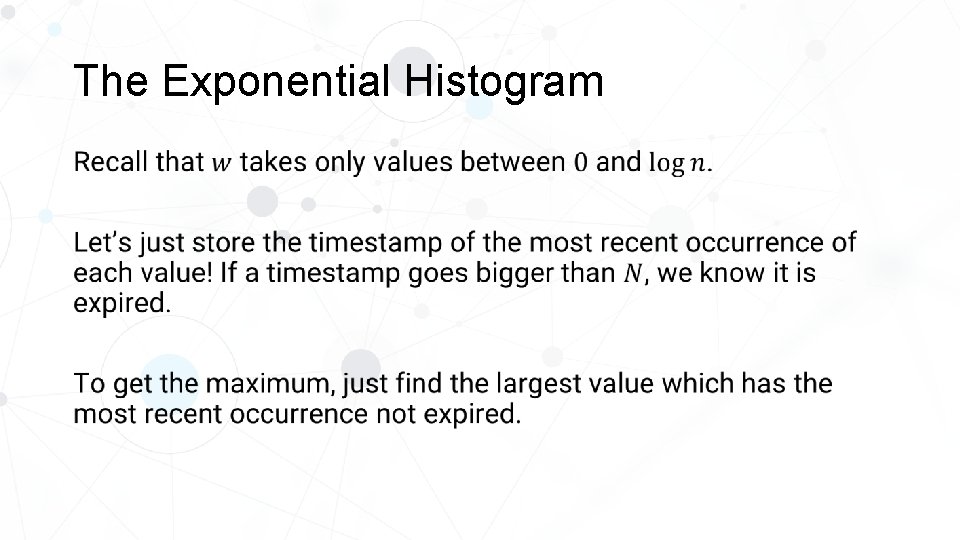
The Exponential Histogram •
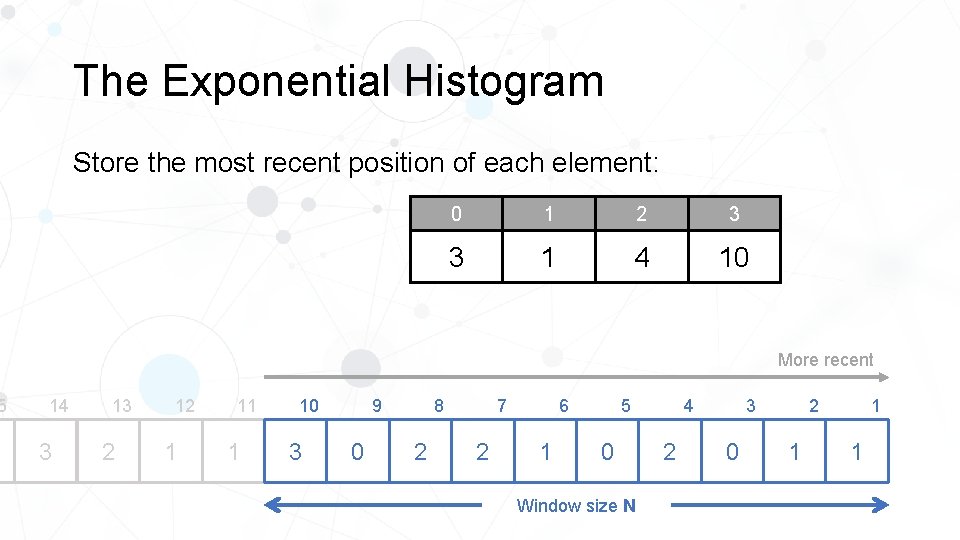
5 The Exponential Histogram Store the most recent position of each element: 0 1 2 3 3 1 4 10 More recent 14 3 13 2 12 1 11 1 10 3 8 9 0 2 2 5 6 7 1 0 Window size N 4 2 2 3 0 1 1 1
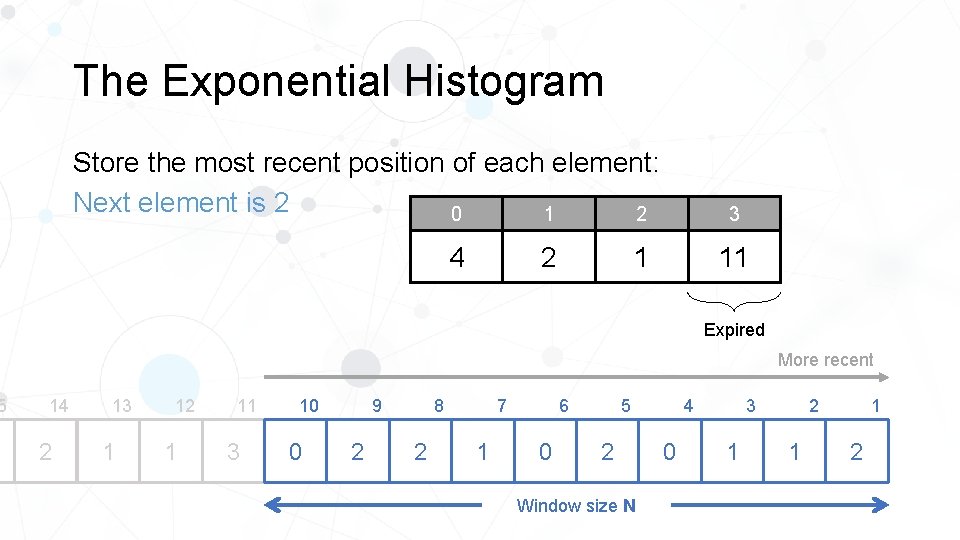
5 The Exponential Histogram Store the most recent position of each element: Next element is 2 1 2 0 2 4 3 11 1 Expired More recent 14 2 13 1 12 1 11 3 10 0 8 9 2 2 1 5 6 7 0 2 Window size N 4 0 2 3 1 1 1 2
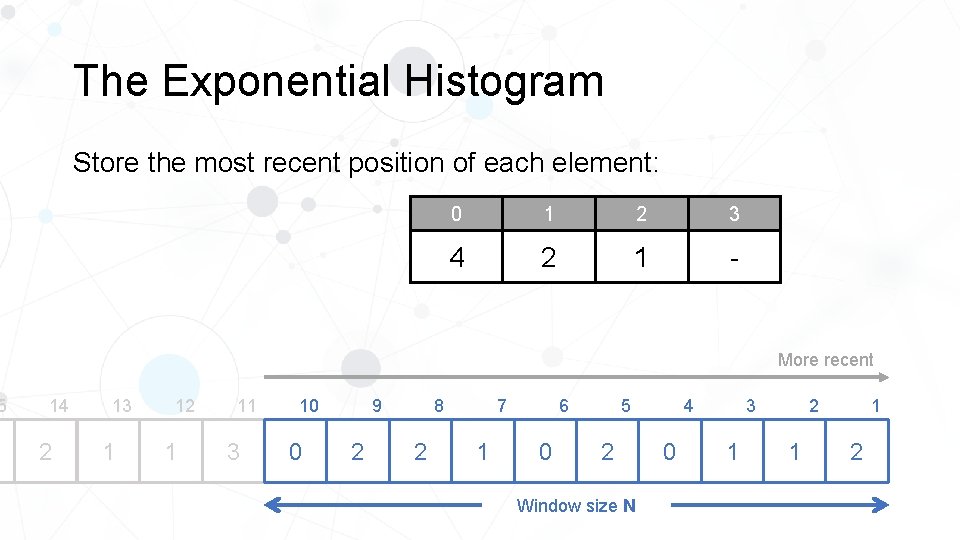
5 The Exponential Histogram Store the most recent position of each element: 0 1 2 3 4 2 1 - More recent 14 2 13 1 12 1 11 3 10 0 8 9 2 2 1 5 6 7 0 2 Window size N 4 0 2 3 1 1 1 2
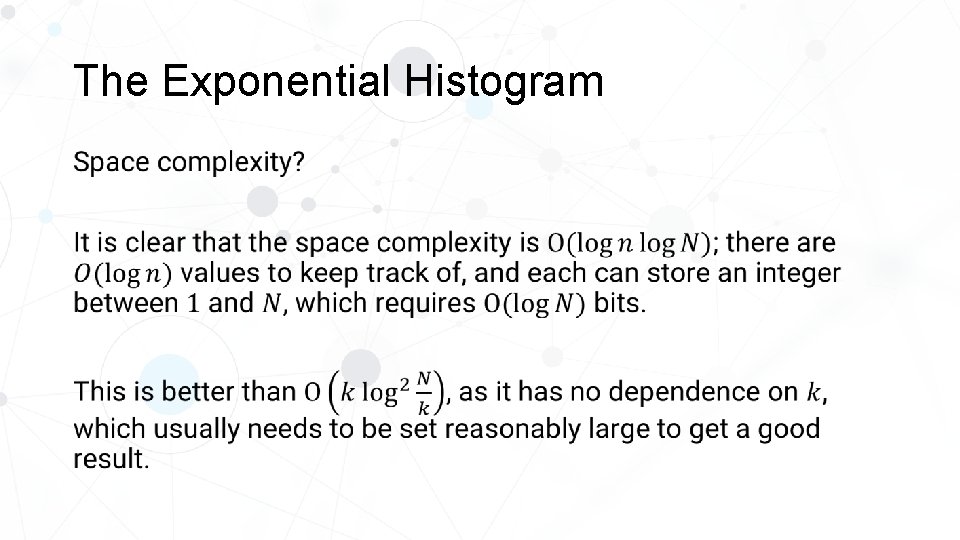
The Exponential Histogram •
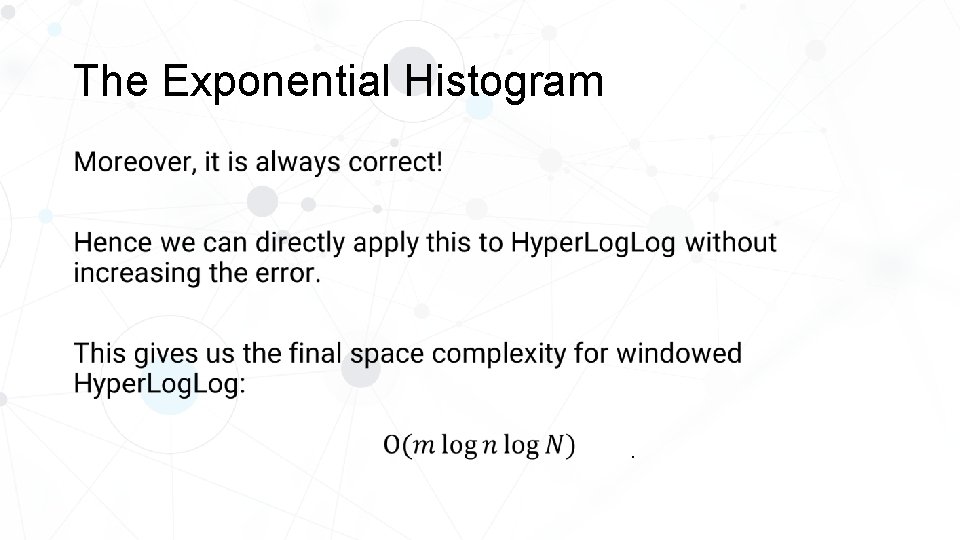
The Exponential Histogram • .

Applications and Extensions
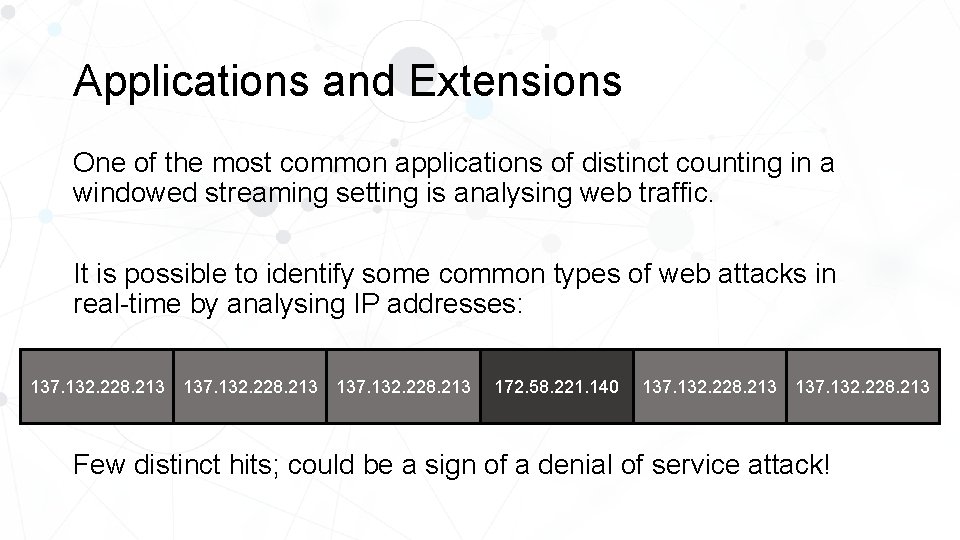
Applications and Extensions One of the most common applications of distinct counting in a windowed streaming setting is analysing web traffic. It is possible to identify some common types of web attacks in real-time by analysing IP addresses: 137. 132. 228. 213 172. 58. 221. 140 137. 132. 228. 213 Few distinct hits; could be a sign of a denial of service attack!

Applications and Extensions In such scenarios we only care about the most recent hits; hits from one or two days ago are not very useful. The window of concern can be quite large, so it is usually infeasible to use linear memory. Here algorithms such as sliding Hyper. Log would be suitable.

Applications and Extensions In real applications, we will probably want to optimize time complexity as well to make sure we can respond in real-time. We did not analyse here the time complexity of most of our operations. If the operations are performed exactly as stated, they can be rather slow. There are many possible optimizations in terms of implementation which we encourage the interested reader to discover for themselves. For example, it is not necessary to maintain the timestamps explicitly; we did this for ease of discourse, but it is quite slow. There are of course many other such optimizations.
- Slides: 79