
Hyper Lex lexical cartography for information retrieval Jean
- Slides: 26
Hyper. Lex: lexical cartography for information retrieval Jean Veronis Presented by: Siddhanth Jain(113050015
Motivation � � Human language is ambigous. Many words can hav multiple meanings depending on context, domai region etc. Such instances of words are known a polysemous. It is very easy to disambiguate these words fo humans but for machines its a difficult job. Task of dismabiguating polysemous words is know as Word Sense Disambiguatio(WSD). WSD is one of the most fundamental problems
Motivation Contd. . . � Supervised approaches to WSD give high accuracy � They need large amount of training data. � Many languages and domains lack such kind of da � Hence semi-supervised and unsupervised approaches are also emerging as prominent options for WSD.
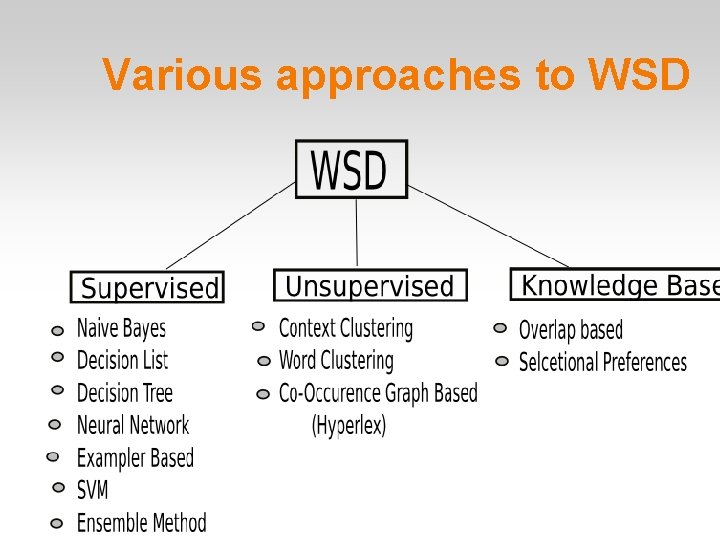
Various approaches to WSD
Hyper. Lex � � � Hyperlex is one of the most famous unsupervise approach for Word Sense Disambiguation. Hyper. Lex is capable of auto-matically determinin the uses of a word in a textbase without recourse to dictionary. Despite of being unsupervised it has been found be comparable to state-of-the-art supervised approaches.
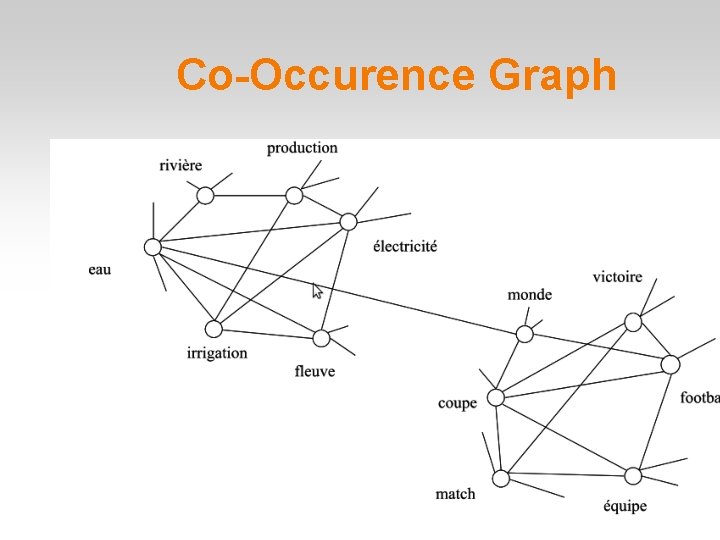
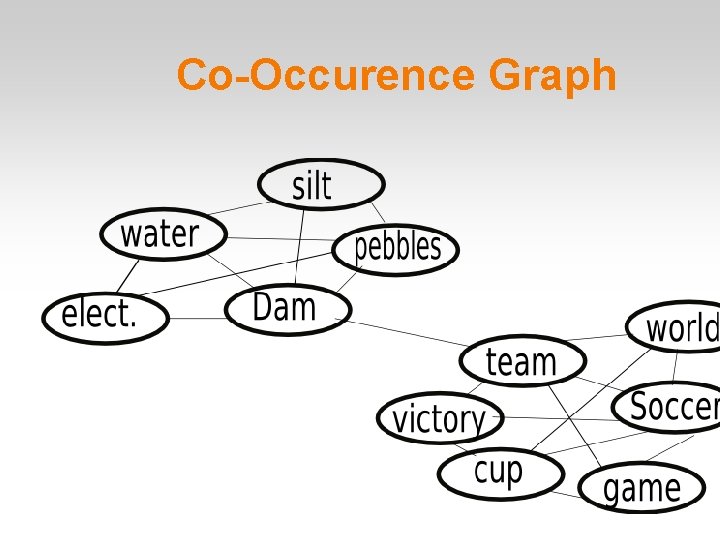
Terminology � � � Co-occurence Graphs For each target word we take all the words that cooccure with it and treat them as nodes. We create an edged between two nodes, A and B if their corresponding words co-occur with each othe
Terminology Contd. . � � � Small World Graph A small-world graph is a type of mathematical grap in which most nodes are not neighbors of on another, but most nodes can be reached from ever other by a small number of hops or steps. Milgram (1967), was the first who proposed theter ‘‘small world’’: any individual on the planet is on ‘‘six degrees away’’ from any other individual in th graph of social relations, even though there a
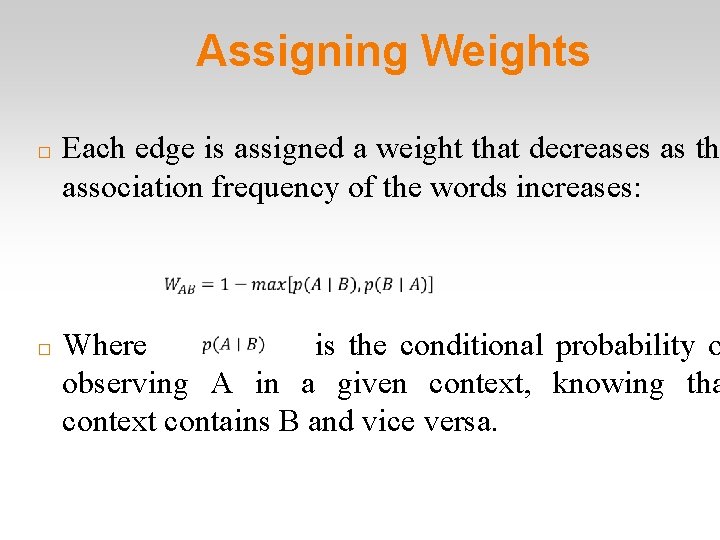
Assigning weights to edges � The weight that we assign to each edge reflects the magnitude of the 'semantic distance' between word � When w=0, the words always co-occured � When w=1, the words never co-occured
Assigning Weights � � Each edge is assigned a weight that decreases as th association frequency of the words increases: Where is the conditional probability o observing A in a given context, knowing tha context contains B and vice versa.
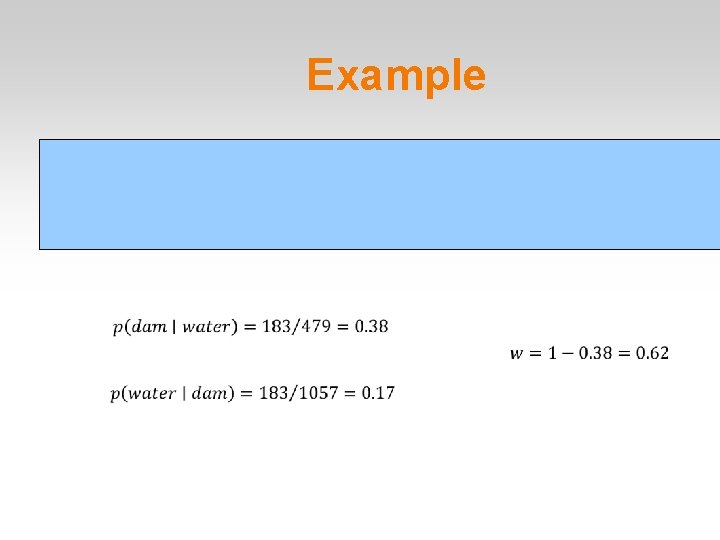
Example
Co-Occurence Graph
Finding Connected Components � � Detecting the different uses of a word thus amoun to isolating the high-density components in i cooccurrence graph. Unfortunately, most exa graph-partitioning techniques are NP-hard. The author has given an approximate algorithm which gives fairly good results.
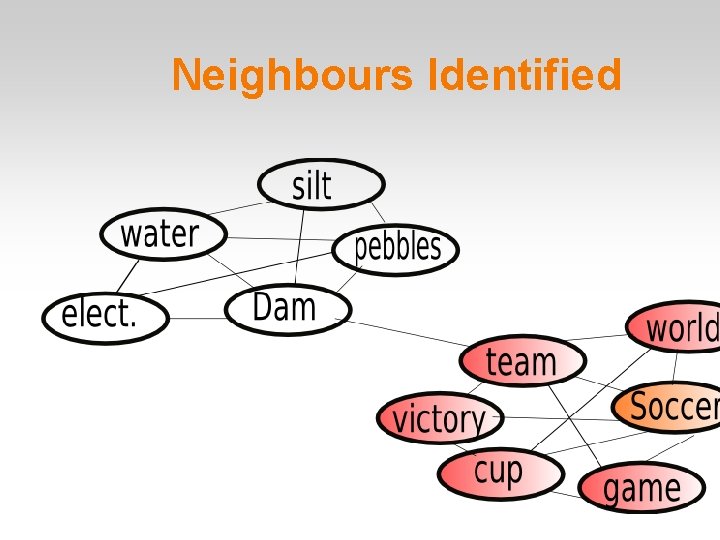
Root Hub � � � In every high-density component, one of the node has a higher degree than the others; it is called th component’s root hub. For example, for the most frequent use of bank, th root hub is the word money. It is easy to find, since it is the hub with the highe degree in the graph (and it is also the most freque word).
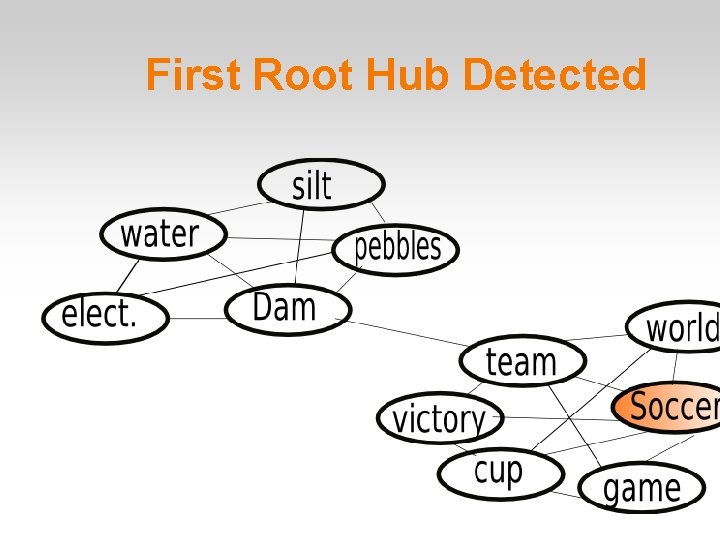
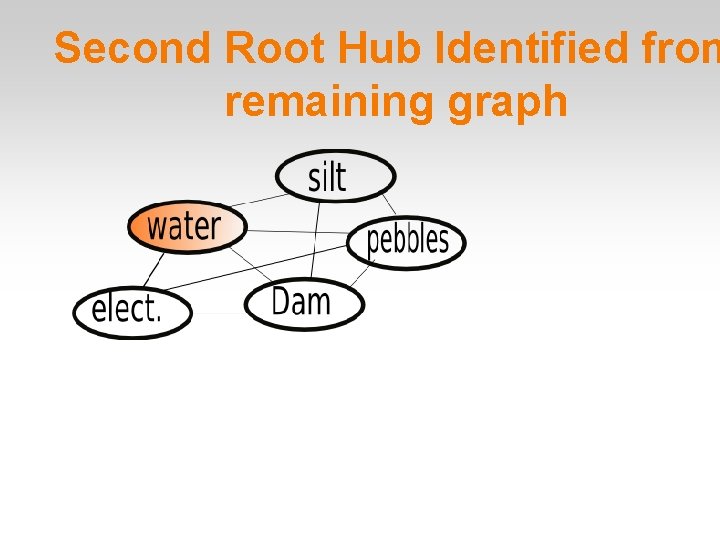
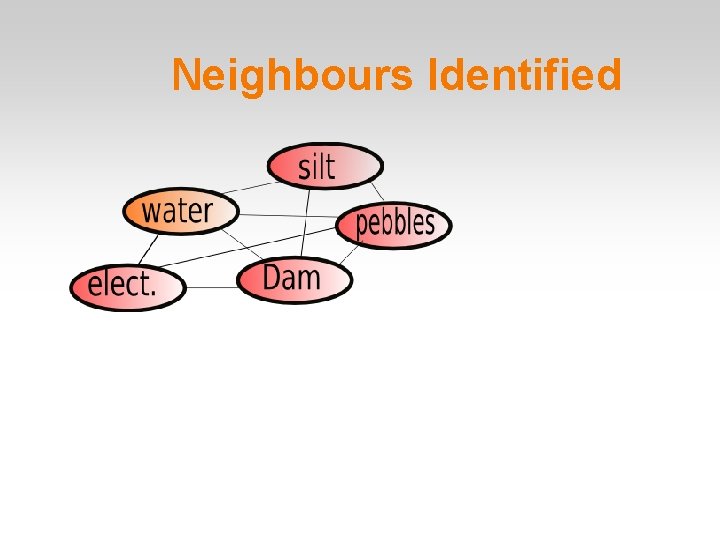
Detecting Root Hubs � � First find the highest degree node and call it the fir root hub. Now delete the selected root hub along with all its neighbours. Repeat this process untill either all nodes have been covered or there is no elligible vertex for a root hub A vertex is considered to be eligible for being a roo hub if the 6 most frequent neighbours have weights less than 0. 8(found experimentally)
Co-Occurence Graph
First Root Hub Detected
Neighbours Identified
Second Root Hub Identified from remaining graph
Neighbours Identified
Delineating Components � � Once all the root hubs have been found connect all of them with the target word with 0 edge weight in co-occurence graph. Now find the MST(Minimum Spanning Tree) for this graph.
MST � � � Target word is assigned a level 0. All root hubs are assigned a level 1. All nodes at level 1 represents different senses of th target word and each one of them represents component.
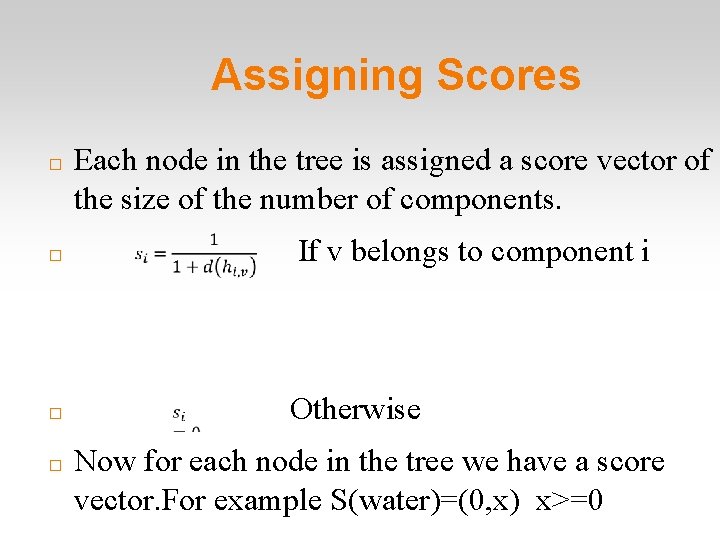
Assigning Scores � � Each node in the tree is assigned a score vector of the size of the number of components. If v belongs to component i Otherwise Now for each node in the tree we have a score vector. For example S(water)=(0, x) x>=0
Disambiguation � � Now we add the score vectors of all vertices prese in the context. The target word is assigned the sense correspondin to the winning root hub.
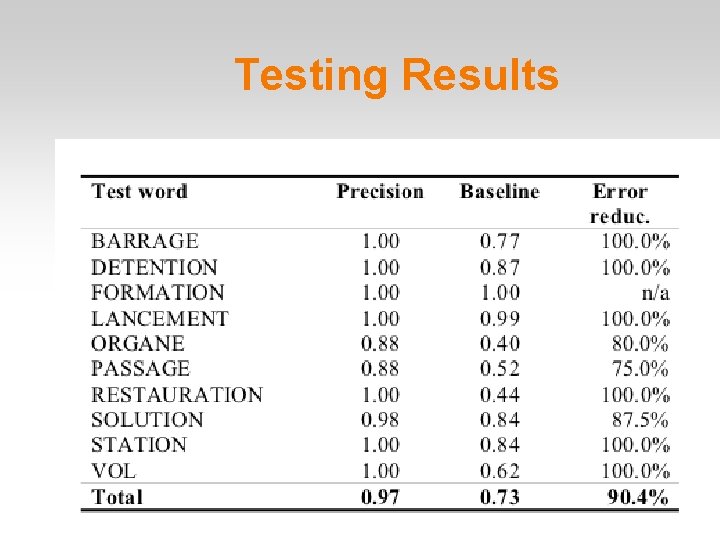
Testing Results
Conclusion � � � Hyperlex in one of the most successful unsupervise approach for WSD. It doesn't need any external lexical resource for disambiguation. Its accuracy with small number of words is comparable to state-of-the-art supervised WSD approaches.
References � � VE RONIS, J. 2004. Hyperlex: Lexical cartograph for information retrieval. Comput. Speech Lang. 18 3, 223– 252 Navigli, R. 2009. Word Sense Disambigua-tion: a survey. ACM Computing Surveys, 41(2): 1– 69