
Hygiene Promotion Campaigns Methods and Tools Module 2
- Slides: 33
Hygiene Promotion Campaigns Methods and Tools Module 2 – Session 5 Peer Education Social Marketing / Campaigns Participatory Methods
Behaviour change in emergency 应急过程中的行为改变 Behaviour change is usually associated with the idea that this always takes a long time 行为改变与长期形成的想法有关。 Can behaviour change happen quickly? 行为改变能迅速发生吗?
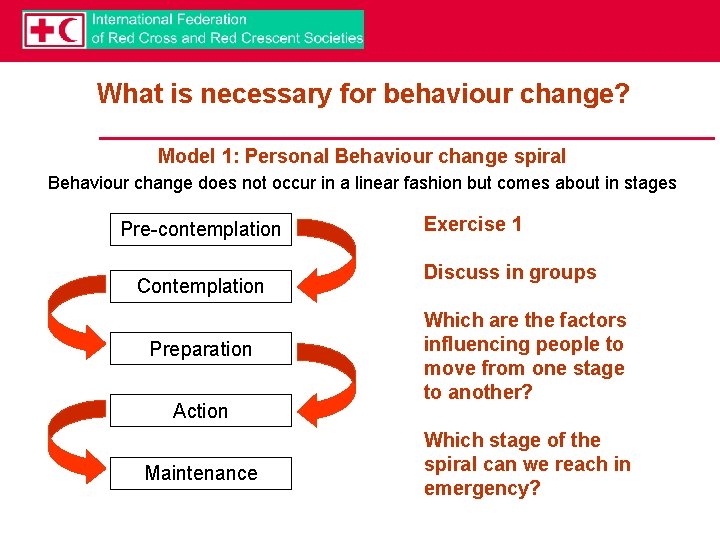
What is necessary for behaviour change? Model 1: Personal Behaviour change spiral Behaviour change does not occur in a linear fashion but comes about in stages Pre-contemplation Contemplation Preparation Action Maintenance Exercise 1 Discuss in groups Which are the factors influencing people to move from one stage to another? Which stage of the spiral can we reach in emergency?
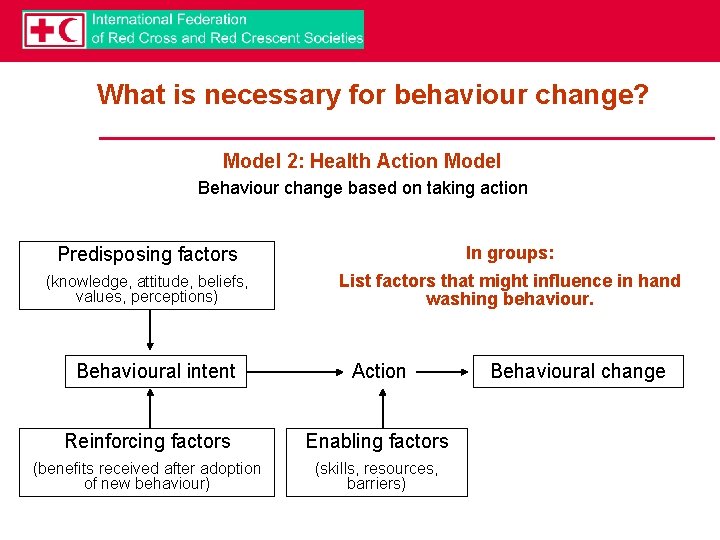
What is necessary for behaviour change? Model 2: Health Action Model Behaviour change based on taking action Predisposing factors In groups: (knowledge, attitude, beliefs, values, perceptions) List factors that might influence in hand washing behaviour. Behavioural intent Action Reinforcing factors Enabling factors (benefits received after adoption of new behaviour) (skills, resources, barriers) Behavioural change
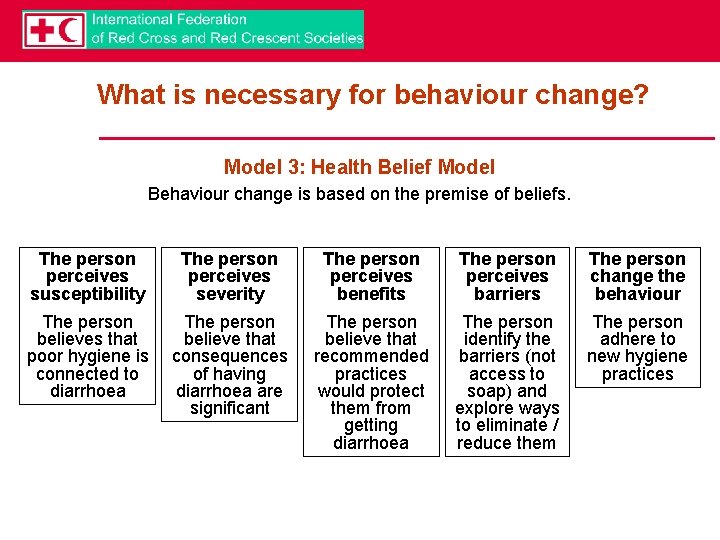
What is necessary for behaviour change? Model 3: Health Belief Model Behaviour change is based on the premise of beliefs. The person perceives susceptibility The person perceives severity The person perceives benefits The person perceives barriers The person change the behaviour The person believes that poor hygiene is connected to diarrhoea The person believe that consequences of having diarrhoea are significant The person believe that recommended practices would protect them from getting diarrhoea The person identify the barriers (not access to soap) and explore ways to eliminate / reduce them The person adhere to new hygiene practices
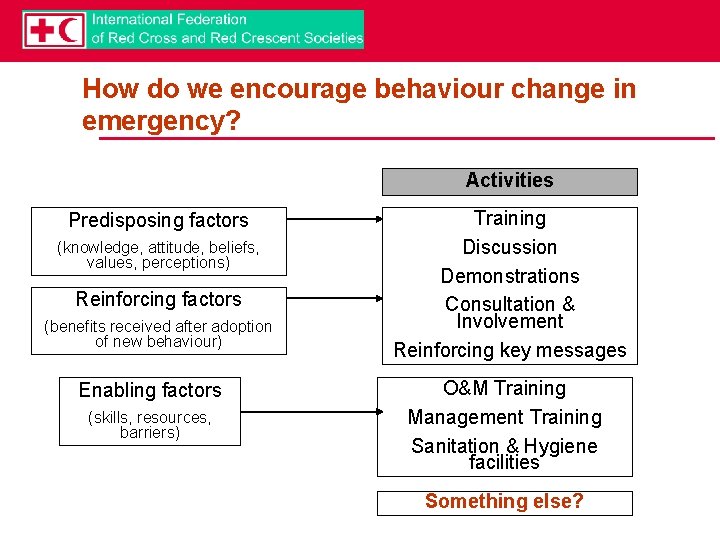
How do we encourage behaviour change in emergency? Activities Predisposing factors (knowledge, attitude, beliefs, values, perceptions) Reinforcing factors (benefits received after adoption of new behaviour) Enabling factors (skills, resources, barriers) Training Discussion Demonstrations Consultation & Involvement Reinforcing key messages O&M Training Management Training Sanitation & Hygiene facilities Something else?
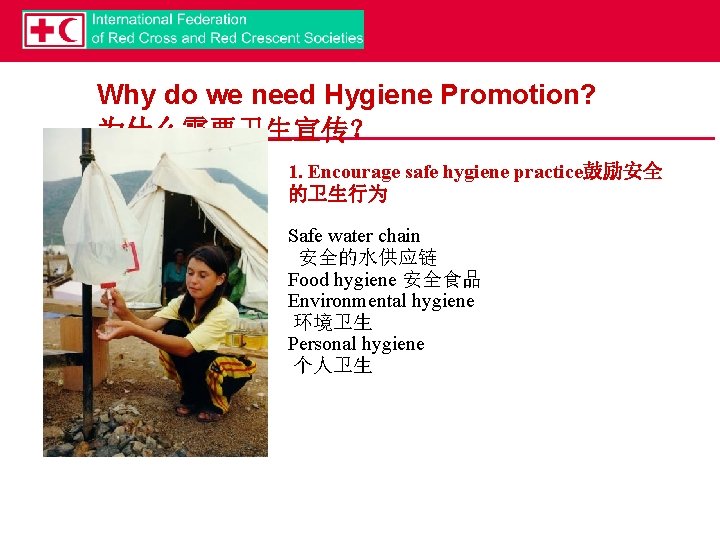
Why do we need Hygiene Promotion? 为什么需要卫生宣传? 1. Encourage safe hygiene practice鼓励安全 的卫生行为 Safe water chain 安全的水供应链 Food hygiene 安全食品 Environmental hygiene 环境卫生 Personal hygiene 个人卫生
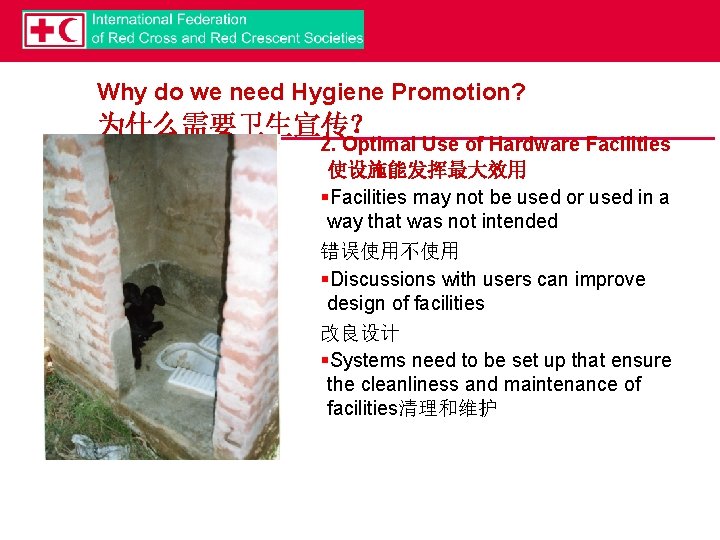
Why do we need Hygiene Promotion? 为什么需要卫生宣传? 2. Optimal Use of Hardware Facilities 使设施能发挥最大效用 §Facilities may not be used or used in a way that was not intended 错误使用不使用 §Discussions with users can improve design of facilities 改良设计 §Systems need to be set up that ensure the cleanliness and maintenance of facilities清理和维护
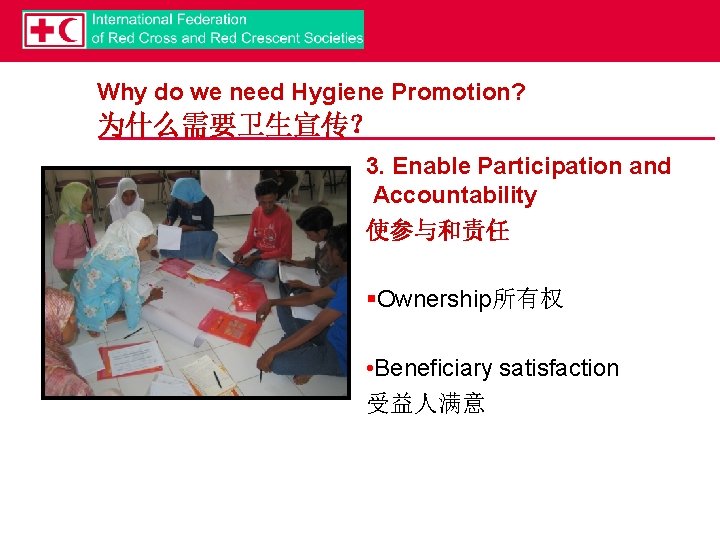
Why do we need Hygiene Promotion? 为什么需要卫生宣传? 3. Enable Participation and Accountability 使参与和责任 §Ownership所有权 • Beneficiary satisfaction 受益人满意
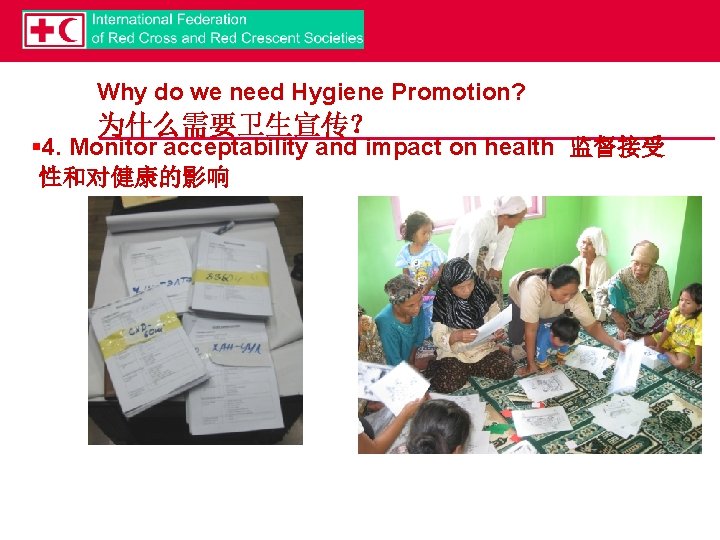
Why do we need Hygiene Promotion? 为什么需要卫生宣传? § 4. Monitor acceptability and impact on health 监督接受 性和对健康的影响
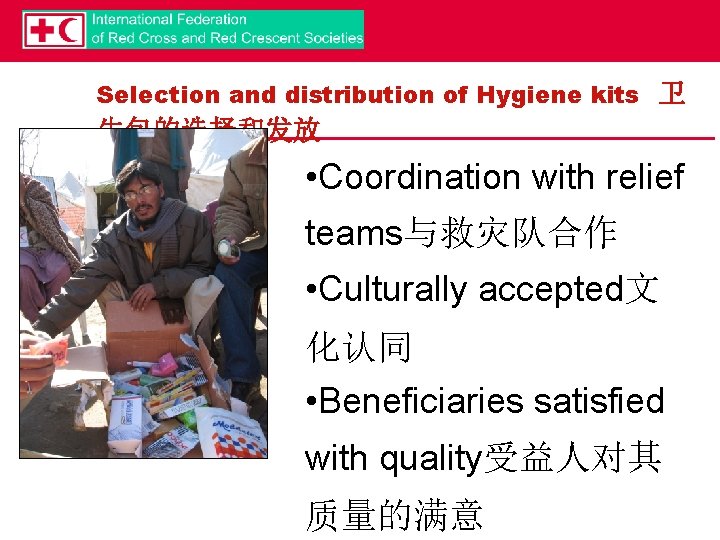
Selection and distribution of Hygiene kits 卫 生包的选择和发放 • Coordination with relief teams与救灾队合作 • Culturally accepted文 化认同 • Beneficiaries satisfied with quality受益人对其 质量的满意
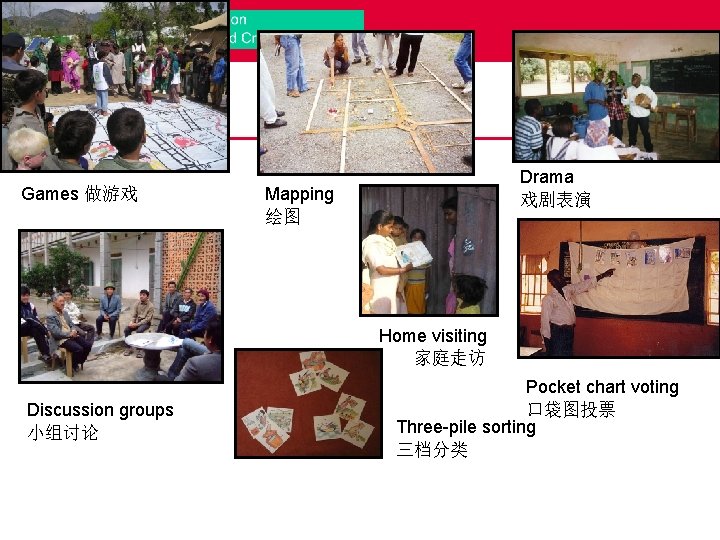
Games 做游戏 Drama 戏剧表演 Mapping 绘图 Home visiting 家庭走访 Discussion groups 小组讨论 Pocket chart voting 口袋图投票 Three-pile sorting 三档分类
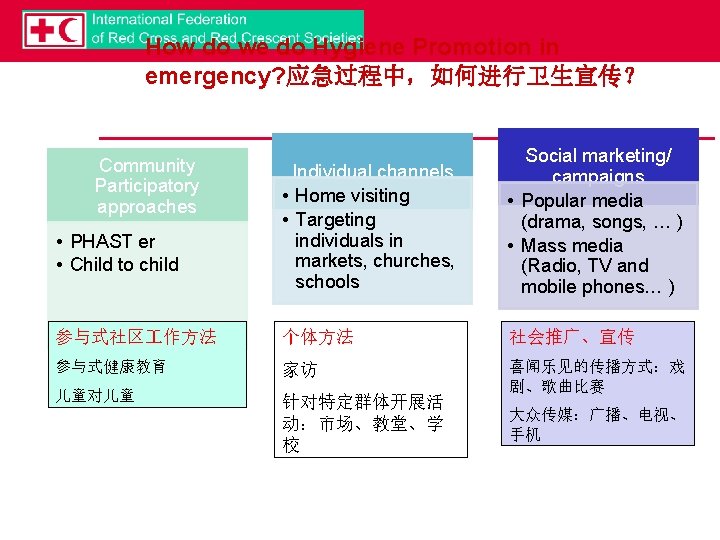
How do we do Hygiene Promotion in emergency? 应急过程中,如何进行卫生宣传? Individual channels • Home visiting • Targeting individuals in markets, churches, schools Social marketing/ campaigns • Popular media (drama, songs, … ) • Mass media (Radio, TV and mobile phones… ) 参与式社区 作方法 个体方法 社会推广、宣传 参与式健康教育 家访 儿童对儿童 针对特定群体开展活 动:市场、教堂、学 校 喜闻乐见的传播方式:戏 剧、歌曲比赛 Community Participatory approaches • PHAST er • Child to child 大众传媒:广播、电视、 手机
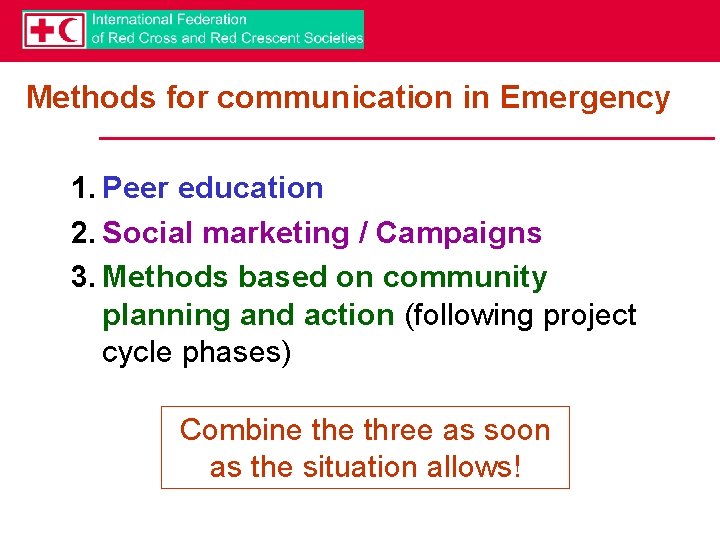
Methods for communication in Emergency 1. Peer education 2. Social marketing / Campaigns 3. Methods based on community planning and action (following project cycle phases) Combine three as soon as the situation allows!
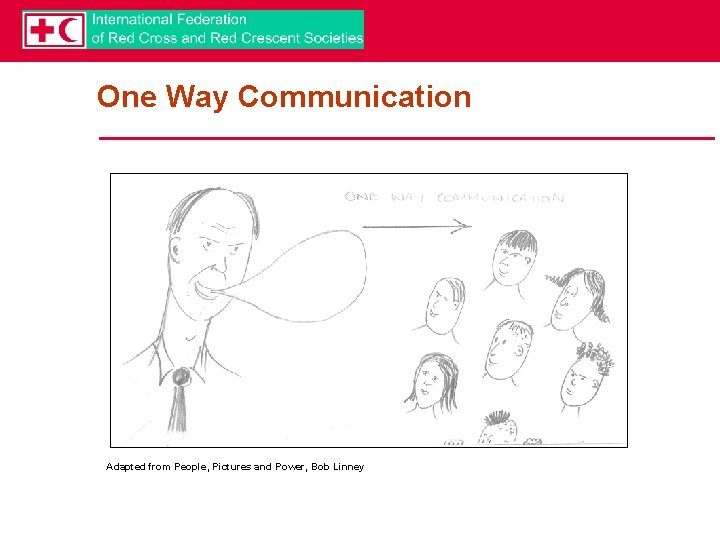
One Way Communication Adapted from People, Pictures and Power, Bob Linney
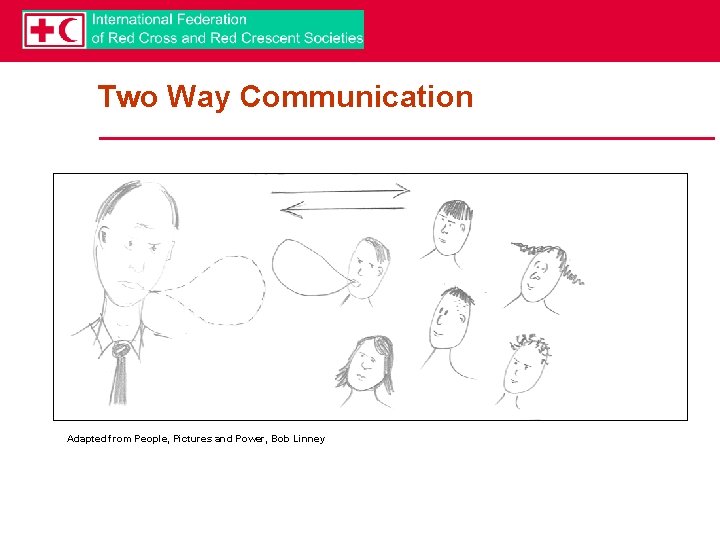
Two Way Communication Adapted from People, Pictures and Power, Bob Linney
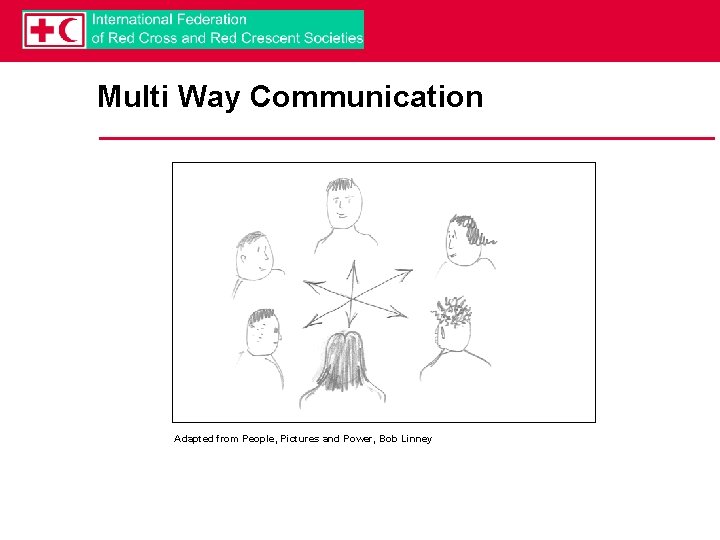
Multi Way Communication Adapted from People, Pictures and Power, Bob Linney
Method 1. - Peer Education §Principle: learning processes occur through observation, imitation and modelling so selected individuals will adapt to the role of group facilitator and will behave as is expected from a person in this position. §The set of tools are designed to influence on individuals’ choices through people who belong to the same social group. §Individual channels §Group channels
Individual channels Based on ‘Hygiene Promotion – A practical manual for relief and development’. • Home visiting ü Target audience: women with children U 5, caregivers, etc. ü Opportunity to assess domestic environment and tailor the hygiene messages to the specific needs of that family ü Useful for those who find difficult to take part in discussion groups ü Visit can be intimidating, need to be handled with sensitivity ü We can not provide too much information in 1 session ü Time consuming 1 volunteers / 5 HH / day ü Flipchart and picture cards might be useful ü Convenient date and time for the family • Targeting individuals in public places (markets, churches, schools, community meeting points, etc. )
Group channels • Discussion groups • Focus discussion group • Community structured meetings • Good interaction with a group of 10 -12 persons. If more than 12, it is recommended to divide the group in sub-groups. • The facilitator promotes participation and stimulate exchange and interaction • Different techniques (practical exercise in groups) • Demonstrations • Hand washing demonstration in schools (team contest), home visits, health centres, etc.
Practical exercise 1: community structured meetings §Group 1: Keyword Technique §Group 2: Elaboration Technique §Group 3: Inter-group Technique
Method 2. - Social marketing / Campaigns §This method seeks to ‘sell’ ideas, attitudes and behaviours. §The set of tools are designed to focus on the consumer preferences and motivations - on learning what people want and need and persuading them to ‘buy-in’ and adhere. §Popular media §Mass media
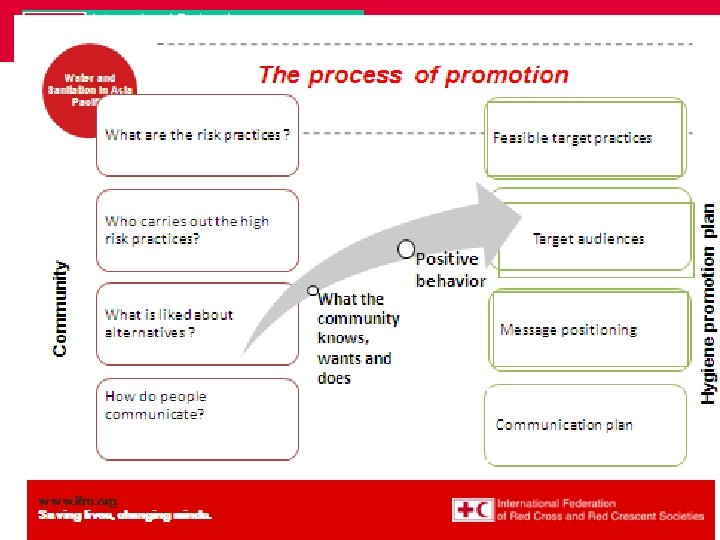
Planning a communication campaign Based on ‘Hygiene Promotion – A practical manual for relief and development’. §Identifying risky hygiene practices. In emergency: §Drinking safe water §Using toilets §Practicing hand washing §Selecting key hygiene messages §Identifying the target audience (primary, secondary and tertiary) §Selecting communication methods and tools §Producing IEC materials and pre-test §Training volunteers + Supervision §M&E
Popular media Based on ‘Hygiene Promotion – A practical manual for relief and development’. §Story-telling (example) §Street - theatre (drama) §Short, lively and spontaneous. Flexible enough to allow audience participation. §Minimum equipment (musical instruments and wardrobe) §Effective in public places: markets, schools, health centres, etc §Do’s and Don’t’s for street-theatre dramas §Details about how to do street-theatre §Puppet show §Specially helpful with children §Do’s and Don’t’s for street puppet shows §Details of how to make puppets §Traditional songs and dance
Mass communication Based on ‘Hygiene Promotion – A practical manual for relief and development’. • Films and videos: • Films and videos can be shown to audience (in larger screens or TV) – Prescription for health (UNICEF) • Discussions might be facilitated after the film or video • Radio broadcast: news, spot announcements, slogans and jingles, phone-in programme, interviews, talks and documentaries, drama, music, quizzes and panel games, magazine programme, etc. • Loudspeakers: • Slogans and jingles • Posters, leaflets, notice boards, stickers, t-shirts, etc. • Posters and leaflets created locally and pre-tested, then produced by professional designers • Guidelines for making posters • Posters can be made on paper, card, cloth, billboards and walls.
Method 3. - Community planning and action §These methods are designed to build selfesteem so the community believes in their ability to take action and make improvement in their own. Also provides sense of responsibility for one’s decisions. §The set of tools are designed to ensure community involvement during the planning phase so they can make their own decisions and take actions.
Tools §Unserialized posters (PHAST STEP 1 Activity 1: Community stories) §Community mapping §Three pile sorting (PHAST STEP 2 Activity 2: Good and bad hygiene behaviours). §Pocket chart (PHAST STEP 2 Activity 3: Investigating community practices). §Transmission routes (PHAST STEP 2 Activity 4: How diseases spread). §Blocking routes (PHAST STEP 3 Activity 1: Task for men and women in the community). §Gender role analysis (PHAST STEP 3 Activity 3: Task for men and women in the community). §Comparative pictures §Serialized pictures §Question box §etc
PHAST in Emergency - PHASTer §Reduction in number of activities (from 17 to 7 activities) §Reduction time of implementation (from 4 months to 4 weeks) §Adapted to different scenarios: cholera outbreak response (Uganda case study) §Scaling up of response §More frequent interaction
Selection of methods and tools Participatory vs. Didactic? Neither is ‘correct’ or ‘incorrect’ The best possible mix of methods should be selected The selection of methods will depend on: §Needs §Target audience §Number of target population §Accessibility to the that affected area and/or population §Budget §Time §Local resource (Human resources)
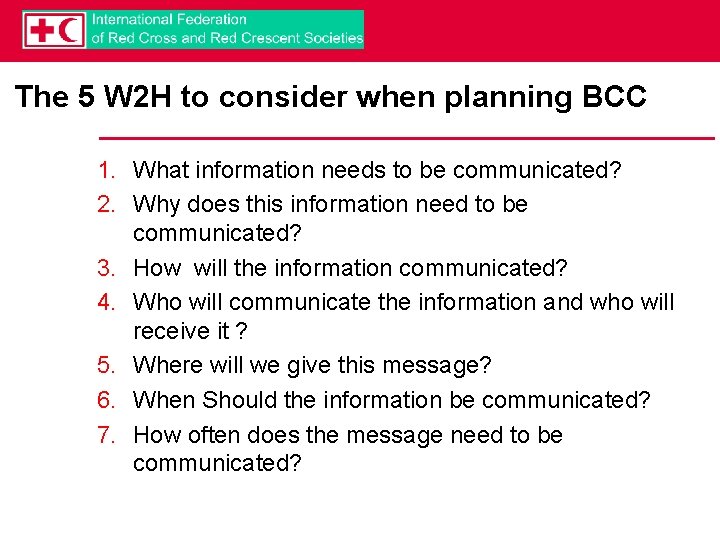
The 5 W 2 H to consider when planning BCC 1. What information needs to be communicated? 2. Why does this information need to be communicated? 3. How will the information communicated? 4. Who will communicate the information and who will receive it ? 5. Where will we give this message? 6. When Should the information be communicated? 7. How often does the message need to be communicated?
To highlight the importance of effective hygiene communication messages: 1. communicate a benefit 2. keep it simple 3. call to action
Exercise 2 §Plan hygiene promotion activities and the approach for their given situation, considering community, RC volunteers, target group, number etc. §Choose the tools and 3 key messages to conduct the sessions