
HYDROTHERMAL METAL SOLUBILITY AND SPECIATION THE WATER MOLECULE
HYDROTHERMAL METAL SOLUBILITY AND SPECIATION
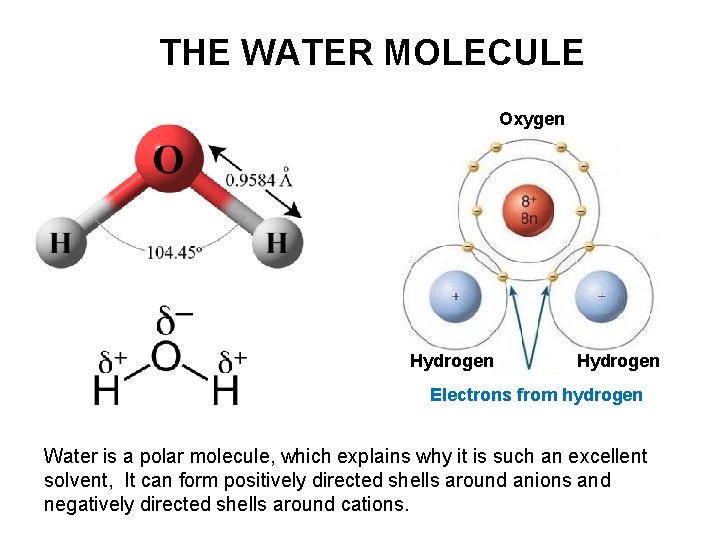
THE WATER MOLECULE Oxygen Hydrogen Electrons from hydrogen Water is a polar molecule, which explains why it is such an excellent solvent, It can form positively directed shells around anions and negatively directed shells around cations.
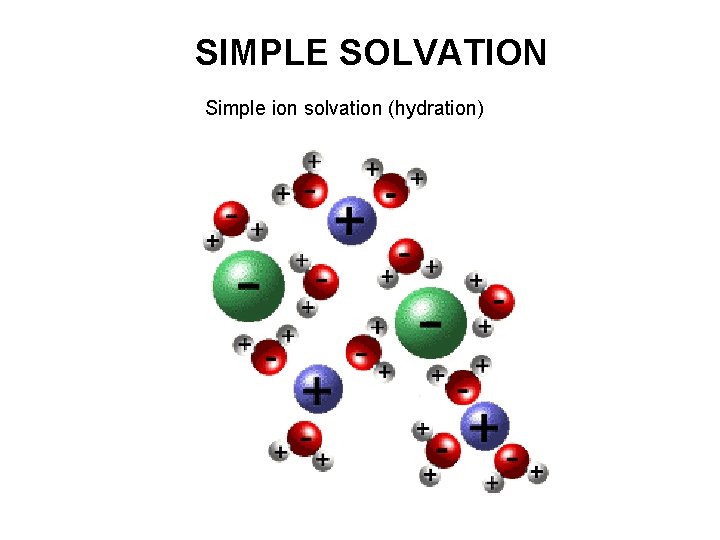
SIMPLE SOLVATION Simple ion solvation (hydration)
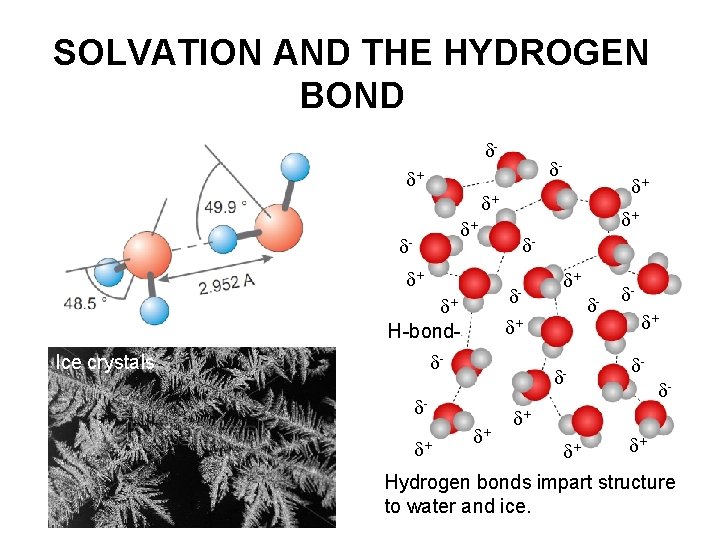
SOLVATION AND THE HYDROGEN BOND - - + + + - + - - + H-bond. Ice crystals + + + - + + + Hydrogen bonds impart structure to water and ice.

THE DIELECTRIC CONSTANT A measure of the capacity of a solvent to solvate ions - high values equal high solvation capacity. External field (capacitor) Internal field (dipoles) δδ+ + + + + δ- δ+ - Uncharged, disoriented dipoles Charged, oriented dipoles Determined by creating an electrical field between two capacitor plates and measuring the voltage. The oriented dipoles create an internal field that opposes the external field. The dielectric constant is the ratio of the voltage required to align the dipoles in a vacuum over that in water.
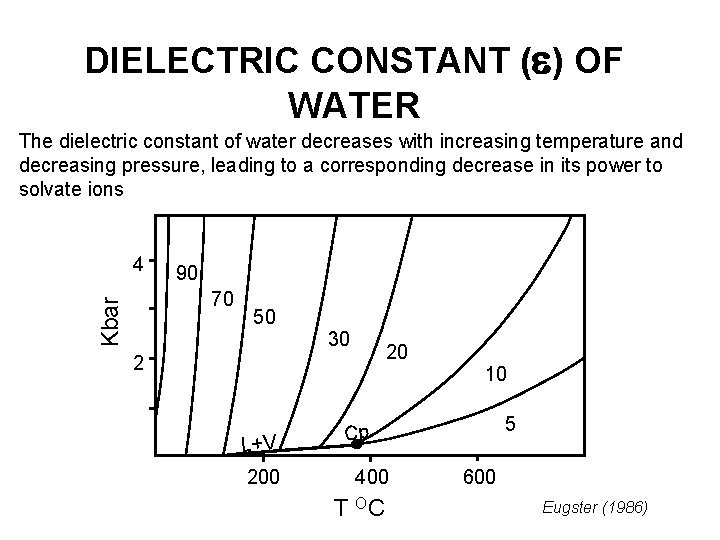
DIELECTRIC CONSTANT ( ) OF WATER The dielectric constant of water decreases with increasing temperature and decreasing pressure, leading to a corresponding decrease in its power to solvate ions 4 90 Kbar 70 50 30 20 2 L+V 200 10 5 Cp 400 T OC 600 Eugster (1986)

COMPLEXATION As the dielectric constant of water decreases, the water molecule shells around metal ions and anions break down facilitating the formation of complex molecules involving these species, e. g. , Cu. Cl 42 -. These complexes will be surrounded by weaker solvation (hydration) shells. O H H O Complex molecule solvation (hydration) O 2 - H H H O H O H
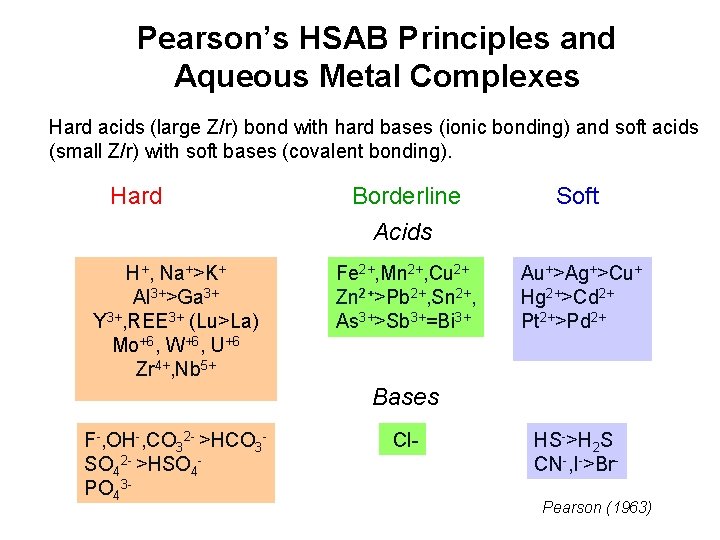
Pearson’s HSAB Principles and Aqueous Metal Complexes Hard acids (large Z/r) bond with hard bases (ionic bonding) and soft acids (small Z/r) with soft bases (covalent bonding). Hard Borderline Soft Acids H+, Na+>K+ Al 3+>Ga 3+ Y 3+, REE 3+ (Lu>La) Mo+6, W+6, U+6 Zr 4+, Nb 5+ Fe 2+, Mn 2+, Cu 2+ Zn 2+>Pb 2+, Sn 2+, As 3+>Sb 3+=Bi 3+ Au+>Ag+>Cu+ Hg 2+>Cd 2+ Pt 2+>Pd 2+ Bases F-, OH-, CO 32 - >HCO 3 SO 42 - >HSO 4 PO 43 - Cl- HS->H 2 S CN-, I->Br. Pearson (1963)
- Slides: 8