
Hydrotherapy BY Dr Abdelrzak abdelnaeim Lecturer of physical

Hydrotherapy BY Dr. Abdelrzak abdelnaeim Lecturer of physical therapy for neurology
�Hydrotherapy is a Greek words hydro means "water" and therapy means "healing". �Hydrotherapy is therapeutic modality that uses water in any form gas (steam), liquid (water), and solid (ice), or temperature(hot and cold) for the treatment of physical or psychological dysfunction.

Chemical, Physical and mechanical properties of water
I. Chemical Properties of Water: �Pure water is a polar molecule consisting of 2 molecules of Hydrogen and 1 molecule of Oxygen. Water possess high dissolving power and this can help in cases of additive material to water for therapeutic causes as in wound care. �The water used may be pure or mixed with other substances as salt, iodine, sulfur, mud, and gas
II. Physical & mechanical properties 1. Specific gravity: is the ratio of the density of a substance to the density of water. Water has specific gravity of 1. 0 at 4°C, and the human body has a specific gravity of 0. 974. �Density: Density = massvolume
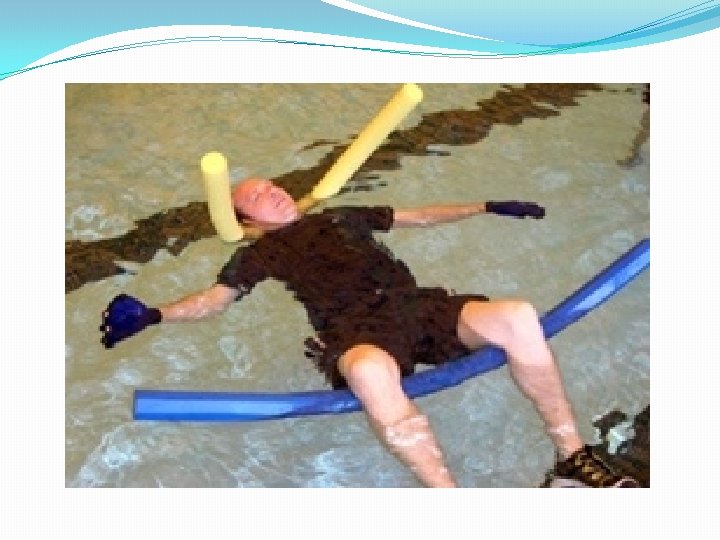
�If an object's specific gravity is less than or equal to that of water (1. 0), it will float in water. �If the specific gravity is greater than that of water, it will sink at a rate based on the difference between the specific gravity of the object and of water. �If density of body further decreased (adding air-filled objects at rest), Body will float higher in water.
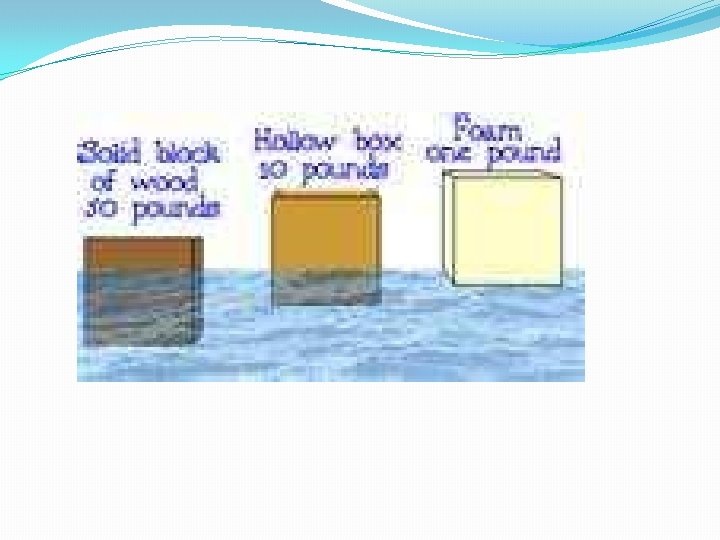
2. Buoyancy �Buoyancy is a force experienced as an upward thrust on the body in the opposite direction to the force of gravity. �According to The Archimedes Principle states that when a body is entirely or partially immersed in fluid at rest, it experiences an upward thrust equal to the weight of the fluid displaces.
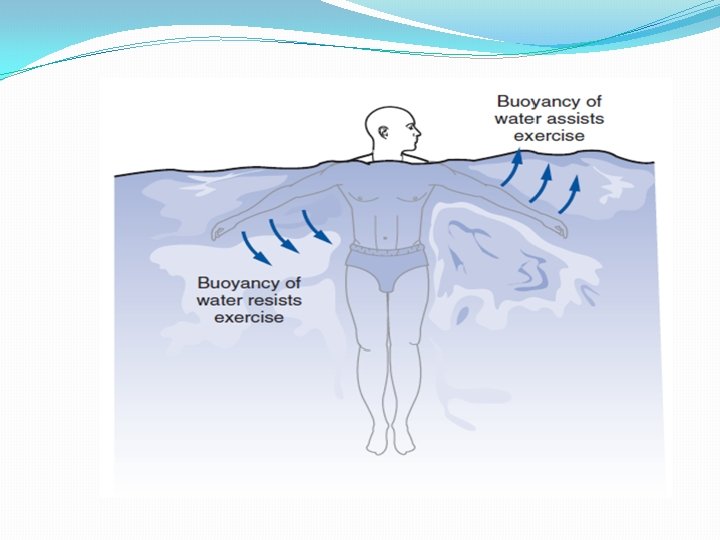
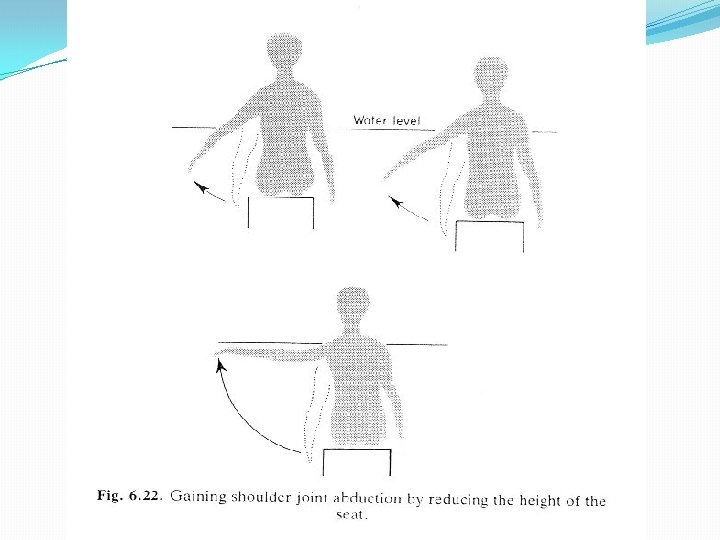
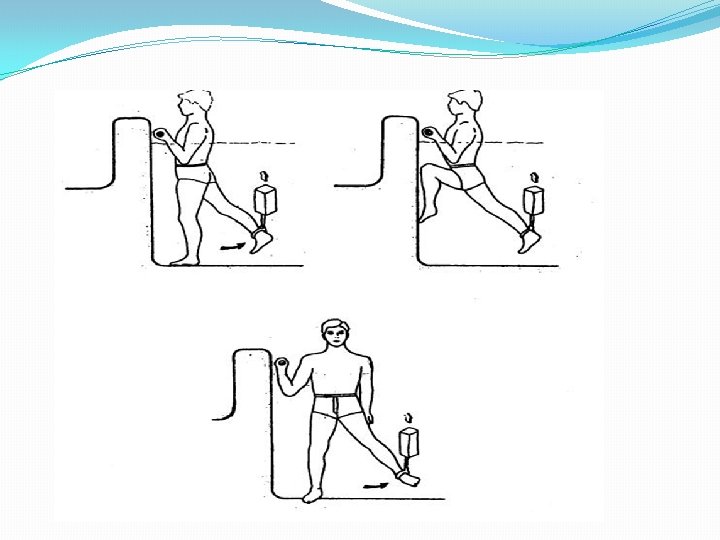
Clinical application of buoyancy: � Weight relief depending on the proportion of the body below water level: immersion to waist level, the weight relief is approximately 50% of the body weight. shoulder level, weight relief is 90% of the body weight � Decrease stress and compression on weight-bearing joints, muscles, and connective tissue. �The upward thrust of water can be used either to assist movement (moving upward with upward thrust) or resist movement (moving downward against the upward thrust).
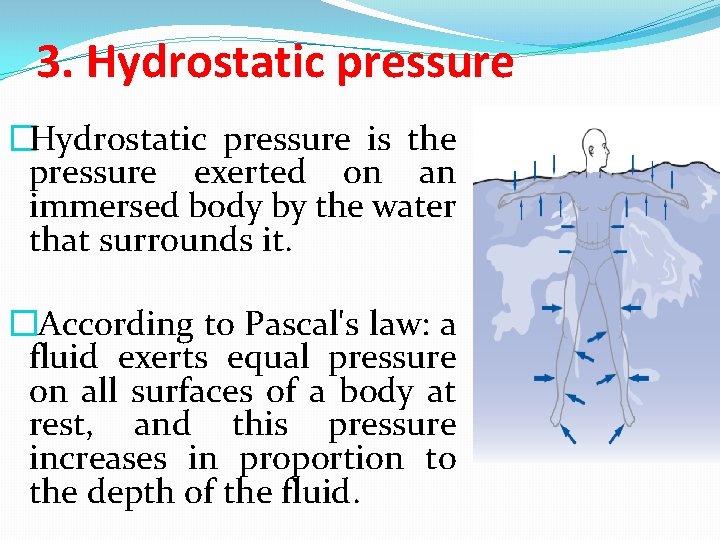
3. Hydrostatic pressure �Hydrostatic pressure is the pressure exerted on an immersed body by the water that surrounds it. �According to Pascal's law: a fluid exerts equal pressure on all surfaces of a body at rest, and this pressure increases in proportion to the depth of the fluid.
�This pressure is dependent on the depth of the immersed part and the density of the liquid. Hydrostatic pressure increases as depth and density of the liquid increase. �Therefore, motion is performed more easily near the surface of the water than at greater depths.
4. Cohesion and Viscosity �Cohesion is the tendency of molecules to attract each other. Viscosity is the internal friction that occurs between molecules of water. � As a body moves through water, there is a resistance to the motion of body in water. �Water resistance is directly proportional to the speed of the movement �The viscosity of water makes it a useful strengthening medium.
5. Turbulence �Turbulence is an irregular movement of water molecules. It may be created by an under water douche, or turbines stationary � • transfers is byheat Water that conduction. � • Moving water transfers heat by conduction and Convection. �This has a relaxing effect and may be used to decrease muscle tension or spasm
6. Specific Heat �Specific heat is the capacity of a substance to store heat. Water can store four times more heat than air and twice as much as a paraffin wax.
7. Thermal conductivity �is the capacity of a substance to conduct heat to other substances or materials. The thermal conductivity of solids is about 100 times that of liquids, which have about 100 times more conductivity than gases. This difference in conductivity explains why, for instance, moist hot towels provide a more effective treatment than dry.
The buoyancy of water weight bearing and allow patients to perform exercise with less trauma and pain on joints. � The resistance provided by water can be used to provide a force against muscle strength. � Immersion acts to drive out edema, lactate, and other metabolic end products. �
Precautions for Hydrotherapy �Hypersensitivity to chemicals used in pool � Multiple sclerosis (water warmer than 88° is not appropriate) � Thermoregulatory problems. �Epilepsy � Excessive fear of water �Never force a patient with a fear of water to engage in hydrotherapy.

Precautions �Peripheral vascular disease � Fever �Dysphagia � Compromised respiratory function � Unstable high or low blood pressure � Severely weakened or deconditioned state
Advantages of hydrotherapy �Free movement with less risk of injury �Decreases weight bearing on joints �Buoyancy may assist weak muscles to allow increased performance of active exercise �Has the ability to affect all major body systems. Disadvantages of hydrotherapy �Slippery environment with increased risk of falls outside pool �Risk of infection �Difficulty stabilizing or isolating body parts during exercise �Risk of drowning

Thank you
- Slides: 24