
Hydrosphere Unit 3 OCEANS What is density Density






- Slides: 25
Hydrosphere - Unit 3 OCEANS
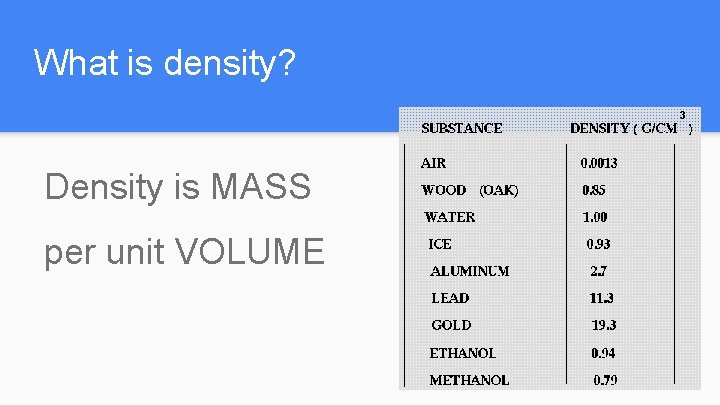
What is density? Density is MASS per unit VOLUME
Ocean Currents Ocean currents are created by changes in: Temperature and Salinity
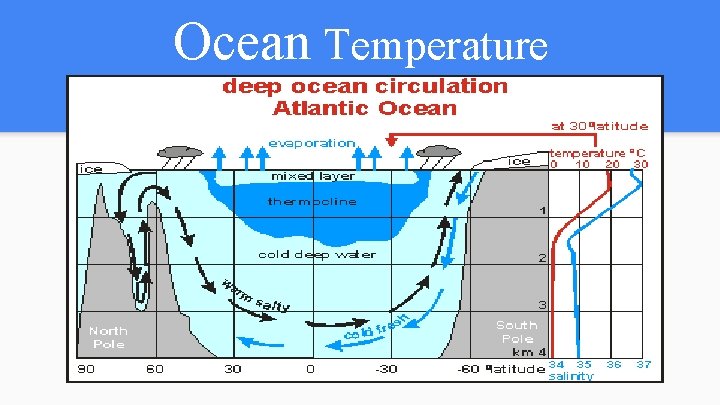
Ocean Temperature ● The Sun heats the upper layers of water. ● First 100 - 300 meters of water much warmer due to mixing (distributes the heat). ● Deeper waters are much colder, often just around 4°C.
Ocean Temperature
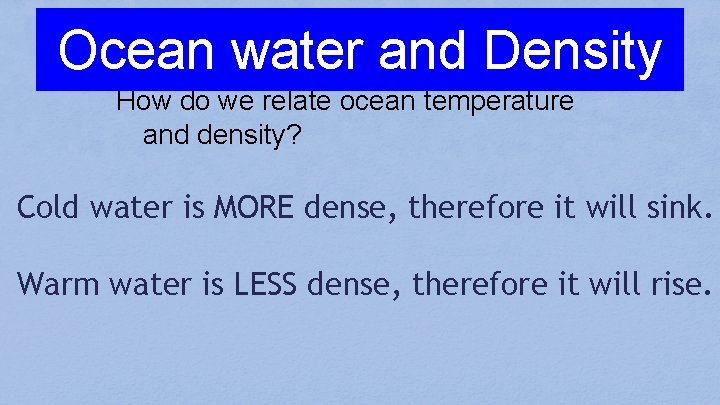
Ocean water and Density How do we relate ocean temperature and density? Cold water is MORE dense, therefore it will sink. Warm water is LESS dense, therefore it will rise.
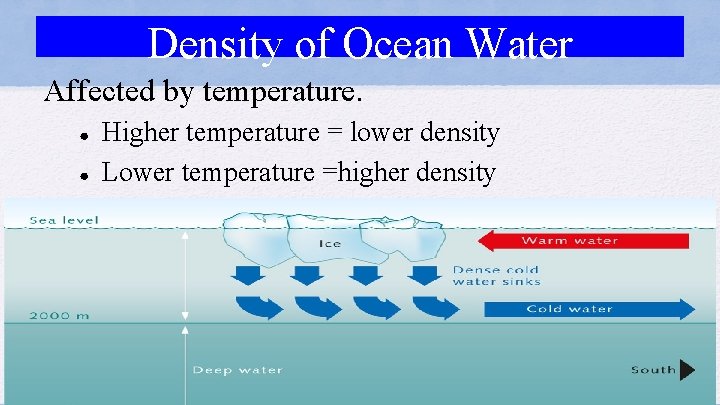
Density of Ocean Water Affected by temperature. ● ● Higher temperature = lower density Lower temperature =higher density
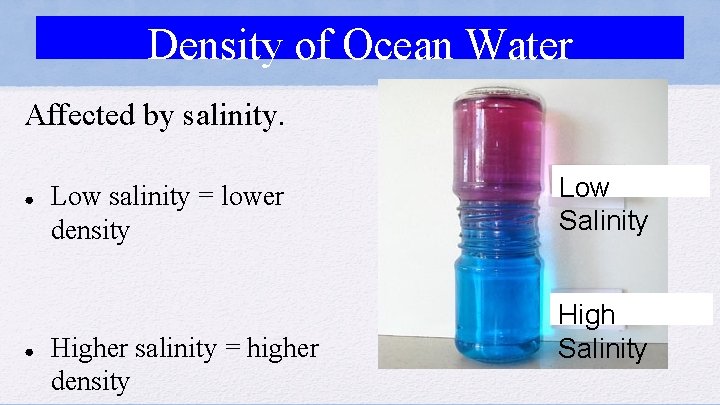
Density of Ocean Water Affected by salinity. ● ● Low salinity = lower density Higher salinity = higher density Low Salinity High Salinity
Video Clips • Ocean Current Salinity Experiment https: //www. youtube. com/watch? v=Pan. Y 6 A HNjuc • Ocean Stratification Demo https: //www. youtube. com/watch? v=7 fq. Otg. G 6 vik
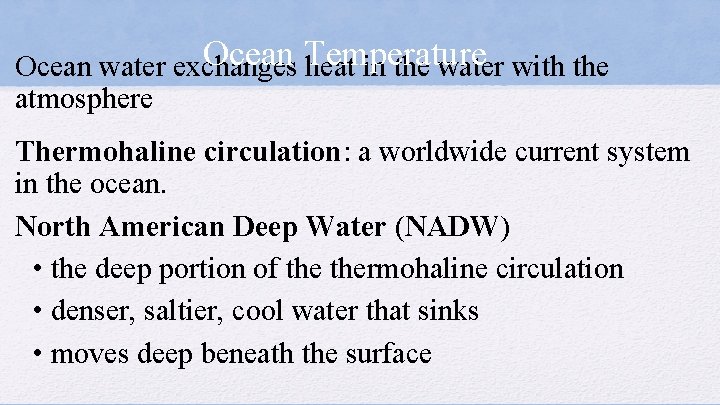
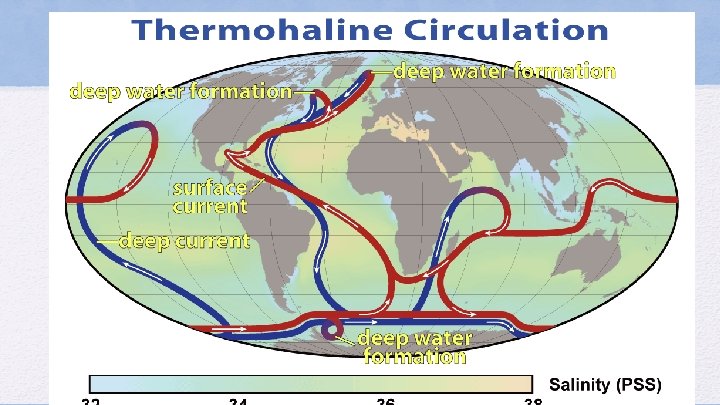
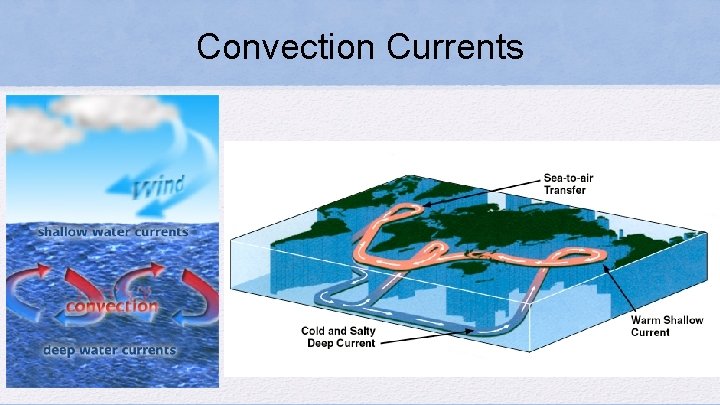
Ocean Temperature Ocean water exchanges heat in the water with the atmosphere Thermohaline circulation: a worldwide current system in the ocean. North American Deep Water (NADW) • the deep portion of thermohaline circulation • denser, saltier, cool water that sinks • moves deep beneath the surface
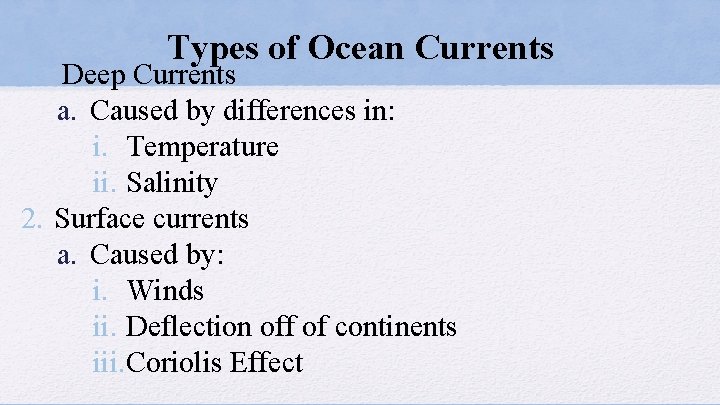
Types of Ocean Currents 1. Deep Currents a. Caused by differences in: i. Temperature ii. Salinity 2. Surface currents a. Caused by: i. Winds ii. Deflection off of continents iii. Coriolis Effect
Videos Coriolis Effect Video: a. (https: //www. youtube. com/watch? v=i 2 mec 3 vgea. I) Difference between Surface and Deep Currents: https: //www. youtube. com/watch? v=3 ix 5 SHp. E 2 Vs
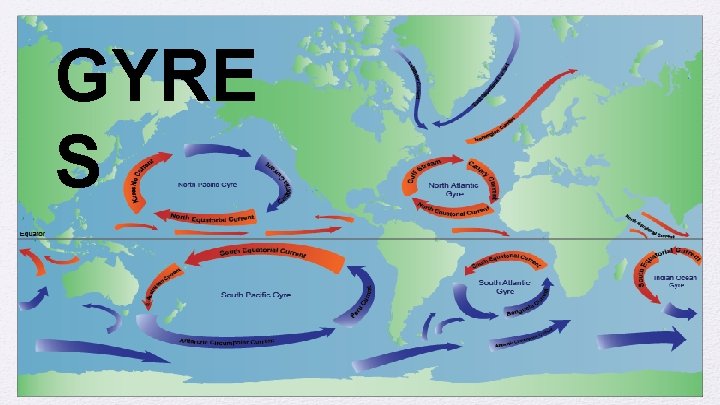
Gyres are large current systems created by global winds and the Earth’s rotation.
GYRE S
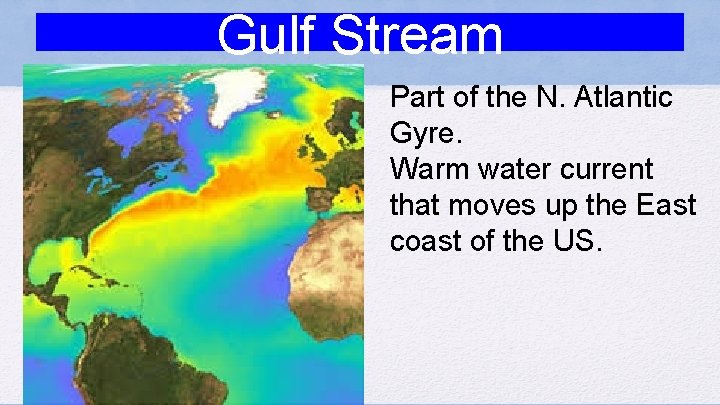
Gulf Stream Part of the N. Atlantic Gyre. Warm water current that moves up the East coast of the US.
Pacific Trash Gyre Video https: //www. youtube. com/watch? v=Co 43 TXJXry. I
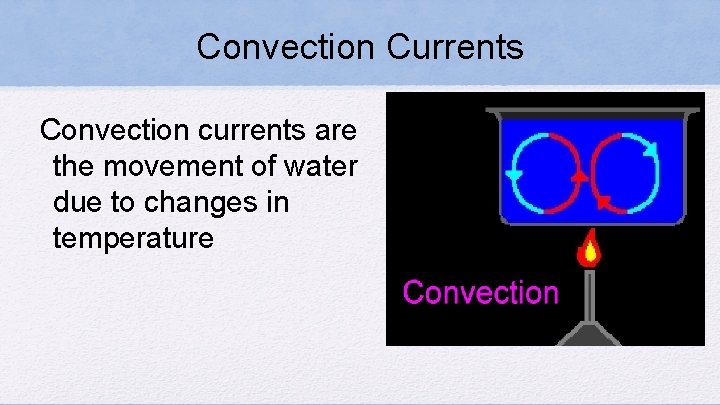
Convection Currents Convection currents are the movement of water due to changes in temperature
Convection Currents
Mr. Wizard!!!! Convection Currents https: //www. youtube. com/watch? v=N 8 m. Cn 8 f 3 za 0
How does water Keep Its Temperature? Specific Heat - the amount of heat required to change a mass of a substance by one degree in temperature. Water has a HIGH specific heat.
What does this mean? It takes a lot of heat to change the temperature of water. Once water is warmed, it takes a long time for it to lose it’s warmth.
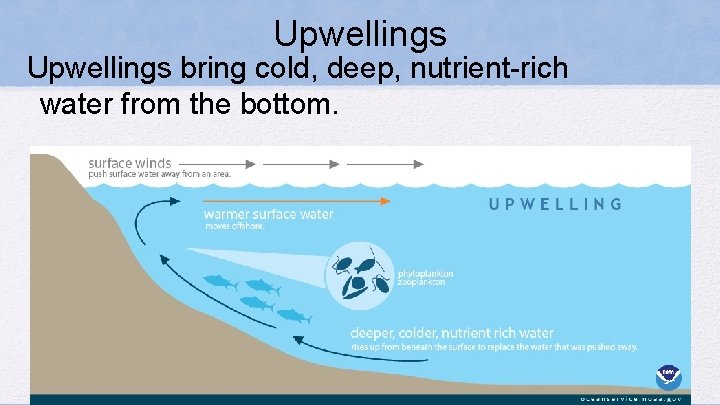
What causes COLD water to be brought towards the surface? As the wind blows water surface water away from the shore, deep cold water is brought up to replace the surface water. This process is called an upwelling.
Upwellings bring cold, deep, nutrient-rich water from the bottom.
Partners/Groups for OA Lab Lorin/Irina Liam/Brock Matthew/Jordan Brendan/Jared/Kevin Jerrel/Greg Raul/Cameron/Joshua Michael/Bryan Abigail/Rachael Brittany/Kallie Alex/Emilio/Brian