
Hydromechanical Model of Geological Carbon Sequestration in Saline
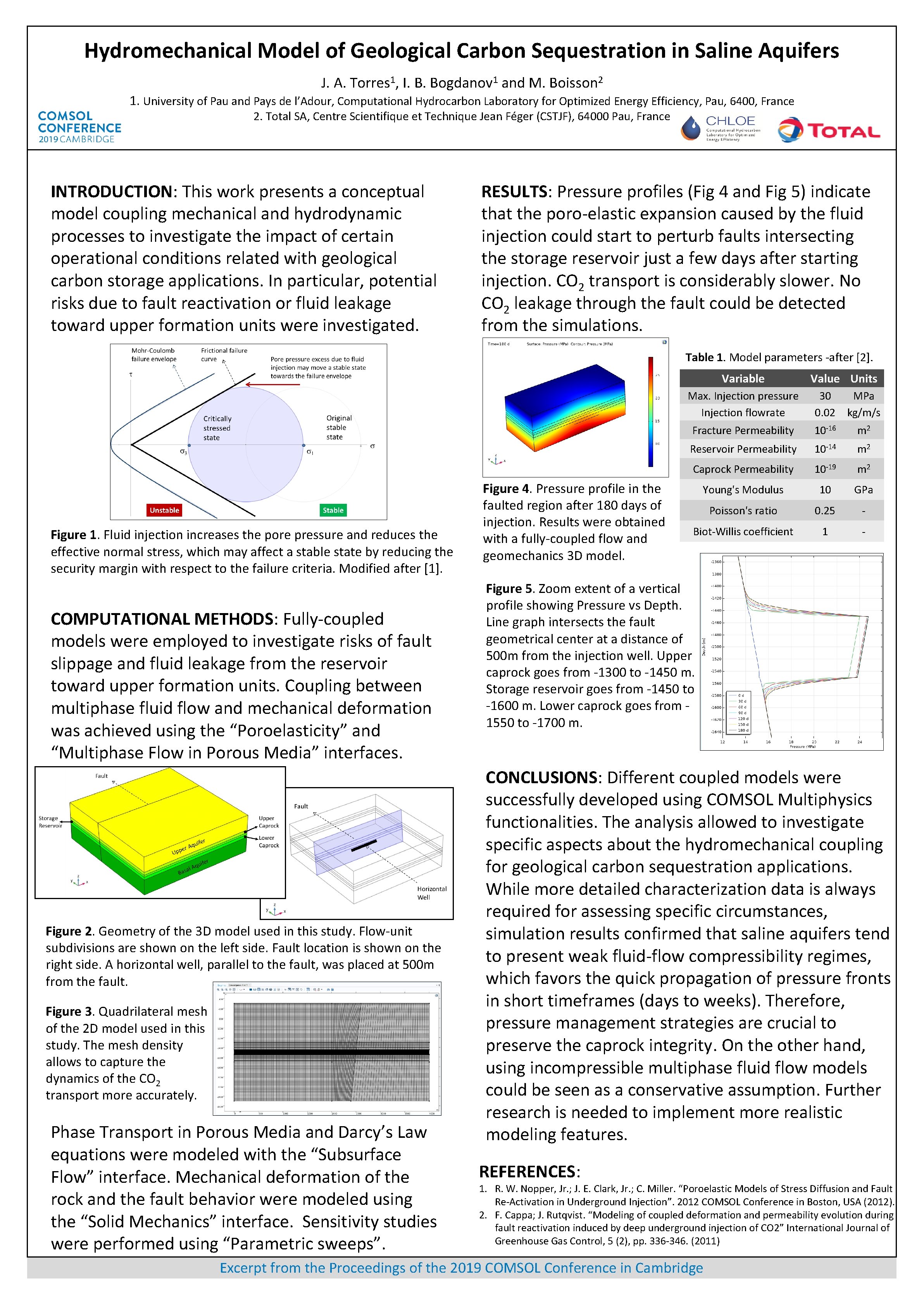
Hydromechanical Model of Geological Carbon Sequestration in Saline Aquifers J. A. Torres 1, I. B. Bogdanov 1 and M. Boisson 2 1. University of Pau and Pays de l’Adour, Computational Hydrocarbon Laboratory for Optimized Energy Efficiency, Pau, 6400, France 2. Total SA, Centre Scientifique et Technique Jean Féger (CSTJF), 64000 Pau, France INTRODUCTION: This work presents a conceptual model coupling mechanical and hydrodynamic processes to investigate the impact of certain operational conditions related with geological carbon storage applications. In particular, potential risks due to fault reactivation or fluid leakage toward upper formation units were investigated. RESULTS: Pressure profiles (Fig 4 and Fig 5) indicate that the poro-elastic expansion caused by the fluid injection could start to perturb faults intersecting the storage reservoir just a few days after starting injection. CO 2 transport is considerably slower. No CO 2 leakage through the fault could be detected from the simulations. Table 1. Model parameters -after [2]. Variable Max. Injection pressure Injection flowrate Figure 1. Fluid injection increases the pore pressure and reduces the effective normal stress, which may affect a stable state by reducing the security margin with respect to the failure criteria. Modified after [1]. COMPUTATIONAL METHODS: Fully-coupled models were employed to investigate risks of fault slippage and fluid leakage from the reservoir toward upper formation units. Coupling between multiphase fluid flow and mechanical deformation was achieved using the “Poroelasticity” and “Multiphase Flow in Porous Media” interfaces. Figure 2. Geometry of the 3 D model used in this study. Flow-unit subdivisions are shown on the left side. Fault location is shown on the right side. A horizontal well, parallel to the fault, was placed at 500 m from the fault. Figure 3. Quadrilateral mesh of the 2 D model used in this study. The mesh density allows to capture the dynamics of the CO 2 transport more accurately. Phase Transport in Porous Media and Darcy’s Law equations were modeled with the “Subsurface Flow” interface. Mechanical deformation of the rock and the fault behavior were modeled using the “Solid Mechanics” interface. Sensitivity studies were performed using “Parametric sweeps”. Figure 4. Pressure profile in the faulted region after 180 days of injection. Results were obtained with a fully-coupled flow and geomechanics 3 D model. Value Units 30 MPa 0. 02 kg/m/s Fracture Permeability 10 -16 m 2 Reservoir Permeability 10 -14 m 2 Caprock Permeability 10 -19 m 2 Young's Modulus 10 GPa Poisson's ratio 0. 25 - Biot-Willis coefficient 1 - Figure 5. Zoom extent of a vertical profile showing Pressure vs Depth. Line graph intersects the fault geometrical center at a distance of 500 m from the injection well. Upper caprock goes from -1300 to -1450 m. Storage reservoir goes from -1450 to -1600 m. Lower caprock goes from 1550 to -1700 m. CONCLUSIONS: Different coupled models were successfully developed using COMSOL Multiphysics functionalities. The analysis allowed to investigate specific aspects about the hydromechanical coupling for geological carbon sequestration applications. While more detailed characterization data is always required for assessing specific circumstances, simulation results confirmed that saline aquifers tend to present weak fluid-flow compressibility regimes, which favors the quick propagation of pressure fronts in short timeframes (days to weeks). Therefore, pressure management strategies are crucial to preserve the caprock integrity. On the other hand, using incompressible multiphase fluid flow models could be seen as a conservative assumption. Further research is needed to implement more realistic modeling features. REFERENCES: 1. R. W. Nopper, Jr. ; J. E. Clark, Jr. ; C. Miller. “Poroelastic Models of Stress Diffusion and Fault Re-Activation in Underground Injection”. 2012 COMSOL Conference in Boston, USA (2012). 2. F. Cappa; J. Rutqvist. “Modeling of coupled deformation and permeability evolution during fault reactivation induced by deep underground injection of CO 2” International Journal of Greenhouse Gas Control, 5 (2), pp. 336 -346. (2011) Excerpt from the Proceedings of the 2019 COMSOL Conference in Cambridge
- Slides: 1