
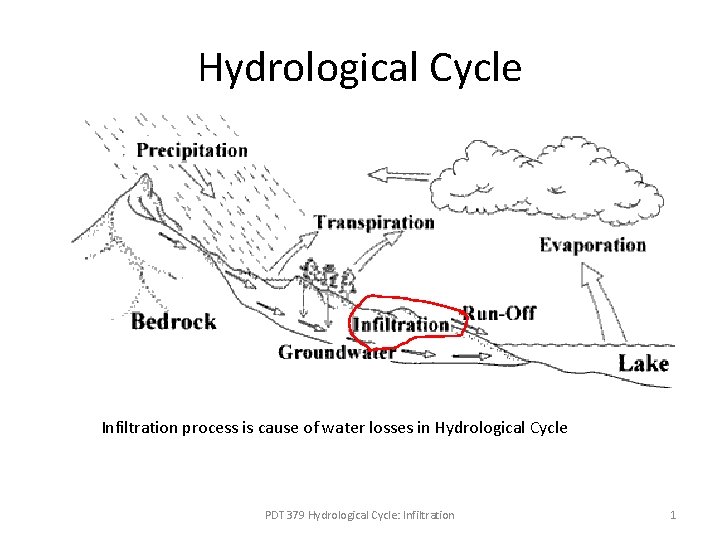
Hydrological Cycle Infiltration process is cause of water

- Slides: 17
Hydrological Cycle Infiltration process is cause of water losses in Hydrological Cycle PDT 379 Hydrological Cycle: Infiltration 1
IINFILTRATION, f • To estimate the amount and timing of infiltration • Infiltration process – Part of rain water infiltrated to the soil due to gravitational force and pressure different – Knowledge in infiltration is important because: • Part of water losses to water supply system • Part of water gain to groundwater system • Provide other implication – to soil strength/slope stability – Groundwater contamination – Crop rooting system PDT 379 Hydrological Cycle: Infiltration 2
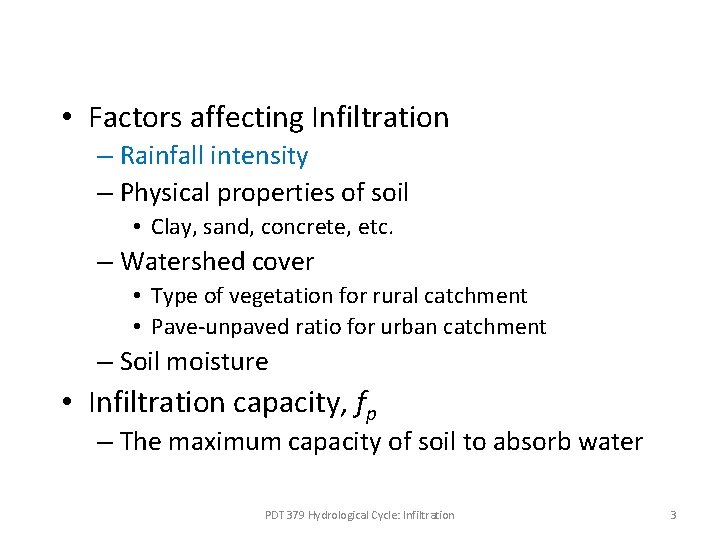
• Factors affecting Infiltration – Rainfall intensity – Physical properties of soil • Clay, sand, concrete, etc. – Watershed cover • Type of vegetation for rural catchment • Pave-unpaved ratio for urban catchment – Soil moisture • Infiltration capacity, fp – The maximum capacity of soil to absorb water PDT 379 Hydrological Cycle: Infiltration 3
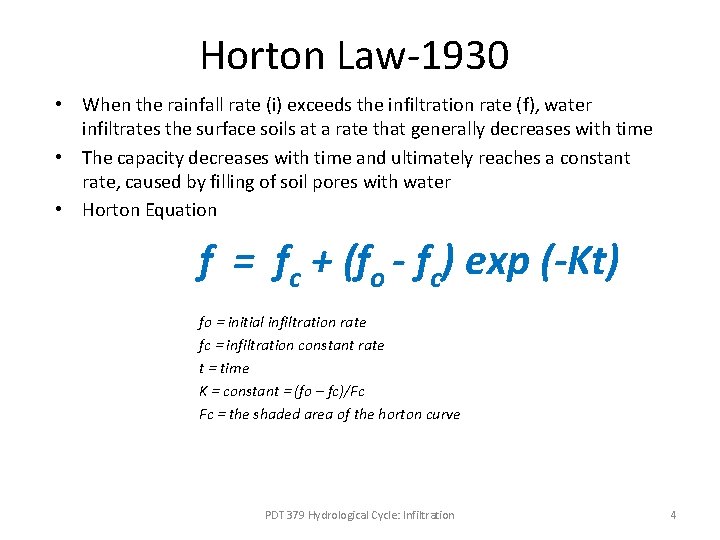
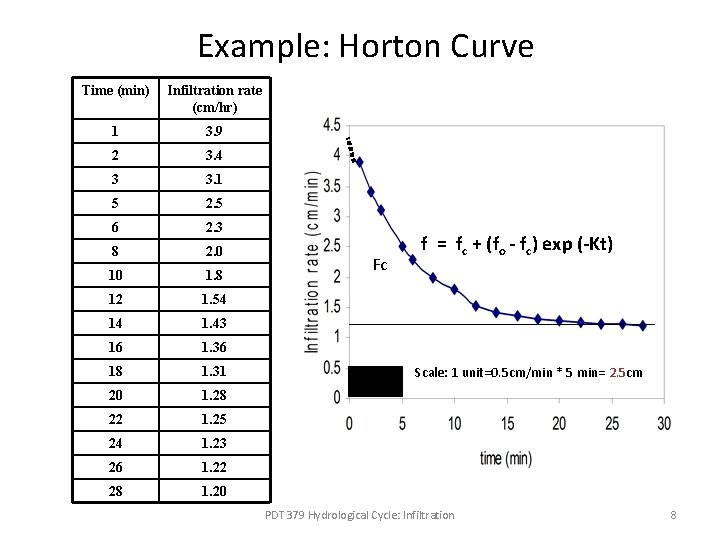
Horton Law-1930 • When the rainfall rate (i) exceeds the infiltration rate (f), water infiltrates the surface soils at a rate that generally decreases with time • The capacity decreases with time and ultimately reaches a constant rate, caused by filling of soil pores with water • Horton Equation f = fc + (fo - fc) exp (-Kt) fo = initial infiltration rate fc = infiltration constant rate t = time K = constant = (fo – fc)/Fc Fc = the shaded area of the horton curve PDT 379 Hydrological Cycle: Infiltration 4
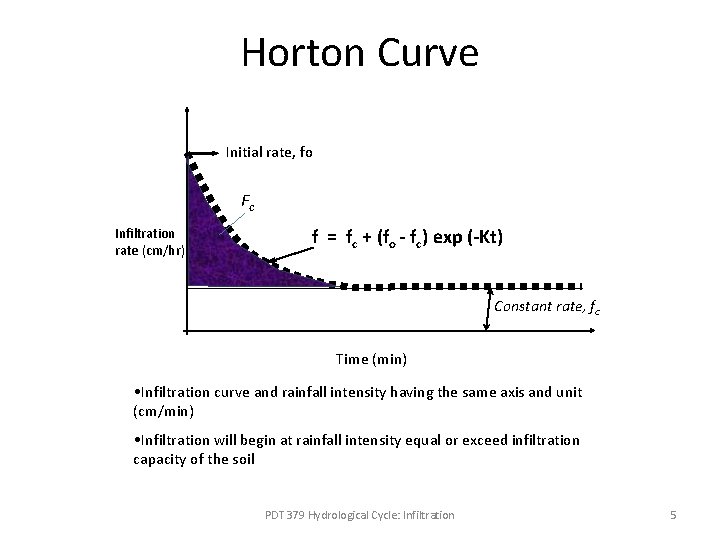
Horton Curve Initial rate, fo Fc Infiltration rate (cm/hr) f = fc + (fo - fc) exp (-Kt) Constant rate, fc Time (min) • Infiltration curve and rainfall intensity having the same axis and unit (cm/min) • Infiltration will begin at rainfall intensity equal or exceed infiltration capacity of the soil PDT 379 Hydrological Cycle: Infiltration 5
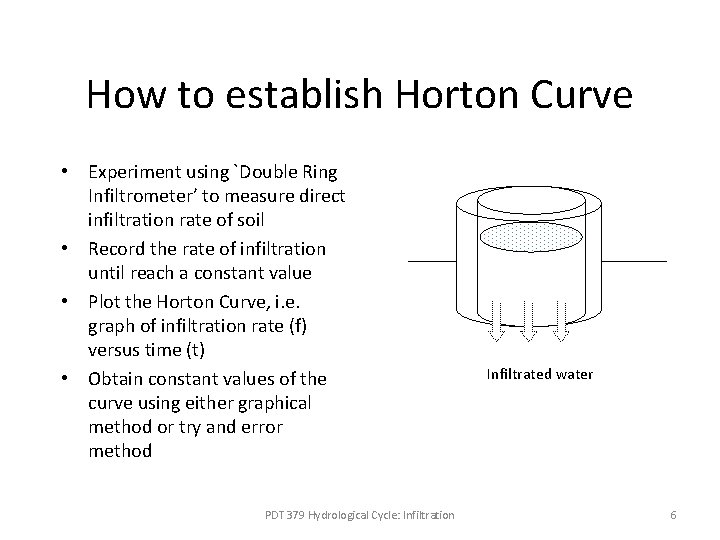
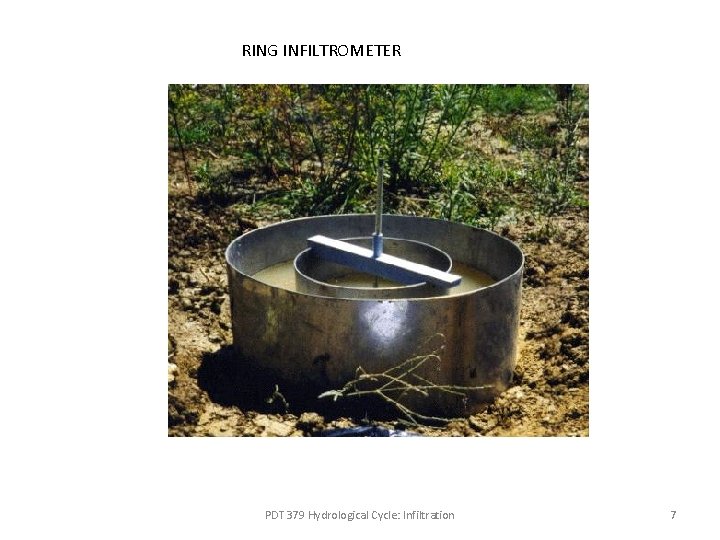
How to establish Horton Curve • Experiment using `Double Ring Infiltrometer’ to measure direct infiltration rate of soil • Record the rate of infiltration until reach a constant value • Plot the Horton Curve, i. e. graph of infiltration rate (f) versus time (t) • Obtain constant values of the curve using either graphical method or try and error method PDT 379 Hydrological Cycle: Infiltration Infiltrated water 6
RING INFILTROMETER PDT 379 Hydrological Cycle: Infiltration 7
Example: Horton Curve Time (min) Infiltration rate (cm/hr) 1 3. 9 2 3. 4 3 3. 1 5 2. 5 6 2. 3 8 2. 0 10 1. 8 12 1. 54 14 1. 43 16 1. 36 18 1. 31 20 1. 28 22 1. 25 24 1. 23 26 1. 22 28 1. 20 Fc f = fc + (fo - fc) exp (-Kt) Scale: 1 unit=0. 5 cm/min * 5 min= 2. 5 cm PDT 379 Hydrological Cycle: Infiltration 8
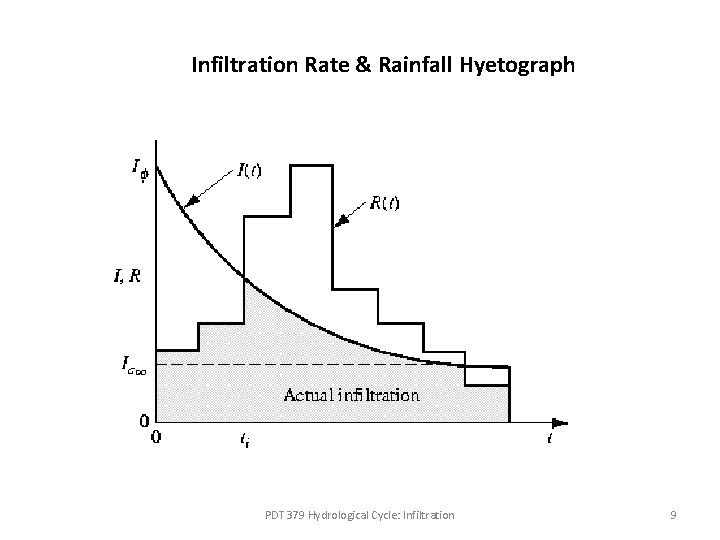
Infiltration Rate & Rainfall Hyetograph PDT 379 Hydrological Cycle: Infiltration 9
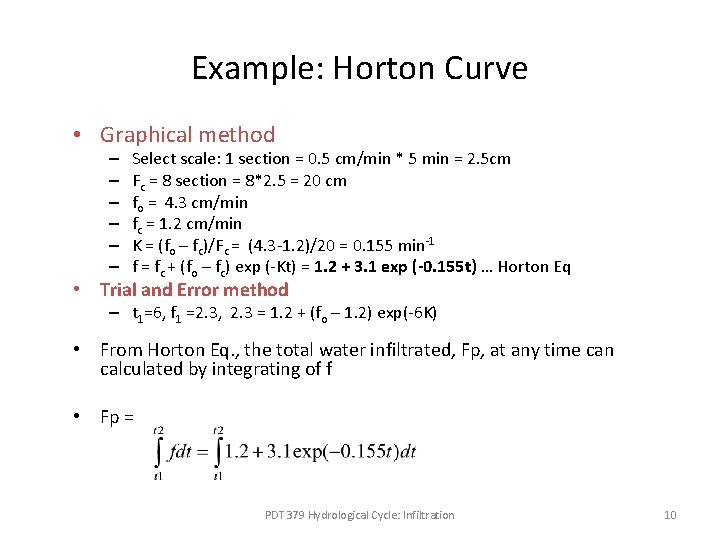
Example: Horton Curve • Graphical method – – – Select scale: 1 section = 0. 5 cm/min * 5 min = 2. 5 cm Fc = 8 section = 8*2. 5 = 20 cm fo = 4. 3 cm/min fc = 1. 2 cm/min K = (fo – fc)/Fc = (4. 3 -1. 2)/20 = 0. 155 min-1 f = fc + (fo – fc) exp (-Kt) = 1. 2 + 3. 1 exp (-0. 155 t) … Horton Eq • Trial and Error method – t 1=6, f 1 =2. 3, 2. 3 = 1. 2 + (fo – 1. 2) exp(-6 K) • From Horton Eq. , the total water infiltrated, Fp, at any time can calculated by integrating of f • Fp = PDT 379 Hydrological Cycle: Infiltration 10
EXAMPLE 2 • The Horton’s infiltration equation for a basin is given by f = 6 + 16 e -2 t where f is in mm/hr and t is in hour. If a storm occurs on this basis with an intensity of more than 22 mm/hr, determine the depth of infiltration for the first 45 minutes and average infiltration rate for the first 75 minutes. PDT 379 Hydrological Cycle: Infiltration 11
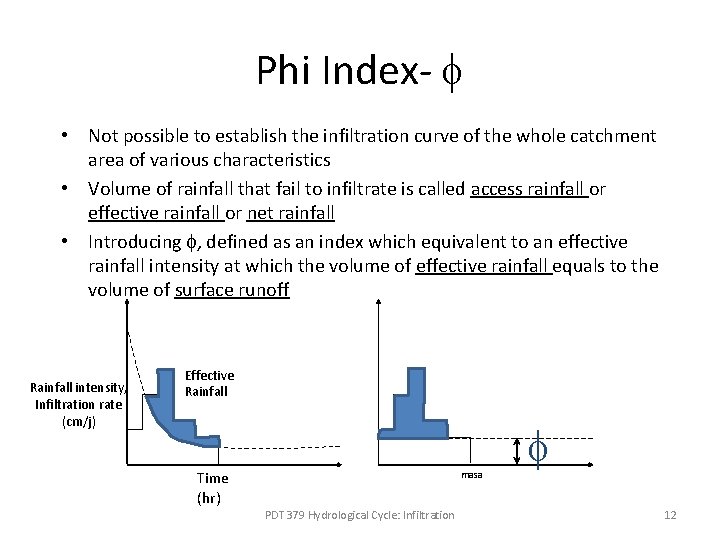
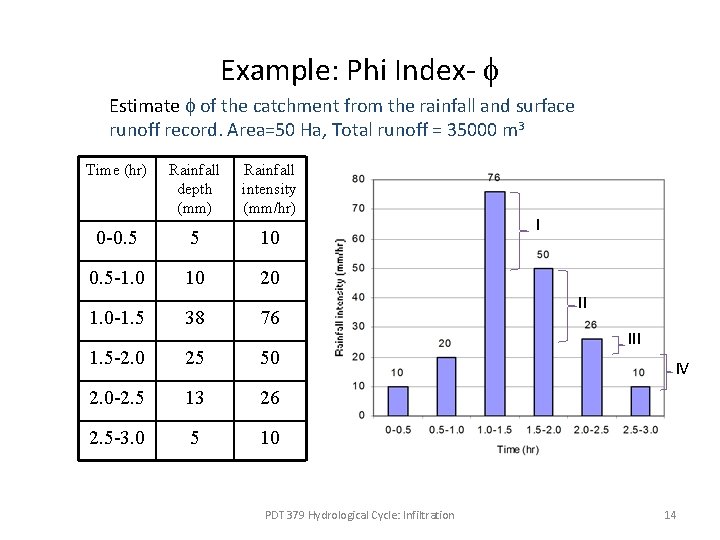
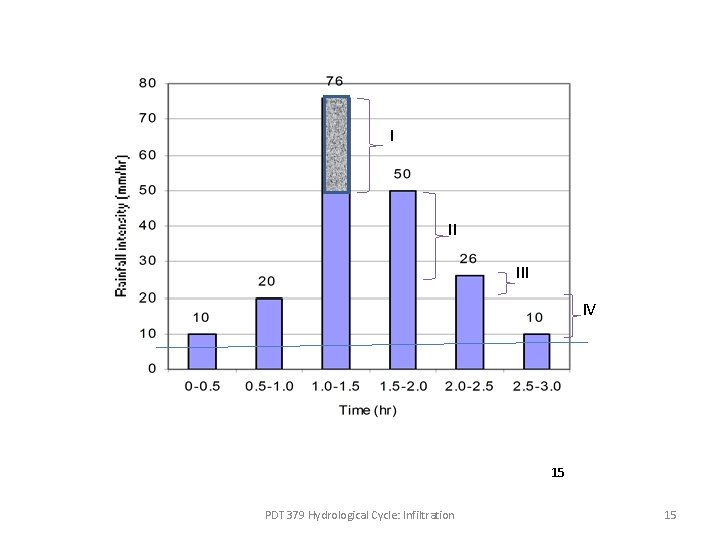
Phi Index- • Not possible to establish the infiltration curve of the whole catchment area of various characteristics • Volume of rainfall that fail to infiltrate is called access rainfall or effective rainfall or net rainfall • Introducing , defined as an index which equivalent to an effective rainfall intensity at which the volume of effective rainfall equals to the volume of surface runoff Rainfall intensity, Infiltration rate (cm/j) Effective Rainfall Time (hr) masa PDT 379 Hydrological Cycle: Infiltration 12
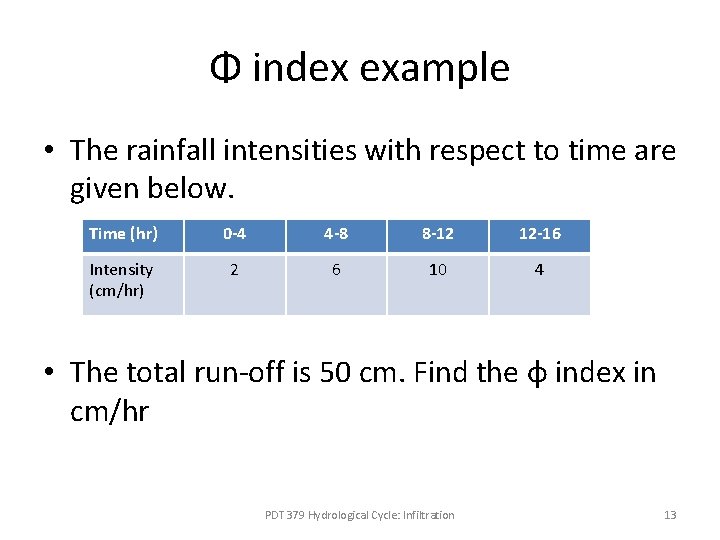
Φ index example • The rainfall intensities with respect to time are given below. Time (hr) 0 -4 4 -8 8 -12 12 -16 Intensity (cm/hr) 2 6 10 4 • The total run-off is 50 cm. Find the φ index in cm/hr PDT 379 Hydrological Cycle: Infiltration 13
Example: Phi Index- Estimate of the catchment from the rainfall and surface runoff record. Area=50 Ha, Total runoff = 35000 m 3 Time (hr) Rainfall depth (mm) Rainfall intensity (mm/hr) 0 -0. 5 5 10 0. 5 -1. 0 10 20 1. 0 -1. 5 38 76 1. 5 -2. 0 25 50 2. 0 -2. 5 13 26 2. 5 -3. 0 5 10 PDT 379 Hydrological Cycle: Infiltration I II IV 14
I II IV 15 PDT 379 Hydrological Cycle: Infiltration 15
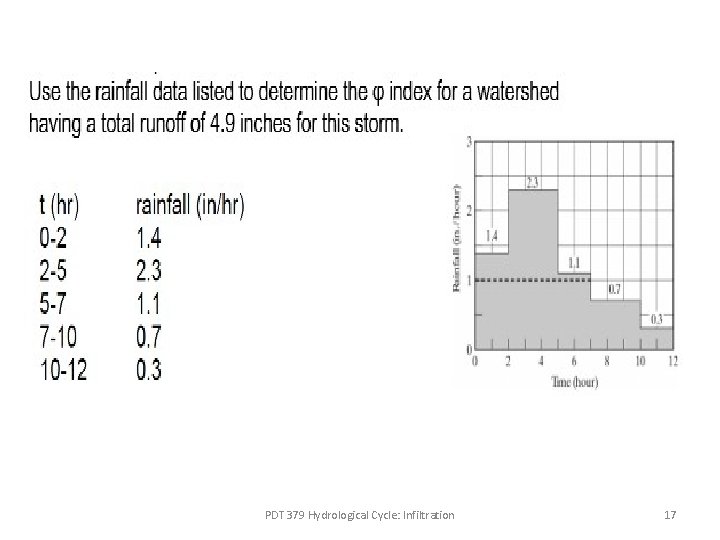
PDT 379 Hydrological Cycle: Infiltration 17
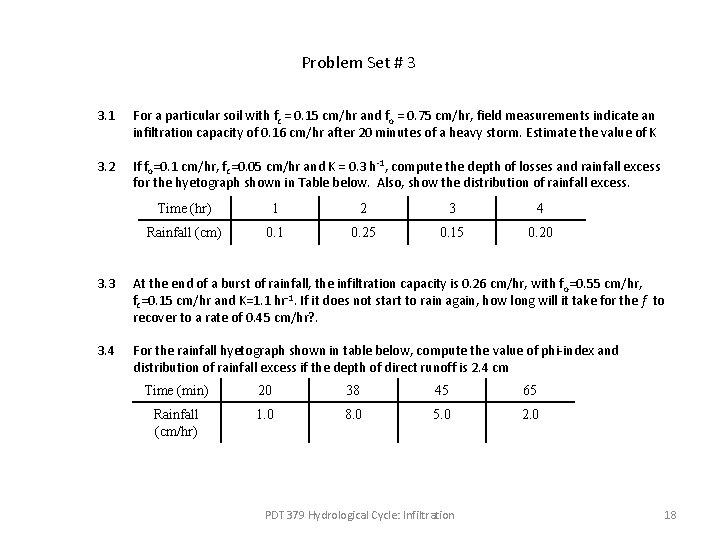
Problem Set # 3 3. 1 For a particular soil with fc = 0. 15 cm/hr and fo = 0. 75 cm/hr, field measurements indicate an infiltration capacity of 0. 16 cm/hr after 20 minutes of a heavy storm. Estimate the value of K 3. 2 If fo=0. 1 cm/hr, fc=0. 05 cm/hr and K = 0. 3 h-1, compute the depth of losses and rainfall excess for the hyetograph shown in Table below. Also, show the distribution of rainfall excess. Time (hr) 1 2 3 4 Rainfall (cm) 0. 1 0. 25 0. 15 0. 20 3. 3 At the end of a burst of rainfall, the infiltration capacity is 0. 26 cm/hr, with f o=0. 55 cm/hr, fc=0. 15 cm/hr and K=1. 1 hr-1. If it does not start to rain again, how long will it take for the f to recover to a rate of 0. 45 cm/hr? . 3. 4 For the rainfall hyetograph shown in table below, compute the value of phi-index and distribution of rainfall excess if the depth of direct runoff is 2. 4 cm Time (min) 20 38 45 65 Rainfall (cm/hr) 1. 0 8. 0 5. 0 2. 0 PDT 379 Hydrological Cycle: Infiltration 18