
Hydrologic Ensemble Forecasts Ensemble Streamflow Prediction ESP CBRFC
Hydrologic Ensemble Forecasts (Ensemble Streamflow Prediction – ESP) CBRFC 2011 Stakeholder Forum November 3, 2011
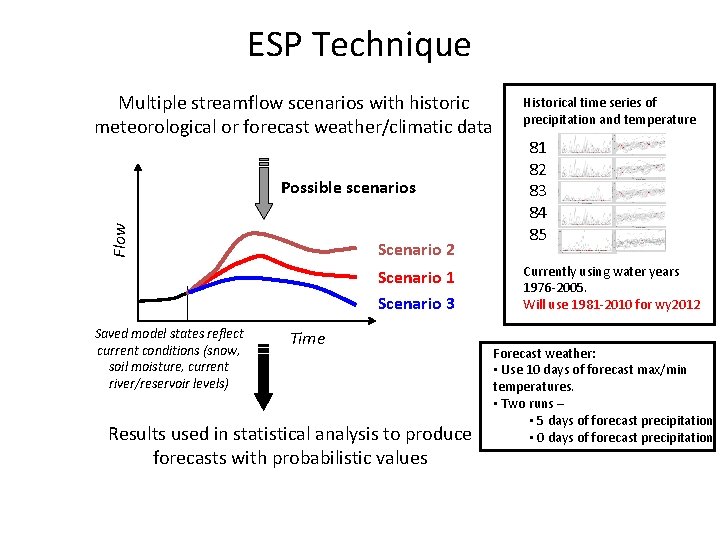
ESP Technique Multiple streamflow scenarios with historic meteorological or forecast weather/climatic data Flow Possible scenarios Scenario 2 Scenario 1 Scenario 3 Saved model states reflect current conditions (snow, soil moisture, current river/reservoir levels) Time Results used in statistical analysis to produce forecasts with probabilistic values Historical time series of precipitation and temperature 81 82 83 84 85 Currently using water years 1976 -2005. Will use 1981 -2010 for wy 2012 Forecast weather: • Use 10 days of forecast max/min temperatures. • Two runs – • 5 days of forecast precipitation • 0 days of forecast precipitation
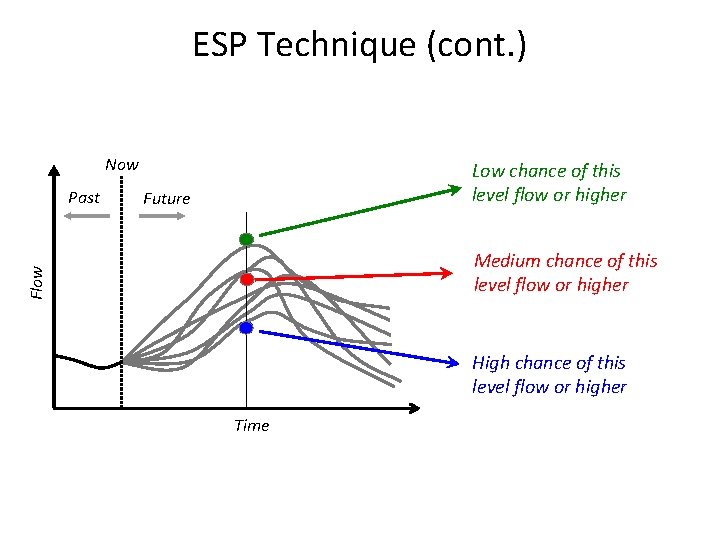
ESP Technique (cont. ) Now Future Medium chance of this level flow or higher Flow Past Low chance of this level flow or higher High chance of this level flow or higher Time
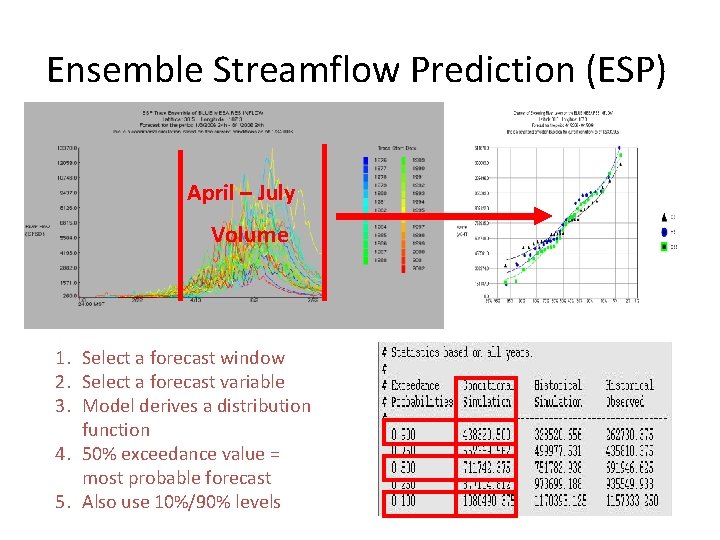
Ensemble Streamflow Prediction (ESP) April – July Volume 1. Select a forecast window 2. Select a forecast variable 3. Model derives a distribution function 4. 50% exceedance value = most probable forecast 5. Also use 10%/90% levels
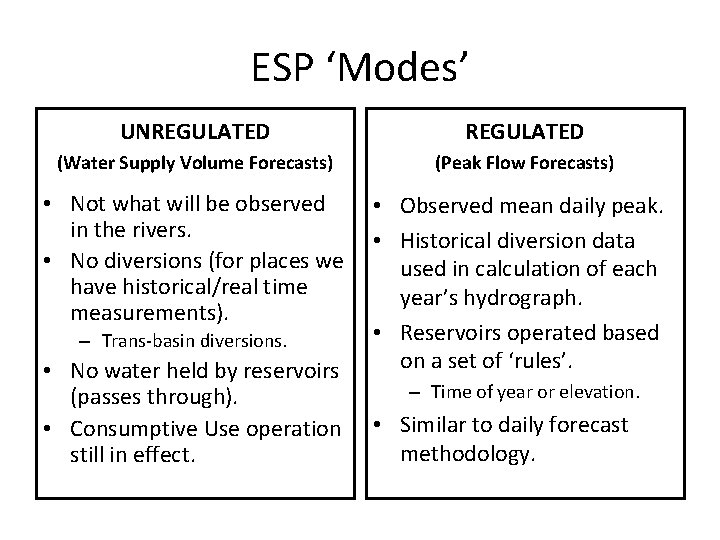
ESP ‘Modes’ UNREGULATED (Water Supply Volume Forecasts) (Peak Flow Forecasts) • Not what will be observed in the rivers. • No diversions (for places we have historical/real time measurements). – Trans-basin diversions. • No water held by reservoirs (passes through). • Consumptive Use operation still in effect. • Observed mean daily peak. • Historical diversion data used in calculation of each year’s hydrograph. • Reservoirs operated based on a set of ‘rules’. – Time of year or elevation. • Similar to daily forecast methodology.

Historic development of ESP NWS/HRL begins ESP development ESP Analysis and Display Program (ESPADP) development started ESP used for drought assessment Climate Prediction Center (CPC) forecast pre-adjustment developed for use in ESP released with NWSRFS 1970 1980 ESP first used at California-Nevada River Forecast Center ESP used for water supply forecasts Work to incorporate climate forecasts 1990 2000 Water Resources Forecasting Services (WARFS) quantifies value of ESPADP deployed to the field Experimental Ensemble Forecast System (XEFS) work begins ESP first presented at the Western Snow Conference Medium to long-range ESP Western Snow Conference paper, 1977 short-mediumlong range ESP
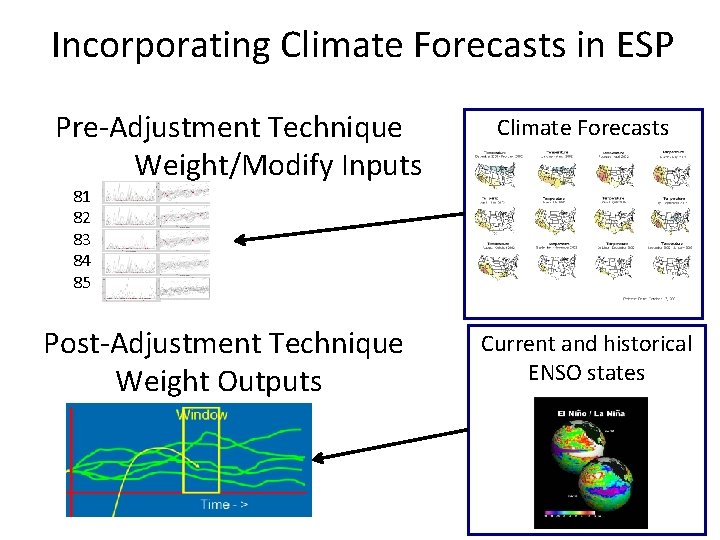
Incorporating Climate Forecasts in ESP Pre-Adjustment Technique Weight/Modify Inputs Climate Forecasts 81 82 83 84 85 Post-Adjustment Technique Weight Outputs Current and historical ENSO states
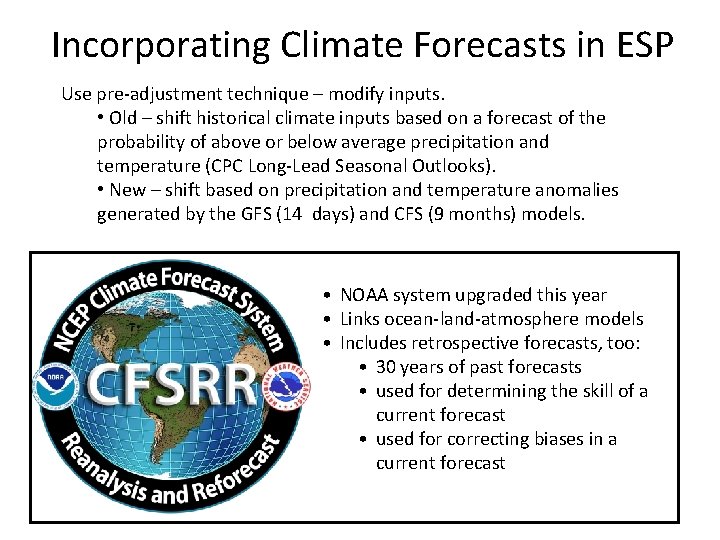
Incorporating Climate Forecasts in ESP Use pre-adjustment technique – modify inputs. • Old – shift historical climate inputs based on a forecast of the probability of above or below average precipitation and temperature (CPC Long-Lead Seasonal Outlooks). • New – shift based on precipitation and temperature anomalies generated by the GFS (14 days) and CFS (9 months) models. • NOAA system upgraded this year • Links ocean-land-atmosphere models • Includes retrospective forecasts, too: • 30 years of past forecasts • used for determining the skill of a current forecast • used for correcting biases in a current forecast
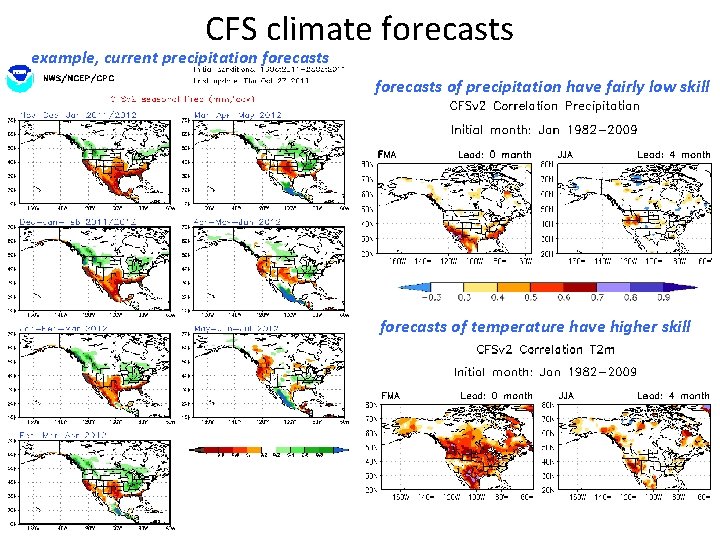
CFS climate forecasts example, current precipitation forecasts of precipitation have fairly low skill forecasts of temperature have higher skill
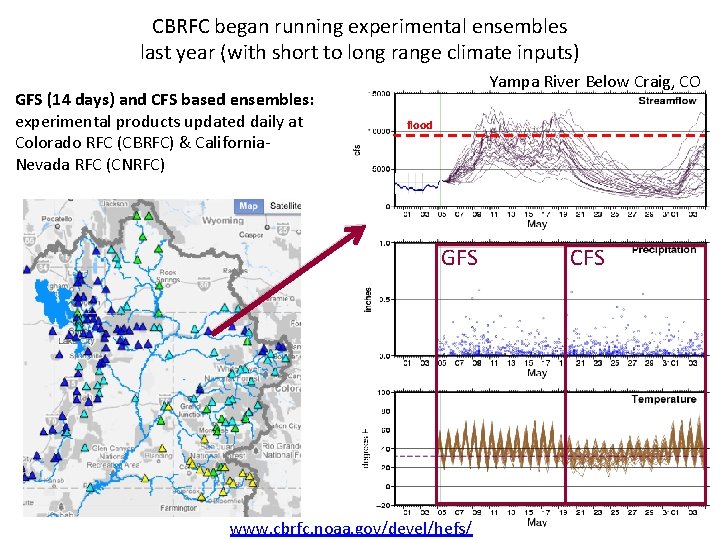
CBRFC began running experimental ensembles last year (with short to long range climate inputs) GFS (14 days) and CFS based ensembles: experimental products updated daily at Colorado RFC (CBRFC) & California. Nevada RFC (CNRFC) Yampa River Below Craig, CO flood GFS www. cbrfc. noaa. gov/devel/hefs/ CFS
Summary • Evaluation of results planned. – Verification of the climate forecasts as well as the resulting streamflow forecasts. – Climate signals not that strong across much of the Colorado River basin. • We will continue to run HEFS this year in an experimental mode. – Available to forecasters as another input to the forecast process.
- Slides: 11