
Hydrograph simulation for a rural watershed using SCS

- Slides: 35
Hydrograph simulation for a rural watershed using SCS curve number and Geographic Information System Dr. S. SURIYA Assistant professor Department of Civil Engineering B. S. Abdur Rahman University Chennai
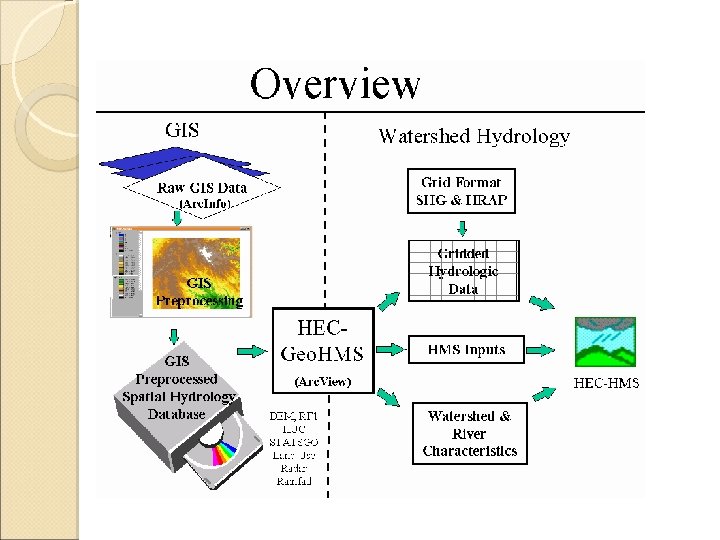
Introduction Floods are the one of the most cataclysmic disaster which impacts on human lives, infrastructure and environment. The threats to floods are influenced by the rate and speed of runoff within the catchment. Implementation of proper flood management system can help to mitigate flood induced hazards. Integration of Remote Sensing (RS), Geographic Information System (GIS) and hydrological models help us to characterize the spatial extent of flooding and associated risks
Problems due to floods Flooding in coastal cities due to urbanization. § Erosion and sedimentation creating degraded areas. § Contamination of surface and ground water sources with effluent. § Sewage, storm water and solid waste discharges in to river. § ◦ Many of these problems may be due to improper approach to the control of storm water by the community and professionals, who give priority to developmental projects with no holistic view of the watershed or social and institutional aspects
RS and GIS RS is a scientific tool adapted for mapping and monitoring the natural resources. A GIS can bring spatial dimensions into the traditional water resource data base, and it has the ability to present an integrated view of the world. In order to solve water related issues, both a spatial representation of the system and an insight into water
Objectives The objectives of the study are ◦ to illustrate the relationship between land use change and runoff response; ◦ to emphasize the linkage of RS and GIS with hydrological models (HEC-HMS) in flood management. ◦ to generate flood inundation hydrograph of the Dasarikuppam watershed using SRTM DEM, SCS curve number and hydrological model HEC- HMS.
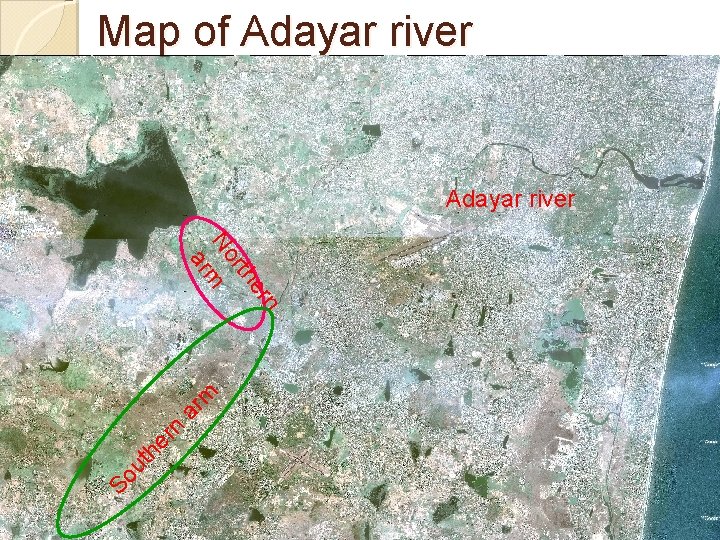
Map of Adayar river er rth No m ar So ut h er n ar m n
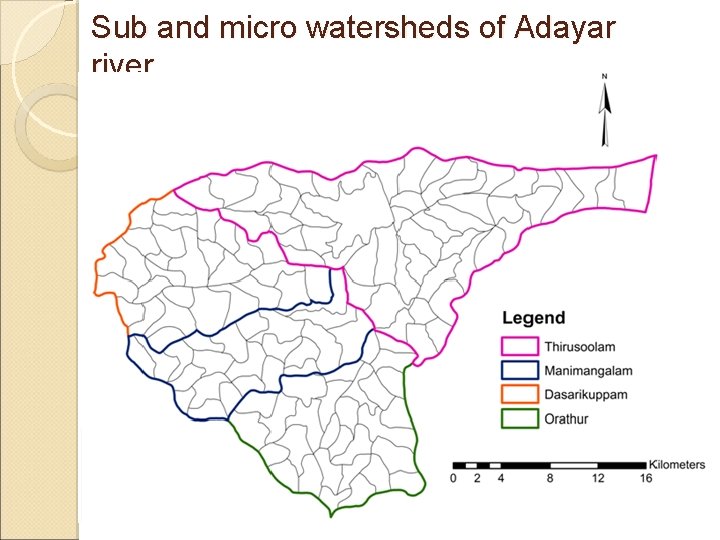
Sub and micro watersheds of Adayar river
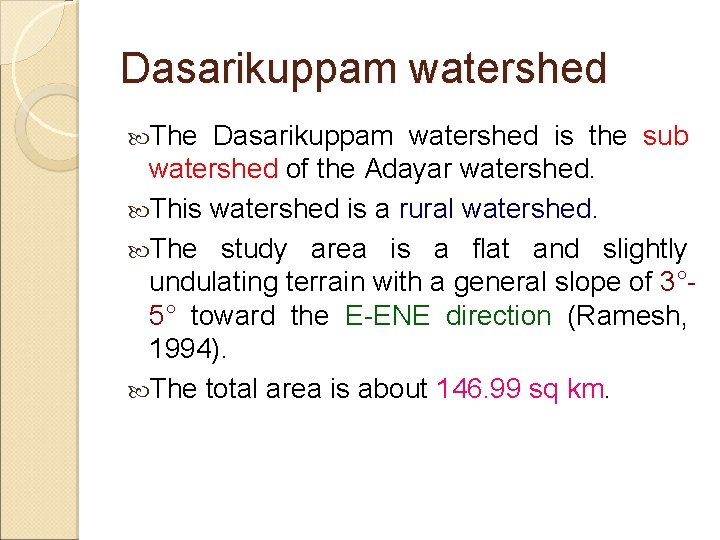
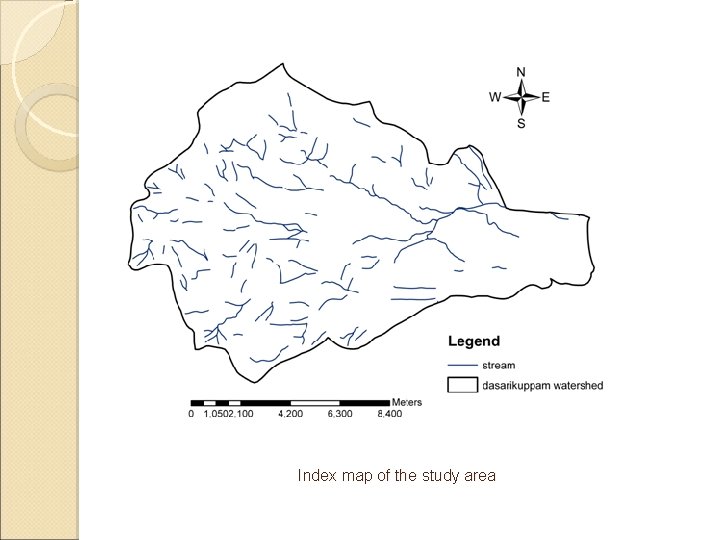
Dasarikuppam watershed The Dasarikuppam watershed is the sub watershed of the Adayar watershed. This watershed is a rural watershed. The study area is a flat and slightly undulating terrain with a general slope of 3° 5° toward the E-ENE direction (Ramesh, 1994). The total area is about 146. 99 sq km.
Index map of the study area
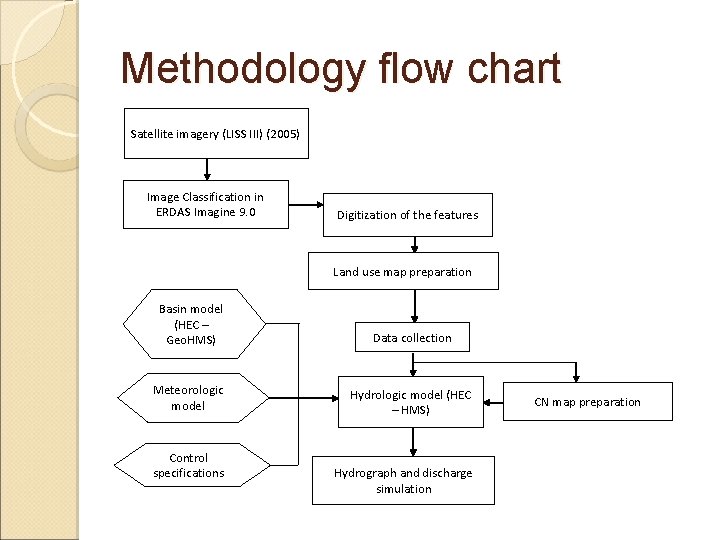
Methodology flow chart Satellite imagery (LISS III) (2005) Image Classification in ERDAS Imagine 9. 0 Digitization of the features Land use map preparation Basin model (HEC – Geo. HMS) Data collection Meteorologic model Hydrologic model (HEC – HMS) Control specifications Hydrograph and discharge simulation CN map preparation
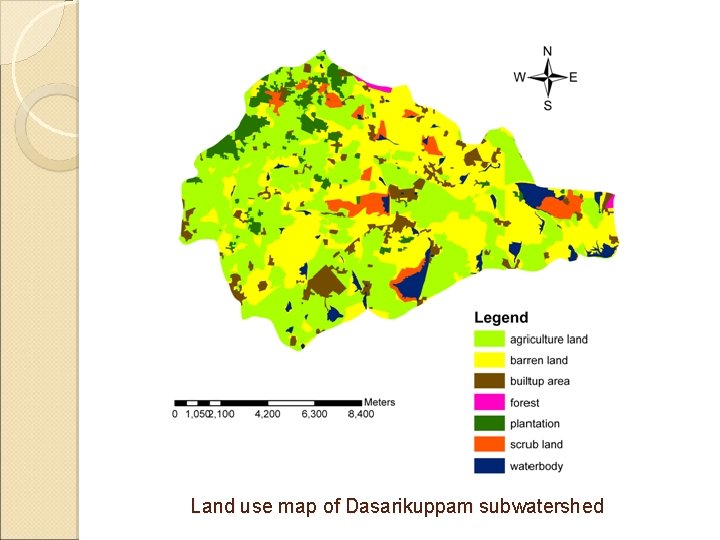
Land use classification LISS III imagery taken in December 8, 2005 was processed and classified using Maximum Likelihood method in ERDAS Imagine 9. 0 and digitized in Arc. Map platform to produce land use map of 2005.
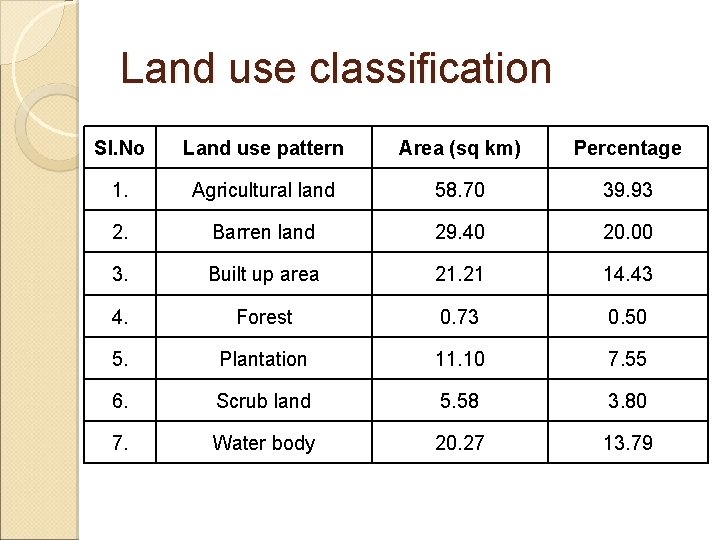
Land use classification Sl. No Land use pattern Area (sq km) Percentage 1. Agricultural land 58. 70 39. 93 2. Barren land 29. 40 20. 00 3. Built up area 21. 21 14. 43 4. Forest 0. 73 0. 50 5. Plantation 11. 10 7. 55 6. Scrub land 5. 58 3. 80 7. Water body 20. 27 13. 79
Land use map of Dasarikuppam subwatershed
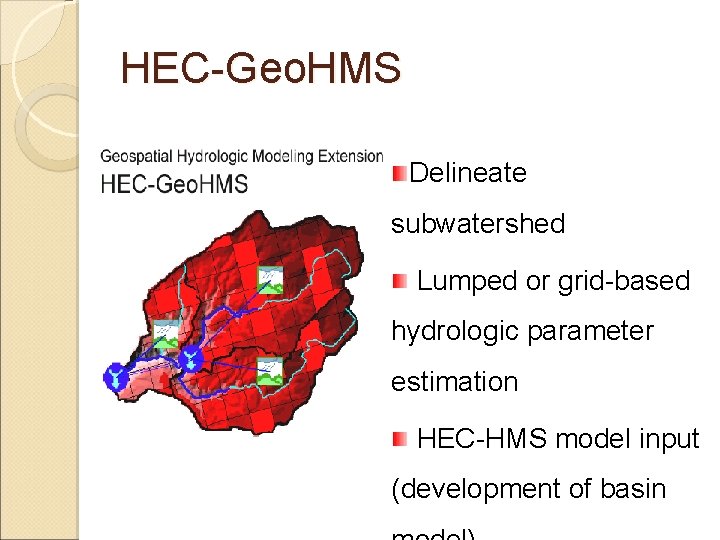
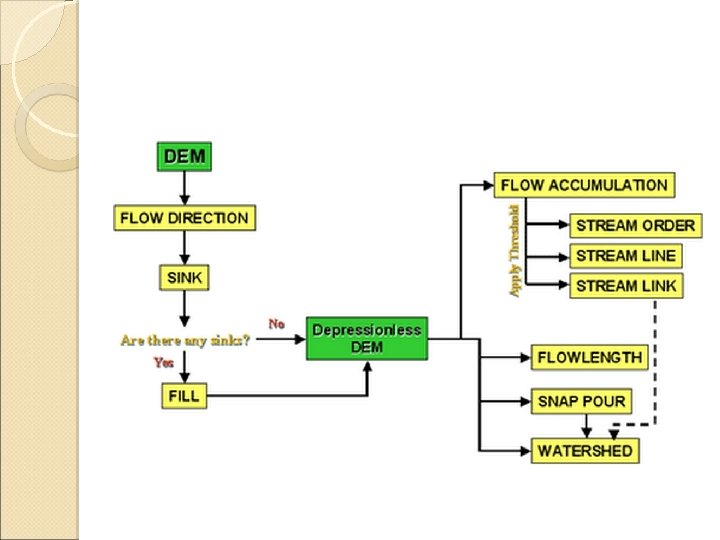
HEC-Geo. HMS Delineate subwatershed Lumped or grid-based hydrologic parameter estimation HEC-HMS model input (development of basin
Arc. View Terrain Preprocessing Basin Processing Basin Characteristics Hydrologic Parameters HMS
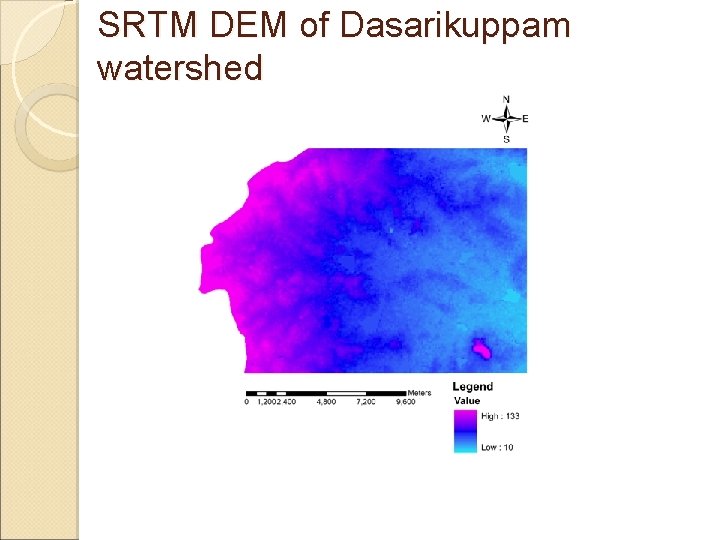
SRTM DEM of Dasarikuppam watershed
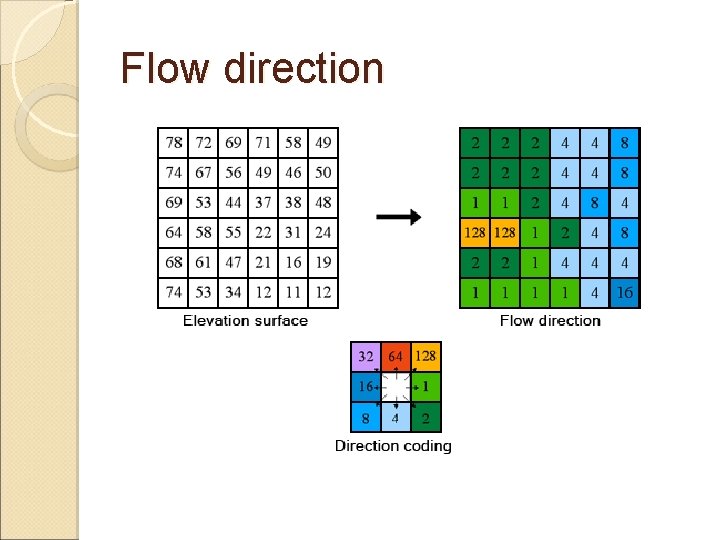
Flow direction
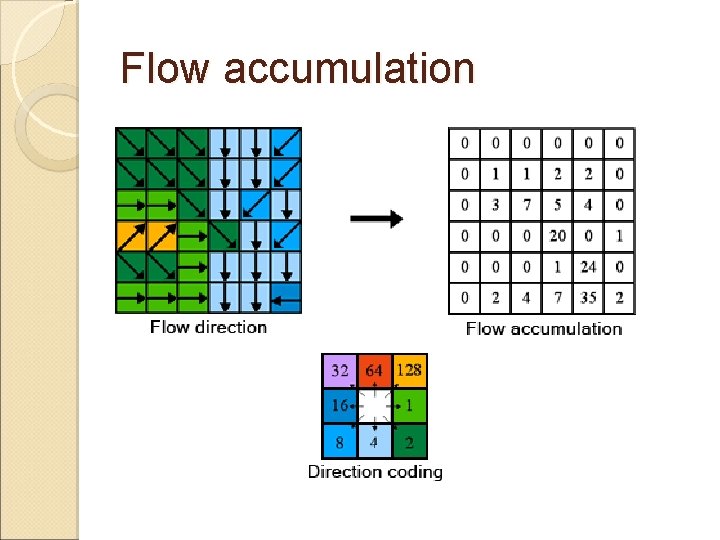
Flow accumulation
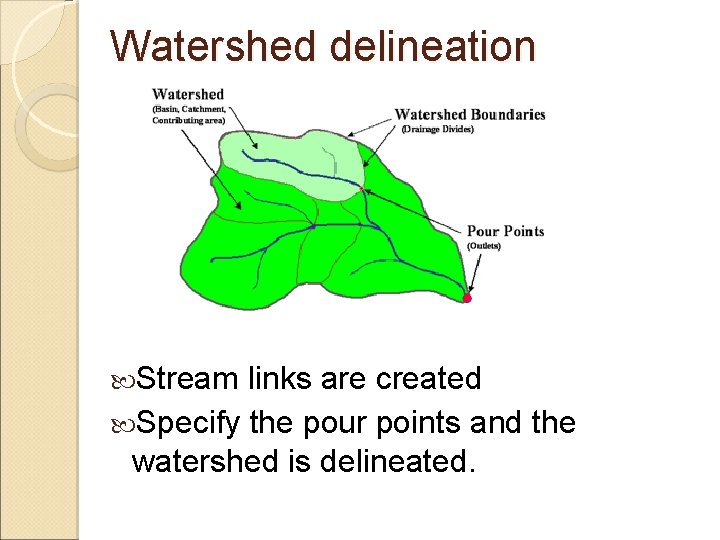
Watershed delineation Stream links are created Specify the pour points and the watershed is delineated.
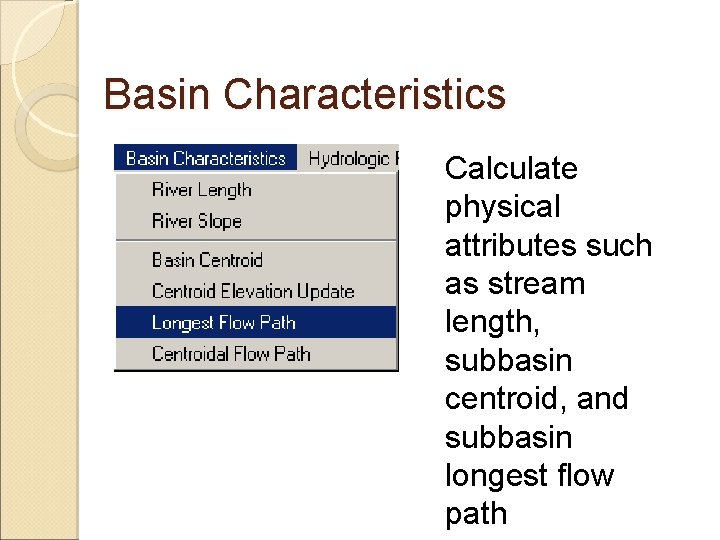
Basin Characteristics Calculate physical attributes such as stream length, subbasin centroid, and subbasin longest flow path
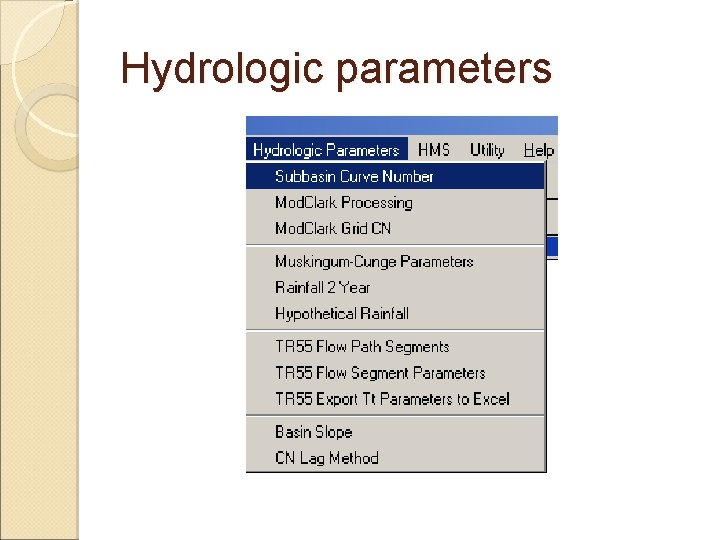
Hydrologic parameters
SCS CN method Jang et al (2007) stated that the Disaster Impact Assessment Manual (2005) suggests the use of synthetic hydrograph techniques such as the Soil Conservation Service (SCS) method for ungauged areas, while the Storm Water Management Model (SWMM) is useful for an area which is gauged. The SCS method was chosen for analysis as: (i) it is commonly used in different environments and provides good results; (ii) its calculation is made easier by the fact that only a few variables need to be estimated (hydrologic soil group, land use and slope); and (iii) despite its simplicity, it yields results that are as good as those of complex models (Lastra et al 2008).
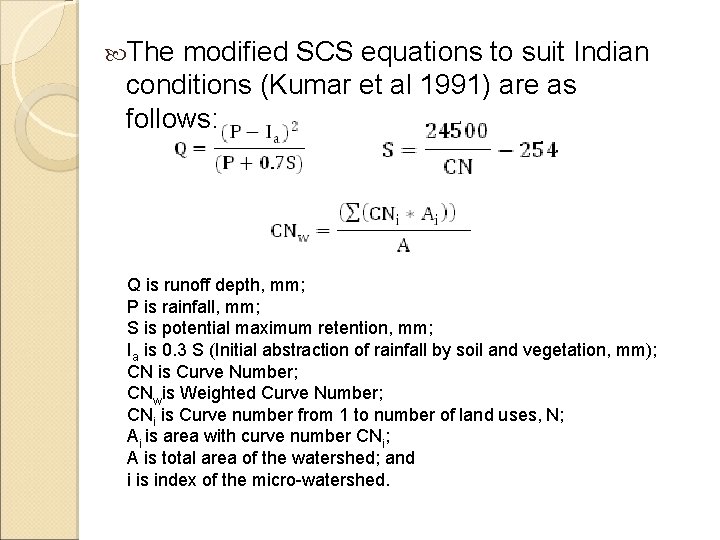
The modified SCS equations to suit Indian conditions (Kumar et al 1991) are as follows: Q is runoff depth, mm; P is rainfall, mm; S is potential maximum retention, mm; Ia is 0. 3 S (Initial abstraction of rainfall by soil and vegetation, mm); CN is Curve Number; CNwis Weighted Curve Number; CNi is Curve number from 1 to number of land uses, N; Ai is area with curve number CNi; A is total area of the watershed; and i is index of the micro-watershed.
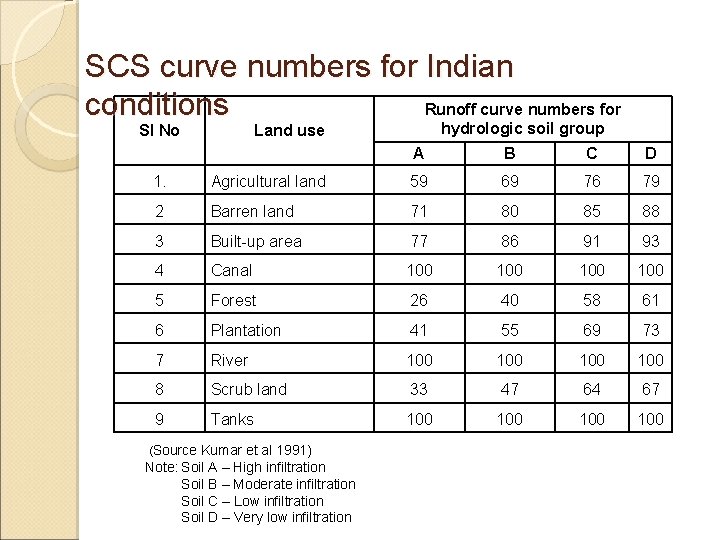
SCS curve numbers for Indian conditions Runoff curve numbers for Sl No hydrologic soil group Land use A B C D 1. Agricultural land 59 69 76 79 2 Barren land 71 80 85 88 3 Built-up area 77 86 91 93 4 Canal 100 100 5 Forest 26 40 58 61 6 Plantation 41 55 69 73 7 River 100 100 8 Scrub land 33 47 64 67 9 Tanks 100 100 (Source Kumar et al 1991) Note: Soil A – High infiltration Soil B – Moderate infiltration Soil C – Low infiltration Soil D – Very low infiltration
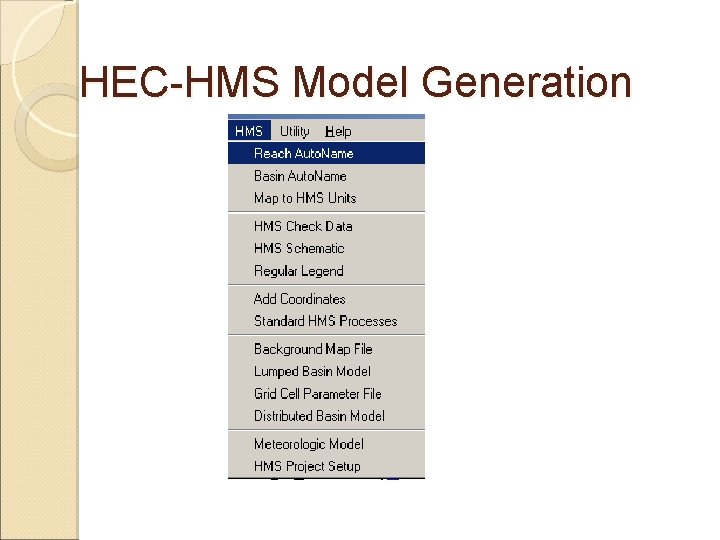
HEC-HMS Model Generation
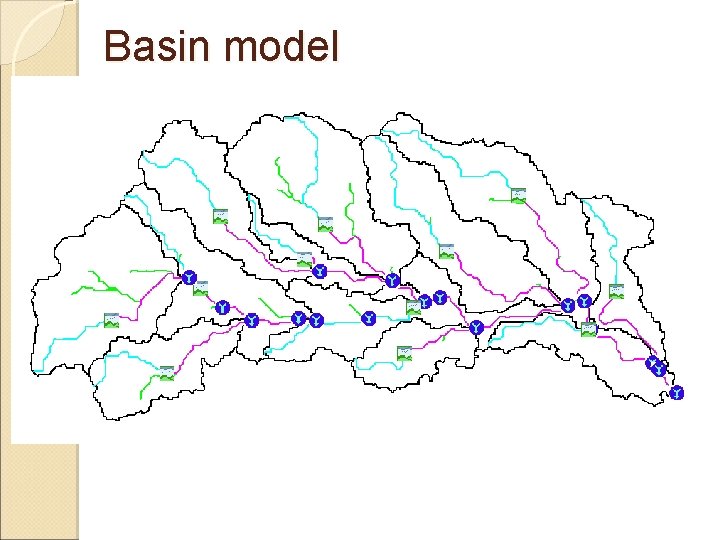
Basin model
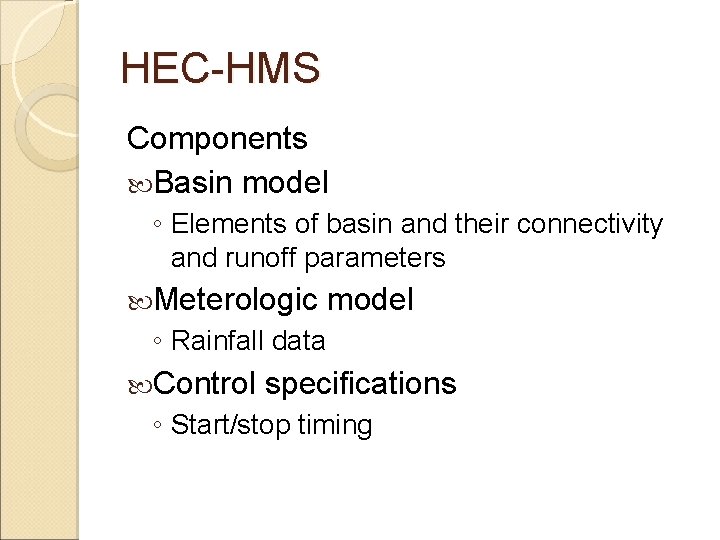
HEC-HMS Components Basin model ◦ Elements of basin and their connectivity and runoff parameters Meterologic model ◦ Rainfall data Control specifications ◦ Start/stop timing
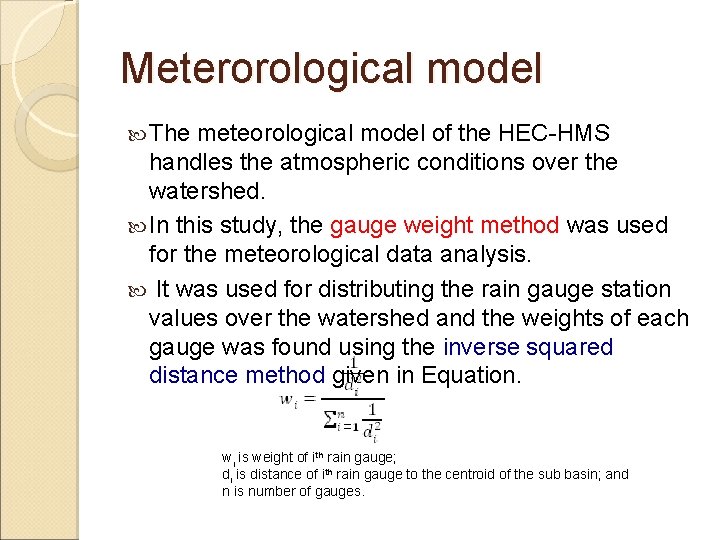
Meterorological model The meteorological model of the HEC-HMS handles the atmospheric conditions over the watershed. In this study, the gauge weight method was used for the meteorological data analysis. It was used for distributing the rain gauge station values over the watershed and the weights of each gauge was found using the inverse squared distance method given in Equation. wi is weight of ith rain gauge; di is distance of ith rain gauge to the centroid of the sub basin; and n is number of gauges.
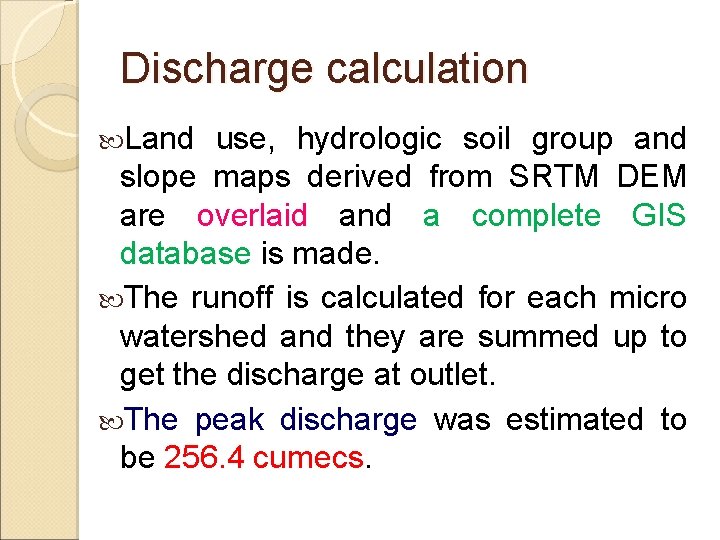
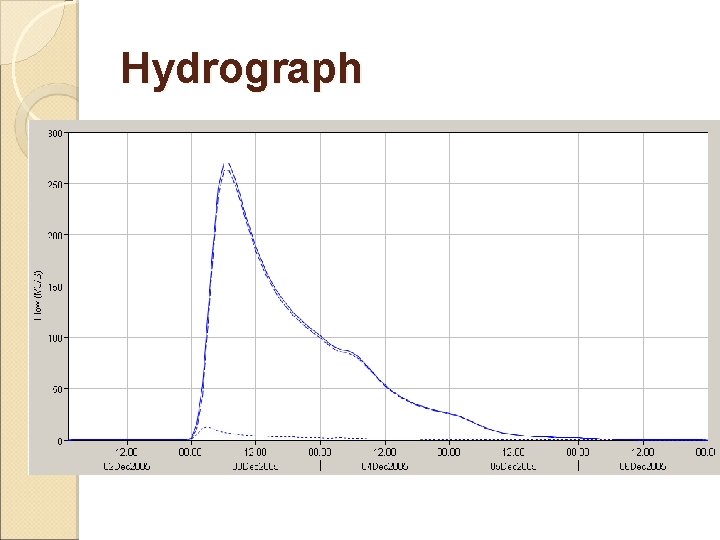
Discharge calculation Land use, hydrologic soil group and slope maps derived from SRTM DEM are overlaid and a complete GIS database is made. The runoff is calculated for each micro watershed and they are summed up to get the discharge at outlet. The peak discharge was estimated to be 256. 4 cumecs.
Hydrograph
Conclusion The Geographic Information System adds a great deal of versatility to the hydrological analysis, due to its spatial data handling and management capabilities. With limited data available, the runoff can be quantified. It is evident from the study that the main role of HEC – Geo. HMS is to devise a watershed data structure under the platform of GIS and that can be imported directly to HEC – HMS. The study clearly demonstrated the integration of remote sensing, GIS and hydrological model HEC – HMS provides a powerful assessment of peak discharge calculations. The starting point is comprehensive spatial planning, while sectoral and institutional aspects must be
Bibliography Disaster Impact Assessment Manual, National Emergency Management Agency (NEMA), Seoul, Korea, 2005. Ramesh R. (1994), ‘Research project on impacts of urban pollution on Adyar river and the adjacent groundwaters of Chennai city’, Unpublished project report submitted to Institute for Water Studies, Taramani, Chennai. Jang, S. , Cho M. , Yoon, J. , Kim, S. , Kim, G. , Kim, L. and Aksoy, H. “Using SWMM as a tool for hydrologic impact assessment”, Desalination, pp. 344 – 356, 2007. Kumar, P. , Tiwari, K. N. and Pal, D. K. “Establishing SCS runoff curve number from IRS digital data base”, Journal of the Indian Society of Remote Sensing, Vol. 19, No. 4, pp. 245 – 251, 1991. Lastra J. , Fernandez E. , Diez-herrero A. , Marquinez J. (2008), ‘Flood hazard delineation combining geomorphological and hydrological methods: an example in the Northern Iberian Peninsula’, Nat Hazards 45: pp. 277 – 293. Lu J. (1990), ‘The efficient use of remote sensing in hydrology model’, Hydrology 6, pp. 9 – 14. Schumann G. , Matgen P. , Cutler M. E. J. , Black A. , Hoffmann L. , Pfister L. (2008), ‘Comparison of remotely sensed water stages from Li. DAR,
THANK YOU