
Hydrogen storage materials and their development Xingguo Li

- Slides: 35
Hydrogen storage materials and their development Xingguo Li Inorganic institute, College of Chem. & Molecular Eng. Depart. Adv. Mater. And Nanotech. , College of Eng. Peking University, China The CODATA 2006 Conference , Beijing, Oct. 23 -25
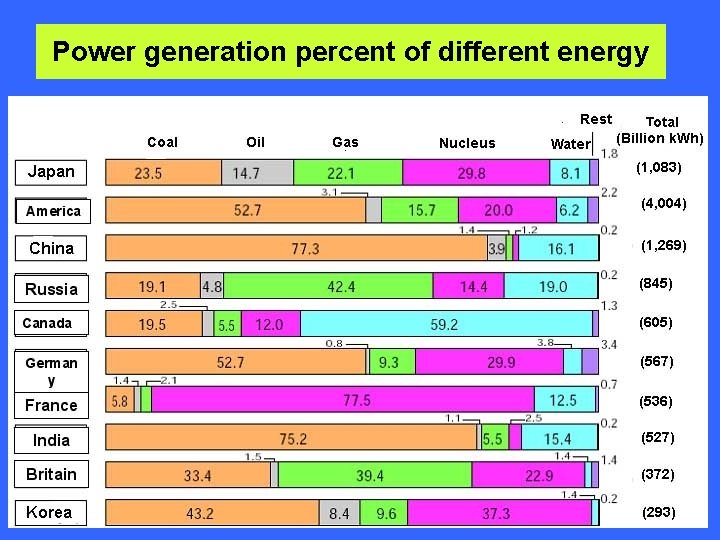
Power generation percent of different energy
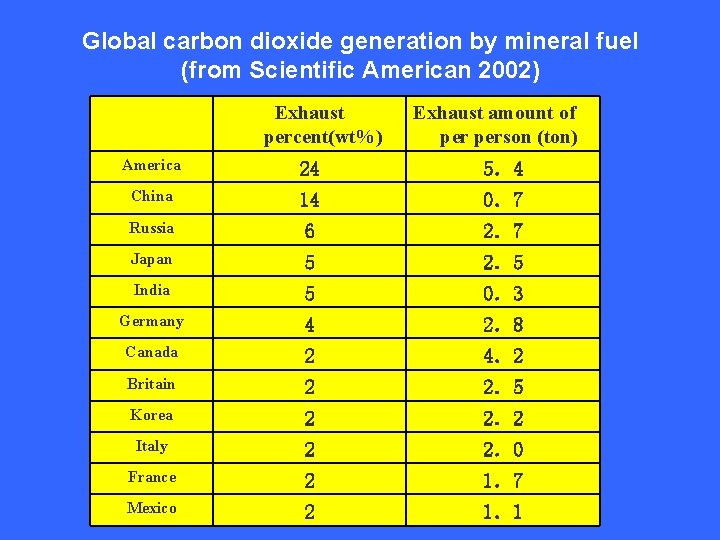
Global carbon dioxide generation by mineral fuel (from Scientific American 2002) Exhaust percent(wt%) Exhaust amount of person (ton) America 24 5.4 China 14 0.7 Russia 6 2.7 Japan 5 2.5 India 5 0.3 Germany 4 2.8 Canada 2 4.2 Britain 2 2.5 Korea 2 2.2 Italy 2 2.0 France 2 1.7 Mexico 2 1.1
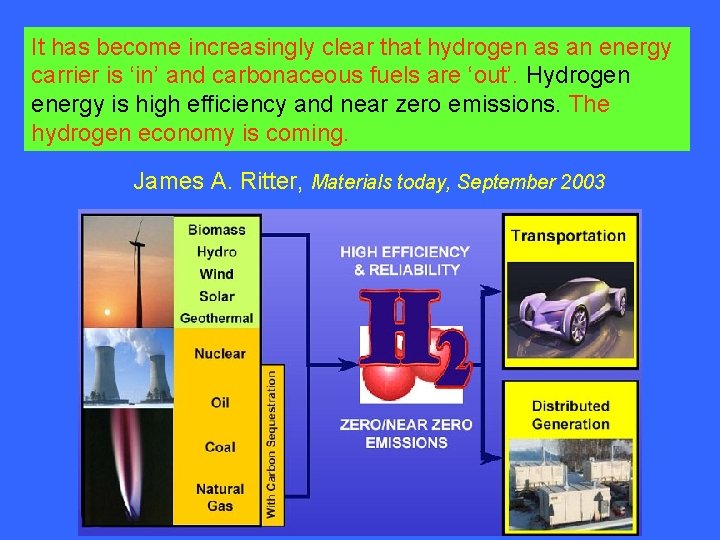
It has become increasingly clear that hydrogen as an energy carrier is ‘in’ and carbonaceous fuels are ‘out’. Hydrogen energy is high efficiency and near zero emissions. The hydrogen economy is coming. James A. Ritter, Materials today, September 2003
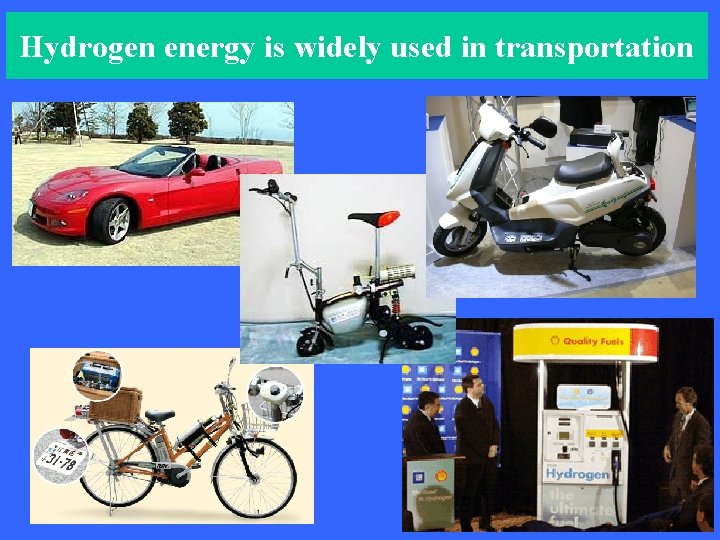
Hydrogen energy is widely used in transportation
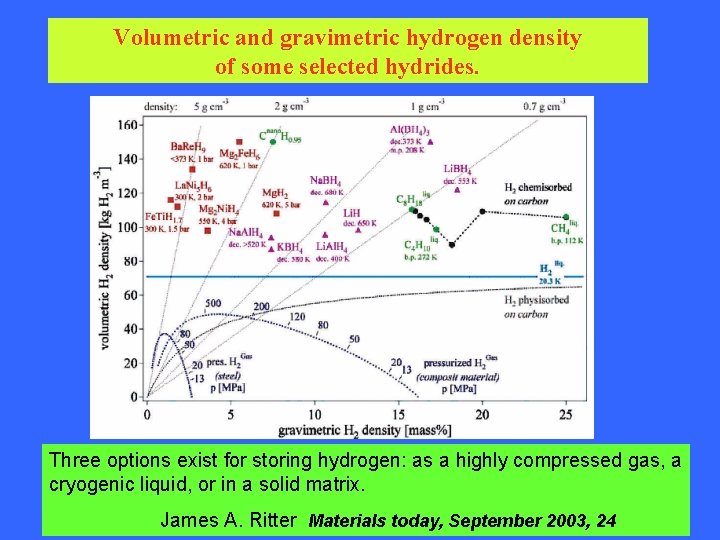
Volumetric and gravimetric hydrogen density of some selected hydrides. Three options exist for storing hydrogen: as a highly compressed gas, a cryogenic liquid, or in a solid matrix. James A. Ritter Materials today, September 2003, 24
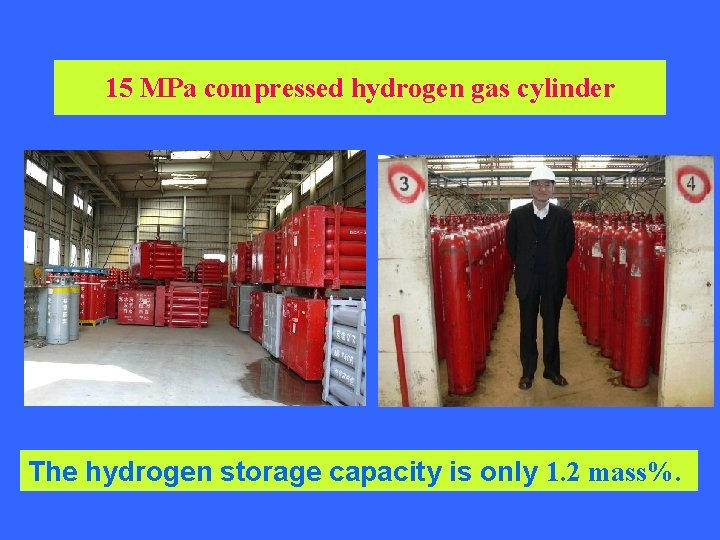
15 MPa compressed hydrogen gas cylinder The hydrogen storage capacity is only 1. 2 mass%.
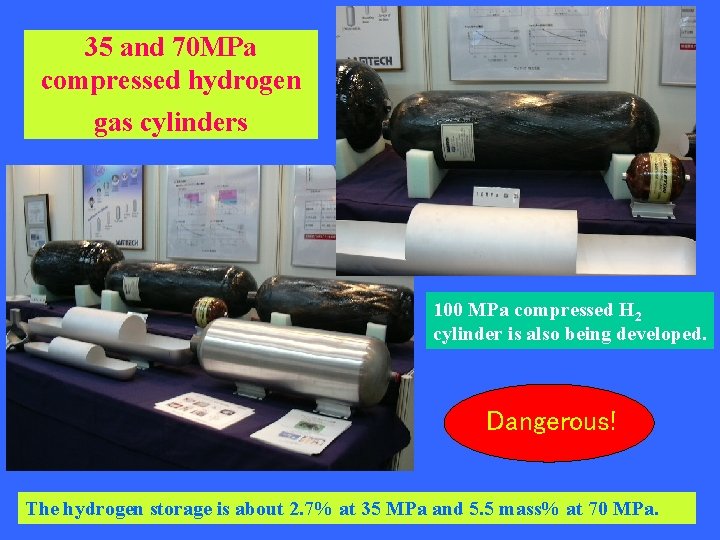
35 and 70 MPa compressed hydrogen gas cylinders 100 MPa compressed H 2 cylinder is also being developed. Dangerous! The hydrogen storage is about 2. 7% at 35 MPa and 5. 5 mass% at 70 MPa.
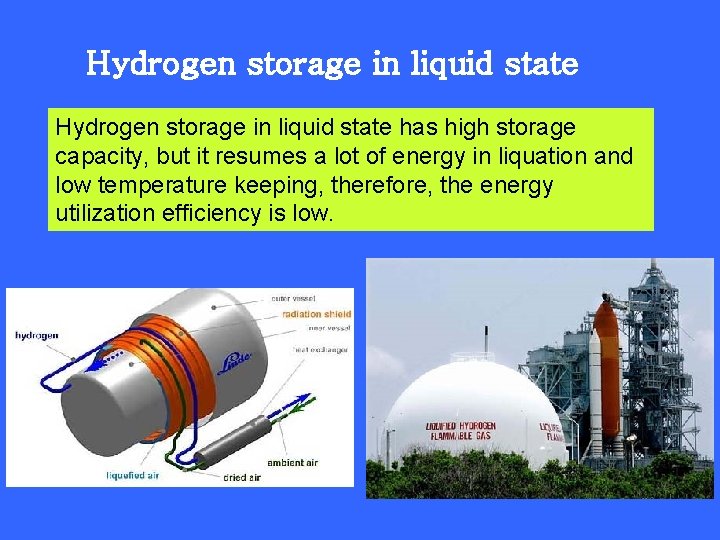
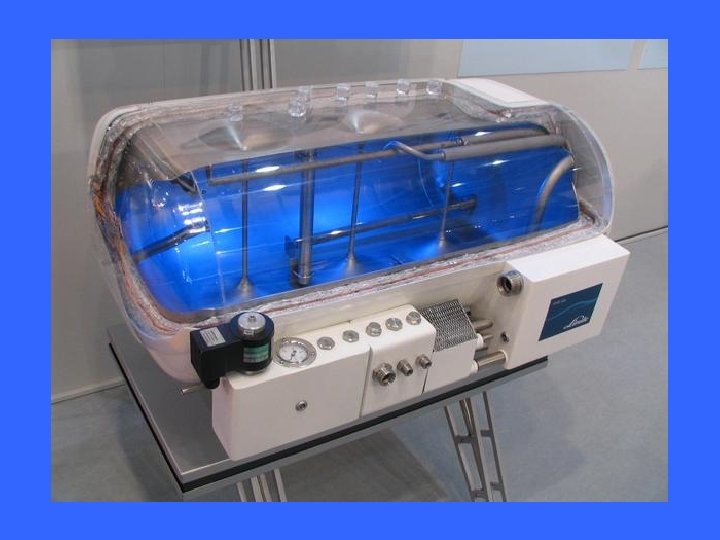
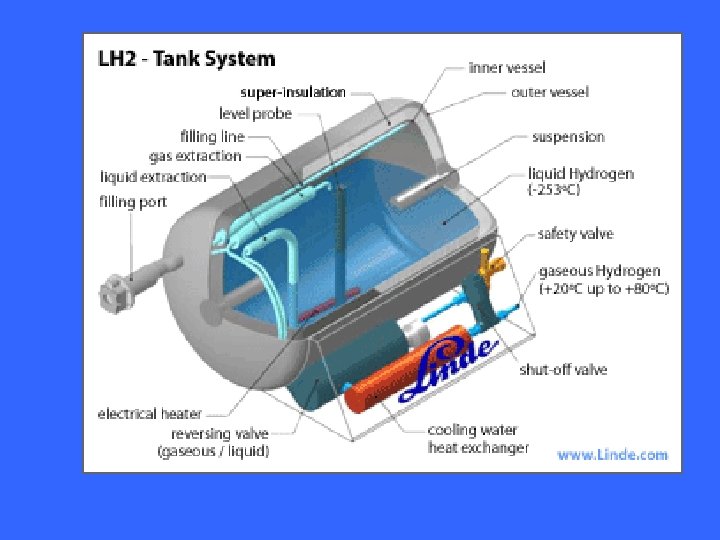
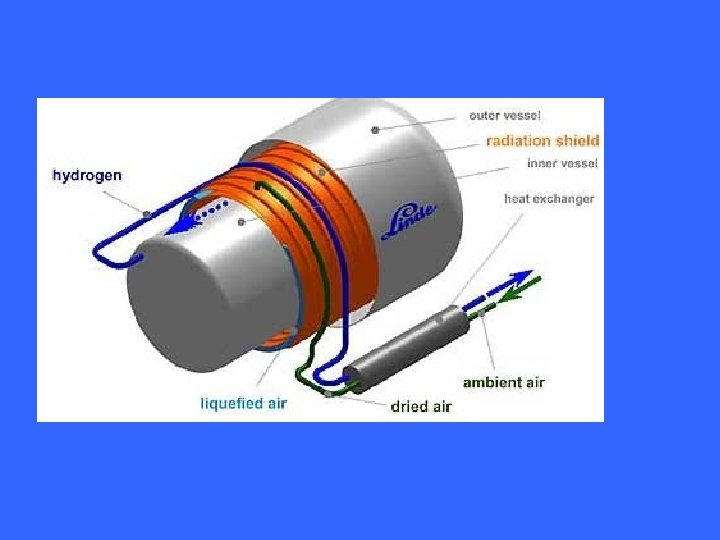
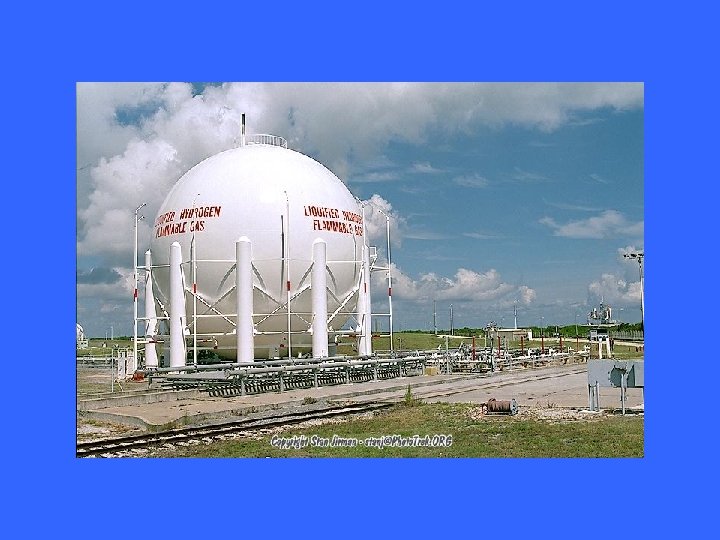
Hydrogen storage in liquid state has high storage capacity, but it resumes a lot of energy in liquation and low temperature keeping, therefore, the energy utilization efficiency is low.
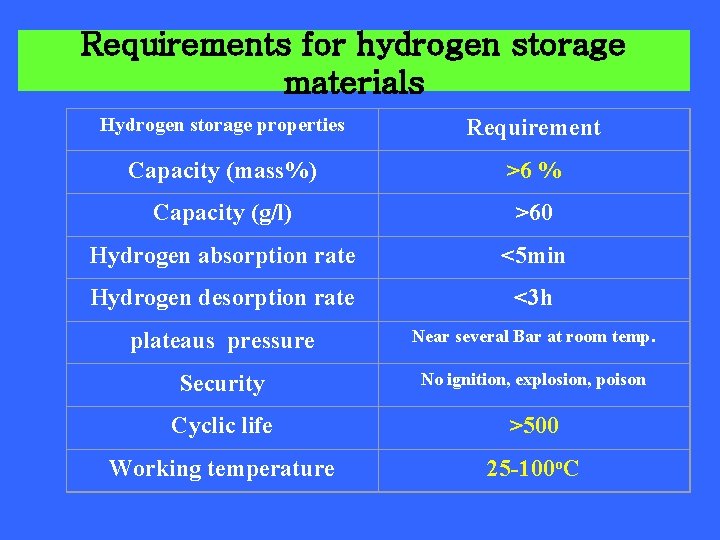
Requirements for hydrogen storage materials Hydrogen storage properties Requirement Capacity (mass%) >6 % Capacity (g/l) >60 Hydrogen absorption rate <5 min Hydrogen desorption rate <3 h plateaus pressure Near several Bar at room temp. Security No ignition, explosion, poison Cyclic life >500 Working temperature 25 -100 o. C
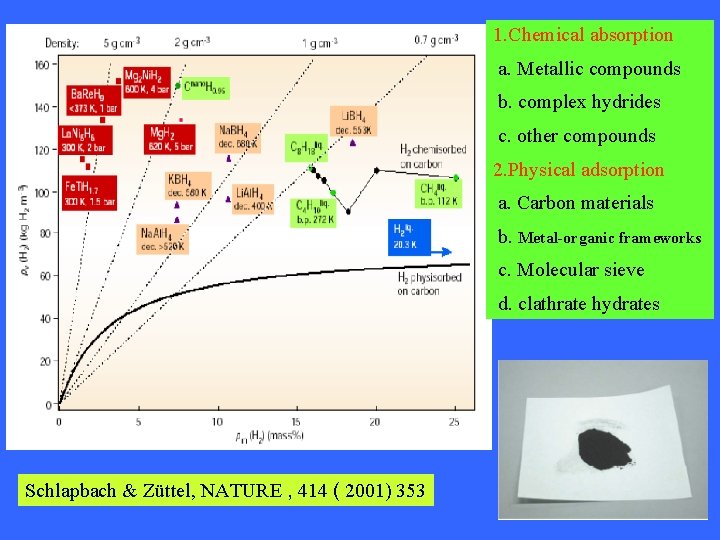
1. Chemical absorption a. Metallic compounds b. complex hydrides c. other compounds 2. Physical adsorption a. Carbon materials b. Metal-organic frameworks c. Molecular sieve d. clathrate hydrates Schlapbach & Züttel, NATURE , 414 ( 2001) 353
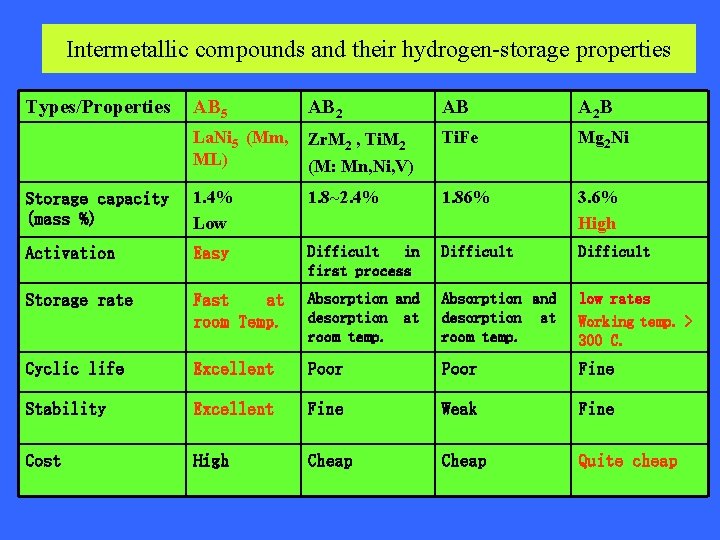
Intermetallic compounds and their hydrogen-storage properties Types/Properties AB 5 AB 2 AB A 2 B La. Ni 5 (Mm, ML) Zr. M 2 , Ti. M 2 (M: Mn, Ni, V) Ti. Fe Mg 2 Ni Storage capacity (mass %) 1. 4% Low 1. 8~2. 4% 1. 86% 3. 6% High Activation Easy Difficult in first process Difficult Storage rate Fast at room Temp. Absorption and desorption at room temp. low rates Working temp. > 300 C. Cyclic life Excellent Poor Fine Stability Excellent Fine Weak Fine Cost High Cheap Quite cheap
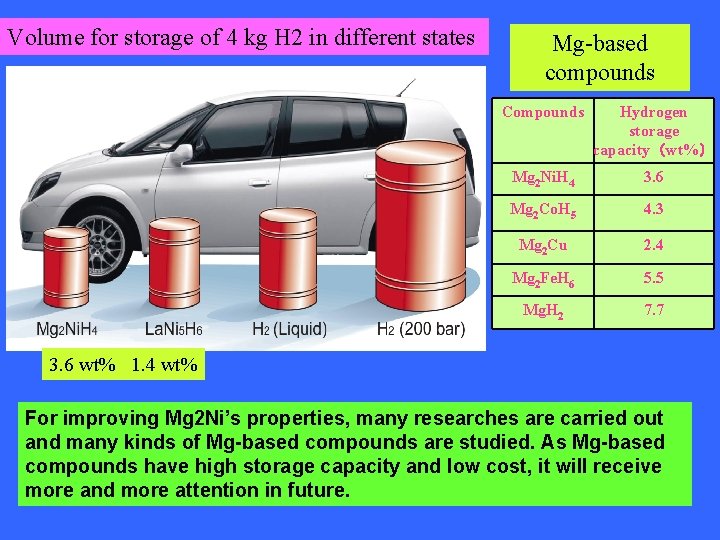
Volume for storage of 4 kg H 2 in different states Mg-based compounds Compounds Hydrogen storage capacity(wt%) Mg 2 Ni. H 4 3. 6 Mg 2 Co. H 5 4. 3 Mg 2 Cu 2. 4 Mg 2 Fe. H 6 5. 5 Mg. H 2 7. 7 3. 6 wt% 1. 4 wt% For improving Mg 2 Ni’s properties, many researches are carried out and many kinds of Mg-based compounds are studied. As Mg-based compounds have high storage capacity and low cost, it will receive more and more attention in future.
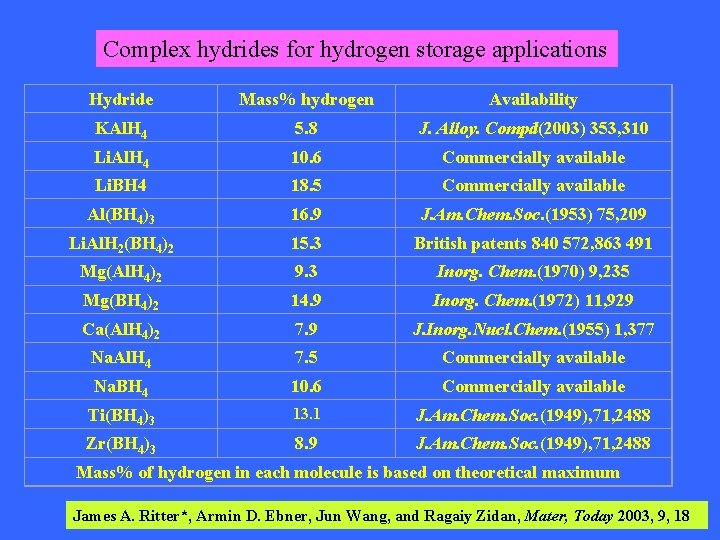
Complex hydrides for hydrogen storage applications Hydride Mass% hydrogen Availability KAl. H 4 5. 8 J. Alloy. Compd(2003) 353, 310 Li. Al. H 4 10. 6 Commercially available Li. BH 4 18. 5 Commercially available Al(BH 4)3 16. 9 J. Am. Chem. Soc. (1953) 75, 209 Li. Al. H 2(BH 4)2 15. 3 British patents 840 572, 863 491 Mg(Al. H 4)2 9. 3 Inorg. Chem. (1970) 9, 235 Mg(BH 4)2 14. 9 Inorg. Chem. (1972) 11, 929 Ca(Al. H 4)2 7. 9 J. Inorg. Nucl. Chem. (1955) 1, 377 Na. Al. H 4 7. 5 Commercially available Na. BH 4 10. 6 Commercially available Ti(BH 4)3 13. 1 J. Am. Chem. Soc. (1949), 71, 2488 Zr(BH 4)3 8. 9 J. Am. Chem. Soc. (1949), 71, 2488 Mass% of hydrogen in each molecule is based on theoretical maximum James A. Ritter*, Armin D. Ebner, Jun Wang, and Ragaiy Zidan, Mater, Today 2003, 9, 18
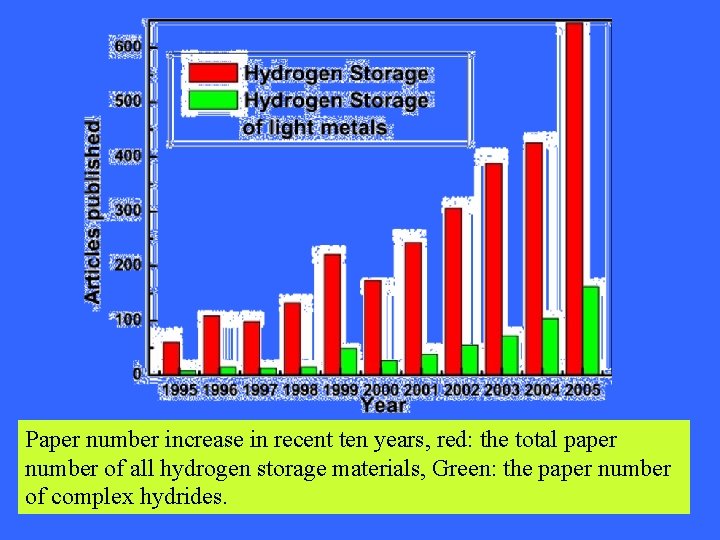
Paper number increase in recent ten years, red: the total paper number of all hydrogen storage materials, Green: the paper number of complex hydrides.
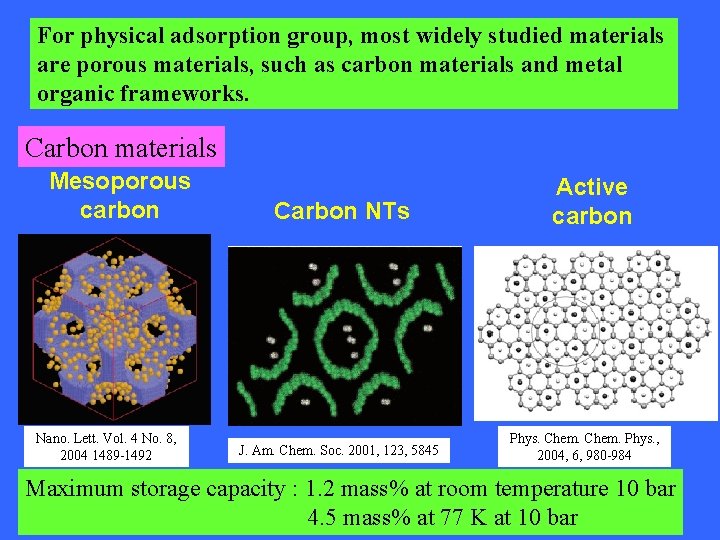
For physical adsorption group, most widely studied materials are porous materials, such as carbon materials and metal organic frameworks. Carbon materials Mesoporous carbon Nano. Lett. Vol. 4 No. 8, 2004 1489 -1492 Carbon NTs J. Am. Chem. Soc. 2001, 123, 5845 Active carbon Phys. Chem. Phys. , 2004, 6, 980 -984 Maximum storage capacity : 1. 2 mass% at room temperature 10 bar 4. 5 mass% at 77 K at 10 bar
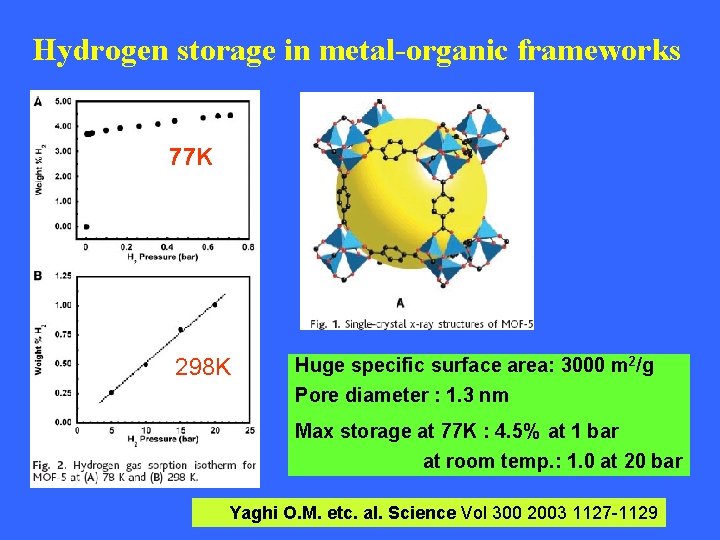
Hydrogen storage in metal-organic frameworks 77 K 298 K Huge specific surface area: 3000 m 2/g Pore diameter : 1. 3 nm Max storage at 77 K : 4. 5% at 1 bar at room temp. : 1. 0 at 20 bar Yaghi O. M. etc. al. Science Vol 300 2003 1127 -1129
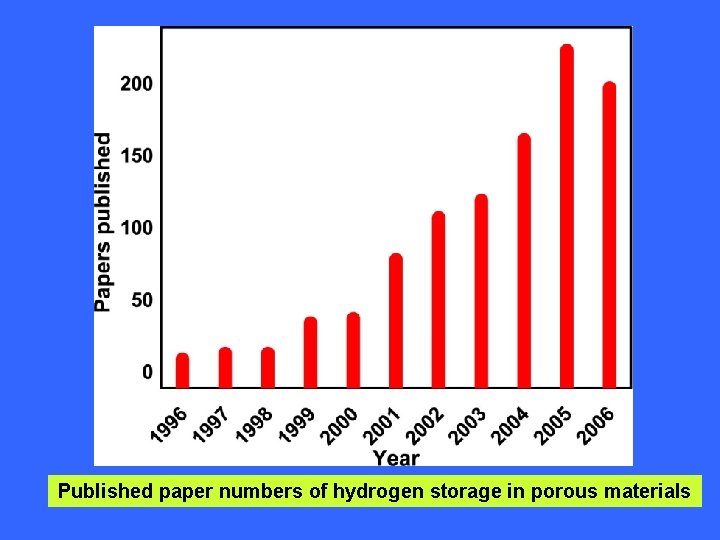
Published paper numbers of hydrogen storage in porous materials
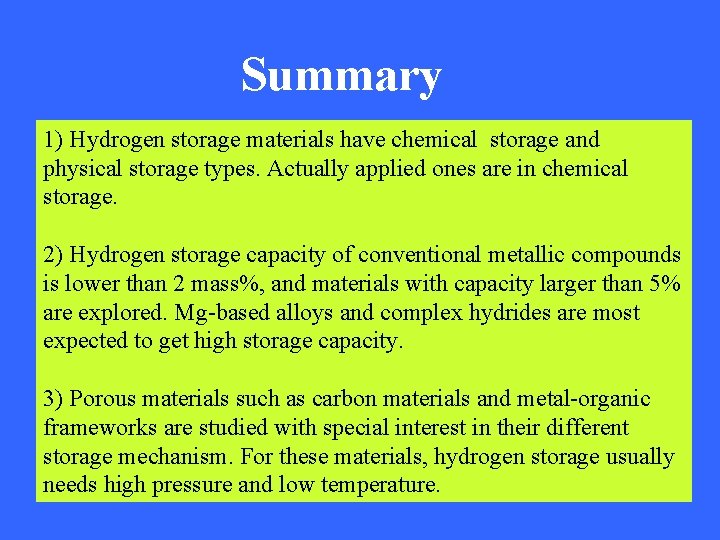
Summary 1) Hydrogen storage materials have chemical storage and physical storage types. Actually applied ones are in chemical storage. 2) Hydrogen storage capacity of conventional metallic compounds is lower than 2 mass%, and materials with capacity larger than 5% are explored. Mg-based alloys and complex hydrides are most expected to get high storage capacity. 3) Porous materials such as carbon materials and metal-organic frameworks are studied with special interest in their different storage mechanism. For these materials, hydrogen storage usually needs high pressure and low temperature.
Thank you very much for your kind attention !
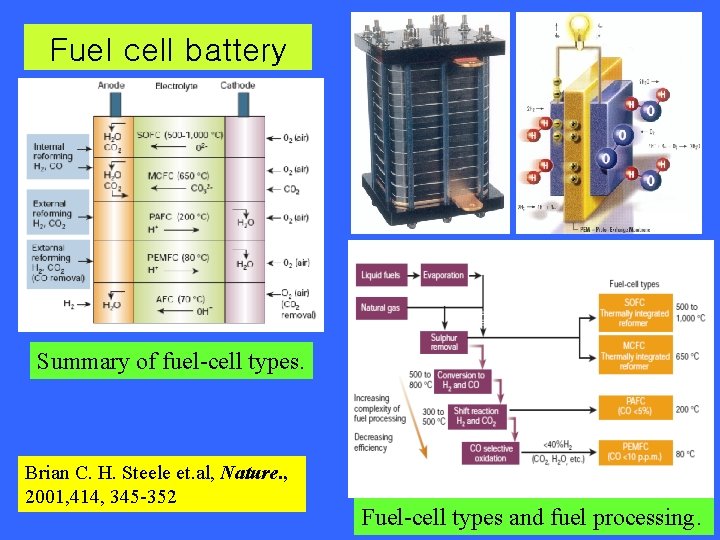
Fuel cell battery Summary of fuel-cell types. Brian C. H. Steele et. al, Nature. , 2001, 414, 345 -352 Fuel-cell types and fuel processing.
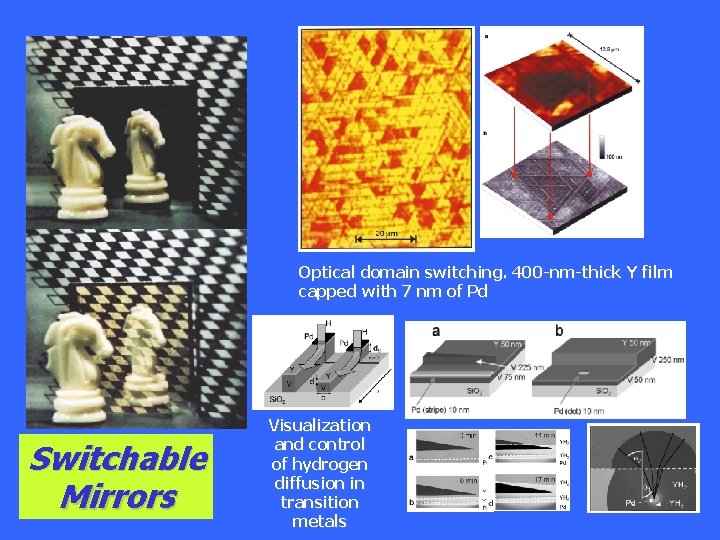
Optical domain switching. 400 -nm-thick Y film capped with 7 nm of Pd Switchable Mirrors Visualization and control of hydrogen diffusion in transition metals
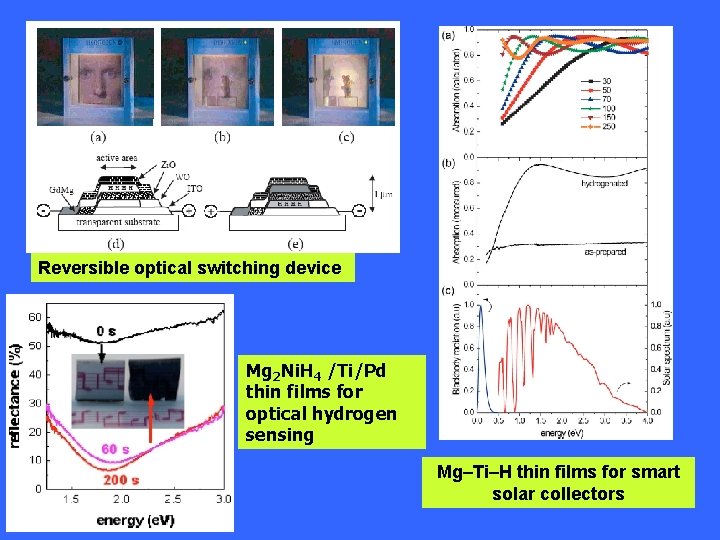
Reversible optical switching device Mg 2 Ni. H 4 /Ti/Pd thin films for optical hydrogen sensing Mg–Ti–H thin films for smart solar collectors
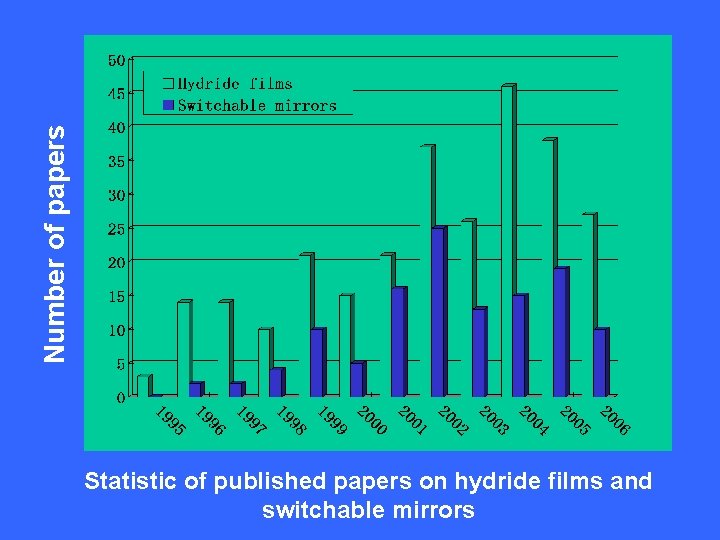
Number of papers Statistic of published papers on hydride films and switchable mirrors
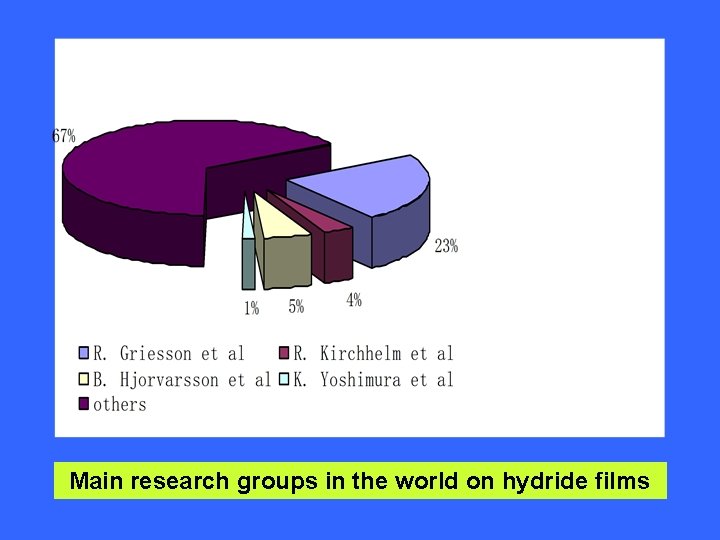
Main research groups in the world on hydride films
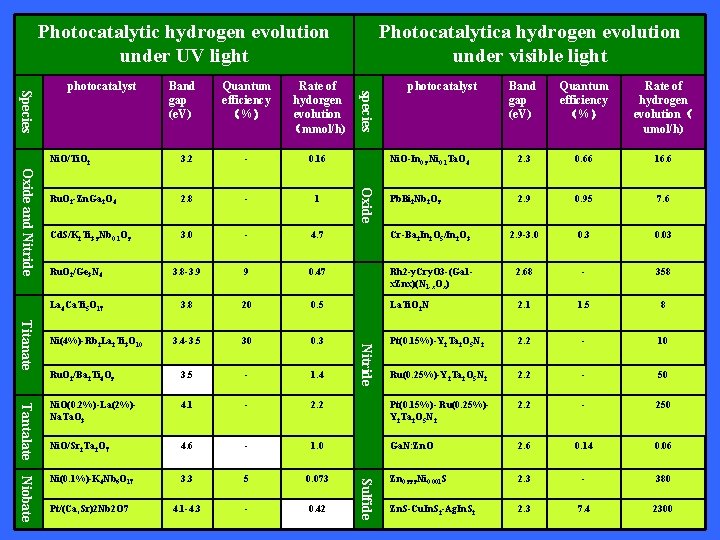
Photocatalytic hydrogen evolution under UV light Band gap (e. V) Quantum efficiency (%) Rate of hydorgen evolution (mmol/h) species Species photocatalyst Photocatalytica hydrogen evolution under visible light photocatalyst Rate of hydrogen evolution( umol/h) Ni. O-In 0. 9 Ni 0. 1 Ta. O 4 2. 3 0. 66 16. 6 Pb. Bi 2 Nb 2 O 9 2. 9 0. 95 7. 6 - 0. 16 Ru. O 2 -Zn. Ga 2 O 4 2. 8 - 1 Cd. S/K 2 Ti 3. 9 Nb 0. 1 O 9 3. 0 - 4. 7 Cr-Ba 2 In 2 O 5/In 2 O 3 2. 9 -3. 0 0. 3 0. 03 Ru. O 2/Ge 3 N 4 3. 8 -3. 9 9 0. 47 Rh 2 -y. Cry. O 3 -(Ga 1 x. Znx)(N 1 -x. Ox) 2. 68 - 358 La 4 Ca. Ti 5 O 17 3. 8 20 0. 5 La. Ti. O 2 N 2. 1 1. 5 8 3. 4 -3. 5 30 0. 3 Pt(0. 15%)-Y 2 Ta 2 O 5 N 2 2. 2 - 10 Ru. O 2/Ba 2 Ti 4 O 9 3. 5 - 1. 4 Ru(0. 25%)-Y 2 Ta 2 O 5 N 2 2. 2 - 50 Ni. O(0. 2%)-La(2%)Na. Ta. O 3 4. 1 - 2. 2 Pt(0. 15%)- Ru(0. 25%)Y 2 Ta 2 O 5 N 2 2. 2 - 250 Ni. O/Sr 2 Ta 2 O 7 4. 6 - 1. 0 Ga. N: Zn. O 2. 6 0. 14 0. 06 Ni(0. 1%)-K 4 Nb 6 O 17 3. 3 5 0. 073 Zn 0. 999 Ni 0. 001 S 2. 3 - 380 Pt/(Ca, Sr)2 Nb 2 O 7 4. 1 -4. 3 - 0. 42 Zn. S-Cu. In. S 2 -Ag. In. S 2 2. 3 7. 4 2300 Nitride Titanate Ni(4%)-Rb 2 La 2 Ti 3 O 10 Oxide 3. 2 Oxide and Nitride Ni. O/Ti. O 2 Niobate Quantum efficiency (%) Tantalate Band gap (e. V) Sulfide
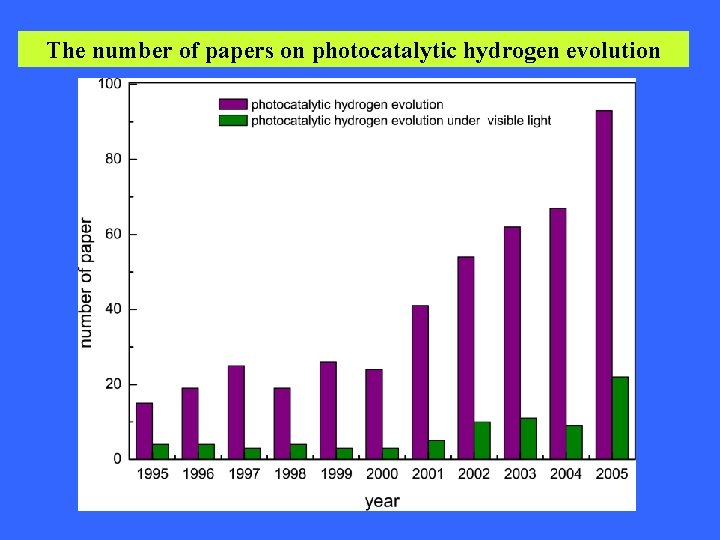
The number of papers on photocatalytic hydrogen evolution
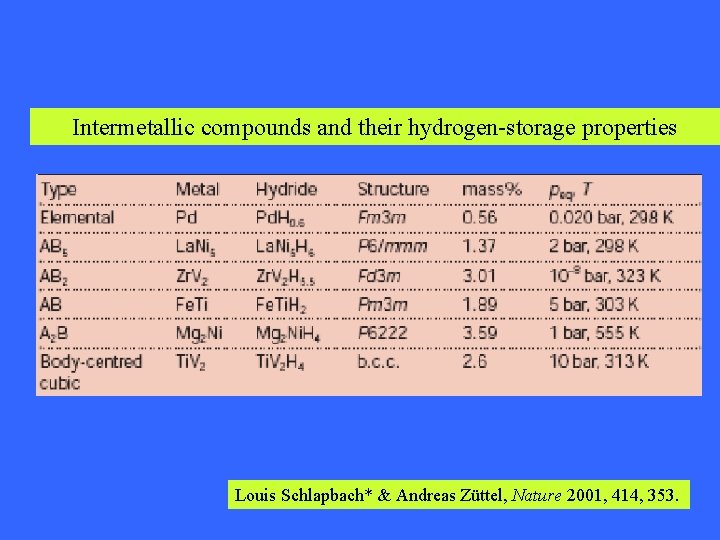
Intermetallic compounds and their hydrogen-storage properties Louis Schlapbach* & Andreas Züttel, Nature 2001, 414, 353.
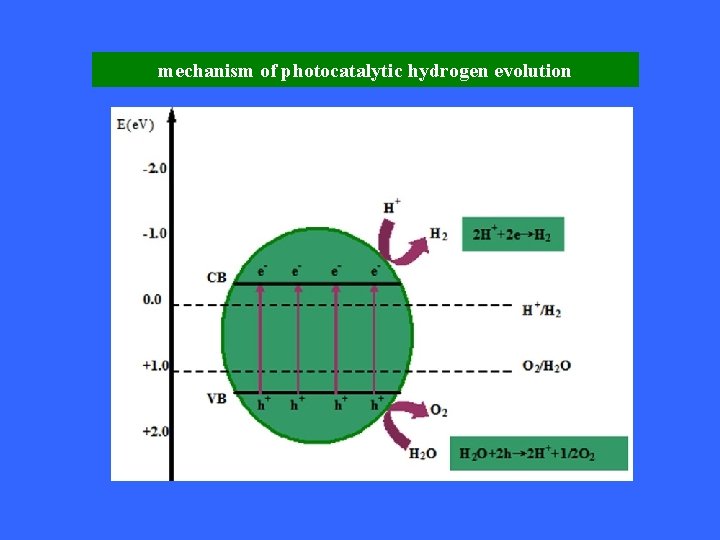
mechanism of photocatalytic hydrogen evolution
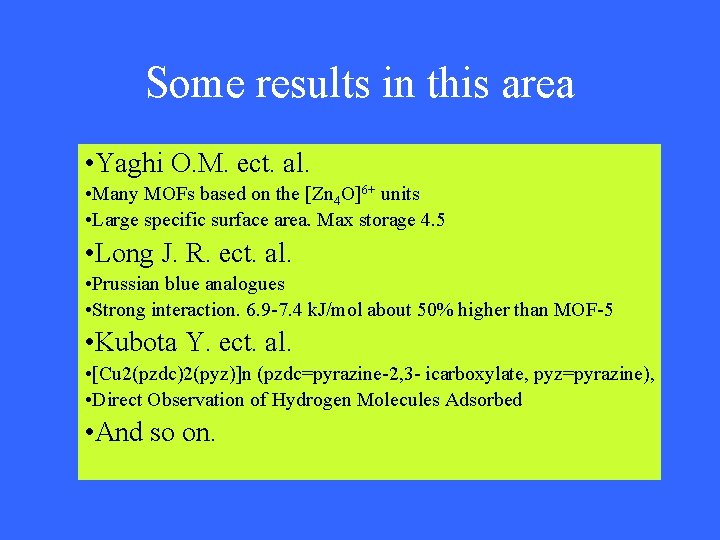
Some results in this area • Yaghi O. M. ect. al. • Many MOFs based on the [Zn 4 O]6+ units • Large specific surface area. Max storage 4. 5 • Long J. R. ect. al. • Prussian blue analogues • Strong interaction. 6. 9 -7. 4 k. J/mol about 50% higher than MOF-5 • Kubota Y. ect. al. • [Cu 2(pzdc)2(pyz)]n (pzdc=pyrazine-2, 3 - icarboxylate, pyz=pyrazine), • Direct Observation of Hydrogen Molecules Adsorbed • And so on.