
Hydrogen Environment Embrittlement on Austenitic Stainless Steels from
Hydrogen Environment Embrittlement on Austenitic Stainless Steels from Room Temperature to Low Temperatures Toshio OGATA Materials Information Station National Institute for Materials Science
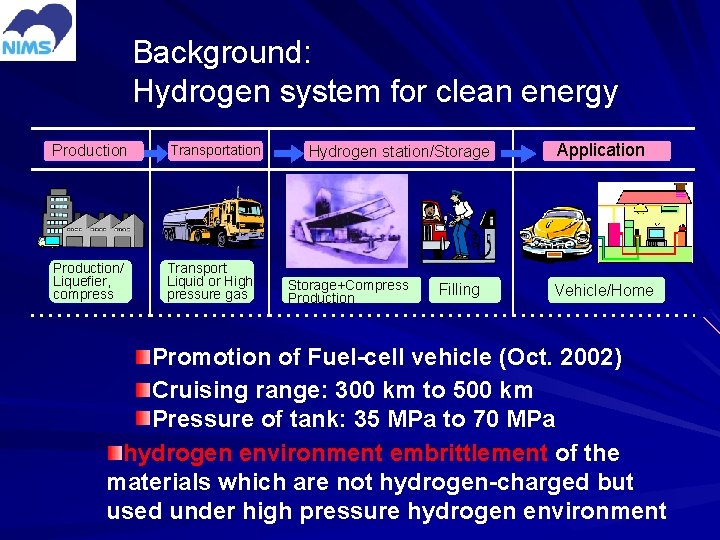
Background: Hydrogen system for clean energy Production Transportation Production/ Liquefier, compress Transport Liquid or High pressure gas Hydrogen station/Storage+Compress Production Filling Application Vehicle/Home Promotion of Fuel-cell vehicle (Oct. 2002) Cruising range: 300 km to 500 km Pressure of tank: 35 MPa to 70 MPa hydrogen environment embrittlement of the materials which are not hydrogen-charged but used under high pressure hydrogen environment
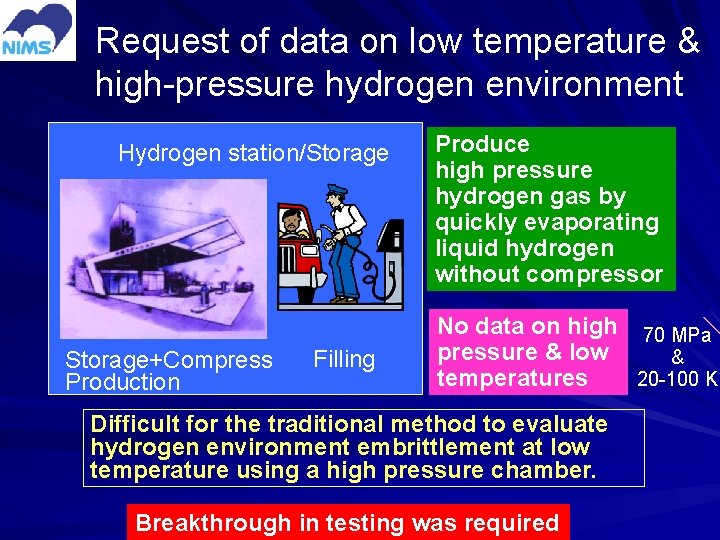
Request of data on low temperature & high-pressure hydrogen environment Hydrogen station/Storage+Compress Production Filling Produce high pressure hydrogen gas by quickly evaporating liquid hydrogen without compressor No data on high 70 MPa pressure & low & temperatures 20 -100 K Difficult for the traditional method to evaluate hydrogen environment embrittlement at low temperature using a high pressure chamber. Breakthrough in testing was required
Current equirements in Japan for the materials for use in H 2 l. Less influence of high-pressure (70 MPa or more) in hydrogen environment and at low temperatures Ø Relative reduction of area in H 2 > 0. 7 to 0. 8 Ø Reduction of are in H 2 > 0. 6 to 0. 7 Ø Japanese steel makers developed the materials but still expensive l. Looking for the possibility of cheaper materials
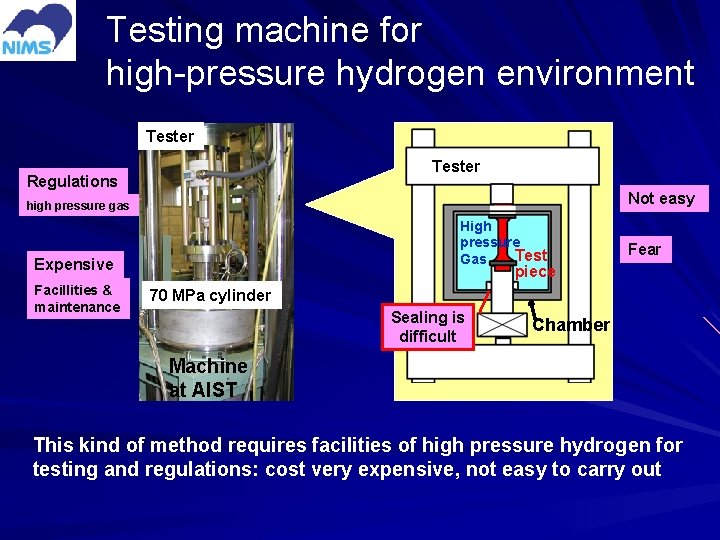
Testing machine for high-pressure hydrogen environment Tester Regulations Not easy high pressure gas High pressure Test Gas Expensive Facillities & maintenance Fear piece 70 MPa cylinder Sealing is difficult Chamber Machine at AIST This kind of method requires facilities of high pressure hydrogen for testing and regulations: cost very expensive, not easy to carry out
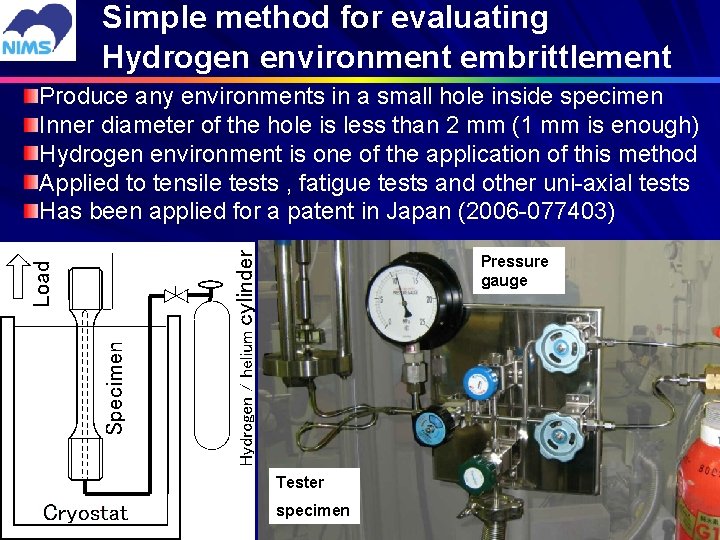
Simple method for evaluating Hydrogen environment embrittlement Produce any environments in a small hole inside specimen Inner diameter of the hole is less than 2 mm (1 mm is enough) Hydrogen environment is one of the application of this method Applied to tensile tests , fatigue tests and other uni-axial tests Has been applied for a patent in Japan (2006 -077403) Pressure gauge Tester specimen
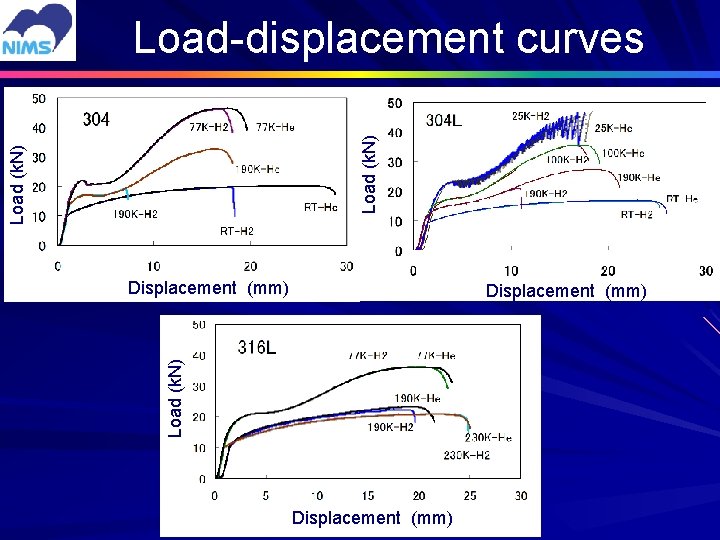
Load (k. N) Load-displacement curves Displacement (mm) Load (k. N) Stroke (mm) Displacement (mm)
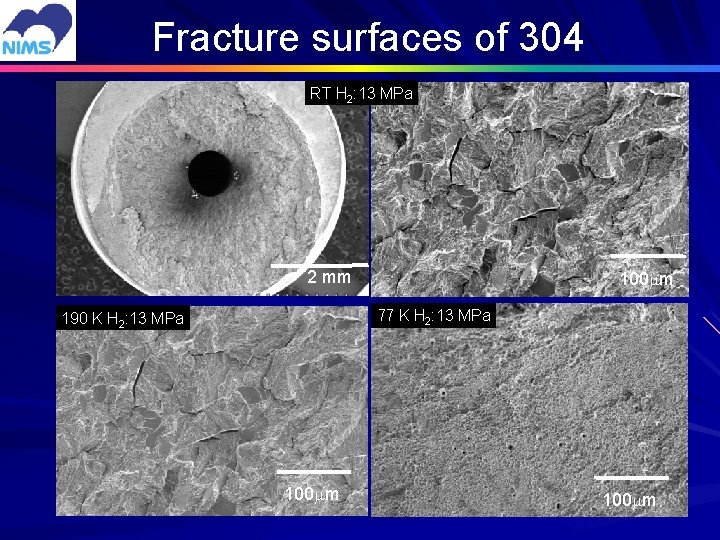
Fracture surfaces of 304 RT H 2: 13 MPa 2 mm 100 mm 77 K H 2: 13 MPa 190 K H 2: 13 MPa 316 L 190 K H 2: 13 MPa 100 mm
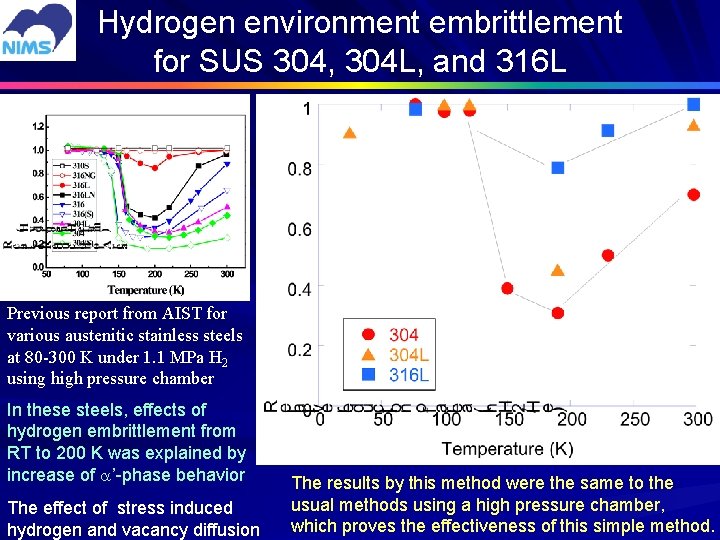
Hydrogen environment embrittlement for SUS 304, 304 L, and 316 L Previous report from AIST for various austenitic stainless steels at 80 -300 K under 1. 1 MPa H 2 using high pressure chamber In these steels, effects of hydrogen embrittlement from RT to 200 K was explained by increase of a’-phase behavior The effect of stress induced hydrogen and vacancy diffusion The results by this method were the same to the usual methods using a high pressure chamber, which proves the effectiveness of this simple method.
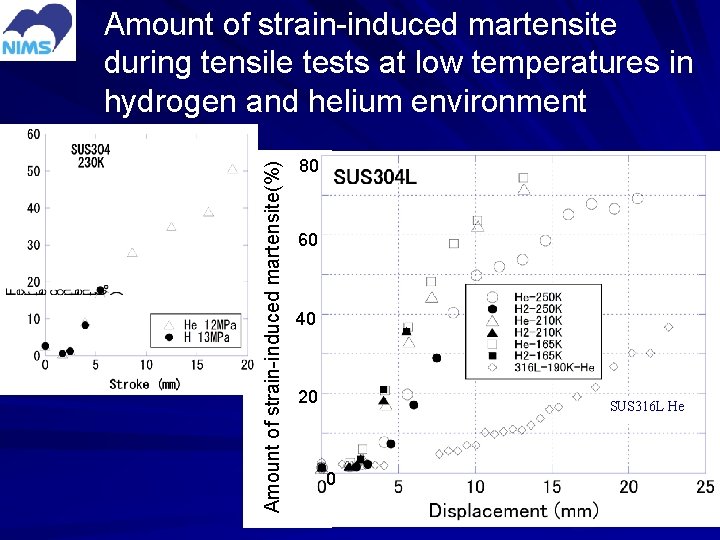
Amount of strain-induced martensite(%) Amount of strain-induced martensite during tensile tests at low temperatures in hydrogen and helium environment 80 60 40 20 SUS 316 L He 0
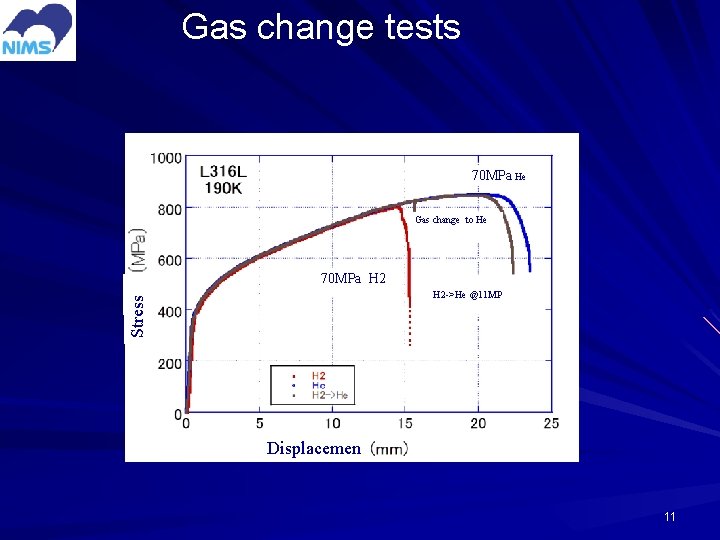
Gas change tests 70 MPa He Gas change to He 70 MPa H 2 Stress H 2 ->He @11 MP Displacemen t 11
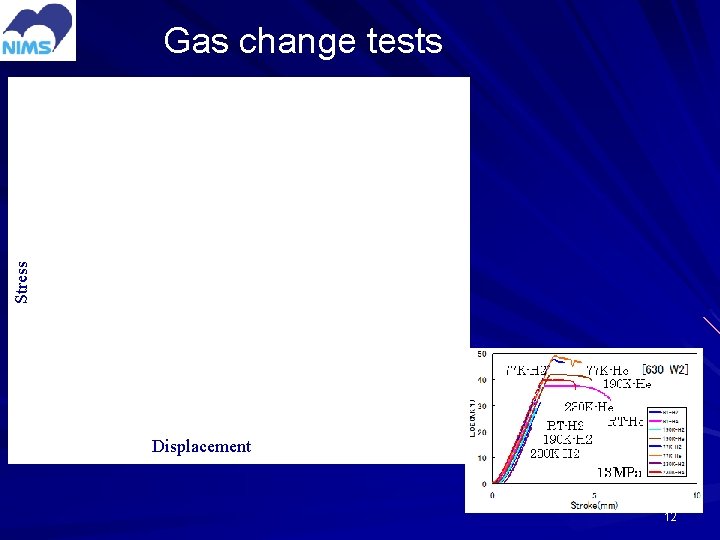
Stress Gas change tests Displacement 12
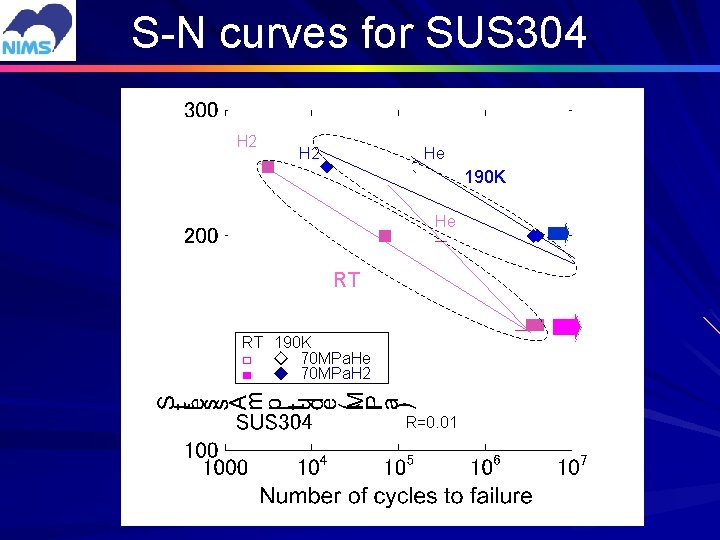
S-N curves for SUS 304 H 2 He 190 K He RT RT 190 K □ ◇ 70 MPa. He ■ ◆ 70 MPa. H 2 R=0. 01
S-N curves for SUS 304 L 190 K RT RT
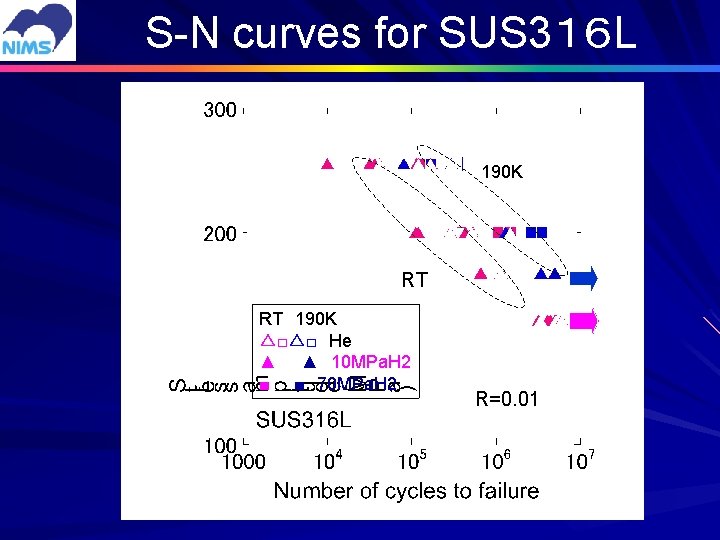
S-N curves for SUS 316 L 190 K RT RT 190 K △□△□ He ▲ ▲ 10 MPa. H 2 ■ ■ 70 MPa. H 2 R=0. 01
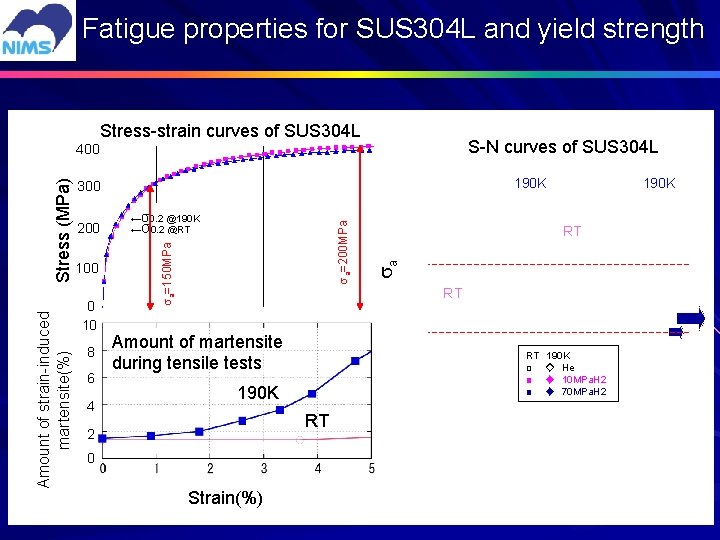
Fatigue properties for SUS 304 L and yield strength Stress-strain curves of SUS 304 L S-N curves of SUS 304 L Amount of strain-induced martensite(%) 0 10 8 6 4 σ RT sa 100 ←σ0. 2 @190 K ← 0. 2 @RT sa=200 MPa 200 190 K 300 sa=150 MPa Stress (MPa) 400 RT Amount of martensite during tensile tests RT □ ■ ■ 190 K RT 2 0 Strain(%) 190 K ◇ He ◆ 10 MPa. H 2 ◆ 70 MPa. H 2
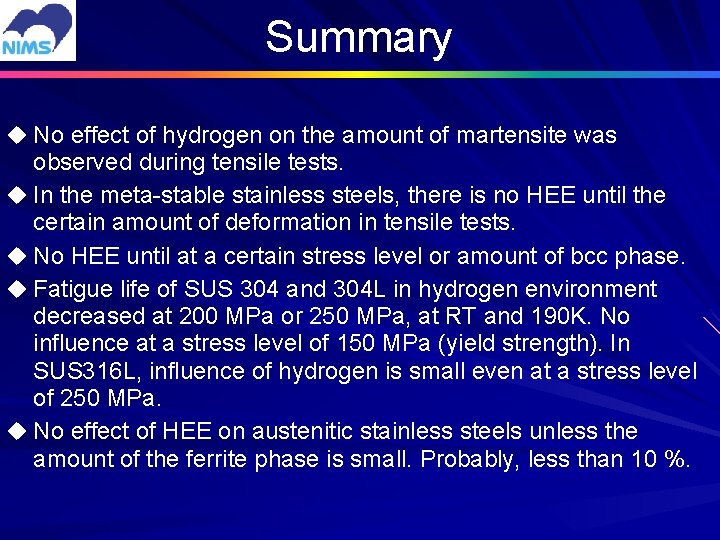
Summary u No effect of hydrogen on the amount of martensite was observed during tensile tests. u In the meta-stable stainless steels, there is no HEE until the certain amount of deformation in tensile tests. u No HEE until at a certain stress level or amount of bcc phase. u Fatigue life of SUS 304 and 304 L in hydrogen environment decreased at 200 MPa or 250 MPa, at RT and 190 K. No influence at a stress level of 150 MPa (yield strength). In SUS 316 L, influence of hydrogen is small even at a stress level of 250 MPa. u No effect of HEE on austenitic stainless steels unless the amount of the ferrite phase is small. Probably, less than 10 %.
Thank you for your attention
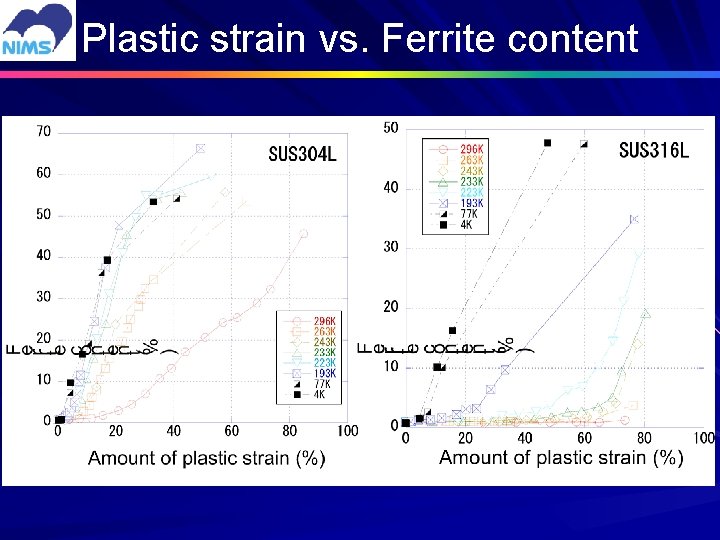
Plastic strain vs. Ferrite content
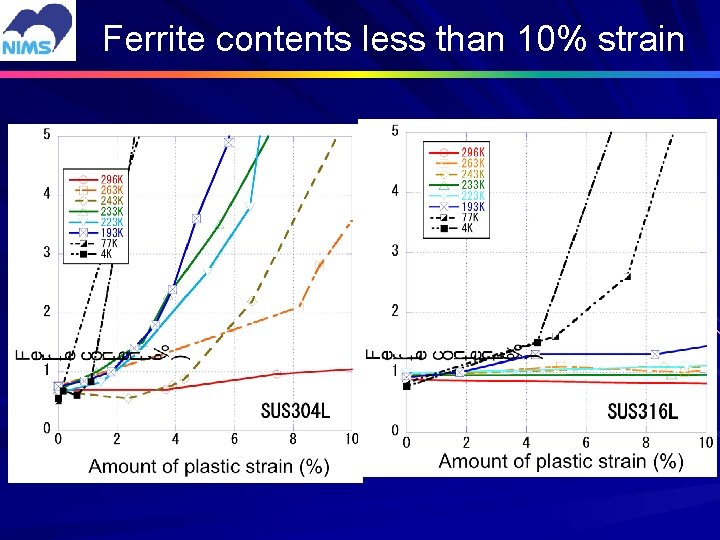
Ferrite contents less than 10% strain
- Slides: 20