
Hydrodynamics Physics 1425 Lecture 27 Michael Fowler UVa







- Slides: 19
Hydrodynamics Physics 1425 Lecture 27 Michael Fowler, UVa
Basic Concepts • Fluid conservation • Bernoulli’s Equation
You are sitting in a rowing boat in a small pond. There are some bricks in the boat. You take the bricks and throw them into the pond. They sink to the bottom. What happens to the water level in the pond, as measured at the bank? A. It falls. B. It rises. C. It stays the same.
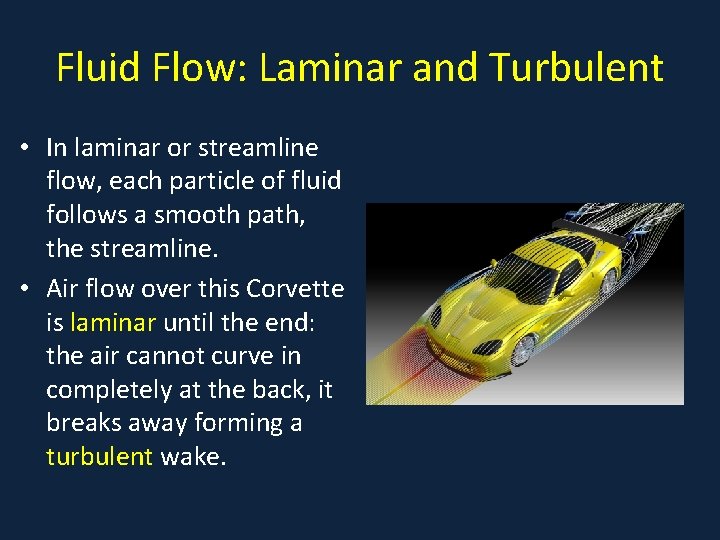
Fluid Flow: Laminar and Turbulent • In laminar or streamline flow, each particle of fluid follows a smooth path, the streamline. • Air flow over this Corvette is laminar until the end: the air cannot curve in completely at the back, it breaks away forming a turbulent wake.
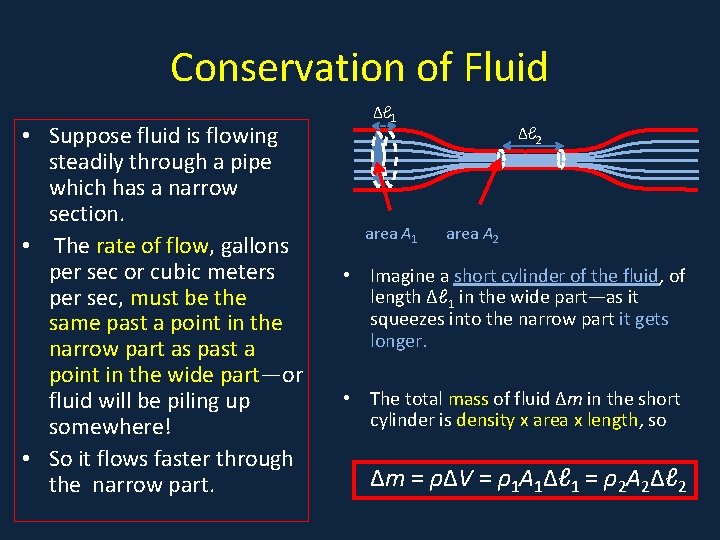
Conservation of Fluid • Suppose fluid is flowing steadily through a pipe which has a narrow section. • The rate of flow, gallons per sec or cubic meters per sec, must be the same past a point in the narrow part as past a point in the wide part—or fluid will be piling up somewhere! • So it flows faster through the narrow part. Δℓ 1 area A 1 Δℓ 2 area A 2 • Imagine a short cylinder of the fluid, of length Δℓ 1 in the wide part—as it squeezes into the narrow part it gets longer. • The total mass of fluid Δm in the short cylinder is density x area x length, so Δm = ρΔV = ρ1 A 1Δℓ 1 = ρ2 A 2Δℓ 2
Fluid Velocity: Equation of Continuity Δℓ 1 Area A 1 Δℓ 2 Area A 2 • If the fluid flows distance Δℓ 1 in the wide tube in time Δt, the mass flow rate past a point is Δm/Δt = ρ1 A 1Δℓ 1/ Δt = ρ1 A 1 v 1. • Since the mass flow rate through area A 1 must equal that through A 2 for steady flow, ρ 1 A 1 v 1 = ρ 2 A 2 v 2 the “equation of continuity” and often the ρ’s can be dropped— water is essentially incompressible, and at low speeds so is air.
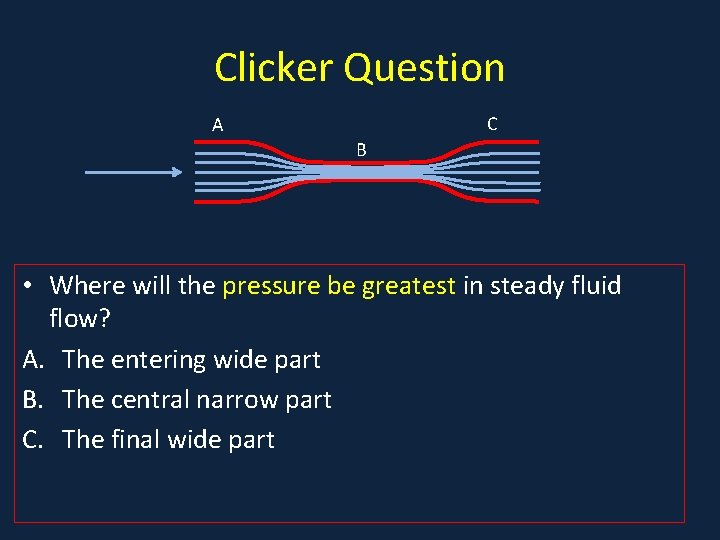
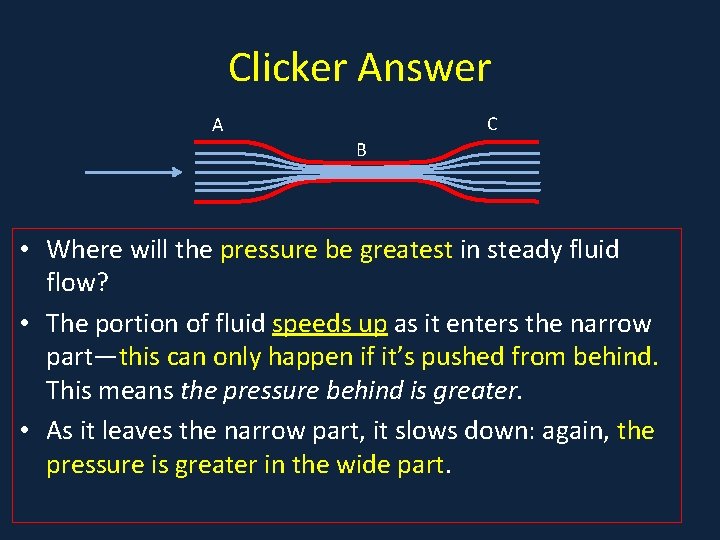
Clicker Question C A B • Where will the pressure be greatest in steady fluid flow? A. The entering wide part B. The central narrow part C. The final wide part
Clicker Answer C A B • Where will the pressure be greatest in steady fluid flow? • The portion of fluid speeds up as it enters the narrow part—this can only happen if it’s pushed from behind. This means the pressure behind is greater. • As it leaves the narrow part, it slows down: again, the pressure is greater in the wide part.
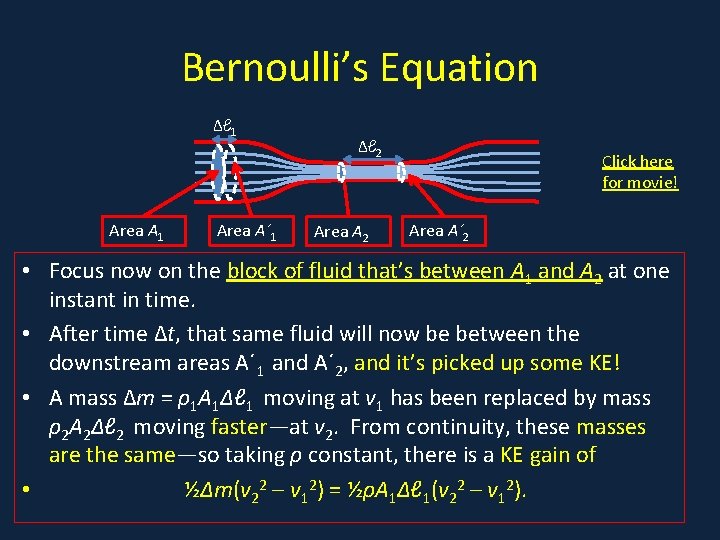
Bernoulli’s Equation Δℓ 1 Area A´ 1 Δℓ 2 Area A 2 Click here for movie! Area A´ 2 • Focus now on the block of fluid that’s between A 1 and A 2 at one instant in time. • After time Δt, that same fluid will now be between the downstream areas A´ 1 and A´ 2, and it’s picked up some KE! • A mass Δm = ρ1 A 1Δℓ 1 moving at v 1 has been replaced by mass ρ2 A 2Δℓ 2 moving faster—at v 2. From continuity, these masses are the same—so taking ρ constant, there is a KE gain of • ½Δm(v 22 – v 12) = ½ρA 1Δℓ 1(v 22 – v 12).
Bernoulli’s Equation Δℓ 1 Pressure P 1 Area A´ 1 For constant density, A 1Δℓ 1 =A 2Δℓ 2 Area A´ 2 • In the time Δt, there is a KE gain of ½ρA 1Δℓ 1(v 22 – v 12). • Where did that energy come from? • In the time Δt, the pressure P 1 on the area A 1 does work: force x distance = P 1 A 1Δℓ 1 • BUT at the same time, our block of fluid did some work itself: it pushed the fluid in front of it, doing work = P 2 A 2Δℓ 2. • SO net work done = (P 1 - P 2) A 1Δℓ 1 =KE gain ½ρA 1Δℓ 1(v 22 – v 12) • That is, P 1 + ½ρv 12 = P 2 + ½ρv 22
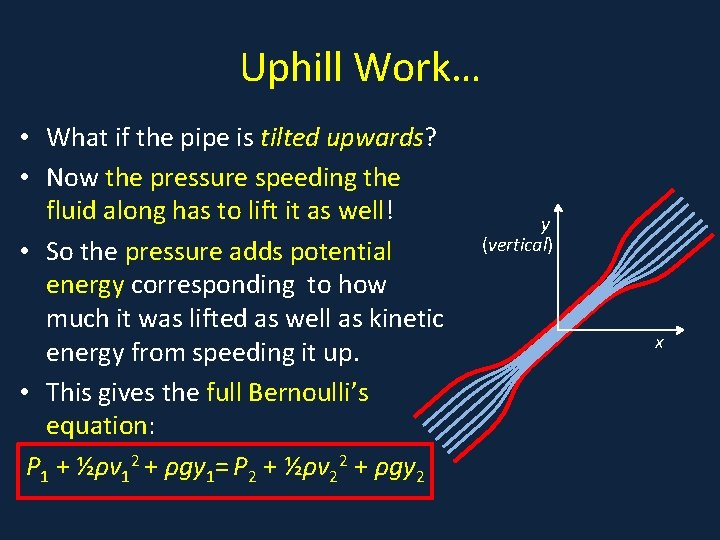
Uphill Work… • What if the pipe is tilted upwards? • V • Now the pressure speeding the fluid along has to lift it as well! y (vertical) • So the pressure adds potential energy corresponding to how much it was lifted as well as kinetic energy from speeding it up. • This gives the full Bernoulli’s equation: P 1 + ½ρv 12 + ρgy 1= P 2 + ½ρv 22 + ρgy 2 x
I hold two sheets of paper hanging from my hands parallel, one or two inches apart. I blow between the two sheets. What happens? A. They move towards each other. B. They move apart.
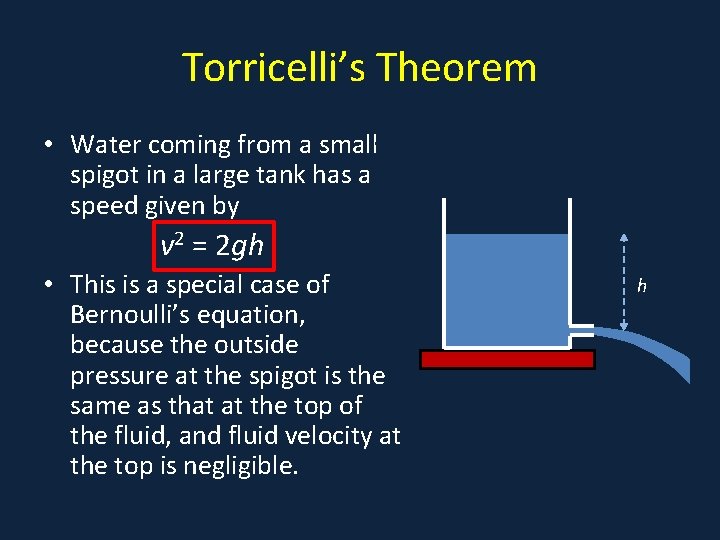
Torricelli’s Theorem • Water coming from a small • x spigot in a large tank has a speed given by v 2 = 2 gh • This is a special case of Bernoulli’s equation, because the outside pressure at the spigot is the same as that at the top of the fluid, and fluid velocity at the top is negligible. h
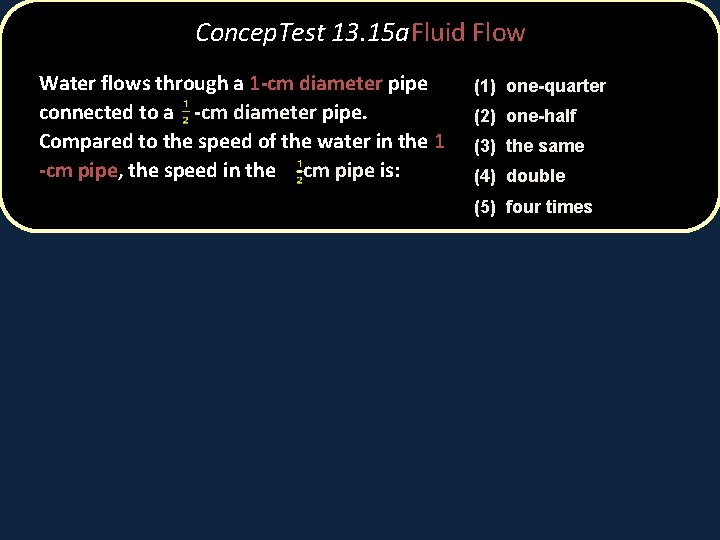
Concep. Test 13. 15 a. Fluid Flow Water flows through a 1 -cm diameter pipe connected to a -cm diameter pipe. Compared to the speed of the water in the 1 -cm pipe, the speed in the -cm pipe is: (1) one-quarter (2) one-half (3) the same (4) double (5) four times
Concep. Test 13. 15 a. Fluid Flow Water flows through a 1 -cm diameter pipe connected to a -cm diameter pipe. Compared to the speed of the water in the 1 -cm pipe, the speed in the -cm pipe is: (1) one-quarter (2) one-half (3) the same (4) double (5) four times v 1 v 2 The area of the small pipe is less, so we know that the water will flow faster there. Because A r 2, when the radius is reduced by one-half, one-half the area is reduced by one-quarter, one-quarter so the speed must increase by four times to keep the flow rate (A v) constant.
Concep. Test 13. 15 b. Blood Pressure I A blood platelet drifts along with the flow of blood through an artery that is partially blocked. As the platelet moves from the wide region into the narrow region, the blood pressure: 1) increases 2) decreases 3) stays the same 4) drops to zero
Concep. Test 13. 15 b. Blood Pressure I A blood platelet drifts along with the flow of blood through an artery that is partially blocked. As the platelet moves from the wide region into the narrow region, the blood pressure: 1) increases 2) decreases 3) stays the same 4) drops to zero The speed increases in the narrow part, part according to the continuity equation. Because the speed is higher, higher the pressure is lower, lower from Bernoulli’s principle. speed is higher here (so pressure is lower)
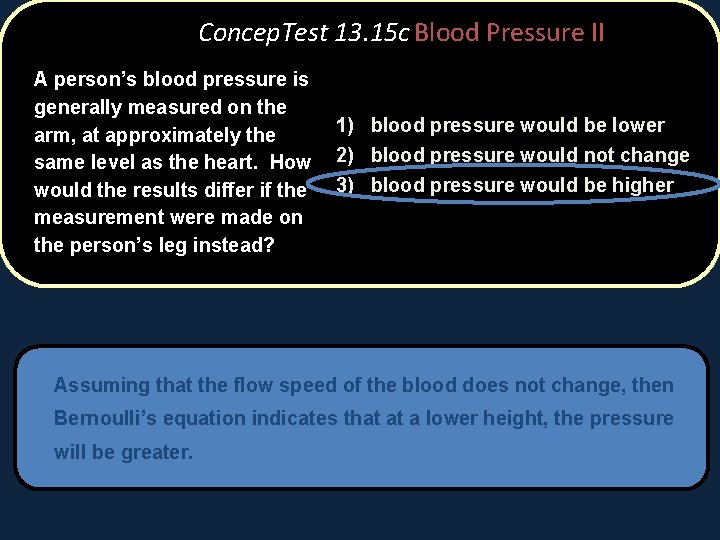
Concep. Test 13. 15 c Blood Pressure II A person’s blood pressure is generally measured on the arm, at approximately the same level as the heart. How would the results differ if the measurement were made on the person’s leg instead? 1) blood pressure would be lower 2) blood pressure would not change 3) blood pressure would be higher
Concep. Test 13. 15 c Blood Pressure II A person’s blood pressure is generally measured on the arm, at approximately the same level as the heart. How would the results differ if the measurement were made on the person’s leg instead? 1) blood pressure would be lower 2) blood pressure would not change 3) blood pressure would be higher Assuming that the flow speed of the blood does not change, then Bernoulli’s equation indicates that at a lower height, the pressure will be greater.