
Hydrocarbons Unit 5 Lesson 1 Hydrocarbons Hydrocarbons are
Hydrocarbons Unit 5 Lesson 1
Hydrocarbons �Hydrocarbons are the simplest of all the organic molecules. �They consist of only carbon and hydrogen, hence the term hydrocarbon. � The very simplest of all the hydrocarbons is methane.
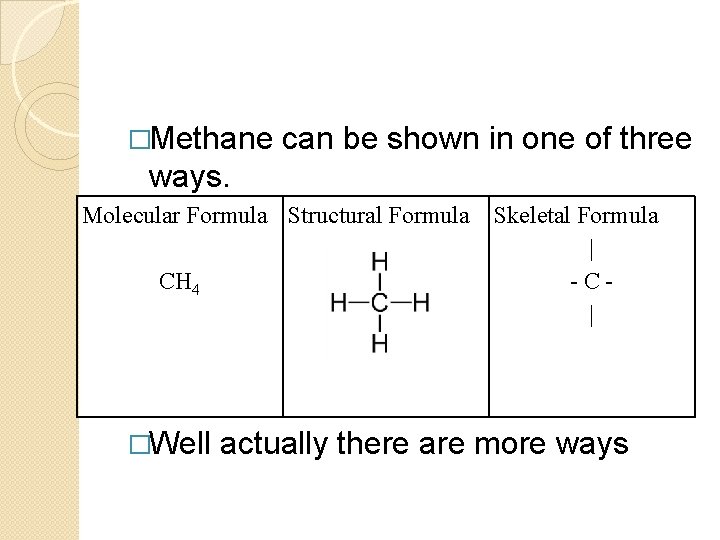
�Methane can be shown in one of three ways. Molecular Formula Structural Formula CH 4 Skeletal Formula | - C | �Well actually there are more ways
�Each type of formula has its own benefits. �Molecular formulas show what is in a compound but very little about how the atoms are put together. �CH 4 �C 3 H 8 �C 8 H 18
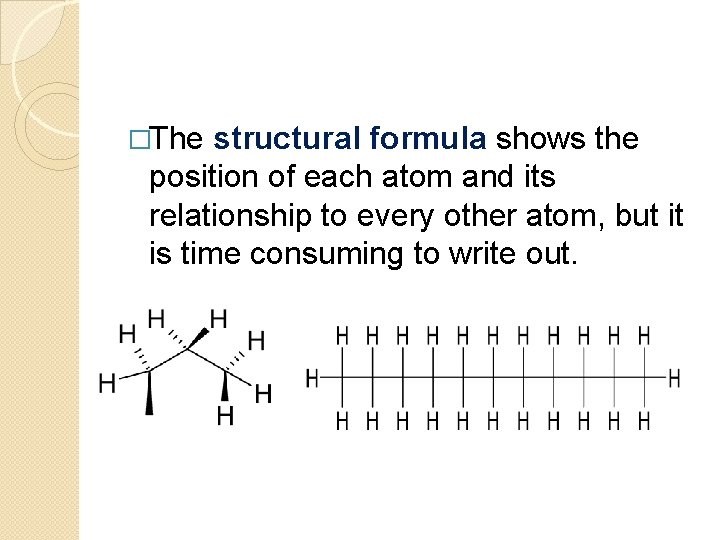
�The structural formula shows the position of each atom and its relationship to every other atom, but it is time consuming to write out.
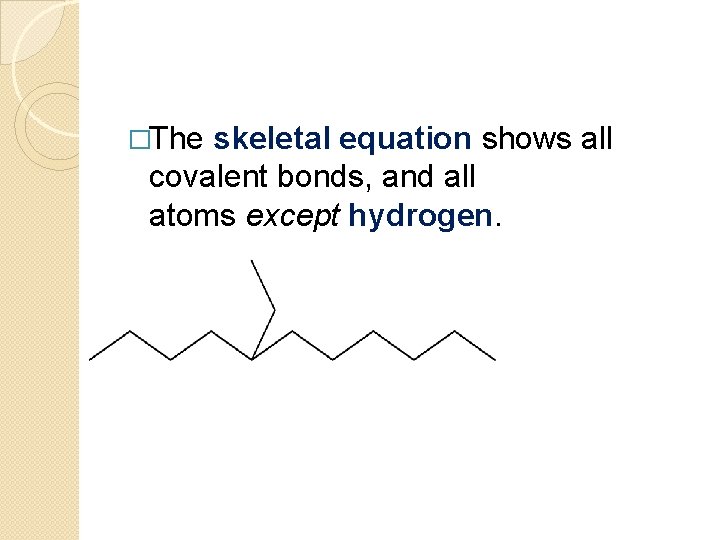
�The skeletal equation shows all covalent bonds, and all atoms except hydrogen.
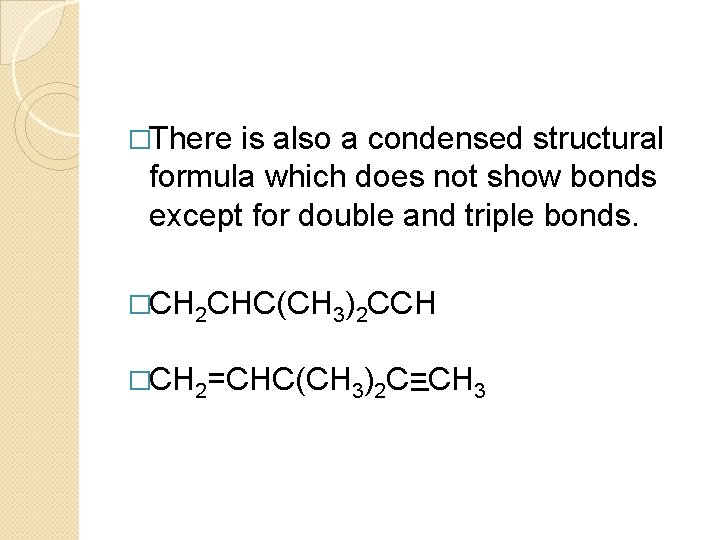
�There is also a condensed structural formula which does not show bonds except for double and triple bonds. �CH 2 CHC(CH 3)2 CCH �CH 2=CHC(CH 3)2 C=CH 3
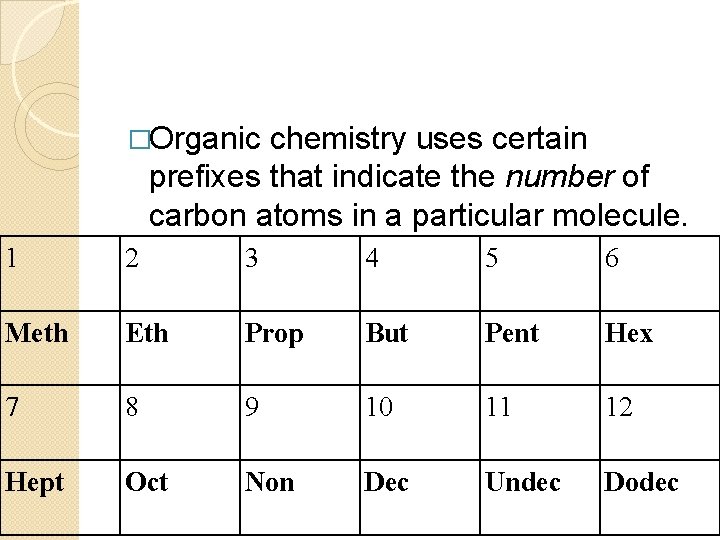
�Organic chemistry uses certain prefixes that indicate the number of carbon atoms in a particular molecule. 1 2 3 4 5 6 Meth Eth Prop But Pent Hex 7 8 9 10 11 12 Hept Oct Non Dec Undec Dodec
The Alkanes �Using methane, CH 4, as a starting point we can add more carbons, one at a time, and more hydrogens to fill out the bonds on the carbons. �Alkanes contain only single carbon to carbon bonds �This first group is called the alkane series and it has the general formula: Cn. H 2 n+2
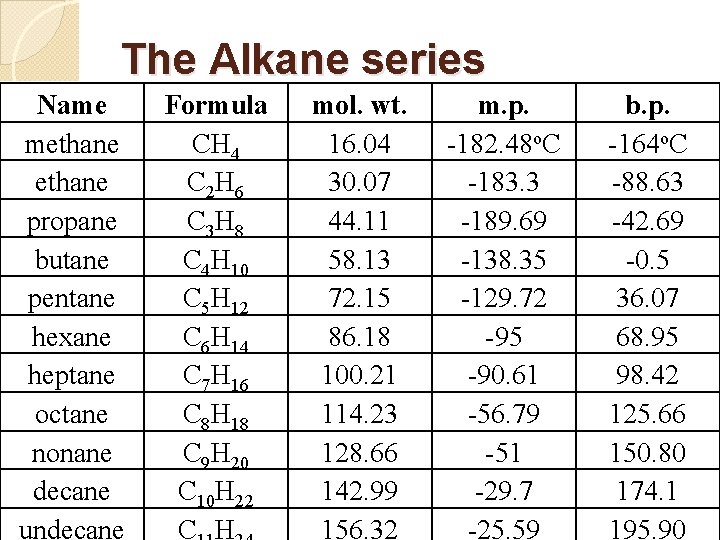
The Alkane series Name methane propane butane pentane hexane heptane octane nonane decane undecane Formula CH 4 C 2 H 6 C 3 H 8 C 4 H 10 C 5 H 12 C 6 H 14 C 7 H 16 C 8 H 18 C 9 H 20 C 10 H 22 C H mol. wt. 16. 04 30. 07 44. 11 58. 13 72. 15 86. 18 100. 21 114. 23 128. 66 142. 99 156. 32 m. p. -182. 48 o. C -183. 3 -189. 69 -138. 35 -129. 72 -95 -90. 61 -56. 79 -51 -29. 7 -25. 59 b. p. -164 o. C -88. 63 -42. 69 -0. 5 36. 07 68. 95 98. 42 125. 66 150. 80 174. 1 195. 90
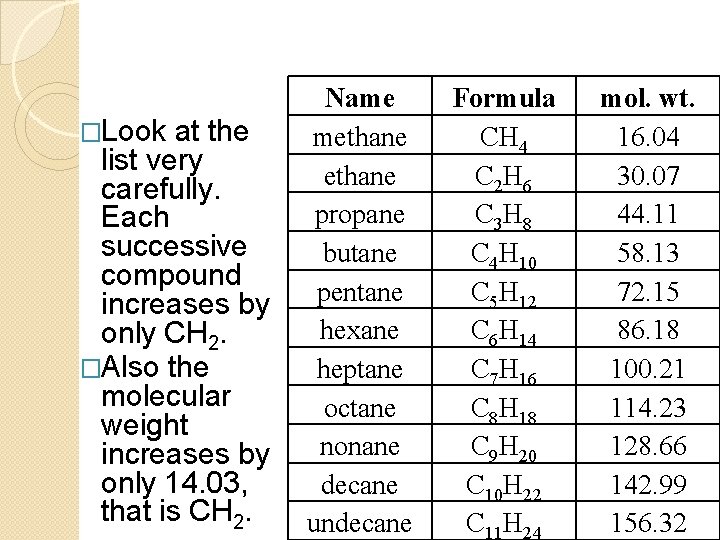
�Look at the list very carefully. Each successive compound increases by only CH 2. �Also the molecular weight increases by only 14. 03, that is CH 2. Name methane propane butane pentane hexane heptane octane nonane decane undecane Formula CH 4 C 2 H 6 C 3 H 8 C 4 H 10 C 5 H 12 C 6 H 14 C 7 H 16 C 8 H 18 C 9 H 20 C 10 H 22 C 11 H 24 mol. wt. 16. 04 30. 07 44. 11 58. 13 72. 15 86. 18 100. 21 114. 23 128. 66 142. 99 156. 32
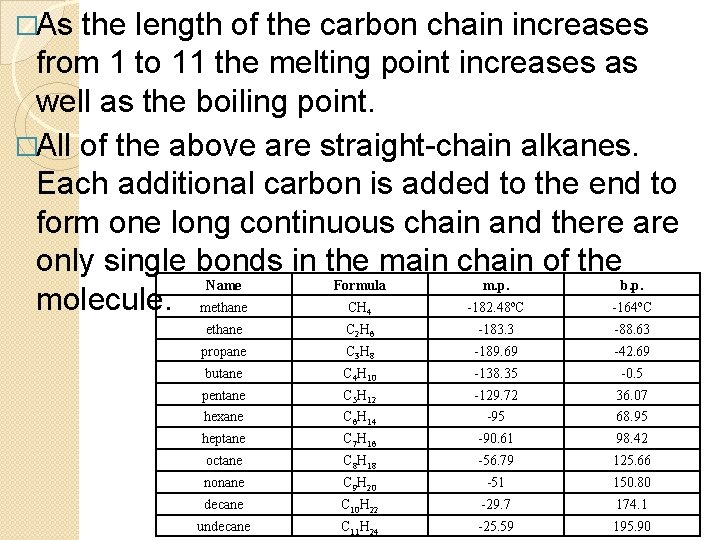
�As the length of the carbon chain increases from 1 to 11 the melting point increases as well as the boiling point. �All of the above are straight-chain alkanes. Each additional carbon is added to the end to form one long continuous chain and there are only single bonds in the main chain of the Name Formula m. p. b. p. molecule. methane CH -182. 48 C -164 C o 4 o ethane C 2 H 6 -183. 3 -88. 63 propane C 3 H 8 -189. 69 -42. 69 butane C 4 H 10 -138. 35 -0. 5 pentane C 5 H 12 -129. 72 36. 07 hexane C 6 H 14 -95 68. 95 heptane C 7 H 16 -90. 61 98. 42 octane C 8 H 18 -56. 79 125. 66 nonane C 9 H 20 -51 150. 80 decane C 10 H 22 -29. 7 174. 1 undecane C 11 H 24 -25. 59 195. 90
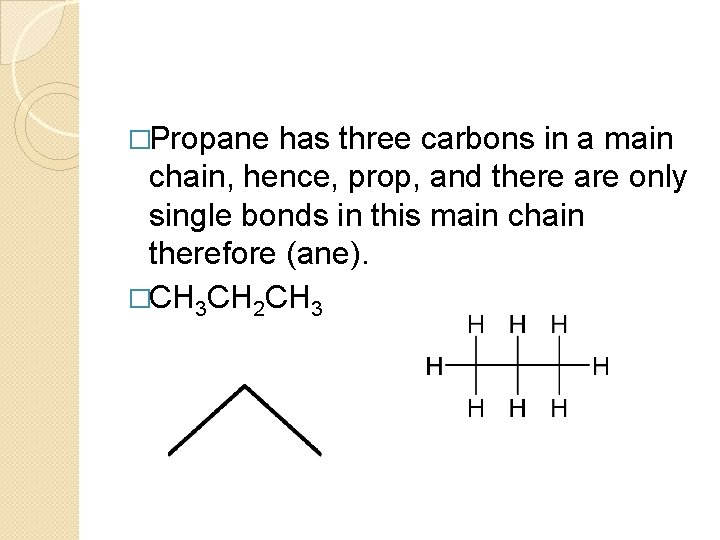
�Propane has three carbons in a main chain, hence, prop, and there are only single bonds in this main chain therefore (ane). �CH 3 CH 2 CH 3
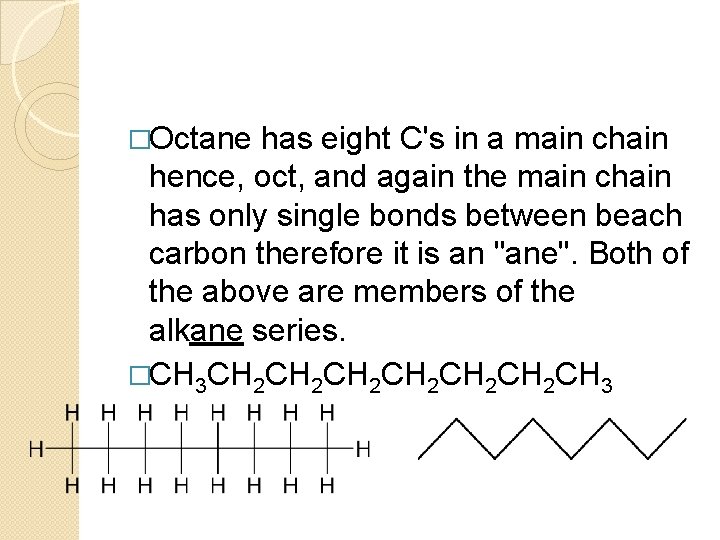
�Octane has eight C's in a main chain hence, oct, and again the main chain has only single bonds between beach carbon therefore it is an "ane". Both of the above are members of the alkane series. �CH 3 CH 2 CH 2 CH 2 CH 3
IUPAC Rules For Naming Organic Compounds. �(International Union of Pure and Applied Chemists) 1. Find the longest continuous carbon chain. Count the number of carbons in it and determine the prefix. 2. Check to make sure that all the bonds in this long chain are single. The ending will be "ane" 3. Put the prefix and ending together.
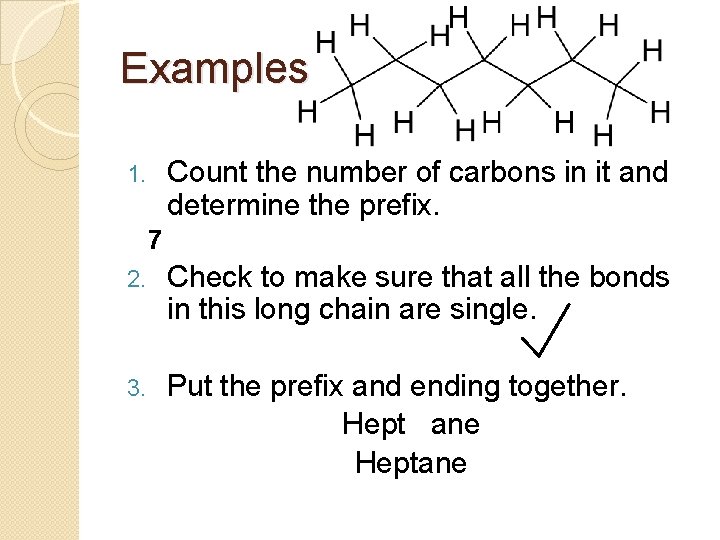
Examples Count the number of carbons in it and determine the prefix. 1. 7 2. Check to make sure that all the bonds in this long chain are single. 3. Put the prefix and ending together. Hept ane Heptane
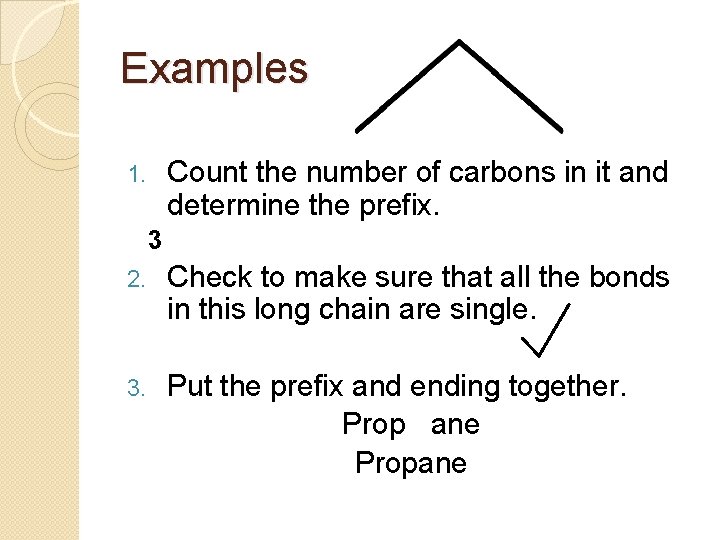
Examples Count the number of carbons in it and determine the prefix. 1. 3 2. Check to make sure that all the bonds in this long chain are single. 3. Put the prefix and ending together. Prop ane Propane
IUPAC Rules for Naming Branched Compounds Determine the longest continuous chain, this will be the parent chain. Give the parent chain a prefix matching the number of carbon's in it. 2. Assign #'s to each C of the parent chain so that the numbers of all attached side pieces add up to the smallest sum. 3. Determine the correct name for each branch or other atom or group. 4. Attach the name of the alkyl group or other substituent to the name of the parent as a prefix. Place the location # in front and separate from the name by a hyphen. 1.
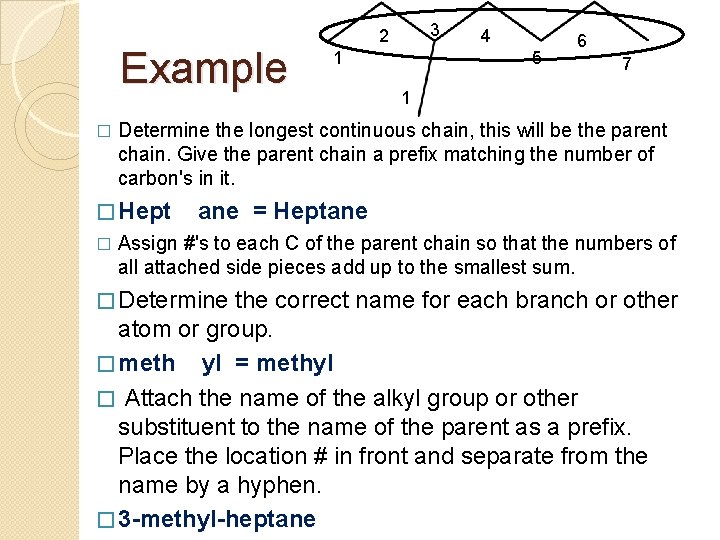
Example � 3 2 4 5 1 6 7 1 Determine the longest continuous chain, this will be the parent chain. Give the parent chain a prefix matching the number of carbon's in it. � Hept ane = Heptane � Assign #'s to each C of the parent chain so that the numbers of all attached side pieces add up to the smallest sum. � Determine the correct name for each branch or other atom or group. � meth yl = methyl � Attach the name of the alkyl group or other substituent to the name of the parent as a prefix. Place the location # in front and separate from the name by a hyphen. � 3 -methyl-heptane
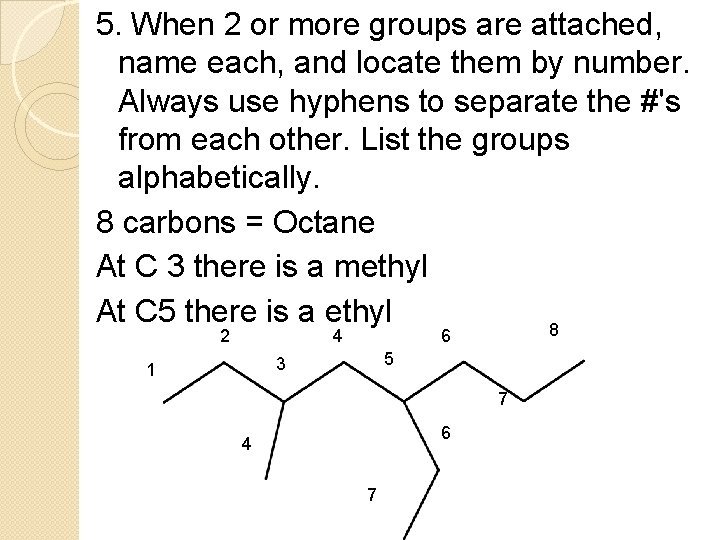
5. When 2 or more groups are attached, name each, and locate them by number. Always use hyphens to separate the #'s from each other. List the groups alphabetically. 8 carbons = Octane At C 3 there is a methyl At C 5 there is a ethyl 8 2 4 6 5 3 1 7 6 4 7
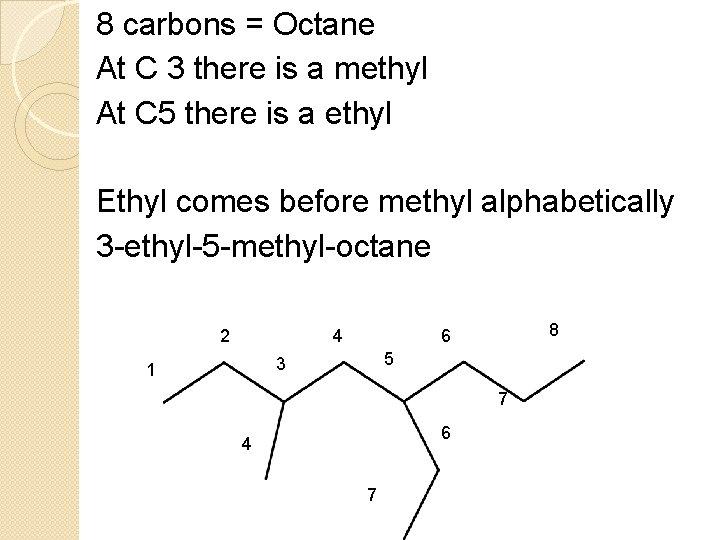
8 carbons = Octane At C 3 there is a methyl At C 5 there is a ethyl Ethyl comes before methyl alphabetically 3 -ethyl-5 -methyl-octane 2 4 5 3 1 8 6 7 6 4 7
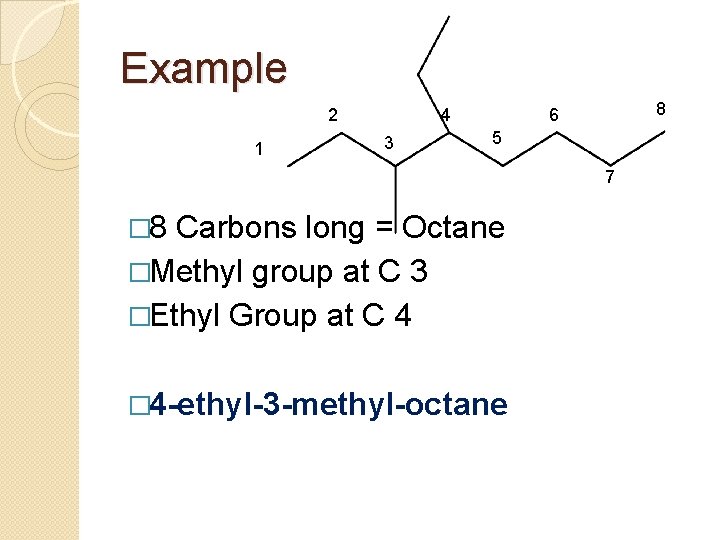
Example 2 1 4 3 8 6 5 7 � 8 Carbons long = Octane �Methyl group at C 3 �Ethyl Group at C 4 � 4 -ethyl-3 -methyl-octane
�When 2 or more of the substituents are identical, use special prefixes such as "di" for 2, "tri" for three and "tetra" for 4 and specify the location #'s of every group.
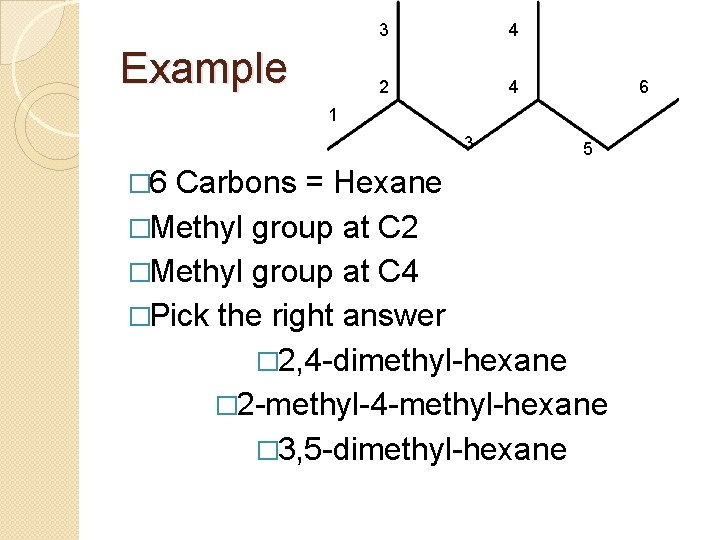
Example 3 4 2 4 6 1 3 5 � 6 Carbons = Hexane �Methyl group at C 2 �Methyl group at C 4 �Pick the right answer � 2, 4 -dimethyl-hexane � 2 -methyl-4 -methyl-hexane � 3, 5 -dimethyl-hexane
7. When identical groups are on the same carbon in the parent chain, repeat the number on the parent
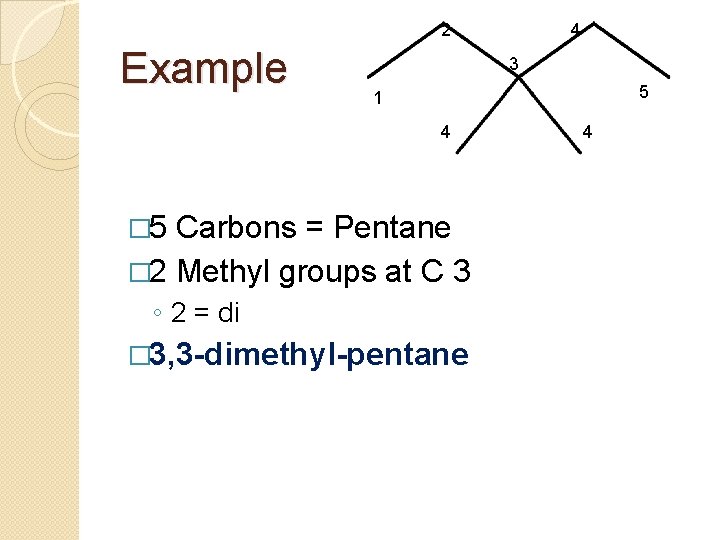
2 Example 4 3 5 1 4 � 5 Carbons = Pentane � 2 Methyl groups at C 3 ◦ 2 = di � 3, 3 -dimethyl-pentane 4
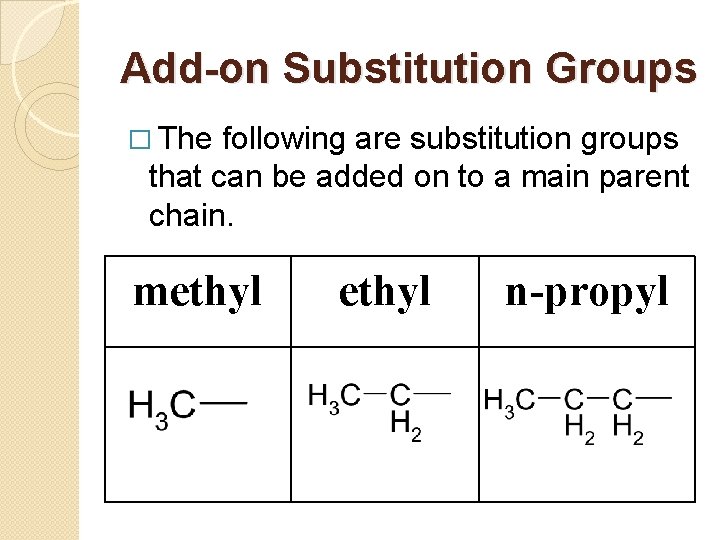
Add-on Substitution Groups � The following are substitution groups that can be added on to a main parent chain. methyl n-propyl
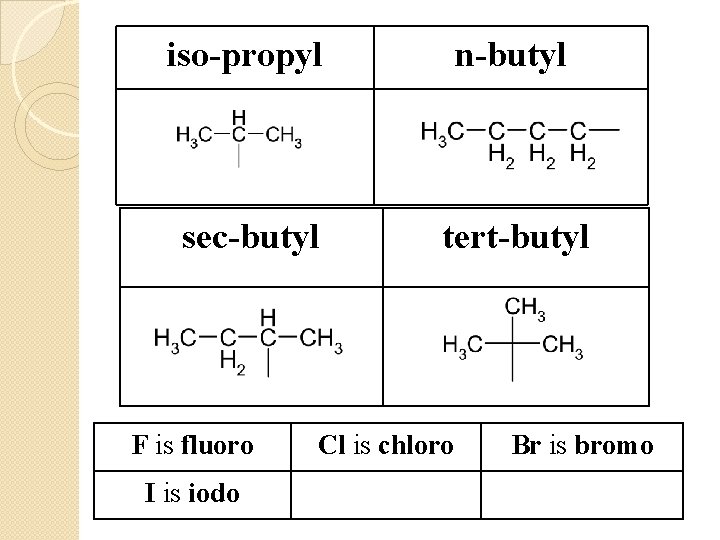
iso-propyl n-butyl sec-butyl tert-butyl F is fluoro I is iodo Cl is chloro Br is bromo
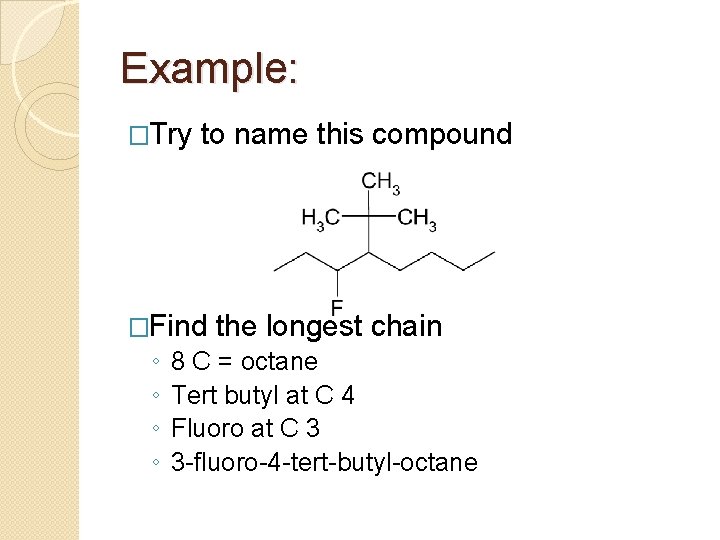
Example: �Try to name this compound �Find the longest chain ◦ ◦ 8 C = octane Tert butyl at C 4 Fluoro at C 3 3 -fluoro-4 -tert-butyl-octane
The Alkenes �An alkene is simply a C=C, that is a double bond between two carbon atoms. The position of the double bond will often determine what is the parent chain. If a double bond exists then the parent chain must include it.
�The double bond also uses up 2 bonds that normally hold hydrogen so the general formula for alkenes is Cn. H 2 n. �The double bond also locks the molecule in a certain position so that attached groups can't rotate around the double bond. This means some special naming conventions.
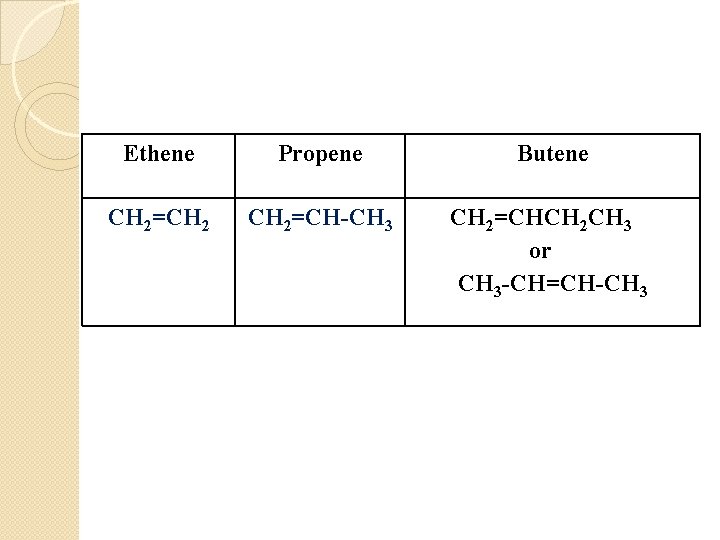
Ethene Propene Butene CH 2=CH 2=CH-CH 3 CH 2=CHCH 2 CH 3 or CH 3 -CH=CH-CH 3
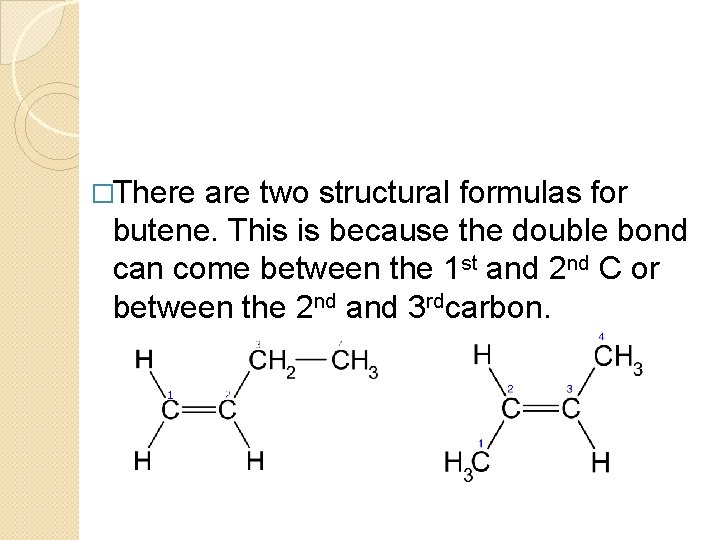
�There are two structural formulas for butene. This is because the double bond can come between the 1 st and 2 nd C or between the 2 nd and 3 rdcarbon.
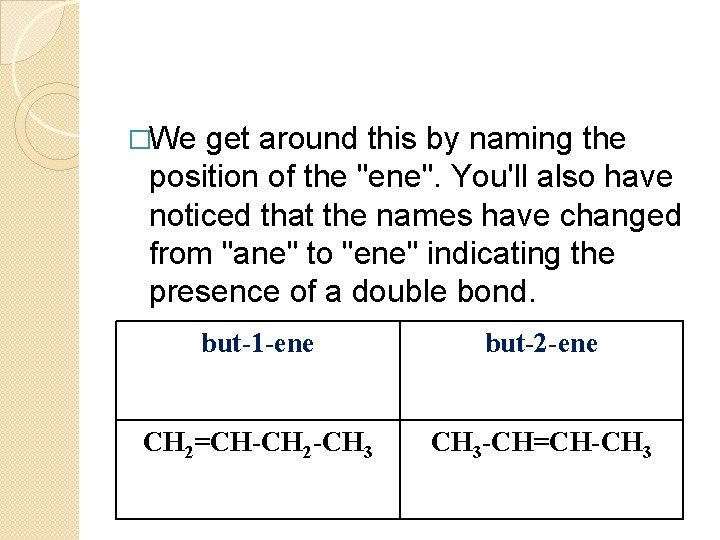
�We get around this by naming the position of the "ene". You'll also have noticed that the names have changed from "ane" to "ene" indicating the presence of a double bond. but-1 -ene but-2 -ene CH 2=CH-CH 2 -CH 3 -CH=CH-CH 3
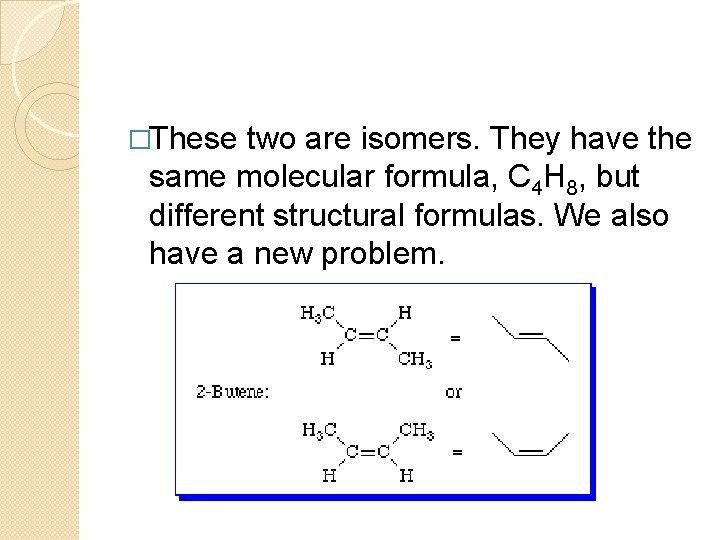
�These two are isomers. They have the same molecular formula, C 4 H 8, but different structural formulas. We also have a new problem.
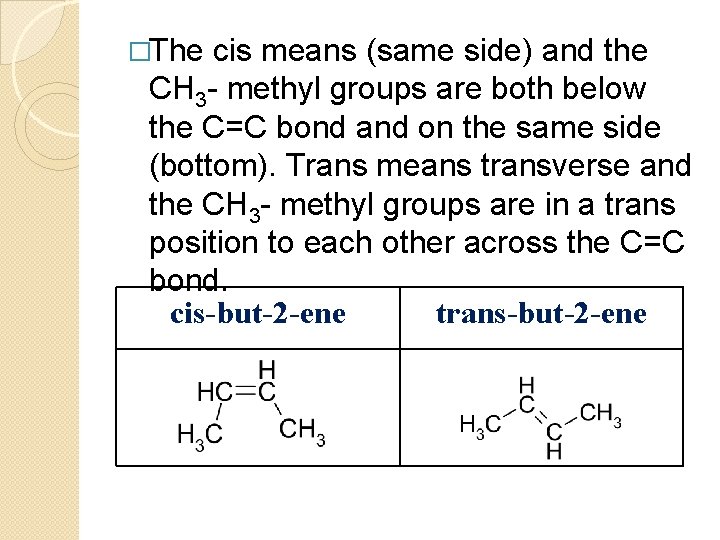
�The cis means (same side) and the CH 3 - methyl groups are both below the C=C bond and on the same side (bottom). Trans means transverse and the CH 3 - methyl groups are in a trans position to each other across the C=C bond. cis-but-2 -ene trans-but-2 -ene
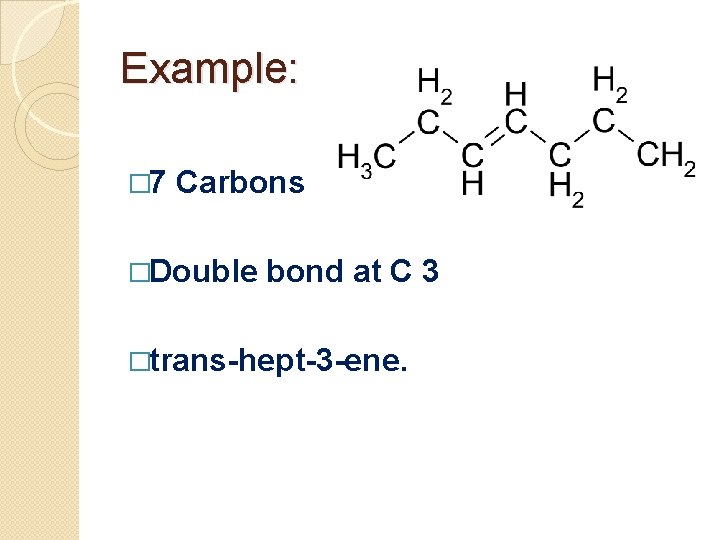
Example: � 7 Carbons �Double bond at C 3 �trans-hept-3 -ene.
Alkynes �The alkyne series is very similar to the alkane and alkene series. They all have at least one triple bond. �Note the fact that a single letter change results in a dramatic change in the structure of a compound.
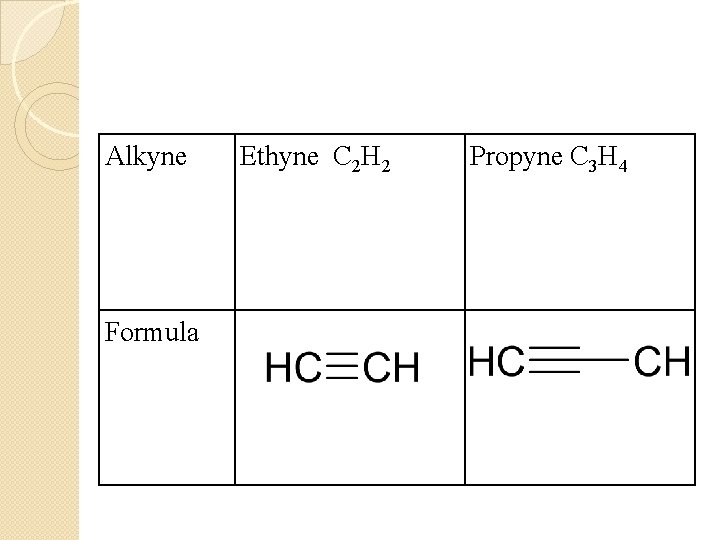
Alkyne Formula Ethyne C 2 H 2 Propyne C 3 H 4
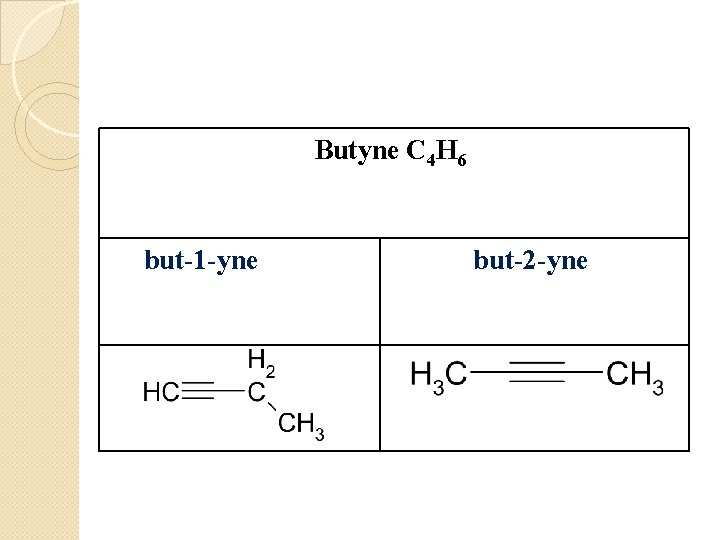
Butyne C 4 H 6 but-1 -yne but-2 -yne
�The pattern continues just as it did for the alkanes and alkenes. The general formula of an alkyne is Cn. H 2 n-2. �The triple bond prevents rotation but it also prevents the formation if cis and trans structures in the parent chain. In the event a parent chain has both an alkyne and an alkene, the alkyne is more important.
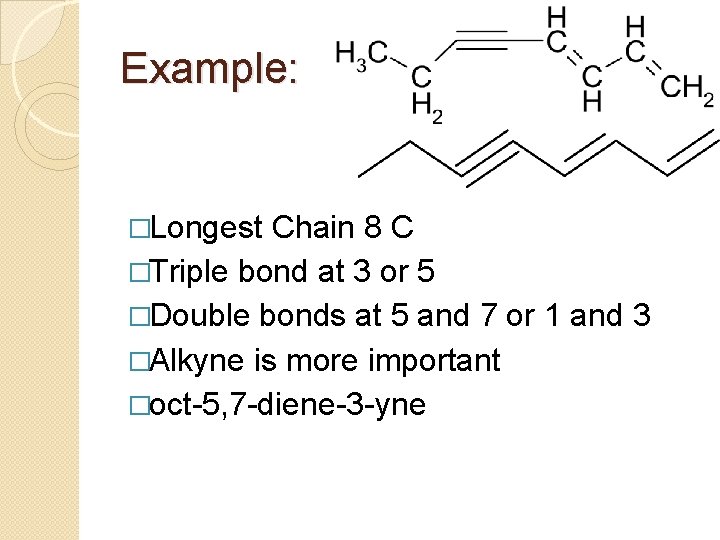
Example: �Longest Chain 8 C �Triple bond at 3 or 5 �Double bonds at 5 and 7 or 1 and 3 �Alkyne is more important �oct-5, 7 -diene-3 -yne
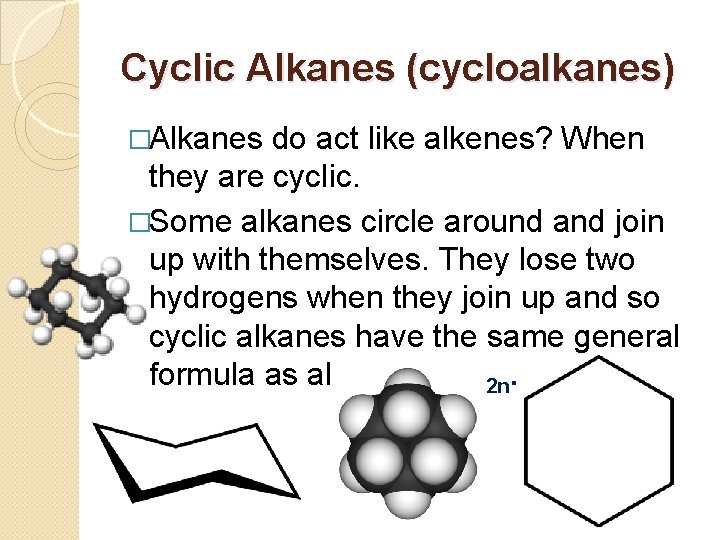
Cyclic Alkanes (cycloalkanes) �Alkanes do act like alkenes? When they are cyclic. �Some alkanes circle around and join up with themselves. They lose two hydrogens when they join up and so cyclic alkanes have the same general formula as alkenes Cn. H 2 n.
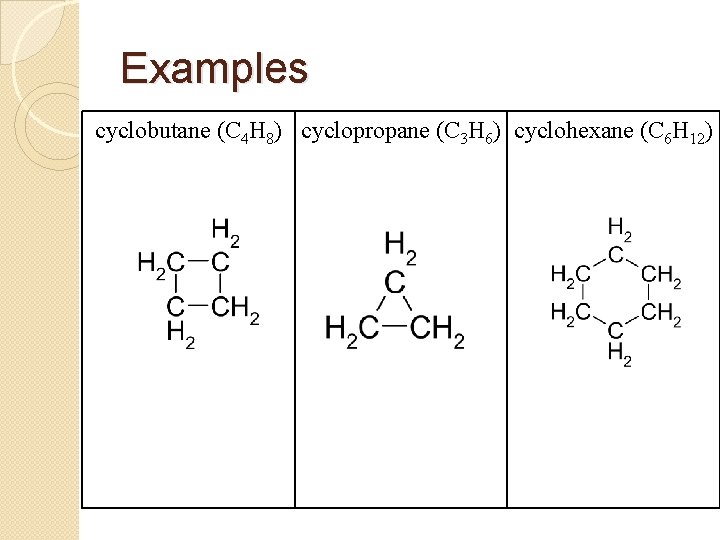
Examples cyclobutane (C 4 H 8) cyclopropane (C 3 H 6) cyclohexane (C 6 H 12)
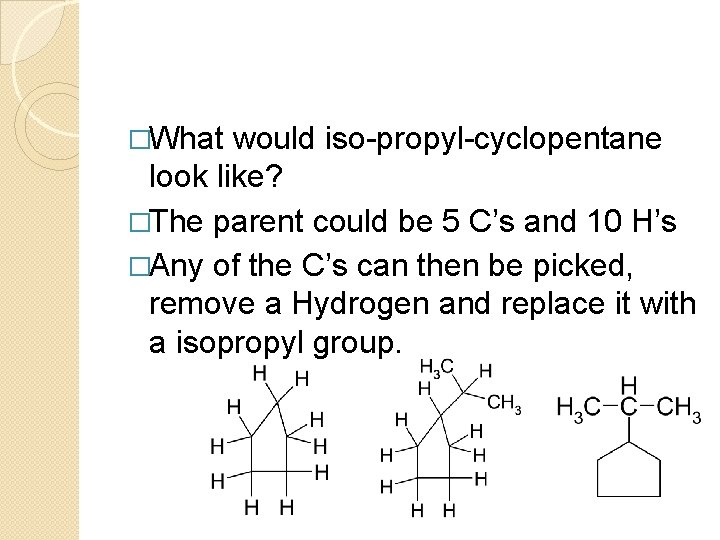
�What would iso-propyl-cyclopentane look like? �The parent could be 5 C’s and 10 H’s �Any of the C’s can then be picked, remove a Hydrogen and replace it with a isopropyl group.
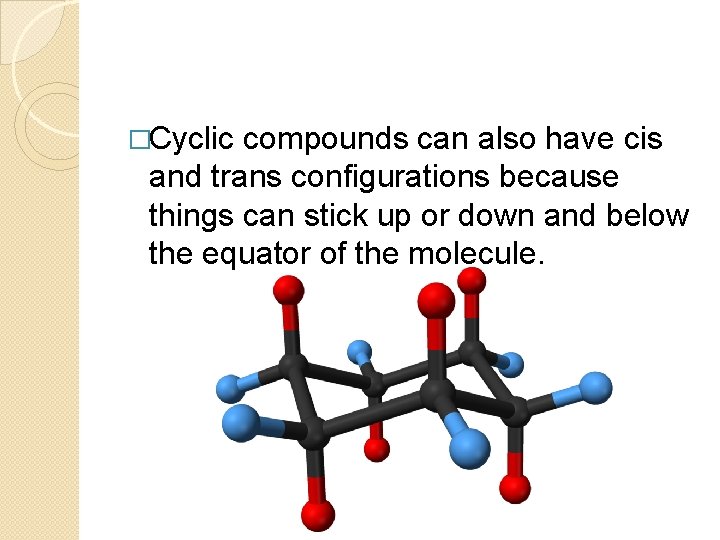
�Cyclic compounds can also have cis and trans configurations because things can stick up or down and below the equator of the molecule.
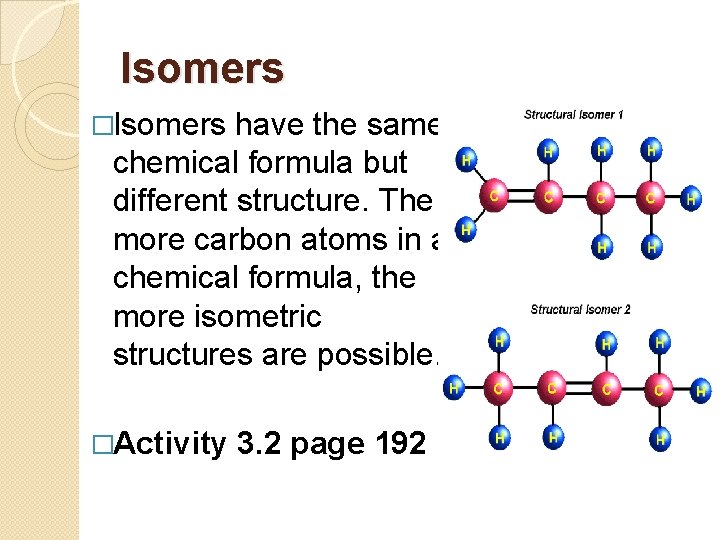
Isomers �Isomers have the same chemical formula but different structure. The more carbon atoms in a chemical formula, the more isometric structures are possible. �Activity 3. 2 page 192
Combustion of Hydrocarbons � Combustion is a reaction with oxygen which produces heat as a result. �Hydrocarbons react with oxygen to produce carbon dioxide and water as products as well as heat. The hydrocarbon that burns is referred to as a fuel. � fuel + oxygen water vapour + carbon dioxide
Incomplete combustion �When there is not enough oxygen present, water still gets created but carbon can only grab one oxygen atom resulting in carbon monoxide. Carbon monoxide is a clear, colorless, odourless gas which is a toxic poison � fuel + inadequate oxygen � Water vapour + carbon monoxide.
Substitution Reactions �Halogenation with light: �In this reaction that takes place with either bromine or chlorine in the presence of UV light. �The halogen with displace one of the hydrogen atoms bonded to one of the carbons, the halogen that is left over will then bond with the hydrogen that has been displaced.
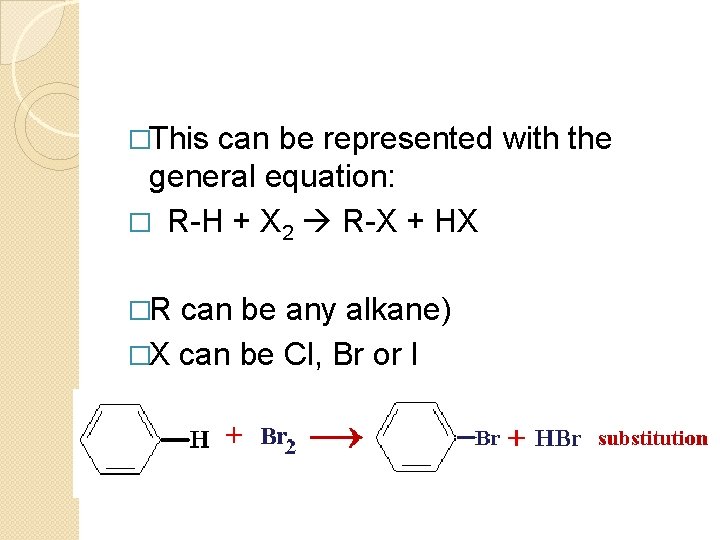
�This can be represented with the general equation: � R-H + X 2 R-X + HX �R can be any alkane) �X can be Cl, Br or I
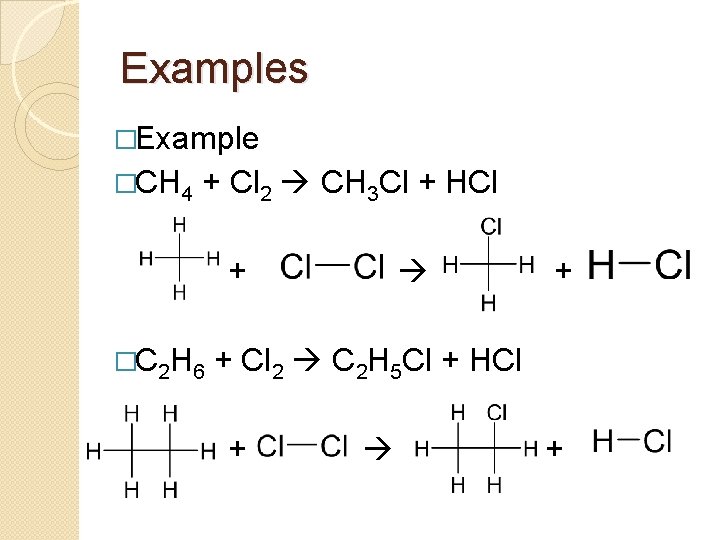
Examples �Example �CH 4 + Cl 2 CH 3 Cl + HCl + �C 2 H 6 + Cl 2 C 2 H 5 Cl + HCl +
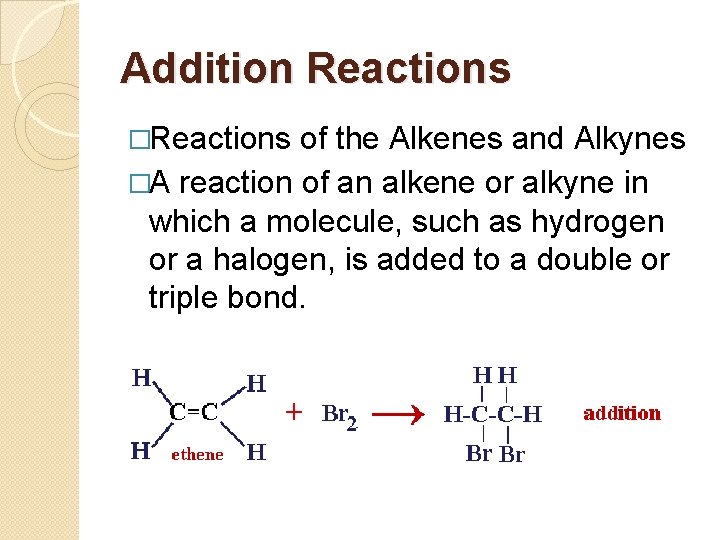
Addition Reactions �Reactions of the Alkenes and Alkynes �A reaction of an alkene or alkyne in which a molecule, such as hydrogen or a halogen, is added to a double or triple bond.
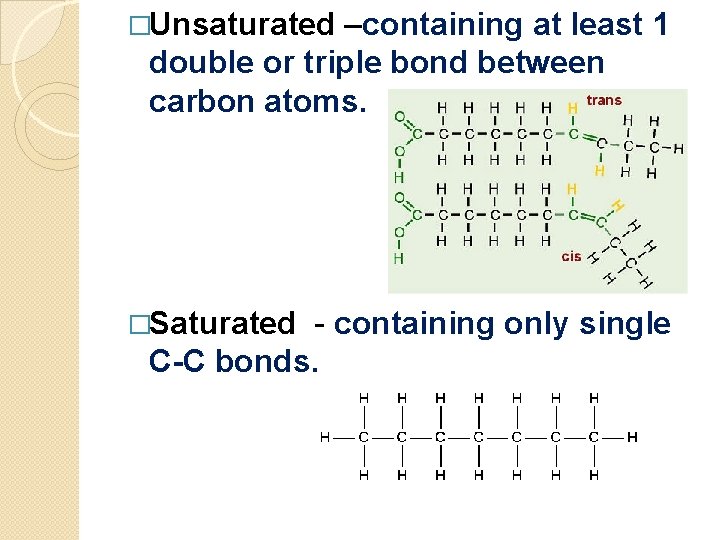
�Unsaturated –containing at least 1 double or triple bond between carbon atoms. �Saturated - containing only single C-C bonds.
Markinikov's Rule: �When a substitution is made across a C=C or triple bond the H will be added to the carbon that already has the most H's on it. �When a dehydration occurs across a C=C or triple bond then the H removed will be from the C that has the most H's on it.
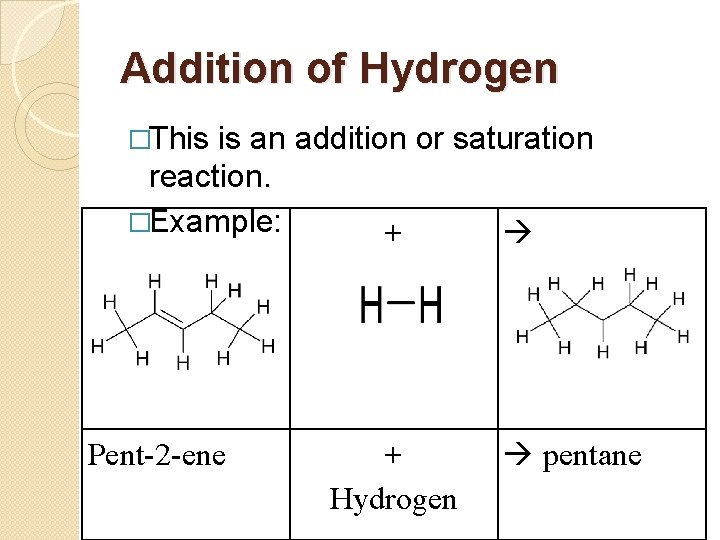
Addition of Hydrogen �This is an addition or saturation reaction. �Example: Pent-2 -ene + + Hydrogen pentane
Halogenation �The addition of a halogen also called chlorination, bromination or iodination, etc) �Trans is preferred over cis addition.
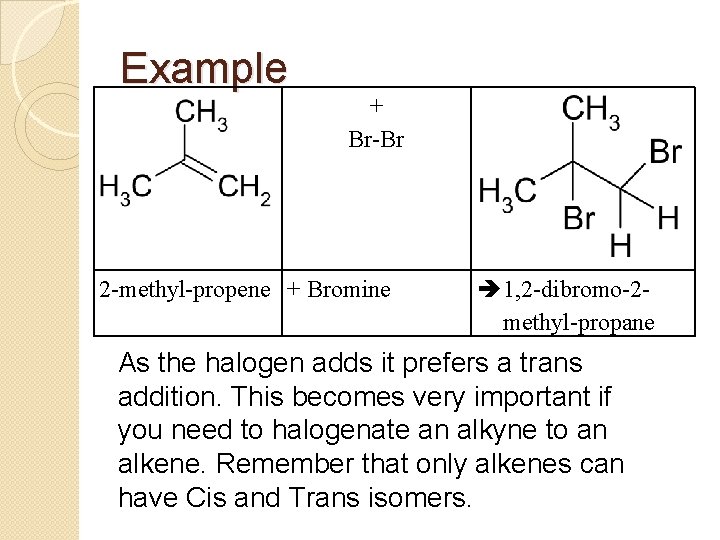
Example + Br-Br 2 -methyl-propene + Bromine 1, 2 -dibromo-2 methyl-propane As the halogen adds it prefers a trans addition. This becomes very important if you need to halogenate an alkyne to an alkene. Remember that only alkenes can have Cis and Trans isomers.
Hydrohalogenation �The addition of a H and a halogen. It is beneficial to add both the H and the halogen in one reagent so one of the binary halogen acids is usually used like HI, HBr, HCl, or HF. HX can be any halogen acid. (HF, HCl, HBr, HI)
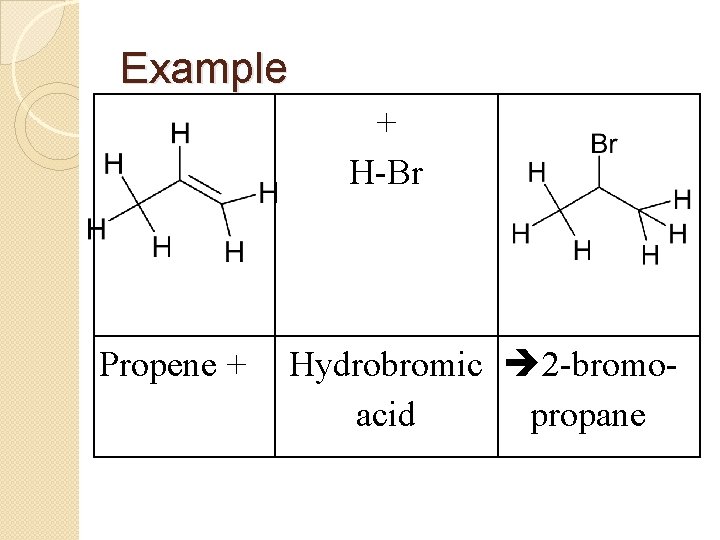
Example Propene + + H-Br Hydrobromic 2 -bromoacid propane
Hydration �This reaction involves the addition of water in the presence of a weak acid. Strong acids tend to draw water away from molecules. �Weak acids only stimulate double bonds (Pi bonds) into breaking. �Water is ionized slightly in weak acids and can then move into take their proper place in the broken alkene bonds.
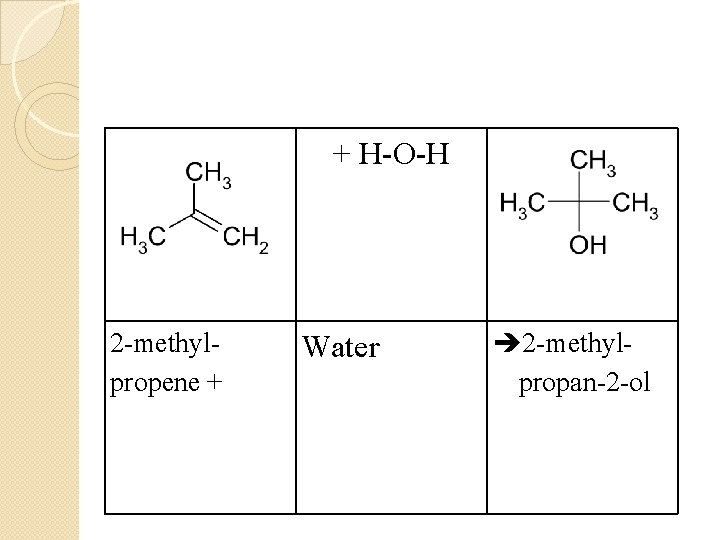
2 -methylpropene + + H-O-H Water 2 -methylpropan-2 -ol
Worksheet �Complete and hand in
- Slides: 63